This is the longest period on the course and the densest, and students drown in it because they try to remember it as one story. It is three. Federal power…
English narration · English + 中文 subtitles burned in
7.1 7.2 7.3
Imperialism and the Spanish-American War
Syllabus
7.1 Contextualizing Period 7
Learning Objective
Preview: Unit 7 Key Concepts
Unit 7.A
Explain the context in which America grew into its role as a world power.
KC-7.1 Growth expanded opportunity, while economic instability led to new efforts to reform U.S. society and its economic system.
KC-7.1.I The United States continued its transition from a rural, agricultural economy to an urban, industrial economy led by large companies.
KC-7.1.II In the Progressive Era of the early 20th century, Progressives responded to political corruption, economic instability, and social concerns by calling for greater government action and other political and social measures.
KC-7.1.III During the 1930s, policymakers responded to the mass unemployment and social upheavals of the Great Depression by transforming the U.S. into a limited welfare state, redefining the goals and ideas of modern American liberalism.
KC-7.2 Innovations in communications and technology contributed to the growth of mass culture, while significant changes occurred in internal and international migration patterns.
KC-7.2.I Popular culture grew in influence in U.S. society, even as debates increased over the effects of culture on public values, morals, and American national identity.
KC-7.2.II Economic pressures, global events, and political developments caused sharp variations in the numbers, sources, and experiences of both international and internal migrants.
KC-7.3 Participation in a series of global conflicts propelled the United States into a position of international power while renewing domestic debates over the nation’s proper role in the world.
KC-7.3.I In the late 19th century and early 20th century, new U.S. territorial ambitions and acquisitions in the Western Hemisphere and the Pacific accompanied heightened public debates over America’s role in the world.
KC-7.3.II World War I and its aftermath intensified ongoing debates about the nation’s role in the world and how best to achieve national security and pursue American interests.
KC-7.3.III U.S. participation in World War II transformed American society, while the victory of the United States and its allies over the Axis powers vaulted the U.S. into a position of global, political, and military leadership.
7.2 Imperialism: Debates
Thematic Focus
Learning Objective
Historical Developments
WOR America in the World — Diplomatic, economic, cultural, and military interactions between empires, nations, and peoples shape the development of America and America’s increasingly important role in the world.
Unit 7.B
Explain the similarities and differences in attitudes about the nation’s proper role in the world.
KC-7.3.I.A Imperialists cited economic opportunities, racial theories, competition with European empires, and the perception in the 1890s that the western frontier was “closed” to argue that Americans were destined to expand their culture and institutions to peoples around the globe.
KC-7.3.I.B Anti-imperialists cited principles of self-determination and invoked both racial theories and the U.S. foreign policy tradition of isolationism to argue that the United States should not extend its territory overseas.
7.3 The Spanish–American War
Thematic Focus
Learning Objective
Historical Developments
WOR America in the World — Diplomatic, economic, cultural, and military interactions between empires, nations, and peoples shape the development of America and America’s increasingly important role in the world.
Unit 7.C
Explain the effects of the Spanish–American War.
KC-7.3.I.C The American victory in the Spanish–American War led to the U.S. acquisition of island territories in the Caribbean and the Pacific, an increase in involvement in Asia, and the suppression of a nationalist movement in the Philippines.
Source: College Board AP Course and Exam Description
Period 7 runs from 1890 to 1945 - the longest and densest period. Three storylines run through it: the growth of federal power in the economy, the rise of mass culture and the arguments it provoked, and the country's move to global power.
New territorial ambitions 领土野心 grew from a search for markets, naval strategy, and beliefs about national mission. Victory in the Spanish-American War 美西战争 gave the United States overseas possessions and forced a genuine argument.
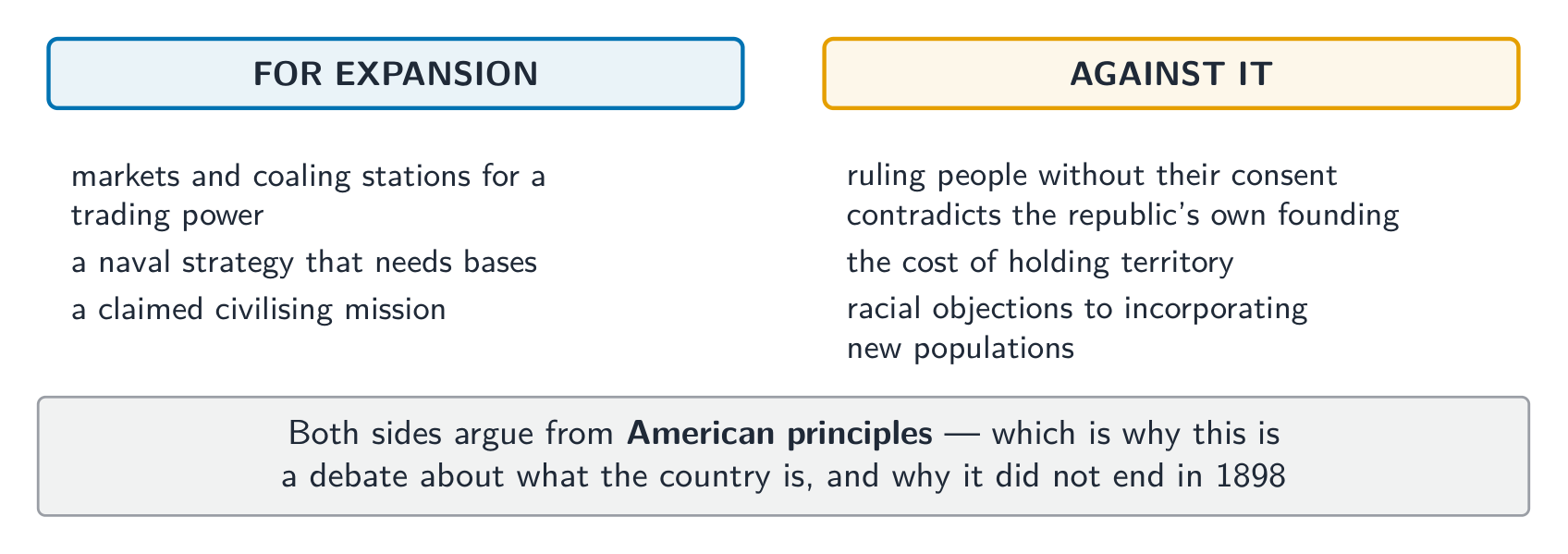
The imperialism debate 帝国主义之争 is the examinable point: supporters argued for markets, strategic bases, and a civilising mission; opponents argued that ruling people without their consent contradicted the country's founding principles, and some argued on racial or economic grounds. Both positions must appear in a strong answer.
GEO Geography and the Environment — Geographic and environmental factors, including competition over and debates about natural resources, shape the development of America and foster regional diversity. The development of America impacts the environment and reshapes geography, which leads to debates about environmental and geographic issues.
Unit 7.D
Compare the goals and effects of the Progressive reform movement.
KC-7.1.II.A Some Progressive Era journalists attacked what they saw as political corruption, social injustice, and economic inequality, while reformers, often from the middle and upper classes and including many women, worked to effect social changes in cities and among immigrant populations.
KC-7.1.II.D The Progressives were divided over many issues. Some Progressives supported Southern segregation, while others ignored its presence. Some Progressives advocated expanding popular participation in government, while others called for greater reliance on professional and technical experts to make government more efficient. Progressives also disagreed about immigration restriction.
KC-7.1.II.B On the national level, Progressives sought federal legislation that they believed would effectively regulate the economy, expand democracy, and generate moral reform. Progressive amendments to the Constitution dealt with issues such as prohibition and women’s suffrage.
Unit 7.E
Compare attitudes toward the use of natural resources from 1890 to 1945.
KC-7.1.II.C Preservationists and conservationists both supported the establishment of national parks while advocating different government responses to the overuse of natural resources.
Source: College Board AP Course and Exam Description
The United States continued its transition from a rural, agricultural economy to an urban, industrial 城市工业化 one, and Progressives 进步主义者 responded to the problems that came with it.
Try it — compare reform approaches. Teacher-written cases grounded in CED Topic 7.4: A journalist exposes political corruption and calls for action. A reformer wants professional experts to make government more efficient. Another wants voters to participate more directly in political decisions. Identify each approach. Do the last two give ordinary voters the same role? Explain a shared reform aim and a difference in method.
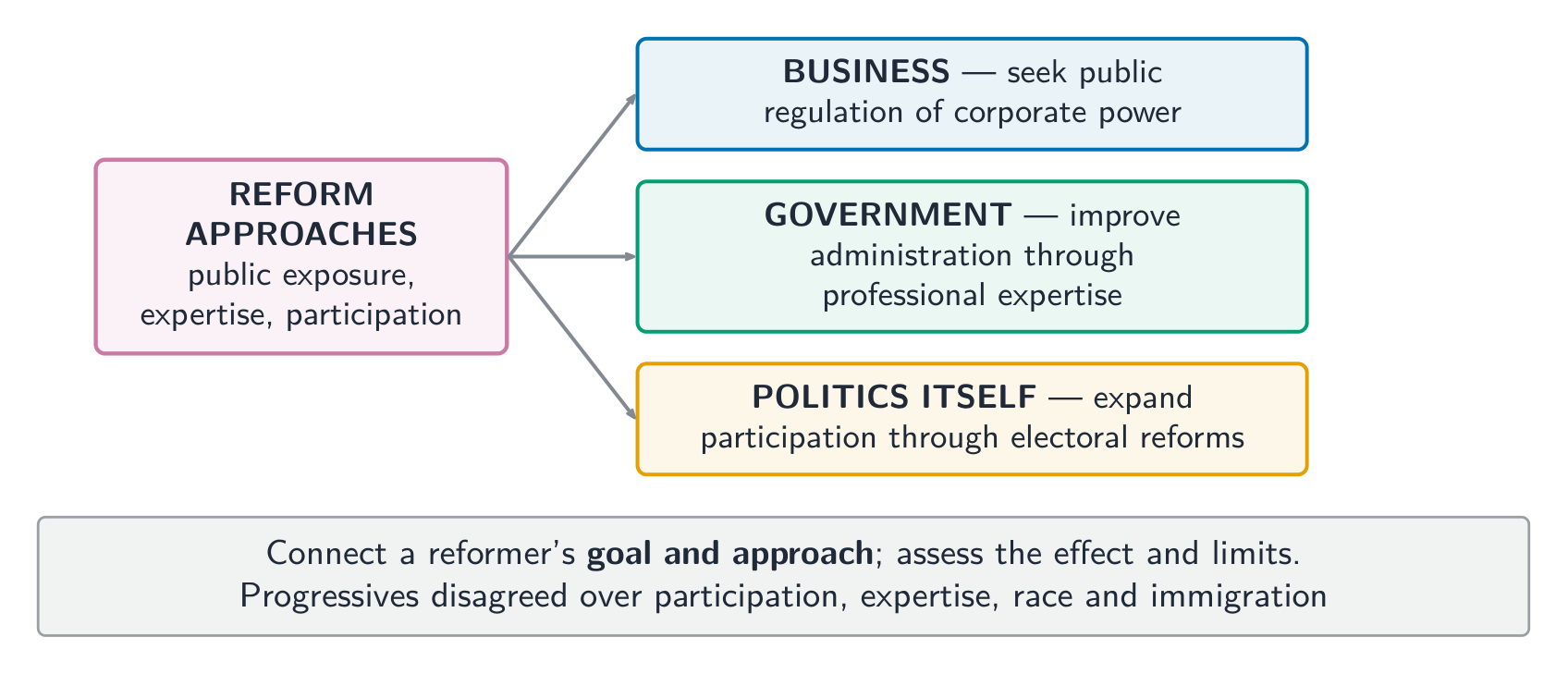
Worked comparison. Journalists exposed corruption, social injustice and inequality, creating pressure for change. Expert administration emphasised expertise and evidence 专业知识与证据 to diagnose problems and improve efficiency. Reform of politics itself 政治改革 could expand voter participation through direct primaries, initiatives, referendums and direct election of senators. Both sought better government, but expert administration and greater voter participation assigned authority differently. Progressives did not follow one fixed sequence.
Document practice — adapted from 2019 AP US History DBQ, Document 2. Paraphrase, not a quotation: in a 1902 speech, President Theodore Roosevelt treated corporations as creations of the state and argued that government had a right and duty to supervise them when they caused harm. He recognised that corporations could also do useful work. Identify the proposed government role. Does this support abolishing every corporation? Does the speech alone prove regulation was enacted and enforced?
Worked reading. Roosevelt advocated public supervision, not elimination of every corporation. Roosevelt used corporations' dependence on state authority to justify public supervision, challenging entirely private control. A speech establishes an expressed position; laws, enforcement and effects require further evidence. This is practice with one document, not a complete answer to the 2019 DBQ on political change, 1890–1920, and implies no score.
Progressives were divided over many issues. Some supported Southern segregation; others ignored it. They also disagreed over immigration restriction. Reform did not mean a shared commitment to equal rights. National reform efforts included economic regulation, expanding democracy and moral reform, including constitutional amendments concerning prohibition and women's suffrage.
Explore
Compare Progressive approaches and targets
Connect goals and approaches while recognising divisions over participation, expertise, race and immigration.
WOR America in the World — Diplomatic, economic, cultural, and military interactions between empires, nations, and peoples shape the development of America and America’s increasingly important role in the world.
Unit 7.F
Explain the causes and consequences of U.S. involvement in World War I.
KC-7.3.II.A After initial neutrality in World War I, the nation entered the conflict, departing from the U.S. foreign policy tradition of noninvolvement in European affairs, in response to Woodrow Wilson’s call for the defense of humanitarian and democratic principles.
KC-7.3.II.B Although the American Expeditionary Forces played a relatively limited role in combat, the United States’ entry helped to tip the balance of the conflict in favor of the Allies.
KC-7.3.II.C Despite Wilson’s deep involvement in postwar negotiations, the U.S. Senate refused to ratify the Treaty of Versailles or join the League of Nations.
7.6 World War I: Home Front
Thematic Focus
Learning Objective
Historical Developments
MIG Migration and Settlement — Push and pull factors shape immigration to and migration within America, and the demographic change as a result of these moves shapes the migrants, society, and the environment.
Unit 7.G
Explain the causes and effects of international and internal migration patterns over time.
KC-7.2.I.C Official restrictions on freedom of speech grew during World War I, as increased anxiety about radicalism led to a Red Scare and attacks on labor activism and immigrant culture.
KC-7.2.II.A.i Immigration from Europe reached its peak in the years before World War I. During World War I, nativist campaigns against some ethnic groups led to the passage of quotas that restricted immigration, particularly from southern and eastern Europe, and increased barriers to Asian immigration.
KC-7.2.II.B.i The increased demand for war production and labor during World War I led many Americans to migrate to urban centers in search of economic opportunities.
KC-7.2.II.C In the Great Migration during and after World War I, African Americans escaping segregation, racial violence, and limited economic opportunity in the South moved to the North and West, where they found new opportunities but still encountered discrimination.
Source: College Board AP Course and Exam Description
Entry into the First World War 第一次世界大战 mobilised the economy and expanded federal power, but it also intensified debates about the nation's role in the world and about civil liberties at home, where dissent was prosecuted.
The war triggered the Great Migration 大迁徙, as African Americans moved north for wartime industrial jobs, reshaping northern cities and politics.
Afterwards the United States pursued a unilateral foreign policy 单边外交政策 - rejecting the League of Nations while remaining economically engaged abroad.
7.7 1920s: Innovations in Communication and Technology
Thematic Focus
Learning Objective
Historical Developments
WXT Work, Exchange, and Technology — The interplay between markets, private enterprise, labor, technology, and government policy shape the American economy. In turn, economic activity shapes society and government policy and drives technological innovation.
Unit 7.H
Explain the causes and effects of the innovations in communication and technology in the United States over time.
KC-7.1.I.A New technologies and manufacturing techniques helped focus the U.S. economy on the production of consumer goods, contributing to improved standards of living, greater personal mobility, and better communications systems.
KC-7.2.I.A New forms of mass media, such as radio and cinema, contributed to the spread of national culture as well as greater awareness of regional cultures.
7.8 1920s: Cultural and Political Controversies
Thematic Focus
Learning Objective
Historical Developments
ARC American and Regional Culture — Creative expression, demographic change, philosophy, religious beliefs, scientific ideas, social mores, and technology shape national, regional, and group cultures in America, and these varying cultures often play a role in shaping government policy and developing economic systems.
Unit 7.G
Explain the causes and effects of international and internal migration patterns over time.
KC-7.1.I.B By 1920, a majority of the U.S. population lived in urban centers, which offered new economic opportunities for women, international migrants, and internal migrants.
KC-7.2.II.A.ii After World War I, nativist campaigns against some ethnic groups led to the passage of quotas that restricted immigration, particularly from southern and eastern Europe, and increased barriers to Asian immigration.
Unit 7.I
Explain the causes and effects of developments in popular culture in the United States over time.
KC-7.2.I.B Migration gave rise to new forms of art and literature that expressed ethnic and regional identities, such as the Harlem Renaissance movement.
KC-7.2.I.D In the 1920s, cultural and political controversies emerged as Americans debated gender roles, modernism, science, religion, and issues related to race and immigration.
Source: College Board AP Course and Exam Description
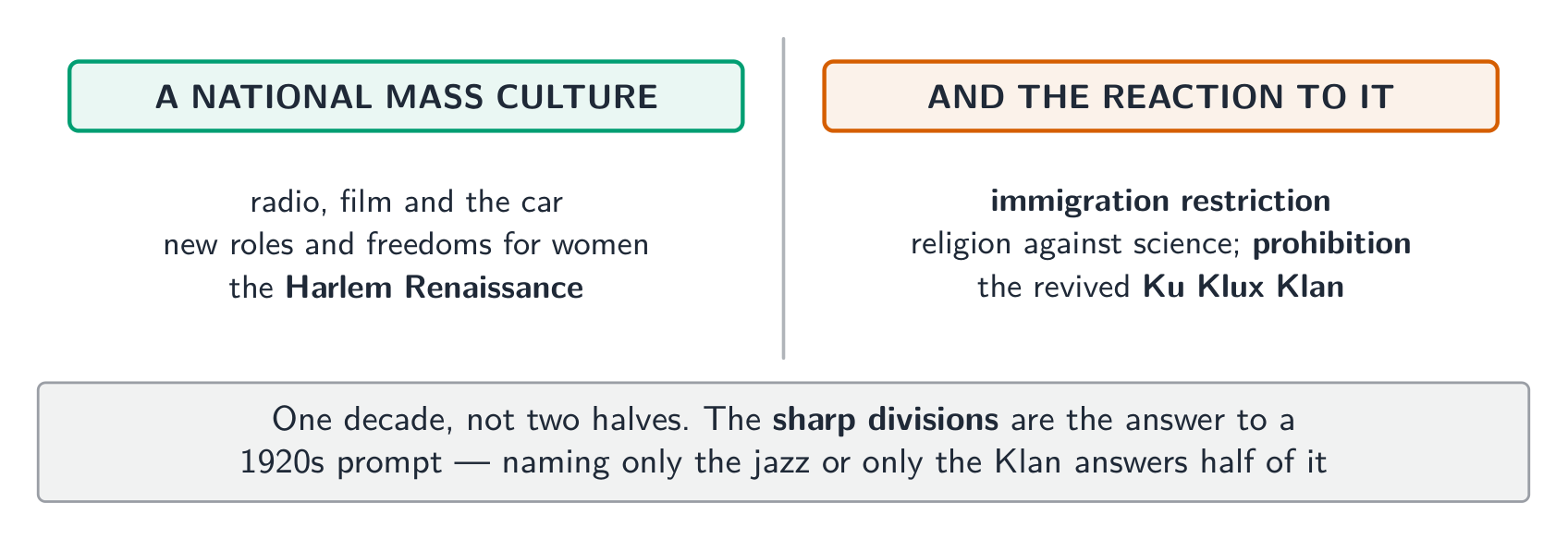
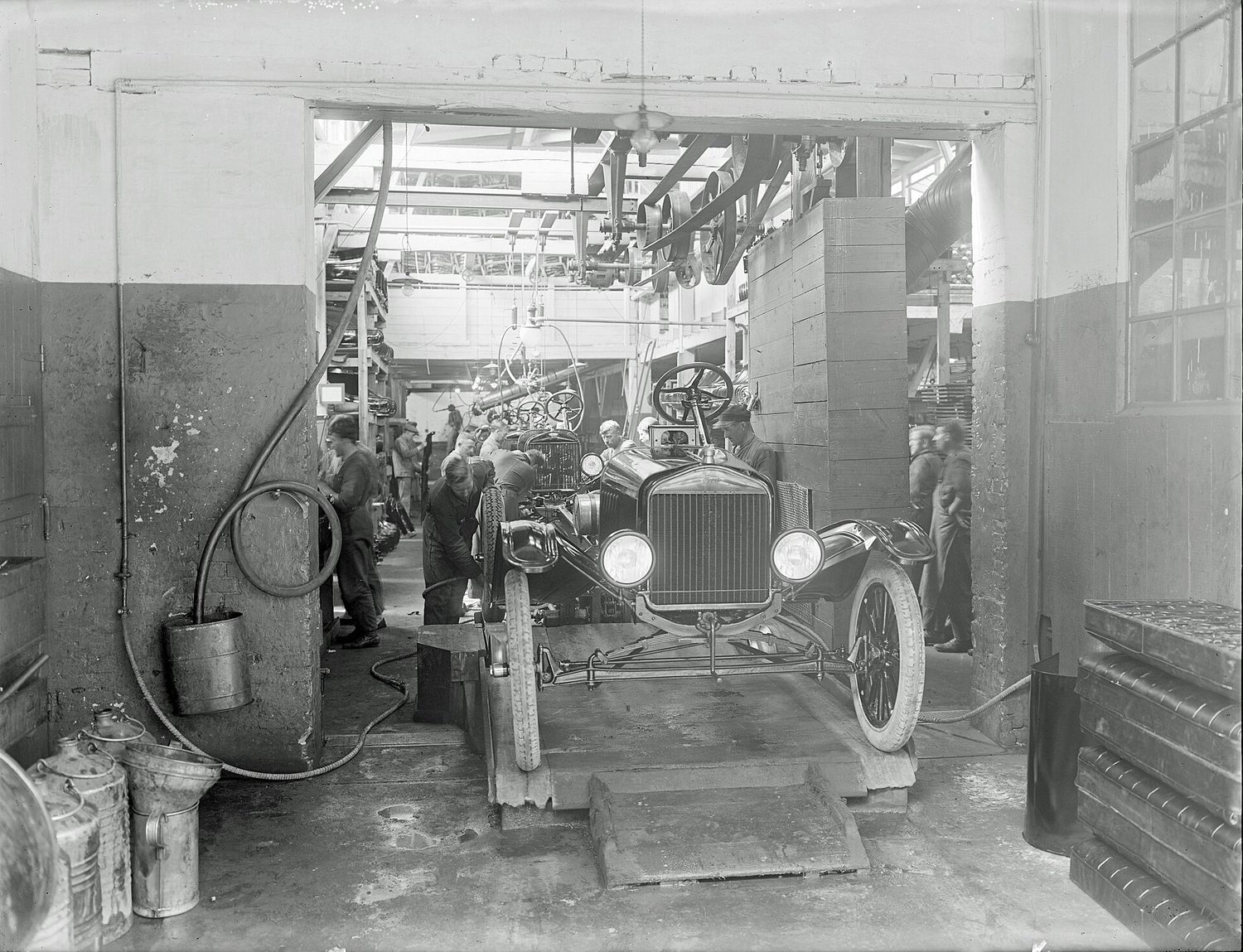
Innovations in communication and technology - radio, film, mass-circulation magazines, and the automobile - contributed to the growth of mass culture 大众文化, which increasingly set national tastes.
The same decade produced sharp divisions 尖锐分歧 over what the country should be:
Immigration restriction 移民限制 through national-origins quotas.
Conflict over religion and science, and over prohibition 禁酒令.
A revived Ku Klux Klan 三K党 and organised nativism.
The Harlem Renaissance 哈莱姆文艺复兴 and the "New Woman" as assertions of new cultural identities.
WXT Work, Exchange, and Technology — The interplay between markets, private enterprise, labor, technology, and government policy shape the American economy. In turn, economic activity shapes society and government policy and drives technological innovation.
Unit 7.J
Explain the causes of the Great Depression and its effects on the economy.
KC-7.1.I The United States continued its transition from a rural, agricultural economy to an urban, industrial economy led by large companies.
KC-7.1.I.C Episodes of credit and market instability in the early 20th century, in particular the Great Depression, led to calls for a stronger financial regulatory system.
KC-7.1.III During the 1930s, policymakers responded to the mass unemployment and social upheavals of the Great Depression by transforming the U.S. into a limited welfare state, redefining the goals and ideas of modern American liberalism.
7.10 The New Deal
Thematic Focus
Learning Objective
Historical Developments
PCE Politics and Power — Debates fostered by social and political groups about the role of government in American social, political, and economic life shape government policy, institutions, political parties, and the rights of citizens.
Unit 7.K
Explain how the Great Depression and the New Deal impacted American political, social, and economic life over time.
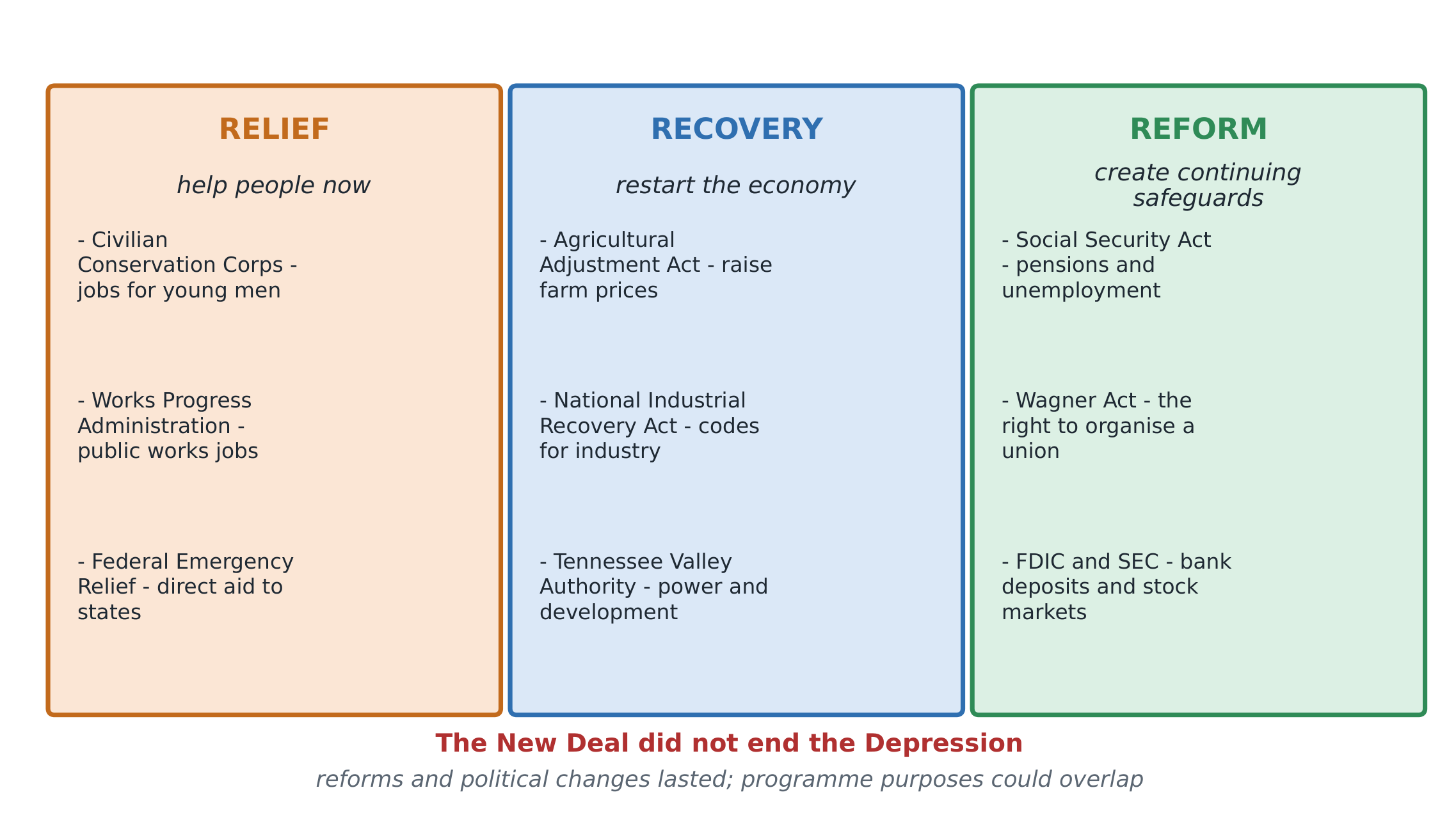
KC-7.1.III.A Franklin Roosevelt’s New Deal attempted to end the Great Depression by using government power to provide relief to the poor, stimulate recovery, and reform the American economy.
KC-7.1.III.B Radical, union, and populist movements pushed Roosevelt toward more extensive efforts to change the American economic system, while conservatives in Congress and the Supreme Court sought to limit the New Deal’s scope.
KC-7.1.III.C Although the New Deal did not end the Depression, it left a legacy of reforms and regulatory agencies and fostered a long-term political realignment in which many ethnic groups, African Americans, and working-class communities identified with the Democratic Party.
KC-7.2.II.B.ii The increased demand for war production and labor during World War II and the economic difficulties of the 1930s led many Americans to migrate to urban centers in search of economic opportunities.
Source: College Board AP Course and Exam Description
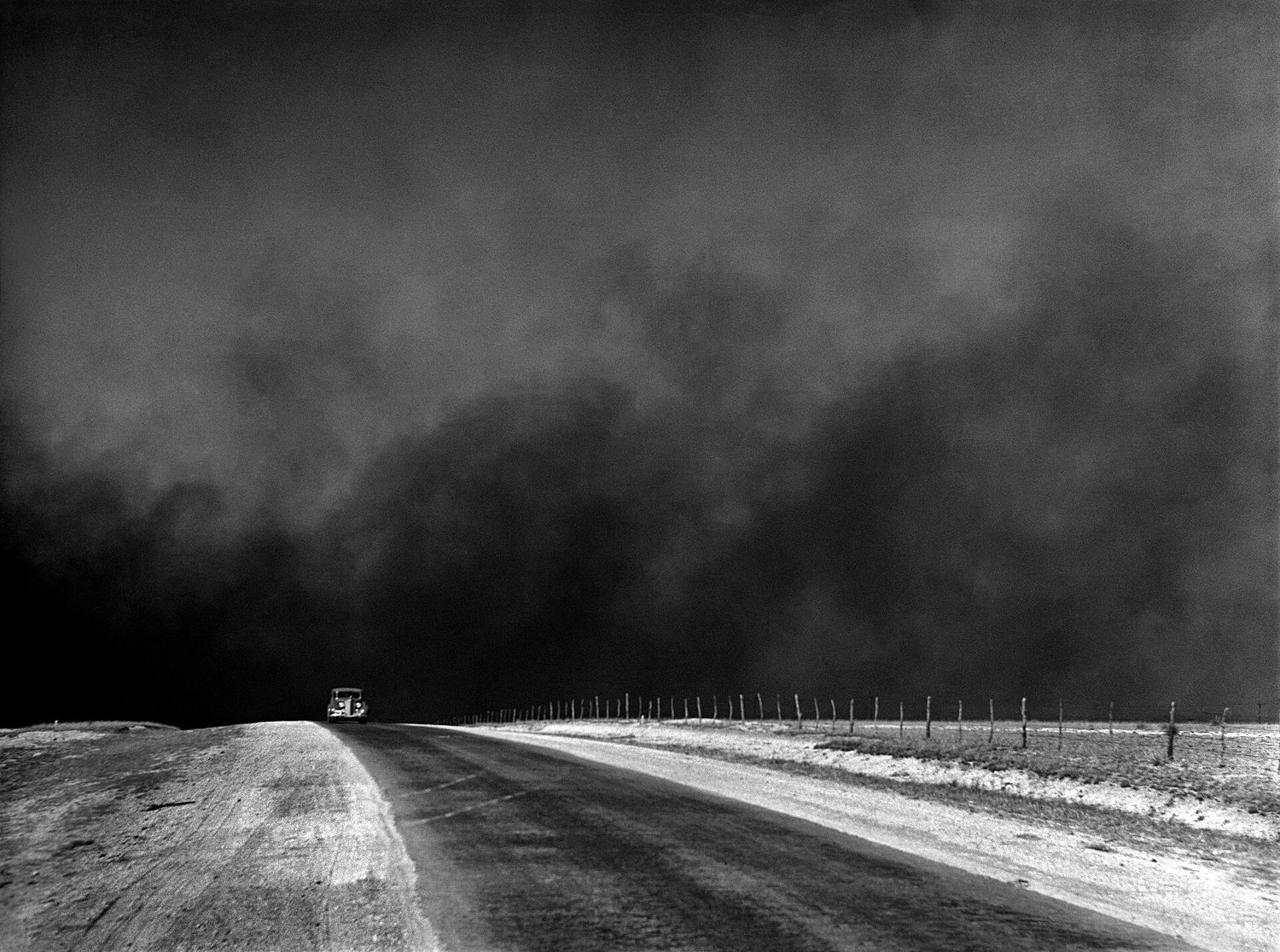
The Great Depression 大萧条 brought mass unemployment and social dislocation. Franklin Roosevelt's New Deal 罗斯福新政 used government power to provide relief 救济, stimulate recovery 复苏 and pursue reform 改革.
Try it — explain programme functions. Teaching summaries: A, the Works Progress Administration employed people on public projects. B, the Agricultural Adjustment Act sought higher farm prices by reducing crop production. C, federal deposit insurance protected covered deposits when an insured bank failed. Match each to relief, recovery or reform, explaining its function. Could an employment programme also help recovery?
Worked purposes. A provided relief through income from work; spending could also support economic activity, so purposes could overlap. B aimed at recovery by reducing output to raise farm prices and improve farmers' incomes. C reformed the financial system through a continuing safeguard for covered deposits. It was not a promise to prevent every future crisis. Sorting agencies alone neither demonstrates success nor makes an argument.
Explain the programme's function and assess its effects rather than treating these categories as exclusive.
Radical, union, and populist movements pushed Roosevelt toward more extensive measures. Conservatives in Congress and the Supreme Court sought to limit the New Deal's scope. Broader action and opposition both shaped contested policies; avoid a single-cause explanation.
Try it — judge effects. Teaching evidence paraphrased from CED Topic 7.10: the New Deal did not end the Depression, but left reforms and regulatory agencies and helped create a lasting political realignment toward the Democratic Party among many ethnic groups, African Americans and working-class communities. Assess the claim that continued depression means the New Deal had no economic or political effects.
Worked judgment. Failure to end the Depression was a limit, not an absence of effects. Relief programmes and lasting safeguards changed government's economic responsibilities. Institutions themselves affected economic life. Political realignment was another lasting effect. Judge a specific purpose with evidence rather than claiming complete success or that nothing changed.
Explore
Sort each New Deal measure by its purpose
Explain programme functions, recognising overlapping purposes and distinguishing aims from effects.
Franklin Roosevelt's New Deal/ˈfræŋklɪn ˈrəʊzəvelts njuː diːl/
relief/rɪˈliːf/
recovery/rɪˈkʌvəri/
reform/rɪˈfɔːm/
7.11 7.12 7.13
The Second World War
Syllabus
7.11 Interwar Foreign Policy
Thematic Focus
Learning Objective
Historical Developments
WOR America in the World — Diplomatic, economic, cultural, and military interactions between empires, nations, and peoples shape the development of America and America’s increasingly important role in the world.
Unit 7.B
Explain the similarities and differences in attitudes about the nation’s proper role in the world.
KC-7.3.II.D In the years following World War I, the United States pursued a unilateral foreign policy that used international investment, peace treaties, and select military intervention to promote a vision of international order, even while maintaining U.S. isolationism.
KC-7.3.II.E In the 1930s, while many Americans were concerned about the rise of fascism and totalitarianism, most opposed taking military action against the aggression of Nazi Germany and Japan until the Japanese attack on Pearl Harbor drew the United States into World War II.
7.12 World War II: Mobilization
Thematic Focus
Learning Objective
Historical Developments
SOC Social Structures — Social categories, roles, and practices are created, maintained, challenged, and transformed throughout American history, shaping government policy, economic systems, culture, and the lives of citizens.
Unit 7.L
Explain how and why U.S. participation in World War II transformed American society.
KC-7.3.III.B The mass mobilization of American society helped end the Great Depression, and the country’s strong industrial base played a pivotal role in winning the war by equipping and provisioning allies and millions of U.S. troops.
KC-7.3.III.C.i Mobilization provided opportunities for women and minorities to improve their socioeconomic positions for the war’s duration, while also leading to debates over racial segregation. Wartime experiences also generated challenges to civil liberties, such as the internment of Japanese Americans.
KC-7.2.II.D Migration to the United States from Mexico and elsewhere in the Western Hemisphere increased, in spite of contradictory government policies toward Mexican immigration.
7.13 World War II: Military
Thematic Focus
Learning Objective
Historical Developments
WOR America in the World — Diplomatic, economic, cultural, and military interactions between empires, nations, and peoples shape the development of America and America’s increasingly important role in the world.
Unit 7.M
Explain the causes and effects of the victory of the United States and its allies over the Axis powers.
KC-7.3.III.A Americans viewed the war as a fight for the survival of freedom and democracy against fascist and militarist ideologies. This perspective was later reinforced by revelations about Japanese wartime atrocities, Nazi concentration camps, and the Holocaust.
KC-7.3.III.C.ii Military service provided opportunities for women and minorities to improve their socioeconomic positions for the war’s duration, while also leading to debates over racial segregation.
KC-7.3.III.D The United States and its allies achieved military victory through Allied cooperation, technological and scientific advances, the contributions of servicemen and women, and campaigns such as Pacific “island-hopping” and the D-Day invasion. The use of atomic bombs hastened the end of the war and sparked debates about the morality of using atomic weapons.
Source: College Board AP Course and Exam Description
Americans viewed the war as a fight for the survival of freedom and democracy against fascist aggression.
Mass mobilization 全面动员 helped end the Great Depression, and it changed society:
Mobilisation and military service provided opportunities for women and minorities 妇女与少数族裔 to improve their status, though within continued segregation and discrimination.
Migration from Mexico and elsewhere in the Western Hemisphere increased to meet labour demand.
Japanese Americans were forcibly interned 拘禁, the period's clearest case of wartime rights denied.
Victory came through Allied cooperation 盟国合作, industrial capacity, and technological advantage, ending with the use of atomic weapons against Japan.
WOR America in the World — Diplomatic, economic, cultural, and military interactions between empires, nations, and peoples shape the development of America and America’s increasingly important role in the world.
Unit 7.N
Explain the consequences of U.S. involvement in World War II.
KC-7.3.III.E The war-ravaged condition of Asia and Europe, and the dominant U.S. role in the Allied victory and postwar peace settlements, allowed the United States to emerge from the war as the most powerful nation on Earth.
Source: College Board AP Course and Exam Description
The war-ravaged condition of Asia and Europe, and the dominant U.S. role in the Allied victory and in the occupations that followed, left the United States as the strongest power in the world - and set up the confrontation with the Soviet Union that Period 8 begins with.
7.15
Comparison in Period 7
Syllabus
7.15 Comparison in Period 7
Learning Objective
Review: Unit 7 Key Concepts
Unit 7.O
Compare the relative significance of the major events of the first half of the 20th century in shaping American identity.
KC-7.1 Growth expanded opportunity, while economic instability led to new efforts to reform U.S. society and its economic system.
KC-7.1.I The United States continued its transition from a rural, agricultural economy to an urban, industrial economy led by large companies.
KC-7.1.II In the Progressive Era of the early 20th century, Progressives responded to political corruption, economic instability, and social concerns by calling for greater government action and other political and social measures.
KC-7.1.III During the 1930s, policymakers responded to the mass unemployment and social upheavals of the Great Depression by transforming the U.S. into a limited welfare state, redefining the goals and ideas of modern American liberalism.
KC-7.2 Innovations in communications and technology contributed to the growth of mass culture, while significant changes occurred in internal and international migration patterns.
KC-7.2.I Popular culture grew in influence in U.S. society, even as debates increased over the effects of culture on public values, morals, and American national identity.
KC-7.2.II Economic pressures, global events, and political developments caused sharp variations in the numbers, sources, and experiences of both international and internal migrants.
KC-7.3 Participation in a series of global conflicts propelled the United States into a position of international power while renewing domestic debates over the nation’s proper role in the world.
KC-7.3.I In the late 19th century and early 20th century, new U.S. territorial ambitions and acquisitions in the Western Hemisphere and the Pacific accompanied heightened public debates over America’s role in the world.
KC-7.3.II World War I and its aftermath intensified ongoing debates about the nation’s role in the world and how best to achieve national security and pursue American interests.
KC-7.3.III U.S. participation in World War II transformed American society, while the victory of the United States and its allies over the Axis powers vaulted the U.S. into a position of global, political, and military leadership.
Source: College Board AP Course and Exam Description
Comparison is one useful reasoning skill for this period. Compare Progressive-era reform and the New Deal through their contexts, goals, government action and limits, using specific evidence.
Exam transfer — 2024 AP US History, Set 2, short-answer Q4(c), paraphrased. Explain how one development from 1900 to 1940 contributed to government involvement in the economy. Try either corporate growth and Progressive regulation or the Great Depression and New Deal relief. Explain how the development prompted a particular response; a sequence alone does not explain causation.
Teacher-written model. Mass unemployment during the Great Depression created demand for help that expanded federal involvement in the economy. New Deal employment programmes such as the WPA provided paid work on public projects to people needing income.
Why this fits. The official scheme accepts the Great Depression contributing to the New Deal. The model explains a need and a government response within the dates. Providing relief does not prove a programme ended the Depression. This is our Q4(c) model, not an official sample or a guarantee of credit.
7.15
Exam tips
When asked to compare imperialist and anti-imperialist positions, explain both with relevant evidence.
Compare Progressive goals, approaches and limits; reformers disagreed about participation, expertise, race and immigration.
Sort New Deal programmes by relief, recovery, reform. Explain their functions, overlapping purposes and effects.
State the CED's verdict directly: the New Deal did not end the Depression but left a lasting legacy.
Wartime opportunity for women and minorities was real and limited. Use relevant evidence; acknowledging a limit alone does not guarantee complexity.
Match evidence to the prompt and dates; explain a causal connection in Q4(c).
Interactive lessons on this topic
Work through it step by step, with instant-check exercises.