| Enduring Understanding | Learning Objective | Essential Knowledge |
|---|---|---|
STR-1 | 3.C |
|
Poetry III
AP English Literature and Composition · Topic 8
 8:40
8:40
Unit 8: Poetry III
Unit 8 is the last poetry unit and it handles the hardest material in the course: the family of devices built on contradiction. But it opens with the most…
English narration · English + 中文 subtitles burned in
8.1
The Function of Structure in a Text
Syllabus
Source: College Board AP Course and Exam Description
Unit 8 is the last poetry unit and it handles advanced material: the family of devices built on contradiction.
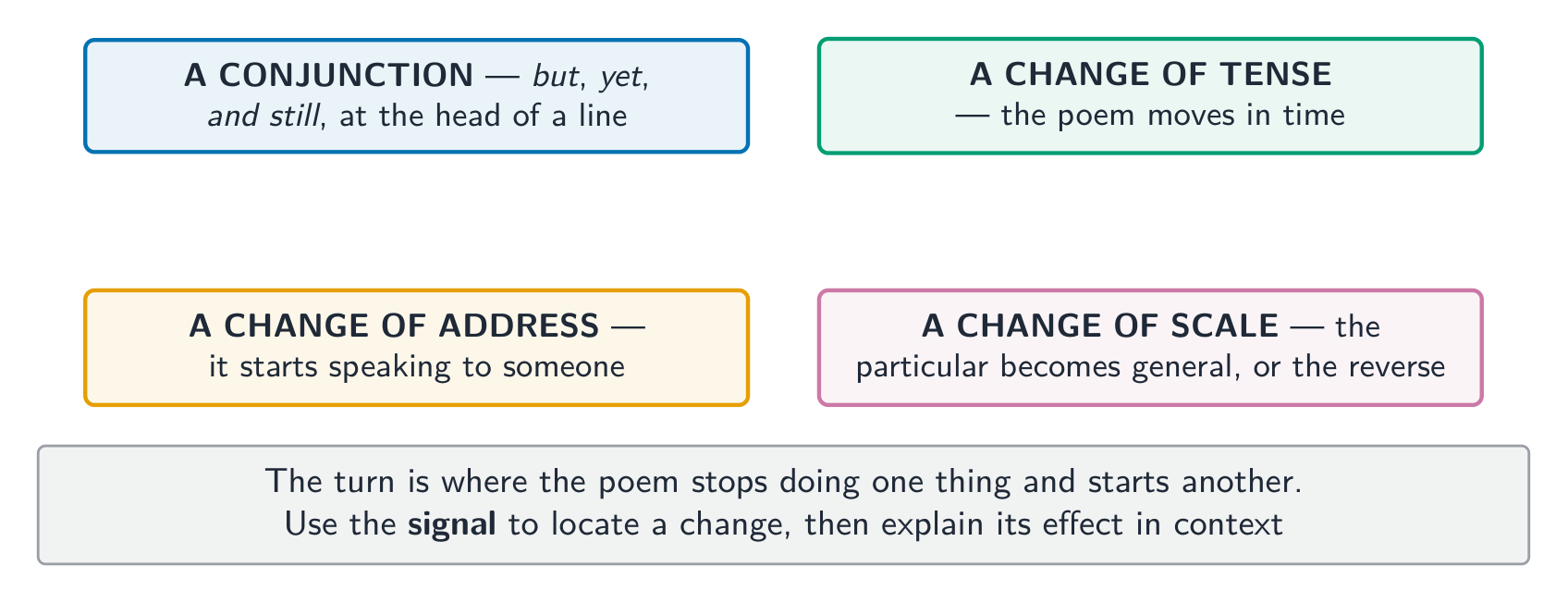
- Ideas and images in a poem may extend beyond a single line or stanza.
- Punctuation is often crucial to understanding a text.
- When structural patterns are created, any interruption in the pattern creates a point of emphasis.
Establish a pattern before interpreting an interruption. Explain what changes and why it matters in context; a signal alone does not supply the interpretation.
Punctuation deserves the emphasis it gets. In a poem, a semicolon and a full stop are different claims about how tightly two statements are joined, and a poem without punctuation has made a decision about how you must read it.
8.2
The Function of Contrasts Within a Text
Syllabus
| Enduring Understanding | Learning Objective | Essential Knowledge |
|---|---|---|
STR-1 | 3.D |
|
Source: College Board AP Course and Exam Description
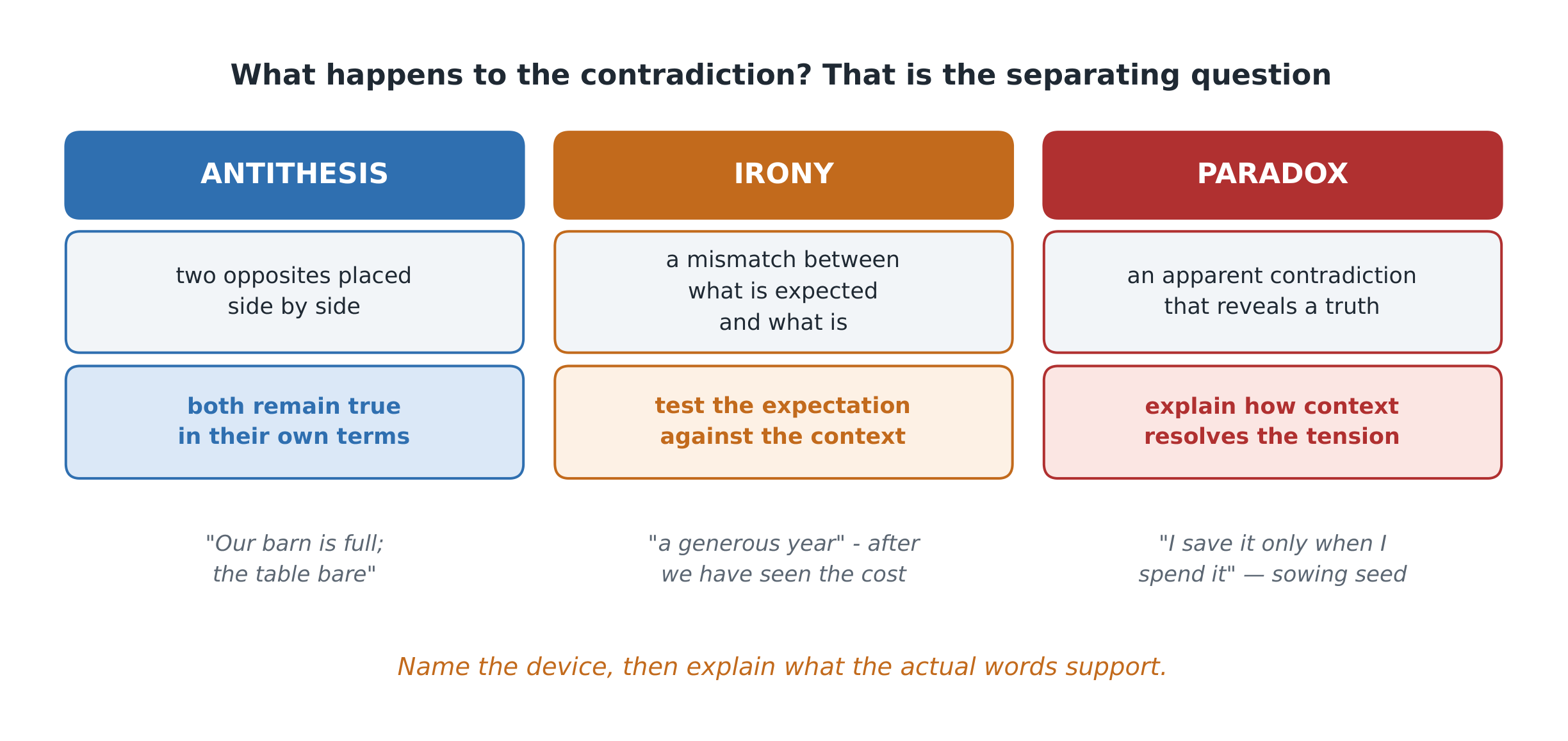
- Juxtaposition may create or demonstrate an antithesis.
- Situational or verbal irony 情境反讽与言语反讽 is created when events or statements are inconsistent with what is expected.
- Paradox 悖论 occurs when seemingly contradictory elements are juxtaposed, but the contradiction - which may be at odds with ordinary logic - reveals a deeper truth.
The distinction matters and students routinely collapse it. An antithesis places two opposed things together, and both remain true in their own terms. An irony is a gap between the expected and the actual - and someone, the writer or the reader, is aware of the gap. A paradox looks like a contradiction and survives inspection: the contradiction is the point, not an error.
Vocabulary
Train
| English |
|---|
| Situational or verbal irony/ˌsɪtʃuːˈeɪʃənl ɔː ˈvɜːbl ˈaɪrəni/ |
| Paradox/ˈpærədɒks/ |
8.3
The Function of Specific Words and Phrases
Syllabus
| Enduring Understanding | Learning Objective | Essential Knowledge |
|---|---|---|
FIG-1 | 5.B |
|
Source: College Board AP Course and Exam Description
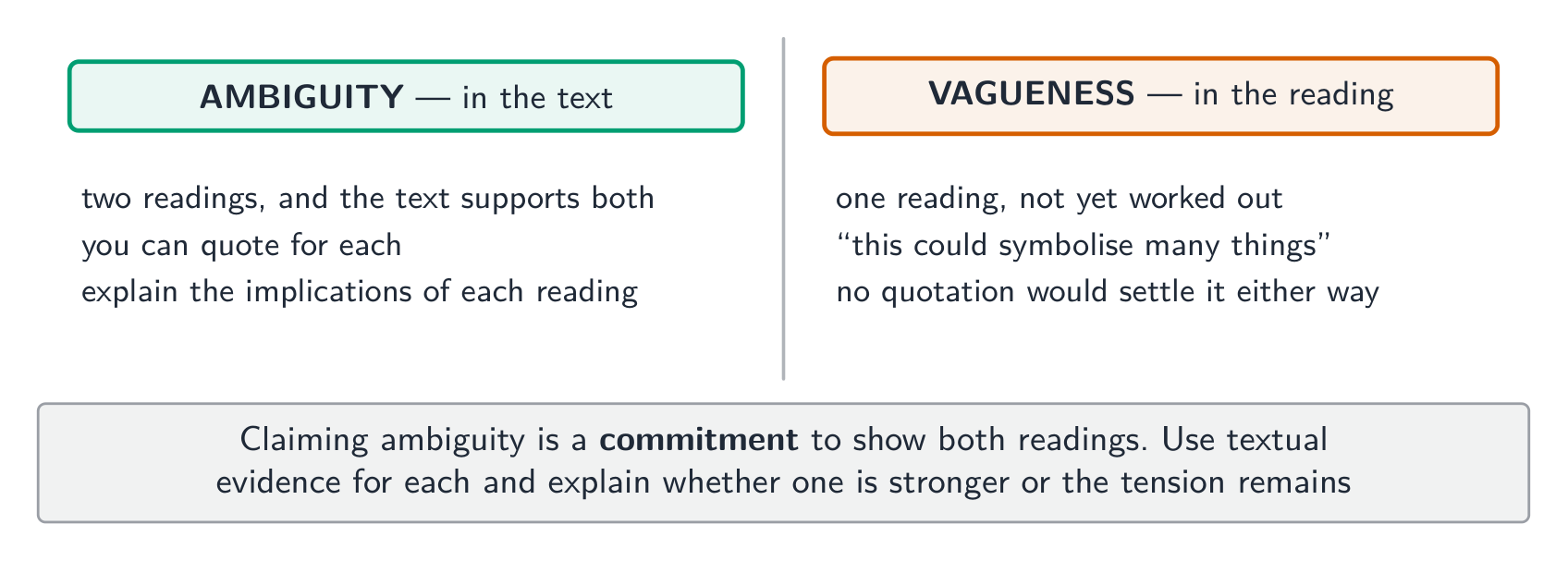
Ambiguity allows for different readings and understandings of a text by different readers.
In this course, ambiguity is a resource. Explore genuinely supported alternative readings and explain their implications. You may defend one or explain a sustained tension; naming ambiguity alone guarantees no scoring point.
Explore
Ambiguity or vagueness?
Support each plausible reading with textual evidence and explain whether one is stronger or tension remains.
8.4
The Function of a Symbol
Syllabus
| Enduring Understanding | Learning Objective | Essential Knowledge |
|---|---|---|
FIG-1 | 5.C |
|
Source: College Board AP Course and Exam Description
Symbols in a text, and the way they are used, may imply that a narrator, character, or speaker has a particular perspective.
A symbol is not free-floating. Ask how the wording establishes the association and whose perspective it expresses. A symbol need not be consciously recognised by a character.
8.5
The Function of a Metaphor
Syllabus
| Enduring Understanding | Learning Objective | Essential Knowledge |
|---|---|---|
FIG-1 | 6.B |
|
Source: College Board AP Course and Exam Description
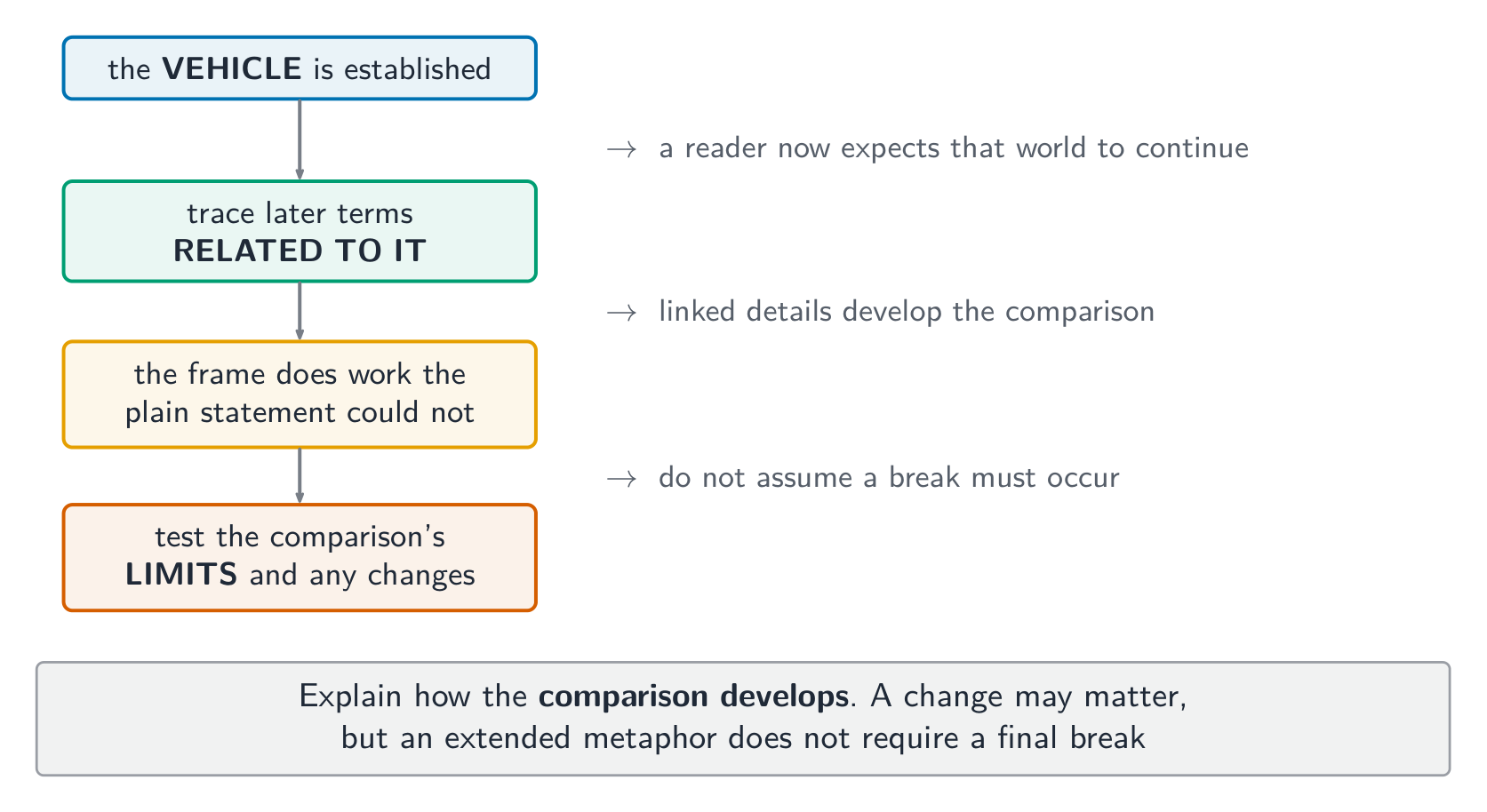
- A conceit 奇喻 is a form of extended metaphor, common in poetry, developing complex comparisons.
- Conceits are often used to make complex comparisons between the natural world and an individual.
- Multiple comparisons, representations, or associations may combine to affect one another in complex ways.
A conceit develops a complex comparison across related details. Trace which qualities transfer, how the comparisons interact and any limits. An extended metaphor need not break its frame, and a change does not automatically prove deliberate strain.
Explore
Follow a developed comparison
Trace linked details and contextual limits. An extended metaphor need not break its frame.
Vocabulary
Train
| English |
|---|
| conceit/kənˈsiːt/ |
8.6
The Function of an Allusion
Syllabus
| Enduring Understanding | Learning Objective | Essential Knowledge |
|---|---|---|
FIG-1 | 6.D |
|
Source: College Board AP Course and Exam Description
Because of shared knowledge about a reference, allusions create emotional or intellectual associations in readers who recognise them.
Note the condition: shared knowledge. An allusion is a bet on the reader's memory, and a poem that alludes heavily has chosen its audience.
8.7 8.8 8.9
Developing a Literary Thesis, Commentary, and Evidence
Syllabus
| Enduring Understanding | Learning Objective | Essential Knowledge |
|---|---|---|
LAN-1 | 7.B |
|
| Enduring Understanding | Learning Objective | Essential Knowledge |
|---|---|---|
LAN-1 | 7.C |
|
| Enduring Understanding | Learning Objective | Essential Knowledge |
|---|---|---|
LAN-1 | 7.D |
|
Source: College Board AP Course and Exam Description
- A thesis expresses an interpretation requiring textual defence.
- More sophisticated literary arguments explain the significance or relevance of an interpretation - explain that significance with textual evidence; no isolated feature guarantees a scoring point.
- Evidence: strategic, effective with commentary, sufficient in quantity and quality, developed recursively.
8.10
Control Over the Elements of Composition
Syllabus
| Enduring Understanding | Learning Objective | Essential Knowledge |
|---|---|---|
LAN-1 | 7.E |
|
Source: College Board AP Course and Exam Description
Writers must acknowledge the words, ideas, images, texts, and intellectual property of others through attribution and citation.
Original practice poem: the remaining seed
The poem and the following mini examples were written for teaching. They are not AP extracts.
Our barn is full; the table bare.
“A generous year,” I tell the chair.
The rent has taken every loaf.
I hold one seed against the frost.
I save it only when I spend it:
I open up my fist and sow.
The empty chair receives no answer.
Tomorrow, will the field say no?
Worked analysis: distinguish the contrasts. The full barn and bare table form an antithesis: production and deprivation are placed together. “A generous year” can be read as verbal irony because the following rent and missing food undermine simple praise. “I save it only when I spend it” is an apparent paradox: sowing uses up the stored seed but offers a way for it to produce more. The poem gives no guarantee that the crop succeeds; frost and the final question keep the hope uncertain. The colon connects the apparently contradictory claim to the sowing that helps explain it. A device label becomes useful through this reasoning.
Worked analysis: bounded ambiguity. The empty chair may foreground a missing companion, or the speaker's habit of addressing an unresponsive object. Both readings must explain the address and the later absence of an answer. Neither establishes a death or identifies the absent person without further evidence. The chair's meaning is inferred from context, not from a rule that all chairs have one symbolic meaning.
Original mini poem: a developed comparison
My worry is a garden.
I water every thorn.
At night I prune its shadows;
by morning more are born.
Worry is the main subject; garden is the comparison subject. Watering, thorns and pruning develop the comparison: attention may sustain the very difficulty the speaker tries to control. “Prune its shadows” extends the image to something that cannot literally be pruned. Explain that complication without assuming that every extended metaphor must end by breaking.
Original allusion example and supplied context
“Not Midas: let my hands make bread.” In the Midas story, the wished-for golden touch makes food unusable. Recognising that reference can make the line a rejection of wealth that defeats ordinary nourishment. A reader without that background may identify the bread as useful food but miss the specific reversal. Distinguish supplied background from words in the poem.
Practice. Explain how the remaining-seed poem combines deprivation and uncertain hope. Use two contrasts and the ending. Then test whether calling the year “generous” must be ironic, or could also preserve a narrower acknowledgement of the harvest.
8.10
Exam tips
- Establish the pattern, then find the interruption. Explain the change in context rather than treating every signal as a complete answer.
- Punctuation is a claim about how tightly statements are joined. A poem without it has made a decision too.
- Antithesis, irony, paradox are not synonyms. Learn the three definitions precisely; conflating them costs marks.
- Ambiguity is a resource. Explore both readings, then argue for one. Support each reading and explain its implication; this alone guarantees no point.
- Ask who attaches the meaning to a symbol. Connect its meaning to the wording and perspective.
- A conceit develops a complex comparison. Trace the linked details and their limits without assuming a compulsory break.
Interactive lessons on this topic
Work through it step by step, with instant-check exercises.