| Enduring Understanding | Learning Objective | Essential Knowledge |
|---|---|---|
CHR-1 | 1.A |
|
Longer Fiction or Drama I
AP English Literature and Composition · Topic 3
 8:35
8:35
Unit 3: Longer Fiction or Drama I
Unit 3 is the first longer-fiction-or-drama unit, and the thing to notice is that the length changes what is analysable. Three things become available that a…
English narration · English + 中文 subtitles burned in
3.1
What Textual Details Reveal About a Character
Syllabus
Source: College Board AP Course and Exam Description
Unit 3 is the first longer-fiction-or-drama unit, and the length changes what is analysable: characters can now change, conflicts can intersect, and setting acquires a social and historical dimension.
The CED's additions on character:
- The description of a character creates expectations for that character's behaviour, and how a character meets or fails those expectations is meaningful.
- Details associated with a character contribute to a reader's interpretation of them.
- A reader's understanding of a character's perspective may depend on the perspective of the narrator.
- A character's perspective may shift during the narrative.
- When narrators or characters compare another character to something else, they reveal their own perspective as much as the compared character's.
- Readers can infer motive from a character's actions or inactions.
That last word - inactions - is the one worth keeping. What a character declines to do is evidence, and it is usually more revealing than what they do.
3.2
Characters Who Change or Remain Unchanged
Syllabus
| Enduring Understanding | Learning Objective | Essential Knowledge |
|---|---|---|
CHR-1 | 1.B |
|
Source: College Board AP Course and Exam Description
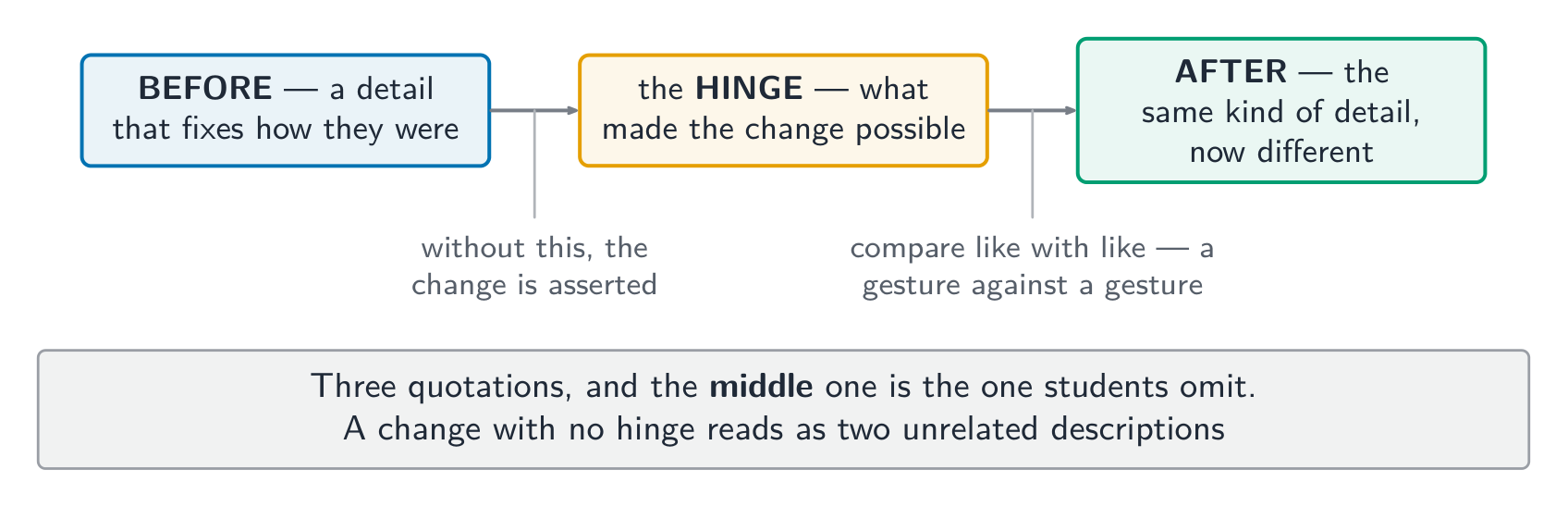
- A dynamic character 动态人物 develops over the narrative and often makes choices that directly or indirectly cause change.
- Character change can be visible and external - health, wealth, circumstance - or internal, in belief, value, or understanding.
- Some characters remain unchanged 静态人物 or are largely unaffected by events.
The unchanged character is not a failure of characterisation; it is often the measure by which the change in others is visible.
Explore
Prove a change with three quotations
Before, hinge, after — and the hinge is the one students omit, which leaves the change asserted.
Vocabulary
Train
| English |
|---|
| dynamic character/daɪˈnæmɪk ˈkærɪktə/ |
| Some characters remain unchanged/sʌm ˈkærɪktəz rɪˈmeɪn ʌnˈtʃeɪndʒd/ |
3.3
Textual Details That Convey Setting
Syllabus
| Enduring Understanding | Learning Objective | Essential Knowledge |
|---|---|---|
SET-1 | 2.A |
|
Source: College Board AP Course and Exam Description
Setting now includes the social, cultural, and historical situation in which the events occur - not only time and place.
This widens what setting can do. A social setting supplies the constraints a character must act within, and constraint is what turns a choice into a revealing one.
3.4
Significant Events in a Plot
Syllabus
| Enduring Understanding | Learning Objective | Essential Knowledge |
|---|---|---|
STR-1 | 3.E |
|
Source: College Board AP Course and Exam Description
- A narrative is delivered through a series of events that relate to a conflict.
- Events include episodes, encounters, and scenes that introduce and develop plot.
- The significance of an event depends on its relationship to the narrative, the conflict, and character development.
That third statement is the test for essay selection: an event matters to your argument only if you can say what it does to the conflict or to a character. Retelling a striking scene that does neither is plot summary, which earns nothing.
3.5
The Function of Conflict in a Text
Syllabus
| Enduring Understanding | Learning Objective | Essential Knowledge |
|---|---|---|
STR-1 | 3.F |
|
Source: College Board AP Course and Exam Description
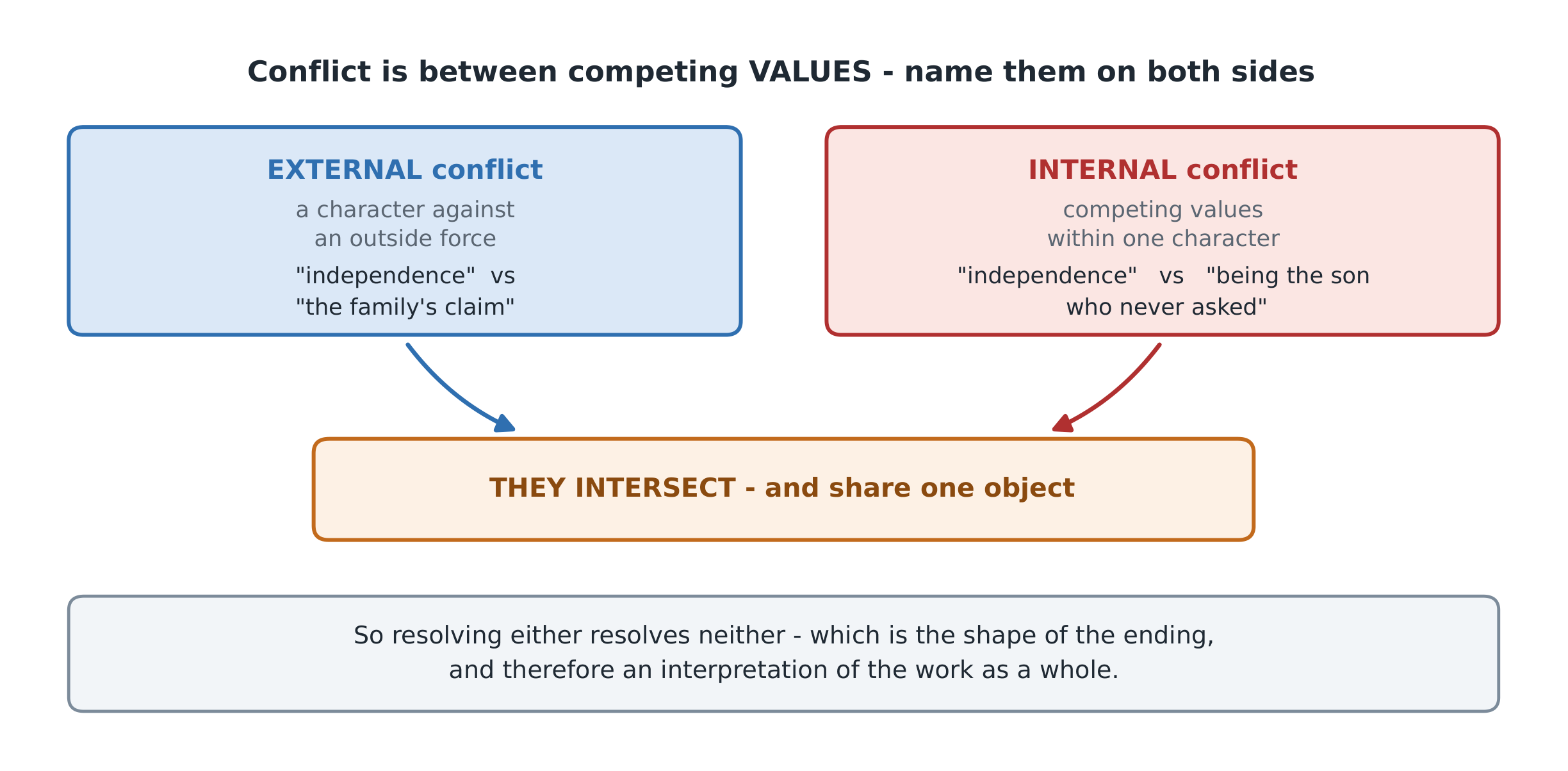
- Conflict 冲突 is tension between competing values, either within a character - internal or psychological conflict - or between a character and an external force.
- A text may contain multiple conflicts, and often two or more intersect 交叉.
- A primary conflict can be heightened by additional conflicts that intersect with it.
- Inconsistencies in a text may create contrasts that represent conflicts of values or perspectives.
Note the definition: conflict is between competing values, not merely between people. Two characters who want the same object are in a dispute; two characters who want incompatible goods are in a conflict, and only the second produces meaning.
Vocabulary
Train
| English |
|---|
| Conflict/ˈkɒnflɪkt/ |
| intersect/ˌɪntəˈsekt/ |
3.6
Developing a Paragraph with Claim and Evidence
Syllabus
| Enduring Understanding | Learning Objective | Essential Knowledge |
|---|---|---|
LAN-1 | 7.A |
|
Source: College Board AP Course and Exam Description
Unchanged from Units 1 and 2: a claim requiring textual defence, textual evidence, and details identified in combination.
3.7
Developing a Literary Thesis Statement
Syllabus
| Enduring Understanding | Learning Objective | Essential Knowledge |
|---|---|---|
LAN-1 | 7.B |
|
Source: College Board AP Course and Exam Description
- A thesis statement expresses an interpretation of a literary text and requires defence through textual evidence.
- It may preview the development or line of reasoning of that interpretation - but is not required to list the reasons.
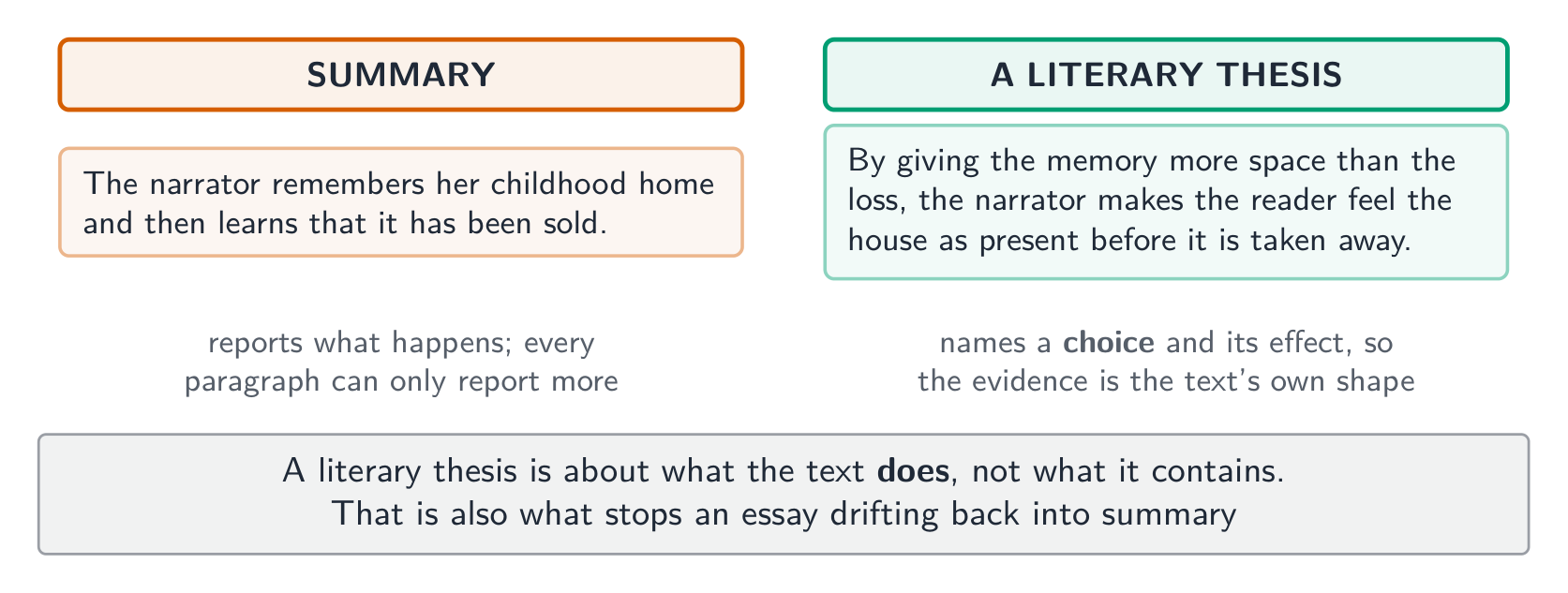
The key word is interpretation. A thesis that states what happens in the text is not a thesis; it is a summary. A thesis must say what the text means or does, which is by definition arguable.
Explore
Sort summary from a literary thesis
A literary thesis is about what the text does, not what it contains — which is also what stops an essay drifting into summary.
3.8
Developing Commentary
Syllabus
| Enduring Understanding | Learning Objective | Essential Knowledge |
|---|---|---|
LAN-1 | 7.C |
|
Source: College Board AP Course and Exam Description
- A line of reasoning 推理线索 is the logical sequence of claims that together defend the overarching thesis.
- It is communicated through commentary explaining the logical relationship between evidence and claim.
Vocabulary
Train
| English |
|---|
| line of reasoning/laɪn ɒv ˈriːzənɪŋ/ |
3.9
Selecting Relevant and Sufficient Evidence
Syllabus
| Enduring Understanding | Learning Objective | Essential Knowledge |
|---|---|---|
LAN-1 | 7.D |
|
Source: College Board AP Course and Exam Description
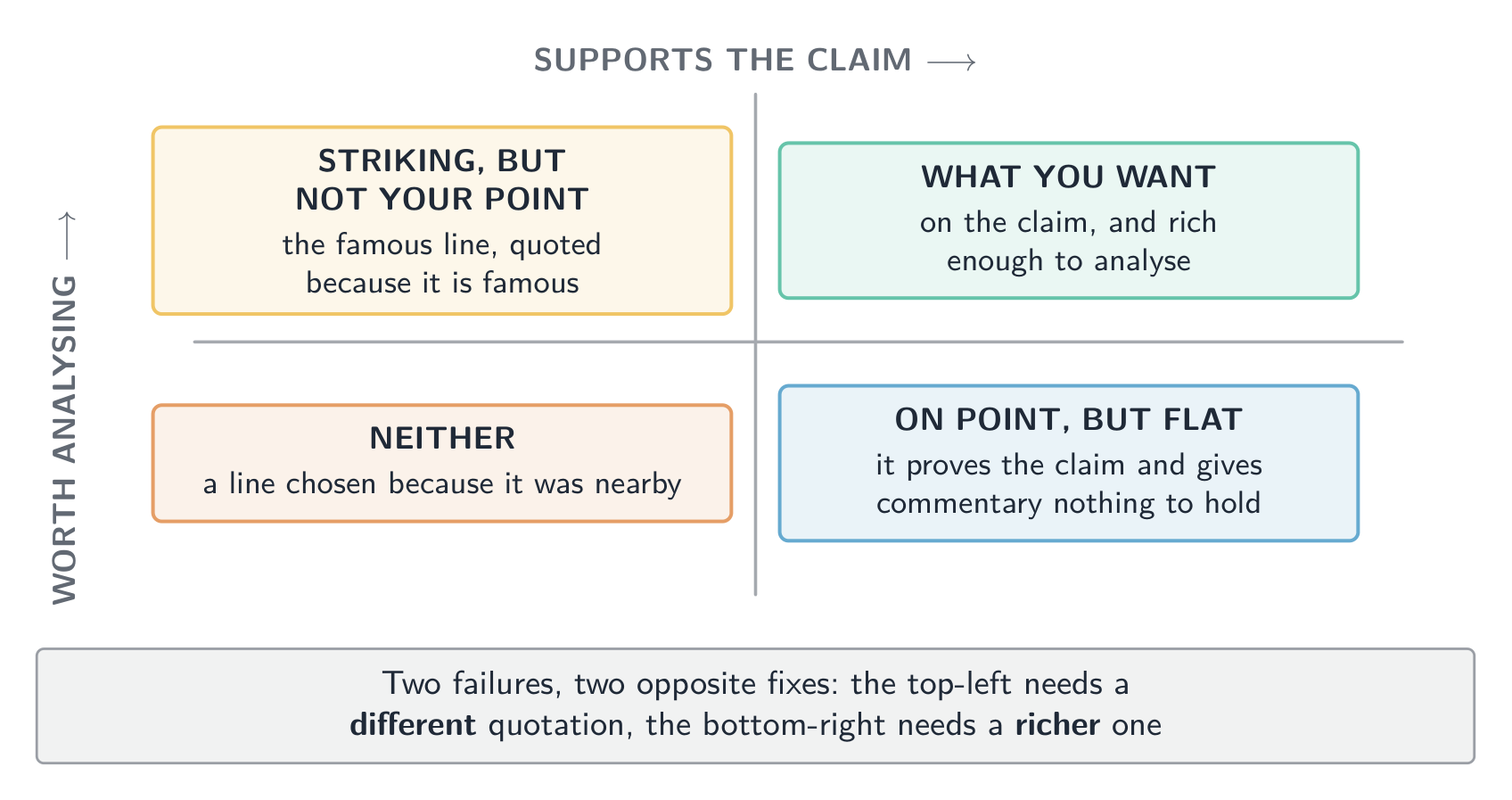
- Writers use evidence strategically - to illustrate, clarify, exemplify, associate, or amplify.
- Evidence is effective when commentary explains its logical relationship to the claim.
- Evidence is sufficient when its quantity and quality provide apt support.
- Developing an interpretation is a recursive process: an interpretation can emerge, and change, as you read and write.
That last point is permission worth taking. If your reading changes while you draft, revise the thesis to match it.
3.10
Control Over the Elements of Composition
Syllabus
| Enduring Understanding | Learning Objective | Essential Knowledge |
|---|---|---|
LAN-1 | 7.E |
|
Source: College Board AP Course and Exam Description
Grammar and mechanics that follow established conventions allow writers to communicate clearly. On this exam, control of language is not a separate mark but a condition of the others: an unclear sentence cannot deliver commentary a reader can credit.
Worked example (a real AP exam task). A Question 3 literary-argument prompt asks you to choose a work and analyse how a character's conflict contributes to an interpretation of the work as a whole. A weak answer narrates the plot around the conflict. A scoring answer identifies competing values and lets them intersect: "The protagonist's external conflict with his family over the inheritance is heightened by an internal one: he wants the independence the money would buy, and he wants to remain the son who never asked for it. Because the two conflicts share a single object, resolving either resolves neither - which is why the novel ends with a choice that satisfies no one, including him." Two conflicts, named as values, and an interpretation of the whole.
3.10
Exam tips
- Inactions reveal motive. What a character declines to do is often the strongest evidence available.
- The unchanged character is the measure by which change in others becomes visible.
- Setting now includes the social and historical situation - it supplies the constraint that makes choices meaningful.
- Conflict is between competing values, not merely between people. Name the values.
- An event matters only if you can say what it does to the conflict or to a character. Otherwise it is plot summary.
- A thesis must state an interpretation, not what happens. Summary cannot be defended.
Interactive lessons on this topic
Work through it step by step, with instant-check exercises.
- Expectation, Comparison and Motive
- Dynamic and Unchanged Characters
- The Social and Historical Setting
- Which Events Are Significant
- Conflict as Competing Values
- A Claim About a Long Text
- Writing a Literary Thesis
- Line of Reasoning and Commentary
- Relevant and Sufficient Evidence
- Control Over the Elements of Composition