| Enduring Understanding | Learning Objective | Essential Knowledge |
|---|---|---|
CHR-1 | 1.B |
|
Longer Fiction or Drama III
AP English Literature and Composition · Topic 9
 7:56
7:56
Unit 9: Longer Fiction or Drama III
Unit 9 is the final unit, and its subject is how texts end — and what an ending lets a reader conclude about the whole work. It opens with the interpretive…
English narration · English + 中文 subtitles burned in
9.1
Characters Who Change or Remain Unchanged
Syllabus
Source: College Board AP Course and Exam Description
Unit 9 is the final unit, and its subject is how texts end - and what an ending lets a reader conclude about the whole work.
- Minor characters often remain unchanged because the narrative does not focus on them; they may serve other functions.
- Readers' interpretations are often affected by a character changing - or not - and by the nature of that change.
The second is the interpretive move the whole course has been building toward. Whether a character changes is not a fact to report; it is the ground on which a reading of the work stands.
9.2
Choices, Actions, and Speech Reveal Complexity
Syllabus
| Enduring Understanding | Learning Objective | Essential Knowledge |
|---|---|---|
CHR-1 | 1.E |
|
Source: College Board AP Course and Exam Description
- A character's responses to the resolution of the narrative - in words or in actions - are revealing.
- Inconsistencies and unexpected developments in a character affect readers' interpretations.
How a character behaves after the crisis is resolved is often the most compressed evidence in a text, and deserves attention alongside earlier evidence.
9.3
Significant Events in a Plot
Syllabus
| Enduring Understanding | Learning Objective | Essential Knowledge |
|---|---|---|
STR-1 | 3.E |
|
Source: College Board AP Course and Exam Description
- Significant events often illustrate competing value systems related to a conflict in the text.
- Events collide and accumulate to create anticipation and suspense.
Note accumulate. Suspense can build across events that narrow possibilities; a single event can also create uncertainty or anticipation.
9.4
The Function of Conflict in a Text
Syllabus
| Enduring Understanding | Learning Objective | Essential Knowledge |
|---|---|---|
STR-1 | 3.F |
|
Source: College Board AP Course and Exam Description
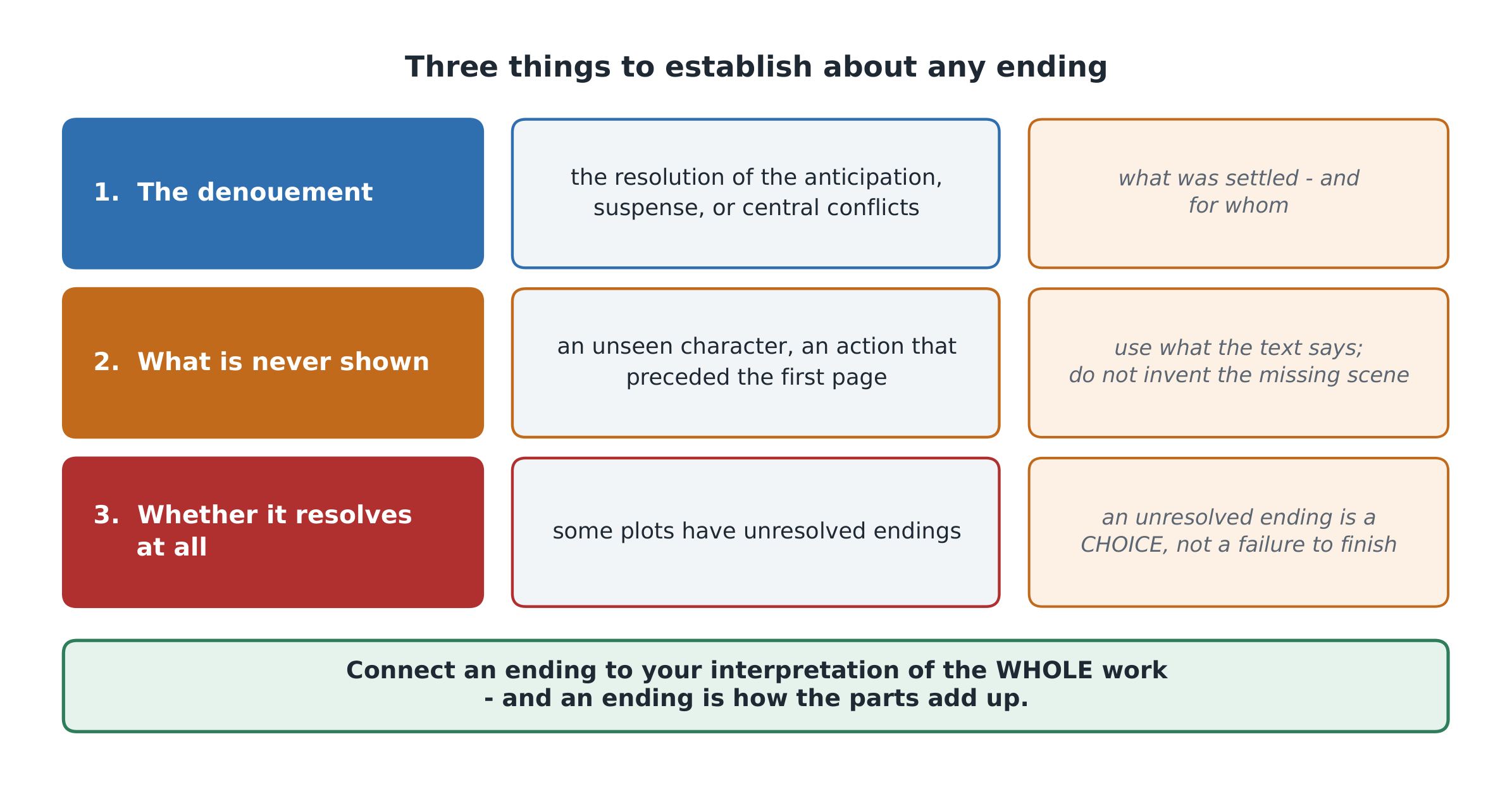
- The resolution of the anticipation, suspense, or central conflicts of a plot may be called the denouement 结局.
- Sometimes things not actually shown in a narrative - an unseen character, a preceding action - affect the interpretation of what is shown.
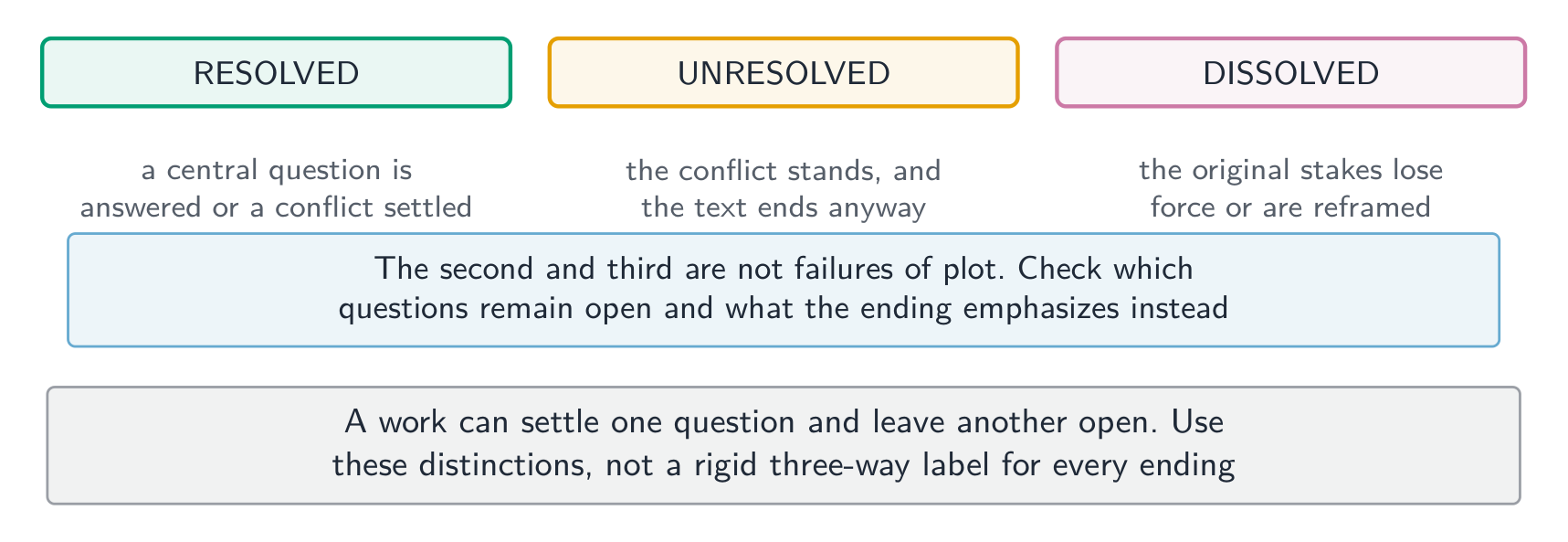
- Although most plots end in resolution, some have unresolved endings, and those affect interpretation too.
Check how offstage events affect what the text does show. What a text keeps offstage - a death that happened before the first page, a character who is discussed and never appears - may shape the events shown. Use the text’s references to it as evidence; do not invent the missing scene.
Explore
Sort each ending by how the conflict closes
Distinguish which question is settled and which remains open; different conflicts can have different outcomes.
Vocabulary
Train
| English |
|---|
| denouement/deɪˈnuːmɒ/ |
9.5
Details, Diction, and Syntax Reveal Perspective
Syllabus
| Enduring Understanding | Learning Objective | Essential Knowledge |
|---|---|---|
NAR-1 | 4.C |
|
Source: College Board AP Course and Exam Description
- Multiple, and even contrasting, perspectives can occur within a single text and contribute to its complexity.
- A narrator or speaker may change over the course of a text as a result of actions and interactions.
- Changes and inconsistencies in a narrator's or speaker's perspective may contribute to irony or to a reader's judgement of reliability.
A narrator who changes is doubly analysable: as a character who developed, and as a lens that altered. A changed perspective may alter the meaning of earlier details; identify which wording supports that revision.
9.6
Developing a Literary Thesis Statement
Syllabus
| Enduring Understanding | Learning Objective | Essential Knowledge |
|---|---|---|
LAN-1 | 7.B |
|
Source: College Board AP Course and Exam Description
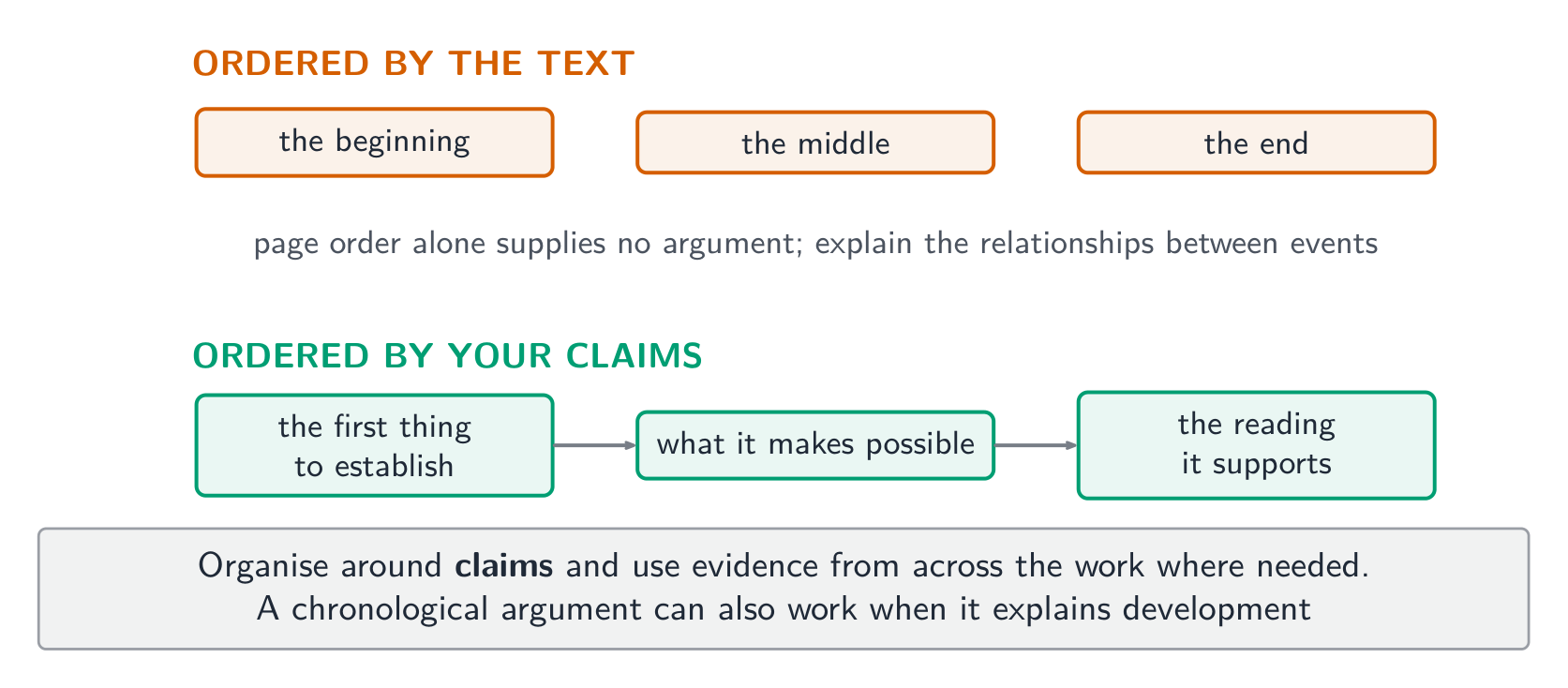
Unchanged: an interpretation requiring textual defence, which may preview the line of reasoning. At this stage, the thesis you are aiming for is one that could not be written before reading the whole work - a claim about how the parts add up.
9.7
Developing Commentary
Syllabus
| Enduring Understanding | Learning Objective | Essential Knowledge |
|---|---|---|
LAN-1 | 7.C |
|
Source: College Board AP Course and Exam Description
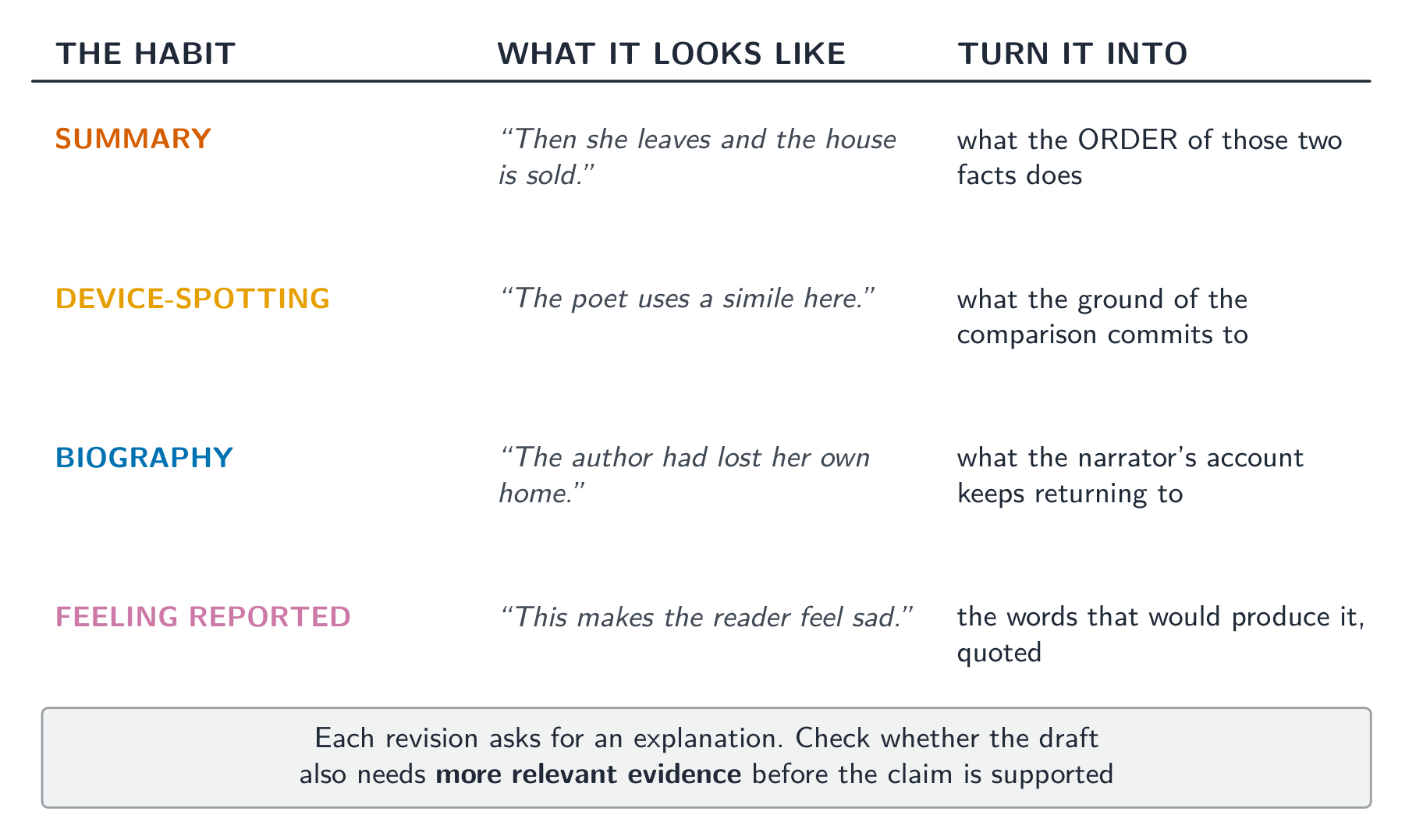
- A line of reasoning is the sequence of claims defending the thesis, communicated through commentary.
- More sophisticated literary arguments explain the significance or relevance of an interpretation.
When a literary-argument prompt asks about the work as a whole, connect the selected event or character to a defensible interpretation of the full work. Follow the actual prompt rather than assuming that naming a device or an ending automatically answers it.
Explore
Revise a claim using evidence
Explain the link between evidence and claim, and check whether more relevant evidence is needed.
9.8
Selecting Relevant and Sufficient Evidence
Syllabus
| Enduring Understanding | Learning Objective | Essential Knowledge |
|---|---|---|
LAN-1 | 7.D |
|
Source: College Board AP Course and Exam Description
Evidence used strategically; effective with commentary; sufficient in quantity and quality; and interpretation developed recursively, revised when the evidence does not support it.
Original complete practice narrative: Monday
This short narrative is written for teaching, not taken from an AP paper or a published novel. It lets you practise ending analysis on a complete small work. For a longer-fiction literary argument, transfer the method to a suitable full work you have studied; this story is not a substitute for knowing that work.
After her brother's accident, Leah left the factory and waited for the inquiry's decision. “I will go back when they tell us what happened,” she said. Each morning the postman put letters on the sill. Each morning she lifted the white envelopes, then put them down. On Friday, her aunt counted the coins in the kitchen jar. “Monday's rent,” she said. Leah counted them again. The postman came with a catalogue and a bill. That evening, Leah took her factory coat from the hook. “Then you have your answer?” her aunt asked. “I have Monday,” Leah said. At dawn she passed the empty sill and walked to the factory. The jar remained on the table.
Worked analysis: an ending with limits. Leah's return answers the practical question of whether she goes back to work, but the inquiry's decision remains unreported. Her earlier condition for returning is displaced by the need for rent. “I have Monday” substitutes an immediate obligation for the explanation she had demanded. The final jar keeps that economic pressure present. Together these details support an interpretation in which ordinary survival continues without settling the demand for an account of the accident. They do not establish what caused the accident or that Leah has forgiven anyone.
Practice. Identify one question the ending answers and one it leaves open. Explain how Leah's final words complicate her earlier promise, using at least two details. Then test the alternative claim that returning to work proves she is satisfied with the inquiry.
9.8
Exam tips
- Whether a character changes is the ground of a reading, not a fact to report.
- How a character behaves at the ending may complicate earlier expectations; explain the connection.
- Suspense accumulates. It may build through a series of narrowing possibilities; explain the actual sequence.
- Offstage events matter through what the text says about them. Do not invent missing evidence.
- An unresolved ending is a choice with meaning, not a failure to finish.
- Question 3 asks for "the work as a whole". Connect the chosen evidence to that interpretation and follow the actual prompt.
Interactive lessons on this topic
Work through it step by step, with instant-check exercises.