| Enduring Understanding | Learning Objective | Essential Knowledge |
|---|---|---|
STR-1 | 3.C |
|
Poetry II
AP English Literature and Composition · Topic 5
 9:03
9:03
Unit 5: Poetry II
Unit 5 is the second poetry unit, and it does two things: it names the forms a poem can take, and it completes the figurative toolkit. Closed forms include…
English narration · English + 中文 subtitles burned in
5.1
The Function of Structure in a Text
Syllabus
Source: College Board AP Course and Exam Description
Unit 5 develops poetry analysis: explain how form, wording and comparisons contribute to an interpretation. Identify a feature accurately, then connect its use to the particular poem.
- Closed forms 格律诗体 use established patterns of lines, stanzas, metre or rhyme.
- Open forms 自由诗体 do not follow a fixed traditional pattern, but can still use deliberate repetition and arrangement.
- Structures can combine to emphasise ideas. Both a regular pattern and a departure from it can matter; neither supplies an interpretation by itself.
Complete original practice poem: The Account
This poem and the mini texts below are original teaching examples, not published poems or authentic AP extracts. Line numbers support references.
1 At dawn the tide asks softly at the door.
2 I stack our chairs above the chalk-white shore.
3 “A little inconvenience,” Father said;
4 the water lifted boards beneath his bed.5 By noon it sends its silver fingers through
6 the garden where our winter carrots grew.
7 I count the rows as columns in a book;
8 it signs each page with what its currents took.9 At dusk it takes what I had called my own.
10 The house is one dark window, water, stone.
11 I write “still standing” by the rising sea;
12 the words stay dry. No doorway shelters me.
Worked reading of structure. Three four-line stanzas move from dawn to noon to dusk. The paired end rhymes include door/shore, said/bed and own/stone. This supports a discussion of regularity without establishing a named traditional form or a fully regular metre. The ordered stanza and rhyme pattern contrasts with the speaker's loss of shelter. The pattern itself matters: analysis need not invent a broken rhyme. Line 12 places a full stop after “dry”, separating the preserved words from the exposed speaker.
Try it before reading on. Select one time marker and one repeated structural feature. Explain how they shape the account of the flood. Do not infer a final recovery or a death that the poem does not report.
Vocabulary
Train
| English |
|---|
| Closed forms/kləʊzd fɔːmz/ |
| Open forms/ˈəʊpən fɔːmz/ |
5.2
Literal and Figurative Meaning
Syllabus
| Enduring Understanding | Learning Objective | Essential Knowledge |
|---|---|---|
FIG-1 | 5.A |
|
Source: College Board AP Course and Exam Description
Words can have several meanings or connotations. Test each proposed meaning against surrounding wording; a dictionary possibility is not enough. You may defend one reading or explain a supported tension.
Worked example. In line 7, “rows” refers literally to carrots in a garden. “Columns in a book” makes the rows resemble an account. Together with “signs”, “takes” and the title, this language invites a figurative reading of loss being recorded. The text does not show an actual financial debt or say that the speaker deserves the loss. A reader should not treat every meaning of “account” as equally established.
5.3
The Function of Specific Words and Phrases
Syllabus
| Enduring Understanding | Learning Objective | Essential Knowledge |
|---|---|---|
FIG-1 | 5.B |
|
Source: College Board AP Course and Exam Description
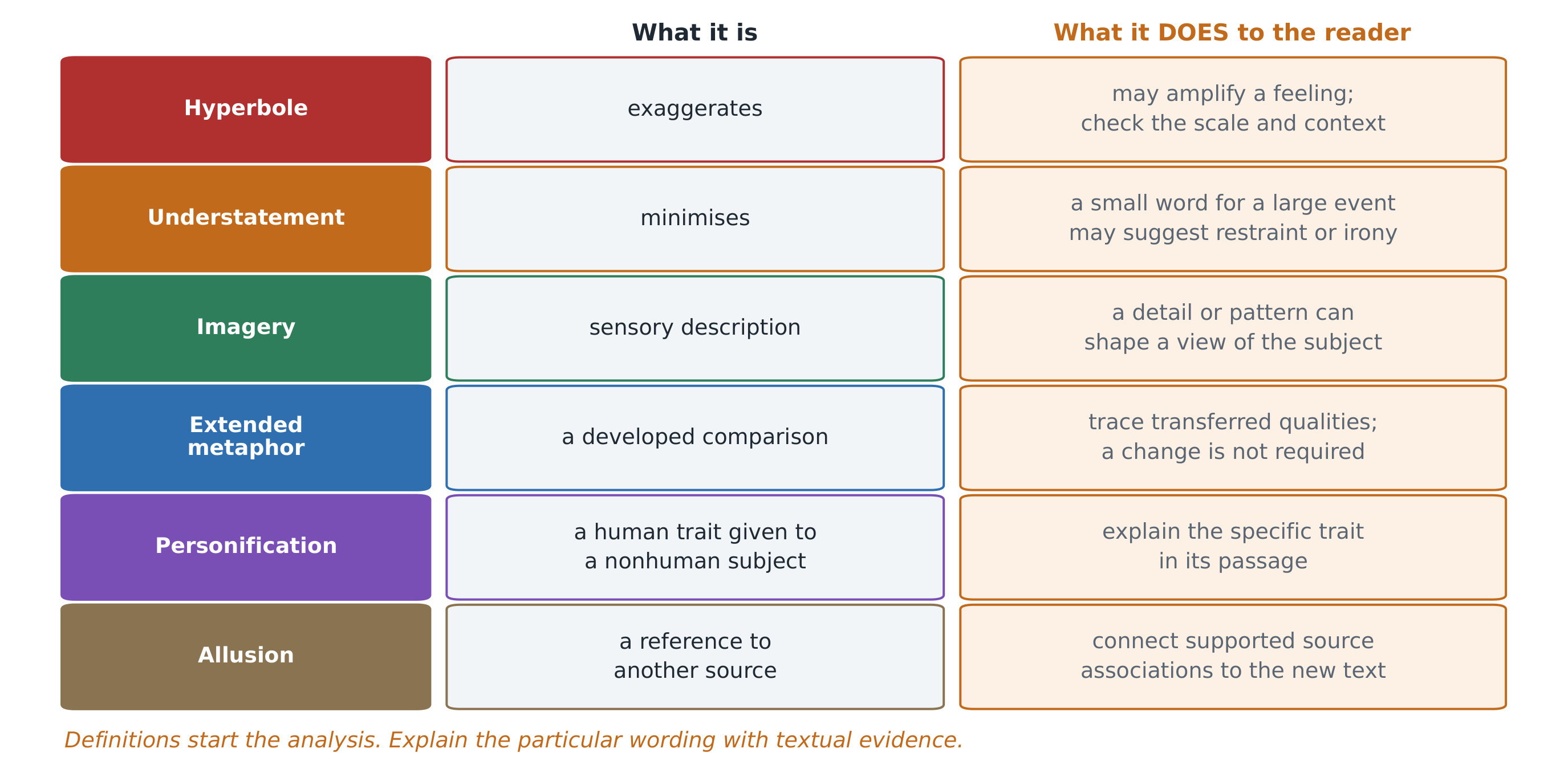
Descriptive words qualify what they describe and influence how it is perceived. Hyperbole 夸张 exaggerates; understatement 低调陈述 minimises. Neither is always stronger. Explain the scale and context of the contrast.
Worked example. “A little inconvenience” in line 3 minimises the flood while line 4 shows water lifting floorboards beneath a bed. The contrast can suggest an effort to sound calm or an inadequate recognition of danger. The poem does not establish Father's private motive. The invented phrase “I waited a thousand years” would instead be hyperbole if used for a short wait: it amplifies the speaker's feeling rather than reporting literal duration.
“Silver” in line 5 gives the water a bright visual quality. Beside “fingers”, it may make the invading water seem delicately attractive before the later loss becomes explicit. Explain that contrast with the later lines rather than assigning silver a universal meaning.
Vocabulary
Train
| English |
|---|
| Hyperbole/haɪˈpɜːbəli/ |
| understatement/ˌʌndəˈsteɪtmənt/ |
5.4
The Function of an Image or Imagery
Syllabus
| Enduring Understanding | Learning Objective | Essential Knowledge |
|---|---|---|
FIG-1 | 5.D |
|
Source: College Board AP Course and Exam Description
An image can describe a literal sensory detail or work through a comparison. Descriptive words contribute to sensory imagery 感官意象 through sight, sound, touch, taste or smell. A collection of images may develop an idea across a text; one carefully placed image can also carry substantial meaning.
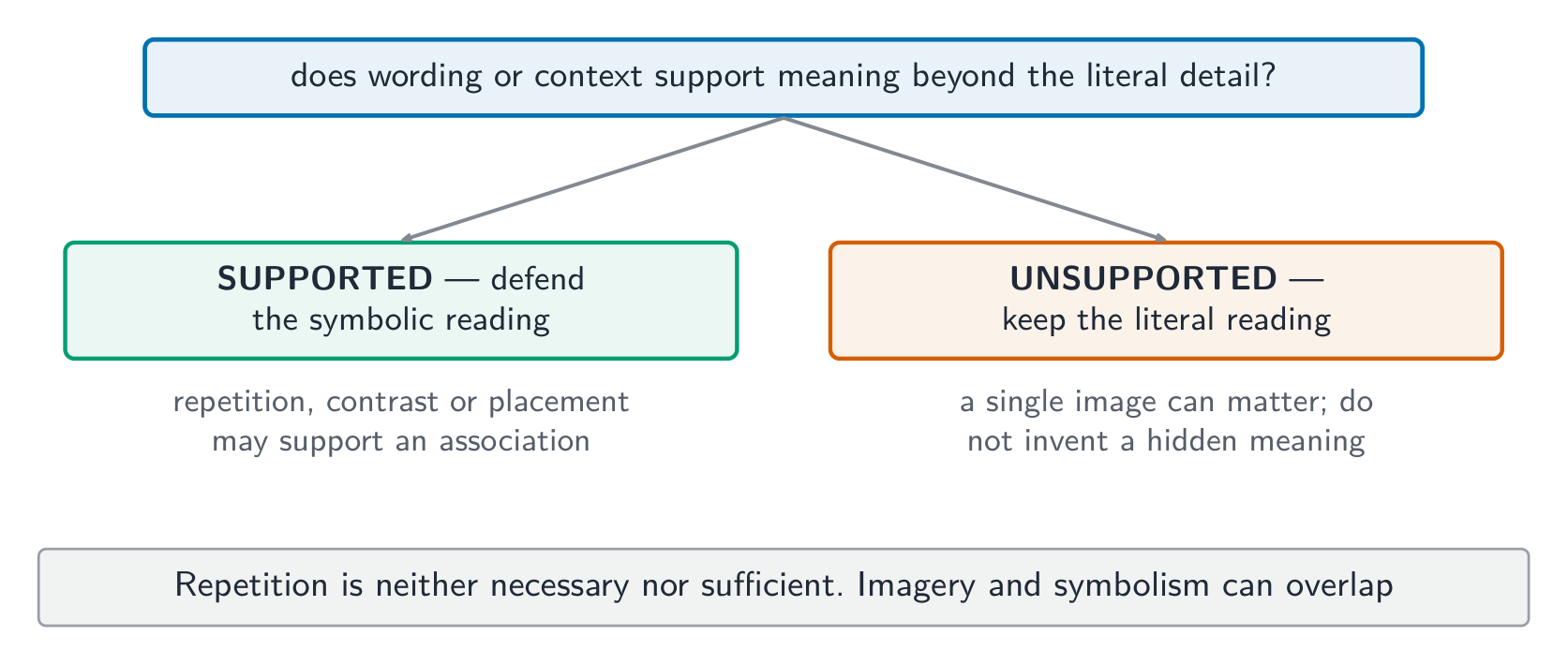
Worked pattern. “Chairs”, “bed”, “garden” and “house” move from objects of daily life towards the loss of the home as a whole. The “dark window” in line 10 is a specific visual detail, while “No doorway shelters me” connects the house to security that the speaker no longer has. The doorway can support a symbolic reading of shelter because of this context, even though the word appears only once. Repetition can strengthen a symbolic reading but is neither necessary nor sufficient. Imagery and symbolism can overlap.
Explore
Image or symbol? Apply the test
Test whether the proposed meaning is supported by wording and context; repetition is optional evidence.
Vocabulary
Train
| English |
|---|
| contribute to sensory imagery/kənˈtrɪbjuːt tə ˈsensəri ˈɪmɪdʒri/ |
5.5
The Function of a Metaphor
Syllabus
| Enduring Understanding | Learning Objective | Essential Knowledge |
|---|---|---|
FIG-1 | 6.B |
|
Source: College Board AP Course and Exam Description
A metaphor transfers particular qualities between a main subject and a comparison subject. An extended metaphor 延伸隐喻 develops related comparisons across a passage or text. Trace the transferred qualities and their limits; the comparison need not change or break to be useful.
Worked example. Lines 7–9 connect garden rows to book columns, currents to signing, and the tide to taking possessions. Together they develop an accounting comparison. The water seems to record and collect the speaker's losses. The speaker's claim of ownership, “what I had called my own”, becomes less secure. This supports an interpretation of threatened control, without proving an actual creditor or a settled belief that the flood is fair.
Vocabulary
Train
| English |
|---|
| extended metaphor/ekˈstendɪd ˈmetəfɔː/ |
5.6
The Function of Personification
Syllabus
| Enduring Understanding | Learning Objective | Essential Knowledge |
|---|---|---|
FIG-1 | 6.C |
|
Source: College Board AP Course and Exam Description
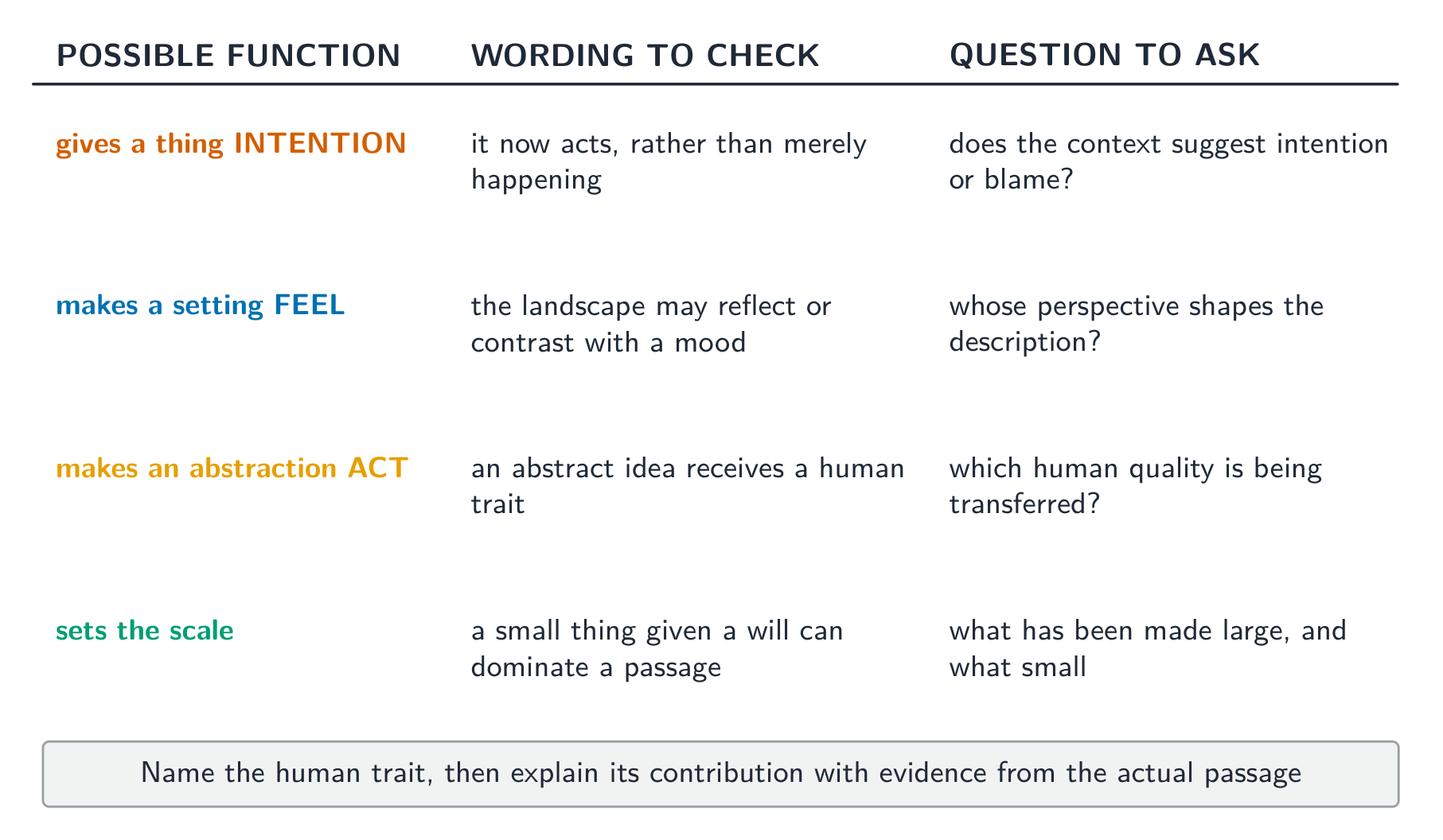
Personification 拟人 gives a human trait or quality to a nonhuman object, animal or idea. Identify the precise trait before explaining its function. A personifying phrase need not imply complete human agency or intention.
Worked sequence. The tide “asks” at dawn, “sends its silver fingers” at noon and “takes” at dusk. The verbs turn a physical process into an increasingly intrusive visitor. Early apparent politeness contrasts with later taking. This is a representation of the flood; the tide does not literally form plans or possess moral blame.
Vocabulary
Train
| English |
|---|
| Personification/pɜːˈsɒnɪfɪkeɪʃn/ |
5.7
The Function of an Allusion
Syllabus
| Enduring Understanding | Learning Objective | Essential Knowledge |
|---|---|---|
FIG-1 | 6.D |
|
Source: College Board AP Course and Exam Description
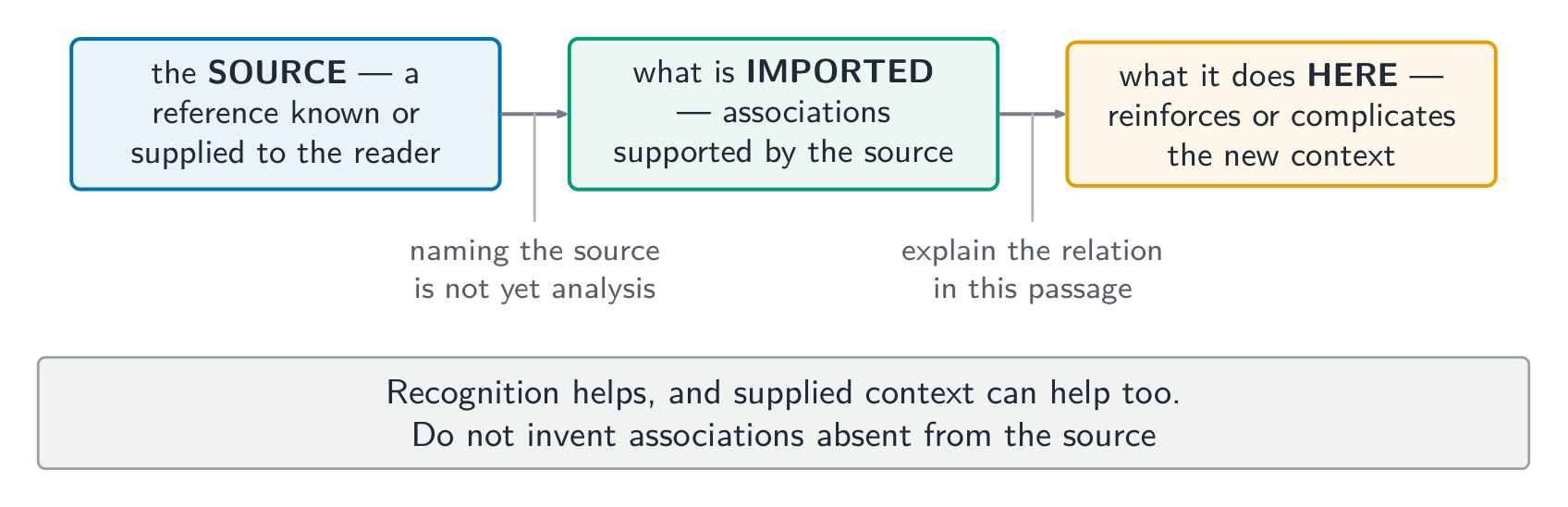
Allusions 典故 refer to other works, myths, sacred texts, art or historical events. A recognised reference can bring associations into the new text. Supplied context may help a reader understand it; do not invent source knowledge or assume all readers share the same response.
Original mini source pack. These two short texts were invented together to practise using a supplied reference.
- Source song, Both Banks: “Build us a bridge; let both banks share the rain.” The line presents a bridge as a way to connect two communities.
- New mini poem: “She paints ‘both banks share the rain’ upon our gate; / then turns the key and asks the guests to wait.”
Worked analysis. The quotation recalls the song's wish for connection. The locked gate and waiting guests limit the welcome that the painted line announces. The reference supports a tension between a public claim of openness and controlled access. It does not establish whether the delay is permanent or why the gate is locked.
Explore
Take an allusion past the source
Use supplied or recognised source associations and explain their relation to the new passage.
Vocabulary
Train
| English |
|---|
| Allusions/əˈluːʒnz/ |
5.8
Developing a Literary Thesis Statement
Syllabus
| Enduring Understanding | Learning Objective | Essential Knowledge |
|---|---|---|
LAN-1 | 7.B |
|
Source: College Board AP Course and Exam Description
A thesis presents an interpretation that can be defended with textual evidence. It may preview the line of reasoning; a device list alone does not explain a meaning.
Practice prompt. Explain how structure and figurative language convey the speaker's changing sense of control in The Account.
Weak start: “The poem uses rhyme, imagery and personification.” This identifies features but supplies no interpretation.
Defensible thesis: “As the tide changes from a visitor that ‘asks’ to a force that ‘takes’, the speaker's orderly account exposes how little control words and ownership give over the loss of home.” The thesis can be tested against the verbs, accounting imagery and final separation between words and shelter. It does not claim a guaranteed score.
5.9
Developing Commentary
Syllabus
| Enduring Understanding | Learning Objective | Essential Knowledge |
|---|---|---|
LAN-1 | 7.C |
|
Source: College Board AP Course and Exam Description
A line of reasoning links claims in support of the thesis. Commentary explains how particular evidence supports each claim; it goes beyond paraphrase and device naming.
Worked paragraph. “The speaker first presents the tide as a visitor that ‘asks’, making the intrusion seem negotiable. By dusk it ‘takes what I had called my own’, and the earlier claim of ownership has become uncertain. This change in verbs makes the speaker's control appear increasingly fragile. The ending preserves the written words ‘still standing’ but leaves the speaker without a sheltering doorway, so the account can record a claim it cannot make physically true.”
This is one defensible reading, not the only possible answer. It does not establish that the speaker has accepted the loss or ceased to resist it.
5.10
Selecting Relevant and Sufficient Evidence
Syllabus
| Enduring Understanding | Learning Objective | Essential Knowledge |
|---|---|---|
LAN-1 | 7.D |
|
Source: College Board AP Course and Exam Description
Select evidence for the claim you are making. Evidence must be accurate, relevant and sufficient, with commentary explaining its contribution. Interpretation is recursive: revise a claim when another line complicates it. No fixed number of quotations fits every task.
Worked revision. “The speaker calmly accepts the flood” is too certain. “I stack our chairs” shows an attempt to protect possessions; “still standing” may show persistence, denial or both. A better bounded claim is that the poem contrasts attempts to preserve order with the loss of physical shelter. A paragraph about change needs evidence from more than one moment, not only the last line.
5.11
Control Over the Elements of Composition
Syllabus
| Enduring Understanding | Learning Objective | Essential Knowledge |
|---|---|---|
LAN-1 | 7.E |
|
Source: College Board AP Course and Exam Description
Transitional elements link ideas through words, clauses, sentences or paragraphs. Choose a connection that reflects the reasoning; a connector cannot create a relation unsupported by the text.
Worked connection: “At dawn, ‘asks’ makes the intrusion seem negotiable. By contrast, the dusk verb ‘takes’ gives the speaker no apparent choice.” The contrast is in the two quoted actions. “Therefore” would need a causal claim, not merely a change of time.
Practice before the model. Write a thesis and a short paragraph answering the practice prompt. Use evidence from two moments; explain one tension and state one limit on your interpretation. Then compare your method with the examples above.
5.11
Exam tips
- Identify the form or device accurately, then explain its use in this text.
- Test possible word meanings against context rather than keeping every meaning automatically.
- Explain hyperbole and understatement without ranking either as universally stronger.
- Support imagery and symbolic readings with precise wording; repetition is optional evidence.
- Trace a developed comparison and distinguish an interpretation from an invented event or motive.
- Use the supplied source context for an allusion and relate it to the new text.
- Select and connect evidence for the specific prompt; revise claims that the ending complicates.
Interactive lessons on this topic
Work through it step by step, with instant-check exercises.