| Enduring Understanding | Learning Objective | Essential Knowledge |
|---|---|---|
CHR-1 | 1.A |
|
Tips
AP English Literature and Composition teaches close reading and literary argument across three text types, each visited three times: short fiction, poetry, and longer fiction or drama. The units spiral, so the same skills return at greater depth.
The course is organised by literary element: character, setting, structure, narration, figurative language, and literary argumentation. Each element has its own skills, and each asks the same underlying question - what does this choice *do* in the text?
"The function of" is the phrase to notice. The framework repeatedly asks for the function of a symbol, a contrast, a shift in narration. Identifying a device is the first step; explaining the work it performs is the answer.
Interpretation must be defensible, not merely personal. A reading earns credit when it is supported by details from the text and developed through reasoning, which is why literary argumentation runs alongside every element.
The notes below follow the nine units in the order the College Board sets them, so short fiction, poetry and longer works alternate exactly as the course does.
-
1
Short Fiction I
Watch lesson1.1
What Textual Details Reveal About a Character
Syllabus
Source: College Board AP Course and Exam Description
AP English Literature reads texts in three genres across nine units - short fiction, poetry, and longer fiction or drama, each visited three times at increasing difficulty. Unit 1 installs the tools for all of them.
Character 人物 is revealed by three things, and the CED names them exactly:
- Description, dialogue, and behaviour 描写、对话与行为 reveal characters to readers.
- Descriptions may come from a speaker, narrator, other characters, or the characters themselves - so who is describing is part of the evidence.
- Perspective 视角 is how narrators, characters, or speakers understand their circumstances, informed by background, experience, and values.
- A character's perspective is both shaped and revealed by relationships with other characters, the environment, and events.
That last point is the one that turns character notes into analysis. A character is not a list of adjectives; a character is a way of seeing, which becomes visible in what they notice, what they misread, and how they respond.
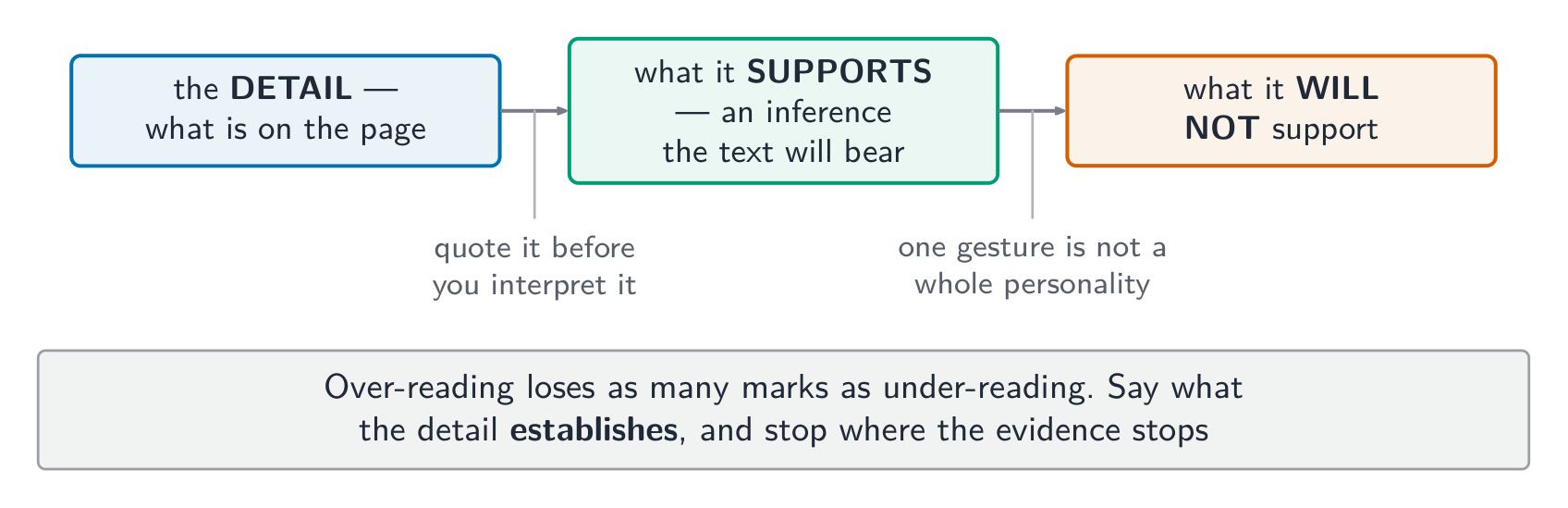
ExploreTake a detail exactly as far as it goes
Over-reading loses as many marks as under-reading: say what the detail establishes, and stop where the evidence stops.
Vocabulary TrainEnglish Character/ˈkærɪktə/ Description, dialogue, and behaviour/dɪˈskrɪpʃn ˈdaɪəlɒɡ ænd bɪˈheɪvjə/ Perspective/pəˈspektɪv/ 1.2
Textual Details That Convey Setting
Syllabus
Enduring Understanding Learning Objective Essential Knowledge SET-1
Setting and the details associated with it not only depict a time and place, but also convey values associated with that setting.2.A
Identify and describe specific textual details that convey or reveal a setting.- SET-1.A Setting includes the time and place during which the events of the text occur.
Source: College Board AP Course and Exam Description
Setting 背景 includes the time and place during which the events of the text occur.
The CED's definition is deliberately minimal, and that is the trap. Setting earns marks not when it is described but when it is shown doing something - constraining a character, explaining a value, or contrasting with an interior state. A paragraph that establishes where a story happens has not yet made a claim.
Vocabulary TrainEnglish Setting/ˈsetɪŋ/ 1.3
How Plot Orders Events
Syllabus
Enduring Understanding Learning Objective Essential Knowledge STR-1
The arrangement of the parts and sections of a text, the relationship of the parts to each other, and the sequence in which the text reveals information are all structural choices made by a writer that contribute to the reader’s interpretation of a text.3.A
Identify and describe how plot orders events in a narrative.- STR-1.A Plot is the sequence of events in a narrative; events throughout a narrative are connected, with each event building on the others, often with a cause-and-effect relationship.
- STR-1.B The dramatic situation of a narrative includes the setting and action of the plot and how that narrative develops to place characters in conflict(s), and often involves the rising or falling fortunes of a main character or set of characters.
Source: College Board AP Course and Exam Description
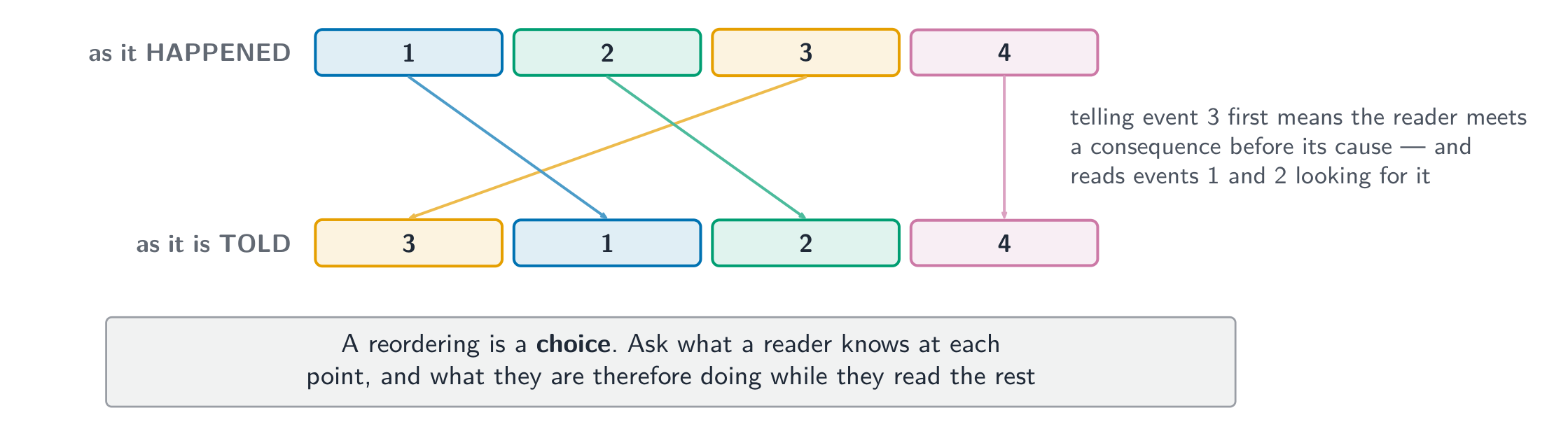
- Plot 情节 is the sequence of events in a narrative; events are connected, each building on those before it.
- The dramatic situation 戏剧情境 includes the setting and action of the plot and how the narrative develops to place characters in conflict.
The word sequence is doing work. Plot is not the events but their order - and an author who reveals something late that happened early has made a choice you can analyse.
Vocabulary TrainEnglish Plot/plɒt/ dramatic situation/drəˈmætɪk ˌsɪtʃuːˈeɪʃn/ 1.4
The Function of a Sequence of Events
Syllabus
Enduring Understanding Learning Objective Essential Knowledge STR-1
The arrangement of the parts and sections of a text, the relationship of the parts to each other, and the sequence in which the text reveals information are all structural choices made by a writer that contribute to the reader’s interpretation of a text.3.B
Explain the function of a particular sequence of events in a plot.- STR-1.C Plot and the exposition that accompanies it focus readers’ attention on the parts of the narrative that matter most to its development, including characters, their relationships, and their roles in the narrative, as well as setting and the relationship between characters and setting.
Source: College Board AP Course and Exam Description
Plot and the exposition that accompanies it focus readers' attention on the parts of the narrative that matter most to the text's meaning.
That sentence is the whole method for prose analysis: proportion is evidence. What the text lingers over, and what it passes in a clause, is the author telling you where to look.
1.5
Identifying the Narrator or Speaker
Syllabus
Enduring Understanding Learning Objective Essential Knowledge NAR-1
A narrator’s or speaker’s perspective controls the details and emphases that affect how readers experience and interpret a text.4.A
Identify and describe the narrator or speaker of a text.- NAR-1.A Narrators or speakers relate accounts to readers and establish a relationship between the text and the reader.
- NAR-1.B Perspective refers to how narrators, characters, or speakers see their circumstances, while point of view refers to the position from which a narrator or speaker relates the events of a narrative.
- NAR-1.C A speaker or narrator is not necessarily the author.
Source: College Board AP Course and Exam Description
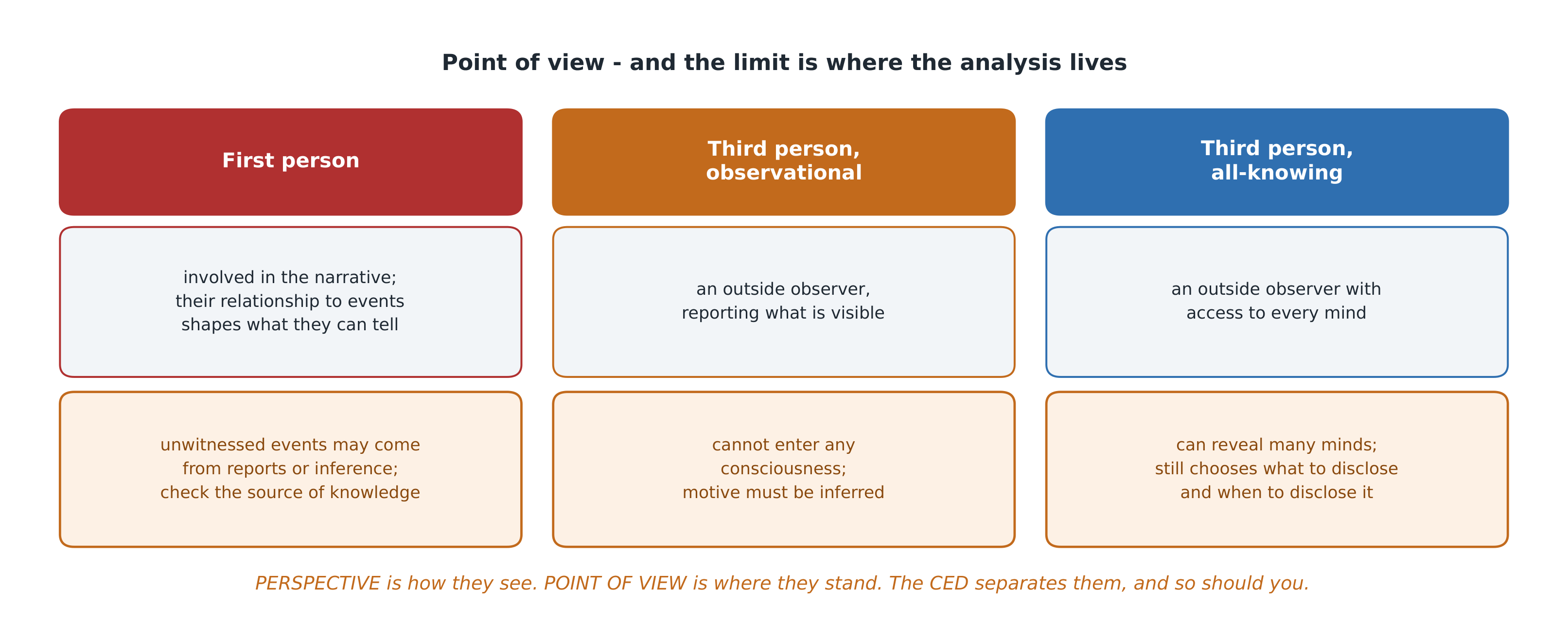
Perspective is how they see; point of view is where they stand. The CED separates them, and so should you - Narrators or speakers relate accounts and establish a relationship between the text and the reader.
- Perspective refers to how narrators, characters, or speakers see their circumstances; point of view 叙述视点 refers to the position from which they relate the account.
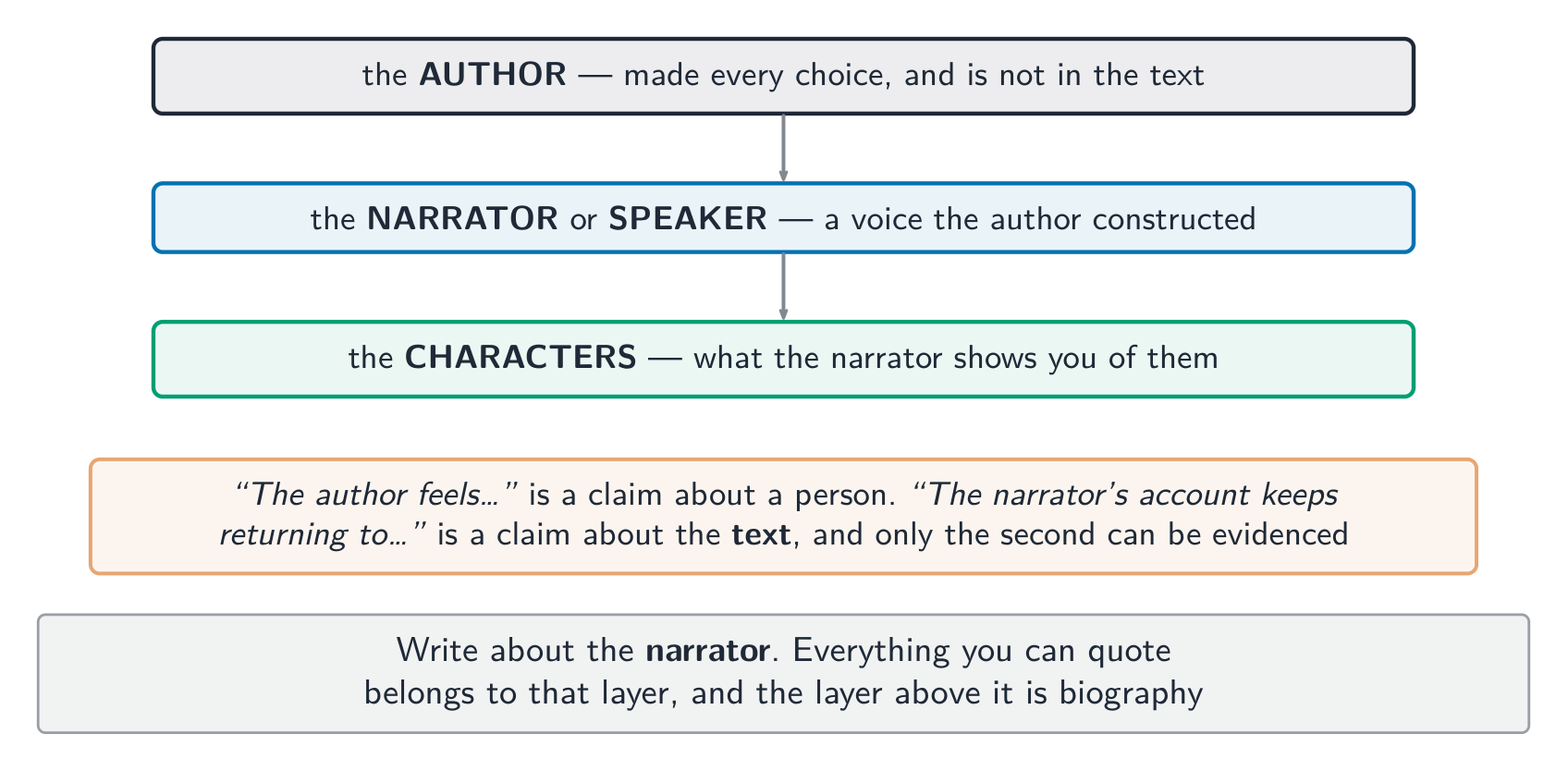
- A speaker or narrator is not necessarily the author. Never write "the author feels" about a first-person narrator.
 Explore
Sort each statement by the layer it belongs to
Everything you can quote belongs to the narrator's layer. The layer above it is biography.
Vocabulary TrainEnglish point of view/pɔɪnt ɒv vjuː/ 1.6
The Function of Point of View
Syllabus
Enduring Understanding Learning Objective Essential Knowledge NAR-1
A narrator’s or speaker’s perspective controls the details and emphases that affect how readers experience and interpret a text.4.B
Identify and explain the function of point of view in a narrative.- NAR-1.D The point of view contributes to what narrators, characters, or speakers can and cannot provide in a text based on their level of involvement and intimacy with the details, events, or characters.
- NAR-1.E Narrators may also be characters, and their role as characters may influence their perspective.
- NAR-1.F First-person narrators are involved in the narrative; their relationship to the events of the plot and the other characters shapes their perspective.
- NAR-1.G Third-person narrators are outside observers.
- NAR-1.H Third-person narrators’ knowledge about events and characters may range from observational to all-knowing, which shapes their perspective.
- NAR-1.I The outside perspective of third-person narrators may not be affected by the events of the narrative.
Source: College Board AP Course and Exam Description
- Point of view contributes to what narrators can and cannot provide in a text, based on their position.
- Narrators may also be characters, and that role may influence their perspective.
- First-person narrators are involved in the narrative; their relationship to events and to other characters shapes what they can tell you.
- Third-person narrators are outside observers, and their knowledge may range from observational to all-knowing 全知.
- The outside perspective of a third-person narrator may not be affected by the events of the narrative.
The analytical payoff is the cannot. A first-person narrator may learn about unwitnessed events through reports or inference. Distinguish that indirect knowledge from direct access to another mind, and explain a gap only when the surrounding text supports its significance. A limited third-person narrator confines you to one consciousness, which is a choice about whose experience counts.
Vocabulary TrainEnglish observational to all-knowing/ɒbzəˈveɪʃənl tʊ ɔːl ˈnəʊɪŋ/ 1.7
Developing a Paragraph with Claim and Evidence
Syllabus
Enduring Understanding Learning Objective Essential Knowledge LAN-1
Readers establish and communicate their interpretations of literature through arguments supported by textual evidence.7.A
Develop a paragraph that includes 1) a claim that requires defense with evidence from the text and 2) the evidence itself.- LAN-1.A In literary analysis, writers read a text closely to identify details that, in combination, enable them to make and defend a claim about an aspect of the text.
- LAN-1.B A claim is a statement that requires defense with evidence from the text.
- LAN-1.C In literary analysis, the initial components of a paragraph are the claim and textual evidence that defends the claim.
Source: College Board AP Course and Exam Description
- In literary analysis, writers read a text closely to identify details that, in combination, enable them to make and defend a claim.
- A claim is a statement that requires defence with evidence from the text.
- The initial components of a paragraph are the claim and the textual evidence that defends it.
Note in combination. A single detail rarely supports an interpretive claim; two or three details that point the same way do.
Original practice passage: the unposted letter
This short passage was written for teaching. It is not an extract from an AP paper.
On the last evening before the station closed, I waited beside its locked ticket window. “You could still post it,” Mara said. I folded the letter until her name disappeared inside. “There is nothing left to say,” I told her. Years later, I call that silence kindness. Mara's answer, if she gave one, is the part I no longer remember.
Worked analysis. The first-person narrator presents avoidance as kindness. Folding Mara's name out of sight and insisting there is “nothing left to say” make that self-description questionable. The later admission about memory further limits the account: Mara's response is unavailable, so the passage does not establish that she agreed. The closed station reinforces the situation's narrowing possibilities. This interpretation links several details without claiming that first person automatically means dishonesty or that the narrator's judgement is the author's.
Practice. Explain how the later phrase “Years later” changes your reading of the earlier silence. Use two details and distinguish what the passage establishes from what remains uncertain.
1.7
Exam tips
- Character is a way of seeing, not a list of adjectives. Analyse what they notice and misread.
- Setting must do something. Describing where a story happens is not yet a claim.
- Plot is the order of events. A late revelation of an early event is an authorial choice worth analysing.
- Proportion is evidence. What the text lingers over is where the meaning is.
- The narrator is not the author. Never write "the author feels" about a first-person narrator.
- The analytical gold in point of view is what the narrator cannot provide.
-
2
Poetry I
Watch lesson2.1
What Textual Details Reveal About a Character
Syllabus
Enduring Understanding Learning Objective Essential Knowledge CHR-1
Characters in literature allow readers to study and explore a range of values, beliefs, assumptions, biases, and cultural norms represented by those characters.1.A
Identify and describe what specific textual details reveal about a character, that character’s perspective, and that character’s motives.- CHR-1.E Characters reveal their perspectives and biases through the words they use, the details they provide in the text, the organization of their thinking, the decisions they make, and the actions they take.
Source: College Board AP Course and Exam Description
Unit 2 is the course's first poetry unit, and it adds two things to Unit 1's toolkit: structure as an object of analysis, and figurative language 比喻性语言 handled precisely rather than by name-dropping.
One addition on character first: characters reveal their perspectives and biases through the words they use, the details they provide, and the details they omit.
That last item is the analytical opening. A meaningful omission can support an interpretation when the surrounding wording creates a reason to expect the missing detail. Do not invent an omitted fact.
Vocabulary TrainEnglish figurative language/ˈfɪɡjərətɪv ˈlæŋɡwɪdʒ/ 2.2
The Function of Structure in a Text
Syllabus
Enduring Understanding Learning Objective Essential Knowledge STR-1
The arrangement of the parts and sections of a text, the relationship of the parts to each other, and the sequence in which the text reveals information are all structural choices made by a writer that contribute to the reader’s interpretation of a text.3.C
Explain the function of structure in a text.- STR-1.D Line and stanza breaks contribute to the development and relationship of ideas in a poem.
- STR-1.E The arrangement of lines and stanzas contributes to the development and relationship of ideas in a poem.
- STR-1.F A text’s structure affects readers’ reactions and expectations by presenting the relationships among the ideas of the text via their relative positions and their placement within the text as a whole.
Source: College Board AP Course and Exam Description
- Line and stanza breaks 行与诗节的断开 contribute to the development and relationship of ideas in a poem.
- The arrangement of lines and stanzas contributes to that development.
- A text's structure affects readers' reactions and expectations by presenting the relationships among ideas.
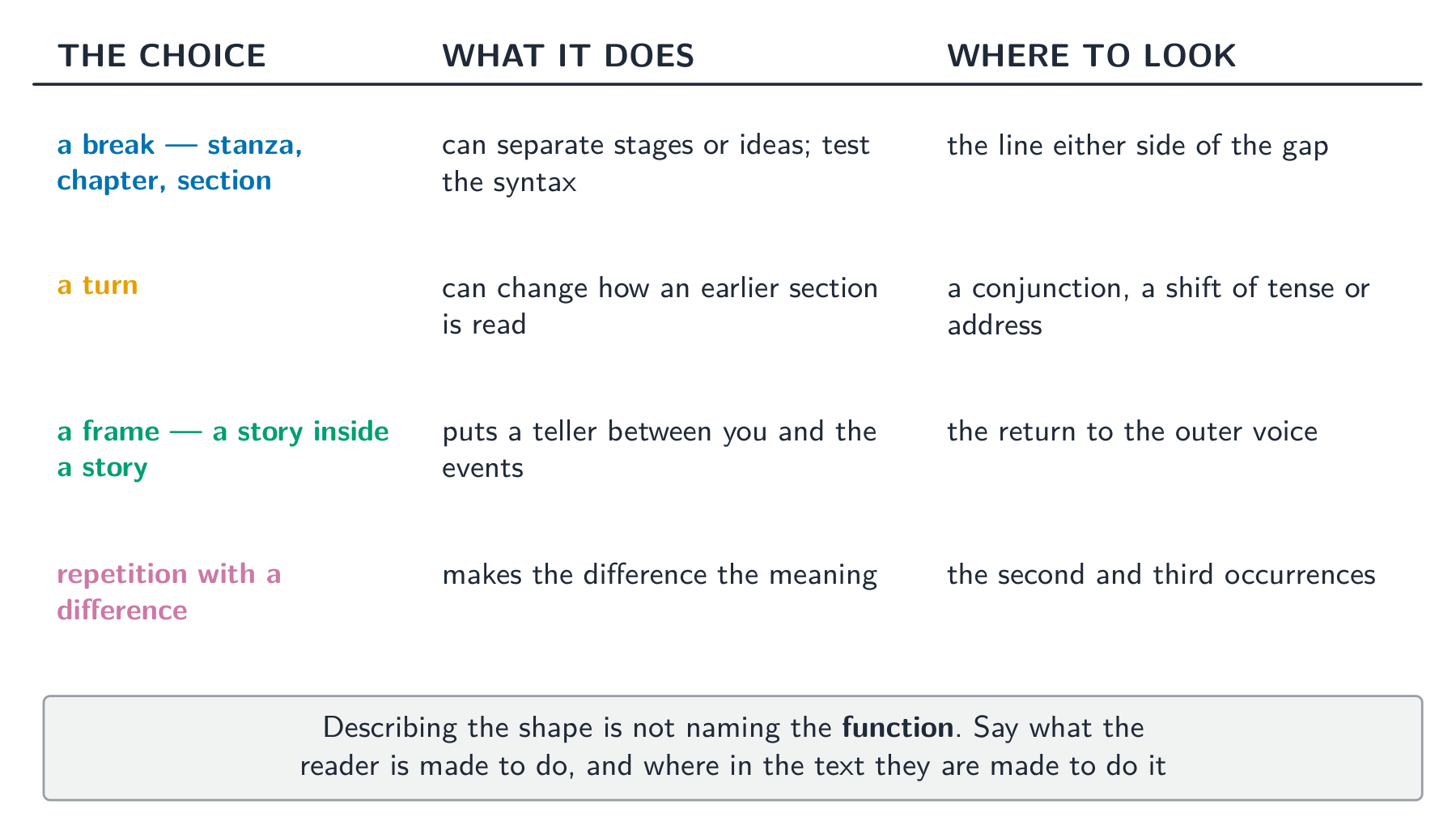
Structure in poetry is not decoration; it is punctuation for thought. Where a line breaks decides which words sit at the ends of lines, and a line ending can give a word prominence, depending on syntax, rhythm and context. A sentence that runs past a line break asks the reader to hold something unresolved; one that stops at the break closes it.
 Explore
Match each structural choice to its function
Describing the shape is not naming the function. Say what the reader is made to do, and where.
Vocabulary TrainEnglish Line and stanza breaks/laɪn ænd ˈstænzə breɪks/ 2.3
The Function of Contrasts Within a Text
Syllabus
Enduring Understanding Learning Objective Essential Knowledge STR-1
The arrangement of the parts and sections of a text, the relationship of the parts to each other, and the sequence in which the text reveals information are all structural choices made by a writer that contribute to the reader’s interpretation of a text.3.D
Explain the function of contrasts within a text.- STR-1.G Contrast can be introduced through focus; tone; point of view; character, narrator, or speaker perspective; dramatic situation or moment; settings or time; or imagery.
- STR-1.H Contrasts are the result of shifts or juxtapositions or both.
- STR-1.I Shifts may be signaled by a word, a structural convention, or punctuation.
- STR-1.J Shifts may emphasize contrasts between particular segments of a text.
Source: College Board AP Course and Exam Description
- Contrast 对照 can be introduced through focus, tone, point of view, character or speaker perspective, and dramatic situation.
- Contrasts are the result of shifts or juxtapositions or both.
- Shifts may be signalled by a word, a structural convention, or punctuation.
- Shifts may emphasise contrasts between particular segments of a text.
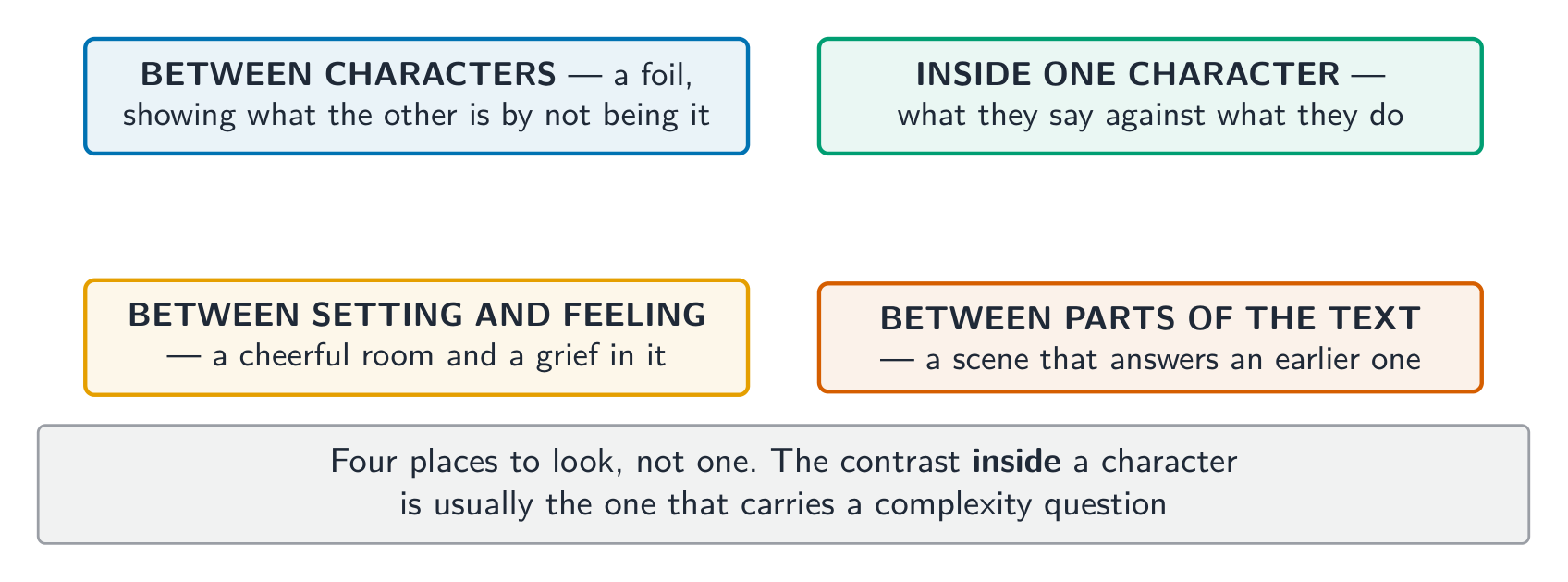
This is the most reliable route into an unseen poem. Find the shift - a but, a stanza break, a change of tense or address - and the poem divides into a before and an after. What changed, and what the change costs or gains, is very often the poem's argument.
ExploreFind the contrast in four places, not one
Students find the obvious pairing and stop — and the contrast inside a character usually carries the complexity question.
Vocabulary TrainEnglish Contrast/ˈkɒntræst/ 2.4
The Function of Specific Words and Phrases
Syllabus
Enduring Understanding Learning Objective Essential Knowledge FIG-1
Comparisons, representations, and associations shift meaning from the literal to the figurative and invite readers to interpret a text.5.B
Explain the function of specific words and phrases in a text.- FIG-1.A An antecedent is a word, phrase, or clause that precedes its referent. Referents may include pronouns, nouns, phrases, or clauses.
- FIG-1.B Referents are ambiguous if they can refer to more than one antecedent, which affects interpretation.
- FIG-1.C Words or phrases may be repeated to emphasize ideas or associations.
- FIG-1.D Alliteration is the repetition of the same letter sound at the beginning of adjacent or nearby words to emphasize those words and their associations or representations.
Source: College Board AP Course and Exam Description
- An antecedent 先行词 is a word, phrase, or clause that precedes its referent.
- Referents are ambiguous if they can refer to more than one antecedent, which affects interpretation 影响阐释.
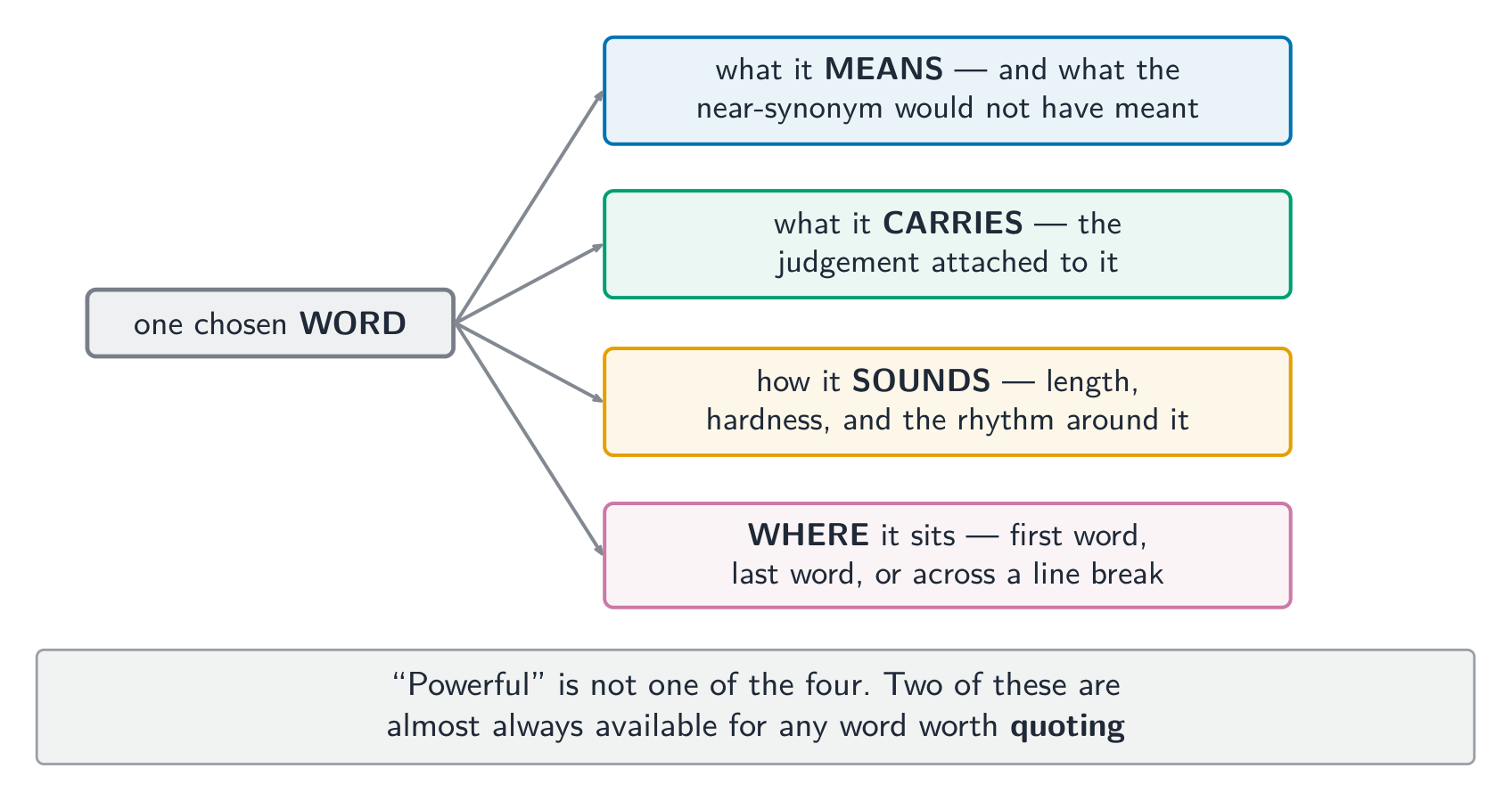
- Words or phrases may be repeated to emphasise ideas or associations.
- Alliteration 头韵 is the repetition of the same initial sound in adjacent or nearby words, emphasising those words.
Ambiguous reference is worth special attention. In poetry or prose, a pronoun with two plausible antecedents can create ambiguity. Test both readings against context before claiming a deliberate effect.
Vocabulary TrainEnglish antecedent/ˌæntɪˈsiːdənt/ affects interpretation/əˈfekts ɪnˌtɜːprɪˈteɪʃn/ Alliteration/əˌlɪtəˈreɪʃn/ 2.5
The Function of a Simile
Syllabus
Enduring Understanding Learning Objective Essential Knowledge FIG-1
Comparisons, representations, and associations shift meaning from the literal to the figurative and invite readers to interpret a text.6.A
Identify and explain the function of a simile.- FIG-1.E A simile uses the words “like” or “as” to liken two objects or concepts to each other.
- FIG-1.F Similes liken two different things to transfer the traits or qualities of one to the other.
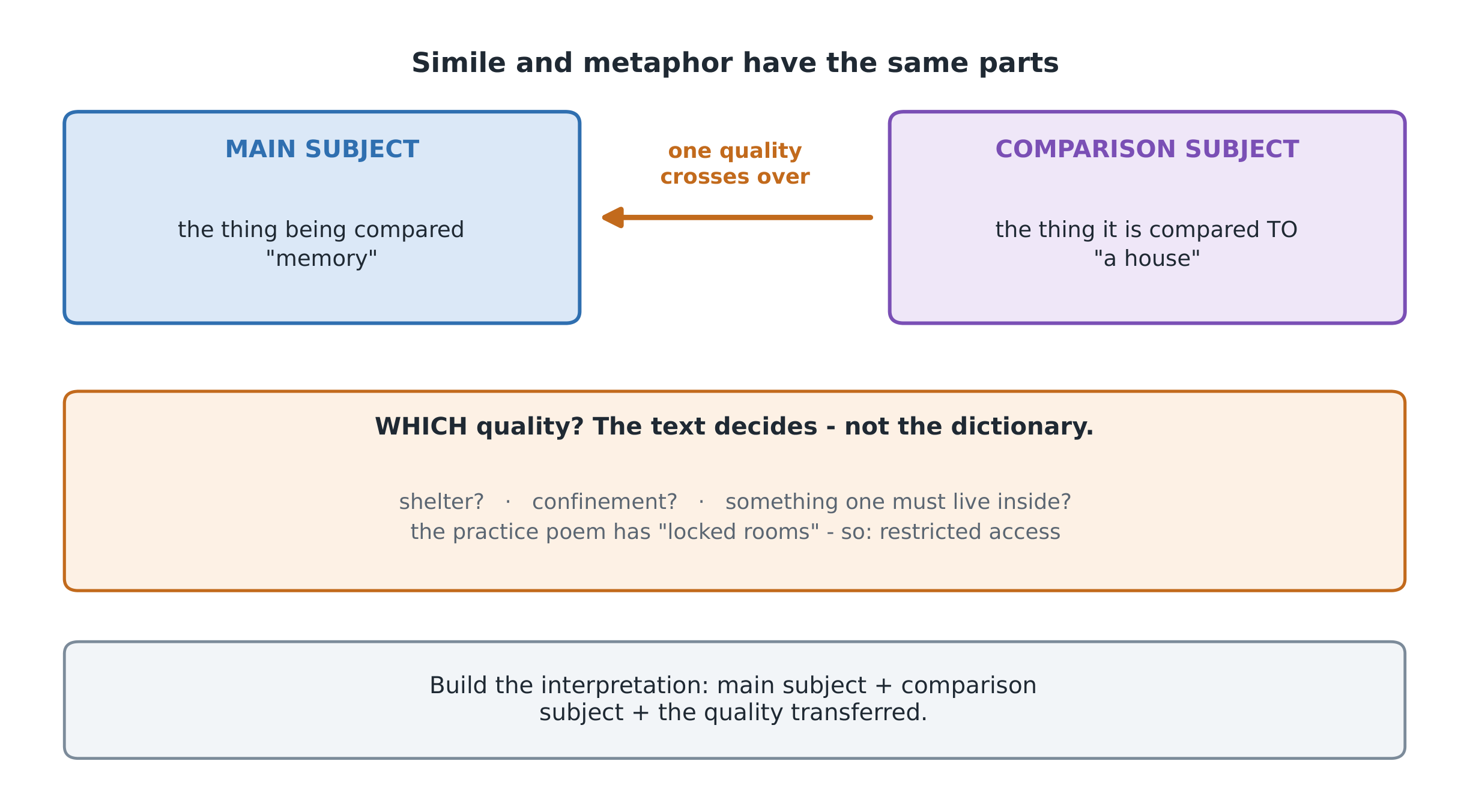
- FIG-1.G In a simile, the thing being compared is the main subject; the thing to which it is being compared is the comparison subject.
Source: College Board AP Course and Exam Description
Name the main subject, name the comparison subject, then say which quality crossed over - A simile 明喻 uses "like" or "as" to liken two objects or concepts.
- Similes liken two different things to transfer the traits or qualities of one to the other.
- In a simile, the thing being compared is the main subject; the thing to which it is compared is the comparison subject.
Those two terms are the whole method. A scoring answer names the main subject, names the comparison subject, and then says which quality was transferred - because that quality is the claim the poem is making.
Vocabulary TrainEnglish simile/ˈsɪmɪlɪ/ 2.6
The Function of a Metaphor
Syllabus
Enduring Understanding Learning Objective Essential Knowledge FIG-1
Comparisons, representations, and associations shift meaning from the literal to the figurative and invite readers to interpret a text.6.B
Identify and explain the function of a metaphor.- FIG-1.H A metaphor implies similarities between two (usually unrelated) concepts or objects in order to reveal or emphasize one or more things about one of them, though the differences between the two may also be revealing.
- FIG-1.I In a metaphor, as in a simile, the thing being compared is the main subject; the thing to which it is being compared is the comparison subject.
- FIG-1.J Comparisons between objects or concepts draw on the experiences and associations readers already have with those objects and concepts.
- FIG-1.K Interpretation of a metaphor may depend on the context of its use; that is, what is happening in a text may determine what is transferred in the comparison.
Source: College Board AP Course and Exam Description
- A metaphor 隐喻 implies similarities between two usually unrelated concepts to reveal or emphasise qualities of the main subject.
- The same main-subject and comparison-subject structure applies.
- Comparisons draw on the experiences and associations readers already have with the comparison subject - which is why a metaphor can fail with an audience that lacks those associations.
- Interpretation of a metaphor may depend on the context of its use: what is happening in the text may determine which of the comparison subject's qualities is meant.
That last point protects you from the commonest error, which is importing every association a word has. If a poem calls grief a house, the relevant quality might be shelter, or confinement, or the fact that one must live inside it. The text decides which.
Vocabulary TrainEnglish metaphor/ˈmetəfɔː/ 2.7
Developing a Paragraph with Claim and Evidence
Syllabus
Enduring Understanding Learning Objective Essential Knowledge LAN-1
Readers establish and communicate their interpretations of literature through arguments supported by textual evidence.7.A
Develop a paragraph that includes 1) a claim that requires defense with evidence from the text and 2) the evidence itself.- LAN-1.A In literary analysis, writers read a text closely to identify details that, in combination, enable them to make and defend a claim about an aspect of the text.
- LAN-1.B A claim is a statement that requires defense with evidence from the text.
- LAN-1.C In literary analysis, the initial components of a paragraph are the claim and textual evidence that defends the claim.
Source: College Board AP Course and Exam Description
Same three components as Unit 1: a claim requiring textual defence, the textual evidence, and details identified in combination.
Original practice poem: memory and a house
This poem was written for teaching. It is not an extract from an AP paper.
Memory is a house.
I polish the key each morning,
but pass the locked rooms
without a sound.
At dusk I leave the door ajar.Worked analysis. Memory is the main subject and a house is the comparison subject. “Polish the key each morning” suggests continuing attachment, while “but” turns towards avoidance of “locked rooms”. Together these details present a past the speaker maintains but does not fully revisit. The final door “ajar” suggests a tentative opening; it does not establish a complete recovery. Context supports restricted access and attachment, rather than every possible quality of a house. Naming “metaphor” alone does not explain that interpretation.
Practice. Explain how “but” and the final line complicate the speaker's attitude. Use the actual words rather than assuming that a house always represents safety or confinement.
2.7
Exam tips
- Explain a significant omission only when the surrounding words support the inference.
- Find the shift first. A but, a stanza break, a change of tense - the poem divides there.
- Test line endings in context. Explain their relation to syntax and emphasis.
- An ambiguous referent can support more than one reading; test the wording before claiming intention.
- Always name main subject and comparison subject, then the quality transferred. That quality is the claim.
- Context decides which quality a metaphor imports. Do not list every association the word has.
-
3
Longer Fiction or Drama I
Watch lesson3.1
What Textual Details Reveal About a Character
Syllabus
Enduring Understanding Learning Objective Essential Knowledge CHR-1
Characters in literature allow readers to study and explore a range of values, beliefs, assumptions, biases, and cultural norms represented by those characters.1.A
Identify and describe what specific textual details reveal about a character, that character’s perspective, and that character’s motives.- CHR-1.F The description of a character creates certain expectations for that character’s behaviors; how a character does or does not meet those expectations affects a reader’s interpretation of that character.
- CHR-1.G Details associated with a character and/or used to describe a character contribute to a reader’s interpretation of that character.
- CHR-1.H Readers’ understanding of a character’s perspective may depend on the perspective of the narrator or speaker.
- CHR-1.I A character’s perspective may shift during the course of a narrative.
- CHR-1.J When narrators, characters, or speakers compare another character to something or someone else, they reveal their perspective on the compared character and may also reveal something innate about the compared character.
- CHR-1.K Readers can infer a character’s motives from that character’s actions or inactions.
Source: College Board AP Course and Exam Description
Unit 3 is the first longer-fiction-or-drama unit, and the length changes what is analysable: characters can now change, conflicts can intersect, and setting acquires a social and historical dimension.
The CED's additions on character:
- The description of a character creates expectations for that character's behaviour, and how a character meets or fails those expectations is meaningful.
- Details associated with a character contribute to a reader's interpretation of them.
- A reader's understanding of a character's perspective may depend on the perspective of the narrator.
- A character's perspective may shift during the narrative.
- When narrators or characters compare another character to something else, they reveal their own perspective as much as the compared character's.
- Readers can infer motive from a character's actions or inactions.
That last word - inactions - is the one worth keeping. What a character declines to do is evidence, and it is usually more revealing than what they do.
3.2
Characters Who Change or Remain Unchanged
Syllabus
Enduring Understanding Learning Objective Essential Knowledge CHR-1
Characters in literature allow readers to study and explore a range of values, beliefs, assumptions, biases, and cultural norms represented by those characters.1.B
Explain the function of a character changing or remaining unchanged.- CHR-1.L A dynamic character who develops over the course of the narrative often makes choices that directly or indirectly affect the climax and/or the resolution of that narrative.
- CHR-1.M Character changes can be visible and external, such as changes to health or wealth, or can be internal, psychological, or emotional changes; external changes can lead to internal changes, and vice versa.
- CHR-1.N Some characters remain unchanged or are largely unaffected by the events of the narrative.
Source: College Board AP Course and Exam Description
- A dynamic character 动态人物 develops over the narrative and often makes choices that directly or indirectly cause change.
- Character change can be visible and external - health, wealth, circumstance - or internal, in belief, value, or understanding.
- Some characters remain unchanged 静态人物 or are largely unaffected by events.
The unchanged character is not a failure of characterisation; it is often the measure by which the change in others is visible.
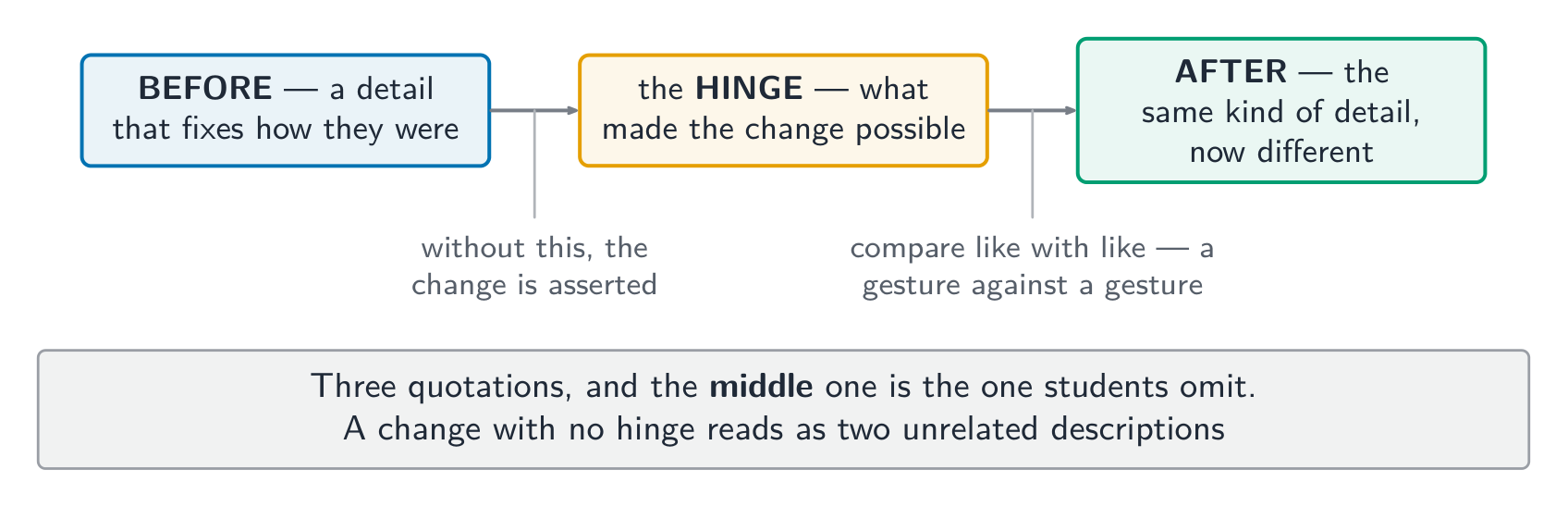
ExploreProve a change with three quotations
Before, hinge, after — and the hinge is the one students omit, which leaves the change asserted.
Vocabulary TrainEnglish dynamic character/daɪˈnæmɪk ˈkærɪktə/ Some characters remain unchanged/sʌm ˈkærɪktəz rɪˈmeɪn ʌnˈtʃeɪndʒd/ 3.3
Textual Details That Convey Setting
Syllabus
Enduring Understanding Learning Objective Essential Knowledge SET-1
Setting and the details associated with it not only depict a time and place, but also convey values associated with that setting.2.A
Identify and describe specific textual details that convey or reveal a setting.- SET-1.B Setting includes the social, cultural, and historical situation during which the events of the text occur.
Source: College Board AP Course and Exam Description
Setting now includes the social, cultural, and historical situation in which the events occur - not only time and place.
This widens what setting can do. A social setting supplies the constraints a character must act within, and constraint is what turns a choice into a revealing one.
3.4
Significant Events in a Plot
Syllabus
Enduring Understanding Learning Objective Essential Knowledge STR-1
The arrangement of the parts and sections of a text, the relationship of the parts to each other, and the sequence in which the text reveals information are all structural choices made by a writer that contribute to the reader’s interpretation of a text.3.E
Explain the function of a significant event or related set of significant events in a plot.- STR-1.K A story, or narrative, is delivered through a series of events that relate to a conflict.
- STR-1.L Events include episodes, encounters, and scenes in a narrative that can introduce and develop a plot.
- STR-1.M The significance of an event depends on its relationship to the narrative, the conflict, and the development of characters.
Source: College Board AP Course and Exam Description
- A narrative is delivered through a series of events that relate to a conflict.
- Events include episodes, encounters, and scenes that introduce and develop plot.
- The significance of an event depends on its relationship to the narrative, the conflict, and character development.
That third statement is the test for essay selection: an event matters to your argument only if you can say what it does to the conflict or to a character. Retelling a striking scene that does neither is plot summary, which earns nothing.
3.5
The Function of Conflict in a Text
Syllabus
Enduring Understanding Learning Objective Essential Knowledge STR-1
The arrangement of the parts and sections of a text, the relationship of the parts to each other, and the sequence in which the text reveals information are all structural choices made by a writer that contribute to the reader’s interpretation of a text.3.F
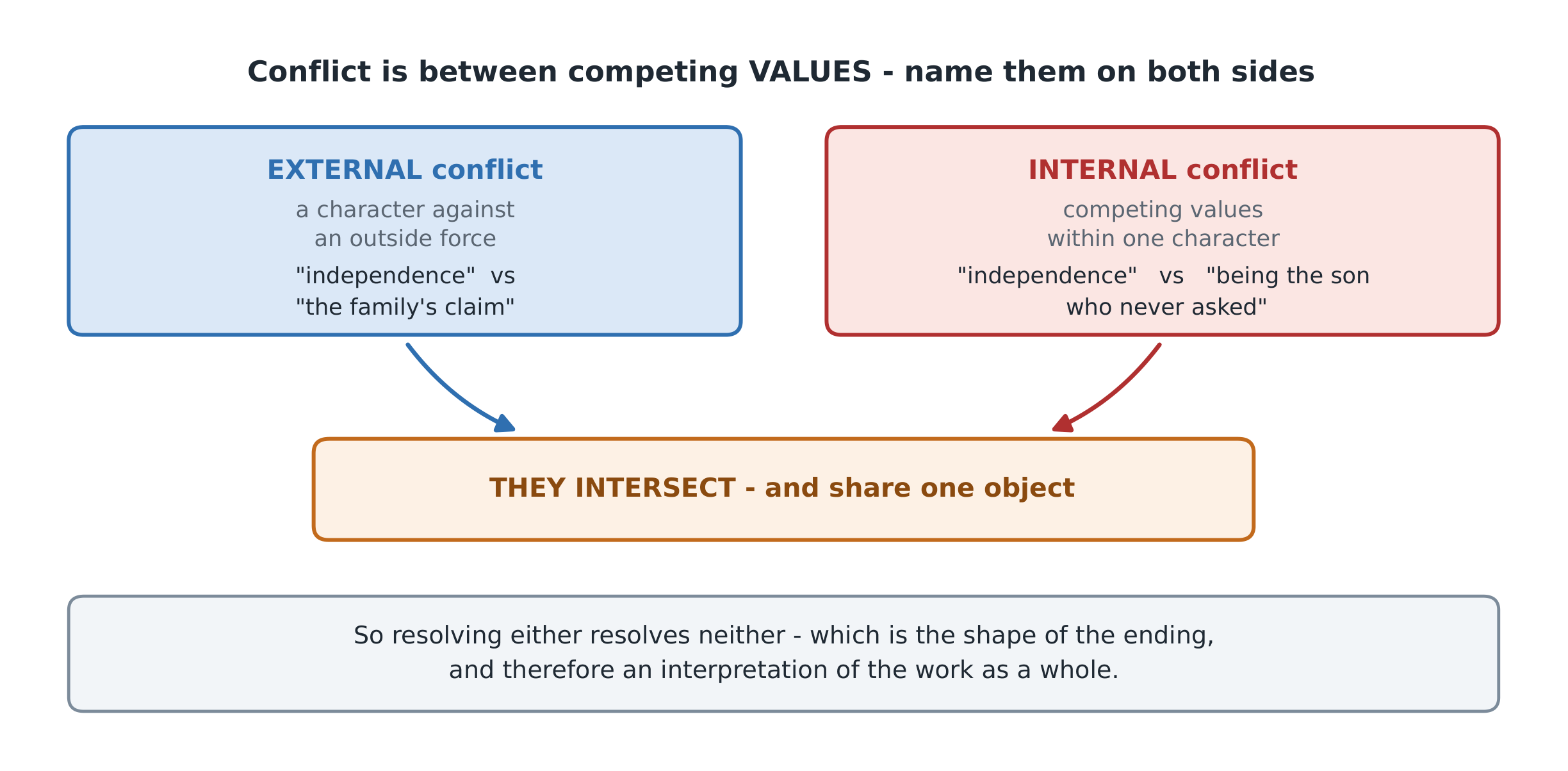
Explain the function of conflict in a text.- STR-1.N Conflict is tension between competing values either within a character, known as internal or psychological conflict, or with outside forces that obstruct a character in some way, known as external conflict.
- STR-1.O A text may contain multiple conflicts. Often two or more conflicts in a text intersect.
- STR-1.P A primary conflict can be heightened by the presence of additional conflicts that intersect with it.
- STR-1.Q Inconsistencies in a text may create contrasts that represent conflicts of values or perspectives.
Source: College Board AP Course and Exam Description
A primary conflict heightened by an intersecting one is the standard shape of a novel or play - Conflict 冲突 is tension between competing values, either within a character - internal or psychological conflict - or between a character and an external force.
- A text may contain multiple conflicts, and often two or more intersect 交叉.
- A primary conflict can be heightened by additional conflicts that intersect with it.
- Inconsistencies in a text may create contrasts that represent conflicts of values or perspectives.
Note the definition: conflict is between competing values, not merely between people. Two characters who want the same object are in a dispute; two characters who want incompatible goods are in a conflict, and only the second produces meaning.
Vocabulary TrainEnglish Conflict/ˈkɒnflɪkt/ intersect/ˌɪntəˈsekt/ 3.6
Developing a Paragraph with Claim and Evidence
Syllabus
Enduring Understanding Learning Objective Essential Knowledge LAN-1
Readers establish and communicate their interpretations of literature through arguments supported by textual evidence.7.A
Develop a paragraph that includes 1) a claim that requires defense with evidence from the text and 2) the evidence itself.- LAN-1.A In literary analysis, writers read a text closely to identify details that, in combination, enable them to make and defend a claim about an aspect of the text.
- LAN-1.B A claim is a statement that requires defense with evidence from the text.
- LAN-1.C In literary analysis, the initial components of a paragraph are the claim and textual evidence that defends the claim.
Source: College Board AP Course and Exam Description
Unchanged from Units 1 and 2: a claim requiring textual defence, textual evidence, and details identified in combination.
3.7
Developing a Literary Thesis Statement
Syllabus
Enduring Understanding Learning Objective Essential Knowledge LAN-1
Readers establish and communicate their interpretations of literature through arguments supported by textual evidence.7.B
Develop a thesis statement that conveys a defensible claim about an interpretation of literature and that may establish a line of reasoning.- LAN-1.D A thesis statement expresses an interpretation of a literary text and requires a defense through use of textual evidence and a line of reasoning, both of which are explained in an essay through commentary.
- LAN-1.E A thesis statement may preview the development or line of reasoning of an interpretation. This is not to say that a thesis statement must list the points of an interpretation, literary elements to be analyzed, or specific evidence to be used in the argument.
Source: College Board AP Course and Exam Description
- A thesis statement expresses an interpretation of a literary text and requires defence through textual evidence.
- It may preview the development or line of reasoning of that interpretation - but is not required to list the reasons.
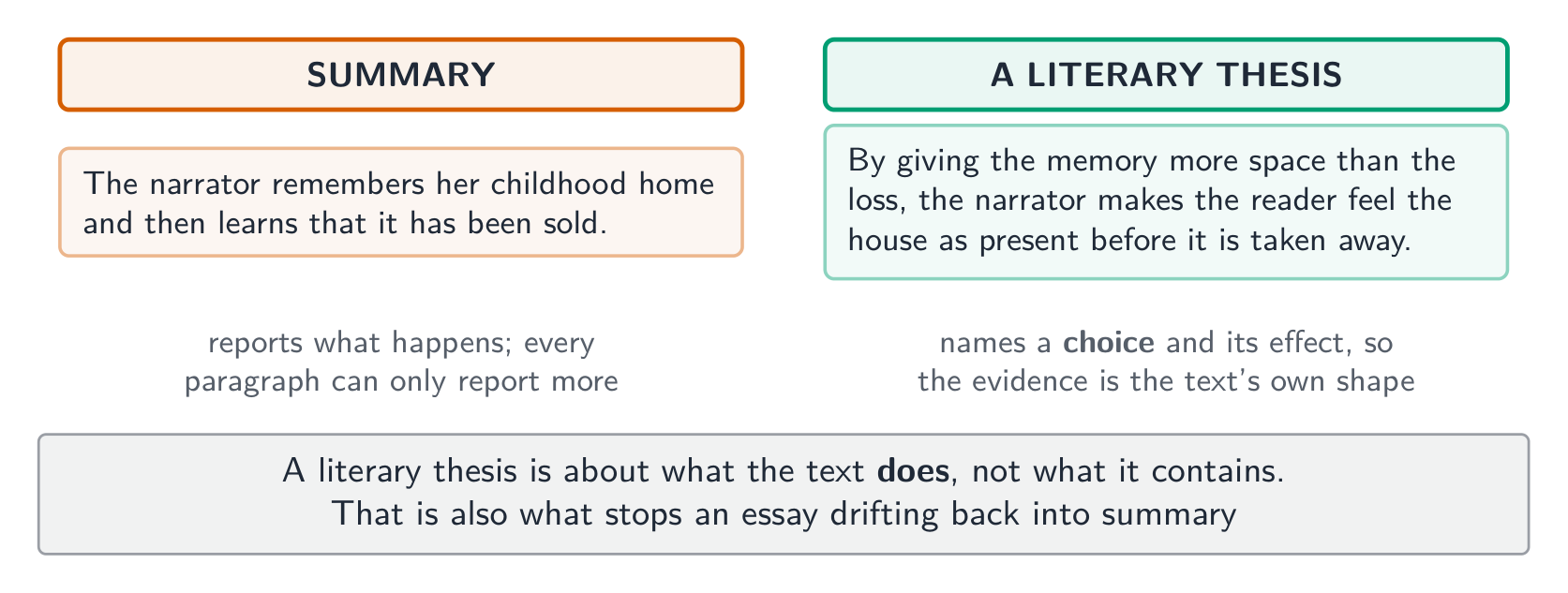
The key word is interpretation. A thesis that states what happens in the text is not a thesis; it is a summary. A thesis must say what the text means or does, which is by definition arguable.
ExploreSort summary from a literary thesis
A literary thesis is about what the text does, not what it contains — which is also what stops an essay drifting into summary.
3.8
Developing Commentary
Syllabus
Enduring Understanding Learning Objective Essential Knowledge LAN-1
Readers establish and communicate their interpretations of literature through arguments supported by textual evidence.7.C
Develop commentary that establishes and explains relationships among textual evidence, the line of reasoning, and the thesis.- LAN-1.F A line of reasoning is the logical sequence of claims that work together to defend the overarching thesis statement.
- LAN-1.G A line of reasoning is communicated through commentary that explains the logical relationship between the overarching thesis statement and the claims/evidence within the body of an essay.
Source: College Board AP Course and Exam Description
- A line of reasoning 推理线索 is the logical sequence of claims that together defend the overarching thesis.
- It is communicated through commentary explaining the logical relationship between evidence and claim.
Vocabulary TrainEnglish line of reasoning/laɪn ɒv ˈriːzənɪŋ/ 3.9
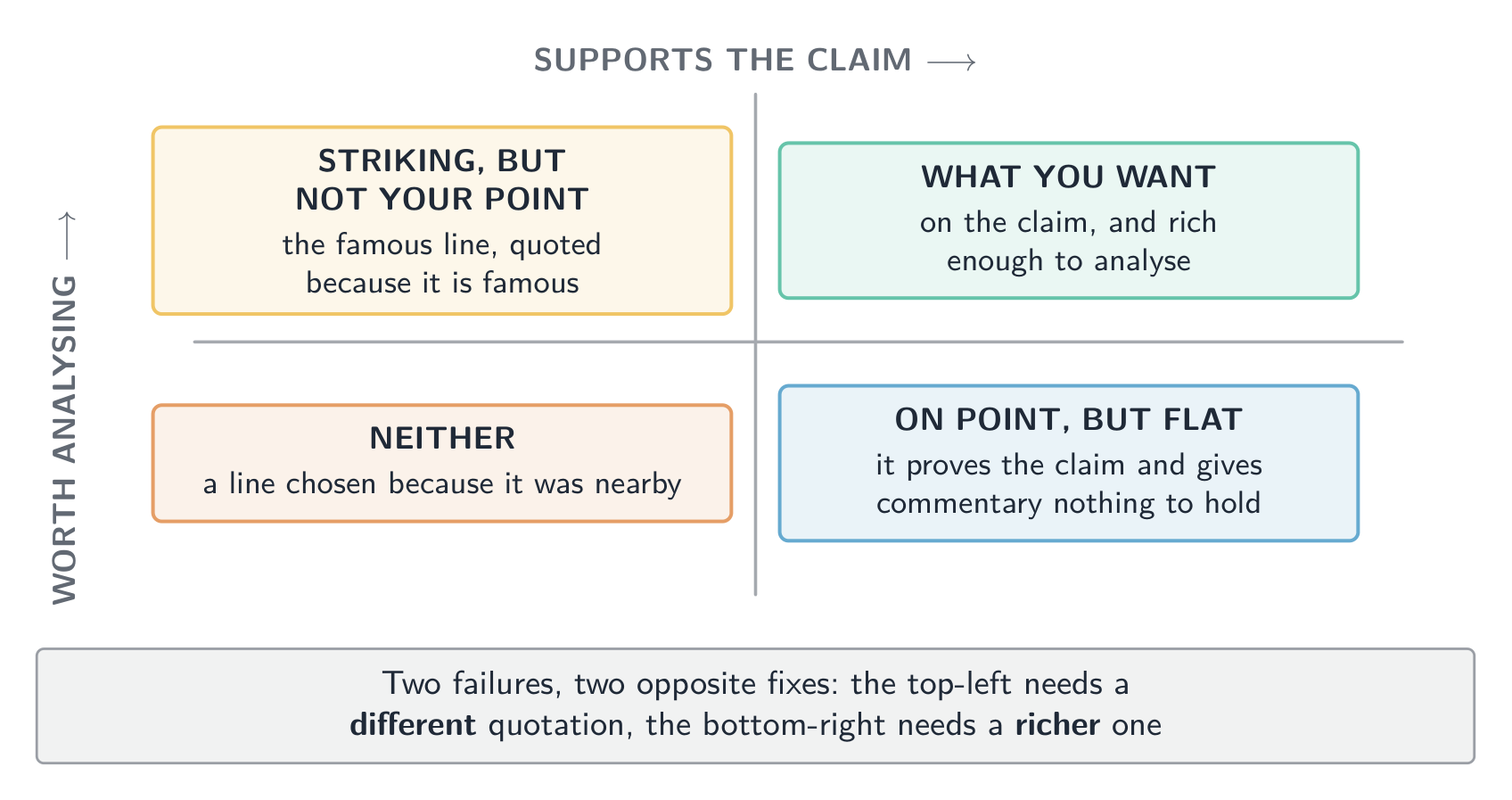
Selecting Relevant and Sufficient Evidence
Syllabus
Enduring Understanding Learning Objective Essential Knowledge LAN-1
Readers establish and communicate their interpretations of literature through arguments supported by textual evidence.7.D
Select and use relevant and sufficient evidence to both develop and support a line of reasoning.- LAN-1.H Writers use evidence strategically and purposefully to illustrate, clarify, exemplify, associate, amplify, or qualify a point.
- LAN-1.I Evidence is effective when the writer of the essay uses commentary to explain a logical relationship between the evidence and the claim.
- LAN-1.J Evidence is sufficient when its quantity and quality provide apt support for the line of reasoning.
- LAN-1.K Developing and supporting an interpretation of a text is a recursive process; an interpretation can emerge from analyzing evidence and then forming a line of reasoning, or the interpretation can emerge from forming a line of reasoning and then identifying relevant evidence to support that line of reasoning.
Source: College Board AP Course and Exam Description
- Writers use evidence strategically - to illustrate, clarify, exemplify, associate, or amplify.
- Evidence is effective when commentary explains its logical relationship to the claim.
- Evidence is sufficient when its quantity and quality provide apt support.
- Developing an interpretation is a recursive process: an interpretation can emerge, and change, as you read and write.
That last point is permission worth taking. If your reading changes while you draft, revise the thesis to match it.
3.10
Control Over the Elements of Composition
Syllabus
Enduring Understanding Learning Objective Essential Knowledge LAN-1
Readers establish and communicate their interpretations of literature through arguments supported by textual evidence.7.E
Demonstrate control over the elements of composition to communicate clearly.- LAN-1.L Grammar and mechanics that follow established conventions of language allow writers to clearly communicate their interpretation of a text.
Source: College Board AP Course and Exam Description
Grammar and mechanics that follow established conventions allow writers to communicate clearly. On this exam, control of language is not a separate mark but a condition of the others: an unclear sentence cannot deliver commentary a reader can credit.
Worked example (a real AP exam task). A Question 3 literary-argument prompt asks you to choose a work and analyse how a character's conflict contributes to an interpretation of the work as a whole. A weak answer narrates the plot around the conflict. A scoring answer identifies competing values and lets them intersect: "The protagonist's external conflict with his family over the inheritance is heightened by an internal one: he wants the independence the money would buy, and he wants to remain the son who never asked for it. Because the two conflicts share a single object, resolving either resolves neither - which is why the novel ends with a choice that satisfies no one, including him." Two conflicts, named as values, and an interpretation of the whole.
3.10
Exam tips
- Inactions reveal motive. What a character declines to do is often the strongest evidence available.
- The unchanged character is the measure by which change in others becomes visible.
- Setting now includes the social and historical situation - it supplies the constraint that makes choices meaningful.
- Conflict is between competing values, not merely between people. Name the values.
- An event matters only if you can say what it does to the conflict or to a character. Otherwise it is plot summary.
- A thesis must state an interpretation, not what happens. Summary cannot be defended.
-
4
Short Fiction II
Watch lesson4.1
What Textual Details Reveal About a Character
Syllabus
Enduring Understanding Learning Objective Essential Knowledge CHR-1
Characters in literature allow readers to study and explore a range of values, beliefs, assumptions, biases, and cultural norms represented by those characters.1.A
Identify and describe what specific textual details reveal about a character, that character’s perspective, and that character’s motives.- CHR-1.O The significance of characters is often revealed through their agency and through nuanced descriptions.
- CHR-1.P Characters’ choices—in speech, action, and inaction— reveal what they value.
Source: College Board AP Course and Exam Description
Unit 4 returns to short fiction with a much larger toolkit. Its two most valuable additions are narrative distance and the idea that choices reveal values.
- The significance of characters is often revealed through their agency 能动性 and through nuanced descriptions.
- Characters' choices - in speech, action, and inaction - reveal what they value.
That second statement is the most practical sentence in the whole course for essay-writing. Whenever you need a claim about a character, look at a choice and ask what it must be true for that choice to have made sense to them.
Vocabulary TrainEnglish agency/ˈeɪdʒənsi/ 4.2
The Function of Contrasting Characters
Syllabus
Enduring Understanding Learning Objective Essential Knowledge CHR-1
Characters in literature allow readers to study and explore a range of values, beliefs, assumptions, biases, and cultural norms represented by those characters.1.C
Explain the function of contrasting characters.- CHR-1.Q The main character in a narrative is the protagonist; the antagonist in the narrative opposes the protagonist and may be another character, the internal conflicts of the protagonist, a collective (such as society), or nature.
- CHR-1.R Protagonists and antagonists may represent contrasting values.
Source: College Board AP Course and Exam Description
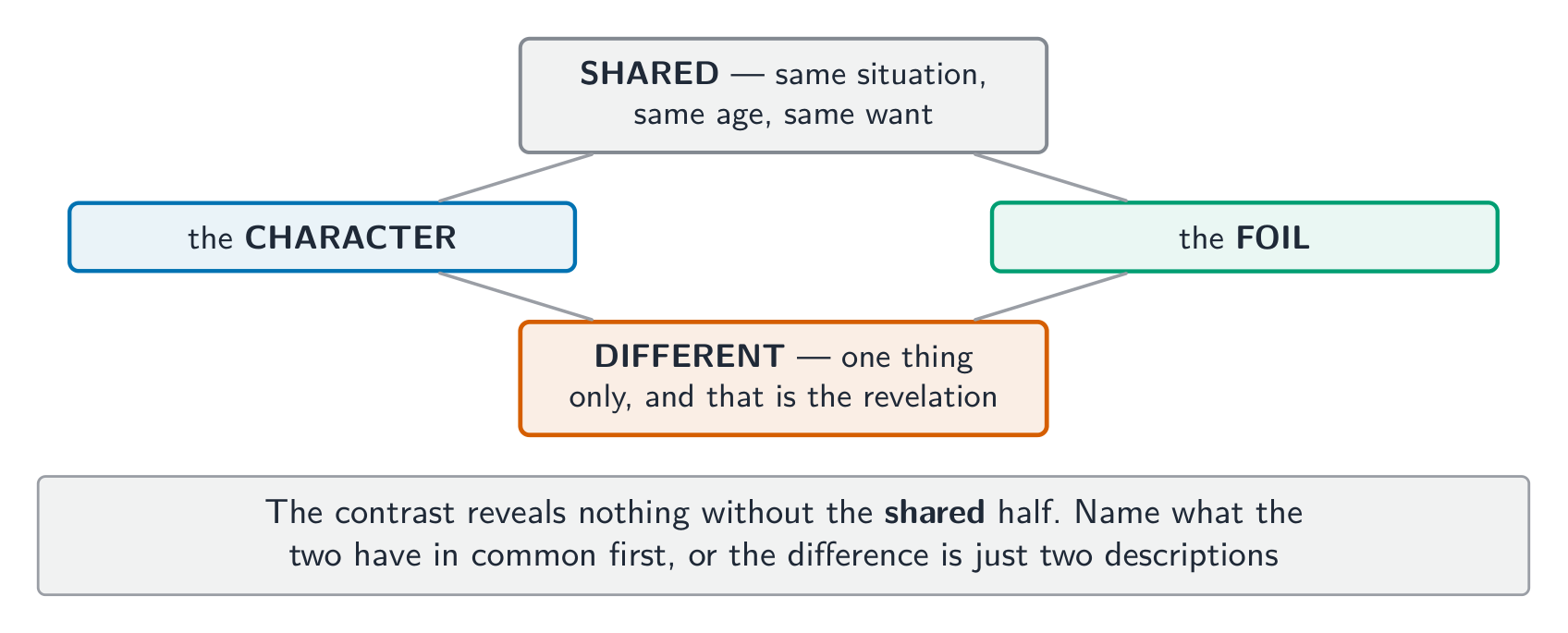
- The main character is the protagonist 主人公; the antagonist 对立者 opposes them.
- Protagonists and antagonists may represent contrasting values.
The word may is doing careful work. An antagonist is not necessarily a villain; the strongest antagonists hold a value the reader can also recognise as good, which is why the conflict is a conflict rather than a rout.
Vocabulary TrainEnglish protagonist/ˈprəʊtəɡənɪst/ antagonist/ænˈtæɡənɪst/ 4.3
Nuances in Characters' Relationships
Syllabus
Enduring Understanding Learning Objective Essential Knowledge CHR-1
Characters in literature allow readers to study and explore a range of values, beliefs, assumptions, biases, and cultural norms represented by those characters.1.D
Describe how textual details reveal nuances and complexities in characters’ relationships with one another.- CHR-1.S Conflict among characters often arises from tensions generated by their different value systems.
Source: College Board AP Course and Exam Description
Conflict among characters often arises from tensions generated by their different value systems.
This is Unit 3's definition applied to relationships. Two characters in a long-running disagreement usually disagree about something prior to the argument they are having.
4.4
The Function of Setting in a Narrative
Syllabus
Enduring Understanding Learning Objective Essential Knowledge SET-1
Setting and the details associated with it not only depict a time and place, but also convey values associated with that setting.2.B
Explain the function of setting in a narrative.- SET-1.C A setting may help establish the mood and atmosphere of a narrative.
Source: College Board AP Course and Exam Description
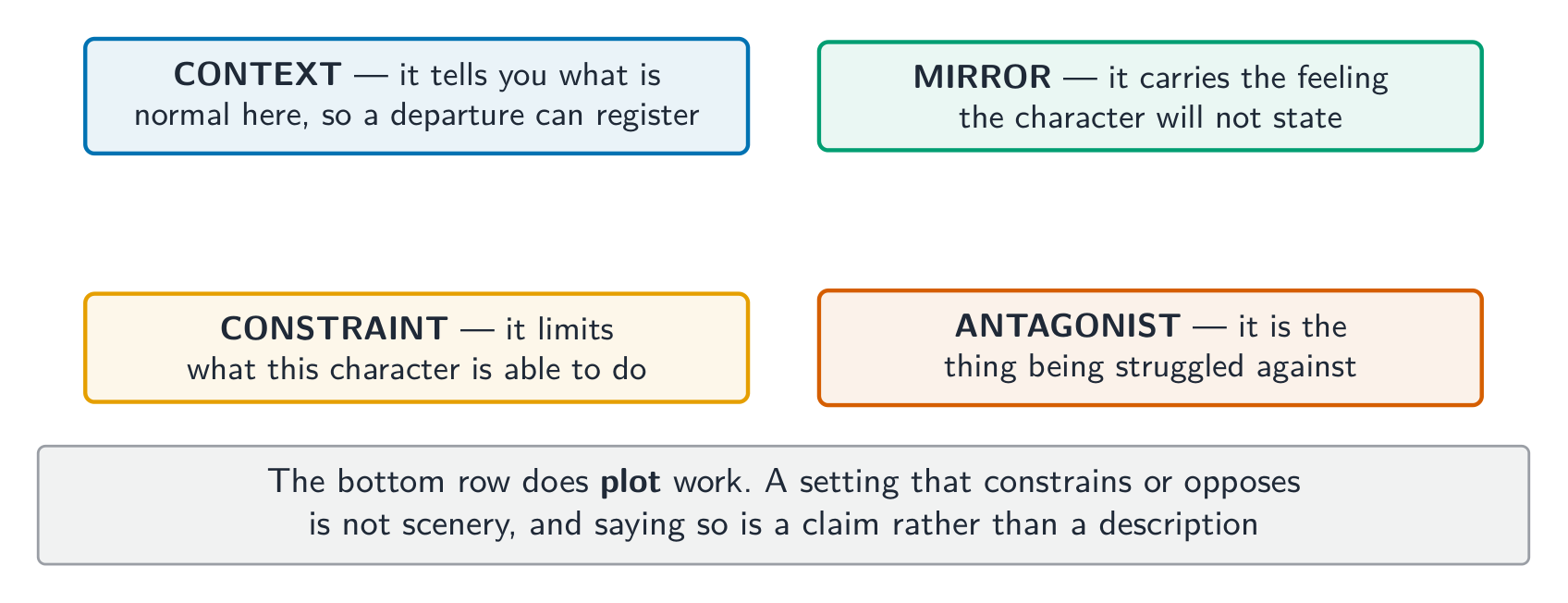
A setting may help establish the mood and atmosphere of a narrative.
Mood is the reader's feeling; atmosphere is the quality the text creates around events. Both are produced by selection - which details of a place the text mentions, and which it does not.
ExploreSort each setting into the job it is doing
The bottom two do plot work: a setting that constrains or opposes a character is not scenery.
4.5
The Relationship Between Character and Setting
Syllabus
Enduring Understanding Learning Objective Essential Knowledge SET-1
Setting and the details associated with it not only depict a time and place, but also convey values associated with that setting.2.C
Describe the relationship between a character and a setting.- SET-1.D The environment a character inhabits provides information about that character.
Source: College Board AP Course and Exam Description
The environment a character inhabits provides information about that character.
This is a second route into character that avoids the trap of psychologising. A room described through its neglect, its order, or its borrowed furniture tells you about the person who lives there, and it is textual evidence rather than speculation.
4.6
How Plot Orders Events
Syllabus
Enduring Understanding Learning Objective Essential Knowledge STR-1
The arrangement of the parts and sections of a text, the relationship of the parts to each other, and the sequence in which the text reveals information are all structural choices made by a writer that contribute to the reader’s interpretation of a text.3.A
Identify and describe how plot orders events in a narrative.- STR-1.R Some patterns in dramatic situations are so common that they are considered archetypes, and these archetypes create certain expectations for how the dramatic situations will progress and be resolved. Note: For the exam, students are not expected to identify or label archetypes.
Source: College Board AP Course and Exam Description
Some patterns in dramatic situations are so common that they are considered archetypes 原型, and these archetypes carry associations readers bring with them.
Use archetypes carefully: recognising one is a starting point, and the interesting analysis is almost always where a text departs from the pattern it invoked.
Vocabulary TrainEnglish archetypes/ˈɑːkɪtaɪps/ 4.7
The Function of Contrasts Within a Text
Syllabus
Enduring Understanding Learning Objective Essential Knowledge STR-1
The arrangement of the parts and sections of a text, the relationship of the parts to each other, and the sequence in which the text reveals information are all structural choices made by a writer that contribute to the reader’s interpretation of a text.3.D
Explain the function of contrasts within a text.- STR-1.S The differences highlighted by a contrast emphasize the particular traits, aspects, or characteristics important for comparison of the things being contrasted.
- STR-1.T Contrasts often represent conflicts in values related to character, narrator, or speaker perspectives on ideas represented by a text.
Source: College Board AP Course and Exam Description
- The differences highlighted by a contrast emphasise particular traits or characteristics in the things contrasted.
- Contrasts often represent conflicts in values related to character, narrator, or speaker perspectives.
4.8
Identifying the Narrator or Speaker
Syllabus
Enduring Understanding Learning Objective Essential Knowledge NAR-1
A narrator’s or speaker’s perspective controls the details and emphases that affect how readers experience and interpret a text.4.A
Identify and describe the narrator or speaker of a text.- NAR-1.J Narrators may function as characters in the narrative who directly address readers and either recall events or describe them as they occur.
Source: College Board AP Course and Exam Description
Narrators may function as characters who directly address readers, and who either recall events or relate them as they occur.
That distinction - recalling versus relating as they occur - is the first axis of narrative distance below.
4.9
The Function of Point of View
Syllabus
Enduring Understanding Learning Objective Essential Knowledge NAR-1
A narrator’s or speaker’s perspective controls the details and emphases that affect how readers experience and interpret a text.4.B
Identify and explain the function of point of view in a narrative.- NAR-1.K Narrative distance refers to the physical distance, chronological distance, relationships, or emotional investment of the narrator to the events or characters of the narrative.
- NAR-1.L Stream of consciousness is a type of narration in which a character’s thoughts are related through a continuous dialogue or description.
Source: College Board AP Course and Exam Description
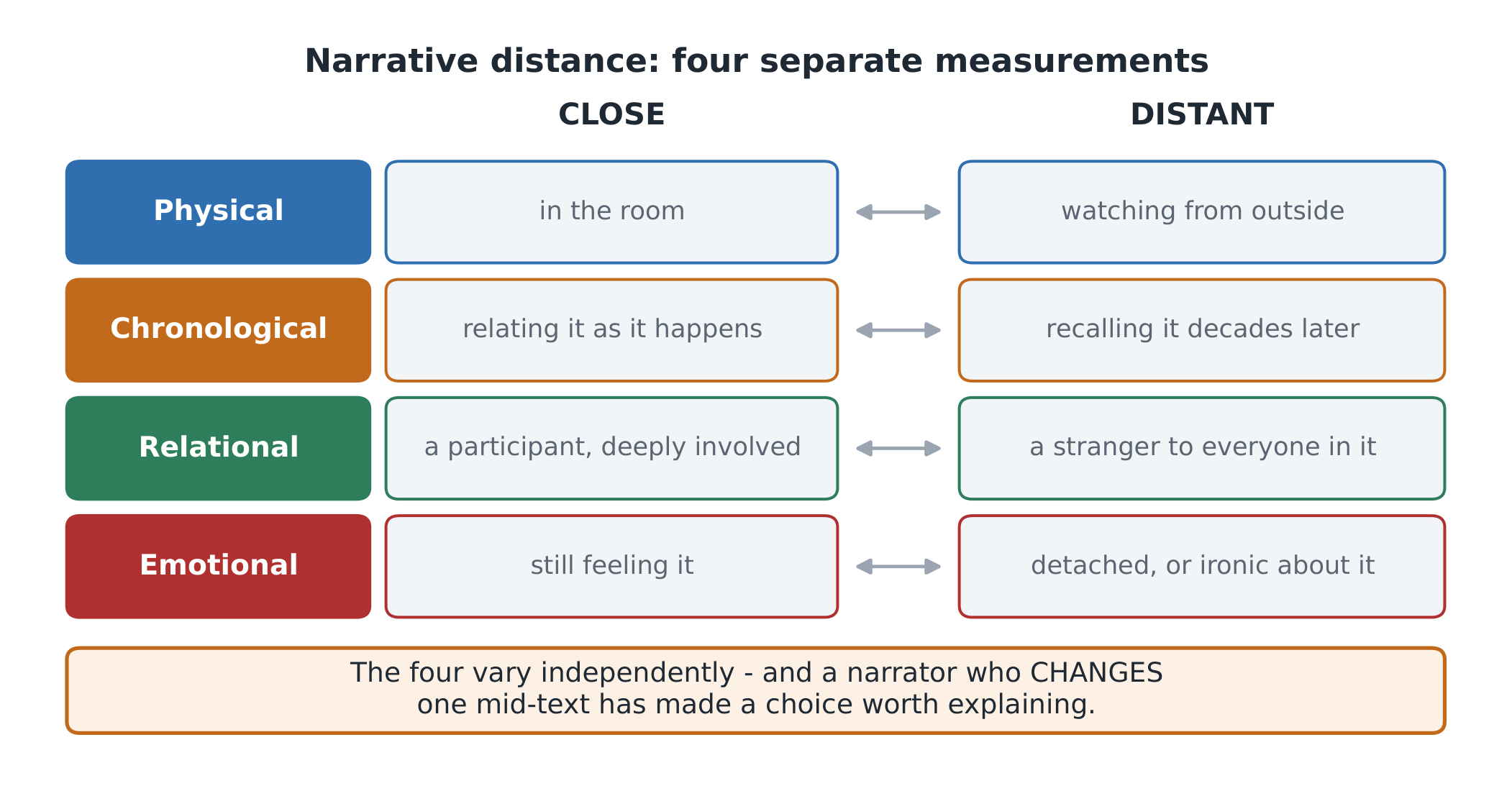
A narrator's position is not one fact but four, and any of them can be the analysis - Narrative distance 叙述距离 refers to the physical distance, chronological distance, relationships, or emotional distance between the narrator and the events or characters.
- Stream of consciousness 意识流 is narration in which a character's thoughts are related through a continuous flow, often with little conventional ordering.
Narrative distance is the most powerful and least-used tool in this course. A narrator recounting their childhood forty years later is chronologically distant, and that distance supplies irony the child could not have had. Reduce the distance - a narrator relating events as they occur - and the irony vanishes, replaced by immediacy and unreliability.
Vocabulary TrainEnglish Narrative distance/ˈnærətɪv ˈdɪstəns/ Stream of consciousness/striːm ɒv ˈkɒnʃəsnəs/ 4.10
Details, Diction, and Syntax Reveal Perspective
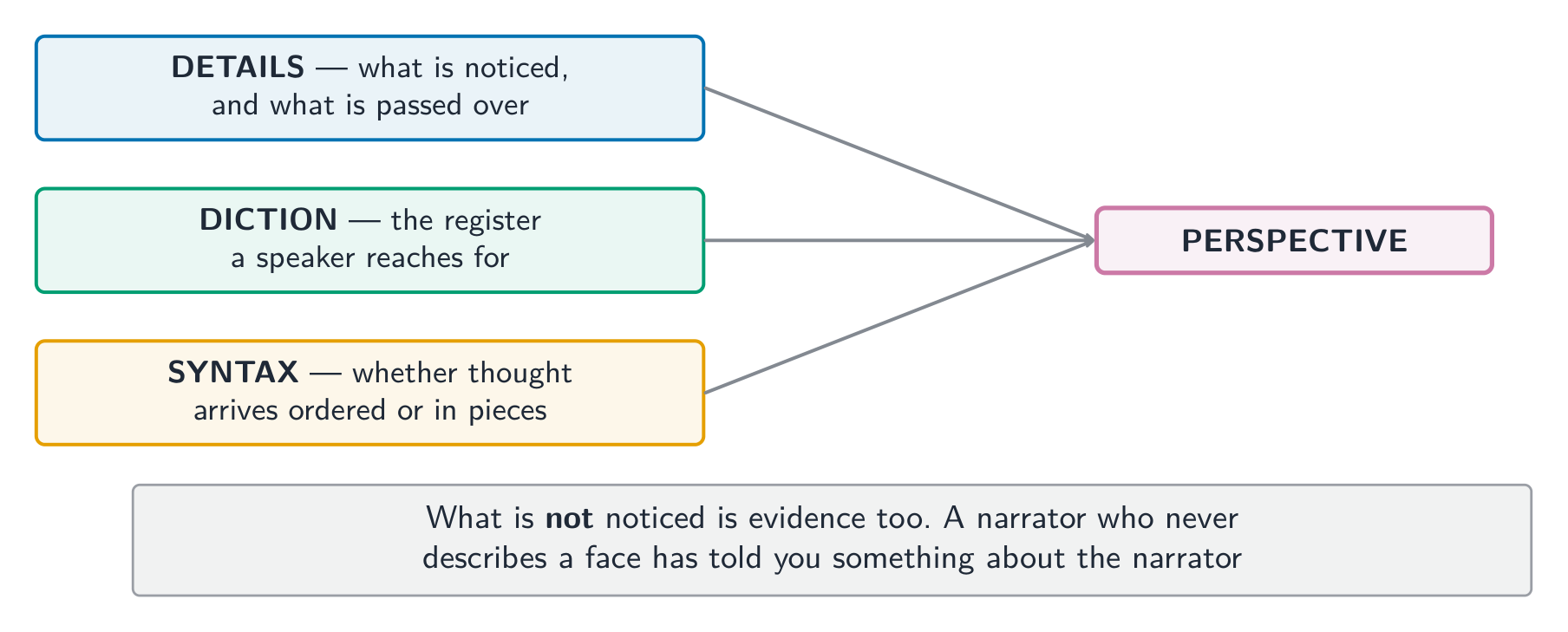
Syllabus
Enduring Understanding Learning Objective Essential Knowledge NAR-1
A narrator’s or speaker’s perspective controls the details and emphases that affect how readers experience and interpret a text.4.C
Identify and describe details, diction, or syntax in a text that reveal a narrator’s or speaker’s perspective.- NAR-1.M The narrators’, characters’, or speakers’ backgrounds and perspectives shape the tone they convey about subjects or events in the text.
- NAR-1.N Descriptive words, such as adjectives and adverbs, not only qualify or modify the things they describe but also convey a perspective toward those things.
- NAR-1.O The attitude of narrators, characters, or speakers toward an idea, character, or situation emerges from their perspective and may be referred to as tone.
Source: College Board AP Course and Exam Description
- Narrators' and characters' backgrounds and perspectives shape the tone they convey.
- Descriptive words not only qualify what they describe but convey a perspective toward it.
- The attitude of a narrator or speaker toward an idea, character, or situation emerges from these choices.
ExploreBuild a perspective from three observables
What is not noticed is evidence too: a narrator who never describes a face has told you something.
4.11
Developing a Literary Thesis Statement
Syllabus
Enduring Understanding Learning Objective Essential Knowledge LAN-1
Readers establish and communicate their interpretations of literature through arguments supported by textual evidence.7.B
Develop a thesis statement that conveys a defensible claim about an interpretation of literature and that may establish a line of reasoning.- LAN-1.D A thesis statement expresses an interpretation of a literary text, and requires a defense, through use of textual evidence and a line of reasoning, both of which are explained in an essay through commentary.
- LAN-1.E A thesis statement may preview the development or line of reasoning of an interpretation. This is not to say that a thesis statement must list the points of an interpretation, literary elements to be analyzed, or specific evidence to be used in the argument.
Source: College Board AP Course and Exam Description
Unchanged: a thesis expresses an interpretation and requires textual defence; it may preview the line of reasoning.
4.12
Developing Commentary
Syllabus
Enduring Understanding Learning Objective Essential Knowledge LAN-1
Readers establish and communicate their interpretations of literature through arguments supported by textual evidence.7.C
Develop commentary that establishes and explains relationships among textual evidence, the line of reasoning, and the thesis.- LAN-1.F A line of reasoning is the logical sequence of claims that work together to defend the overarching thesis statement.
- LAN-1.G A line of reasoning is communicated through commentary that explains the logical relationship between the overarching thesis statement and the claims/evidence within the body of an essay.
- LAN-1.M The body paragraphs of a written argument develop the reasoning and justify claims using evidence and providing commentary that links the evidence to the overall thesis.
- LAN-1.N Effective paragraphs are cohesive and often use topic sentences to state a claim and explain the reasoning that connects the various claims and evidence that make up the body of an essay.
Source: College Board AP Course and Exam Description
- A line of reasoning is the logical sequence of claims defending the thesis, communicated through commentary.
- Body paragraphs develop the reasoning and justify claims using evidence.
- Effective paragraphs are cohesive and often use topic sentences 主题句 to state a claim and explain the reasoning.
Vocabulary TrainEnglish topic sentences/ˈtɒpɪk ˈsentənsɪz/ 4.13
Selecting Relevant and Sufficient Evidence
Syllabus
Enduring Understanding Learning Objective Essential Knowledge LAN-1
Readers establish and communicate their interpretations of literature through arguments supported by textual evidence.7.D
Select and use relevant and sufficient evidence to both develop and support a line of reasoning.- LAN-1.H Writers use evidence strategically and purposefully to illustrate, clarify, exemplify, associate, amplify, or qualify a point.
- LAN-1.I Evidence is effective when the writer of the essay uses commentary to explain a logical relationship between the evidence and the claim.
- LAN-1.J Evidence is sufficient when its quantity and quality provide apt support for the line of reasoning.
- LAN-1.K Developing and supporting an interpretation of a text is a recursive process; an interpretation can emerge from analyzing evidence and then forming a line of reasoning, or the interpretation can emerge from forming a line of reasoning and then identifying relevant evidence to support that line of reasoning.
Source: College Board AP Course and Exam Description
Same four points as Unit 3: evidence used strategically; effective when commentary explains the relationship; sufficient in quantity and quality; and interpretation as a recursive process.
4.14
Control Over the Elements of Composition
Syllabus
Enduring Understanding Learning Objective Essential Knowledge LAN-1
Readers establish and communicate their interpretations of literature through arguments supported by textual evidence.7.E
Demonstrate control over the elements of composition to communicate clearly.- LAN-1.O Coherence occurs at different levels in a piece of writing. In a sentence, the idea in one clause logically links to an idea in the next. In a paragraph, the idea in one sentence logically links to an idea in the next. In a text, the ideas in one paragraph logically link to the ideas in the next.
- LAN-1.P Writers achieve coherence when the arrangement and organization of reasons, evidence, ideas, or details is logical. Writers may use transitions, repetition, synonyms, pronoun references, or parallel structure to indicate relationships between and among those reasons, evidence, ideas, or details.
Source: College Board AP Course and Exam Description
Coherence occurs at different levels - within a sentence, between sentences, across the essay - and writers achieve it when the arrangement of reasons, evidence, and details makes the line of reasoning followable.
Worked example (a real AP exam task). A prose fiction prompt asks how the author's narrative choices convey the narrator's attitude to a remembered event. A weak answer: "The narrator is nostalgic and uses descriptive language." A scoring answer uses narrative distance: "The narrator relates a single afternoon from a distance of decades, and the distance is doing the work: he describes his own excitement in the third person - 'the boy ran' - before returning to 'I' for the disappointment. Choosing where to close the chronological gap lets him withhold sympathy from his younger self while claiming the loss as his own." Distance, its variation, and the attitude it produces.
4.14
Exam tips
- Choices reveal values. Ask what must have been true for the choice to make sense to that character.
- An antagonist is not a villain. The strongest hold a value the reader can also recognise as good.
- The environment tells you about the character - and it is textual evidence, not speculation.
- Archetypes are a starting point. The analysis is where the text departs from the pattern.
- Narrative distance has four kinds - physical, chronological, relational, emotional. It is the most underused tool here.
- A narrator who closes or opens the distance mid-text has made a choice. Say what it produces.
-
5
Poetry II
Watch lesson5.1
The Function of Structure in a Text
Syllabus
Enduring Understanding Learning Objective Essential Knowledge STR-1
The arrangement of the parts and sections of a text, the relationship of the parts to each other, and the sequence in which the text reveals information are all structural choices made by a writer that contribute to the reader’s interpretation of a text.3.C
Explain the function of structure in a text.- STR-1.U Closed forms of poetry include predictable patterns in the structure of lines, stanzas, meter, and rhyme, which develop relationships among ideas in the poem. Note: The AP Exam will not require students to label or identify specific rhyme schemes, metrical patterns, or forms of poetry.
- STR-1.V Open forms of poetry may not follow expected or predictable patterns in the structure of their lines or stanzas, but they may still have structures that develop relationships between ideas in the poem.
- STR-1.W Structures combine in texts to emphasize certain ideas and concepts.
Source: College Board AP Course and Exam Description
Unit 5 develops poetry analysis: explain how form, wording and comparisons contribute to an interpretation. Identify a feature accurately, then connect its use to the particular poem.
- Closed forms 格律诗体 use established patterns of lines, stanzas, metre or rhyme.
- Open forms 自由诗体 do not follow a fixed traditional pattern, but can still use deliberate repetition and arrangement.
- Structures can combine to emphasise ideas. Both a regular pattern and a departure from it can matter; neither supplies an interpretation by itself.
Complete original practice poem: The Account
This poem and the mini texts below are original teaching examples, not published poems or authentic AP extracts. Line numbers support references.
1 At dawn the tide asks softly at the door.
2 I stack our chairs above the chalk-white shore.
3 “A little inconvenience,” Father said;
4 the water lifted boards beneath his bed.5 By noon it sends its silver fingers through
6 the garden where our winter carrots grew.
7 I count the rows as columns in a book;
8 it signs each page with what its currents took.9 At dusk it takes what I had called my own.
10 The house is one dark window, water, stone.
11 I write “still standing” by the rising sea;
12 the words stay dry. No doorway shelters me.Worked reading of structure. Three four-line stanzas move from dawn to noon to dusk. The paired end rhymes include door/shore, said/bed and own/stone. This supports a discussion of regularity without establishing a named traditional form or a fully regular metre. The ordered stanza and rhyme pattern contrasts with the speaker's loss of shelter. The pattern itself matters: analysis need not invent a broken rhyme. Line 12 places a full stop after “dry”, separating the preserved words from the exposed speaker.
Try it before reading on. Select one time marker and one repeated structural feature. Explain how they shape the account of the flood. Do not infer a final recovery or a death that the poem does not report.
Vocabulary TrainEnglish Closed forms/kləʊzd fɔːmz/ Open forms/ˈəʊpən fɔːmz/ 5.2
Literal and Figurative Meaning
Syllabus
Enduring Understanding Learning Objective Essential Knowledge FIG-1
Comparisons, representations, and associations shift meaning from the literal to the figurative and invite readers to interpret a text.5.A
Distinguish between the literal and figurative meanings of words and phrases.- FIG-1.L Words with multiple meanings or connotations add nuance or complexity that can contribute to interpretations of a text.
Source: College Board AP Course and Exam Description
Words can have several meanings or connotations. Test each proposed meaning against surrounding wording; a dictionary possibility is not enough. You may defend one reading or explain a supported tension.
Worked example. In line 7, “rows” refers literally to carrots in a garden. “Columns in a book” makes the rows resemble an account. Together with “signs”, “takes” and the title, this language invites a figurative reading of loss being recorded. The text does not show an actual financial debt or say that the speaker deserves the loss. A reader should not treat every meaning of “account” as equally established.
5.3
The Function of Specific Words and Phrases
Syllabus
Enduring Understanding Learning Objective Essential Knowledge FIG-1
Comparisons, representations, and associations shift meaning from the literal to the figurative and invite readers to interpret a text.5.B
Explain the function of specific words and phrases in a text.- FIG-1.M Descriptive words, such as adjectives and adverbs, qualify or modify the things they describe and affect readers’ interaction with the text.
- FIG-1.N Hyperbole exaggerates while understatement minimizes. Exaggerating or minimizing an aspect of an object focuses attention on that trait and conveys a perspective about the object.
Source: College Board AP Course and Exam Description
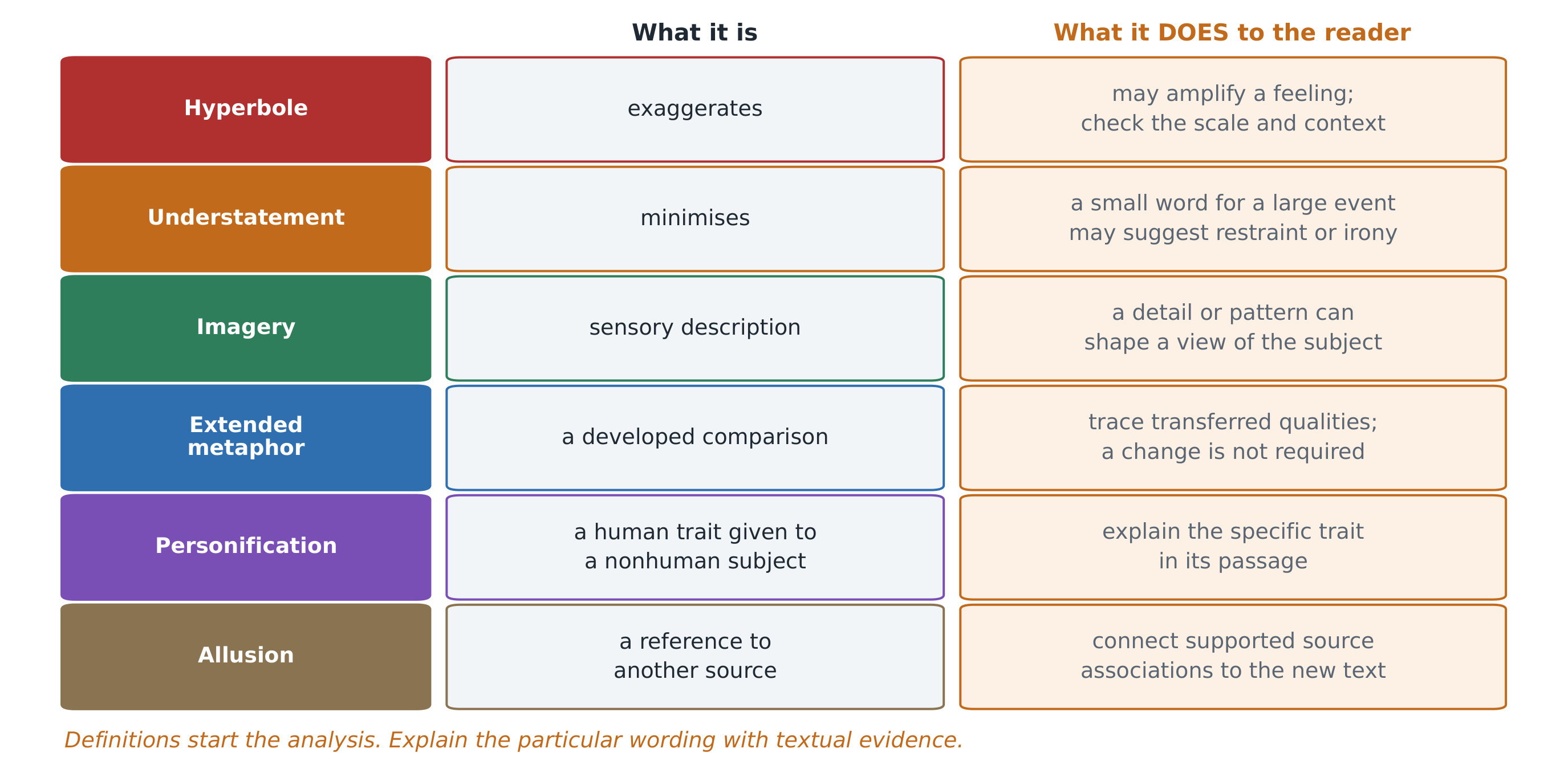
Descriptive words qualify what they describe and influence how it is perceived. Hyperbole 夸张 exaggerates; understatement 低调陈述 minimises. Neither is always stronger. Explain the scale and context of the contrast.
Worked example. “A little inconvenience” in line 3 minimises the flood while line 4 shows water lifting floorboards beneath a bed. The contrast can suggest an effort to sound calm or an inadequate recognition of danger. The poem does not establish Father's private motive. The invented phrase “I waited a thousand years” would instead be hyperbole if used for a short wait: it amplifies the speaker's feeling rather than reporting literal duration.
“Silver” in line 5 gives the water a bright visual quality. Beside “fingers”, it may make the invading water seem delicately attractive before the later loss becomes explicit. Explain that contrast with the later lines rather than assigning silver a universal meaning.
Vocabulary TrainEnglish Hyperbole/haɪˈpɜːbəli/ understatement/ˌʌndəˈsteɪtmənt/ 5.4
The Function of an Image or Imagery
Syllabus
Enduring Understanding Learning Objective Essential Knowledge FIG-1
Comparisons, representations, and associations shift meaning from the literal to the figurative and invite readers to interpret a text.5.D
Identify and explain the function of an image or imagery.- FIG-1.O Descriptive words, such as adjectives and adverbs, contribute to sensory imagery.
- FIG-1.P An image can be literal or it can be a form of a comparison that represents something in a text through associations with the senses.
- FIG-1.Q A collection of images, known as imagery, may emphasize ideas in parts of or throughout a text.
Source: College Board AP Course and Exam Description
An image can describe a literal sensory detail or work through a comparison. Descriptive words contribute to sensory imagery 感官意象 through sight, sound, touch, taste or smell. A collection of images may develop an idea across a text; one carefully placed image can also carry substantial meaning.
Worked pattern. “Chairs”, “bed”, “garden” and “house” move from objects of daily life towards the loss of the home as a whole. The “dark window” in line 10 is a specific visual detail, while “No doorway shelters me” connects the house to security that the speaker no longer has. The doorway can support a symbolic reading of shelter because of this context, even though the word appears only once. Repetition can strengthen a symbolic reading but is neither necessary nor sufficient. Imagery and symbolism can overlap.
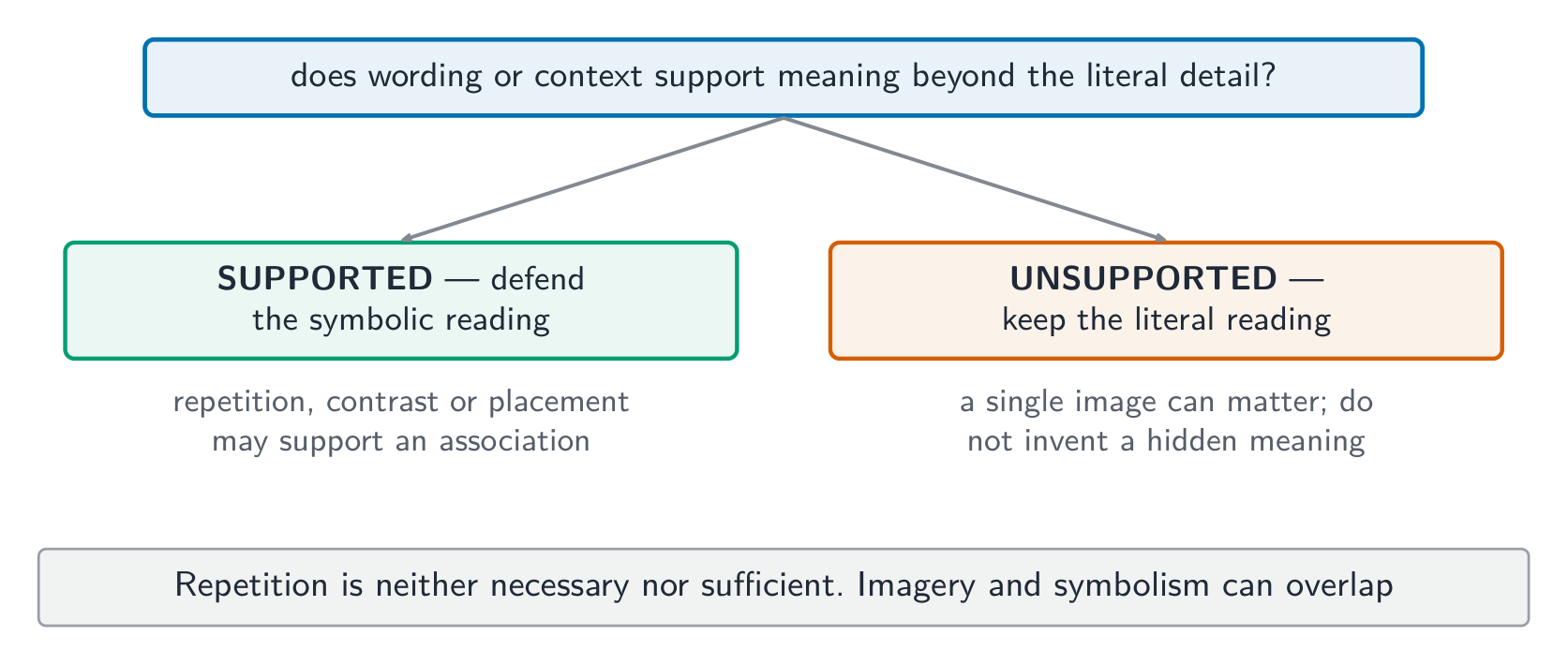 Explore
Image or symbol? Apply the test
Test whether the proposed meaning is supported by wording and context; repetition is optional evidence.
Vocabulary TrainEnglish contribute to sensory imagery/kənˈtrɪbjuːt tə ˈsensəri ˈɪmɪdʒri/ 5.5
The Function of a Metaphor
Syllabus
Enduring Understanding Learning Objective Essential Knowledge FIG-1
Comparisons, representations, and associations shift meaning from the literal to the figurative and invite readers to interpret a text.6.B
Identify and explain the function of a metaphor.- FIG-1.R Metaphorical comparisons do not focus solely on the objects being compared; they focus on the particular traits, qualities, or characteristics of the things being compared.
- FIG-1.S Comparisons not only communicate literal meaning but may also convey figurative meaning or transmit a perspective.
- FIG-1.T An extended metaphor is created when the comparison of a main subject and comparison subject persists through parts of or an entire text, and when the comparison is expanded through additional details, similes, and images.
- FIG-1.U Interpretation of an extended metaphor may depend on the context of its use; that is, what is happening in a text may determine what is transferred in the comparison.
Source: College Board AP Course and Exam Description
A metaphor transfers particular qualities between a main subject and a comparison subject. An extended metaphor 延伸隐喻 develops related comparisons across a passage or text. Trace the transferred qualities and their limits; the comparison need not change or break to be useful.
Worked example. Lines 7–9 connect garden rows to book columns, currents to signing, and the tide to taking possessions. Together they develop an accounting comparison. The water seems to record and collect the speaker's losses. The speaker's claim of ownership, “what I had called my own”, becomes less secure. This supports an interpretation of threatened control, without proving an actual creditor or a settled belief that the flood is fair.
Vocabulary TrainEnglish extended metaphor/ekˈstendɪd ˈmetəfɔː/ 5.6
The Function of Personification
Syllabus
Enduring Understanding Learning Objective Essential Knowledge FIG-1
Comparisons, representations, and associations shift meaning from the literal to the figurative and invite readers to interpret a text.6.C
Identify and explain the function of personification.- FIG-1.V Personification is a type of comparison that assigns a human trait or quality to a nonhuman object, entity, or idea, thus characterizing that object, entity, or idea.
Source: College Board AP Course and Exam Description
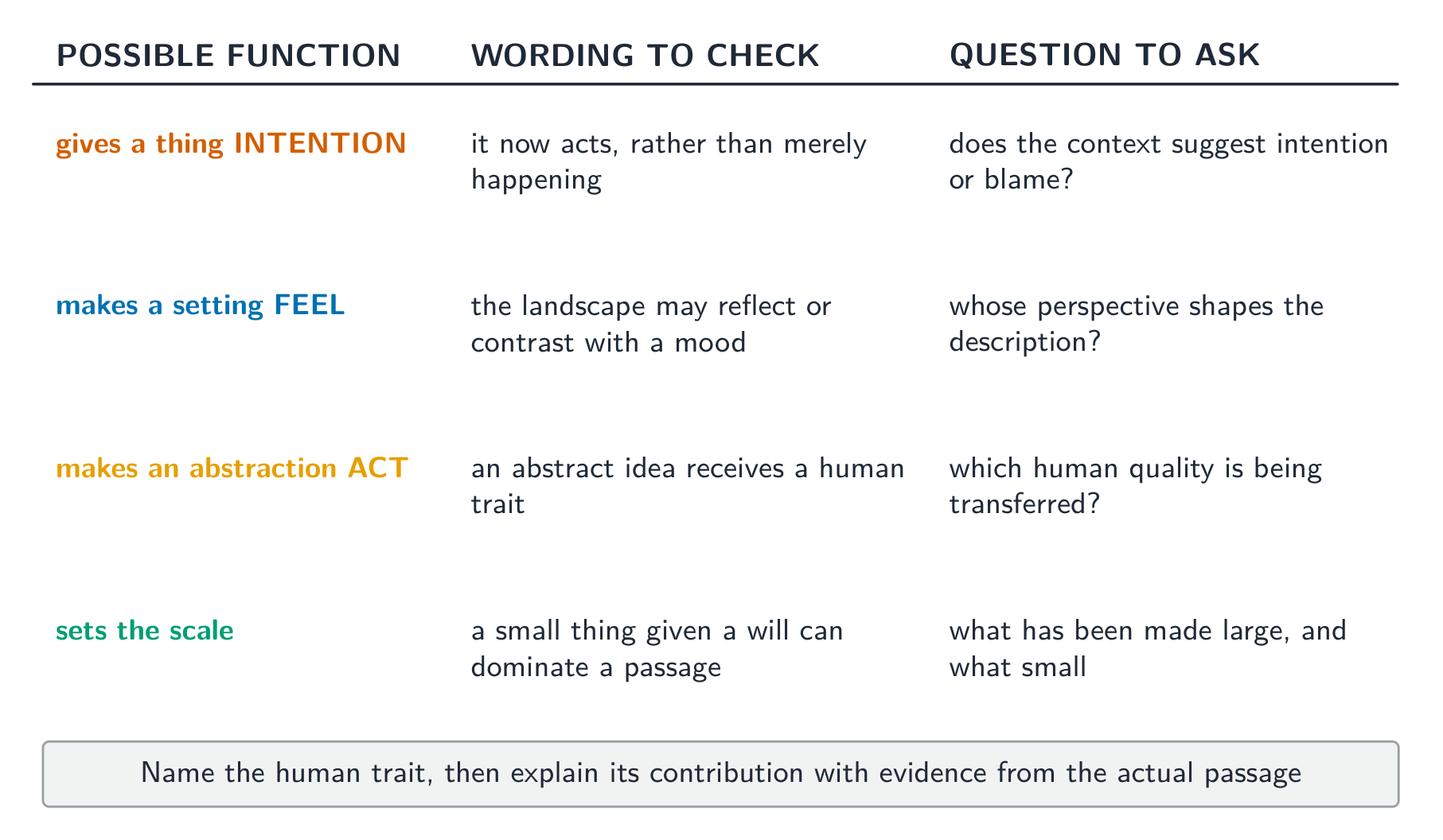
Personification 拟人 gives a human trait or quality to a nonhuman object, animal or idea. Identify the precise trait before explaining its function. A personifying phrase need not imply complete human agency or intention.
Worked sequence. The tide “asks” at dawn, “sends its silver fingers” at noon and “takes” at dusk. The verbs turn a physical process into an increasingly intrusive visitor. Early apparent politeness contrasts with later taking. This is a representation of the flood; the tide does not literally form plans or possess moral blame.
Vocabulary TrainEnglish Personification/pɜːˈsɒnɪfɪkeɪʃn/ 5.7
The Function of an Allusion
Syllabus
Enduring Understanding Learning Objective Essential Knowledge FIG-1
Comparisons, representations, and associations shift meaning from the literal to the figurative and invite readers to interpret a text.6.D
Identify and explain the function of an allusion.- FIG-1.W Allusions in a text can reference literary works including myths and sacred texts; other works of art including paintings and music; or people, places, or events outside the text.
Source: College Board AP Course and Exam Description
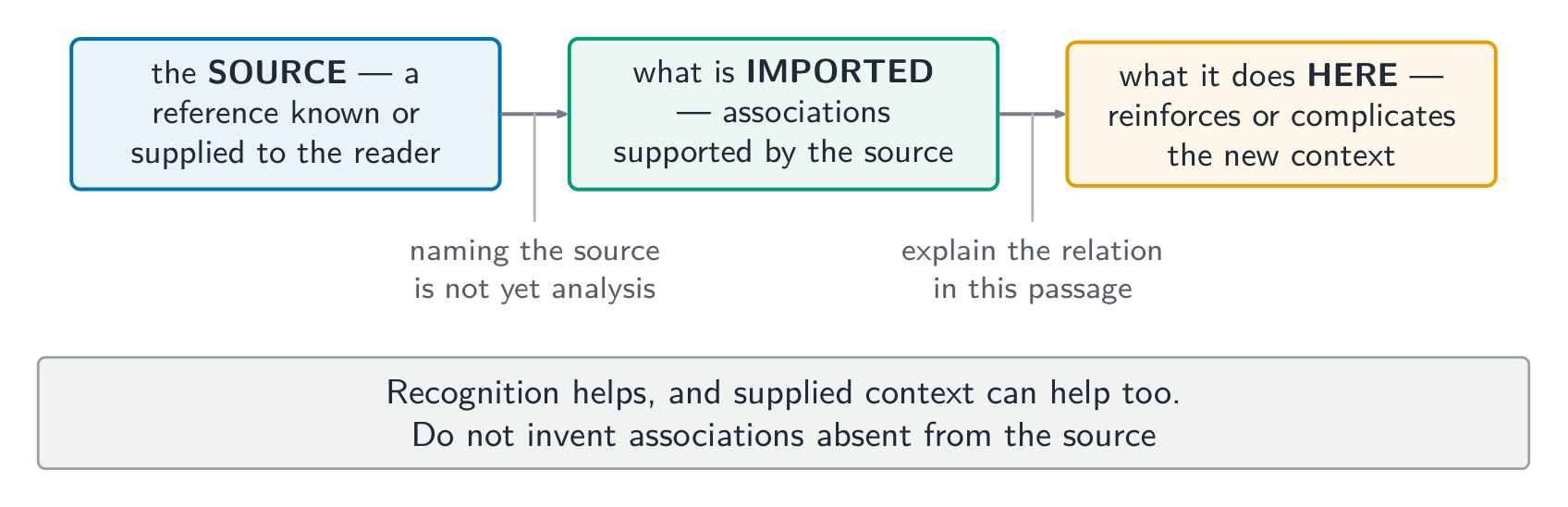
Allusions 典故 refer to other works, myths, sacred texts, art or historical events. A recognised reference can bring associations into the new text. Supplied context may help a reader understand it; do not invent source knowledge or assume all readers share the same response.
Original mini source pack. These two short texts were invented together to practise using a supplied reference.
- Source song, Both Banks: “Build us a bridge; let both banks share the rain.” The line presents a bridge as a way to connect two communities.
- New mini poem: “She paints ‘both banks share the rain’ upon our gate; / then turns the key and asks the guests to wait.”
Worked analysis. The quotation recalls the song's wish for connection. The locked gate and waiting guests limit the welcome that the painted line announces. The reference supports a tension between a public claim of openness and controlled access. It does not establish whether the delay is permanent or why the gate is locked.
ExploreTake an allusion past the source
Use supplied or recognised source associations and explain their relation to the new passage.
Vocabulary TrainEnglish Allusions/əˈluːʒnz/ 5.8
Developing a Literary Thesis Statement
Syllabus
Enduring Understanding Learning Objective Essential Knowledge LAN-1
Readers establish and communicate their interpretations of literature through arguments supported by textual evidence.7.B
Develop a thesis statement that conveys a defensible claim about an interpretation of literature and that may establish a line of reasoning.- LAN-1.D A thesis statement expresses an interpretation of a literary text, and requires a defense, through use of textual evidence and a line of reasoning, both of which are explained in an essay through commentary.
- LAN-1.E A thesis statement may preview the development or line of reasoning of an interpretation. This is not to say that a thesis statement must list the points of an interpretation, literary elements to be analyzed, or specific evidence to be used in the argument.
Source: College Board AP Course and Exam Description
A thesis presents an interpretation that can be defended with textual evidence. It may preview the line of reasoning; a device list alone does not explain a meaning.
Practice prompt. Explain how structure and figurative language convey the speaker's changing sense of control in The Account.
Weak start: “The poem uses rhyme, imagery and personification.” This identifies features but supplies no interpretation.
Defensible thesis: “As the tide changes from a visitor that ‘asks’ to a force that ‘takes’, the speaker's orderly account exposes how little control words and ownership give over the loss of home.” The thesis can be tested against the verbs, accounting imagery and final separation between words and shelter. It does not claim a guaranteed score.
5.9
Developing Commentary
Syllabus
Enduring Understanding Learning Objective Essential Knowledge LAN-1
Readers establish and communicate their interpretations of literature through arguments supported by textual evidence.7.C
Develop commentary that establishes and explains relationships among textual evidence, the line of reasoning, and the thesis.- LAN-1.F A line of reasoning is the logical sequence of claims that work together to defend the overarching thesis statement.
- LAN-1.G A line of reasoning is communicated through commentary that explains the logical relationship between the overarching thesis statement and the claims/evidence within the body of an essay.
Source: College Board AP Course and Exam Description
A line of reasoning links claims in support of the thesis. Commentary explains how particular evidence supports each claim; it goes beyond paraphrase and device naming.
Worked paragraph. “The speaker first presents the tide as a visitor that ‘asks’, making the intrusion seem negotiable. By dusk it ‘takes what I had called my own’, and the earlier claim of ownership has become uncertain. This change in verbs makes the speaker's control appear increasingly fragile. The ending preserves the written words ‘still standing’ but leaves the speaker without a sheltering doorway, so the account can record a claim it cannot make physically true.”
This is one defensible reading, not the only possible answer. It does not establish that the speaker has accepted the loss or ceased to resist it.
5.10
Selecting Relevant and Sufficient Evidence
Syllabus
Enduring Understanding Learning Objective Essential Knowledge LAN-1
Readers establish and communicate their interpretations of literature through arguments supported by textual evidence.7.D
Select and use relevant and sufficient evidence to both develop and support a line of reasoning.- LAN-1.H Writers use evidence strategically and purposefully to illustrate, clarify, exemplify, associate, amplify, or qualify a point.
- LAN-1.I Evidence is effective when the writer of the essay uses commentary to explain a logical relationship between the evidence and the claim.
- LAN-1.J Evidence is sufficient when its quantity and quality provide apt support for the line of reasoning.
- LAN-1.K Developing and supporting an interpretation of a text is a recursive process; an interpretation can emerge from analyzing evidence and then forming a line of reasoning, or the interpretation can emerge from forming a line of reasoning and then identifying relevant evidence to support that line of reasoning.
Source: College Board AP Course and Exam Description
Select evidence for the claim you are making. Evidence must be accurate, relevant and sufficient, with commentary explaining its contribution. Interpretation is recursive: revise a claim when another line complicates it. No fixed number of quotations fits every task.
Worked revision. “The speaker calmly accepts the flood” is too certain. “I stack our chairs” shows an attempt to protect possessions; “still standing” may show persistence, denial or both. A better bounded claim is that the poem contrasts attempts to preserve order with the loss of physical shelter. A paragraph about change needs evidence from more than one moment, not only the last line.
5.11
Control Over the Elements of Composition
Syllabus
Enduring Understanding Learning Objective Essential Knowledge LAN-1
Readers establish and communicate their interpretations of literature through arguments supported by textual evidence.7.E
Demonstrate control over the elements of composition to communicate clearly.- LAN-1.Q Transitional elements are words or other elements (phrases, clauses, sentences, or paragraphs) that assist in creating coherence between sentences and paragraphs by showing relationships between ideas.
Source: College Board AP Course and Exam Description
Transitional elements link ideas through words, clauses, sentences or paragraphs. Choose a connection that reflects the reasoning; a connector cannot create a relation unsupported by the text.
Worked connection: “At dawn, ‘asks’ makes the intrusion seem negotiable. By contrast, the dusk verb ‘takes’ gives the speaker no apparent choice.” The contrast is in the two quoted actions. “Therefore” would need a causal claim, not merely a change of time.
Practice before the model. Write a thesis and a short paragraph answering the practice prompt. Use evidence from two moments; explain one tension and state one limit on your interpretation. Then compare your method with the examples above.
5.11
Exam tips
- Identify the form or device accurately, then explain its use in this text.
- Test possible word meanings against context rather than keeping every meaning automatically.
- Explain hyperbole and understatement without ranking either as universally stronger.
- Support imagery and symbolic readings with precise wording; repetition is optional evidence.
- Trace a developed comparison and distinguish an interpretation from an invented event or motive.
- Use the supplied source context for an allusion and relate it to the new text.
- Select and connect evidence for the specific prompt; revise claims that the ending complicates.
-
6
Longer Fiction or Drama II
Watch lesson6.1
What Textual Details Reveal About a Character
Syllabus
Enduring Understanding Learning Objective Essential Knowledge CHR-1
Characters in literature allow readers to study and explore a range of values, beliefs, assumptions, biases, and cultural norms represented by those characters.1.A
Identify and describe what specific textual details reveal about a character, that character’s perspective, and that character’s motives.- CHR-1.T Different character, narrator, or speaker perspectives often reveal different information, develop different attitudes, and influence different interpretations of a text and the ideas in it.
Source: College Board AP Course and Exam Description
Unit 6 is the second longer-fiction-or-drama unit and it adds the two most sophisticated tools in the course: narrator reliability and the symbol.
Different character, narrator, or speaker perspectives often reveal different information and develop different interpretations of the same events.
In a long work with several perspectives, the discrepancies between them are not a problem to reconcile. They are the text's method.
6.2
The Function of Contrasting Characters
Syllabus
Enduring Understanding Learning Objective Essential Knowledge CHR-1
Characters in literature allow readers to study and explore a range of values, beliefs, assumptions, biases, and cultural norms represented by those characters.1.C
Explain the function of contrasting characters.- CHR-1.U Foil characters (foils) serve to illuminate, through contrast, the traits, attributes, or values of another character.
Source: College Board AP Course and Exam Description
Foil characters 陪衬人物 serve to illuminate, through contrast, the traits, attributes, or values of another character.
A foil is not an antagonist. A foil may be an ally, a sibling, a friend - what makes them a foil is that they are similar enough for the difference to be visible. The useful question is always: what does this character have that the protagonist lacks, and what does the text do with that gap?
Vocabulary TrainEnglish Foil characters/fɔɪl ˈkærɪktəz/ 6.3
Choices, Actions, and Speech Reveal Complexity
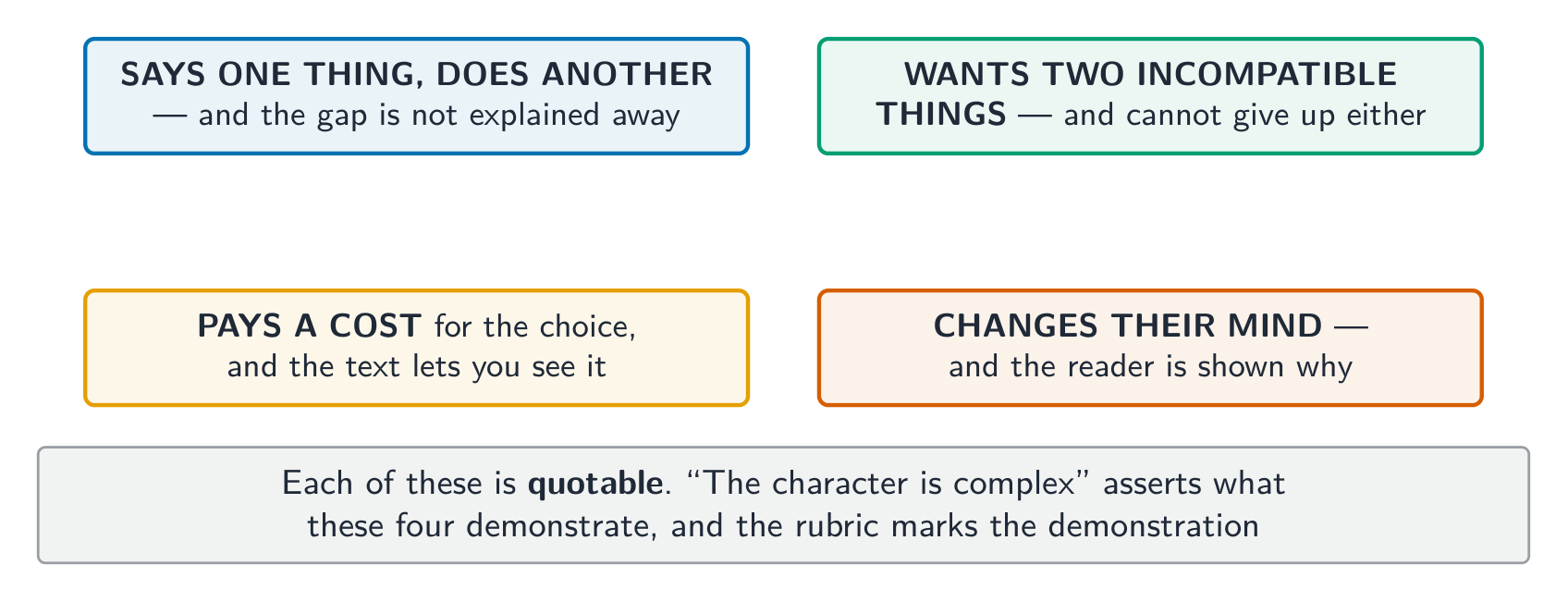
Syllabus
Enduring Understanding Learning Objective Essential Knowledge CHR-1
Characters in literature allow readers to study and explore a range of values, beliefs, assumptions, biases, and cultural norms represented by those characters.1.E
Explain how a character’s own choices, actions, and speech reveal complexities in that character, and explain the function of those complexities.- CHR-1.V Inconsistencies between the private thoughts of characters and their actual behavior reveal tensions and complexities between private and professed values.
- CHR-1.W A character’s competing, conflicting, or inconsistent choices or actions contribute to complexity in a text.
Source: College Board AP Course and Exam Description
- Inconsistencies between the private thoughts of characters and their actual behaviour reveal tensions.
- A character's competing, conflicting, or inconsistent choices contribute to complexity.
This is where AP Literature parts company with simpler reading. Inconsistency is not a flaw in a character; it is the evidence that the character has an interior. A character who always acts on what they think is a position, not a person.
ExploreFind the quotable sign of complexity
The rubric marks the demonstration, not the assertion — and each of these is something you can quote.
6.4
How Plot Orders Events
Syllabus
Enduring Understanding Learning Objective Essential Knowledge STR-1
The arrangement of the parts and sections of a text, the relationship of the parts to each other, and the sequence in which the text reveals information are all structural choices made by a writer that contribute to the reader’s interpretation of a text.3.A
Identify and describe how plot orders events in a narrative.- STR-1.X Some narrative structures interrupt the chronology of a plot; such structures include flashback, foreshadowing, in medias res, and stream of consciousness.
Source: College Board AP Course and Exam Description
Some narrative structures interrupt the chronology of a plot: flashback 倒叙, foreshadowing 伏笔, and in medias res 从中间开始.
Vocabulary TrainEnglish flashback/ˈflæʃbæk/ foreshadowing/fɔːˈʃædəʊɪŋ/ in medias res/ɪn ˈmiːdiːəz rez/ 6.5
The Function of a Sequence of Events
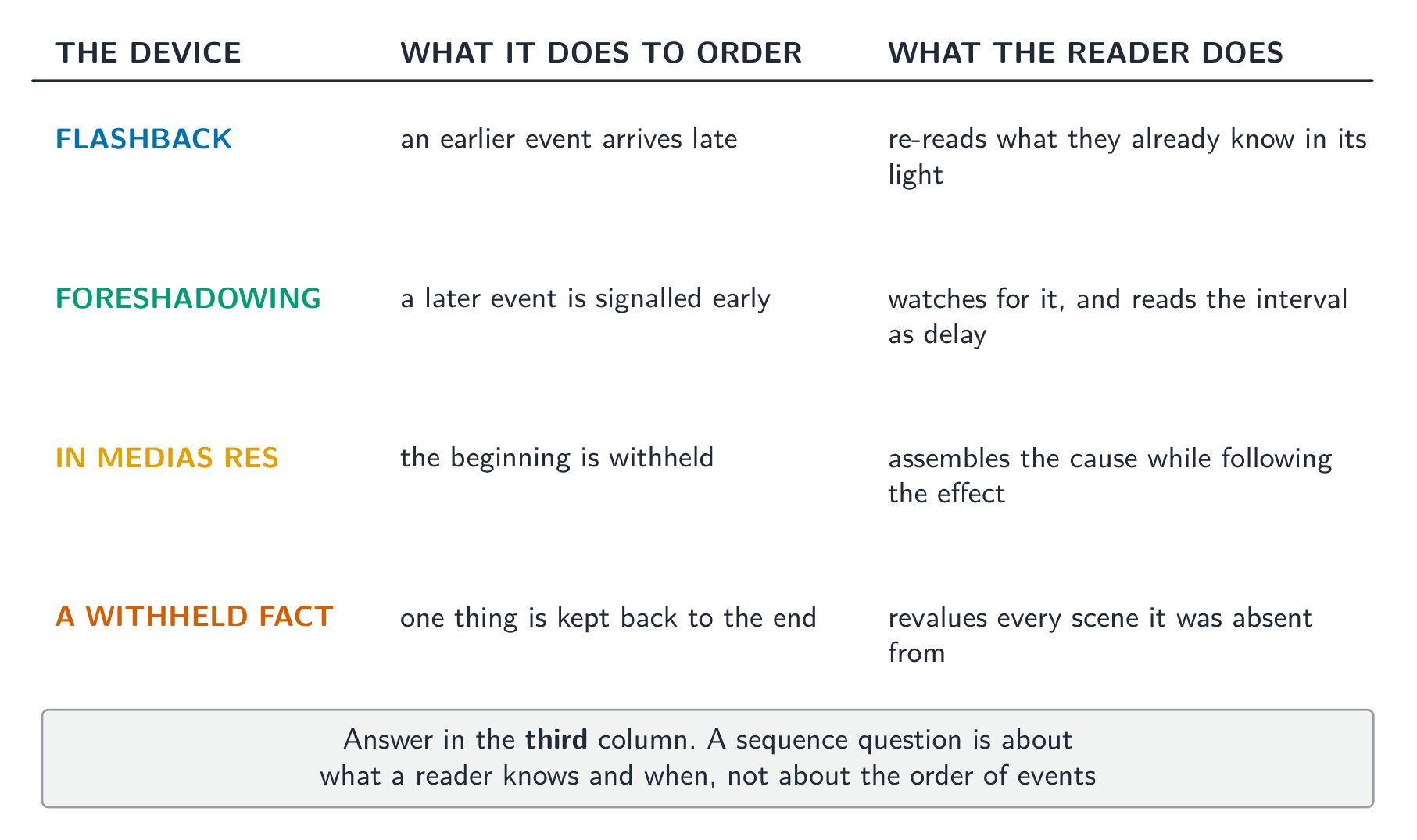
Syllabus
Enduring Understanding Learning Objective Essential Knowledge STR-1
The arrangement of the parts and sections of a text, the relationship of the parts to each other, and the sequence in which the text reveals information are all structural choices made by a writer that contribute to the reader’s interpretation of a text.3.B
Explain the function of a particular sequence of events in a plot.- STR-1.Y Narrative structures that interrupt the chronology of a plot, such as flashback, foreshadowing, in medias res, and stream of consciousness, can directly affect readers’ experiences with a text by creating anticipation or suspense or building tension.
Source: College Board AP Course and Exam Description
Those interrupting structures affect the reader's experience of the narrative - what is known when, and therefore what is felt when.
The analytical move is always to ask what the reader knows at that moment. Foreshadowing gives the reader knowledge the characters lack, which converts suspense into dread. A flashback withholds until a later point, so the earlier scenes are read twice - once in ignorance and once in retrospect.
ExploreMatch each device to what the reader then does
A sequence question is about what a reader knows and when, not about the order of events.
6.6
The Function of Contrasts Within a Text
Syllabus
Enduring Understanding Learning Objective Essential Knowledge STR-1
The arrangement of the parts and sections of a text, the relationship of the parts to each other, and the sequence in which the text reveals information are all structural choices made by a writer that contribute to the reader’s interpretation of a text.3.D
Explain the function of contrasts within a text.- STR-1.Z Contrasts often represent contradictions or inconsistencies that introduce nuance, ambiguity, or contradiction into a text. As a result, contrasts make texts more complex.
Source: College Board AP Course and Exam Description
Contrasts often represent contradictions or inconsistencies that introduce nuance, ambiguity, or contradictory interpretations.
Note the last phrase. The CED explicitly permits a text to support more than one reading. An essay that acknowledges a competing interpretation and shows why its own is better is doing exactly what the sophistication point rewards.
6.7
Details, Diction, and Syntax Reveal Perspective
Syllabus
Enduring Understanding Learning Objective Essential Knowledge NAR-1
A narrator’s or speaker’s perspective controls the details and emphases that affect how readers experience and interpret a text.4.C
Identify and describe details, diction, or syntax in a text that reveal a narrator’s or speaker’s perspective.- NAR-1.P The narrator’s or speaker’s tone toward events or characters in a text influences readers’ interpretation of the ideas associated with those things.
- NAR-1.Q The syntactical arrangement of phrases and clauses in a sentence can emphasize details or ideas and convey a narrator’s or speaker’s tone.
- NAR-1.R Information included and/or not included in a text conveys the perspective of characters, narrators, and/ or speakers.
- NAR-1.S A narrator’s or speaker’s perspective may influence the details and amount of detail in a text and may reveal biases, motivations, or understandings.
Source: College Board AP Course and Exam Description
- A narrator's or speaker's tone toward events or characters influences readers' interpretations.
- The syntactical arrangement of phrases and clauses can emphasise details or ideas.
- Information included and not included conveys the perspective of characters and narrators.
- A narrator's perspective may influence the details and the amount of detail in a text.
6.8
How a Narrator's Reliability Affects a Narrative
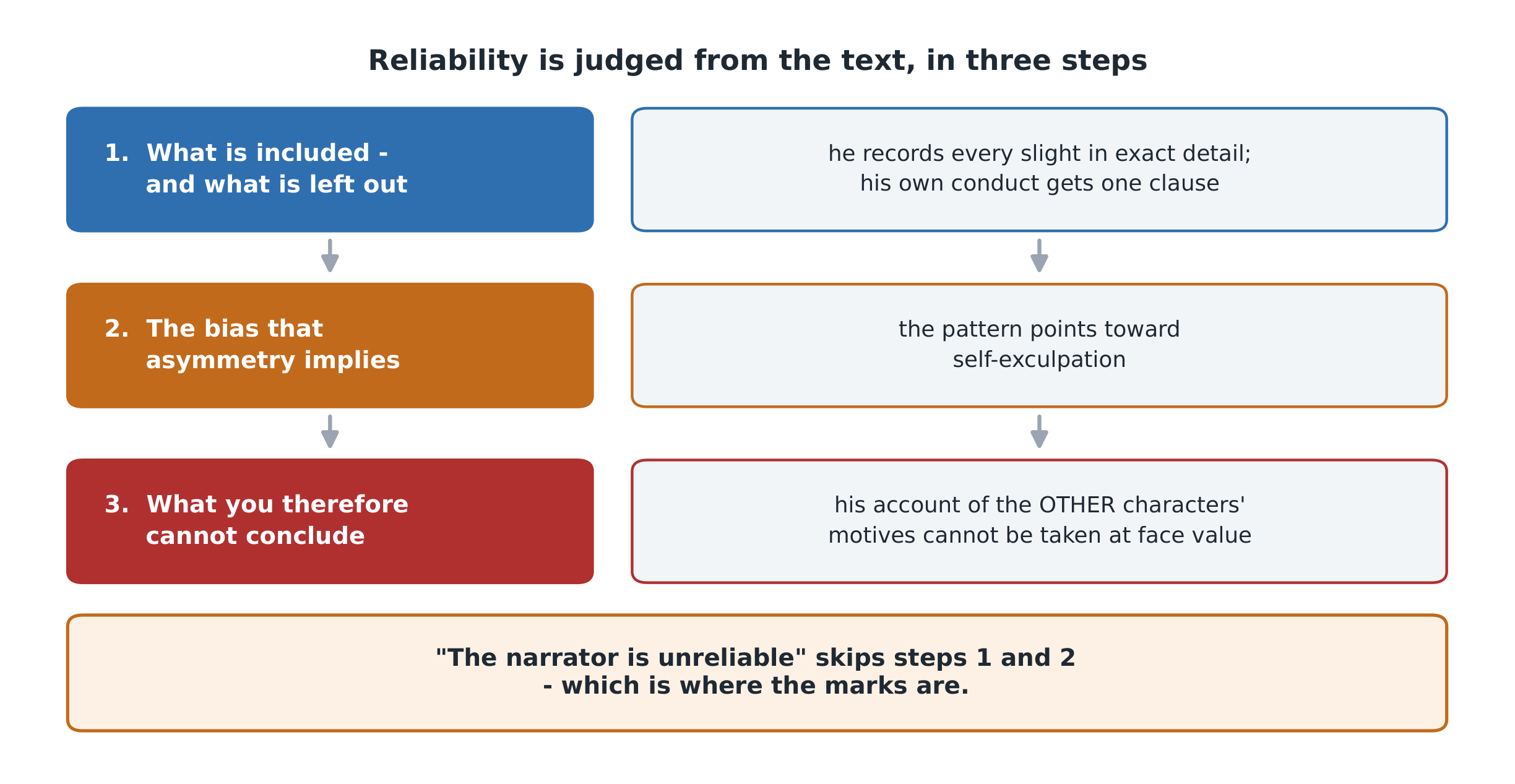
Syllabus
Enduring Understanding Learning Objective Essential Knowledge NAR-1
A narrator’s or speaker’s perspective controls the details and emphases that affect how readers experience and interpret a text.4.D
Explain how a narrator’s reliability affects a narrative.- NAR-1.T Readers can infer narrators’ biases by noting which details they choose to include in a narrative and which they choose to omit.
- NAR-1.U Readers who detect bias in a narrator may find that narrator less reliable.
- NAR-1.V The reliability of a narrator may influence a reader’s understanding of a character’s motives.
Source: College Board AP Course and Exam Description
Bias is inferred from what is included and omitted. Detected bias reduces reliability. Reduced reliability changes what you can conclude about motive - Readers can infer narrators' biases by noting which details they choose to include and which they omit.
- Readers who detect bias in a narrator may find that narrator less reliable.
- The reliability of a narrator may influence a reader's understanding of a character's motives.
The CED gives this as a chain, and reproducing the chain is what makes an answer analytical rather than impressionistic. You do not assert that a narrator is unreliable; you show the pattern of inclusion and omission, name the bias it implies, and then say what that bias prevents you from concluding.
6.9
The Function of a Symbol
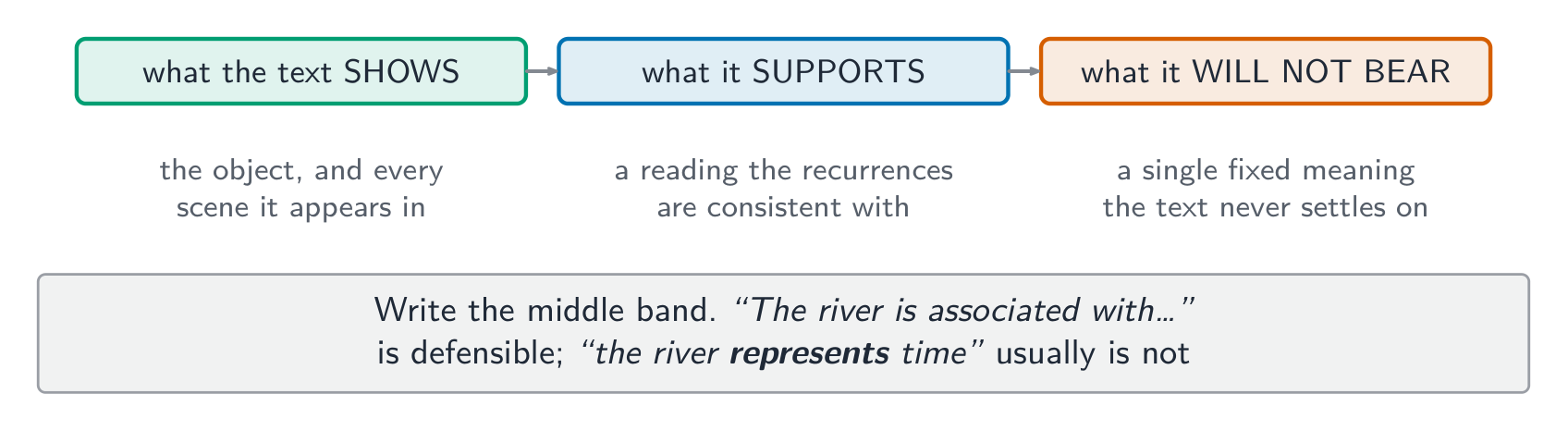
Syllabus
Enduring Understanding Learning Objective Essential Knowledge FIG-1
Comparisons, representations, and associations shift meaning from the literal to the figurative and invite readers to interpret a text.5.C
Identify and explain the function of a symbol.- FIG-1.AA When a character comes to represent, or stand for, an idea or concept, that character becomes symbolic; some symbolic characters have become so common they are archetypal. Note: The AP Exam will not require students to identify or label archetypes.
- FIG-1.X When a material object comes to represent, or stand for, an idea or concept, it becomes a symbol.
- FIG-1.Y A symbol is an object that represents a meaning, so it is said to be symbolic or representative of that meaning. A symbol can represent different things depending on the experiences of a reader or the context of its use in a text.
- FIG-1.Z Certain symbols are so common and recurrent that many readers have associations with them prior to reading a text. Other symbols are more contextualized and only come to represent certain things through their use in a particular text.
Source: College Board AP Course and Exam Description
- When a material object comes to represent an idea or concept, it becomes a symbol 象征.
- When a character comes to represent an idea, that character becomes symbolic.
- A symbol is an object that represents a meaning, so it is said to be symbolic or representative of that meaning.
- Certain symbols are so common and recurrent that readers bring associations to them before reading.
The last point is a warning. A conventional symbol arrives with meanings attached, and the text may be using them, refusing them, or inverting them. Check what the text does before importing the convention.
Vocabulary TrainEnglish symbol/ˈsɪmbl/ 6.10 6.11 6.12
Developing a Literary Thesis, Commentary, and Evidence
Syllabus
Enduring Understanding Learning Objective Essential Knowledge LAN-1
Readers establish and communicate their interpretations of literature through arguments supported by textual evidence.7.B
Develop a thesis statement that conveys a defensible claim about an interpretation of literature and that may establish a line of reasoning.- LAN-1.D A thesis statement expresses an interpretation of a literary text, and requires a defense, through use of textual evidence and a line of reasoning, both of which are explained in an essay through commentary.
- LAN-1.E A thesis statement may preview the development or line of reasoning of an interpretation. This is not to say that a thesis statement must list the points of an interpretation, literary elements to be analyzed, or specific evidence to be used in the argument.
Enduring Understanding Learning Objective Essential Knowledge LAN-1
Readers establish and communicate their interpretations of literature through arguments supported by textual evidence.7.C
Develop commentary that establishes and explains relationships among textual evidence, the line of reasoning, and the thesis.- LAN-1.F A line of reasoning is the logical sequence of claims that work together to defend the overarching thesis statement.
- LAN-1.G A line of reasoning is communicated through commentary that explains the logical relationship between the overarching thesis statement and the claims/evidence within the body of an essay.
Enduring Understanding Learning Objective Essential Knowledge LAN-1
Readers establish and communicate their interpretations of literature through arguments supported by textual evidence.7.D
Select and use relevant and sufficient evidence to both develop and support a line of reasoning.- LAN-1.H Writers use evidence strategically and purposefully to illustrate, clarify, exemplify, associate, amplify, or qualify a point.
- LAN-1.I Evidence is effective when the writer of the essay uses commentary to explain a logical relationship between the evidence and the claim.
- LAN-1.J Evidence is sufficient when its quantity and quality provide apt support for the line of reasoning.
- LAN-1.K Developing and supporting an interpretation of a text is a recursive process; an interpretation can emerge from analyzing evidence and then forming a line of reasoning, or the interpretation can emerge from forming a line of reasoning and then identifying relevant evidence to support that line of reasoning.
Source: College Board AP Course and Exam Description
Unchanged from Units 3-5: an interpretation requiring textual defence; a line of reasoning of claims communicated through commentary; evidence used strategically, effective with commentary, sufficient in quantity and quality, developed recursively.
6.13
Control Over the Elements of Composition
Syllabus
Enduring Understanding Learning Objective Essential Knowledge LAN-1
Readers establish and communicate their interpretations of literature through arguments supported by textual evidence.7.E
Demonstrate control over the elements of composition to communicate clearly.- LAN-1.R Writers convey their ideas in a sentence through strategic selection and placement of phrases and clauses. Writers may use coordination to illustrate a balance or equality between ideas or subordination to illustrate an imbalance or inequality.
- LAN-1.S Writers use words that enhance the clear communication of an interpretation.
- LAN-1.T Punctuation conveys relationships between and among parts of a sentence.
Source: College Board AP Course and Exam Description
- Writers convey ideas through the strategic selection and placement of phrases and clauses.
- Writers use words that enhance the clear communication of an interpretation.
- Punctuation conveys relationships between parts of a sentence.
Worked example (a real AP exam task). A Question 3 literary-argument prompt asks how an unreliable narrator contributes to an interpretation of a work as a whole. A weak answer asserts: "The narrator is unreliable because he lies." A scoring answer runs the CED's chain: "The narrator records every slight he received in exact detail and summarises his own conduct in a clause - 'there was an argument, and I left'. The asymmetry of detail implies a bias toward self-exculpation, which means his account of the other characters' motives cannot be taken at face value. The novel therefore asks the reader to reconstruct a story the narrator is committed to not telling, and its subject is less the events than his need to arrange them." Inclusion and omission, the bias inferred, and what that bias prevents.
6.13
Exam tips
- Discrepancies between perspectives are the method, not a problem to reconcile.
- A foil is similar enough for the difference to show. Ask what they have that the protagonist lacks.
- Inconsistency is evidence of an interior. A perfectly consistent character is a position, not a person.
- For any structural interruption, ask what the reader knows at that moment. That is the effect.
- Reliability is a chain: inclusion and omission, then bias, then what you cannot conclude. Show all three.
- With a conventional symbol, check whether the text uses, refuses, or inverts the association before importing it.
-
7
Short Fiction III
Watch lesson7.1
Characters Who Change or Remain Unchanged
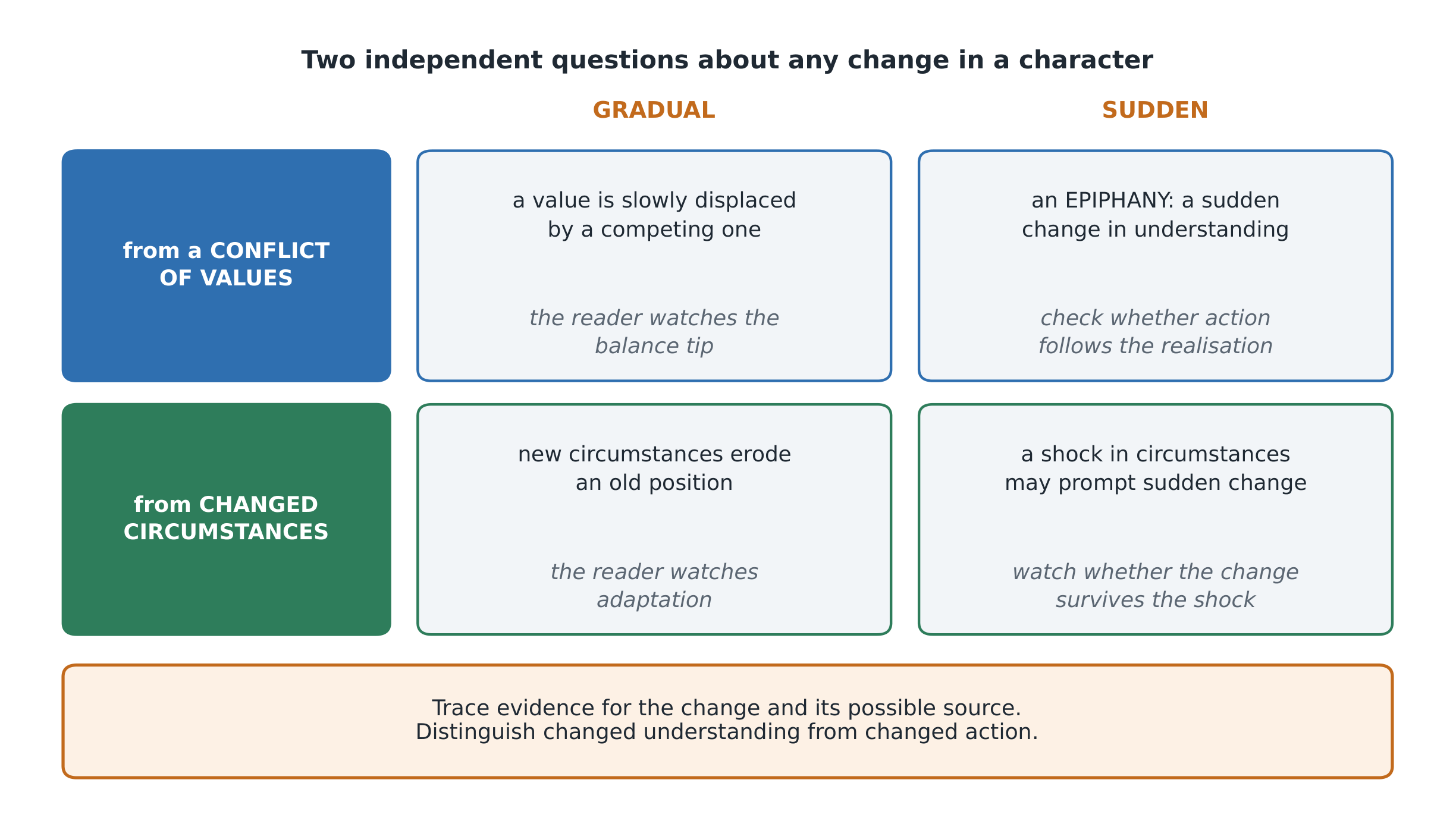
Syllabus
Enduring Understanding Learning Objective Essential Knowledge CHR-1
Characters in literature allow readers to study and explore a range of values, beliefs, assumptions, biases, and cultural norms represented by those characters.1.B
Explain the function of a character changing or remaining unchanged.- CHR-1.AA An epiphany may affect the plot by causing a character to act on his or her sudden realization.
- CHR-1.X Often the change in a character emerges directly from a conflict of values represented in the narrative.
- CHR-1.Y Changes in a character’s circumstances may lead to changes in that character.
- CHR-1.Z While characters can change gradually over the course of a narrative, they can also change suddenly as the result of a moment of realization, known as an epiphany. An epiphany allows a character to see things in a new light and is often directly related to a central conflict of the narrative.
Source: College Board AP Course and Exam Description
Unit 7 is the last short-fiction unit, and it sharpens two things: how change happens in a character, and pacing as a deliberate manipulation of time.
- Often the change in a character emerges directly from a conflict of values represented in the narrative.
- Changes in a character's circumstances may lead to changes in that character.
- Characters can change gradually, but they can also change suddenly 骤然.
- An epiphany 顿悟 may affect the plot by causing a character to act on a sudden realisation.
Trace the evidence for a change, its possible source and its consequences or limits. The two axes are independent, which is what makes them useful. A change caused by a conflict of values can arrive gradually or in an instant, and an epiphany can alter the character’s understanding even before any action follows. Explain separately whether it changes the plot; the absence of action may itself matter.
Vocabulary TrainEnglish suddenly/ˈsʌdənli/ epiphany/ɪˈpɪfənɪ/ 7.2
Nuances in Characters' Relationships
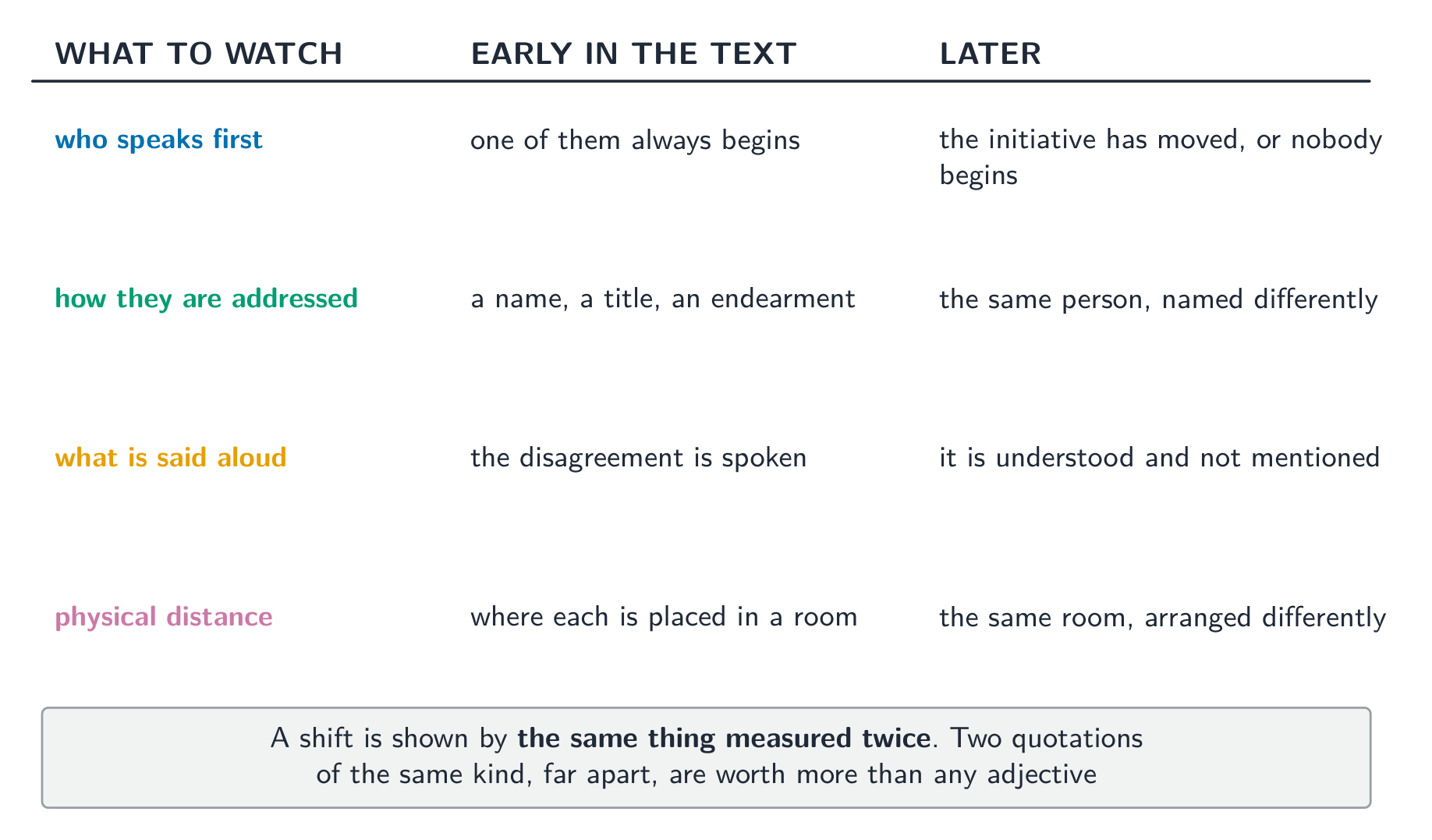
Syllabus
Enduring Understanding Learning Objective Essential Knowledge CHR-1
Characters in literature allow readers to study and explore a range of values, beliefs, assumptions, biases, and cultural norms represented by those characters.1.D
Describe how textual details reveal nuances and complexities in characters’ relationships with one another.- CHR-1.AB A group or force can function as a character.
- CHR-1.AC When readers consider a character, they should examine how that character interacts with other characters, groups, or forces and what those interactions may indicate about the character.
- CHR-1.AD The relationship between a character and a group, including the inclusion or exclusion of that character, reveals the collective attitude of the group toward that character and possibly the character’s attitude toward the group.
Source: College Board AP Course and Exam Description
- A group or force can function as a character.
- Readers should examine how a character interacts with other characters.
- The relationship between a character and a group - including their inclusion in or exclusion from it - is significant.
The group-as-character idea is worth taking literally. A town, a family, an institution can hold values, exert pressure, and oppose a protagonist exactly as an individual antagonist would, and reading it that way often unlocks a story with no obvious opponent.
7.3
The Function of Setting in a Narrative
Syllabus
Enduring Understanding Learning Objective Essential Knowledge SET-1
Setting and the details associated with it not only depict a time and place, but also convey values associated with that setting.2.B
Explain the function of setting in a narrative.- SET-1.E When a setting changes, it may suggest other movements, changes, or shifts in the narrative.
- SET-1.F Settings may be contrasted in order to establish a conflict of values or ideas associated with those settings.
Source: College Board AP Course and Exam Description
- When a setting changes, it may suggest other movements, changes, or shifts in the narrative.
- Settings may be contrasted to establish a conflict of values or ideas associated with them.
Contrasted settings may carry competing values. Establish the association through description and behaviour rather than assuming that every change of place encodes a conflict.
7.4
The Relationship Between Character and Setting
Syllabus
Enduring Understanding Learning Objective Essential Knowledge SET-1
Setting and the details associated with it not only depict a time and place, but also convey values associated with that setting.2.C
Describe the relationship between a character and a setting.- SET-1.G The way characters interact with their surroundings provides insights about those characters and the setting(s) they inhabit.
- SET-1.H The way characters behave in or describe their surroundings reveals an attitude about those surroundings and contributes to the development of those characters and readers’ interpretations of them.
Source: College Board AP Course and Exam Description
- The way characters interact with their surroundings provides insights about them.
- The way characters behave in or describe their surroundings reveals an attitude toward those surroundings.
7.5
How Plot Orders Events
Syllabus
Enduring Understanding Learning Objective Essential Knowledge STR-1
The arrangement of the parts and sections of a text, the relationship of the parts to each other, and the sequence in which the text reveals information are all structural choices made by a writer that contribute to the reader’s interpretation of a text.3.A
Identify and describe how plot orders events in a narrative.- STR-1.AA Pacing is the manipulation of time in a text. Several factors contribute to the pace of a narrative, including arrangement of details, frequency of events, narrative structures, syntax, the tempo or speed at which events occur, or shifts in tense and chronology in the narrative.
Source: College Board AP Course and Exam Description
Pacing 节奏 is the manipulation of time in a text, and several factors contribute to it - the length given to an event, the compression of long periods, the interruption of chronology.
Vocabulary TrainEnglish Pacing/ˈpeɪsɪŋ/ 7.6
The Function of a Sequence of Events
Syllabus
Enduring Understanding Learning Objective Essential Knowledge STR-1
The arrangement of the parts and sections of a text, the relationship of the parts to each other, and the sequence in which the text reveals information are all structural choices made by a writer that contribute to the reader’s interpretation of a text.3.B
Explain the function of a particular sequence of events in a plot.- STR-1.AB Narrative pacing may evoke an emotional reaction in readers by the order in which information is revealed; the relationships between the information, when it is provided, and other parts of the narrative; and the significance of the revealed information to other parts of the narrative.
Source: College Board AP Course and Exam Description
Narrative pacing may evoke an emotional reaction in readers by the order in which information is revealed.
Pacing is measurable and therefore very usable as evidence. Count the pages a text gives to an afternoon and to the following decade, and interpret the disproportion alongside syntax, chronology and context. Length alone does not establish the only important event.
7.7
How a Narrator's Reliability Affects a Narrative
Syllabus
Enduring Understanding Learning Objective Essential Knowledge NAR-1
A narrator’s or speaker’s perspective controls the details and emphases that affect how readers experience and interpret a text.4.D
Explain how a narrator’s reliability affects a narrative.- NAR-1.W Some narrators or speakers may provide details and information that others do not or cannot provide. Multiple narrators or speakers may provide contradictory information in a text.
Source: College Board AP Course and Exam Description
Some narrators or speakers may provide details and information that others do not or cannot provide.
Compare narrators where a text offers more than one. Differences in access, emphasis or contradiction can reveal how the text directs a reader. Different access alone does not establish dishonesty.
7.8
The Function of a Symbol
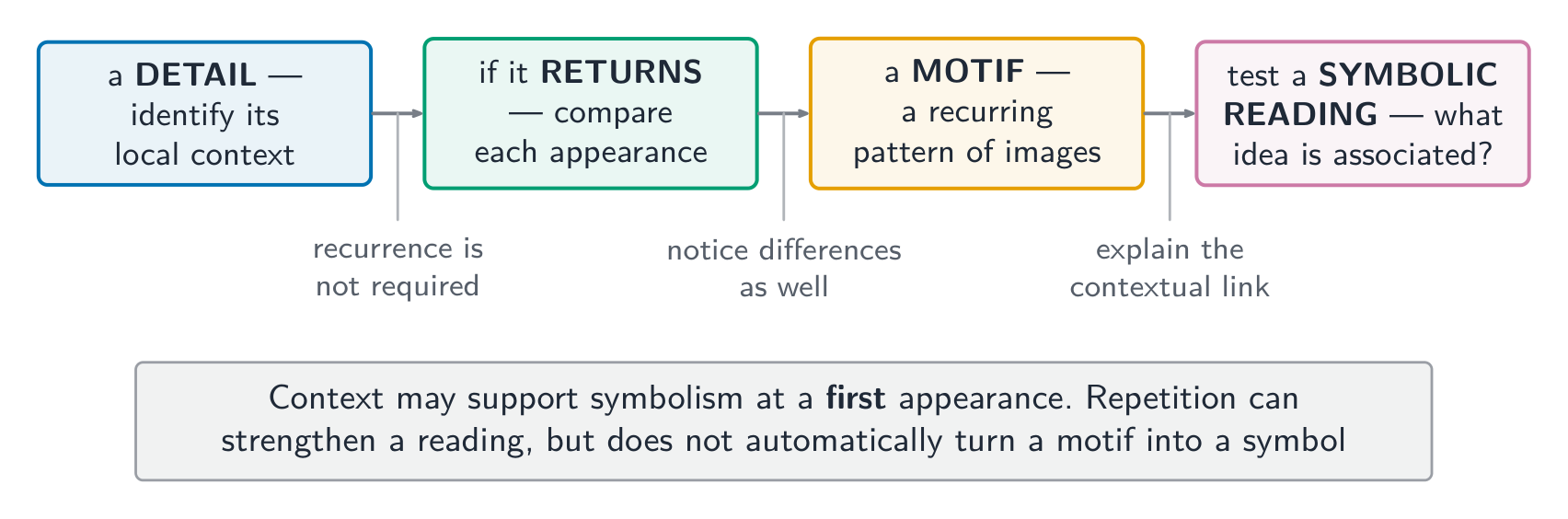
Syllabus
Enduring Understanding Learning Objective Essential Knowledge FIG-1
Comparisons, representations, and associations shift meaning from the literal to the figurative and invite readers to interpret a text.5.C
Identify and explain the function of a symbol.- FIG-1.AB A setting may become symbolic when it is, or comes to be, associated with abstractions such as emotions, ideologies, and beliefs.
- FIG-1.AC Over time, some settings have developed certain associations such that they almost universally symbolize particular concepts.
Source: College Board AP Course and Exam Description
- A setting may become symbolic when it is associated with abstractions - emotions, ideas, times of life.
- Over time, some settings have developed associations so strong that they almost universally symbolise something.
ExploreTest a symbolic reading
Context can support symbolism on a first appearance. Recurrence can strengthen a reading but is not required.
7.9
The Function of an Image or Imagery
Syllabus
Enduring Understanding Learning Objective Essential Knowledge FIG-1
Comparisons, representations, and associations shift meaning from the literal to the figurative and invite readers to interpret a text.5.D
Identify and explain the function of an image or imagery.- FIG-1.AD A motif is a unified pattern of recurring objects or images used to emphasize a significant idea in large parts of or throughout a text.
Source: College Board AP Course and Exam Description
A motif 母题 is a unified pattern of recurring objects or images used to emphasise a significant idea.
A motif differs from a symbol in that it need not stand for one thing. It accumulates: each recurrence adds to what the pattern means, so compare what changes across relevant appearances, including exceptions. Repetition makes a motif; a single detail can carry symbolic meaning when its context supports the association.
Vocabulary TrainEnglish motif/məʊˈtiːf/ 7.10
The Function of a Simile
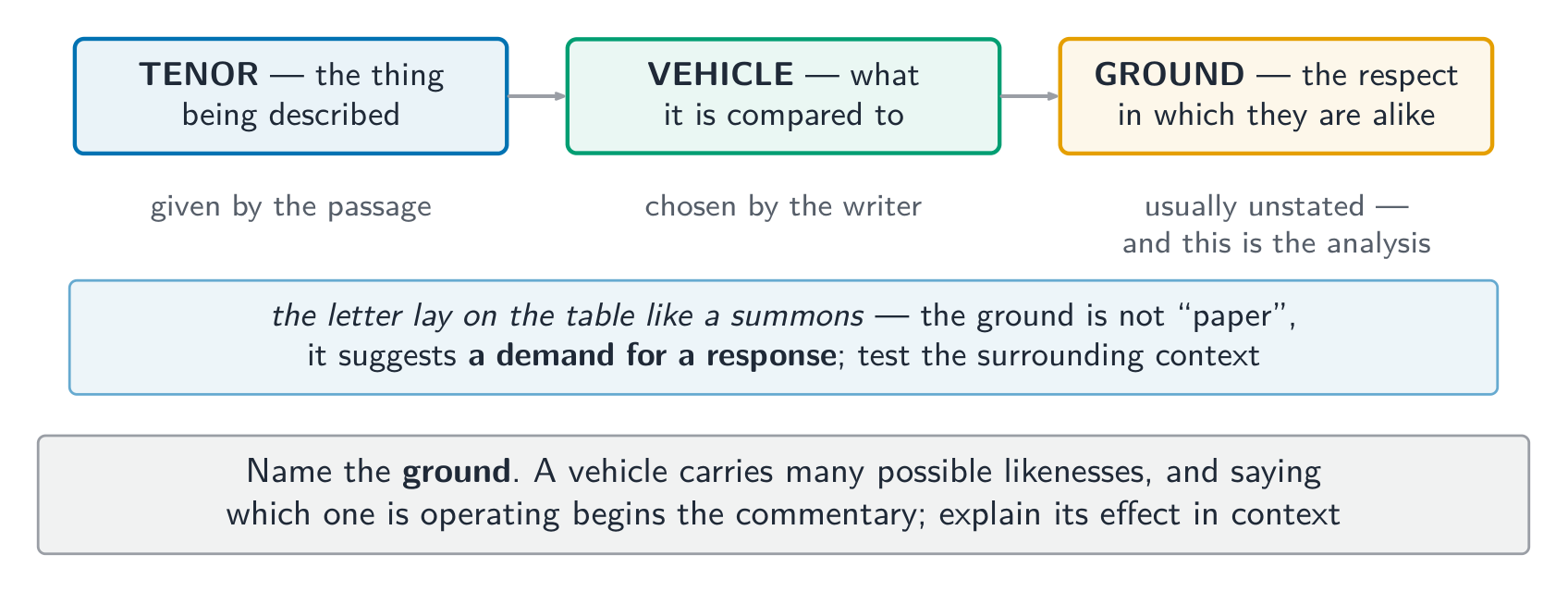
Syllabus
Enduring Understanding Learning Objective Essential Knowledge FIG-1
Comparisons, representations, and associations shift meaning from the literal to the figurative and invite readers to interpret a text.6.A
Identify and explain the function of a simile.- FIG-1.AE The function of a simile relies on the selection of the objects being compared as well as the traits of the objects.
Source: College Board AP Course and Exam Description
The function of a simile relies on the selection of the objects being compared as well as the traits transferred. Both halves are choices, and both can be analysed.
ExploreName the ground of the comparison
Identify the shared quality and explain its effect in context.
7.11
The Function of Personification
Syllabus
Enduring Understanding Learning Objective Essential Knowledge FIG-1
Comparisons, representations, and associations shift meaning from the literal to the figurative and invite readers to interpret a text.6.C
Identify and explain the function of personification.- FIG-1.AF By assigning the qualities of a nonhuman object, entity, or idea to a person or character, the narrator, character, or speaker communicates an attitude about that person or character.
Source: College Board AP Course and Exam Description
The CED adds the reverse move here: assigning the qualities of a nonhuman object, entity, or idea to a person or character - describing a person as mechanical, as weather, as an animal.
This is worth watching for, because it usually indicates a judgement. A character described in the vocabulary of machinery has been characterised, and by someone.
7.12 7.13 7.14
Developing a Literary Thesis, Commentary, and Evidence
Syllabus
Enduring Understanding Learning Objective Essential Knowledge LAN-1
Readers establish and communicate their interpretations of literature through arguments supported by textual evidence.7.B
Develop a thesis statement that conveys a defensible claim about an interpretation of literature and that may establish a line of reasoning.- LAN-1.D A thesis statement expresses an interpretation of a literary text, and requires a defense, through use of textual evidence and a line of reasoning, both of which are explained in an essay through commentary.
- LAN-1.E A thesis statement may preview the development or line of reasoning of an interpretation. This is not to say that a thesis statement must list the points of an interpretation, literary elements to be analyzed, or specific evidence to be used in the argument.
Enduring Understanding Learning Objective Essential Knowledge LAN-1
Readers establish and communicate their interpretations of literature through arguments supported by textual evidence.7.C
Develop commentary that establishes and explains relationships among textual evidence, the line of reasoning, and the thesis.- LAN-1.F A line of reasoning is the logical sequence of claims that work together to defend the overarching thesis statement.
- LAN-1.G A line of reasoning is communicated through commentary that explains the logical relationship between the overarching thesis statement and the claims/evidence within the body of an essay.
- LAN-1.U More sophisticated literary arguments may explain the significance or relevance of an interpretation within a broader context, discuss alternative interpretations of a text, or use relevant analogies to help an audience better understand an interpretation.
Enduring Understanding Learning Objective Essential Knowledge LAN-1
Readers establish and communicate their interpretations of literature through arguments supported by textual evidence.7.D
Select and use relevant and sufficient evidence to both develop and support a line of reasoning.- LAN-1.H Writers use evidence strategically and purposefully to illustrate, clarify, exemplify, associate, amplify, or qualify a point.
- LAN-1.I Evidence is effective when the writer of the essay uses commentary to explain a logical relationship between the evidence and the claim.
- LAN-1.J Evidence is sufficient when its quantity and quality provide apt support for the line of reasoning.
- LAN-1.K Developing and supporting an interpretation of a text is a recursive process; an interpretation can emerge from analyzing evidence and then forming a line of reasoning, or the interpretation can emerge from forming a line of reasoning and then identifying relevant evidence to support that line of reasoning.
- LAN-1.V Textual evidence may require revision to an interpretation and a line of reasoning if the evidence does not sufficiently support the initial interpretation and line of reasoning.
Source: College Board AP Course and Exam Description
- Unchanged: a thesis expresses an interpretation requiring textual defence.
- New: more sophisticated literary arguments may explain the significance or relevance of an interpretation - why this reading matters, not only that it is supportable. Explain the significance with evidence; no isolated phrase guarantees a scoring point.
- New: textual evidence may require revision to an interpretation if the evidence does not support it.
Original practice passage: the ferry vote
This passage is written for teaching. It is not an extract from an AP exam.
At the council table, Nora laid the ferry petition beside the clock. The chair called her “our practical girl”, as he had before she began collecting signatures. “The bridge is the sensible choice,” he said. Nora looked through the window at the landing where her mother still waited each morning. For the first time, she heard “practical” as a request to be silent. “Practical for whom?” she asked. The chair covered the petition with his agenda. Outside, Nora unfolded it again; the paper shook like a small sail. Three years passed before the ferry returned. Nora kept the chair's agenda, its edges soft from handling.
Worked analysis: change and its limits. Nora's new interpretation of “practical” is an explicit moment of realisation. Her question challenges the chair's apparent consensus; covering the petition shows his resistance rather than a persuaded council. The later return of the ferry does not establish that her question caused the outcome.
Worked analysis: setting and imagery. The council table and agenda concentrate control, while the landing connects policy to her mother's routine. The paper “like a small sail” suggests fragility and possible movement. Context supports those qualities; it does not make the paper a literal boat. The handled agenda may represent remembered exclusion, but other readings need to explain why Nora keeps it. Symbolic interpretation requires context, not a fixed repetition count.
Worked analysis: pacing. The dialogue and gesture develop the meeting in detail, while “Three years passed before the ferry returned” compresses a long delay. This contrast gives the challenge immediacy while leaving the intervening campaign unexplained. The final handled agenda complicates a simple victory reading: the experience remains present for Nora.
Practice. Explain how the chair's treatment of Nora changes after her question. Then explain how the three-year summary limits a claim that Nora's speech alone saved the ferry. Use actual wording and distinguish the narration's evidence from an untested inference.
7.12 7.13 7.14
Exam tips
- A change needs a source (a conflict of values, or changed circumstances) and a consequence in the plot.
- An epiphany changes understanding. Check whether action follows and what happens if it does not.
- A group can function as a character. Try it on any story with no obvious antagonist.
- Contrasted settings may carry competing values; establish the link through details.
- Pacing includes space, syntax and chronology. Describe the choice and explain its effect in context.
- For a motif, compare relevant recurrences and differences. Context, not repetition alone, supports symbolic meaning.
-
8
Poetry III
Watch lesson8.1
The Function of Structure in a Text
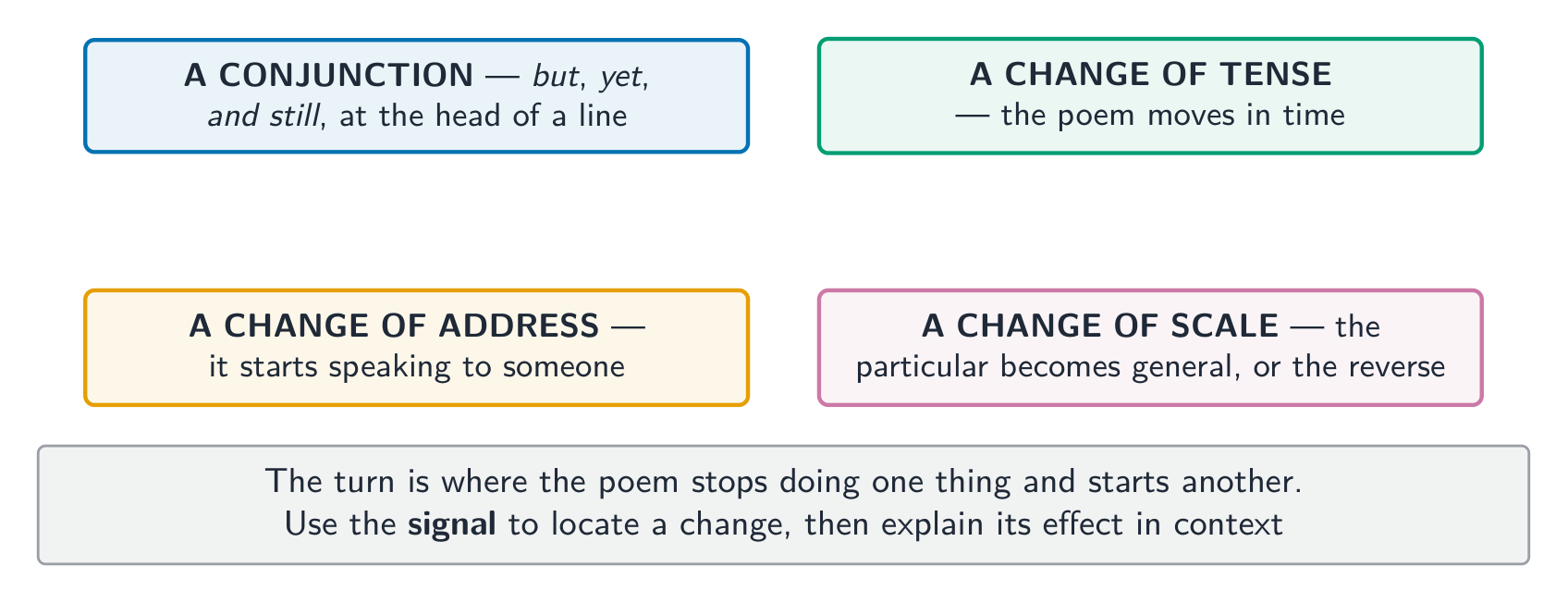
Syllabus
Enduring Understanding Learning Objective Essential Knowledge STR-1
The arrangement of the parts and sections of a text, the relationship of the parts to each other, and the sequence in which the text reveals information are all structural choices made by a writer that contribute to the reader’s interpretation of a text.3.C
Explain the function of structure in a text.- STR-1.AC Ideas and images in a poem may extend beyond a single line or stanza.
- STR-1.AD Punctuation is often crucial to the understanding of a text.
- STR-1.AE When structural patterns are created in a text, any interruption in the pattern creates a point of emphasis.
Source: College Board AP Course and Exam Description
Unit 8 is the last poetry unit and it handles advanced material: the family of devices built on contradiction.
- Ideas and images in a poem may extend beyond a single line or stanza.
- Punctuation is often crucial to understanding a text.
- When structural patterns are created, any interruption in the pattern creates a point of emphasis.
Establish a pattern before interpreting an interruption. Explain what changes and why it matters in context; a signal alone does not supply the interpretation.
Punctuation deserves the emphasis it gets. In a poem, a semicolon and a full stop are different claims about how tightly two statements are joined, and a poem without punctuation has made a decision about how you must read it.
8.2
The Function of Contrasts Within a Text
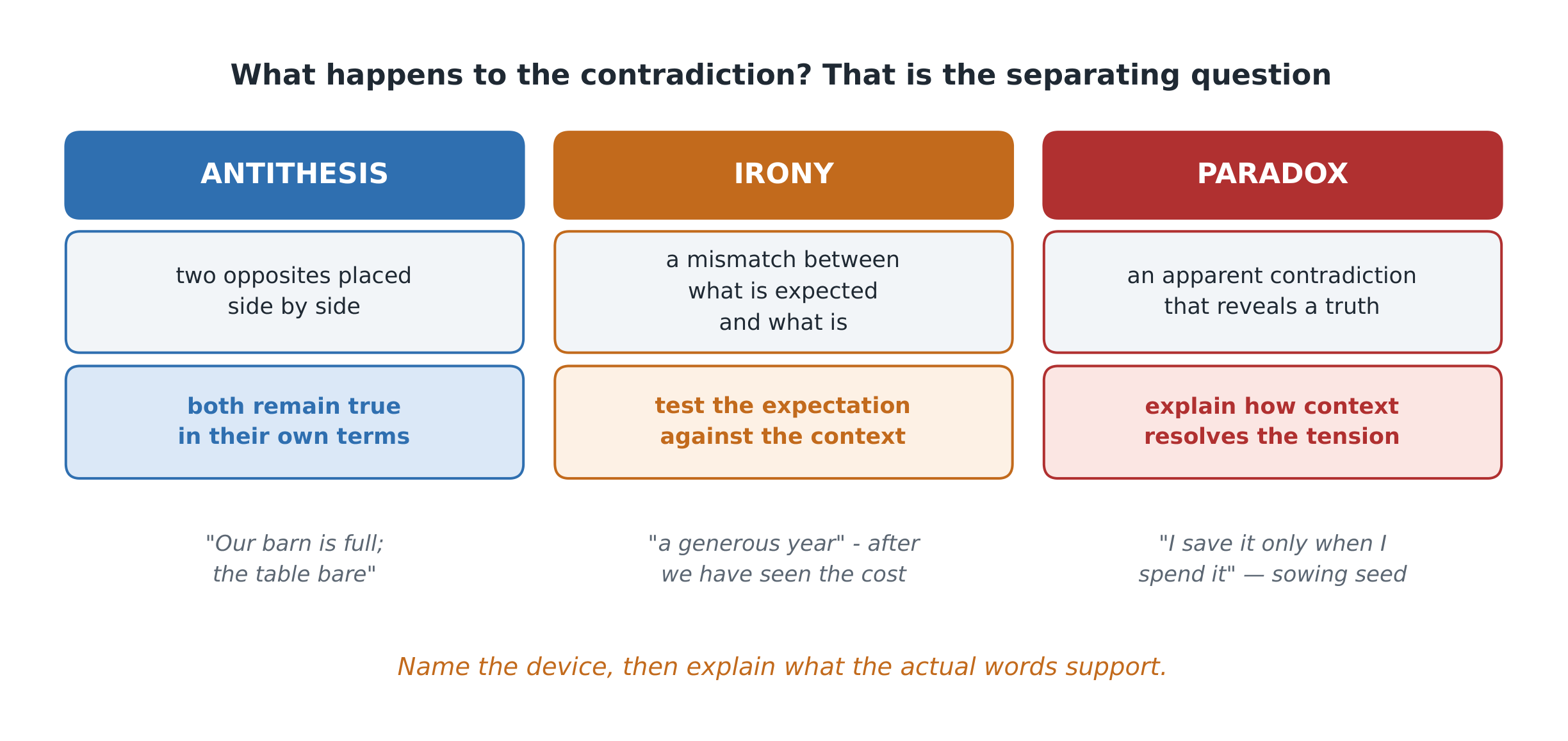
Syllabus
Enduring Understanding Learning Objective Essential Knowledge STR-1
The arrangement of the parts and sections of a text, the relationship of the parts to each other, and the sequence in which the text reveals information are all structural choices made by a writer that contribute to the reader’s interpretation of a text.3.D
Explain the function of contrasts within a text.- STR-1.AF Juxtaposition may create or demonstrate an antithesis.
- STR-1.AG Situational or verbal irony is created when events or statements in a text are inconsistent with either the expectations readers bring to a text or the expectations established by the text itself.
- STR-1.AH Paradox occurs when seemingly contradictory elements are juxtaposed, but the contradiction—which may or may not be reconciled—can reveal a hidden or unexpected idea.
Source: College Board AP Course and Exam Description
Antithesis sets opposites side by side. Irony is a mismatch. A paradox contradicts and is still true - Juxtaposition may create or demonstrate an antithesis.
- Situational or verbal irony 情境反讽与言语反讽 is created when events or statements are inconsistent with what is expected.
- Paradox 悖论 occurs when seemingly contradictory elements are juxtaposed, but the contradiction - which may be at odds with ordinary logic - reveals a deeper truth.
The distinction matters and students routinely collapse it. An antithesis places two opposed things together, and both remain true in their own terms. An irony is a gap between the expected and the actual - and someone, the writer or the reader, is aware of the gap. A paradox looks like a contradiction and survives inspection: the contradiction is the point, not an error.
Vocabulary TrainEnglish Situational or verbal irony/ˌsɪtʃuːˈeɪʃənl ɔː ˈvɜːbl ˈaɪrəni/ Paradox/ˈpærədɒks/ 8.3
The Function of Specific Words and Phrases
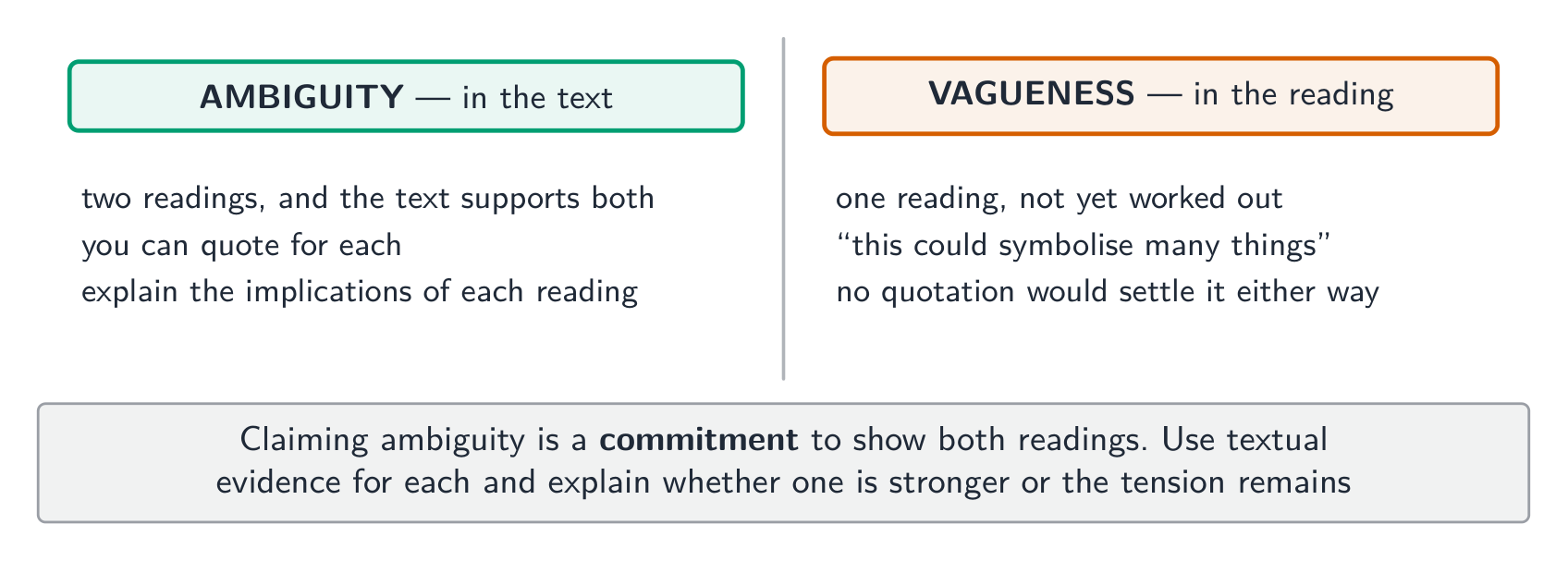
Syllabus
Enduring Understanding Learning Objective Essential Knowledge FIG-1
Comparisons, representations, and associations shift meaning from the literal to the figurative and invite readers to interpret a text.5.B
Explain the function of specific words and phrases in a text.- FIG-1.AG Ambiguity allows for different readings and understandings of a text by different readers.
Source: College Board AP Course and Exam Description
Ambiguity allows for different readings and understandings of a text by different readers.
In this course, ambiguity is a resource. Explore genuinely supported alternative readings and explain their implications. You may defend one or explain a sustained tension; naming ambiguity alone guarantees no scoring point.
ExploreAmbiguity or vagueness?
Support each plausible reading with textual evidence and explain whether one is stronger or tension remains.
8.4
The Function of a Symbol
Syllabus
Enduring Understanding Learning Objective Essential Knowledge FIG-1
Comparisons, representations, and associations shift meaning from the literal to the figurative and invite readers to interpret a text.5.C
Identify and explain the function of a symbol.- FIG-1.AH Symbols in a text and the way they are used may imply that a narrator, character, or speaker has a particular attitude or perspective.
Source: College Board AP Course and Exam Description
Symbols in a text, and the way they are used, may imply that a narrator, character, or speaker has a particular perspective.
A symbol is not free-floating. Ask how the wording establishes the association and whose perspective it expresses. A symbol need not be consciously recognised by a character.
8.5
The Function of a Metaphor
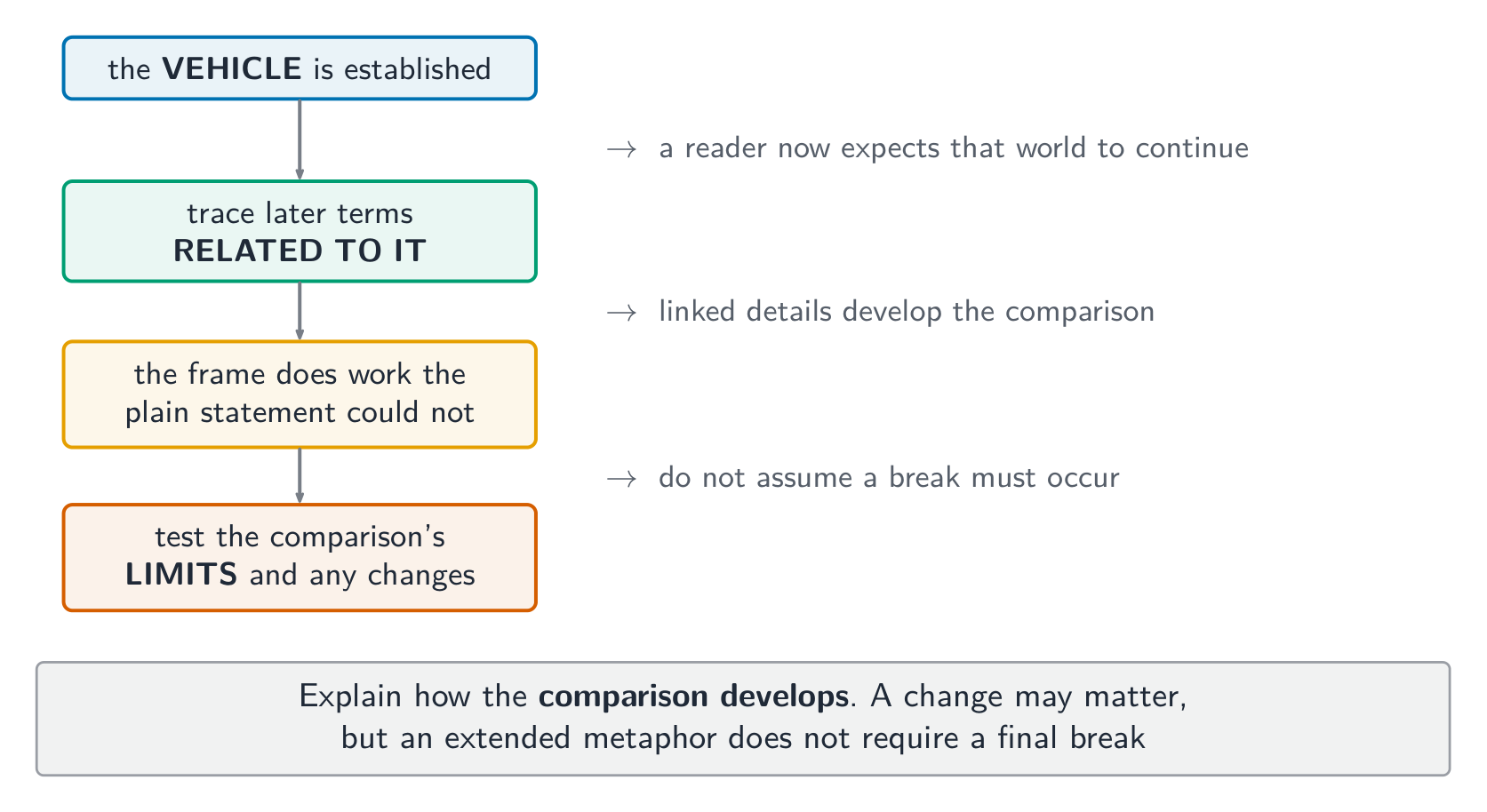
Syllabus
Enduring Understanding Learning Objective Essential Knowledge FIG-1
Comparisons, representations, and associations shift meaning from the literal to the figurative and invite readers to interpret a text.6.B
Identify and explain the function of a metaphor.- FIG-1.AI A conceit is a form of extended metaphor that often appears in poetry. Conceits develop complex comparisons that present images, concepts, and associations in surprising or paradoxical ways.
- FIG-1.AJ Often, conceits are used to make complex comparisons between the natural world and an individual.
- FIG-1.AK Multiple comparisons, representations, or associations may combine to affect one another in complex ways.
Source: College Board AP Course and Exam Description
- A conceit 奇喻 is a form of extended metaphor, common in poetry, developing complex comparisons.
- Conceits are often used to make complex comparisons between the natural world and an individual.
- Multiple comparisons, representations, or associations may combine to affect one another in complex ways.
A conceit develops a complex comparison across related details. Trace which qualities transfer, how the comparisons interact and any limits. An extended metaphor need not break its frame, and a change does not automatically prove deliberate strain.
ExploreFollow a developed comparison
Trace linked details and contextual limits. An extended metaphor need not break its frame.
Vocabulary TrainEnglish conceit/kənˈsiːt/ 8.6
The Function of an Allusion
Syllabus
Enduring Understanding Learning Objective Essential Knowledge FIG-1
Comparisons, representations, and associations shift meaning from the literal to the figurative and invite readers to interpret a text.6.D
Identify and explain the function of an allusion.- FIG-1.AL Because of shared knowledge about a reference, allusions create emotional or intellectual associations and understandings.
Source: College Board AP Course and Exam Description
Because of shared knowledge about a reference, allusions create emotional or intellectual associations in readers who recognise them.
Note the condition: shared knowledge. An allusion is a bet on the reader's memory, and a poem that alludes heavily has chosen its audience.
8.7 8.8 8.9
Developing a Literary Thesis, Commentary, and Evidence
Syllabus
Enduring Understanding Learning Objective Essential Knowledge LAN-1
Readers establish and communicate their interpretations of literature through arguments supported by textual evidence.7.B
Develop a thesis statement that conveys a defensible claim about an interpretation of literature and that may establish a line of reasoning.- LAN-1.D A thesis statement expresses an interpretation of a literary text, and requires a defense, through use of textual evidence and a line of reasoning, both of which are explained in an essay through commentary.
- LAN-1.E A thesis statement may preview the development or line of reasoning of an interpretation. This is not to say that a thesis statement must list the points of an interpretation, literary elements to be analyzed, or specific evidence to be used in the argument.
Enduring Understanding Learning Objective Essential Knowledge LAN-1
Readers establish and communicate their interpretations of literature through arguments supported by textual evidence.7.C
Develop commentary that establishes and explains relationships among textual evidence, the line of reasoning, and the thesis.- LAN-1.F A line of reasoning is the logical sequence of claims that work together to defend the overarching thesis statement.
- LAN-1.G A line of reasoning is communicated through commentary that explains the logical relationship between the overarching thesis statement and the claims/evidence within the body of an essay.
- LAN-1.U More sophisticated literary arguments may explain the significance or relevance of an interpretation within a broader context, discuss alternative interpretations of a text, or use relevant analogies to help an audience better understand an interpretation.
Enduring Understanding Learning Objective Essential Knowledge LAN-1
Readers establish and communicate their interpretations of literature through arguments supported by textual evidence.7.D
Select and use relevant and sufficient evidence to both develop and support a line of reasoning.- LAN-1.H Writers use evidence strategically and purposefully to illustrate, clarify, exemplify, associate, amplify, or qualify a point.
- LAN-1.I Evidence is effective when the writer of the essay uses commentary to explain a logical relationship between the evidence and the claim.
- LAN-1.J Evidence is sufficient when its quantity and quality provide apt support for the line of reasoning.
- LAN-1.K Developing and supporting an interpretation of a text is a recursive process; an interpretation can emerge from analyzing evidence and then forming a line of reasoning, or the interpretation can emerge from forming a line of reasoning and then identifying relevant evidence to support that line of reasoning.
Source: College Board AP Course and Exam Description
- A thesis expresses an interpretation requiring textual defence.
- More sophisticated literary arguments explain the significance or relevance of an interpretation - explain that significance with textual evidence; no isolated feature guarantees a scoring point.
- Evidence: strategic, effective with commentary, sufficient in quantity and quality, developed recursively.
8.10
Control Over the Elements of Composition
Syllabus
Enduring Understanding Learning Objective Essential Knowledge LAN-1
Readers establish and communicate their interpretations of literature through arguments supported by textual evidence.7.E
Demonstrate control over the elements of composition to communicate clearly.- LAN-1.W Writers must acknowledge words, ideas, images, texts, and other intellectual property of others through attribution, citation, or reference. Note: Students are not expected to use a specific attribution style (like MLA) within the timed essays on the AP Exam, but should follow such guidelines for any extended papers they develop in class through multiple revisions.
Source: College Board AP Course and Exam Description
Writers must acknowledge the words, ideas, images, texts, and intellectual property of others through attribution and citation.
Original practice poem: the remaining seed
The poem and the following mini examples were written for teaching. They are not AP extracts.
Our barn is full; the table bare.
“A generous year,” I tell the chair.
The rent has taken every loaf.
I hold one seed against the frost.
I save it only when I spend it:
I open up my fist and sow.
The empty chair receives no answer.
Tomorrow, will the field say no?Worked analysis: distinguish the contrasts. The full barn and bare table form an antithesis: production and deprivation are placed together. “A generous year” can be read as verbal irony because the following rent and missing food undermine simple praise. “I save it only when I spend it” is an apparent paradox: sowing uses up the stored seed but offers a way for it to produce more. The poem gives no guarantee that the crop succeeds; frost and the final question keep the hope uncertain. The colon connects the apparently contradictory claim to the sowing that helps explain it. A device label becomes useful through this reasoning.
Worked analysis: bounded ambiguity. The empty chair may foreground a missing companion, or the speaker's habit of addressing an unresponsive object. Both readings must explain the address and the later absence of an answer. Neither establishes a death or identifies the absent person without further evidence. The chair's meaning is inferred from context, not from a rule that all chairs have one symbolic meaning.
Original mini poem: a developed comparison
My worry is a garden.
I water every thorn.
At night I prune its shadows;
by morning more are born.Worry is the main subject; garden is the comparison subject. Watering, thorns and pruning develop the comparison: attention may sustain the very difficulty the speaker tries to control. “Prune its shadows” extends the image to something that cannot literally be pruned. Explain that complication without assuming that every extended metaphor must end by breaking.
Original allusion example and supplied context
“Not Midas: let my hands make bread.” In the Midas story, the wished-for golden touch makes food unusable. Recognising that reference can make the line a rejection of wealth that defeats ordinary nourishment. A reader without that background may identify the bread as useful food but miss the specific reversal. Distinguish supplied background from words in the poem.
Practice. Explain how the remaining-seed poem combines deprivation and uncertain hope. Use two contrasts and the ending. Then test whether calling the year “generous” must be ironic, or could also preserve a narrower acknowledgement of the harvest.
8.10
Exam tips
- Establish the pattern, then find the interruption. Explain the change in context rather than treating every signal as a complete answer.
- Punctuation is a claim about how tightly statements are joined. A poem without it has made a decision too.
- Antithesis, irony, paradox are not synonyms. Learn the three definitions precisely; conflating them costs marks.
- Ambiguity is a resource. Explore both readings, then argue for one. Support each reading and explain its implication; this alone guarantees no point.
- Ask who attaches the meaning to a symbol. Connect its meaning to the wording and perspective.
- A conceit develops a complex comparison. Trace the linked details and their limits without assuming a compulsory break.
-
9
Longer Fiction or Drama III
Watch lesson9.1
Characters Who Change or Remain Unchanged
Syllabus
Enduring Understanding Learning Objective Essential Knowledge CHR-1
Characters in literature allow readers to study and explore a range of values, beliefs, assumptions, biases, and cultural norms represented by those characters.1.B
Explain the function of a character changing or remaining unchanged.- CHR-1.AE Minor characters often remain unchanged because the narrative doesn’t focus on them. They may only be part of the narrative to advance the plot or to interact with major characters.
- CHR-1.AF Readers’ interpretations of a text are often affected by a character changing—or not—and the meaning conveyed by such changes or lack thereof.
Source: College Board AP Course and Exam Description
Unit 9 is the final unit, and its subject is how texts end - and what an ending lets a reader conclude about the whole work.
- Minor characters often remain unchanged because the narrative does not focus on them; they may serve other functions.
- Readers' interpretations are often affected by a character changing - or not - and by the nature of that change.
The second is the interpretive move the whole course has been building toward. Whether a character changes is not a fact to report; it is the ground on which a reading of the work stands.
9.2
Choices, Actions, and Speech Reveal Complexity
Syllabus
Enduring Understanding Learning Objective Essential Knowledge CHR-1
Characters in literature allow readers to study and explore a range of values, beliefs, assumptions, biases, and cultural norms represented by those characters.1.E
Explain how a character’s own choices, actions, and speech reveal complexities in that character, and explain the function of those complexities.- CHR-1.AG A character’s responses to the resolution of the narrative—in their words or in their actions—reveal something about that character’s own values; these responses may be inconsistent with the previously established behaviors or perspectives of that character.
- CHR-1.AH Inconsistencies and unexpected developments in a character affect readers’ interpretation of that character; other characters; events in the plot; conflicts; the perspective of the narrator, character, or speaker; and/or setting.
Source: College Board AP Course and Exam Description
- A character's responses to the resolution of the narrative - in words or in actions - are revealing.
- Inconsistencies and unexpected developments in a character affect readers' interpretations.
How a character behaves after the crisis is resolved is often the most compressed evidence in a text, and deserves attention alongside earlier evidence.
9.3
Significant Events in a Plot
Syllabus
Enduring Understanding Learning Objective Essential Knowledge STR-1
The arrangement of the parts and sections of a text, the relationship of the parts to each other, and the sequence in which the text reveals information are all structural choices made by a writer that contribute to the reader’s interpretation of a text.3.E
Explain the function of a significant event or related set of significant events in a plot.- STR-1.AI Significant events often illustrate competing value systems that relate to a conflict present in the text.
- STR-1.AJ Events in a plot collide and accumulate to create a sense of anticipation and suspense.
Source: College Board AP Course and Exam Description
- Significant events often illustrate competing value systems related to a conflict in the text.
- Events collide and accumulate to create anticipation and suspense.
Note accumulate. Suspense can build across events that narrow possibilities; a single event can also create uncertainty or anticipation.
9.4
The Function of Conflict in a Text
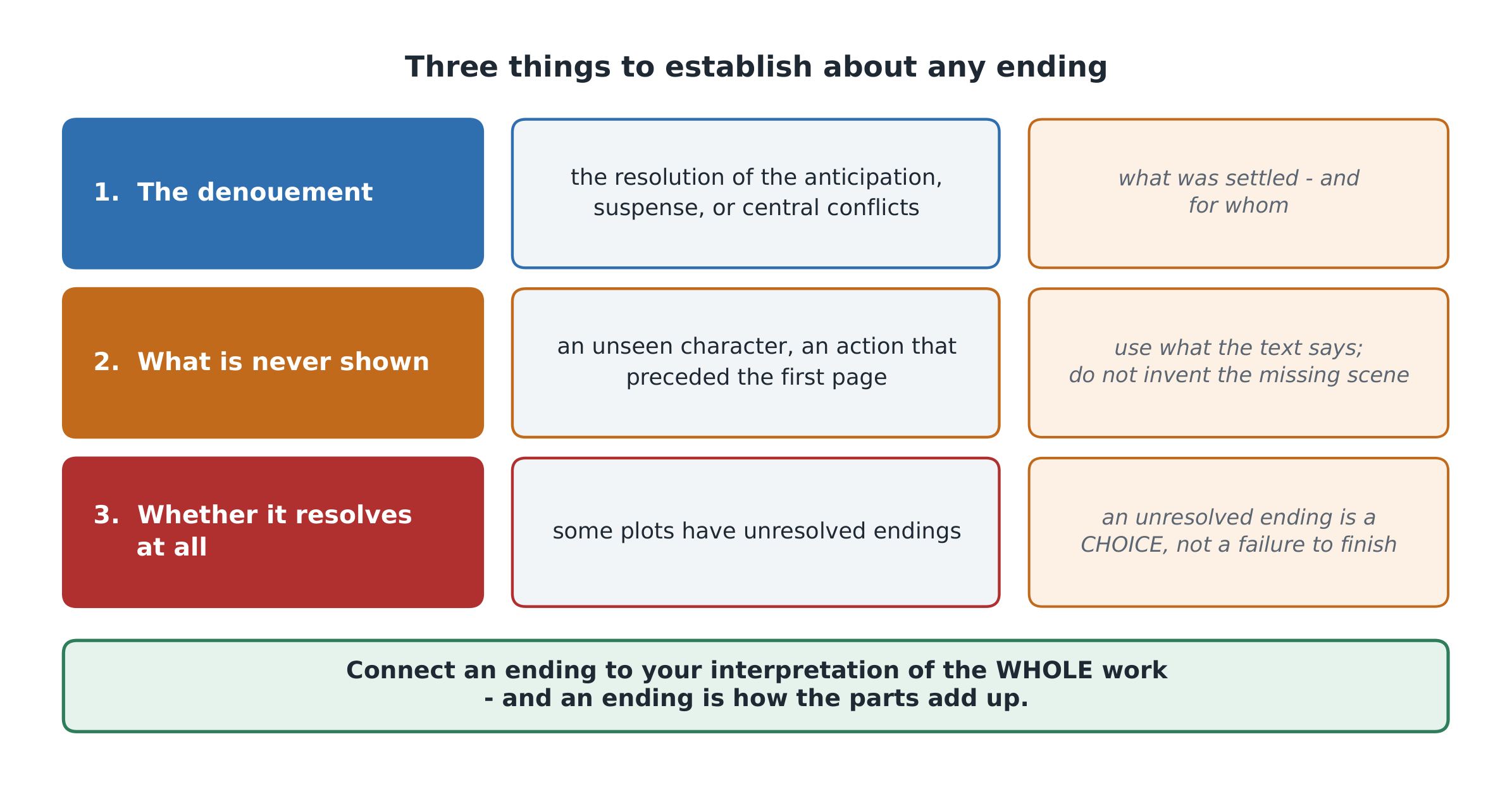
Syllabus
Enduring Understanding Learning Objective Essential Knowledge STR-1
The arrangement of the parts and sections of a text, the relationship of the parts to each other, and the sequence in which the text reveals information are all structural choices made by a writer that contribute to the reader’s interpretation of a text.3.F
Explain the function of conflict in a text.- STR-1.AK The resolution of the anticipation, suspense, or central conflicts of a plot may be referred to as the moment of catharsis or emotional release.
- STR-1.AL Sometimes things not actually shown in a narrative, such as an unseen character or a preceding action, may be in conflict with or result in conflict for a character.
- STR-1.AM Although most plots end in resolution of the central conflicts, some have unresolved endings, and the lack of resolution may contribute to interpretations of the text.
Source: College Board AP Course and Exam Description
What was resolved, what was never shown, and whether the text resolves at all - The resolution of the anticipation, suspense, or central conflicts of a plot may be called the denouement 结局.
- Sometimes things not actually shown in a narrative - an unseen character, a preceding action - affect the interpretation of what is shown.
- Although most plots end in resolution, some have unresolved endings, and those affect interpretation too.
Check how offstage events affect what the text does show. What a text keeps offstage - a death that happened before the first page, a character who is discussed and never appears - may shape the events shown. Use the text’s references to it as evidence; do not invent the missing scene.
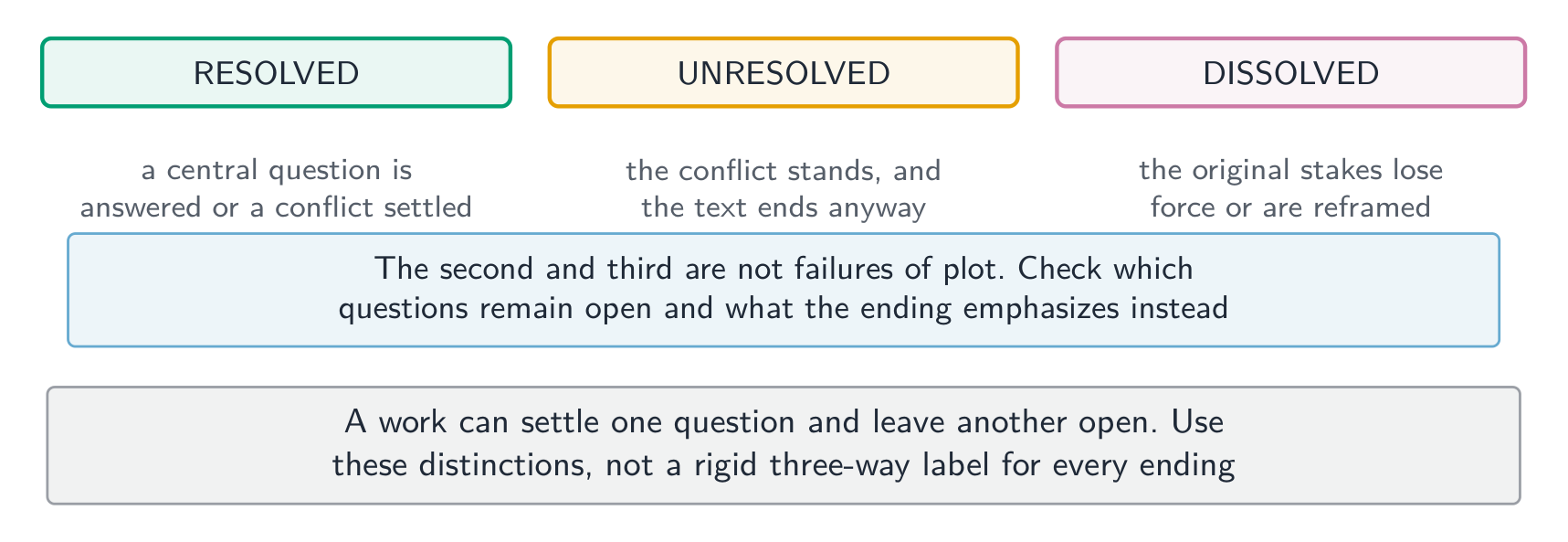 Explore
Sort each ending by how the conflict closes
Distinguish which question is settled and which remains open; different conflicts can have different outcomes.
Vocabulary TrainEnglish denouement/deɪˈnuːmɒ/ 9.5
Details, Diction, and Syntax Reveal Perspective
Syllabus
Enduring Understanding Learning Objective Essential Knowledge NAR-1
A narrator’s or speaker’s perspective controls the details and emphases that affect how readers experience and interpret a text.4.C
Identify and describe details, diction, or syntax in a text that reveal a narrator’s or speaker’s perspective.- NAR-1.X Multiple, and even contrasting, perspectives can occur within a single text and contribute to the complexity of the text.
- NAR-1.Y A narrator or speaker may change over the course of a text as a result of actions and interactions.
- NAR-1.Z Changes and inconsistencies in a narrator’s or speaker’s perspective may contribute to irony or the complexity of the text.
Source: College Board AP Course and Exam Description
- Multiple, and even contrasting, perspectives can occur within a single text and contribute to its complexity.
- A narrator or speaker may change over the course of a text as a result of actions and interactions.
- Changes and inconsistencies in a narrator's or speaker's perspective may contribute to irony or to a reader's judgement of reliability.
A narrator who changes is doubly analysable: as a character who developed, and as a lens that altered. A changed perspective may alter the meaning of earlier details; identify which wording supports that revision.
9.6
Developing a Literary Thesis Statement
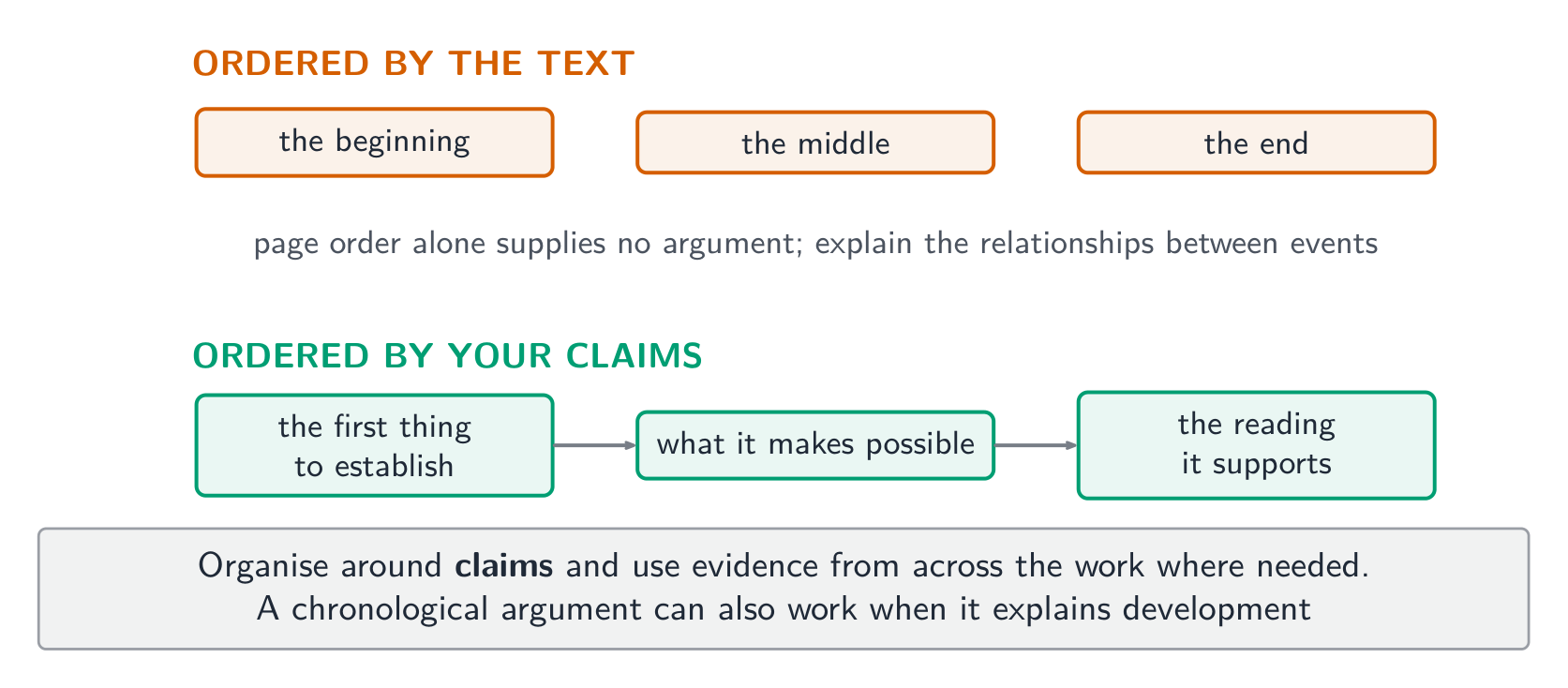
Syllabus
Enduring Understanding Learning Objective Essential Knowledge LAN-1
Readers establish and communicate their interpretations of literature through arguments supported by textual evidence.7.B
Develop a thesis statement that conveys a defensible claim about an interpretation of literature and that may establish a line of reasoning.- LAN-1.D A thesis statement expresses an interpretation of a literary text, and requires a defense, through use of textual evidence and a line of reasoning, both of which are explained in an essay through commentary.
- LAN-1.E A thesis statement may preview the development or line of reasoning of an interpretation. This is not to say that a thesis statement must list the points of an interpretation, literary elements to be analyzed, or specific evidence to be used in the argument.
Source: College Board AP Course and Exam Description
Unchanged: an interpretation requiring textual defence, which may preview the line of reasoning. At this stage, the thesis you are aiming for is one that could not be written before reading the whole work - a claim about how the parts add up.
9.7
Developing Commentary
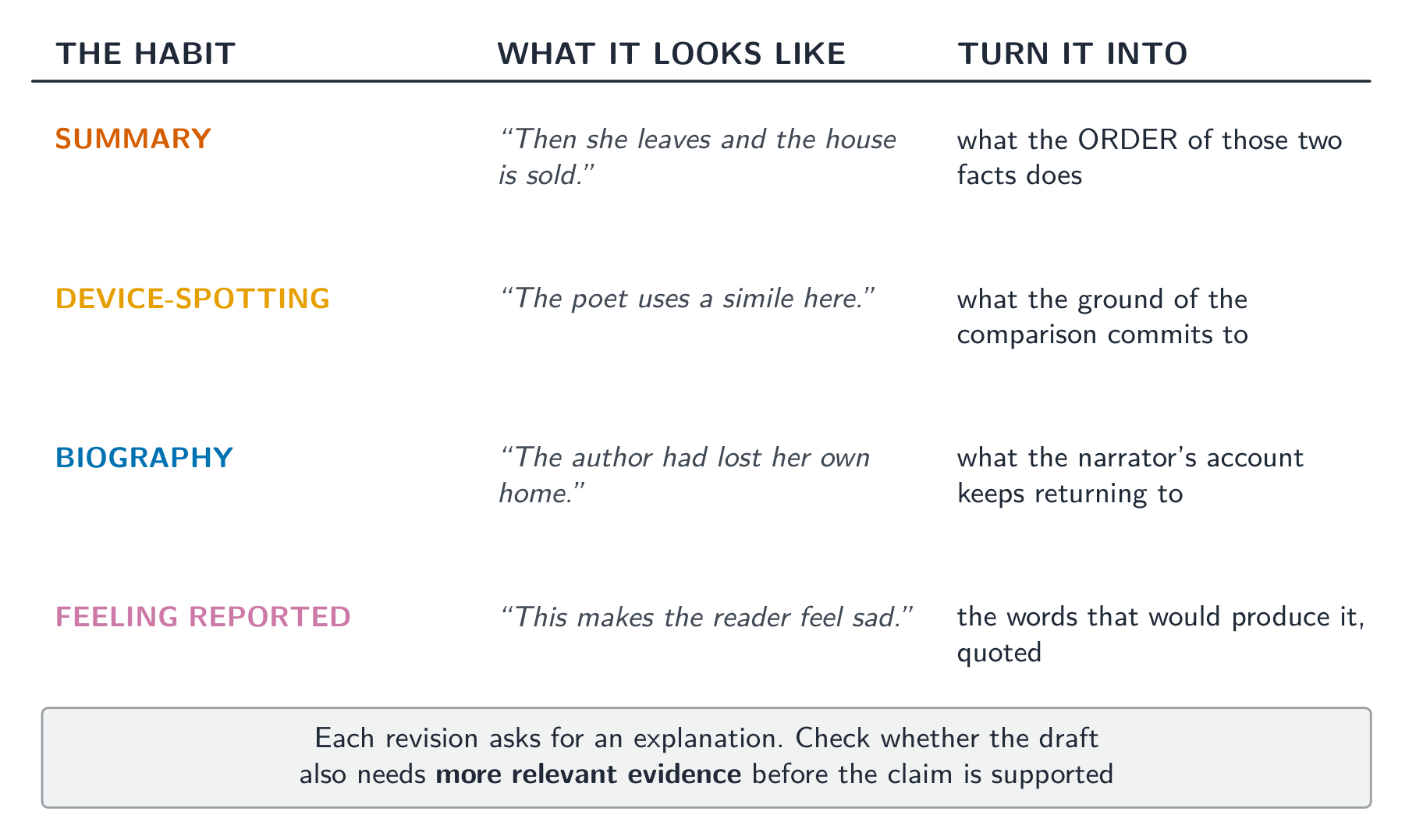
Syllabus
Enduring Understanding Learning Objective Essential Knowledge LAN-1
Readers establish and communicate their interpretations of literature through arguments supported by textual evidence.7.C
Develop commentary that establishes and explains relationships among textual evidence, the line of reasoning, and the thesis.- LAN-1.F A line of reasoning is the logical sequence of claims that work together to defend the overarching thesis statement.
- LAN-1.G A line of reasoning is communicated through commentary that explains the logical relationship between the overarching thesis statement and the claims/evidence within the body of an essay.
- LAN-1.U More sophisticated literary arguments may explain the significance or relevance of an interpretation within a broader context, discuss alternative interpretations of a text, or use relevant analogies to help an audience better understand an interpretation.
Source: College Board AP Course and Exam Description
- A line of reasoning is the sequence of claims defending the thesis, communicated through commentary.
- More sophisticated literary arguments explain the significance or relevance of an interpretation.
When a literary-argument prompt asks about the work as a whole, connect the selected event or character to a defensible interpretation of the full work. Follow the actual prompt rather than assuming that naming a device or an ending automatically answers it.
ExploreRevise a claim using evidence
Explain the link between evidence and claim, and check whether more relevant evidence is needed.
9.8
Selecting Relevant and Sufficient Evidence
Syllabus
Enduring Understanding Learning Objective Essential Knowledge LAN-1
Readers establish and communicate their interpretations of literature through arguments supported by textual evidence.7.D
Select and use relevant and sufficient evidence to both develop and support a line of reasoning.- LAN-1.H Writers use evidence strategically and purposefully to illustrate, clarify, exemplify, associate, amplify, or qualify a point.
- LAN-1.I Evidence is effective when the writer of the essay uses commentary to explain a logical relationship between the evidence and the claim.
- LAN-1.J Evidence is sufficient when its quantity and quality provide apt support for the line of reasoning.
- LAN-1.K Developing and supporting an interpretation of a text is a recursive process; an interpretation can emerge from analyzing evidence and then forming a line of reasoning, or the interpretation can emerge from forming a line of reasoning and then identifying relevant evidence to support that line of reasoning.
Source: College Board AP Course and Exam Description
Evidence used strategically; effective with commentary; sufficient in quantity and quality; and interpretation developed recursively, revised when the evidence does not support it.
Original complete practice narrative: Monday
This short narrative is written for teaching, not taken from an AP paper or a published novel. It lets you practise ending analysis on a complete small work. For a longer-fiction literary argument, transfer the method to a suitable full work you have studied; this story is not a substitute for knowing that work.
After her brother's accident, Leah left the factory and waited for the inquiry's decision. “I will go back when they tell us what happened,” she said. Each morning the postman put letters on the sill. Each morning she lifted the white envelopes, then put them down. On Friday, her aunt counted the coins in the kitchen jar. “Monday's rent,” she said. Leah counted them again. The postman came with a catalogue and a bill. That evening, Leah took her factory coat from the hook. “Then you have your answer?” her aunt asked. “I have Monday,” Leah said. At dawn she passed the empty sill and walked to the factory. The jar remained on the table.
Worked analysis: an ending with limits. Leah's return answers the practical question of whether she goes back to work, but the inquiry's decision remains unreported. Her earlier condition for returning is displaced by the need for rent. “I have Monday” substitutes an immediate obligation for the explanation she had demanded. The final jar keeps that economic pressure present. Together these details support an interpretation in which ordinary survival continues without settling the demand for an account of the accident. They do not establish what caused the accident or that Leah has forgiven anyone.
Practice. Identify one question the ending answers and one it leaves open. Explain how Leah's final words complicate her earlier promise, using at least two details. Then test the alternative claim that returning to work proves she is satisfied with the inquiry.
9.8
Exam tips
- Whether a character changes is the ground of a reading, not a fact to report.
- How a character behaves at the ending may complicate earlier expectations; explain the connection.
- Suspense accumulates. It may build through a series of narrowing possibilities; explain the actual sequence.
- Offstage events matter through what the text says about them. Do not invent missing evidence.
- An unresolved ending is a choice with meaning, not a failure to finish.
- Question 3 asks for "the work as a whole". Connect the chosen evidence to that interpretation and follow the actual prompt.