| Enduring Understanding | Learning Objective | Essential Knowledge |
|---|---|---|
CHR-1 | 1.B |
|
Short Fiction III
AP English Literature and Composition · Topic 7
 9:01
9:01
Unit 7: Short Fiction III
Unit 7 is the last short-fiction unit, and it sharpens two things: how change happens in a character, and pacing as a deliberate manipulation of time. Take…
English narration · English + 中文 subtitles burned in
7.1
Characters Who Change or Remain Unchanged
Syllabus
Source: College Board AP Course and Exam Description
Unit 7 is the last short-fiction unit, and it sharpens two things: how change happens in a character, and pacing as a deliberate manipulation of time.
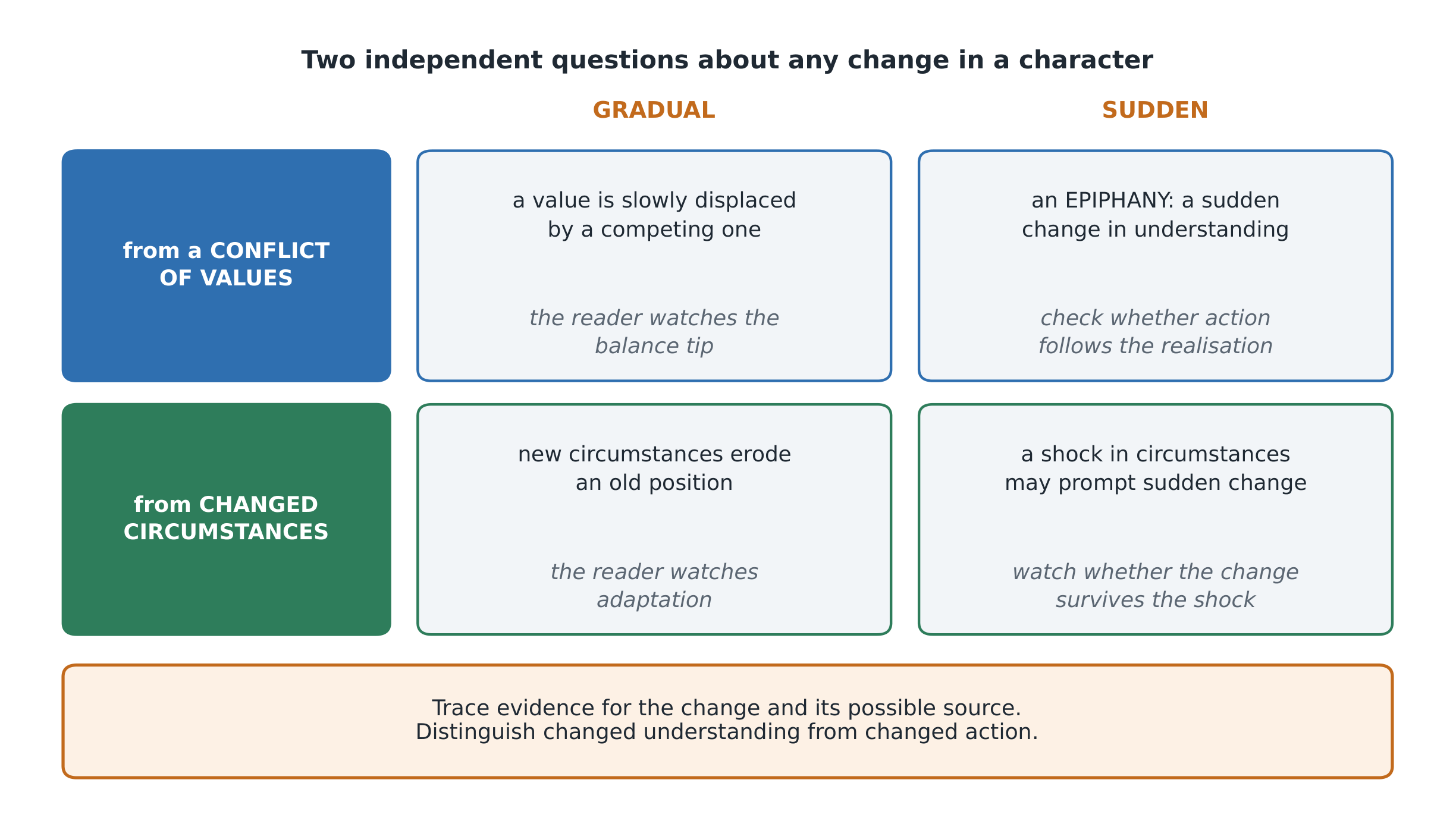
- Often the change in a character emerges directly from a conflict of values represented in the narrative.
- Changes in a character's circumstances may lead to changes in that character.
- Characters can change gradually, but they can also change suddenly 骤然.
- An epiphany 顿悟 may affect the plot by causing a character to act on a sudden realisation.
The two axes are independent, which is what makes them useful. A change caused by a conflict of values can arrive gradually or in an instant, and an epiphany can alter the character’s understanding even before any action follows. Explain separately whether it changes the plot; the absence of action may itself matter.
Vocabulary
Train
| English |
|---|
| suddenly/ˈsʌdənli/ |
| epiphany/ɪˈpɪfənɪ/ |
7.2
Nuances in Characters' Relationships
Syllabus
| Enduring Understanding | Learning Objective | Essential Knowledge |
|---|---|---|
CHR-1 | 1.D |
|
Source: College Board AP Course and Exam Description
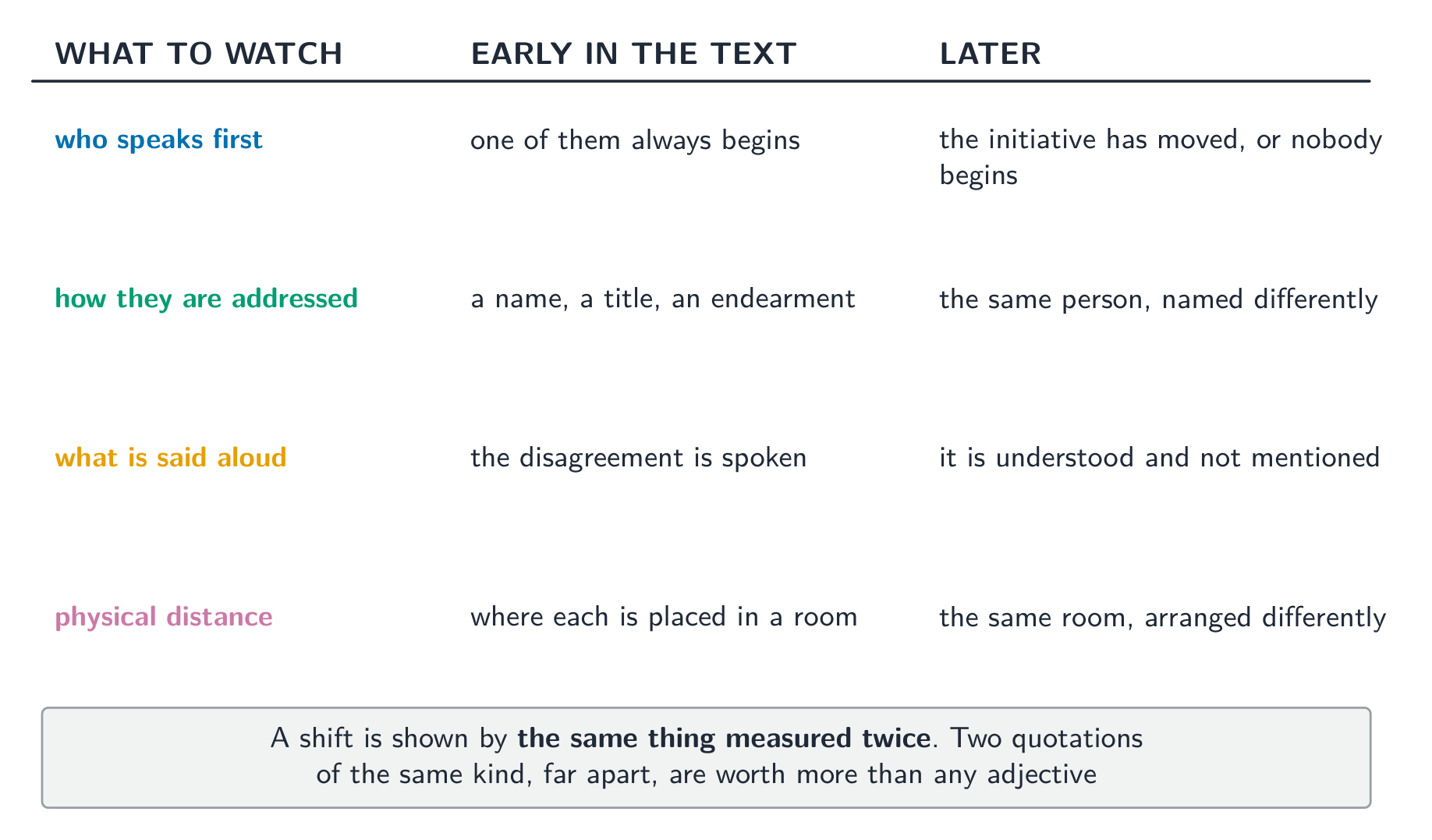
- A group or force can function as a character.
- Readers should examine how a character interacts with other characters.
- The relationship between a character and a group - including their inclusion in or exclusion from it - is significant.
The group-as-character idea is worth taking literally. A town, a family, an institution can hold values, exert pressure, and oppose a protagonist exactly as an individual antagonist would, and reading it that way often unlocks a story with no obvious opponent.
7.3
The Function of Setting in a Narrative
Syllabus
| Enduring Understanding | Learning Objective | Essential Knowledge |
|---|---|---|
SET-1 | 2.B |
|
Source: College Board AP Course and Exam Description
- When a setting changes, it may suggest other movements, changes, or shifts in the narrative.
- Settings may be contrasted to establish a conflict of values or ideas associated with them.
Contrasted settings may carry competing values. Establish the association through description and behaviour rather than assuming that every change of place encodes a conflict.
7.4
The Relationship Between Character and Setting
Syllabus
| Enduring Understanding | Learning Objective | Essential Knowledge |
|---|---|---|
SET-1 | 2.C |
|
Source: College Board AP Course and Exam Description
- The way characters interact with their surroundings provides insights about them.
- The way characters behave in or describe their surroundings reveals an attitude toward those surroundings.
7.5
How Plot Orders Events
Syllabus
| Enduring Understanding | Learning Objective | Essential Knowledge |
|---|---|---|
STR-1 | 3.A |
|
Source: College Board AP Course and Exam Description
Pacing 节奏 is the manipulation of time in a text, and several factors contribute to it - the length given to an event, the compression of long periods, the interruption of chronology.
Vocabulary
Train
| English |
|---|
| Pacing/ˈpeɪsɪŋ/ |
7.6
The Function of a Sequence of Events
Syllabus
| Enduring Understanding | Learning Objective | Essential Knowledge |
|---|---|---|
STR-1 | 3.B |
|
Source: College Board AP Course and Exam Description
Narrative pacing may evoke an emotional reaction in readers by the order in which information is revealed.
Pacing is measurable and therefore very usable as evidence. Count the pages a text gives to an afternoon and to the following decade, and interpret the disproportion alongside syntax, chronology and context. Length alone does not establish the only important event.
7.7
How a Narrator's Reliability Affects a Narrative
Syllabus
| Enduring Understanding | Learning Objective | Essential Knowledge |
|---|---|---|
NAR-1 | 4.D |
|
Source: College Board AP Course and Exam Description
Some narrators or speakers may provide details and information that others do not or cannot provide.
Compare narrators where a text offers more than one. Differences in access, emphasis or contradiction can reveal how the text directs a reader. Different access alone does not establish dishonesty.
7.8
The Function of a Symbol
Syllabus
| Enduring Understanding | Learning Objective | Essential Knowledge |
|---|---|---|
FIG-1 | 5.C |
|
Source: College Board AP Course and Exam Description
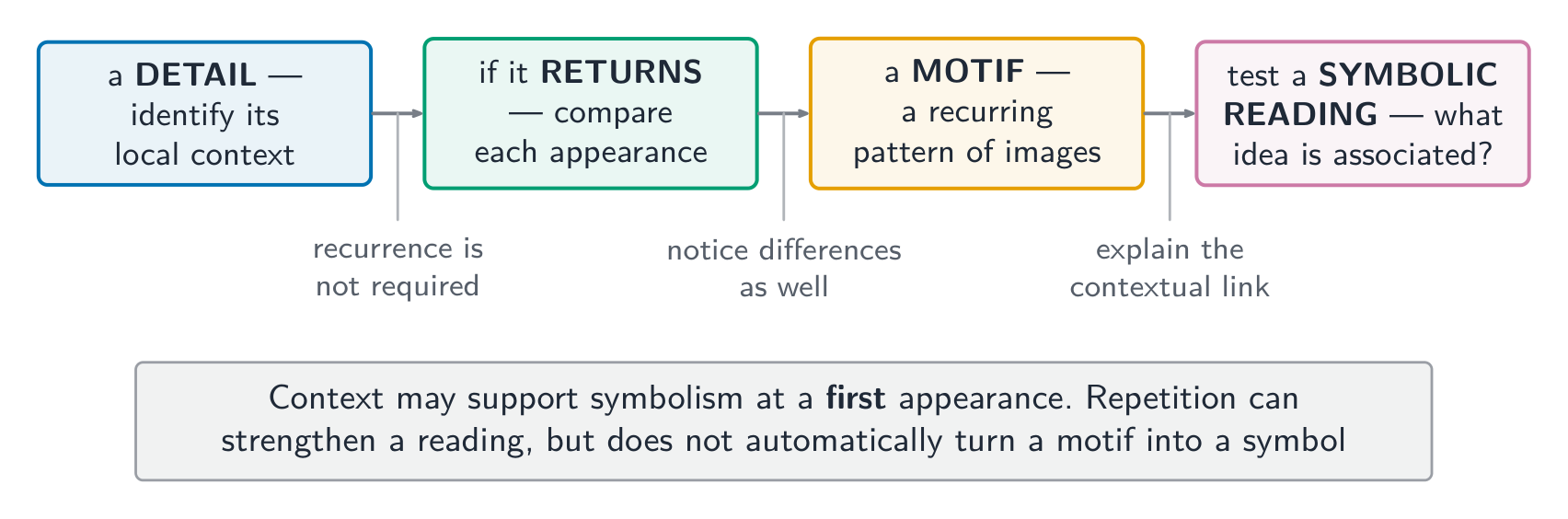
- A setting may become symbolic when it is associated with abstractions - emotions, ideas, times of life.
- Over time, some settings have developed associations so strong that they almost universally symbolise something.
Explore
Test a symbolic reading
Context can support symbolism on a first appearance. Recurrence can strengthen a reading but is not required.
7.9
The Function of an Image or Imagery
Syllabus
| Enduring Understanding | Learning Objective | Essential Knowledge |
|---|---|---|
FIG-1 | 5.D |
|
Source: College Board AP Course and Exam Description
A motif 母题 is a unified pattern of recurring objects or images used to emphasise a significant idea.
A motif differs from a symbol in that it need not stand for one thing. It accumulates: each recurrence adds to what the pattern means, so compare what changes across relevant appearances, including exceptions. Repetition makes a motif; a single detail can carry symbolic meaning when its context supports the association.
Vocabulary
Train
| English |
|---|
| motif/məʊˈtiːf/ |
7.10
The Function of a Simile
Syllabus
| Enduring Understanding | Learning Objective | Essential Knowledge |
|---|---|---|
FIG-1 | 6.A |
|
Source: College Board AP Course and Exam Description
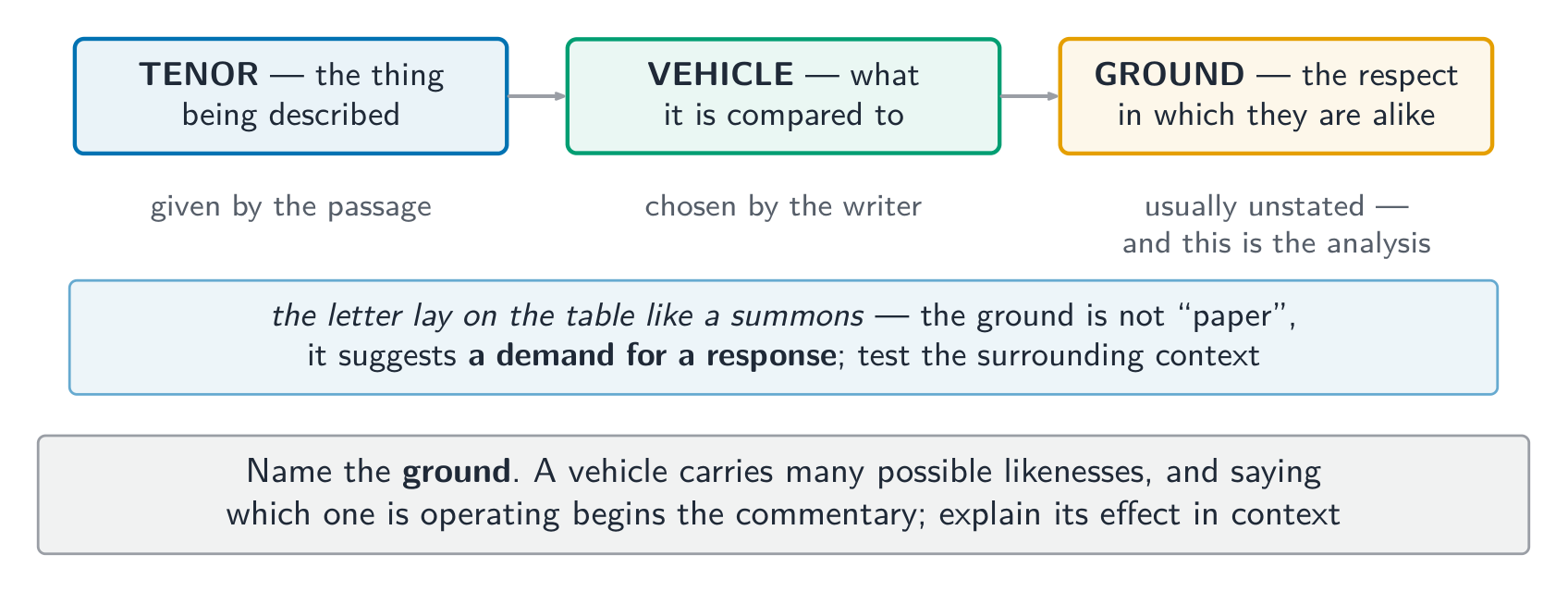
The function of a simile relies on the selection of the objects being compared as well as the traits transferred. Both halves are choices, and both can be analysed.
Explore
Name the ground of the comparison
Identify the shared quality and explain its effect in context.
7.11
The Function of Personification
Syllabus
| Enduring Understanding | Learning Objective | Essential Knowledge |
|---|---|---|
FIG-1 | 6.C |
|
Source: College Board AP Course and Exam Description
The CED adds the reverse move here: assigning the qualities of a nonhuman object, entity, or idea to a person or character - describing a person as mechanical, as weather, as an animal.
This is worth watching for, because it usually indicates a judgement. A character described in the vocabulary of machinery has been characterised, and by someone.
7.12 7.13 7.14
Developing a Literary Thesis, Commentary, and Evidence
Syllabus
| Enduring Understanding | Learning Objective | Essential Knowledge |
|---|---|---|
LAN-1 | 7.B |
|
| Enduring Understanding | Learning Objective | Essential Knowledge |
|---|---|---|
LAN-1 | 7.C |
|
| Enduring Understanding | Learning Objective | Essential Knowledge |
|---|---|---|
LAN-1 | 7.D |
|
Source: College Board AP Course and Exam Description
- Unchanged: a thesis expresses an interpretation requiring textual defence.
- New: more sophisticated literary arguments may explain the significance or relevance of an interpretation - why this reading matters, not only that it is supportable. Explain the significance with evidence; no isolated phrase guarantees a scoring point.
- New: textual evidence may require revision to an interpretation if the evidence does not support it.
Original practice passage: the ferry vote
This passage is written for teaching. It is not an extract from an AP exam.
At the council table, Nora laid the ferry petition beside the clock. The chair called her “our practical girl”, as he had before she began collecting signatures. “The bridge is the sensible choice,” he said. Nora looked through the window at the landing where her mother still waited each morning. For the first time, she heard “practical” as a request to be silent. “Practical for whom?” she asked. The chair covered the petition with his agenda. Outside, Nora unfolded it again; the paper shook like a small sail. Three years passed before the ferry returned. Nora kept the chair's agenda, its edges soft from handling.
Worked analysis: change and its limits. Nora's new interpretation of “practical” is an explicit moment of realisation. Her question challenges the chair's apparent consensus; covering the petition shows his resistance rather than a persuaded council. The later return of the ferry does not establish that her question caused the outcome.
Worked analysis: setting and imagery. The council table and agenda concentrate control, while the landing connects policy to her mother's routine. The paper “like a small sail” suggests fragility and possible movement. Context supports those qualities; it does not make the paper a literal boat. The handled agenda may represent remembered exclusion, but other readings need to explain why Nora keeps it. Symbolic interpretation requires context, not a fixed repetition count.
Worked analysis: pacing. The dialogue and gesture develop the meeting in detail, while “Three years passed before the ferry returned” compresses a long delay. This contrast gives the challenge immediacy while leaving the intervening campaign unexplained. The final handled agenda complicates a simple victory reading: the experience remains present for Nora.
Practice. Explain how the chair's treatment of Nora changes after her question. Then explain how the three-year summary limits a claim that Nora's speech alone saved the ferry. Use actual wording and distinguish the narration's evidence from an untested inference.
7.12 7.13 7.14
Exam tips
- A change needs a source (a conflict of values, or changed circumstances) and a consequence in the plot.
- An epiphany changes understanding. Check whether action follows and what happens if it does not.
- A group can function as a character. Try it on any story with no obvious antagonist.
- Contrasted settings may carry competing values; establish the link through details.
- Pacing includes space, syntax and chronology. Describe the choice and explain its effect in context.
- For a motif, compare relevant recurrences and differences. Context, not repetition alone, supports symbolic meaning.
Interactive lessons on this topic
Work through it step by step, with instant-check exercises.