| Enduring Understanding | Learning Objective | Essential Knowledge |
|---|---|---|
CHR-1 | 1.A |
|
Longer Fiction or Drama II
AP English Literature and Composition · Topic 6
 9:35
9:35
Unit 6: Longer Fiction or Drama II
Unit 6 is the second longer-fiction-or-drama unit, and it adds the two most sophisticated tools in the course: narrator reliability and the symbol. It opens…
English narration · English + 中文 subtitles burned in
6.1
What Textual Details Reveal About a Character
Syllabus
Source: College Board AP Course and Exam Description
Unit 6 is the second longer-fiction-or-drama unit and it adds the two most sophisticated tools in the course: narrator reliability and the symbol.
Different character, narrator, or speaker perspectives often reveal different information and develop different interpretations of the same events.
In a long work with several perspectives, the discrepancies between them are not a problem to reconcile. They are the text's method.
6.2
The Function of Contrasting Characters
Syllabus
| Enduring Understanding | Learning Objective | Essential Knowledge |
|---|---|---|
CHR-1 | 1.C |
|
Source: College Board AP Course and Exam Description
Foil characters 陪衬人物 serve to illuminate, through contrast, the traits, attributes, or values of another character.
A foil is not an antagonist. A foil may be an ally, a sibling, a friend - what makes them a foil is that they are similar enough for the difference to be visible. The useful question is always: what does this character have that the protagonist lacks, and what does the text do with that gap?
Vocabulary
Train
| English |
|---|
| Foil characters/fɔɪl ˈkærɪktəz/ |
6.3
Choices, Actions, and Speech Reveal Complexity
Syllabus
| Enduring Understanding | Learning Objective | Essential Knowledge |
|---|---|---|
CHR-1 | 1.E |
|
Source: College Board AP Course and Exam Description
- Inconsistencies between the private thoughts of characters and their actual behaviour reveal tensions.
- A character's competing, conflicting, or inconsistent choices contribute to complexity.
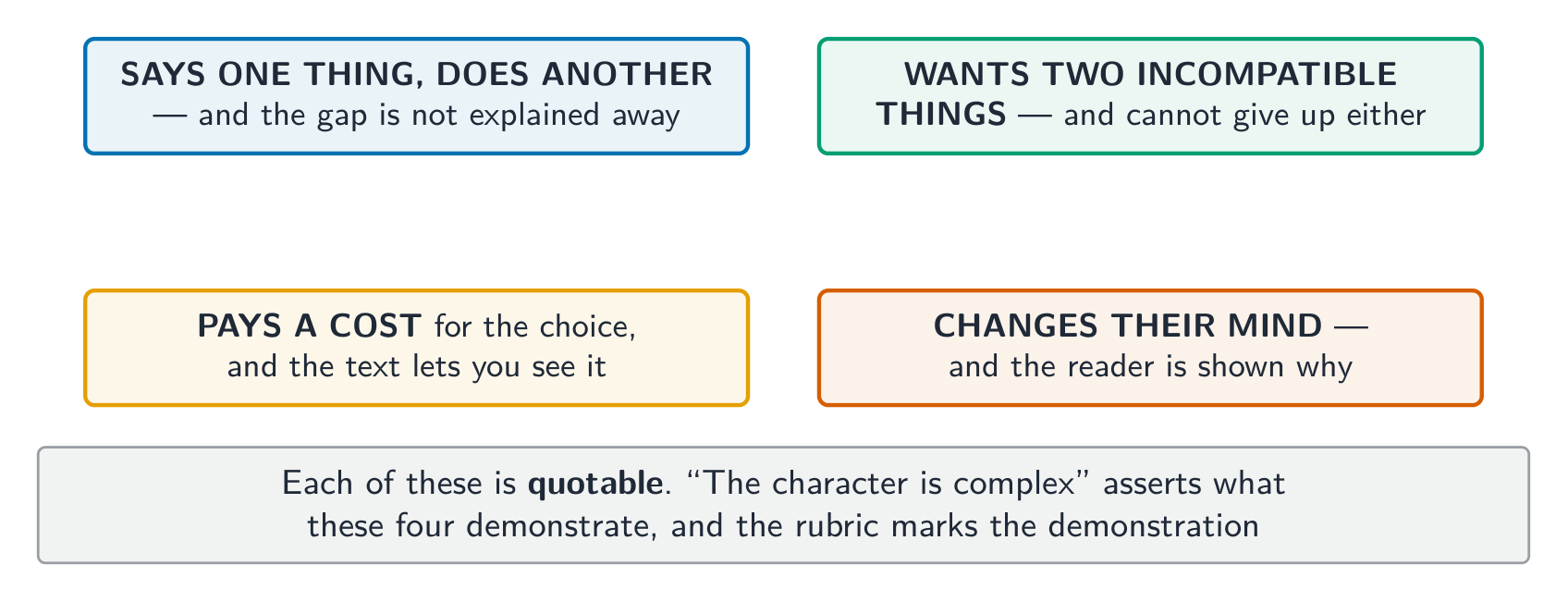
This is where AP Literature parts company with simpler reading. Inconsistency is not a flaw in a character; it is the evidence that the character has an interior. A character who always acts on what they think is a position, not a person.
Explore
Find the quotable sign of complexity
The rubric marks the demonstration, not the assertion — and each of these is something you can quote.
6.4
How Plot Orders Events
Syllabus
| Enduring Understanding | Learning Objective | Essential Knowledge |
|---|---|---|
STR-1 | 3.A |
|
Source: College Board AP Course and Exam Description
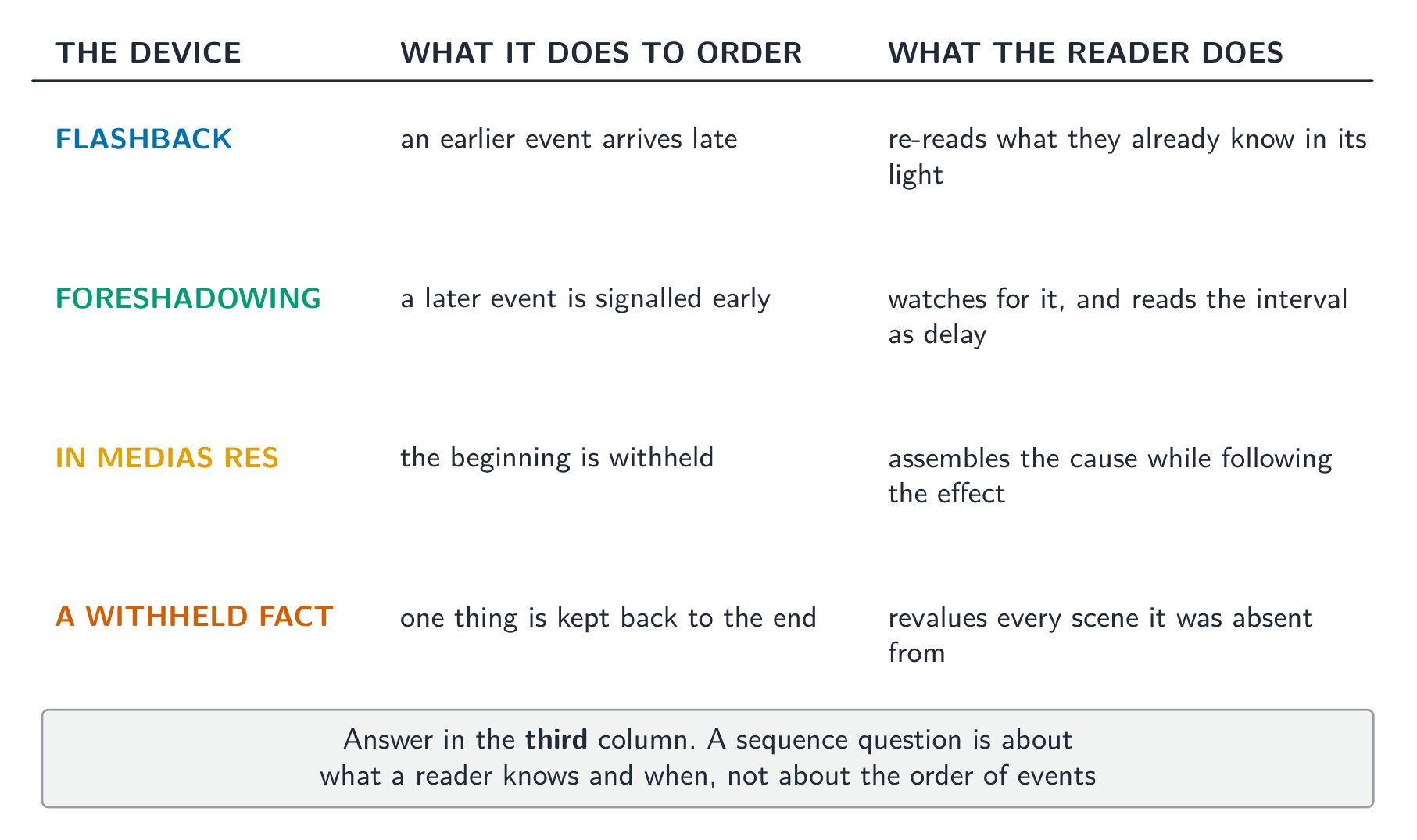
Some narrative structures interrupt the chronology of a plot: flashback 倒叙, foreshadowing 伏笔, and in medias res 从中间开始.
Vocabulary
Train
| English |
|---|
| flashback/ˈflæʃbæk/ |
| foreshadowing/fɔːˈʃædəʊɪŋ/ |
| in medias res/ɪn ˈmiːdiːəz rez/ |
6.5
The Function of a Sequence of Events
Syllabus
| Enduring Understanding | Learning Objective | Essential Knowledge |
|---|---|---|
STR-1 | 3.B |
|
Source: College Board AP Course and Exam Description
Those interrupting structures affect the reader's experience of the narrative - what is known when, and therefore what is felt when.
The analytical move is always to ask what the reader knows at that moment. Foreshadowing gives the reader knowledge the characters lack, which converts suspense into dread. A flashback withholds until a later point, so the earlier scenes are read twice - once in ignorance and once in retrospect.
Explore
Match each device to what the reader then does
A sequence question is about what a reader knows and when, not about the order of events.
6.6
The Function of Contrasts Within a Text
Syllabus
| Enduring Understanding | Learning Objective | Essential Knowledge |
|---|---|---|
STR-1 | 3.D |
|
Source: College Board AP Course and Exam Description
Contrasts often represent contradictions or inconsistencies that introduce nuance, ambiguity, or contradictory interpretations.
Note the last phrase. The CED explicitly permits a text to support more than one reading. An essay that acknowledges a competing interpretation and shows why its own is better is doing exactly what the sophistication point rewards.
6.7
Details, Diction, and Syntax Reveal Perspective
Syllabus
| Enduring Understanding | Learning Objective | Essential Knowledge |
|---|---|---|
NAR-1 | 4.C |
|
Source: College Board AP Course and Exam Description
- A narrator's or speaker's tone toward events or characters influences readers' interpretations.
- The syntactical arrangement of phrases and clauses can emphasise details or ideas.
- Information included and not included conveys the perspective of characters and narrators.
- A narrator's perspective may influence the details and the amount of detail in a text.
6.8
How a Narrator's Reliability Affects a Narrative
Syllabus
| Enduring Understanding | Learning Objective | Essential Knowledge |
|---|---|---|
NAR-1 | 4.D |
|
Source: College Board AP Course and Exam Description
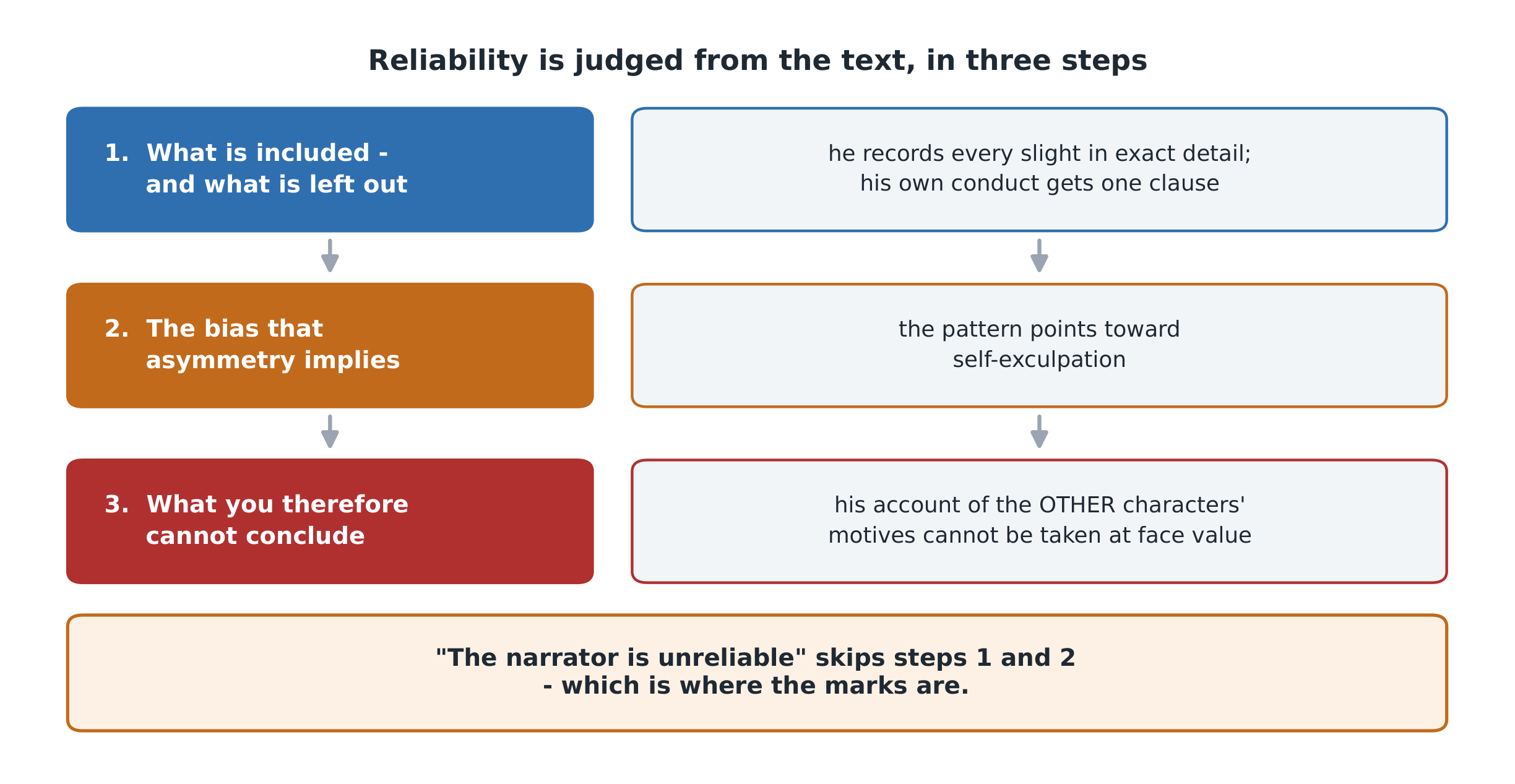
- Readers can infer narrators' biases by noting which details they choose to include and which they omit.
- Readers who detect bias in a narrator may find that narrator less reliable.
- The reliability of a narrator may influence a reader's understanding of a character's motives.
The CED gives this as a chain, and reproducing the chain is what makes an answer analytical rather than impressionistic. You do not assert that a narrator is unreliable; you show the pattern of inclusion and omission, name the bias it implies, and then say what that bias prevents you from concluding.
6.9
The Function of a Symbol
Syllabus
| Enduring Understanding | Learning Objective | Essential Knowledge |
|---|---|---|
FIG-1 | 5.C |
|
Source: College Board AP Course and Exam Description
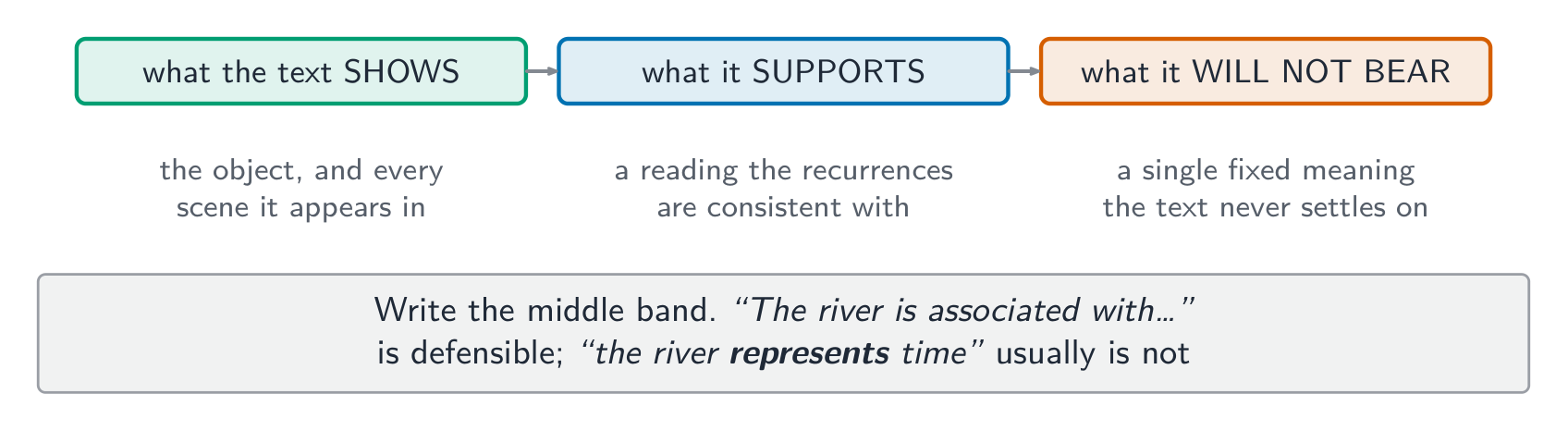
- When a material object comes to represent an idea or concept, it becomes a symbol 象征.
- When a character comes to represent an idea, that character becomes symbolic.
- A symbol is an object that represents a meaning, so it is said to be symbolic or representative of that meaning.
- Certain symbols are so common and recurrent that readers bring associations to them before reading.
The last point is a warning. A conventional symbol arrives with meanings attached, and the text may be using them, refusing them, or inverting them. Check what the text does before importing the convention.
Vocabulary
Train
| English |
|---|
| symbol/ˈsɪmbl/ |
6.10 6.11 6.12
Developing a Literary Thesis, Commentary, and Evidence
Syllabus
| Enduring Understanding | Learning Objective | Essential Knowledge |
|---|---|---|
LAN-1 | 7.B |
|
| Enduring Understanding | Learning Objective | Essential Knowledge |
|---|---|---|
LAN-1 | 7.C |
|
| Enduring Understanding | Learning Objective | Essential Knowledge |
|---|---|---|
LAN-1 | 7.D |
|
Source: College Board AP Course and Exam Description
Unchanged from Units 3-5: an interpretation requiring textual defence; a line of reasoning of claims communicated through commentary; evidence used strategically, effective with commentary, sufficient in quantity and quality, developed recursively.
6.13
Control Over the Elements of Composition
Syllabus
| Enduring Understanding | Learning Objective | Essential Knowledge |
|---|---|---|
LAN-1 | 7.E |
|
Source: College Board AP Course and Exam Description
- Writers convey ideas through the strategic selection and placement of phrases and clauses.
- Writers use words that enhance the clear communication of an interpretation.
- Punctuation conveys relationships between parts of a sentence.
Worked example (a real AP exam task). A Question 3 literary-argument prompt asks how an unreliable narrator contributes to an interpretation of a work as a whole. A weak answer asserts: "The narrator is unreliable because he lies." A scoring answer runs the CED's chain: "The narrator records every slight he received in exact detail and summarises his own conduct in a clause - 'there was an argument, and I left'. The asymmetry of detail implies a bias toward self-exculpation, which means his account of the other characters' motives cannot be taken at face value. The novel therefore asks the reader to reconstruct a story the narrator is committed to not telling, and its subject is less the events than his need to arrange them." Inclusion and omission, the bias inferred, and what that bias prevents.
6.13
Exam tips
- Discrepancies between perspectives are the method, not a problem to reconcile.
- A foil is similar enough for the difference to show. Ask what they have that the protagonist lacks.
- Inconsistency is evidence of an interior. A perfectly consistent character is a position, not a person.
- For any structural interruption, ask what the reader knows at that moment. That is the effect.
- Reliability is a chain: inclusion and omission, then bias, then what you cannot conclude. Show all three.
- With a conventional symbol, check whether the text uses, refuses, or inverts the association before importing it.
Interactive lessons on this topic
Work through it step by step, with instant-check exercises.
- Different Perspectives, Different Texts
- Foil Characters
- Complexity from Contradiction
- Structures That Interrupt Chronology
- What an Interruption Does
- Contrast as Complication
- Syntax, Selection and Perspective
- Reliability
- Symbols
- A Thesis Without the Text in Front of You
- Commentary from Memory
- Sufficient Evidence Across a Whole Work
- Coordination, Subordination, Punctuation