| Enduring Understanding | Learning Objective | Essential Knowledge |
|---|---|---|
CHR-1 | 1.A |
|
Short Fiction II
AP English Literature and Composition · Topic 4
 10:46
10:46
Unit 4: Short Fiction II
Unit 4 returns to short fiction with a much larger toolkit, and its two most valuable additions are narrative distance and the idea that choices reveal values.…
English narration · English + 中文 subtitles burned in
4.1
What Textual Details Reveal About a Character
Syllabus
Source: College Board AP Course and Exam Description
Unit 4 returns to short fiction with a much larger toolkit. Its two most valuable additions are narrative distance and the idea that choices reveal values.
- The significance of characters is often revealed through their agency 能动性 and through nuanced descriptions.
- Characters' choices - in speech, action, and inaction - reveal what they value.
That second statement is the most practical sentence in the whole course for essay-writing. Whenever you need a claim about a character, look at a choice and ask what it must be true for that choice to have made sense to them.
Vocabulary
Train
| English |
|---|
| agency/ˈeɪdʒənsi/ |
4.2
The Function of Contrasting Characters
Syllabus
| Enduring Understanding | Learning Objective | Essential Knowledge |
|---|---|---|
CHR-1 | 1.C |
|
Source: College Board AP Course and Exam Description
- The main character is the protagonist 主人公; the antagonist 对立者 opposes them.
- Protagonists and antagonists may represent contrasting values.
The word may is doing careful work. An antagonist is not necessarily a villain; the strongest antagonists hold a value the reader can also recognise as good, which is why the conflict is a conflict rather than a rout.
Vocabulary
Train
| English |
|---|
| protagonist/ˈprəʊtəɡənɪst/ |
| antagonist/ænˈtæɡənɪst/ |
4.3
Nuances in Characters' Relationships
Syllabus
| Enduring Understanding | Learning Objective | Essential Knowledge |
|---|---|---|
CHR-1 | 1.D |
|
Source: College Board AP Course and Exam Description
Conflict among characters often arises from tensions generated by their different value systems.
This is Unit 3's definition applied to relationships. Two characters in a long-running disagreement usually disagree about something prior to the argument they are having.
4.4
The Function of Setting in a Narrative
Syllabus
| Enduring Understanding | Learning Objective | Essential Knowledge |
|---|---|---|
SET-1 | 2.B |
|
Source: College Board AP Course and Exam Description
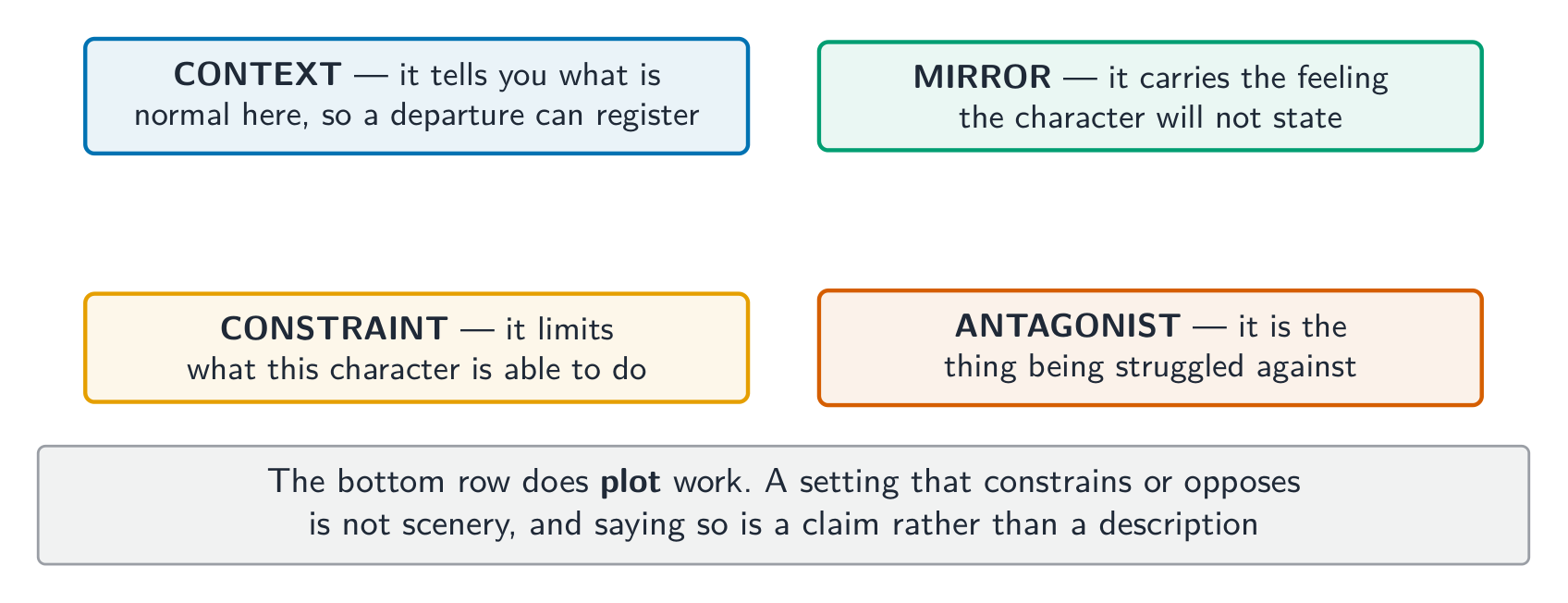
A setting may help establish the mood and atmosphere of a narrative.
Mood is the reader's feeling; atmosphere is the quality the text creates around events. Both are produced by selection - which details of a place the text mentions, and which it does not.
Explore
Sort each setting into the job it is doing
The bottom two do plot work: a setting that constrains or opposes a character is not scenery.
4.5
The Relationship Between Character and Setting
Syllabus
| Enduring Understanding | Learning Objective | Essential Knowledge |
|---|---|---|
SET-1 | 2.C |
|
Source: College Board AP Course and Exam Description
The environment a character inhabits provides information about that character.
This is a second route into character that avoids the trap of psychologising. A room described through its neglect, its order, or its borrowed furniture tells you about the person who lives there, and it is textual evidence rather than speculation.
4.6
How Plot Orders Events
Syllabus
| Enduring Understanding | Learning Objective | Essential Knowledge |
|---|---|---|
STR-1 | 3.A |
|
Source: College Board AP Course and Exam Description
Some patterns in dramatic situations are so common that they are considered archetypes 原型, and these archetypes carry associations readers bring with them.
Use archetypes carefully: recognising one is a starting point, and the interesting analysis is almost always where a text departs from the pattern it invoked.
Vocabulary
Train
| English |
|---|
| archetypes/ˈɑːkɪtaɪps/ |
4.7
The Function of Contrasts Within a Text
Syllabus
| Enduring Understanding | Learning Objective | Essential Knowledge |
|---|---|---|
STR-1 | 3.D |
|
Source: College Board AP Course and Exam Description
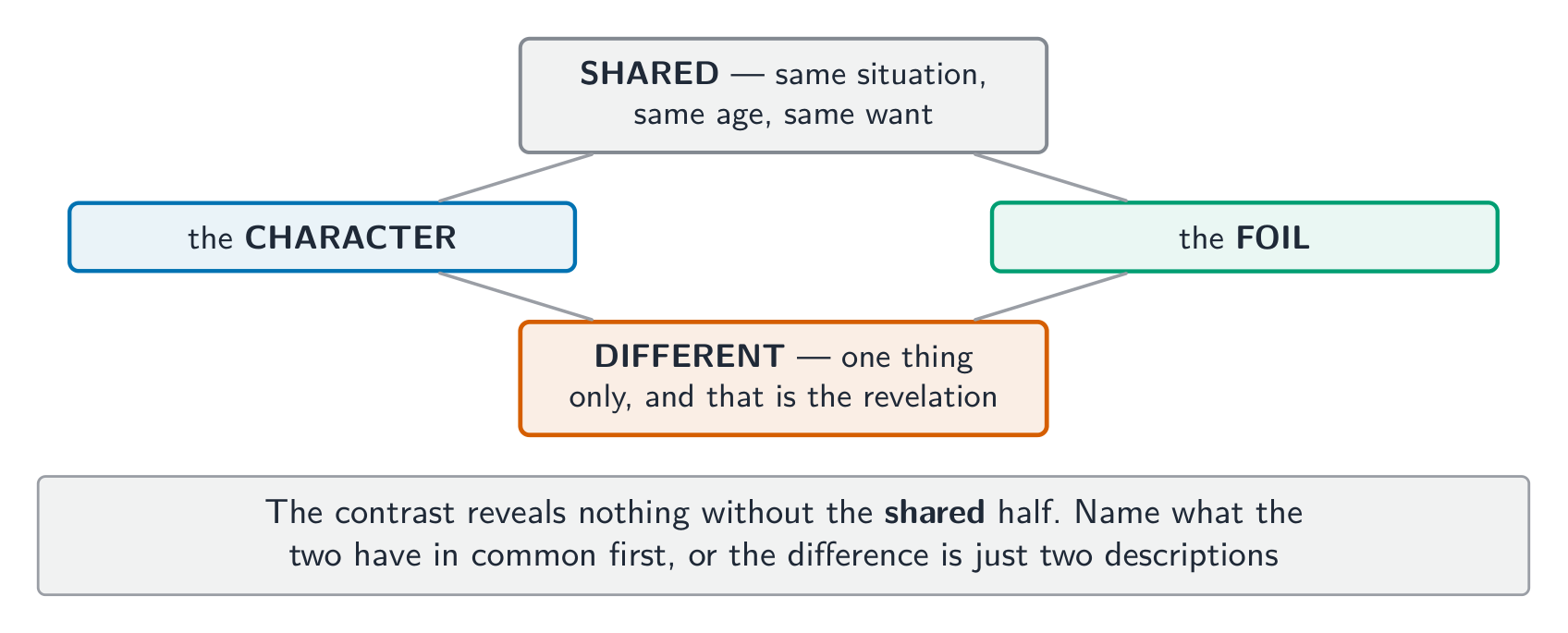
- The differences highlighted by a contrast emphasise particular traits or characteristics in the things contrasted.
- Contrasts often represent conflicts in values related to character, narrator, or speaker perspectives.
4.8
Identifying the Narrator or Speaker
Syllabus
| Enduring Understanding | Learning Objective | Essential Knowledge |
|---|---|---|
NAR-1 | 4.A |
|
Source: College Board AP Course and Exam Description
Narrators may function as characters who directly address readers, and who either recall events or relate them as they occur.
That distinction - recalling versus relating as they occur - is the first axis of narrative distance below.
4.9
The Function of Point of View
Syllabus
| Enduring Understanding | Learning Objective | Essential Knowledge |
|---|---|---|
NAR-1 | 4.B |
|
Source: College Board AP Course and Exam Description
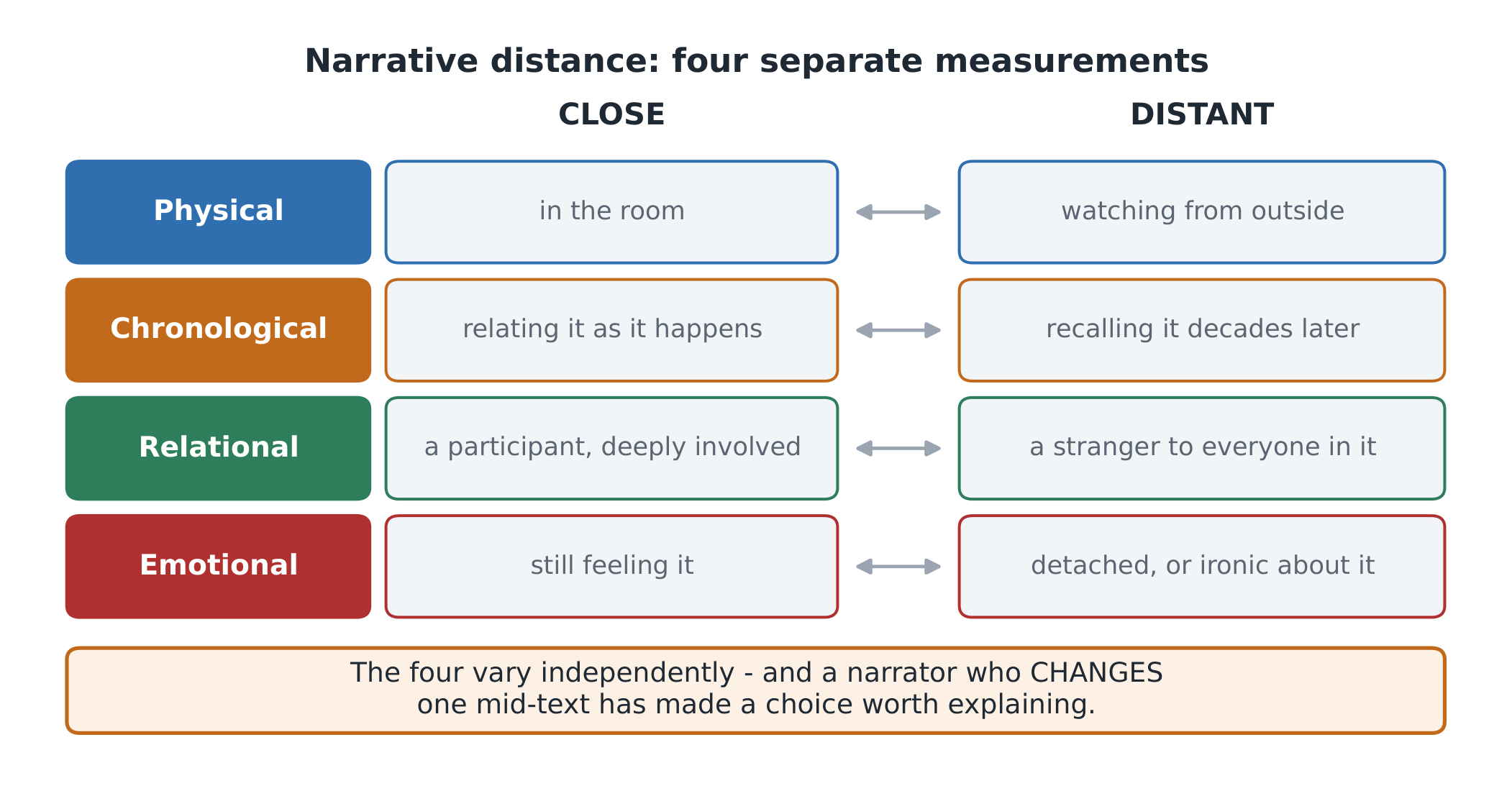
- Narrative distance 叙述距离 refers to the physical distance, chronological distance, relationships, or emotional distance between the narrator and the events or characters.
- Stream of consciousness 意识流 is narration in which a character's thoughts are related through a continuous flow, often with little conventional ordering.
Narrative distance is the most powerful and least-used tool in this course. A narrator recounting their childhood forty years later is chronologically distant, and that distance supplies irony the child could not have had. Reduce the distance - a narrator relating events as they occur - and the irony vanishes, replaced by immediacy and unreliability.
Vocabulary
Train
| English |
|---|
| Narrative distance/ˈnærətɪv ˈdɪstəns/ |
| Stream of consciousness/striːm ɒv ˈkɒnʃəsnəs/ |
4.10
Details, Diction, and Syntax Reveal Perspective
Syllabus
| Enduring Understanding | Learning Objective | Essential Knowledge |
|---|---|---|
NAR-1 | 4.C |
|
Source: College Board AP Course and Exam Description
- Narrators' and characters' backgrounds and perspectives shape the tone they convey.
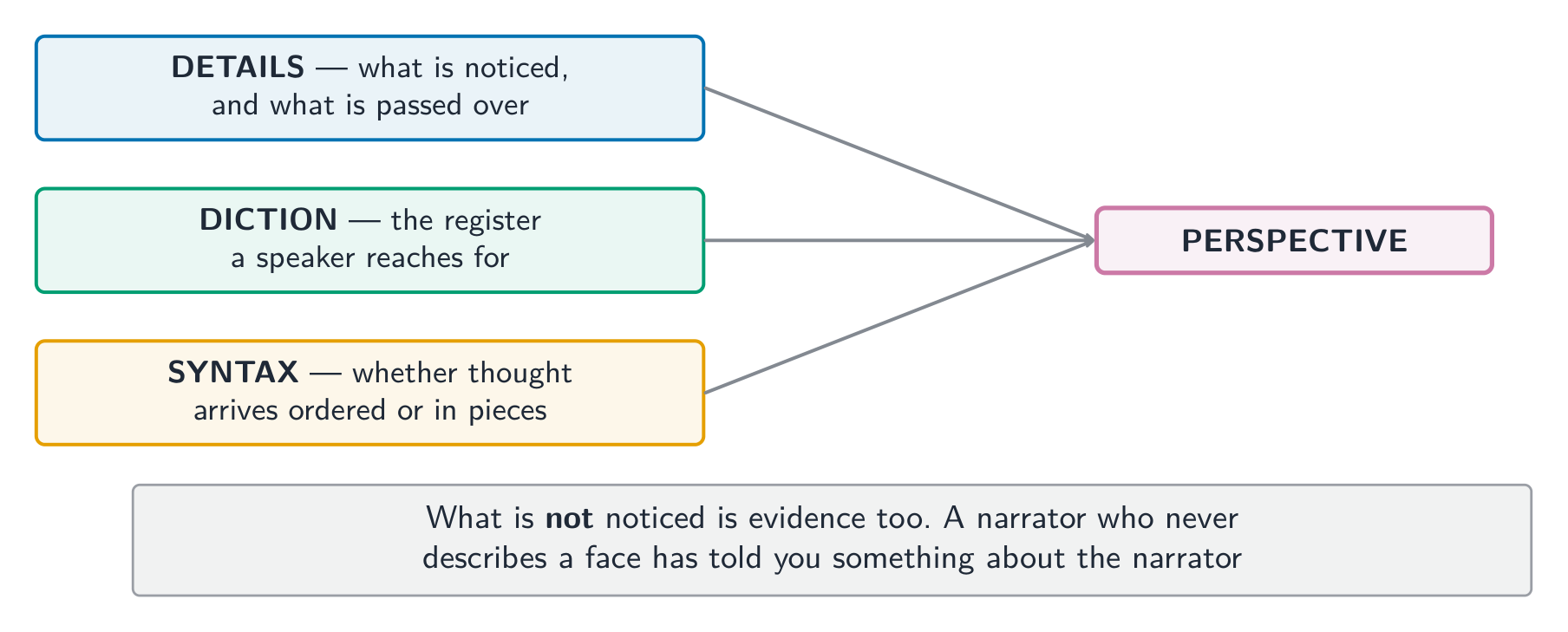
- Descriptive words not only qualify what they describe but convey a perspective toward it.
- The attitude of a narrator or speaker toward an idea, character, or situation emerges from these choices.
Explore
Build a perspective from three observables
What is not noticed is evidence too: a narrator who never describes a face has told you something.
4.11
Developing a Literary Thesis Statement
Syllabus
| Enduring Understanding | Learning Objective | Essential Knowledge |
|---|---|---|
LAN-1 | 7.B |
|
Source: College Board AP Course and Exam Description
Unchanged: a thesis expresses an interpretation and requires textual defence; it may preview the line of reasoning.
4.12
Developing Commentary
Syllabus
| Enduring Understanding | Learning Objective | Essential Knowledge |
|---|---|---|
LAN-1 | 7.C |
|
Source: College Board AP Course and Exam Description
- A line of reasoning is the logical sequence of claims defending the thesis, communicated through commentary.
- Body paragraphs develop the reasoning and justify claims using evidence.
- Effective paragraphs are cohesive and often use topic sentences 主题句 to state a claim and explain the reasoning.
Vocabulary
Train
| English |
|---|
| topic sentences/ˈtɒpɪk ˈsentənsɪz/ |
4.13
Selecting Relevant and Sufficient Evidence
Syllabus
| Enduring Understanding | Learning Objective | Essential Knowledge |
|---|---|---|
LAN-1 | 7.D |
|
Source: College Board AP Course and Exam Description
Same four points as Unit 3: evidence used strategically; effective when commentary explains the relationship; sufficient in quantity and quality; and interpretation as a recursive process.
4.14
Control Over the Elements of Composition
Syllabus
| Enduring Understanding | Learning Objective | Essential Knowledge |
|---|---|---|
LAN-1 | 7.E |
|
Source: College Board AP Course and Exam Description
Coherence occurs at different levels - within a sentence, between sentences, across the essay - and writers achieve it when the arrangement of reasons, evidence, and details makes the line of reasoning followable.
Worked example (a real AP exam task). A prose fiction prompt asks how the author's narrative choices convey the narrator's attitude to a remembered event. A weak answer: "The narrator is nostalgic and uses descriptive language." A scoring answer uses narrative distance: "The narrator relates a single afternoon from a distance of decades, and the distance is doing the work: he describes his own excitement in the third person - 'the boy ran' - before returning to 'I' for the disappointment. Choosing where to close the chronological gap lets him withhold sympathy from his younger self while claiming the loss as his own." Distance, its variation, and the attitude it produces.
4.14
Exam tips
- Choices reveal values. Ask what must have been true for the choice to make sense to that character.
- An antagonist is not a villain. The strongest hold a value the reader can also recognise as good.
- The environment tells you about the character - and it is textual evidence, not speculation.
- Archetypes are a starting point. The analysis is where the text departs from the pattern.
- Narrative distance has four kinds - physical, chronological, relational, emotional. It is the most underused tool here.
- A narrator who closes or opens the distance mid-text has made a choice. Say what it produces.
Interactive lessons on this topic
Work through it step by step, with instant-check exercises.
- Agency and What Characters Value
- Protagonist and Antagonist
- Nuance in Relationships
- What a Setting Does
- Character and Environment
- Patterns and Expectations
- What a Contrast Emphasises
- Narrators Who Address You
- Narrative Distance
- Where Tone Comes From
- A Thesis for a Given Prompt
- Body Paragraphs and Topic Sentences
- Choosing Evidence from a Short Passage
- Coherence at Three Levels