English
| Core | Supplement |
|---|---|
| 1 Identify physical and chemical changes, and describe the differences between them |
日本語
| コア | サプリメント |
|---|---|
| 1 物理変化および化学変化を識別し、それらの違いを説明する |
IGCSE Chemistry · IGCSE 化学 · Topic 6 · トピック 6
 15:53
15:53
反応速度と平衡
台所の上の牛乳は一日で腐ります。冷蔵庫では一週間持ちます。同じ牛乳ですが、反応の進行速度が異なります。まずquick check:化学…
English narration · English + 中文 subtitles burned in · 英語ナレーション・英語+中文字幕 burning-in

| Core | Supplement |
|---|---|
| 1 Identify physical and chemical changes, and describe the differences between them |
| コア | サプリメント |
|---|---|
| 1 物理変化および化学変化を識別し、それらの違いを説明する |
Source: Cambridge International syllabus · 出典: Cambridge International シラバス
A physical change 物理变化 does not make a new substance. The substance only changes its state or shape, and the change can usually be reversed. Melting ice and dissolving sugar are physical changes.
A chemical change 化学变化 (a chemical reaction) makes one or more new substances and is usually hard to reverse. Signs of a chemical change include a colour change, a gas being given off, an energy change, or a precipitate 沉淀 (a solid) forming.
| Physical change | Chemical change |
|---|---|
| no new substance made | new substance(s) made |
| easy to reverse | usually hard to reverse |
| e.g. melting, boiling, dissolving | e.g. burning, rusting |
物理変化では新たな物質は生成されない。物質の状態や形状のみが変化し、通常は逆転可能である。氷の溶解や砂糖の溶解は物理変化である。
化学変化(化学反応)は、1つ以上の新しい物質を生成し、通常は逆転させることが困難です。化学変化の兆候には、色の変化、ガスの発生、エネルギーの変化、または沈殿(固体)の生成が含まれます。
| 物理変化 | 化学変化 |
|---|---|
| 新しい物質は生成されない | 新しい物質が生成される |
| 容易に逆転できる | 通常は逆転が困難 |
| 例:融解、沸騰、溶解 | 例:燃焼、錆び |
Step through the difference. A physical change makes no new substance and is usually easy to reverse; a chemical change makes a new substance and is hard to undo. · 違いを確認しましょう。物理変化では新しい物質は生成せず、通常容易に元に戻せます;化学変化では新しい物質が生成され、元に戻すのは困難です。

| Core | Supplement |
|---|---|
| 5 Describe collision theory in terms of: (a) number of particles per unit volume (b) frequency of collisions between particles (c) kinetic energy of particles (d) activation energy, $E_a$ | |
| 1 Describe the effect on the rate of reaction of: (a) changing the concentration of solutions (b) changing the pressure of gases (c) changing the surface area of solids (d) changing the temperature (e) adding or removing a catalyst, including enzymes | 6 Describe and explain the effect on the rate of reaction of: (a) changing the concentration of solutions (b) changing the pressure of gases (c) changing the surface area of solids (d) changing the temperature (e) adding or removing a catalyst, including enzymes using collision theory |
| 2 State that a catalyst increases the rate of a reaction and is unchanged at the end of a reaction | 7 State that a catalyst decreases the activation energy, $E_a$, of a reaction |
| 3 Describe practical methods for investigating the rate of a reaction including change in mass of a reactant or a product and the formation of a gas | 8 Evaluate practical methods for investigating the rate of a reaction including change in mass of a reactant or a product and the formation of a gas |
| 4 Interpret data, including graphs, from rate of reaction experiments |
| コア | サプリメント |
|---|---|
| 5 衝突理論を以下の観点から説明せよ:(a) 単位体積あたりの粒子数 (b) 粒子間の衝突頻度 (c) 粒子の運動エネルギー (d) 活性化エネルギー $E_a$ | |
| 1 反応速度に与える影響を記述せよ:(a) 溶液の濃度の変更 (b) 気体の圧力の変更 (c) 固体の表面積の変更 (d) 温度の変更 (e)触媒(酵素を含む)の添加または除去 | 6 衝突理論を用いて、反応速度に与える影響を説明せよ:(a) 溶液の濃度の変更 (b) 気体の圧力の変更 (c) 固体の表面積の変更 (d) 温度の変更 (e)触媒(酵素を含む)の添加または除去 |
| 2 触媒は反応の速度を増加させ、反応の終了後には変化しないことを述べよ | 7 触媒は反応の活性化エネルギー $E_a$ を減少させることを述べよ |
| 3 反応速度を調べるための実験手法を記述せよ。反応物または生成物の質量の変化および気体の生成を含む | 8 反応速度を調べるための実験手法を評価せよ。反応物または生成物の質量の変化および気体の生成を含む |
| 4 反応速度の実験から得られたデータ(グラフを含む)を解釈せよ |
Source: Cambridge International syllabus · 出典: Cambridge International シラバス
The rate of reaction 反应速率 tells you how fast the reactants 反应物 change into products 生成物.
Collision theory 碰撞理论 explains what controls the rate. For a reaction to happen, the particles 粒子 must collide 碰撞, and they must collide with enough energy. The least energy they need is the activation energy 活化能 ($E_a$). A faster rate happens when the particles have successful collisions more often.
| Change | Effect | Reason (collision theory) |
|---|---|---|
| increase concentration 浓度 of a solution | faster | more particles in the same volume, so collisions happen more often |
| increase pressure 压强 of gases | faster | particles are pushed closer, so collisions happen more often |
| increase surface area 表面积 of a solid | faster | more particles are exposed, so collisions happen more often |
| increase temperature | faster | particles gain kinetic energy 动能 and move faster, so collisions are more frequent and more of them have enough energy |
| add a catalyst 催化剂 | faster | the catalyst lowers the activation energy, so more collisions are successful |
A catalyst speeds up a reaction but is not used up — it is unchanged at the end. It works by lowering the activation energy. Enzymes 酶 are biological catalysts (catalysts that work in living things).
You can follow a reaction over time in these ways:
On a graph of product against time, the line is steepest at the start (fastest rate), becomes less steep as reactants are used up, and goes flat when the reaction has finished.
反応速度は、反応物から生成物への変化がどの速さで起こるかを示します。
衝突理論は、反応速度を支配する要因を説明します。反応が起こるためには、粒子同士が衝突し、かつ十分なエネルギーを持って衝突する必要があります。必要な最小限のエネルギーを活性エネルギー($E_a$)といいます。粒子の成功する衝突回数が増えると、反応速度は速くなります。
| 変化 | 効果 | 理由(衝突理論) |
|---|---|---|
| 溶液の濃度を上げる | 速くなる | 同じ体積内の粒子数が増えるため、衝突の機会が増える |
| 気体の圧力を上げる | 速くなる | 粒子が押し寄せ合うため、衝突の機会が増える |
| 固体の表面積を broaden | 速くなる | 露出した粒子数が増えるため、衝突の機会が増える |
| 温度を上げる | 速くなる | 粒子は運動エネルギーを得て速く動くため、衝突の頻度が高まり、かつ十分のエネルギーを持つ衝突が増える |
| 触媒を加える | 速くなる | 触媒は活性エネルギーを下げるため、成功する衝突の割合が増える |

触媒は反応を加速しますが、消費されません。反応の最終的に変化することはありません。活性エネルギーを下げることで機能します。酵素は生物学的な触媒(生体内で機能する触媒)です。

反応を時間経過とともに追跡する方法として、以下のようなものがあります:

生成物を横軸に時間をとったグラフにおいて、曲線は始点で最も急(反応速度が最大)になり、反応物が消費されるにつれて緩やかになり、反応が終わると水平になります。

The gradient of the volume–time curve is the rate; it is steepest at the start and flattens as reactants run out. · 体積-時間曲線の傾きは速度であり、始点で最も急で、試薬が尽きるにつれて緩やかになる。
conc = c₀·bᵗ
Concentration falls over time — fast at first, then slower. · 濃度は時間とともに 低下 する — 最初は速く、後に遅くなる。
Watch the particles collide. Heat speeds them up so they collide more often and harder; more particles or a catalyst give more successful collisions — the rate climbs. · 粒子が衝突する様子を見る。熱は粒子を加速させ、衝突の頻度と強さを増します;より多くの粒子や触媒はより成功した衝突をもたらす — 速度は上昇する。
| English | 日本語 |
|---|---|
| physical change/ˈfɪzɪkl tʃeɪndʒ/ | 物理変化 |
| chemical change/ˈkemɪkl tʃeɪndʒ/ | 化学変化 |
| precipitate/prɪˈsɪpɪteɪt/ | 沈殿物 |
| rate of reaction/reɪt ɒv rɪˈækʃn/ | 反応速度 |
| reactants/rɪˈæktənts/ | 反応物である |
| products/ˈprɒdʌkts/ | 生成物 |
| collision theory/kəˈlɪʒn ˈθɪəri/ | 衝突理論 |
| particles/ˈpɑːtɪklz/ | 粒子 |
| collide/kəˈlaɪd/ | 衝突 |
| activation energy/ˌæktɪˈveɪʃn ˈenədʒi/ | 活性化エネルギー |
| concentration/ˌkɒnsənˈtreɪʃn/ | 濃度 |
| pressure/ˈpreʃə/ | 圧力 |
| surface area/ˈsɜːfɪs ˈeərɪə/ | 表面積 |
| kinetic energy/kɪˈnetɪk ˈenədʒi/ | 運動エネルギー |
| catalyst/ˈkætəlɪst/ | 触媒 |
| enzymes/ˈenzaɪmz/ | 酵素 |
| syringe/sɪˈrɪndʒ/ | 注射器 |
| reversible reaction/rɪˈvɜːsɪbl rɪˈækʃn/ | 可逆反応 |
| hydrated/haɪˈdreɪtɪd/ | 水和物(_attrated_) |
| anhydrous/ænˈhaɪdrəs/ | 無水物(_anhydrous_) |
| closed system/kləʊzd ˈsɪstəm/ | 閉じた系 |

| Core | Supplement |
|---|---|
| 1 State that some chemical reactions are reversible as shown by the symbol $\rightleftharpoons$ | 3 State that a reversible reaction in a closed system is at equilibrium when: (a) the rate of the forward reaction is equal to the rate of the reverse reaction (b) the concentrations of reactants and products are no longer changing |
| 2 Describe how changing the conditions can change the direction of a reversible reaction for: (a) the effect of heat on hydrated compounds (b) the addition of water to anhydrous compounds limited to copper(II) sulfate and cobalt(II) chloride | 4 Predict and explain, for a reversible reaction, how the position of equilibrium is affected by: (a) changing temperature (b) changing pressure (c) changing concentration (d) using a catalyst using information provided |
| 5 State the symbol equation for the production of ammonia in the Haber process, $\text{N}_2\text{(g)} + 3\text{H}_2\text{(g)} \rightleftharpoons 2\text{NH}_3\text{(g)}$ | |
| 6 State the sources of the hydrogen (methane) and nitrogen (air) in the Haber process | |
| 7 State the typical conditions in the Haber process as $450\text{ }^{\circ}\text{C}$, $20\,000\text{ kPa}/200\text{ atm}$ and an iron catalyst | |
| 8 State the symbol equation for the conversion of sulfur dioxide to sulfur trioxide in the Contact process, $2\text{SO}_2\text{(g)} + \text{O}_2\text{(g)} \rightleftharpoons 2\text{SO}_3\text{(g)}$ | |
| 9 State the sources of the sulfur dioxide (burning sulfur or roasting sulfide ores) and oxygen (air) in the Contact process | |
| 10 State the typical conditions for the conversion of sulfur dioxide to sulfur trioxide in the Contact process as $450\text{ }^{\circ}\text{C}$, $200\text{ kPa}/2\text{ atm}$ and a vanadium(V) oxide catalyst | |
| 11 Explain, in terms of rate of reaction and position of equilibrium, why the typical conditions stated are used in the Haber process and in the Contact process, including safety considerations and economics |
| コア | サプリメント |
|---|---|
| 1 化学反応の一部是可逆であること、その表現に使用される記号 $\rightleftharpoons$ を述べよ | 3 密閉系における可逆反応が平衡状態にあるとき、以下の条件が満たされることを述べよ:(a) 正反応の速度が逆反応の速度と等しい (b) 反応物および生成物の濃度が一定となる |
| 2 可逆反応の進行方向が条件の変化によってどのように変化するかを記述せよ:(a) 熱による水素化物の影響 (b) 無水化合物への水の添加(銅(II)硫酸塩およびコバルト(II)塩化物のみ) | 4 提供された情報を用いて、可逆反応において平衡位置が以下のように影響を受けることを予測し説明せよ:(a) 温度の変更 (b) 圧力の変更 (c) 濃度の変更 (d) 触媒の使用 |
| 5 ハーバー法によるアンモニア合成の記号方程式 $\text{N}_2\text{(g)} + 3\text{H}_2\text{(g)} \rightleftharpoons 2\text{NH}_3\text{(g)}$ を述べよ | |
| 6 ハーバー法における水素(メタン)および窒素(空気)の原料を述べよ | |
| 7 ハーバー法の一般的な反応条件として $450\text{ }^{\circ}\text{C}$、$20\,000\text{ kPa}/200\text{ atm}$ および鉄触媒を述べよ | |
| 8 コンタクト法による二酸化硫黄から三酸化硫黄への変換の記号方程式 $2\text{SO}_2\text{(g)} + \text{O}_2\text{(g)} \rightleftharpoons 2\text{SO}_3\text{(g)}$ を述べよ | |
| 9 コンタクト法における二酸化硫黄(硫黄の燃焼または硫化鉱石の焙煎)および酸素(空気)の原料を述べよ | |
| 10 コンタクト法における二酸化硫黄から三酸化硫黄への変換のための一般的な反応条件として $450\text{ }^{\circ}\text{C}$、$200\text{ kPa}/2\text{ atm}$ および五酸化二バナジウム触媒を述べよ | |
| 11 ハーバー法およびコンタクト法で用いられる一般的な反応条件が採用される理由を、反応速度と平衡位置の観点から説明せよ。安全性および経済性の考慮点を含む |
Source: Cambridge International syllabus · 出典: Cambridge International シラバス
Some reactions are reversible 可逆反应: the products can react to form the reactants again. We show this with the symbol $\rightleftharpoons$.
A clear example uses hydrated 水合 and anhydrous 无水 compounds:
Adding water to the anhydrous solid (and seeing the colour return) is used as a test for water.
In a closed system 密闭系统 (where nothing enters or leaves), a reversible reaction reaches equilibrium 平衡 when:
The position of equilibrium 平衡位置 tells you whether there are more reactants or more products. You can move it:
The Haber process 哈伯法 makes ammonia:
The Contact process 接触法 turns sulfur dioxide into sulfur trioxide:
The conditions are a compromise 折中:
ある反応は可逆的です。生成物が再び反応して反応物に戻ることができます。これを記号 $\rightleftharpoons$ で表します。
明確な例として、水合化合物と無水化合物が挙げられます:
無水固体に水を加えて色が変わることを確認することは、水の検出法として用いられます。
外部との物質交換がない閉鎖系において、可逆反応は次の条件が満たされたときに平衡状態になります:
平衡位置は、反応物と生成物のどちらが多いかを示します。これを以下のように変更できます:
ハーバー法はアンモニアを製造します:
コンタクト法は、二酸化硫黄を三酸化硫黄に変換します:
これらの条件は妥協点です:
Change temperature, pressure or concentration and watch a reversible reaction shift to a new balance. · 温度、圧力、または濃度を変化させ、可逆反応が新しい平衡へシフトする様子を見よ。
| English | 日本語 |
|---|---|
| equilibrium/ˌiːkwɪˈlɪbrɪəm/ | 平衡 |
| forward reaction/ˈfɔːwəd rɪˈækʃn/ | 順反応 |
| reverse reaction/rɪˈvɜːs rɪˈækʃn/ | 逆反応 |
| position of equilibrium/pəˈzɪʃn ɒv ˌiːkwɪˈlɪbrɪəm/ | 平衡の位置 |
| endothermic/ˌendəʊˈθɜːmɪk/ | 吸熱反応 |
| exothermic/eɡzəˈðɜːmɪk/ | 発熱反応 |
| Haber process/ˈheɪbə ˈprəʊses/ | ハーバー法 |
| hydrogen/ˈhaɪdrədʒn/ | 水素 |
| methane/ˈmiːθeɪn/ | メタン |
| nitrogen/ˈnaɪtrədʒn/ | 窒素 |
| iron/ˈaɪən/ | 鉄 |
| Contact process/ˈkɒntækt ˈprəʊses/ | コンタクト法 |
| sulfur/ˈsʌlfɜː/ | 硫黄 |
| oxygen/ˈɒksɪdʒn/ | 酸素 |
| vanadium(V) oxide/væˈneɪdɪəm ˈɒksaɪd/ | 五酸化バナジウム |
| compromise/ˈkɒmprəmaɪz/ | 妥協 |

| Core | Supplement |
|---|---|
| 1 Use a Roman numeral to indicate the oxidation number of an element in a compound | |
| 2 Define redox reactions as involving simultaneous oxidation and reduction | |
| 3 Define oxidation as gain of oxygen and reduction as loss of oxygen | 6 Define oxidation in terms of: (a) loss of electrons (b) an increase in oxidation number |
| 7 Define reduction in terms of: (a) gain of electrons (b) a decrease in oxidation number | |
| 4 Identify redox reactions as reactions involving gain and loss of oxygen | 8 Identify redox reactions as reactions involving gain and loss of electrons |
| 5 Identify oxidation and reduction in redox reactions | 9 Identify redox reactions by changes in oxidation number using: (a) the oxidation number of elements in their uncombined state is zero (b) the oxidation number of a monatomic ion is the same as the charge on the ion (c) the sum of the oxidation numbers in a compound is zero (d) the sum of the oxidation numbers in an ion is equal to the charge on the ion |
| 10 Identify redox reactions by the colour changes involved when using acidified aqueous potassium manganate(VII) or aqueous potassium iodide | |
| 11 Define an oxidising agent as a substance that oxidises another substance and is itself reduced | |
| 12 Define a reducing agent as a substance that reduces another substance and is itself oxidised | |
| 13 Identify oxidising agents and reducing agents in redox reactions |
| コア | サプリメント |
|---|---|
| 1 化合物中の元素の酸化数を示すためにローマ数字を使用せよ | |
| 2 酸化還元反応が酸化的反応と還元的反応が同時に起こる反応であることを定義せよ | |
| 3 酸化を酸素の付加、還元を酸素の脱離として定義せよ | 6 酸化を以下の観点から定義せよ:(a) 電子の放出 (b) 酸化数の増加 |
| 7 還元を以下の観点から定義せよ:(a) 電子の取得 (b) 酸化数の減少 | |
| 4 酸化還元反応が酸素の付加および脱離を伴う反応であることを特定せよ | 8 酸化還元反応が電子の付加および脱離を伴う反応であることを特定せよ |
| 5 酸化還元反応における酸化および還元の特定 | 9 酸化数の変化を用いて酸化還元反応を特定せよ:(a) 単体状態の元素の酸化数はゼロである (b) 単原子イオンの酸化数はイオンの電荷と同じである (c) 化合物内の酸化数の総和はゼロである (d) イオン内の酸化数の総和はイオンの電荷に等しい |
| 10 酸性化aqueousカリウムマンガン酸(VII)またはaqueousカリウムヨウ化物を用いた際の色変化に基づき、酸化還元反応を特定せよ | |
| 11 酸化剤を、他の物質を酸化自身は還元される物質として定義せよ | |
| 12 還元剤を、他の物質を還元自身は酸化される物質として定義せよ | |
| 13 酸化還元反応における酸化剤および還元剤の特定 |
Source: Cambridge International syllabus · 出典: Cambridge International シラバス
Oxidation 氧化 and reduction 还原 always happen at the same time, in what is called a redox reaction 氧化还原反应. ('Redox' is short for reduction–oxidation.)
There are three ways to describe oxidation and reduction:
A useful memory aid is OIL RIG: Oxidation Is Loss, Reduction Is Gain — of electrons.
The oxidation number is shown by a Roman numeral, as in iron(II) and iron(III). The rules are:
Worked example. Find the oxidation number of manganese in the manganate(VII) ion, $\text{MnO}_4^{-}$. Each oxygen is $-2$, and there are four of them, giving $4 \times (-2) = -8$. The oxidation numbers in an ion must add up to the charge on the ion, which here is $-1$. So if manganese is $x$, then $x + (-8) = -1$, giving $x = +7$ - exactly what the (VII) in the name tells you. Set the total to the ion's charge, not to zero: zero is only for a neutral compound.
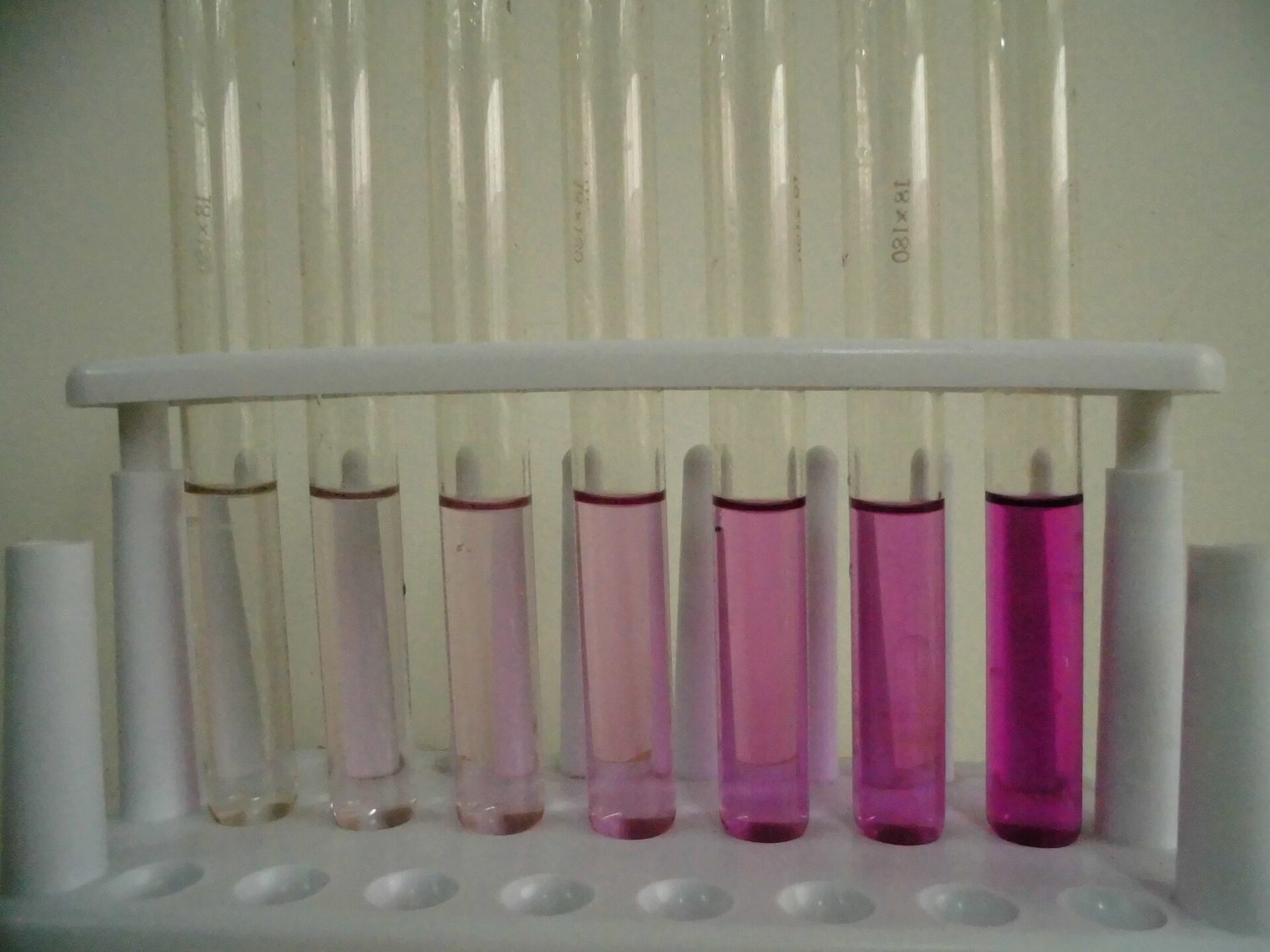
Some redox reactions show clear colour changes:
酸化と還元は常に同時に起こり、これを酸化還元反応と呼びます。(「Redox」は reduction–oxidation の略語です。)
酸化と還元を説明する方法には3つあります:
便利な暗記法としてOIL RIGがあります:Oxidation Is Loss, Reduction Is Gain — 電子についてです。
酸化数はローマ数字で示され、例えば鉄(II)や鉄(III)のように表されます。ルールは以下の通りです:
計算例。 マンガン酸(VII)イオン $\text{MnO}_4^{-}$ 中のマンガンの酸化数を求めよ。各酸素は $-2$ で、4つあるため $4 \times (-2) = -8$ となる。イオン内の酸化数の総和はイオンの電荷と等しく、ここでは $-1$ である。したがって、マンガンが $x$ なら、$x + (-8) = -1$ となり、$x = +7$ となる — これは名前の (VII) が示す値と一致する。合計はゼロではなくイオンの電荷に設定すること:ゼロは中性化合物の場合のみである。
いくつかの酸化還元反応では明確な色の変化が見られます:
Step through a redox reaction. One substance loses electrons while another gains them — you can never have one without the other. · 酸化還元反応をステップごとに確認する。一方の物質が電子を失う間にもう一方が得る — どちらか片方だけが存在することは never ない。
| English | 日本語 |
|---|---|
| oxidation/ˌɒksɪˈdeɪʃn/ | 酸化反応 |
| reduction/rɪˈdʌkʃn/ | 還元 |
| redox reaction/rɪˈdɒks rɪˈækʃn/ | 酸化還元反応 |
| potassium manganate(VII)/pəˈtæsɪəm ˈmæŋɡəneɪt/ | 高マンガン酸カリウム |
| potassium iodide/pəˈtæsɪəm ˈaɪədaɪd/ | ヨウ化カリウム |
| iodine/ˈaɪədiːn/ | ヨウ素 |
| English | 日本語 |
|---|---|
| electrons/ɪˈlektrɒnz/ | 電子 |
| oxidation number/ˌɒksɪˈdeɪʃn ˈnʌmbə/ | 酸化数 |
| oxidising agent/ˈɒksɪdaɪzɪŋ ˈeɪdʒənt/ | 酸化剤 |
| reducing agent/rɪˈdjuːsɪŋ ˈeɪdʒənt/ | 還元剤 |
Work through it step by step, with instant-check exercises. · 一歩ずつ進め、即時チェック付きの問題で学習します。
Loading subjects… · 科目を読み込み中...