Rate of reaction and collision theory
Introduced| English | Meaning |
|---|---|
| rate of reaction/reɪt ɒv rɪˈækʃn/ | The change in the amount or concentration of a reactant or product per unit time. |
| collision theory/kəˈlɪʒn ˈθɪəri/ | The explanation that reactions require collisions with sufficient energy and suitable orientation. |
| surface area/ˈsɜːfɪs ˈeərɪə/ | The total area of the outer surfaces of a three-dimensional object. |
How fast does it react?
- Some reactions are over in a flash; others take years. The rate of reaction 反应速率 measures the speed.
- It is explained by how often particles collide.
For a reaction to happen, particles must:
Difficulty 1/5 · 100 coins + a small bonus on first completion today
Collisions need at least the activation energy.
Collision theory 碰撞理论
- For particles to react, they must collide with enough energy (the activation energy).
- The more frequent and energetic the collisions, the faster the reaction.

A catalyst lowers the activation energy so more collisions succeed; the enthalpy change is unchanged
Rate from a gas-volume graph
The gradient of the volume–time curve is the rate; it is steepest at the start and flattens as reactants run out.
Rate of reaction
conc = c₀·bᵗ
Concentration falls over time — fast at first, then slower.
Which increase the rate of reaction? (Select all that apply.)
Difficulty 2/5 · 140 coins + a small bonus on first completion today
Lower temperature slows the rate.
Higher temperature speeds up a reaction because particles:
Difficulty 1/5 · 100 coins + a small bonus on first completion today
Faster particles collide more frequently and energetically.
Breaking a solid into smaller pieces increases its ______ area, speeding the reaction.
Difficulty 1/5 · 100 coins + a small bonus on first completion today
More surface area means more collisions.
What speeds up a reaction
- Higher temperature: particles move faster, colliding more often and harder.
- Higher concentration / pressure: more particles in a space → more collisions.
- Smaller pieces (more surface area 表面积): more particles exposed to collide.

Breaking a solid into a powder exposes much more surface, so the reaction is faster
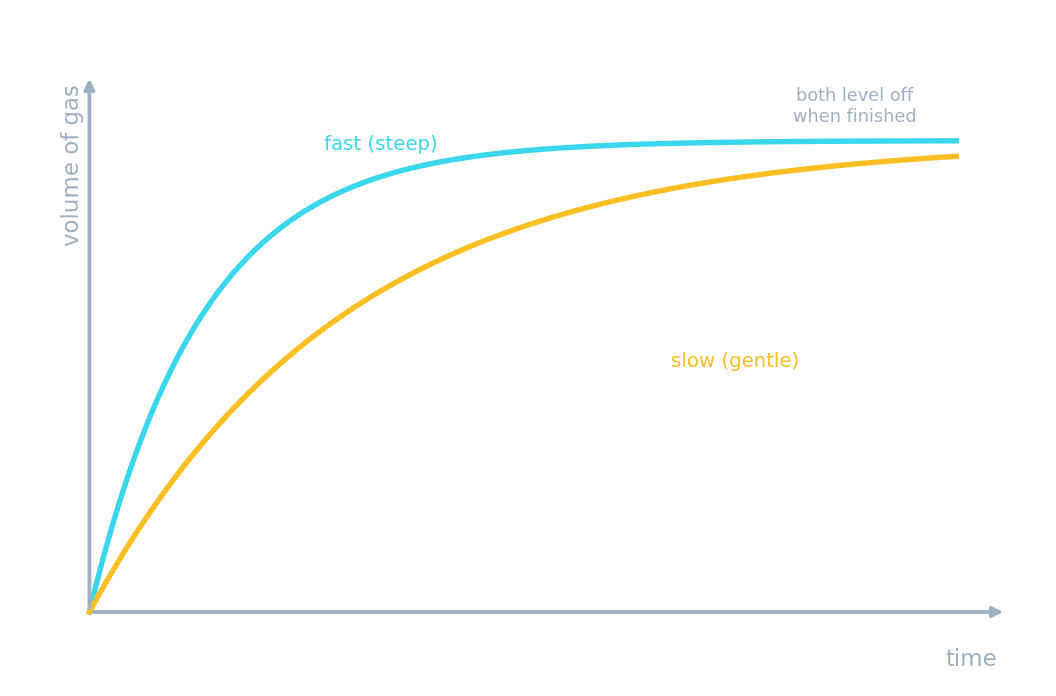
A steeper curve means a faster rate; both level off when the reaction finishes.
Collision theory in action
Watch the particles collide. Heat speeds them up so they collide more often and harder; more particles or a catalyst give more successful collisions — the rate climbs.
On a graph of product against time, a steeper line means a faster reaction.
Difficulty 1/5 · 100 coins + a small bonus on first completion today
Steeper = more product per unit time = faster.
Measuring rate
- Measure how fast a product forms (e.g. gas volume) or a reactant is used up over time.
- A steeper graph line means a faster rate.
Rate is about collision frequency and energy. Anything that makes particles collide more often or with more energy speeds the reaction up. The graph levels off when a reactant runs out.
You've got it
- collision theory: particles must collide with enough energy to react
- rate increases with temperature, concentration/pressure, surface area
- measure rate by product formed or reactant used over time; steeper = faster