The Haber and Contact processes
Introduced| English | Meaning |
|---|---|
| Contact process/ˈkɒntækt ˈprəʊses/ | An industrial process for making sulfuric acid through catalytic oxidation of sulfur dioxide to sulfur trioxide. |
| ammonia/æˈməʊnɪə/ | A pungent gas with formula NH3, whose aqueous solution is alkaline. |
| sulfuric acid/sʌlˈfjʊərɪk ˈæsɪd/ | The acid H2SO4, which can donate two protons per molecule. |
| Haber process/ˈheɪbə ˈprəʊses/ | The industrial production of ammonia by reacting nitrogen with hydrogen under controlled temperature and pressure using a catalyst. |
| iron catalyst/ˈaɪən ˈkætəlɪst/ | iron catalyst |
| yield/jiːld/ | The amount of product obtained in a reaction, often expressed as a percentage of the theoretical amount. |
Equilibrium in industry
- Two of the world's most important industrial reactions are reversible.
- The Haber and Contact processes 接触法 make ammonia 氨气 and sulfuric acid 硫酸.
The Haber process makes:
Difficulty 1/5 · 100 coins + a small bonus on first completion today
N₂ + H₂ ⇌ NH₃ in the Haber process.
The catalyst used in the Haber process is:
Difficulty 1/5 · 100 coins + a small bonus on first completion today
Iron catalyses the Haber process.
The Haber process combines nitrogen and hydrogen to make ______.
Difficulty 1/5 · 100 coins + a small bonus on first completion today
Ammonia (NH₃) is used to make fertilisers.
The Haber process 哈伯法
- The Haber process makes ammonia (NH₃) from nitrogen + hydrogen (a reversible reaction).
- Conditions: about 450 °C, 200 atmospheres pressure, and an iron catalyst 铁催化剂.
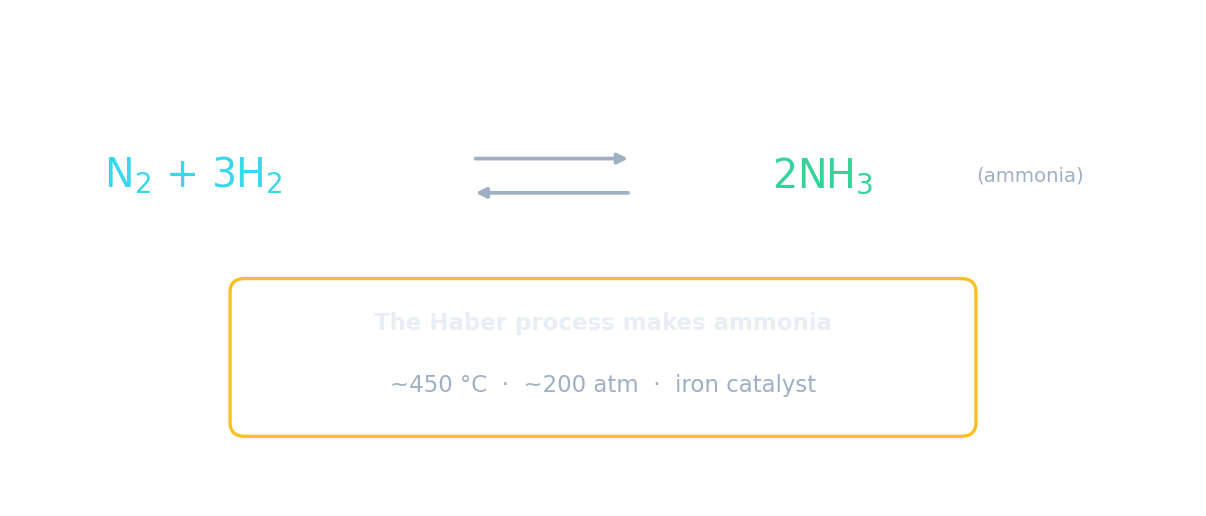
The Haber process makes ammonia: N₂ + 3H₂ ⇌ 2NH₃
The Haber & Contact processes
compromise: yield vs rate
Pressure raises yield; temperature is a compromise between yield and rate.
The Contact process is used to make:
Difficulty 1/5 · 100 coins + a small bonus on first completion today
The Contact process makes sulfuric acid.
The Contact process
- The Contact process makes sulfuric acid, via sulfur trioxide.
- A key reversible step uses a vanadium(V) oxide catalyst.
Industrial conditions are chosen as a compromise between yield, rate and cost.
Difficulty 1/5 · 100 coins + a small bonus on first completion today
No single condition is best for all three.
Choosing the conditions
- Conditions are a compromise: a good yield 产率 at a reasonable rate and cost.
- For example, higher pressure improves ammonia yield but is expensive and dangerous.
Worked example. In the Haber process, a lower temperature would give more ammonia (higher yield) but far too slowly. 450 °C is a compromise — a reasonable yield at a useful rate.
You've got it
- the Haber process makes ammonia from nitrogen + hydrogen (iron catalyst, ~450 °C, high pressure)
- the Contact process makes sulfuric acid (vanadium(V) oxide catalyst)
- conditions are a compromise between yield, rate and cost