Reversible reactions and equilibrium
| English | Chinese | Pinyin |
|---|---|---|
| reversible reaction | 可逆反应 | kě nì fǎn yìng |
| dynamic equilibrium | 动态平衡 | dòng tài píng héng |
| closed system | 密闭系统 | mì bì xì tǒng |
Reactions that go both ways
- Many reactions can run forwards and backwards at the same time.
- When the two directions balance, the reaction reaches equilibrium.
A reversible reaction is shown by the symbol:
The ⇌ sign shows a reversible reaction.
Reversible reactions 可逆反应
- A reversible reaction can go both ways, shown by a ⇌ sign.
- The products can react to re-form the reactants.
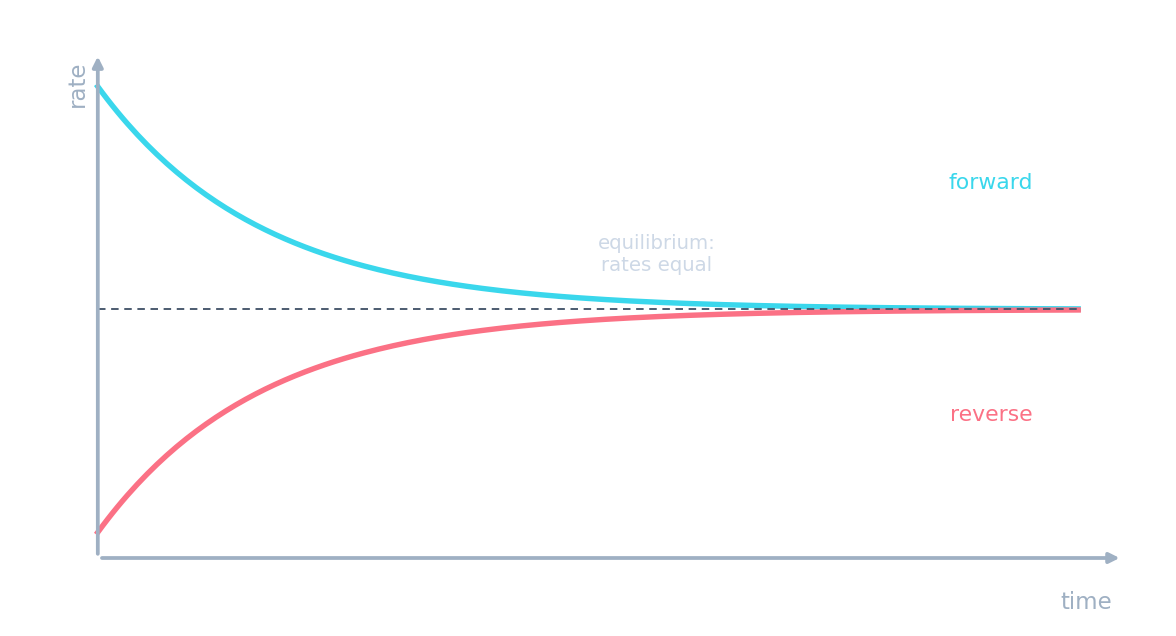
Forward and reverse rates become equal at dynamic equilibrium
Reversible reactions & equilibrium
the system opposes the change
Change the conditions and the equilibrium shifts to partly cancel your change.
At dynamic equilibrium, the forward and backward reactions:
Equal rates mean constant amounts.
Equilibrium can only be reached in a:
A closed system stops anything escaping.
Dynamic equilibrium 动态平衡
- In a closed system 密闭系统, the forward and backward reactions reach the same rate.
- This is dynamic equilibrium: both reactions continue, but the amounts stay constant.

Heating blue copper sulfate drives off water; adding water turns it blue again
At equilibrium, the reactions have completely stopped.
Both reactions continue at the same rate — it is dynamic.
Changing temperature, pressure or ______ shifts the equilibrium position.
The system responds to oppose the change.
Changing the conditions
- Changing temperature, pressure or concentration shifts the position of equilibrium.
- The system responds to oppose the change (more product or more reactant forms).
Equilibrium is dynamic, not stopped. The forward and backward reactions are still happening — they're just going at the same rate, so the overall amounts don't change.
You've got it
- a reversible reaction (⇌) goes both ways
- in a closed system it reaches dynamic equilibrium (forward rate = backward rate)
- changing temperature, pressure or concentration shifts the equilibrium position