Skip to content · ⁨コンテンツへスキップ⁩

Poetry III · ⁨詩歌 III⁩

AP English Literature and Composition · ⁨AP 英語文学と作文⁩ · Topic 8 · ⁨トピック 8⁩

View Slides · ⁨查看幻灯片⁩ Train · ⁨練習する⁩
Video lesson for this topic · ⁨このトピックのビデオレッスン⁩ Open the video page · ⁨動画ページを開く⁩
8:40

単元8: 詩 III

単元8は最後の詩単元であり、コースで最も難しい材料を取り扱います:矛盾に基づいた装置のファミリーです。しかし、最も…から始まります。

English narration · English + 中文 subtitles burned in · ⁨英語ナレーション・英語+中文字幕 burning-in⁩

8.1

The Function of Structure in a Text

Syllabus · ⁨シラバス⁩
English

Enduring Understanding (STR-1): The arrangement of the parts and sections of a text, the relationship of the parts to each other, and the sequence in which the text reveals information are all structural choices made by a writer that contribute to the reader’s interpretation of a text.

Learning Objective 3.C: Explain the function of structure in a text.

  • STR-1.AC Ideas and images in a poem may extend beyond a single line or stanza.
  • STR-1.AD Punctuation is often crucial to the understanding of a text.
  • STR-1.AE When structural patterns are created in a text, any interruption in the pattern creates a point of emphasis.
日本語

永続的理解 (STR-1): テキストの構成部分とセクションの配置、各部分同士の関係、そしてテキストが情報を開示する順序は、すべて作家による構造的選択であり、これらは読者によるテキストの解釈に寄与する。

学習目標 3.C: テキストにおける構造の機能を説明する。

  • STR-1.AC 詩における思想やイメージは、単一の行や節に留まらず、より広い範囲にわたって展開されることがある。
  • STR-1.AD 句読法は、テキストの理解にとってしばしば重要である。
  • STR-1.AE テキストに構造的なパターンが形成される場合、そのパターンへの中断が強調点となる。

Source: College Board AP Course and Exam Description · ⁨出典: College Board AP コースおよび試験説明書⁩

English

Unit 8 is the last poetry unit and it handles the hardest material in the course: the family of devices built on contradiction.

  • Ideas and images in a poem may extend beyond a single line or stanza.
  • Punctuation is often crucial to understanding a text.
  • When structural patterns are created, any interruption in the pattern creates a point of emphasis.

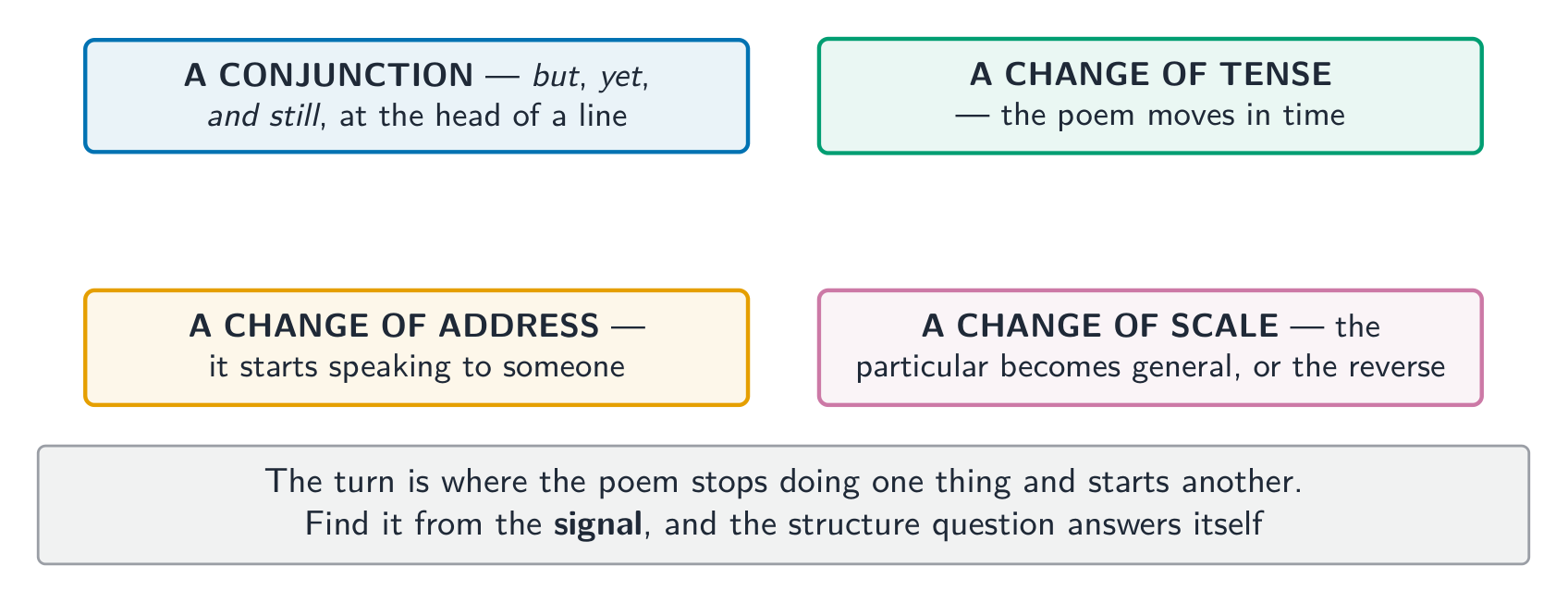
That third statement is the most efficient reading tool in the course. Establish what the poem has been doing, then find the moment it stops doing it. That moment is where the poem points.

Punctuation deserves the emphasis it gets. In a poem, a semicolon and a full stop are different claims about how tightly two statements are joined, and a poem without punctuation has made a decision about how you must read it.

日本語

Unit 8は最後の詩の単位であり、コースの中で最も難しい素材来处理します: 矛盾に基づいた装置のファミリーです。

  • 詩内の理念やイメージは、単一の行や stanza を超えて拡張されることがあります。
  • 句読点は、テキストを理解するためにしばしば不可欠です。
  • 構造パターンが形成されると、そのパターン中の中断は強調の点となります。

この三つ目の文は、本コースで最も効率的な読書ツールである。詩がこれまで何を続けてきたかを把握し、そこから何をやめようとしている瞬間を見つける。その瞬間こそが、詩が指向するポイントである。

句読点には、その強調に値する重要性があります。詩において、セミコロンとフルストップは、2つの文がどれほど密接に結びついているかについての異なる主張であり、句読点のない詩は、あなたがどのように読むべきかについて決断を下しています。

詩の方向転換を示す4つの合図
8.2

The Function of Contrasts Within a Text

Syllabus · ⁨シラバス⁩
English

Enduring Understanding (STR-1): The arrangement of the parts and sections of a text, the relationship of the parts to each other, and the sequence in which the text reveals information are all structural choices made by a writer that contribute to the reader’s interpretation of a text.

Learning Objective 3.D: Explain the function of contrasts within a text.

  • STR-1.AF Juxtaposition may create or demonstrate an antithesis.
  • STR-1.AG Situational or verbal irony is created when events or statements in a text are inconsistent with either the expectations readers bring to a text or the expectations established by the text itself.
  • STR-1.AH Paradox occurs when seemingly contradictory elements are juxtaposed, but the contradiction—which may or may not be reconciled—can reveal a hidden or unexpected idea.
日本語

永続的理解 (STR-1): テキストの構成部分とセクションの配置、各部分同士の関係、そしてテキストが情報を開示する順序は、すべて作家による構造的選択であり、これらは読者によるテキストの解釈に寄与する。

学習目標 3.D: テキスト内の対比の機能を説明する。

  • STR-1.AF 並置(ジュータポジション)は、対立概念を生み出したり示したりすることがある。
  • STR-1.AG テキスト内の出来事や表現が、読者がテキストに対して持ち込む期待値や、テキスト自体によって確立された期待値と矛盾する場合、状況的・言語的皮肉が生じる。
  • STR-1.AH 逆説は、一見矛盾している要素が並置されることで生じるが、この矛盾(和解される場合もあればそうでない場合もある)が、隠された或未预期的な思想を明らかにすることがある。

Source: College Board AP Course and Exam Description · ⁨出典: College Board AP コースおよび試験説明書⁩

English
  • Juxtaposition may create or demonstrate an antithesis.
  • Situational or verbal irony 情境反讽与言语反讽 is created when events or statements are inconsistent with what is expected.
  • Paradox 悖论 occurs when seemingly contradictory elements are juxtaposed, but the contradiction - which may be at odds with ordinary logic - reveals a deeper truth.

The distinction matters and students routinely collapse it. An antithesis places two opposed things together, and both remain true in their own terms. An irony is a gap between the expected and the actual - and someone, the writer or the reader, is aware of the gap. A paradox looks like a contradiction and survives inspection: the contradiction is the point, not an error.

日本語
対比に基づく3つの修辞技法 - 全てが同じ技法ではありません
反義法(アンチテーシス)は、対立する概念を並置します。皮肉(アイロニー)は不整合です。逆説(パラドックス)は矛盾しながらも真実であり続けます
  • 並置(ジュータポジション)は、反義法を生み出したり、提示したりすることがあります。
  • 状況的・言語的皮肉 は、出来事や声明が期待される内容と一致しない場合に生じます。
  • 逆説 は、一見すると矛盾する要素が並置され、その矛盾(通常の論理とは対立する場合もある)がより深い真実を明らかにする時に発生します。

この区別は重要ですが、学生はしばしばこれらを混同してしまいます。反義法では、2つの対立する要素が並置され、それぞれ独自の文脈内では真実であり続けます。皮肉とは、期待されたことと現実との間のギャップであり、誰かが(作家か読者か)このギャップに気づいています。逆説は矛盾のように見え、分析しても成立しますが、矛盾自体が要点であり、誤りではありません。

Vocabulary · ⁨語彙⁩ Train · ⁨練習する⁩
English 日本語
Situational or verbal irony/ˌsɪtʃuːˈeɪʃənl ɔː ˈvɜːbl ˈaɪrəni/ 状況的または言語的皮肉
Paradox/ˈpærədɒks/ 逆説(Paradox)
conceit/kənˈsiːt/ 隠喩
8.3

The Function of Specific Words and Phrases

Syllabus · ⁨シラバス⁩
English

Enduring Understanding (FIG-1): Comparisons, representations, and associations shift meaning from the literal to the figurative and invite readers to interpret a text.

Learning Objective 5.B: Explain the function of specific words and phrases in a text.

  • FIG-1.AG Ambiguity allows for different readings and understandings of a text by different readers.
日本語

持続的理解(FIG-1): 比較、表現、連想は意味を字義から比喩へと移行させ、読者にテキストの解釈を促す。

学習目標 5.B: テキスト内の特定の単語や句の機能を説明する。

  • FIG-1.AG 曖昧性は、異なる読者によってテキストを異なる読み方や解釈とする可能性を生む。

Source: College Board AP Course and Exam Description · ⁨出典: College Board AP コースおよび試験説明書⁩

English

Ambiguity allows for different readings and understandings of a text by different readers.

In this course, ambiguity is a resource. An essay that identifies a genuinely ambiguous element, explores both readings, and then argues for one is doing exactly what the sophistication point rewards - far more than an essay that pretends the text is simpler than it is.

日本語

曖昧性(アンビグニュティ)は、異なる読者がテキストに対して異なる解釈や理解を行うことを可能にします。

このコースにおいて、曖昧性はリソースとして扱われます。実際に曖昧な要素を特定し、両方の解釈を探求した上で、どちらを支持するかを論じるエッセイは、洗練度の高い評価基準が求めるものを正確に果たしており、テキストを実際よりも単純だと装うエッセイよりも遥かに優れています。

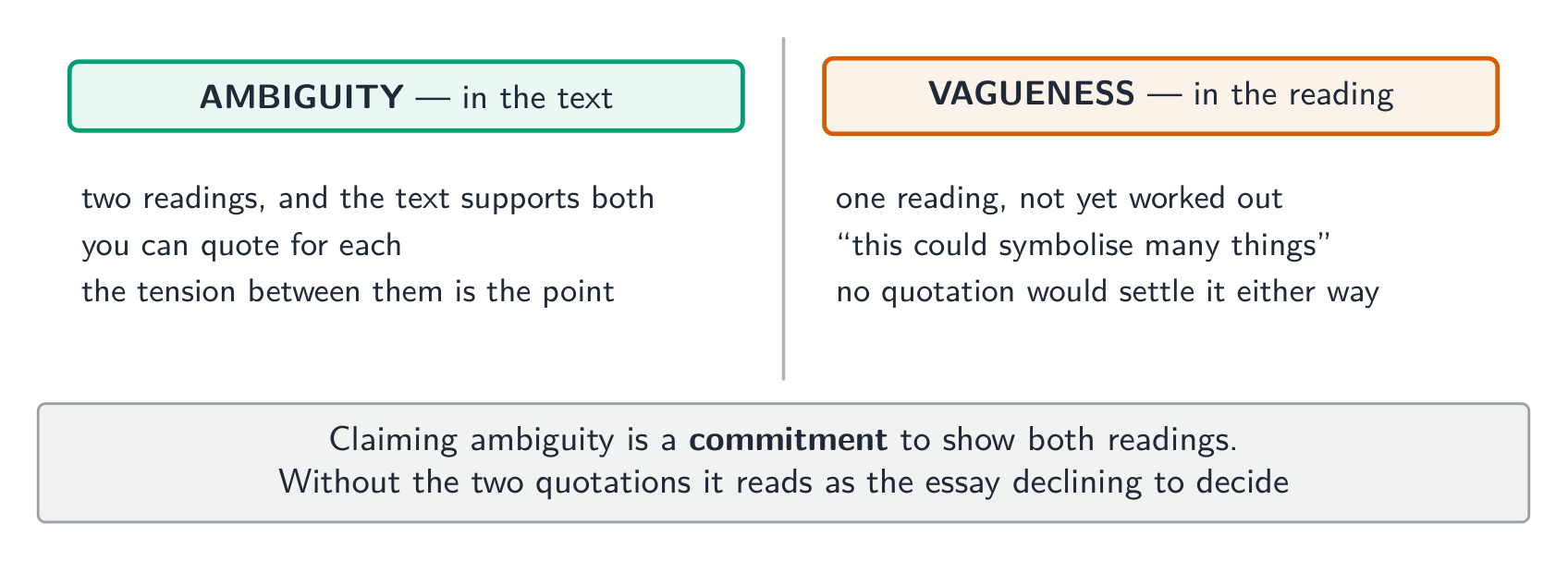
曖昧性を主張することは、両方の解釈を示すことを約束することです
Explore · ⁨探索⁩

Ambiguity or vagueness? · ⁨曖昧さか、それとも不明瞭さか?⁩

Claiming ambiguity commits you to showing both readings. Without the two quotations it reads as declining to decide. · ⁨曖昧さを主張するなら両方の解釈を示さなければならない。引用文が二つなければ、単に判断を避けると読まれる。⁩

8.4

The Function of a Symbol · ⁨象徴の機能⁩

Syllabus · ⁨シラバス⁩
English

Enduring Understanding (FIG-1): Comparisons, representations, and associations shift meaning from the literal to the figurative and invite readers to interpret a text.

Learning Objective 5.C: Identify and explain the function of a symbol.

  • FIG-1.AH Symbols in a text and the way they are used may imply that a narrator, character, or speaker has a particular attitude or perspective.
日本語

持続的理解(FIG-1): 比較、表現、連想は意味を字義から比喩へと移行させ、読者にテキストの解釈を促す。

学習目標 5.C: 象徴の機能を特定して説明する。

  • FIG-1.AH テキスト内の象徴やその使用方法は、語り手、登場人物、または話者が特定の態度や視点を持っていることを暗示している可能性がある。

Source: College Board AP Course and Exam Description · ⁨出典: College Board AP コースおよび試験説明書⁩

English

Symbols in a text, and the way they are used, may imply that a narrator, character, or speaker has a particular perspective.

A symbol is not free-floating. Someone in the text is treating that object as meaningful, and asking who attaches this meaning is often more productive than asking what the meaning is.

日本語

テキスト内の象徴やその使い方は、物語語り、登場人物、または話者が特定の視点を持っていることを示唆している可能性があります。

象徴は自由浮遊しているわけではありません。テキスト内の誰かがその物体に意味を与えており、「何が意味を持つか」を問うよりも「谁がその意味を付与しているか」を問う方が、多くの場合、より生産的です。

8.5

The Function of a Metaphor

Syllabus · ⁨シラバス⁩
English

Enduring Understanding (FIG-1): Comparisons, representations, and associations shift meaning from the literal to the figurative and invite readers to interpret a text.

Learning Objective 6.B: Identify and explain the function of a metaphor.

  • FIG-1.AI A conceit is a form of extended metaphor that often appears in poetry. Conceits develop complex comparisons that present images, concepts, and associations in surprising or paradoxical ways.
  • FIG-1.AJ Often, conceits are used to make complex comparisons between the natural world and an individual.
  • FIG-1.AK Multiple comparisons, representations, or associations may combine to affect one another in complex ways.
日本語

持続的理解(FIG-1): 比較、表現、連想は意味を字義から比喩へと移行させ、読者にテキストの解釈を促す。

学習目標 6.B: 隠喩の機能を特定し説明する。

  • FIG-1.AI コンセプト(隠喩の一種)は、詩で頻繁に見られる延長された隠喩の形式である。コンセプトは、驚くべきか逆説的な方法で、イメージ、概念、連想を提示する複雑な比較を展開する。
  • FIG-1.AJ 多くの場合、コンセプトは自然世界と個人との間の複雑な比較を行うために用いられる。
  • FIG-1.AK 複数の比較、表現、あるいは連想が組み合わさって複雑な相互作用を生むことがある。

Source: College Board AP Course and Exam Description · ⁨出典: College Board AP コースおよび試験説明書⁩

English
  • A conceit 奇喻 is a form of extended metaphor, common in poetry, developing complex comparisons.
  • Conceits are often used to make complex comparisons between the natural world and an individual.
  • Multiple comparisons, representations, or associations may combine to affect one another in complex ways.

A conceit is an extended metaphor that has been pushed further than seems reasonable, and the strain is deliberate. When analysing one, follow how far the poet takes the comparison and where it starts to resist - the resistance is usually the poem's real subject.

日本語
  • 奇喻(コンシエイト) は、詩に共通する延長メタファーの一種であり、複雑な比較を展開します。
  • 奇喻は、自然世界と個人との間にある複雑な比較を成立させるために頻繁に使われます。
  • 複数の比較、表現、あるいは連想が、複雑な方法で互いに影響し合うことがあります。

奇喻とは、合理的ではないほどまで押し込まれた延長メタファーであり、その緊張感は意図的なものです。分析する際は、詩人がどの程度まで比較を推し進め、どこから抵抗が始まるかを追跡してください。その抵抗こそが、詩の本当の主題であることが一般的です。

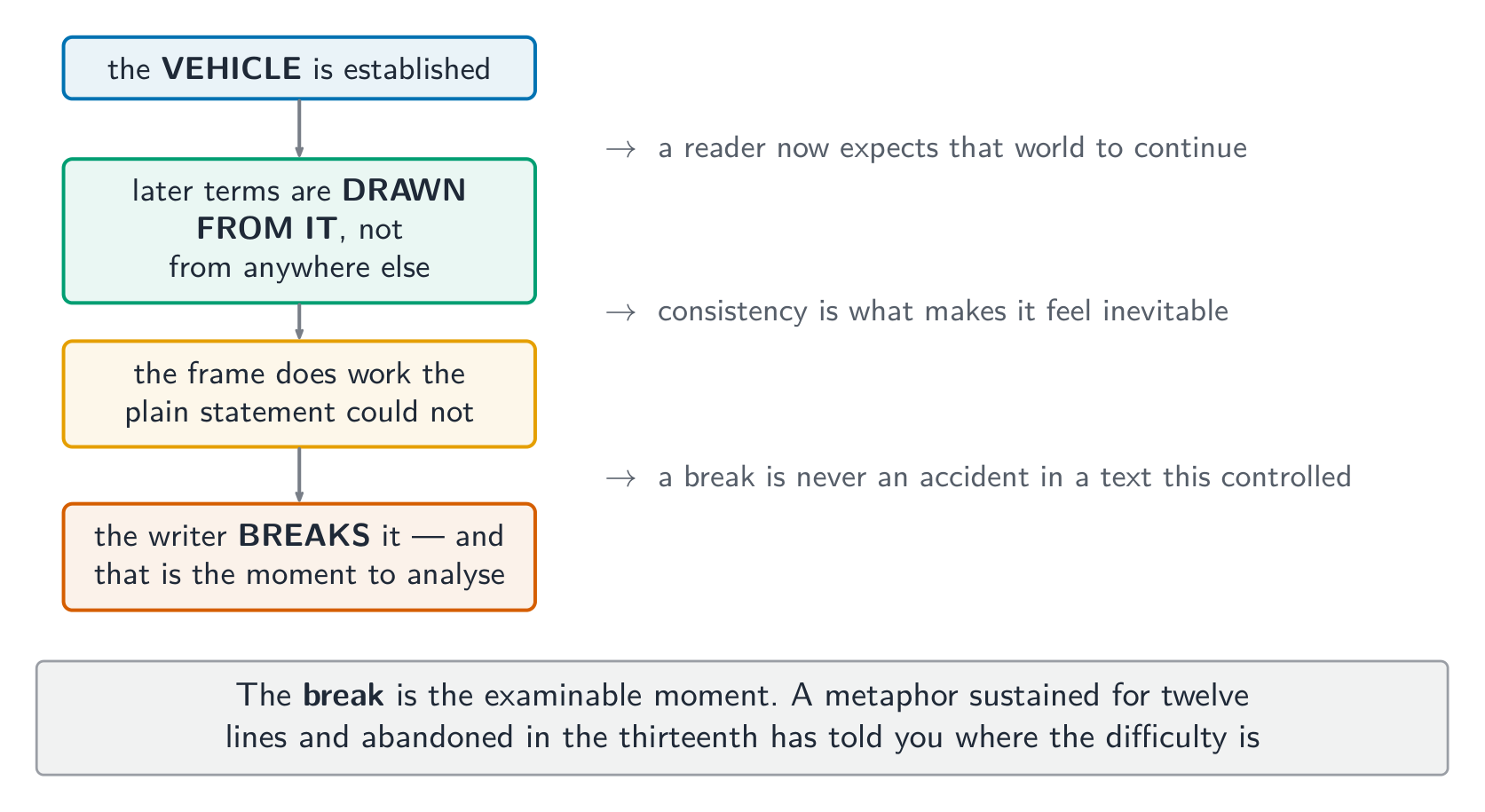
この中断が試験対象となる瞬間です - 統制されたテキストが意図せず枠組みを破ることはありません
Explore · ⁨探索⁩

Follow an extended metaphor to its break · ⁨延長メタファーの破綻まで追跡せよ⁩

An extended metaphor is a metaphor with obligations — and the place the writer breaks the frame is deliberate and analysable. · ⁨拡張的比喩は義務を負った比喩であり、作家が枠組みを壊す場所は意図的であり、分析可能である。⁩

8.6

The Function of an Allusion · ⁨典故の機能⁩

Syllabus · ⁨シラバス⁩
English

Enduring Understanding (FIG-1): Comparisons, representations, and associations shift meaning from the literal to the figurative and invite readers to interpret a text.

Learning Objective 6.D: Identify and explain the function of an allusion.

  • FIG-1.AL Because of shared knowledge about a reference, allusions create emotional or intellectual associations and understandings.
日本語

持続的理解(FIG-1): 比較、表現、連想は意味を字義から比喩へと移行させ、読者にテキストの解釈を促す。

学習目標 6.D: 典拠の機能を特定し説明する。

  • FIG-1.AL 共有された知識に基づく参照のため、典拠は感情的または知覚的な連想や理解を生み出す。

Source: College Board AP Course and Exam Description · ⁨出典: College Board AP コースおよび試験説明書⁩

English

Because of shared knowledge about a reference, allusions create emotional or intellectual associations in readers who recognise them.

Note the condition: shared knowledge. An allusion is a bet on the reader's memory, and a poem that alludes heavily has chosen its audience.

日本語

参照に関する共有された知識があるため、オブリュージョンはそれを認識した読者に感情的あるいは知的な連想を生み出します。

条件に注意してください:共有された知識。オブリュージョンは読者の記憶に対する賭けであり、多用する詩はその聴衆を選定しています。

8.7 8.8 8.9

Developing a Literary Thesis, Commentary, and Evidence · ⁨文学的 Thesis の発展、解説、および根拠⁩

Syllabus · ⁨シラバス⁩
English

Enduring Understanding (LAN-1): Readers establish and communicate their interpretations of literature through arguments supported by textual evidence.

Learning Objective 7.B: Develop a thesis statement that conveys a defensible claim about an interpretation of literature and that may establish a line of reasoning.

  • LAN-1.D A thesis statement expresses an interpretation of a literary text, and requires a defense, through use of textual evidence and a line of reasoning, both of which are explained in an essay through commentary.
  • LAN-1.E A thesis statement may preview the development or line of reasoning of an interpretation. This is not to say that a thesis statement must list the points of an interpretation, literary elements to be analyzed, or specific evidence to be used in the argument.
日本語

持続的理解(LAN-1): 読者は、テキストの証拠で裏付けられた議論を通じて、文学作品の解釈を確立し伝達する。

学習目標 7.B: 文学の解釈に対する正当な主張を伝え、かつ論理の道筋を確立する可能性のあるテーゼステートメントを作成する。

  • LAN-1.D テーゼ文は文学作品の解釈を表し、エッセイの中で解説によって説明文と推論の系によって守られる必要がある。
  • LAN-1.E テーゼステートメントは、解釈の展開や論理の道筋を予見することがあります。これは、テーゼステートメントが解釈のポイント、分析されるべき文学的要素、または議論で用いられる具体的な証拠をリストアップしなければならないという意味ではありません。
English

Enduring Understanding (LAN-1): Readers establish and communicate their interpretations of literature through arguments supported by textual evidence.

Learning Objective 7.C: Develop commentary that establishes and explains relationships among textual evidence, the line of reasoning, and the thesis.

  • LAN-1.F A line of reasoning is the logical sequence of claims that work together to defend the overarching thesis statement.
  • LAN-1.G A line of reasoning is communicated through commentary that explains the logical relationship between the overarching thesis statement and the claims/evidence within the body of an essay.
  • LAN-1.U More sophisticated literary arguments may explain the significance or relevance of an interpretation within a broader context, discuss alternative interpretations of a text, or use relevant analogies to help an audience better understand an interpretation.
日本語

持続的理解(LAN-1): 読者は、テキストの証拠で裏付けられた議論を通じて、文学作品の解釈を確立し伝達する。

学習目標 7.C: テキストの証拠、論理の道筋、およびテーゼとの間の関係を確立して説明する解説を作成する。

  • LAN-1.F 論理の道筋とは、包括的なテーゼステートメントを防御するために協力して機能する主張の論理的な順序です。
  • LAN-1.G 論理の道筋は、包括的なテーゼステートメントとエッセイの本文に含まれる主張/証拠との間の論理的関係を説明する解説を通じて伝達されます。
  • LAN-1.U より洗練された文学的議論では、解釈の意義や関連性をより広い文脈の中で説明したり、テキストに対する代替的な解釈を議論したり、適切なアナロジーを使用して聴衆に解釈をよりよく理解させたりする。
English

Enduring Understanding (LAN-1): Readers establish and communicate their interpretations of literature through arguments supported by textual evidence.

Learning Objective 7.D: Select and use relevant and sufficient evidence to both develop and support a line of reasoning.

  • LAN-1.H Writers use evidence strategically and purposefully to illustrate, clarify, exemplify, associate, amplify, or qualify a point.
  • LAN-1.I Evidence is effective when the writer of the essay uses commentary to explain a logical relationship between the evidence and the claim.
  • LAN-1.J Evidence is sufficient when its quantity and quality provide apt support for the line of reasoning.
  • LAN-1.K Developing and supporting an interpretation of a text is a recursive process; an interpretation can emerge from analyzing evidence and then forming a line of reasoning, or the interpretation can emerge from forming a line of reasoning and then identifying relevant evidence to support that line of reasoning.
日本語

持続的理解(LAN-1): 読者は、テキストの証拠で裏付けられた議論を通じて、文学作品の解釈を確立し伝達する。

学習目標 7.D: 論理の道筋を展開し支援するために、関連して十分十分な証拠を選定して使用する。

  • LAN-1.H 作家は、点を示し、明瞭にし、例示し、関連付け、拡大し、または限定するために、戦略的かつ意図的に証拠を使用します。
  • LAN-1.I エッセイの著者が解説を用いて証拠と主張との間の論理的関係を説明する場合、証拠は効果的です。
  • LAN-1.J 証拠の量と質が論理の道筋に対して適切な支援を提供する場合、それは十分です。
  • LAN-1.K テキストの解釈を展開し支援することは反復的プロセスです。解釈は、証拠を分析してから論理の道筋を形成することから生まれる也可能れば、論理の道筋を形成してからそれを支持するための関連する証拠を特定することから生まれることもあります。

Source: College Board AP Course and Exam Description · ⁨出典: College Board AP コースおよび試験説明書⁩

English
  • A thesis expresses an interpretation requiring textual defence.
  • More sophisticated literary arguments explain the significance or relevance of an interpretation - the sophistication point, stated by the CED.
  • Evidence: strategic, effective with commentary, sufficient in quantity and quality, developed recursively.
日本語
  • テーシスは、テキストによる防衛を必要とする解釈を表明します。
  • より洗練された文学的議論は、解釈の意義や関連性を説明します - CEDによって定義された洗練度のポイントです。
  • 証拠:戦略的であり、解説付きで効果的であり、量と質の面で十分であり、再帰的に展開されます。
8.10

Control Over the Elements of Composition · ⁨作文要素への統制⁩

Syllabus · ⁨シラバス⁩
English

Enduring Understanding (LAN-1): Readers establish and communicate their interpretations of literature through arguments supported by textual evidence.

Learning Objective 7.E: Demonstrate control over the elements of composition to communicate clearly.

  • LAN-1.W Writers must acknowledge words, ideas, images, texts, and other intellectual property of others through attribution, citation, or reference. Note: Students are not expected to use a specific attribution style (like MLA) within the timed essays on the AP Exam, but should follow such guidelines for any extended papers they develop in class through multiple revisions.
日本語

持続的理解(LAN-1): 読者は、テキストの証拠で裏付けられた議論を通じて、文学作品の解釈を確立し伝達する。

学習目標 7.E: 構成要素を統制することで、明確にコミュニケーションを行うことを示す。

  • LAN-1.W 作家は、引用や参照を通じて、他者の言葉、思想、イメージ、テキスト、およびその他の知的財産権を認める必要がある。注意: AP試験の時間制限付き作文では、MLAのような特定の引用様式を使用する必要はないが、教室内で複数の推敲を経て完成させる長期論文においては、これらのガイドラインに従うべきである。

Source: College Board AP Course and Exam Description · ⁨出典: College Board AP コースおよび試験説明書⁩

English

Writers must acknowledge the words, ideas, images, texts, and intellectual property of others through attribution and citation.

Worked example (a real AP exam task). A poetry-analysis prompt asks how the poet's use of contrast conveys a complex attitude. A weak answer calls everything irony. A scoring answer separates the devices: "The poem places the harvest against the emptied village - an antithesis, in which both are simply true. But the speaker calls the year 'generous', and the surrounding stanzas have shown what the generosity cost; that mismatch is verbal irony. The final line is neither: 'the fuller the barn, the fewer to eat from it' is a paradox, and it is the only statement the poem does not undercut - the contradiction is exactly the truth the speaker has arrived at." Three devices, correctly distinguished, and an interpretation that needs all three.

日本語

作家は、出典表示と引用を通じて、他者の言葉、思想、イメージ、テキスト、および知的財産を認める必要があります。

** worked example (実際のAP試験課題) **。ある詩の分析プロンプトは、詩人の対比の使い方がどのような複雑な態度を伝えているかを問います。弱い回答はすべてを皮肉とします。高得点の回答は修辞技法を分離します:「詩は収穫と空虚な村を対置しています - これは反義法であり、どちらも単に真実です。しかし、話者は年を『寛容』と呼んでおり、周囲の stanza はその寛容が何 costing したかを見せていました;この不一致は言語的皮肉です。最終行は neither です:『倉庫が一杯になるほど、そこから食べる人は減る』は逆説であり、それが詩が否定しない唯一の声明です - この矛盾こそが、話者が到達した真実そのものです。」」。3つの修辞技法が正しく区別され、それら全てを必要とする解釈です。

8.10

Exam tips · ⁨試験対策⁩

English
  • Establish the pattern, then find the interruption. The interruption is where the poem points.
  • Punctuation is a claim about how tightly statements are joined. A poem without it has made a decision too.
  • Antithesis, irony, paradox are not synonyms. Learn the three definitions precisely; conflating them costs marks.
  • Ambiguity is a resource. Explore both readings, then argue for one. That is the sophistication point.
  • Ask who attaches the meaning to a symbol. It is usually more productive than asking what it means.
  • A conceit is a comparison pushed past comfort. Follow it to where it resists - that is the subject.
日本語
  • パターンを確認し、その後、中断を見つけます。 その中断こそが、詩が指し示す場所です。
  • 句読点は、文がどれほど密接に結びついているかという主張です。 句読点のない詩もまた、決断を下しています。
  • 反義法、皮肉、逆説は同義語ではありません。 3つの定義を正確に学び、混同すると失点します。
  • 曖昧性はリソースです。 両方の解釈を探求した上で、どちらを支持するかを論じます。これが洗練度のポイントです。
  • 象徴に対して「誰が意味を付与しているか」を問うてください。「何を意味するか」を問うよりも、多くの場合、より生産的です。
  • 奇喻 とは、快適さを越えた比較です。それが抵抗する地点まで追跡してください - それが主題です。

Interactive lessons on this topic · ⁨このトピックのインタラクティブ授業⁩

Work through it step by step, with instant-check exercises. · ⁨一歩ずつ進め、即時チェック付きの問題で学習します。⁩

Past Papers · ⁨過去問⁩

More topics in AP English Literature and Composition · ⁨AP 英語文学と作文⁩ · ⁨AP English Literature and Composition · ⁨AP 英語文学と作文⁩ の他のトピック⁩

Log in or create account · ⁨ログインまたはアカウント作成⁩

IGCSE, A-Level & AP