Skip to content · ⁨コンテンツへスキップ⁩

Gene Expression and Regulation · ⁨遺伝子発現と調節⁩

AP Biology · ⁨AP生物学⁩ · Topic 6 · ⁨トピック 6⁩

View Slides · ⁨查看幻灯片⁩ Train · ⁨練習する⁩
Video lesson for this topic · ⁨このトピックのビデオレッスン⁩ Open the video page · ⁨動画ページを開く⁩
8:40

遺伝子発現と調節

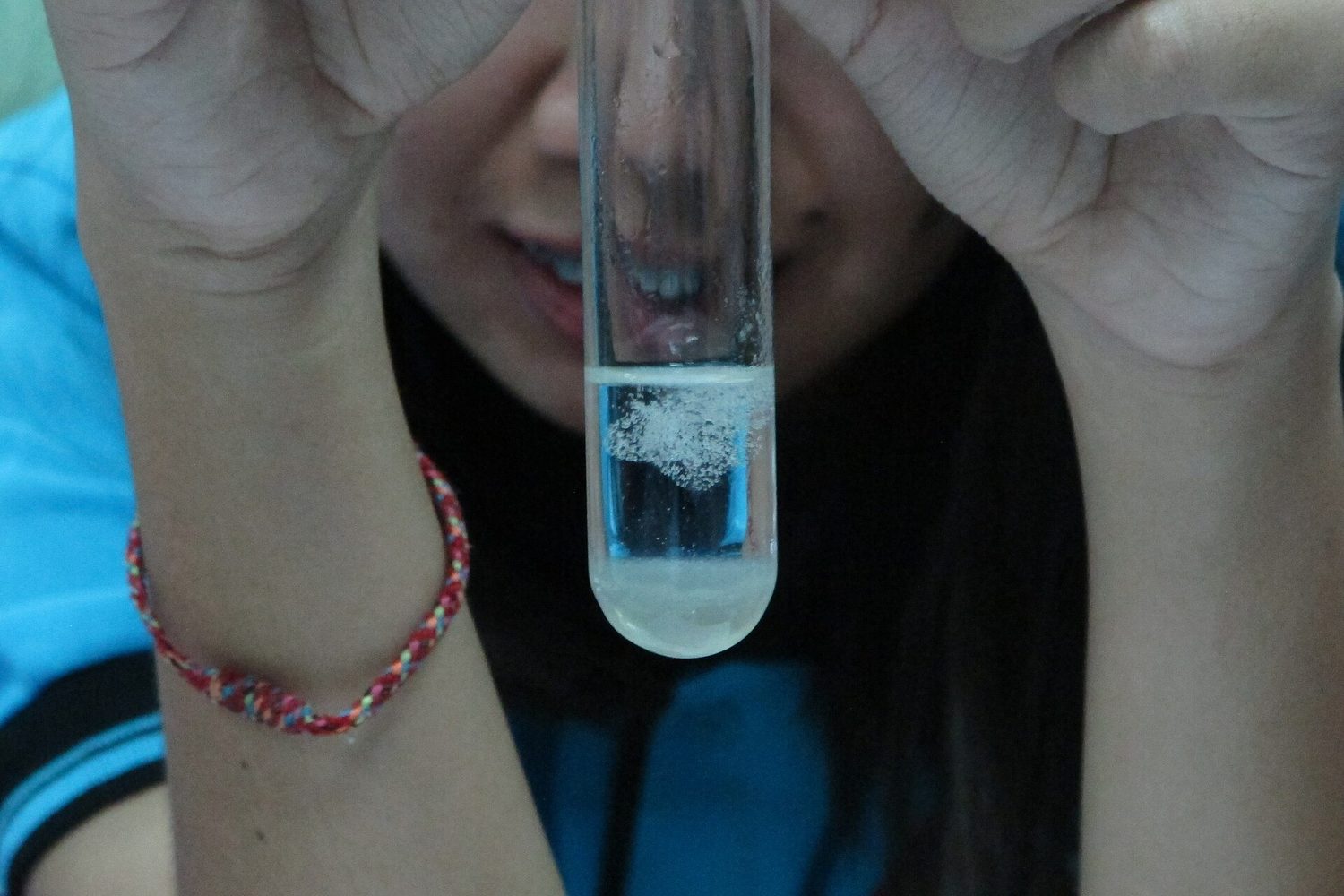
チューブ内の白い糸状物は本物のDNAであり、通常の細胞から抽出されたものだ。それは何も見てとれないように見える。だが、あなたの体が生涯必要とするあらゆる指令を内包している……

English narration · English + 中文 subtitles burned in · ⁨英語ナレーション・英語+中文字幕 burning-in⁩

6.1

DNA and RNA Structure · ⁨DNAとRNAの構造⁩

Syllabus · ⁨シラバス⁩
English

Enduring Understanding (BIG IDEA 3 — Information Storage and Transmission): Living systems store, retrieve, transmit, and respond to information essential to life processes.

Learning Objective 6.1.A: Describe the structures involved in passing hereditary information from one generation to the next.

  • 6.1.A.1 Genetic information is stored in and passed to subsequent generations through DNA molecules and, in some cases, RNA molecules.
    • 6.1.A.1.i Prokaryotic organisms typically have circular chromosomes.
    • 6.1.A.1.ii Eukaryotic organisms typically have multiple linear chromosomes that are comprised of DNA. These chromosomes are condensed using histones and associated proteins.
  • 6.1.A.2 Prokaryotes and eukaryotes can contain plasmids, which are extra-chromosomal circular molecules of DNA.

Learning Objective 6.1.B: Describe the characteristics of DNA that allow it to be used as hereditary material.

  • 6.1.B.1 Nucleic acids exhibit specific nucleotide base pairing that is conserved through evolution.
    • 6.1.B.1.i Purines (guanine and adenine) have a double ring structure.
    • 6.1.B.1.ii Pyrimidines (cytosine, thymine, and uracil) have a single ring structure.
    • 6.1.B.1.iii Purines pair with pyrimidines: adenine with thymine (or uracil in RNA) and guanine with cytosine.
日本語

永続的理解(BIG IDEA 3 — 情報の保存と伝達): 生命系は、生命過程に不可欠な情報を保存し、検索し、伝達し、応答する。

学習目標 6.1.A: 親世代から次世代へ遺伝情報を伝える際に関与する構造を記述する。

  • 6.1.A.1 遺伝情報はDNA分子に蓄積され、後世代へ受け継がれる。また、場合によってはRNA分子によっても行われる。
    • 6.1.A.1.i 原核生物は通常、環状染色体を持つ。
    • 6.1.A.1.ii 真核生物は通常、複数の直線状染色体を持ち、これらはDNAで構成されている。これらの染色体はヒストンおよび関連タンパク質によって凝縮される。
  • 6.1.A.2 原核生物と真核生物は、染色体外の環状DNA分子であるプラシドを含むことができる。

学習目標 6.1.B: 遺伝物質としてDNAが使われることを可能にするDNAの特性を記述する。

  • 6.1.B.1 核酸は、進化を通じて保存された特定のヌクレオチド塩基対形成を示す。
    • 6.1.B.1.i プリン(グアニンおよびアデニン)は二重環構造を持つ。
    • 6.1.B.1.ii ピリミジン(シトシン、チミン、ウラシル)は単一環構造を持つ。
    • 6.1.B.1.iii プリンはピリミジンと対をなす:アデニンはチミン(またはRNAではウラシル)と、グアニンはシトシンと対をなす。
Source: College Board AP Course and Exam Description · ⁨出典: College Board AP コースおよび試験説明書⁩

English

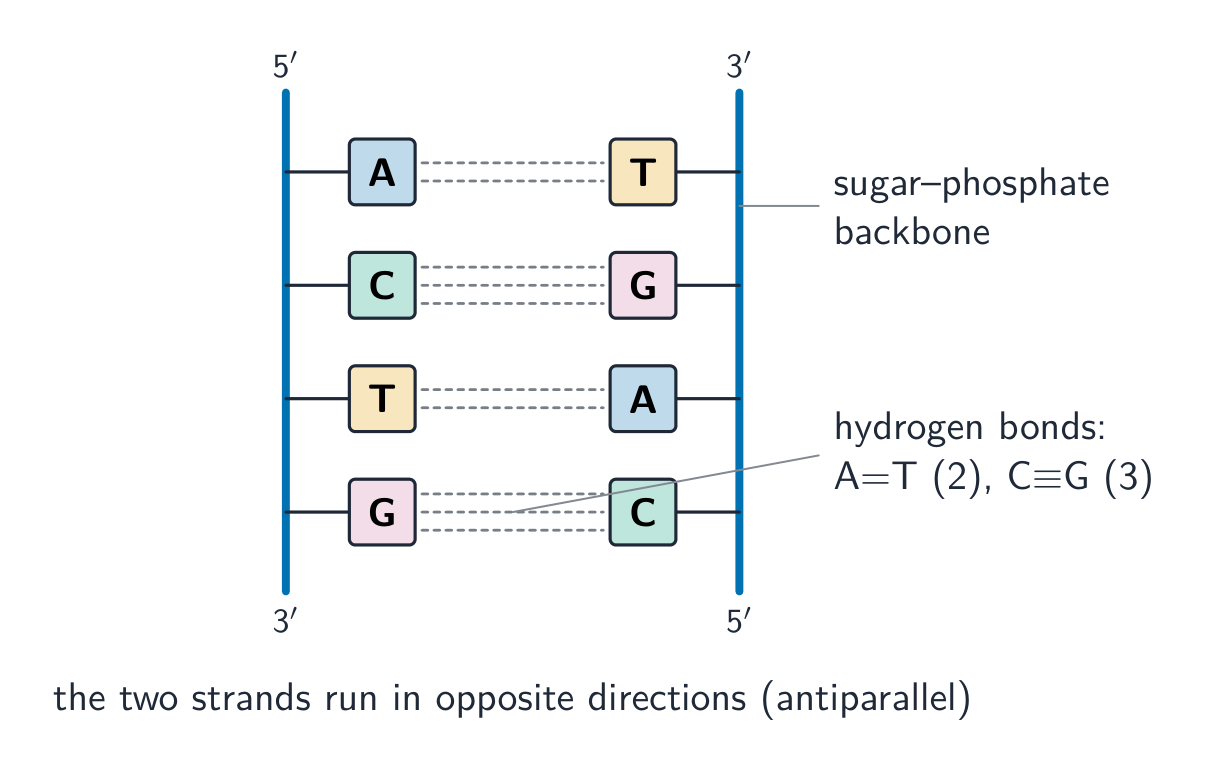
DNA carries genetic information as a double helix 双螺旋 of two strands. Its nucleotides 核苷酸 pair by rule – A with T, G with C (complementary base pairing 互补配对) – so one strand specifies the other. The strands run antiparallel 反平行. RNA is single-stranded, uses uracil (U) instead of thymine, and has ribose sugar.

How the DNA is packaged differs between the domains, and the CED asks for both.

  • Prokaryotic organisms typically have a single circular chromosome 环状染色体 in the cytoplasm, often with extra small circles called plasmids.
  • Eukaryotic organisms typically have multiple linear chromosomes 线性染色体, and each is condensed by wrapping around proteins called histones 组蛋白. That packing is what fits two metres of DNA into a nucleus a few micrometres across — and because a tightly wound region is hard for the transcription machinery to reach, the packing is itself a level of gene regulation.
日本語
細胞抽出液からの沈殿DNAの巻き取り — DNAは実際に可視化できる分子である

DNA は二本鎖の二重らせんとして遺伝情報を持ちます。ヌクレオチドは特定のルールでペアリングし、AはTと、GはCと対応します(相補的塩基対合)。これにより一本の鎖がもう一本の鎖を決定します。両方の鎖は反平行に走ります。RNA は一本鎖であり、チミンの代わりにウラシル(U)を使用し、リボース糖を含みます。

相補的塩基対によって保持された二本の反平行なDNA鎖

DNAのパッケージング方法はドメインによって異なり、CEDでは両方を問うている。

  • 原核生物は通常、細胞質内に単一の環状染色体を持ち、追加の小さな輪(プラスミド)を持つことが多い。
  • 真核生物は通常、複数の直線状染色体を持ち、それぞれがヒストンと呼ばれるタンパク質に巻き取られることで凝縮されている。この詰まり方が、数マイクロメートルの核内に2メートルものDNAを収めることを可能にしている——また、巻きの密な領域は転写装置がアクセスしにくいため、パッケージング自体が遺伝子発現調節の一レベルとなっている。
6.2

DNA Replication · ⁨DNA複製⁩

Syllabus · ⁨シラバス⁩
English

Enduring Understanding (BIG IDEA 3 — Information Storage and Transmission): Living systems store, retrieve, transmit, and respond to information essential to life processes.

Learning Objective 6.2.A: Describe the mechanisms by which genetic information is copied for transmission between generations.

  • 6.2.A.1 DNA replication ensures continuity of hereditary information.
    • 6.2.A.1.i DNA is synthesized in the 5' to 3' direction.
    • 6.2.A.1.ii Replication is a semiconservative process, meaning one strand of DNA serves as the template for a new strand of complementary DNA.
    • 6.2.A.1.iii Helicase unwinds the DNA strands.
    • 6.2.A.1.iv Topoisomerase relaxes supercoiling in front of the replication fork.
    • 6.2.A.1.v DNA polymerase requires RNA primers to initiate DNA synthesis.
    • 6.2.A.1.vi DNA polymerase synthesizes new strands of DNA continuously on the leading strand and discontinuously on the lagging strand.
    • 6.2.A.1.vii Ligase joins the fragments on the lagging strand.
    • Exclusion statement: The names of the steps and particular enzymes involved, excluding DNA polymerase, ligase, RNA polymerase, helicase, and topoisomerase, are beyond the scope of the AP Exam.
日本語

永続的理解(BIG IDEA 3 — 情報の保存と伝達): 生命系は、生命過程に不可欠な情報を保存し、検索し、伝達し、応答する。

学習目標 6.2.A: 世代間の伝達のために遺伝情報がコピーされるメカニズムを記述する。

  • 6.2.A.1 DNA複製は、遺伝情報の連続性を保証する。
    • 6.2.A.1.i DNAは5'から3'方向に合成される。
    • 6.2.A.1.ii 複製は半保存的プロセスであり、DNAの一本鎖が新しい相補的なDNA鎖のためのテンプレートとなることを意味する。
    • 6.2.A.1.iii ヘリカーゼがDNA鎖を解く。
    • 6.2.A.1.iv トポイソメラーゼが複製フォークの前にある超らせん構造を緩める。
    • 6.2.A.1.v DNAポリメラーゼは、DNA合成を開始するためにRNAプライマーを必要とする。
    • 6.2.A.1.vi DNAポリメラーゼは、リードストランド上では新しいDNA鎖を連続的に、ラグgingストランド上では不連続的に合成する。
    • 6.2.A.1.vii リガーゼはラグgingストランド上の断片をつなぐ。
    • 除外事項: ステップの名前およびDNAポリメラーゼ、リガーゼ、RNAポリメラーゼ、ヘリカーゼ、トポイソメラーゼ以外の特定の酵素に関する名称は、AP試験の対象外である。

Source: College Board AP Course and Exam Description · ⁨出典: College Board AP コースおよび試験説明書⁩

English

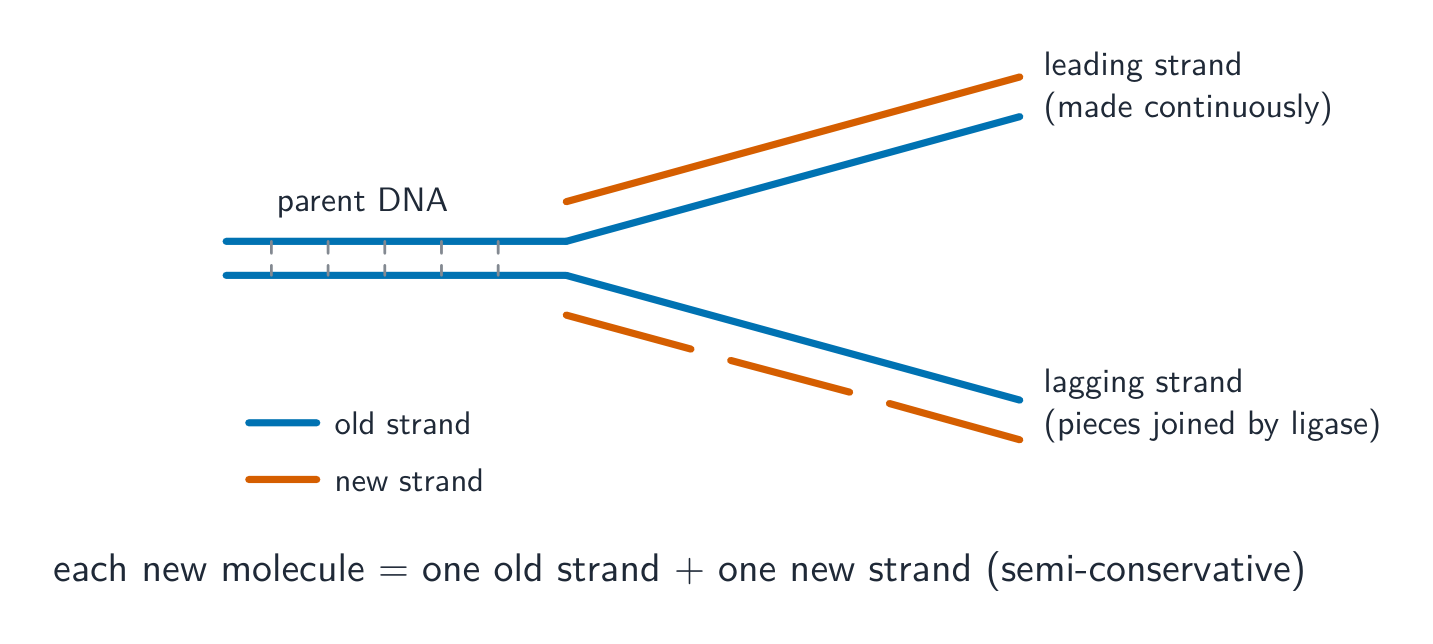
Before a cell divides, DNA is copied semiconservatively 半保留复制: the helix unwinds and each old strand templates a new one, so each daughter helix has one old and one new strand. DNA polymerase 聚合酶 adds nucleotides following base-pairing rules, building the new strand and proofreading as it goes.

日本語

細胞分裂の前に、DNAは半保存的にコピーされます。らせんが解け、古い各鎖が新しい鎖の鋳型となり、娘らせんはそれぞれ1本の古い鎖と1本の新しい鎖を持ちます。DNAポリメラーゼは塩基対合ルールに従ってヌクレオチドを追加し、新しい鎖を合成しながら校对(校正)を行います。

複製フォークにおける半保存的DNA複製
複製フォークにおける半保存的DNA複製
6.3

Transcription and RNA Processing · ⁨転写とRNA処理⁩

Syllabus · ⁨シラバス⁩
Big IdeaLearning ObjectiveEssential Knowledge

Big Idea 3 — Information Storage and Transmission
Living systems store, retrieve, transmit, and respond to information essential to life processes.

6.3.A
Describe the mechanisms by which genetic information flows from DNA to RNA to protein.

  • 6.3.A.1 The sequence of the RNA bases, together with the structure of the RNA molecule, determines RNA function.
    • 6.3.A.1.i Messenger RNA (mRNA) molecules carry information from DNA in the nucleus to the ribosome in the cytoplasm.
    • 6.3.A.1.ii Distinct transfer RNA (tRNA) molecules bind specific amino acids and have anticodon sequences that base pair with the codons of mRNA. tRNA is recruited to the ribosome during translation to generate the primary peptide sequence based on the mRNA sequence.
    • 6.3.A.1.iii Ribosomal RNA (rRNA) molecules are functional building blocks of ribosomes.
  • 6.3.A.2 RNA polymerases use a single template strand of DNA to direct the inclusion of bases in the newly formed RNA molecule. This process is known as transcription.
  • 6.3.A.3 The enzyme RNA polymerase synthesizes mRNA molecules in the 5' to 3' direction by reading the template DNA strand in the 3' to 5' direction.
  • 6.3.A.4 In eukaryotic cells the mRNA transcript undergoes a series of enzyme-mediated modifications.
    • 6.3.A.4.i The addition of a poly-A tail makes mRNA more stable.
    • 6.3.A.4.ii The addition of a GTP cap helps with ribosomal recognition.
    • 6.3.A.4.iii The excision of introns, along with the splicing and retention of exons, generates different versions of the resulting mature mRNA molecule. This process is known as alternative splicing.

Source: College Board AP Course and Exam Description · ⁨出典: College Board AP コースおよび試験説明書⁩

English

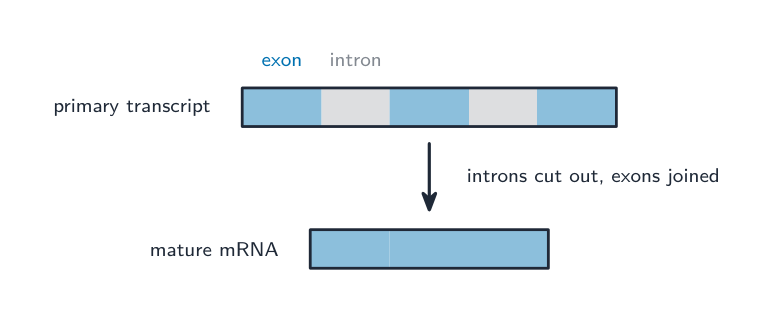
Transcription 转录 copies a gene's DNA into messenger RNA 信使RNA (mRNA). RNA polymerase reads the template strand and builds a complementary RNA. In eukaryotes the mRNA is then processed: a cap and tail are added, and introns 内含子 (non-coding parts) are spliced out, leaving the exons 外显子.

The 5′ cap added during processing is a modified guanine nucleotide — a GTP cap — and its job is recognition: it helps the ribosome recognise and bind the mRNA, as well as protecting the transcript from degradation as it leaves the nucleus.

日本語

転写では、遺伝子のDNAがmRNA(メッセンジャーRNA)にコピーされます。RNAポリメラーゼが鋳型鎖を読み取り、相補的なRNAを合成します。真核生物では、その後mRNAは処理され、キャップとテールが追加され、イントロン(非コード領域)がスプライシングされて除去され、エクソンが残ります。

イントロンが除去され、エクソンが連結されて成熟したmRNAとなる

処理中に追加される5′キャップは、修飾されたグアニンヌクレオチド——GTPキャップ——であり、その機能は認識です。これはリボソームがmRNAを認識して結合するのを助け、同時に転写物が核から出る際に分解されるのを保護します。

Explore · ⁨探索⁩

Transcribe DNA into messenger RNA · ⁨DNAをmRNAに転写する⁩

Transcription copies a DNA template into mRNA, pairing A→U, T→A, C→G, G→C. Step through to build the RNA strand base by base. · ⁨転写ではDNAテンプレートをmRNAにコピーし、A→U、T→A、C→G、G→Cと対合する。進んでRNA鎖を塩基ごとに構築する。⁩

6.4

Translation · ⁨翻訳⁩

Syllabus · ⁨シラバス⁩
English

Enduring Understanding (BIG IDEA 3 — Information Storage and Transmission): Living systems store, retrieve, transmit, and respond to information essential to life processes.

Learning Objective 6.4.A: Explain how the phenotype of an organism is determined by its genotype.

  • 6.4.A.1 Translation of the mRNA to generate a polypeptide occurs on ribosomes that are present in the cytoplasm of both prokaryotic and eukaryotic cells, as well as the cytoplasmic surface of the rough ER of eukaryotic cells.
  • 6.4.A.2 In prokaryotic organisms, translation of the mRNA molecule occurs while it is being transcribed.
  • 6.4.A.3 Translation involves many sequential steps, including initiation, elongation, and termination. The salient features of translation include:
    • 6.4.A.3.i Translation is initiated when the rRNA in the ribosome interacts with the mRNA at the start codon (AUG, coding for the amino acid methionine).
    • 6.4.A.3.ii The sequence of nucleotides on the mRNA is read in triplets, called codons.
    • 6.4.A.3.iii Each codon encodes a specific amino acid, which can be deduced by using a genetic code chart. Many amino acids are encoded by more than one codon.
    • 6.4.A.3.iv Nearly all living organisms use the same genetic code, which is evidence for the common ancestry of all living organisms.
    • 6.4.A.3.v tRNA brings the correct amino acid to the place specified by the codon on the mRNA.
    • 6.4.A.3.vi The amino acid is transferred to the growing polypeptide chain.
    • 6.4.A.3.vii The process continues along the mRNA until a stop codon is reached.
    • 6.4.A.3.viii Translation terminates with the release of the newly synthesized protein.
    • Exclusion statement: The details and names of the enzymes and factors involved in each of these steps are beyond the scope of the AP Exam.
    • Exclusion statement: Memorization of the genetic code, with the exception of the start codon AUG, is beyond the scope of the AP Exam.
  • 6.4.A.4 Genetic information in retroviruses is a special case and has an alternate flow of information: from RNA to DNA, made possible by reverse transcriptase, an enzyme that copies the viral RNA genome into DNA. This DNA integrates into the host genome and is transcribed and translated for the assembly of new viral progeny.
日本語

永続的理解(BIG IDEA 3 — 情報の保存と伝達): 生命系は、生命過程に不可欠な情報を保存し、検索し、伝達し、応答する。

学習目標 6.4.A: 生物体の表現型がゲノタイプによってどのように決定されるかを説明する。

  • 6.4.A.1 mRNAの翻訳によるポリピプチド生成は、原核生物および真核生物の両方の細胞質、ならびに真核生物の粗面小胞体細胞質表面にあるリボソーム上で行われる。
  • 6.4.A.2 原核生物において、mRNA分子の翻訳はその転写中に行われる。
  • 6.4.A.3翻訳は、開始、伸長、終結を含む多くの連続したステップを伴います。翻訳の主な特徴は以下の通りです:
    • 6.4.A.3.i リボソーム内のrRNAが起始コドン(AUG、アミノ酸メチオニンをコード)におけるmRNAと相互作用することで、翻訳は開始されます。
    • 6.4.A.3.ii mRNA上のヌクレオチド配列は三重体として読み取られ、これらをコドンと呼びます。
    • 6.4.A.3.iii 各コドンは特定のアミノ酸をコードしており、遺伝子暗号表を用いることでその対応を導き出すことができます。多くのアミノ酸は複数のコドンによってコードされています。
    • 6.4.A.3.iv ほぼすべての生物が同じ遺伝子暗号を使用しており、これはあらゆる生物が共通の祖先を持つことの証拠となっています。
    • 6.4.A.3.v tRNAは、mRNA上のコドンによって指定された場所に正しいアミノ酸を持ち込みます。
    • 6.4.A.3.vi アミノ酸は伸長中のポリペプチド鎖に転移されます。
    • 6.4.A.3.vii このプロセスはmRNAに沿って進行し、停止コドンに到達するまで続きます。
    • 6.4.A.3.viii 翻訳は、新しく合成されたタンパク質が遊離されることで終了します。
    • 除外事項: これらの各ステップに関与する酵素や因子の詳細および名称は、AP試験の範囲外です。
    • 除外事項: 起始コドンAUGを除く、遺伝子暗号の暗記はAP試験の範囲外です。
  • 6.4.A.4 レトロウイルスの遺伝情報は特別なケースであり、逆転写酵素という酵素によってウイルスRNAゲノムがDNAにコピーされることにより可能となる、RNAからDNAへの代替的な情報流があります。このDNAは宿主ゲノムに組み込まれ、新しいウイルス子孫の組立のために転写・翻訳されます。

Source: College Board AP Course and Exam Description · ⁨出典: College Board AP コースおよび試験説明書⁩

English

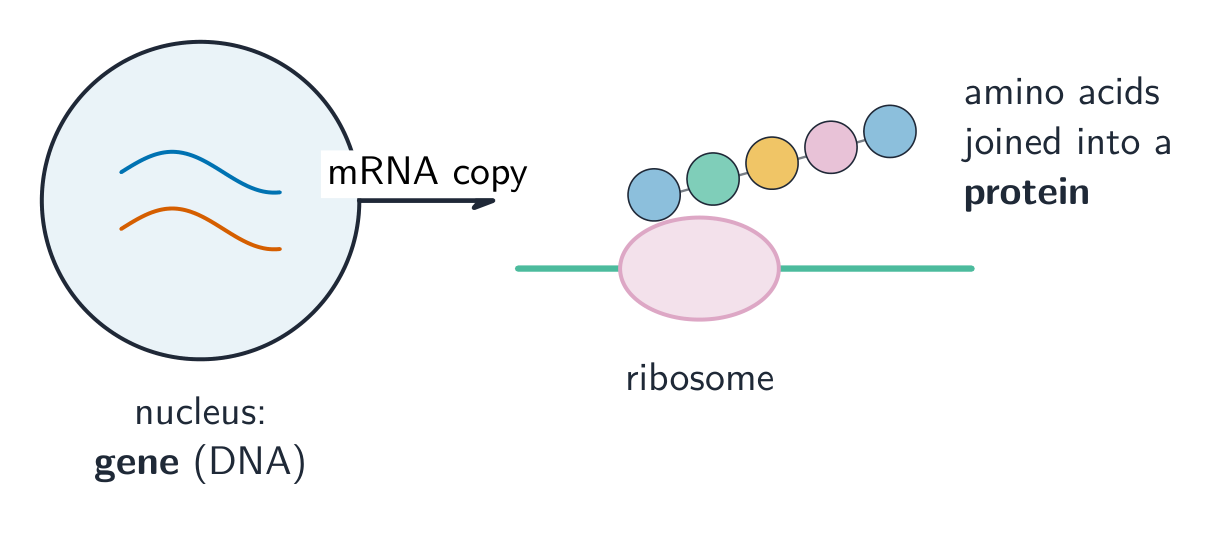
Translation 翻译 builds a protein from the mRNA at the ribosome 核糖体. The mRNA is read in three-base codons 密码子, each specifying one amino acid (the genetic code). Transfer RNA 转运RNA brings the matching amino acid, and the ribosome links them into a polypeptide until a stop codon ends it. This is the "central dogma": DNA → RNA → protein.

日本語

翻訳では、mRNAに基づいてタンパク質がリボソームで合成されます。mRNAは3塩基ごとのコドンとして読み取られ、それぞれが1つのアミノ酸を指定します(遺伝暗号)。tRNA(転送RNA)が対応するアミノ酸を運び、リボソームはそれらをペプチド結合でつないでポリピペプチドを形成し、ストップコドンで終了します。これが「中心原理」です:DNA → RNA → タンパク質。

リボソームがmRNAを読み取ってアミノ酸からタンパク質を合成する様子
6.5

Regulation of Gene Expression · ⁨遺伝子発現の調節⁩

Syllabus · ⁨シラバス⁩
English

Enduring Understanding (BIG IDEA 3 — Information Storage and Transmission): Living systems store, retrieve, transmit, and respond to information essential to life processes.

Learning Objective 6.5.A: Describe the types of interactions that regulate gene expression.

  • 6.5.A.1 Regulatory sequences are stretches of DNA that interact with regulatory proteins to control transcription. Some genes are constitutively expressed, and others are inducible.
  • 6.5.A.2 Epigenetic changes can affect gene expression through reversible modifications of DNA or histones.
  • 6.5.A.3 The phenotype of a cell or an organism is determined by the combination of genes that are expressed and the levels at which they are expressed.
    • 6.5.A.3.i Observable cell differentiation results from the expression of genes for tissue-specific proteins.
    • 6.5.A.3.ii Induction of transcription factors during development results in sequential gene expression.
    • 6.5.A.3.iii The function and amount of gene products determine the phenotype of organisms.

Learning Objective 6.5.B: Explain how the location of regulatory sequences relates to their function.

  • 6.5.B.1 Both prokaryotes and eukaryotes have groups of genes that are coordinately regulated.
    • 6.5.B.1.i Prokaryotes regulate operons in an inducible or repressible system.
    • 6.5.B.1.ii In eukaryotes, groups of genes may be influenced by the same transcription factors to coordinately regulate expression.
日本語

永続的理解(BIG IDEA 3 — 情報の保存と伝達): 生命系は、生命過程に不可欠な情報を保存し、検索し、伝達し、応答する。

学習目標 6.5.A: 遺伝子発現を調節する相互作用の種類を説明すること。

  • 6.5.A.1 調節配列とは、調節タンパク質と相互作用して転写を制御するDNAの領域です。一部の遺伝子は恒常的に発現し、他の遺伝子は誘導性です。
  • 6.5.A.2 エピジェネティック変化は、DNAやヒストンの可逆的な修飾を通じて遺伝子発現に影響を与えることがあります。
  • 6.5.A.3 細胞や個体の表現型は、発現している遺伝子の組み合わせと、それらが発現するレベルによって決定されます。
    • 6.5.A.3.i 観察可能な細胞分化は、組織特異的タンパク質の遺伝子の発現によって生じます。
    • 6.5.A.3.ii 発生過程での転写因子の誘導は、順次的な遺伝子発現をもたらします。
    • 6.5.A.3.iii 遺伝子産物の機能と量が発現型を決定します。

学習目標 6.5.B: 調節配列の位置がその機能とどのように関連しているかを説明すること。

  • 6.5.B.1 原核生物も真核生物も、協調的に調節される遺伝子のグループを持っています。
    • 6.5.B.1.i 原核生物は、誘導性または阻害性システムにおいてオペロンを調節します。
    • 6.5.B.1.ii 真核生物では、同じ転写因子の影響を受けることで、遺伝子のグループが協調的に発現を調節されることがあります。

Source: College Board AP Course and Exam Description · ⁨出典: College Board AP コースおよび試験説明書⁩

English

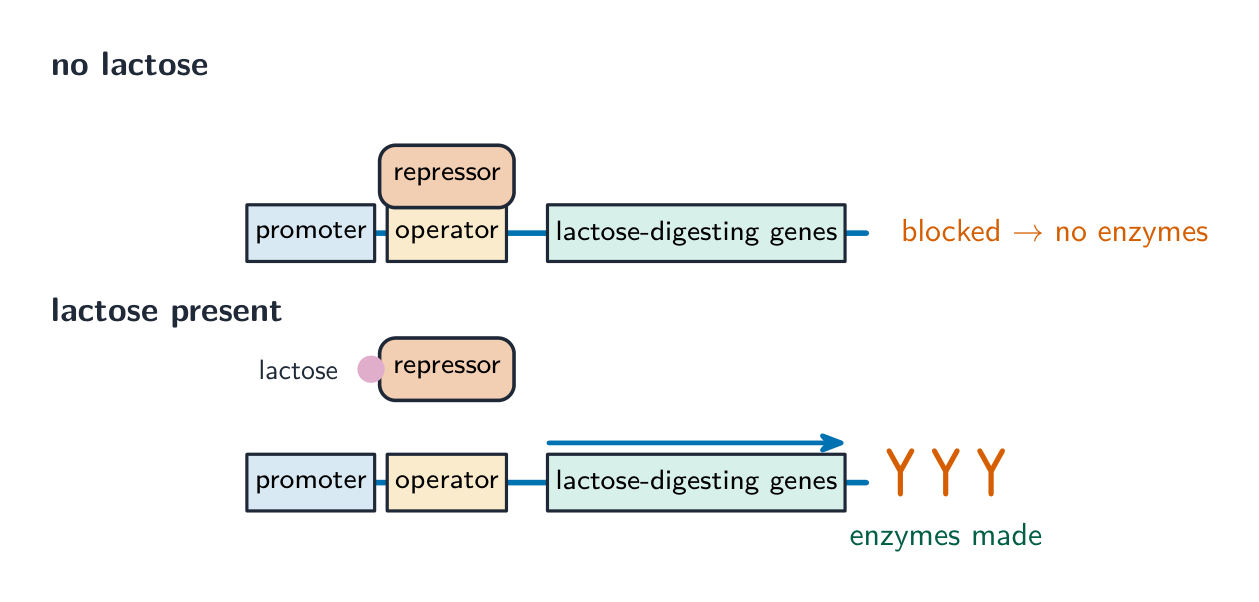
Cells control which genes are expressed and when. In prokaryotes, operons 操纵子 switch groups of genes on or off. In eukaryotes, regulation happens at many levels – which genes are transcribed (transcription factors, promoters, enhancers), RNA processing, and after translation. This lets a cell respond to its environment without changing its DNA.

日本語

細胞はどの遺伝子が発現し、いつ発現するかを制御します。原核生物では、オペロンが遺伝子群のオン・オフを切り替えます。真核生物では、調節は多くのレベルで行われます——どの遺伝子が転写されるか(転写因子、プロモーター、エンハンサー)、RNA処理、翻訳後など。これにより、細胞はDNAを変更することなく環境に応答できます。

ラックオペロンはラクトースが存在する場合のみ遺伝子をオンにする
6.6

Gene Expression and Cell Specialization · ⁨遺伝子発現と細胞特分化⁩

Syllabus · ⁨シラバス⁩
English

Enduring Understanding (BIG IDEA 3 — Information Storage and Transmission): Living systems store, retrieve, transmit, and respond to information essential to life processes.

Learning Objective 6.6.A: Explain how the binding of transcription factors to promoter regions affects gene expression and the phenotype of the organism.

  • 6.6.A.1 RNA polymerase and transcription factors bind to promoter or enhancer DNA sequences to initiate transcription. These sequences can be upstream or downstream of the transcription start site.
  • 6.6.A.2 Negative regulatory molecules inhibit gene expression by binding to DNA and blocking transcription.

Learning Objective 6.6.B: Explain the connection between the regulation of gene expression and phenotypic differences in cells and organisms.

  • 6.6.B.1 Gene regulation results in differential gene expression and influences cell products and functions.
  • 6.6.B.2 Certain small RNA molecules have roles in regulating gene expression.
日本語

永続的理解(BIG IDEA 3 — 情報の保存と伝達): 生命系は、生命過程に不可欠な情報を保存し、検索し、伝達し、応答する。

学習目標 6.6.A: 転写因子のプロモーター領域への結合が遺伝子発現および個体の表現型に与える影響を説明すること。

  • 6.6.A.1 RNAポリメラーゼと転写因子は、転写を開始するためにプロモーターまたはエンハンサーのDNA配列に結合します。これらの配列は転写開始部位の上流または下流にあることがあります。
  • 6.6.A.2 負の調節分子は、DNAに結合して転写をブロックすることで、遺伝子発現を抑制します。

学習目標 6.6.B: 遺伝子発現の調節と細胞・個体の表現型の違いとの関連性を説明すること。

  • 6.6.B.1 遺伝子調節は、遺伝子発現の差を生じさせ、細胞産物および機能に影響を与えます。
  • 6.6.B.2 特定の小さなRNA分子は、遺伝子発現の調節に役割を果たします。

Source: College Board AP Course and Exam Description · ⁨出典: College Board AP コースおよび試験説明書⁩

English

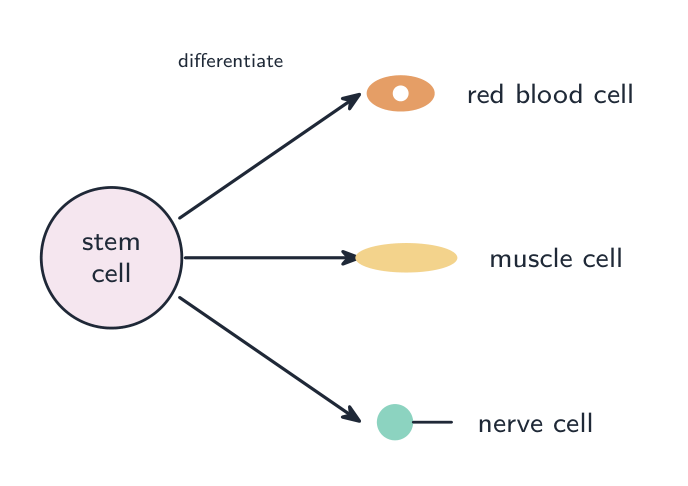
Every cell in a body has the same DNA, yet cells differ because they express different genes – differential gene expression 差异表达. This is how one fertilized egg produces many specialized cell types (muscle, nerve, skin); signals during development turn specific genes on and off.

日本語

体中のすべての細胞は同じDNAを持っていますが、異なる遺伝子来表达することで細胞は異なります——差別的遺伝子発現。これが1つの受精卵から多数の特殊化した細胞タイプ(筋、神経、皮膚など)が生み出される仕組みです。発生中のシグナルが特定の遺伝子のオン・オフを調整します。

幹細胞が特殊化した細胞タイプへ分化する様子
6.7

Mutations · ⁨突然変異⁩

Syllabus · ⁨シラバス⁩
English

Enduring Understanding (BIG IDEA 3 — Information Storage and Transmission): Living systems store, retrieve, transmit, and respond to information essential to life processes.

Learning Objective 6.7.A: Describe the various types of mutation.

  • 6.7.A.1 Alterations in a DNA sequence are mutations that can cause changes in the type or amount of the protein produced and the consequent phenotype. DNA mutations can be beneficial, detrimental, or neutral based on the effect or the lack of effect they have on the resulting nucleic acid or protein and the phenotypes that are conferred by the protein.
    • 6.7.A.1.i Point mutations occur when one nucleotide has been substituted for a different nucleotide.
    • 6.7.A.1.ii Frameshift mutations occur when one or more nucleotides are inserted or deleted, causing the reading frame to be shifted.
    • 6.7.A.1.iii Nonsense mutations occur when there is a point mutation that causes a premature stop.
    • 6.7.A.1.iv Silent mutations occur when the change in the nucleotide sequence has no effect on the amino acid sequence.
    • Illustrative examples for 6.7.A.1:
      • Mutations in the CFTR gene disrupt ion transport and result in cystic fibrosis.
      • Mutations in the MC1R gene give adaptive melanism in pocket mice.
    • Exclusion statement: Knowledge of specific mutations and their effects is beyond the scope of the AP Exam.

Learning Objective 6.7.B: Explain how changes in genotype may result in changes in phenotype.

  • 6.7.B.1 Errors in DNA replication or DNA repair mechanisms as well as external factors, including radiation and reactive chemicals, can cause random mutations in the DNA.
    • 6.7.B.1.i Whether a mutation is beneficial, detrimental, or neutral depends on the environmental context.
    • 6.7.B.1.ii Mutations are a source of genetic variation.
  • 6.7.B.2 Errors in mitosis or meiosis can result in changes in phenotype.
    • 6.7.B.2.i Changes in chromosome number resulting from nondisjunction often result in new phenotypes caused by triploidy (aneuploidy).
    • 6.7.B.2.ii Changes in chromosome number often result in disorders with developmental limitations.
    • 6.7.B.2.iii Alterations in chromosome structure lead to genetic disorders.
    • Exclusion statement: Knowledge of specific disorders related to changes in chromosome number is beyond the scope of the AP Exam.

Learning Objective 6.7.C: Explain how alterations in DNA sequences contribute to variation that can be subject to natural selection.

  • 6.7.C.1 Changes in genotype may affect phenotypes that are subject to natural selection. Genetic changes that enhance survival and reproduction can be selected for by environmental conditions.
    • 6.7.C.1.i The horizontal acquisitions of genetic information in prokaryotes via transformation (uptake of DNA), transduction (viral transmission of genetic information), conjugation (cell-to-cell transfer of DNA), and transposition (movement of DNA segments within and between DNA molecules) increase genetic variation.
    • 6.7.C.1.ii Related viruses can recombine genetic information if they infect the same host cell.
    • 6.7.C.1.iii Reproductive processes that increase genetic variation are evolutionarily conserved and are shared by various organisms.
    • Illustrative examples for 6.7.C.1: Sickle cell anemia
日本語

永続的理解(BIG IDEA 3 — 情報の保存と伝達): 生命系は、生命過程に不可欠な情報を保存し、検索し、伝達し、応答する。

学習目標 6.7.A: さまざまなタイプの変異を説明すること。

  • 6.7.A.1 DNA配列の変化は変異であり、生成されるタンパク質の種類や量の変化、およびそれに続く表現型の変化を引き起こすことがあります。DNA変異は、結果として生じる核酸やタンパク質、およびタンパク質がもたらす表現型に対する効果、あるいは効果がない点に基づいて、有益であるか、有害であるか、あるいは中立であることがあり得ます。
    • 6.7.A.1.i ポイント変異は、1つのヌクレオチードが異なるヌクレオチードに置換されることで発生します。
    • 6.7.A.1.ii フレームシフト変異は、1つ以上のヌクレオチードが挿入または欠失し、読み枠がずれることで発生します。
    • 6.7.A.1.iii ノンセンス変異は、ポイント変異が prematurely な停止を招くことで発生します。
    • 6.7.A.1.iv シ lent変異は、ヌクレオチード配列の変化がアミノ酸配列に影響を与えない場合に発生します。
    • 6.7.A.1のための例示:
      • CFTR遺伝子の変異はイオン輸送を乱し、嚢胞性線維症を引き起こします。
      • MC1R遺伝子の変異はポケットマウスの適応的メラニズムをもたらします。
    • 除外事項: 特定の変異とその効果に関する知識は、AP試験の範囲外です。

学習目標 6.7.B: 遺伝子型の変化がなぜ表現型の変化につながるかを説明すること。

  • 6.7.B.1 DNA複製やDNA修復機構のエラー、ならびに放射線や反応性化学物質などの外部要因は、DNAのランダムな変異を引き起こすことがあります。
    • 6.7.B.1.i 変異が有益であるか、有害であるか、あるいは中立であるかは、環境的文脈に依存します。
    • 6.7.B.1.ii 変異は遺伝的変異の源である。
  • 6.7.B.2 有丝分裂または減数分裂におけるエラーが、表現型の変化をもたらすことがある。
    • 6.7.B.2.i 非分離による染色体数の変化は、三倍体(非整倍体)によって引き起こされる新しい表現型を伴うことが多い。
    • 6.7.B.2.ii 染色体数の変化は、発育上の制限を伴う疾患を引き起こすことがよくある。
    • 6.7.B.2.iii 染色体構造の変異は、遺伝性疾患を引き起こす。
    • 除外事項: 染色体数の変化に関連する特定の疾患に関する知識は、AP試験の範囲外である。

学習目標 6.7.C: DNA配列の変異が自然選択の対象となる変異に寄与する仕組みを説明せよ。

  • 6.7.C.1 遺伝子型の変化は、自然選択の対象となる表現型に影響を与えることができる。生存と繁殖を促進する遺伝的変化は、環境条件によって選択されることがある。
    • 6.7.C.1.i 原核生物における水平遺伝子導入(DNAの取り込みである変換、ウイルスによる遺伝情報の伝達である転導、細胞間でのDNAの移動である接合、およびDNA分子内・分子間でのDNA断片の移動である転座)は、遺伝的変異を増加させる。
    • 6.7.C.1.ii 関連するウイルスが同じ宿主細胞に感染した場合、遺伝情報を組換えることができる。
    • 6.7.C.1.iii 遺伝的変異を増加させる生殖プロセスは、進化的に保存されており、多様な生物間で共有されている。
    • 6.7.C.1の例示: 鎌状赤血球貧血症

Source: College Board AP Course and Exam Description · ⁨出典: College Board AP コースおよび試験説明書⁩

English

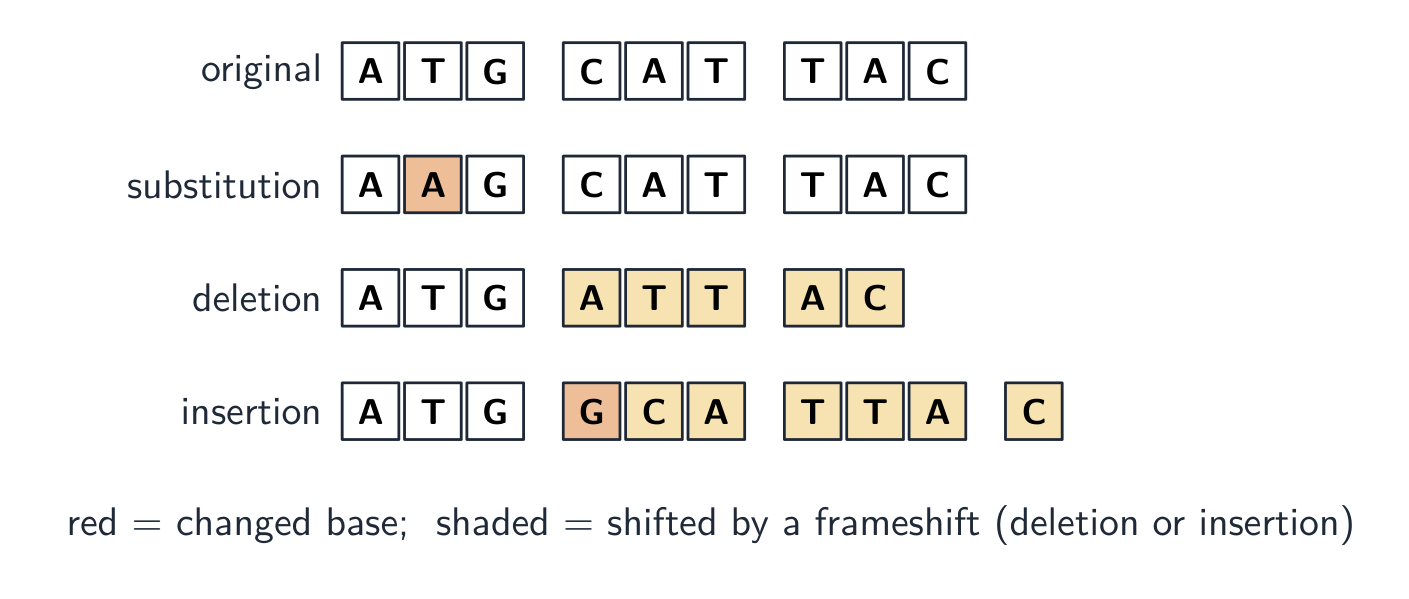
A mutation 突变 is a change in the DNA sequence. Point mutations change one base (silent, missense, or nonsense); insertions/deletions can cause a frameshift 移码 that garbles everything downstream. Mutations in gametes are heritable; they may be harmful, neutral, or beneficial – and beneficial ones supply the variation for natural selection.

Whole-chromosome errors change the phenotype too. Mutation is not only a change of base: errors in mitosis or meiosis can result in changes in phenotype. If chromosomes fail to separate — nondisjunction 不分离 — a gamete receives an extra copy or none, and the resulting zygote has an abnormal chromosome number (aneuploidy 非整倍性). Trisomy 21 is the familiar example. Because a whole chromosome carries hundreds of genes, the phenotypic effect is far broader than a point mutation's.

日本語

突然変異はDNA配列の変化のことです。ポイント突变は1塩基の変化であり、無効突变(サイレント)、ミセンス突变、またはノンスンス突变です。挿入/欠失はフレームシフトを引き起こし、下流のすべてを誤った配列に変えます。生殖細胞での突然変異は遺伝され、有害、中立、あるいは有利になることがあります。有利な変異は自然選択のための多様性を供給します。

置換、欠失、挿入変異
置換、欠失、挿入変異

染色体全体の誤差も表現型を変化させます。 変異は単なる塩基の変化ではありません:有糸分裂や減数分裂の誤差が表現型の変化をもたらすことがあります。染色体が分離しない(非分離)と、配偶体は追加された拷贝またはゼロを受け取り、結果として生じた受精卵は異常な染色体数(異数性)を持ちます。21番三体症候群はその有名な例です。染色体全体には数百の遺伝子が含まれているため、表現型への影響は点変異よりもはるかに広範です。

Vocabulary · ⁨語彙⁩ Train · ⁨練習する⁩
English 日本語
double helix/ˈdʌbl ˈhiːlɪks/ 二重らせん
nucleotides/ˈnjuːklɪɒtaɪdz/ ヌクレオチド
complementary base pairing/ˌkɒmplɪˈmentəri beɪs ˈpeərɪŋ/ 塩基対
antiparallel/ˌæntɪˈpærəlel/ 反平行
single circular chromosome/ˈsɪŋɡl ˈsɜːkjʊlə ˈkrəʊməsəʊm/ 単一の環状染色体
multiple linear chromosomes/ˈmʌltɪpl ˈlɪnɪə ˈkrəʊməsəʊmz/ 複数の線状染色体
condensed by wrapping around proteins called histones/kənˈdenst baɪ ˈræpɪŋ əˈraʊnd ˈprəʊtiːnz kɔːld ˈhɪstəʊnz/ ヒストンと呼ばれるタンパク質に巻き付いて凝縮する
semiconservatively/ˌsemɪkənˈsɜːvətɪvli/ 半保存的に
DNA polymerase/ˌdiː en ˈeɪ ˌpɒlɪməˈreɪz/ DNAポリメラーゼ
Transcription/trænˈskrɪpʃn/ 転写
messenger RNA/ˈmesɪndʒə ˌɑː en ˈeɪ/ メッセンジャーRNA
introns/ɪnˈtrɒnz/ インtron
exons/eɡˈzɒnz/ エクソン
Translation/trænˈsleɪʃn/ 翻訳
ribosome/ˈriːbəʊsəʊm/ リボソーム
codons/ˈkəʊdɒnz/ コドン
Transfer RNA/ˈtrænsfɜː ˌɑː en ˈeɪ/ 転送RNA
operons/ˈɒpərənz/ オペロン
differential gene expression/ˌdɪfəˈrenʃl dʒiːn ekˈspreʃn/ 遺伝子の発現制御
mutation/mjuːˈteɪʃn/ 突然変異
frameshift/ˈfreɪmʃɪft/ フレームシフト
nondisjunction/ˌnɒndɪsˈdʒʌŋkʃn/ 非分離
aneuploidy/ˈeɪnəplɔɪdi/ 非整倍体
Biotechnology/ˌbaɪəʊtekˈnɒlədʒi/ バイオテクノロジー
6.8

Biotechnology · ⁨バイオテクノロジー⁩

Syllabus · ⁨シラバス⁩
English

Enduring Understanding (BIG IDEA 3 — Information Storage and Transmission): Living systems store, retrieve, transmit, and respond to information essential to life processes.

Learning Objective 6.8.A: Explain the use of genetic engineering techniques in analyzing or manipulating DNA.

  • 6.8.A.1 Genetic engineering techniques can be used to analyze and manipulate DNA and RNA.
    • 6.8.A.1.i Gel electrophoresis is a process that separates DNA fragments by size and charge.
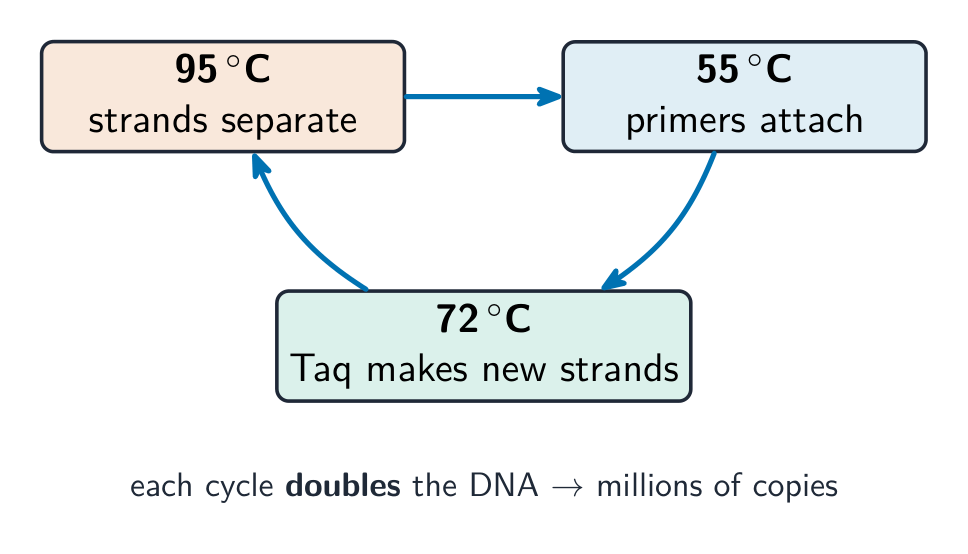
    • 6.8.A.1.ii During polymerase chain reaction (PCR), DNA fragments are amplified by denaturing DNA, annealing primers to the original strand, and extending the new DNA molecule.
    • 6.8.A.1.iii Bacterial transformation introduces foreign DNA into bacterial cells.
    • 6.8.A.1.iv DNA sequencing technology determines the order of nucleotides in a DNA molecule. Typically, these techniques result in a DNA fingerprint that allows for the comparison of DNA sequences from various samples.
    • Illustrative examples for 6.8.A.1:
      • Amplified DNA fragments can be used to identify organisms and perform phylogenetic analysis.
      • Analysis of DNA can be used for forensic identification.
      • Genetically modified organisms include transgenic animals.
      • Gene cloning allows propagation of DNA fragments.
    • Exclusion statement: Knowledge of the details of each of these genetic engineering techniques is beyond the scope of the AP Exam.
日本語

永続的理解(BIG IDEA 3 — 情報の保存と伝達): 生命系は、生命過程に不可欠な情報を保存し、検索し、伝達し、応答する。

学習目標 6.8.A: DNAの解析や操作における遺伝子工学的技術の利用について説明せよ。

  • 6.8.A.1 遺伝子工学的技術は、DNAおよびRNAの解析や操作に用いられることができる。
    • 6.8.A.1.i ゲル電気泳動は、サイズと電荷に基づいてDNA断片を分離するプロセスである。
    • 6.8.A.1.ii ポリメラー鎖反応(PCR)では、DNAの変性、プライマーの元の鎖へのannealing、および新しいDNA分子の伸長により、DNA断片が増幅される。
    • 6.8.A.1.iii 細菌への変換は、外来DNAを細菌細胞内に導入する。
    • 6.8.A.1.iv DNAシーケンシング技術は、DNA分子内の塩基配列の順序を決定する。通常、これらの技術は、異なるサンプルからのDNA配列を比較できるDNAフィンガープリントを生じる。
    • 6.8.A.1の例示:
      • 増幅されたDNA断片は、生物の同定および系統解析に用いられることがある。
      • DNAの解析は、法医学的識別に用いられることがある。
      • 遺伝子組み換え生物には、トランスジェニック動物が含まれる。
      • ゲノムクローニングは、DNA断片の増殖を可能にする。
    • 除外事項: これらの各遺伝子工学的技術の詳細に関する知識は、AP試験の範囲外である。

Source: College Board AP Course and Exam Description · ⁨出典: College Board AP コースおよび試験説明書⁩

English

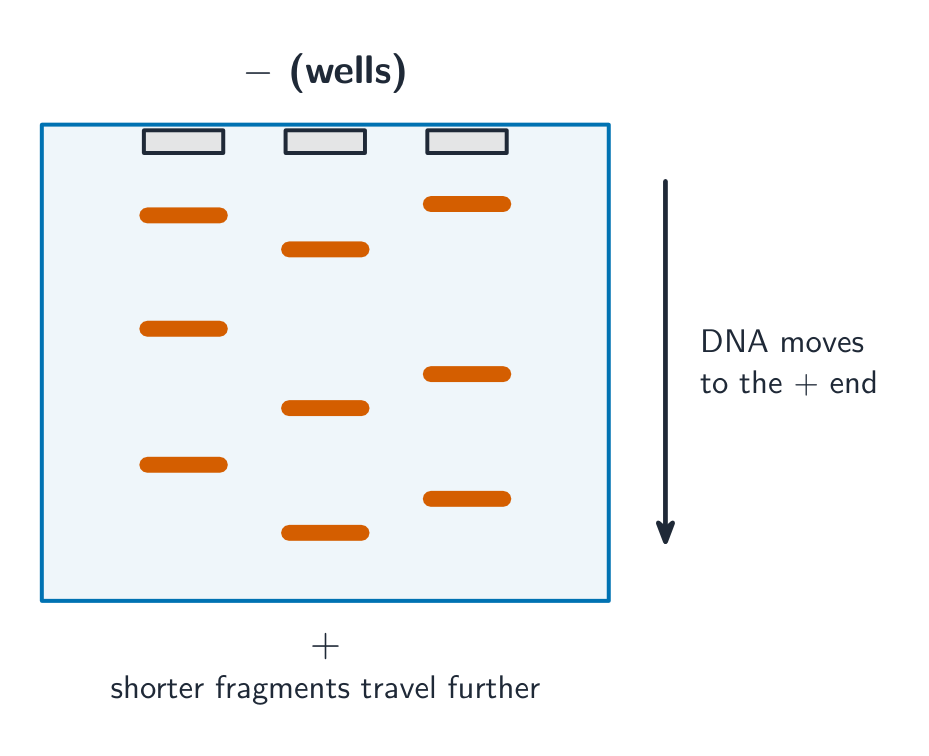
Biotechnology 生物技术 tools manipulate genetic material: PCR 聚合酶链反应 copies DNA, gel electrophoresis 凝胶电泳 separates DNA fragments by size, restriction enzymes and cloning move genes between organisms, and CRISPR edits sequences. These techniques enable genetic testing, engineered organisms, and medical treatments.

Worked example. A template DNA strand 3'-TAC GGA TTC-5' is transcribed into mRNA 5'-AUG CCU AAG-3'. A ribosome reads three codons: AUG = Met (start), CCU = Pro, AAG = Lys — coding for Met–Pro–Lys. Changing the third base of a codon often gives the same amino acid, because the genetic code is degenerate, which softens the effect of many mutations.

Reading DNA identifies individuals. Because the number of repeats at certain non-coding loci varies from person to person, analysis of DNA can be used for forensic identification: amplify those regions by PCR, separate the fragments by gel electrophoresis, and compare the pattern of band positions with a reference sample. A match is a statement about probability rather than certainty, which is why several loci are tested rather than one.

日本語
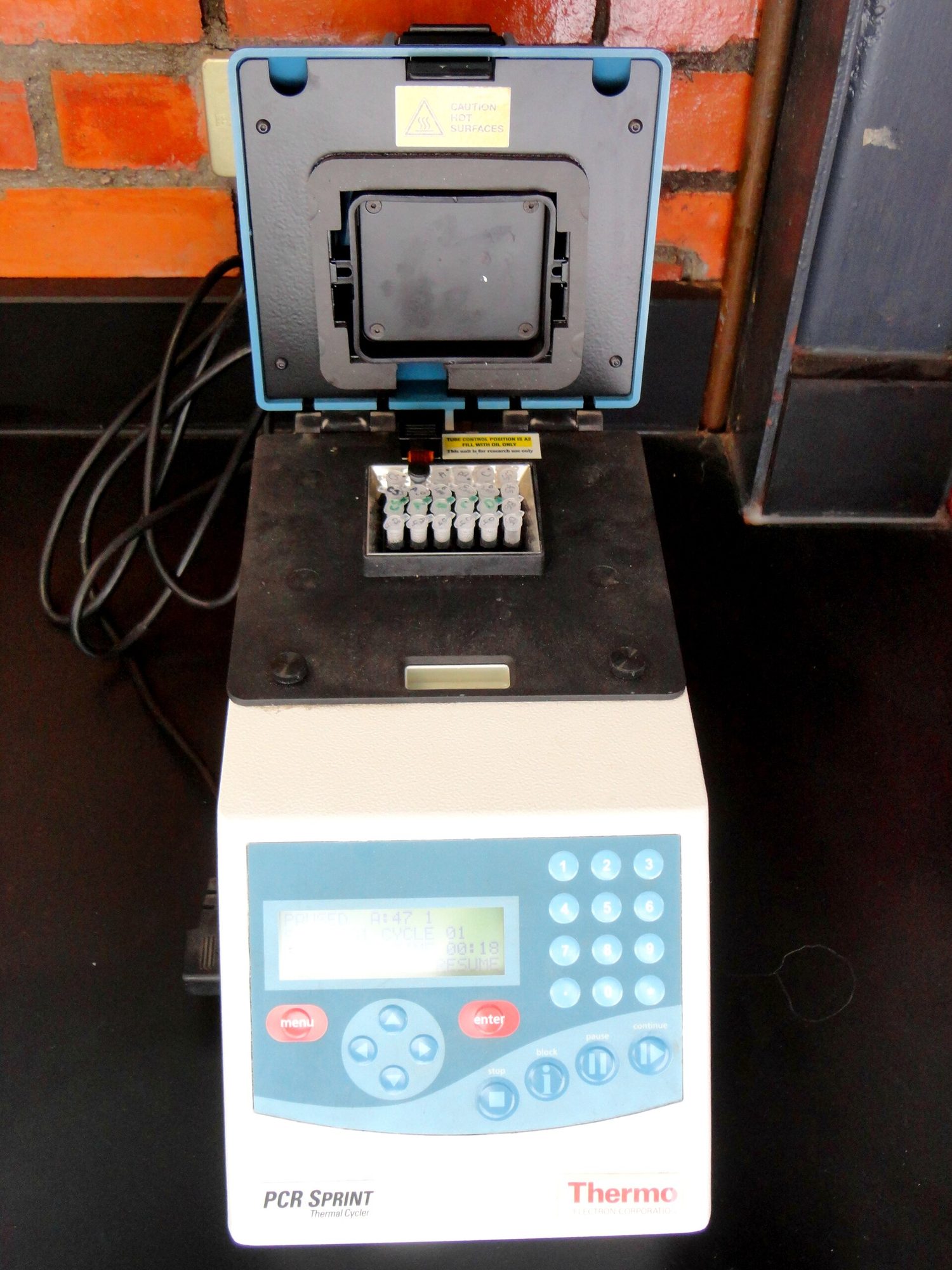
サーマルサイクラーはDNAを増幅するために(PCR)サンプルを繰り返し加熱・冷却する
サーモサイクラーが試料を繰り返し加熱・冷却してDNAを増幅する(PCR)
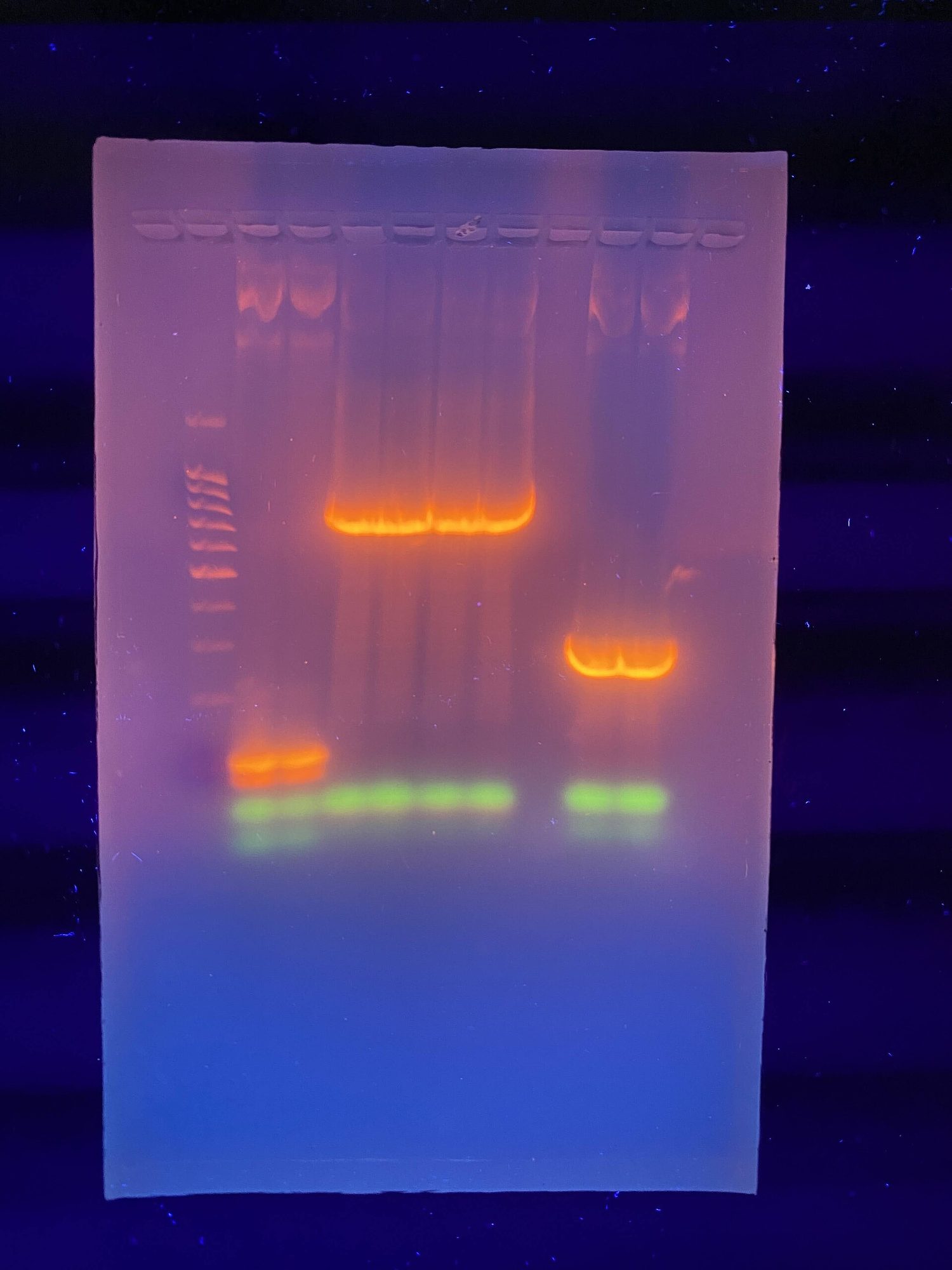
UV光下でのアガロースゲル:DNA断片がサイズ別に分かれ、明るい帯として可視化されている
UV光下のアガロースゲル:DNA断片がサイズ別に分かれて明るいバンドとして見える

バイオテクノロジーのツールは遺伝物質を操作します:PCRでDNAをコピーし、ゲル電気泳動でサイズ別にDNA断片を分離し、制限酵素やクローニングで遺伝子を生物間で移動させ、CRISPRで配列を編集します。これらの技術により、遺伝子検査、組み換え生物、および医療治療が可能になります。

ゲル電気泳動により、DNA断片が長さによって分離される
ゲル電気泳動は長さに基づいてDNA断片を分離します
ポリメラーゼ鎖反応(PCR)では、各サイクルでDNA量が倍増する
ポリメラーゼ鎖反応は各サイクルでDNAを倍増させます

演習例。 鋳型DNA鎖 3'-TAC GGA TTC-5' が転写されてmRNA 5'-AUG CCU AAG-3' となります。リボソームは3つのコドンを読み取ります:AUG = メチオニン(開始)、CCU = プロリン、AAG = リシン — これにより Met–Pro–Lys をコードします。コドンの第三塩基を変えることはしばしば同じアミノ酸をもたらしますが、これは遺伝子が重複性を持っているため、多くの突然変異の影響が和らぐからです。

** DNAの読み取りは個人を識別します。** 特定の非コーディング座標における反復回数が人によって異なるため、DNA解析は法医学的識別に使用できます:PCRでその領域を増幅し、ゲル電気泳動で断片を分離し、バンド位置のパターンを参照サンプルと比較します。一致は確実性ではなく確率に関する声明であるため、1つの座標ではなく複数の座標がテストされます。

Vocabulary · ⁨語彙⁩ Train · ⁨練習する⁩
English 日本語
PCR/ˌpiː siː ˈɑː/ PCR
gel electrophoresis/dʒel ɪˌlektrəʊfɔːˈriːsɪs/ ゲル電気泳動
6.8

Exam tips · ⁨試験対策⁩

English
  • Know the central dogma DNA → RNA → protein: transcription makes mRNA, translation reads it in three-base codons at the ribosome.
  • Remember RNA is single-stranded and uses U instead of T; replication is semiconservative.
  • Every cell has the same DNA — cells differ because they express different genes (differential gene expression).
  • A mutation is a change in the DNA sequence and may be harmful, neutral, or beneficial (the raw material for selection).
  • Link biotech tools to their jobs: PCR copies DNA; gel electrophoresis separates fragments by size.
日本語
  • 中心説 DNA → RNA → タンパク質を知っていること:転写はmRNAを作り、翻訳はリボソームで3塩基ごとのコドンとしてそれを読みます。
  • RNAは一本鎖で、Tの代わりにUを使用すること、複製が半保存的であることを覚えていること。
  • 全ての細胞は同じDNAを持っています — 細胞は異なる遺伝子発現(遺伝子発現の差)するため異なります。
  • 変異はDNA配列の変化であり、有害、中性、あるいは有利になる可能性があります(自然選択のための原材料)。
  • バイオテクノロジーのツールとその役割を結びつけること:PCRはDNAをコピーし、ゲル電気泳動はサイズに基づいて断片を分離する。

Interactive lessons on this topic · ⁨このトピックのインタラクティブ授業⁩

Work through it step by step, with instant-check exercises. · ⁨一歩ずつ進め、即時チェック付きの問題で学習します。⁩

Past Papers · ⁨過去問⁩

More topics in AP Biology · ⁨AP生物学⁩ · ⁨AP Biology · ⁨AP生物学⁩ の他のトピック⁩

Log in or create account · ⁨ログインまたはアカウント作成⁩

IGCSE, A-Level & AP