Biotechnology
Introduced| English |
|---|
| PCR/ˌpiː siː ˈɑː/ |
| biotechnology/ˌbaɪəʊtekˈnɒlədʒi/ |
| transformation/trænsfɔːˈmeɪʃn/ |
| genetic engineering/dʒɪˈnetɪk ˌendʒɪˈnɪərɪŋ/ |
| gel electrophoresis/dʒel ɪˌlektrəʊfɔːˈriːsɪs/ |
A DNA band appears even in the empty control
- A PCR 聚合酶链反应 test gives a band in the sample lane and in a control containing no DNA template. That result needs investigation before anyone claims the target was present.
- Biotechnology 生物技术 tools answer different questions: PCR amplifies a region, a gel separates fragments, sequencing reads bases and transformation 转化 introduces DNA into cells.
PCR: copying DNA
- Biotechnology often starts by making many copies of a gene.
- PCR (the polymerase chain reaction) does exactly this.
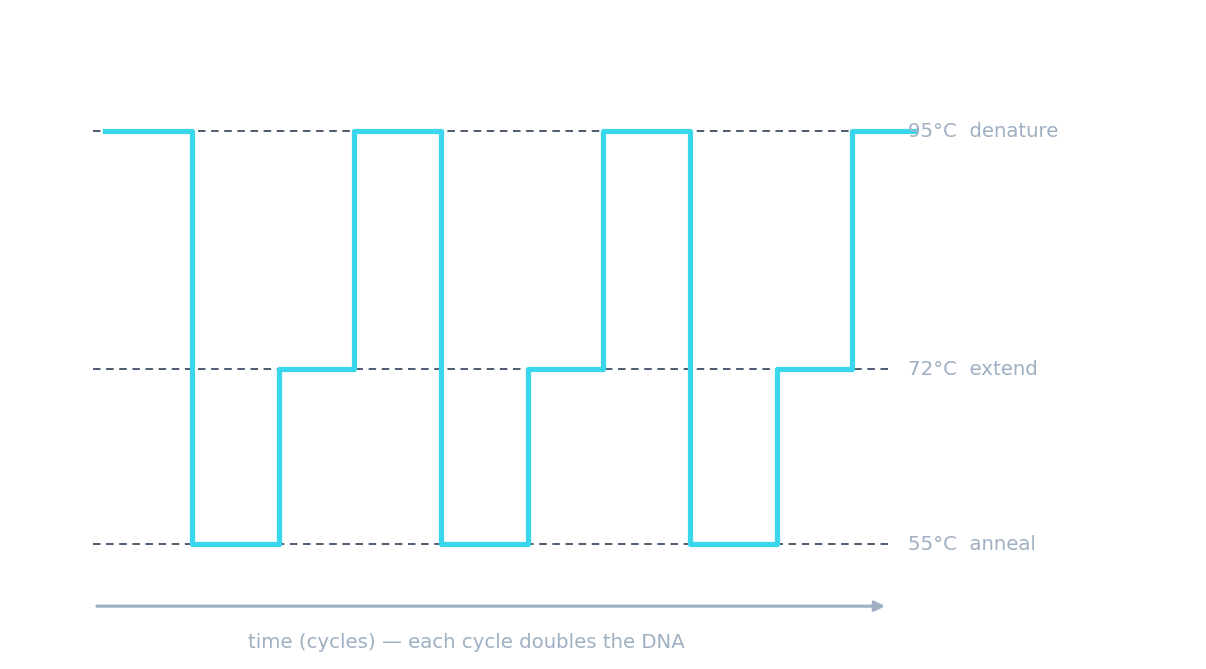
- Cycles of heating and cooling copy a piece of DNA again and again.
- In an ideal reaction, each cycle doubles the target region; real amplification can be less efficient.
Biotechnology means…
Biotechnology uses organisms and their molecules — like DNA and enzymes — to make products and tools.
Genetic engineering 基因工程
- Genetic engineering moves a gene from one organism into another.
- A useful gene is cut out and inserted into a new host.
- The host then reads that gene and makes its protein.
- This lets us give an organism a brand-new ability.
PCR - copying DNA
Step through one PCR cycle - heat separates the strands, primers attach, and each strand is copied, doubling the DNA.
What does PCR do?
PCR (the polymerase chain reaction) copies a target piece of DNA over and over, doubling it each cycle.
What biotechnology can do
- Bacteria are engineered to make human insulin for diabetics.
- Crops are given genes for pest resistance or extra vitamins.
- DNA can be read to diagnose disease or identify a person.
- Gene therapy even aims to fix faulty genes in patients.
Moving a gene from one organism into another is called genetic ____.
Genetic engineering transfers a gene between organisms — for example, putting a human gene into bacteria.
Bacteria can be engineered to make human insulin as medicine.
The human insulin gene is put into bacteria, which then produce insulin cheaply and safely.
Select all true statements about biotechnology.
Powerful tools raise real ethical questions worth careful thought. The other three are correct.
PCR separates, primes and extends
- Heating denatures the DNA, separating its strands. Cooling lets short primers anneal to matching sequences that define the target region. A heat-stable DNA polymerase then extends from the primers.
- Repeated cycles amplify that region. Ideal doubling gives 2ⁿ copies from one target after n cycles, but real reactions are less efficient; PCR copies existing DNA, not the whole organism.
Order one PCR cycle.
Heating separates strands; primers supply ends; polymerase extends.
Starting from one target copy, what is the ideal number after five doubling cycles?
2⁵ = 32. This is an ideal model, not a guaranteed experimental yield.
A gel separates fragments by size
- In gel electrophoresis 凝胶电泳, negatively charged DNA moves towards the positive electrode. In the same gel under the same conditions, smaller fragments normally travel farther than larger fragments.
- A size ladder gives a reference. A matching band position indicates similar fragment size, not proof that every base in the two fragments is identical.
In one gel, a 200-base-pair and an 800-base-pair DNA fragment start together. Which usually travels farther?
Smaller fragments pass through the gel more readily.
Transformation and sequencing answer different questions
- Transformation introduces foreign DNA into a bacterial cell. A plasmid can carry a useful gene; selection helps find cells that acquired it, but uptake does not guarantee useful expression.
- DNA sequencing reads the nucleotide order. A DNA fingerprint compares informative patterns between samples; matching a limited pattern supports a comparison, rather than proving two complete genomes identical.
Equal band positions alone prove two DNA samples have identical nucleotide sequences.
Same-sized DNA can have different base sequences; sequencing distinguishes them.
Worked example: choose the evidence
- To ask whether a sample contains a target region, amplify it by PCR and compare its product with controls on a gel. A positive control checks that the reaction works; a no-template control checks for contamination.
- If the no-template control also has the target band, the sample band is not trustworthy evidence by itself. To identify a base substitution in two same-size products, sequence the DNA rather than rely on gel position.
A no-template PCR control has the same target-sized band as the sample. What should you investigate?
A target product without template suggests contamination or another assay problem.
These tools are powerful, and power brings responsibility. Editing genes and modifying organisms raise real ethical questions — about safety, fairness, and consent. Biotechnology must be used thoughtfully, not just because we can.
Bacteria that make human insulin:
- Some people with diabetes require insulin; older preparations were obtained from animal tissues.
- Now the human insulin gene is placed into bacteria by genetic engineering.
- Engineered cells produce insulin protein, which must be processed, purified and quality-checked before medical use.
Biotechnology uses living things and their molecules as tools. PCR copies a piece of DNA millions of times; genetic engineering moves a gene between organisms, letting (for example) bacteria make human insulin. These powerful tools bring great benefits — and real ethical questions.