Transcription and RNA Processing
Introduced 8:40
Gene Expression and Regulation
That white thread in the tube is real DNA, pulled out of ordinary cells. It looks like nothing at all. But it holds every instruction your body will ever need.…
English narration · English and 中文 subtitles you can switch
In this lesson
| English | Meaning |
|---|---|
| transcription/trænˈskrɪpʃn/ | The production of an RNA molecule using a DNA sequence as its template. |
| RNA polymerase/ˌɑː en ˈeɪ ˌpɒlɪməˈreɪz/ | the enzyme that builds RNA from a DNA template |
| messenger RNA/ˈmesɪndʒə ˌɑː en ˈeɪ/ | An RNA molecule that carries a gene's coding information to a ribosome for protein synthesis. |
One gene, many proteins
- Humans have only about 20 000 protein-coding genes, yet our cells make far more than 20 000 different proteins. Part of the answer is in how a gene's message is copied and edited before it is used.
- Genetic information flows DNA → RNA → protein. This lesson covers the first step, transcription 转录, and how eukaryotic cells process the RNA copy.
Three kinds of RNA
| RNA | Job |
|---|---|
| mRNA (messenger) 信使RNA | carries the gene's information from DNA in the nucleus to a ribosome in the cytoplasm |
| tRNA (transfer) 转运RNA | each binds a specific amino acid; its anticodon base-pairs with an mRNA codon during translation |
| rRNA (ribosomal) 核糖体RNA | a building block of ribosomes |
- For every RNA, the base sequence and the molecule's shape together determine what it does.
Match each RNA to its job.
Difficulty 2/5 · 140 coins + a small bonus on first completion today
Messenger, transfer and ribosomal RNA each have a different job set by their sequence and shape.
Transcription: RNA polymerase reads the template
- RNA polymerase RNA聚合酶 uses one strand of the DNA, the template strand 模板链, to build an RNA molecule by complementary base pairing: DNA A → RNA U, T → A, G → C, C → G.
- RNA polymerase reads the template 3′ → 5′ and builds the RNA 5′ → 3′ (new nucleotides are added to the 3′ end). The mRNA has the same sequence as the other DNA strand (the coding strand), with U in place of T.
- Template strand: 3′-TAC GGA TTC-5′
- mRNA: 5′-AUG CCU AAG-3′
- Coding strand: 5′-ATG CCT AAG-3′ (same as the mRNA, with T for U)
Transcription: DNA to mRNA
Step through transcription - the DNA template is copied into mRNA by base pairing (A to U, T to A, G to C, C to G).
Transcription copies a gene from DNA into…
Difficulty 1/5 · 100 coins + a small bonus on first completion today
Transcription makes an mRNA copy of one gene, which can leave the nucleus.
When transcribing DNA into mRNA, a DNA "A" is copied as an mRNA…
Difficulty 1/5 · 100 coins + a small bonus on first completion today
RNA uses uracil, so a DNA A pairs with an mRNA U (DNA T → mRNA A, G → C, C → G).
The enzyme that builds the mRNA copy is RNA ____.
Difficulty 1/5 · 100 coins + a small bonus on first completion today
RNA polymerase reads the DNA template and joins RNA nucleotides into mRNA.
A DNA template strand reads 3′-ACGTTA-5′. What is the mRNA?
Difficulty 1/5 · 100 coins + a small bonus on first completion today
Pair each base (A→U, C→G, G→C, T→A) and write the mRNA 5′→3′, antiparallel to the template.
RNA processing in eukaryotes
- The first transcript (pre-mRNA) is modified by enzymes before it leaves the nucleus. A 5′ GTP cap helps the ribosome recognize the mRNA. A poly-A tail (a chain of adenine nucleotides) at the 3′ end makes the mRNA more stable.
- Introns 内含子 (non-coding sections) are cut out and the exons 外显子 are joined (splicing 剪接). In alternative splicing, different combinations of exons are kept, so one gene can produce several different mRNAs and proteins.
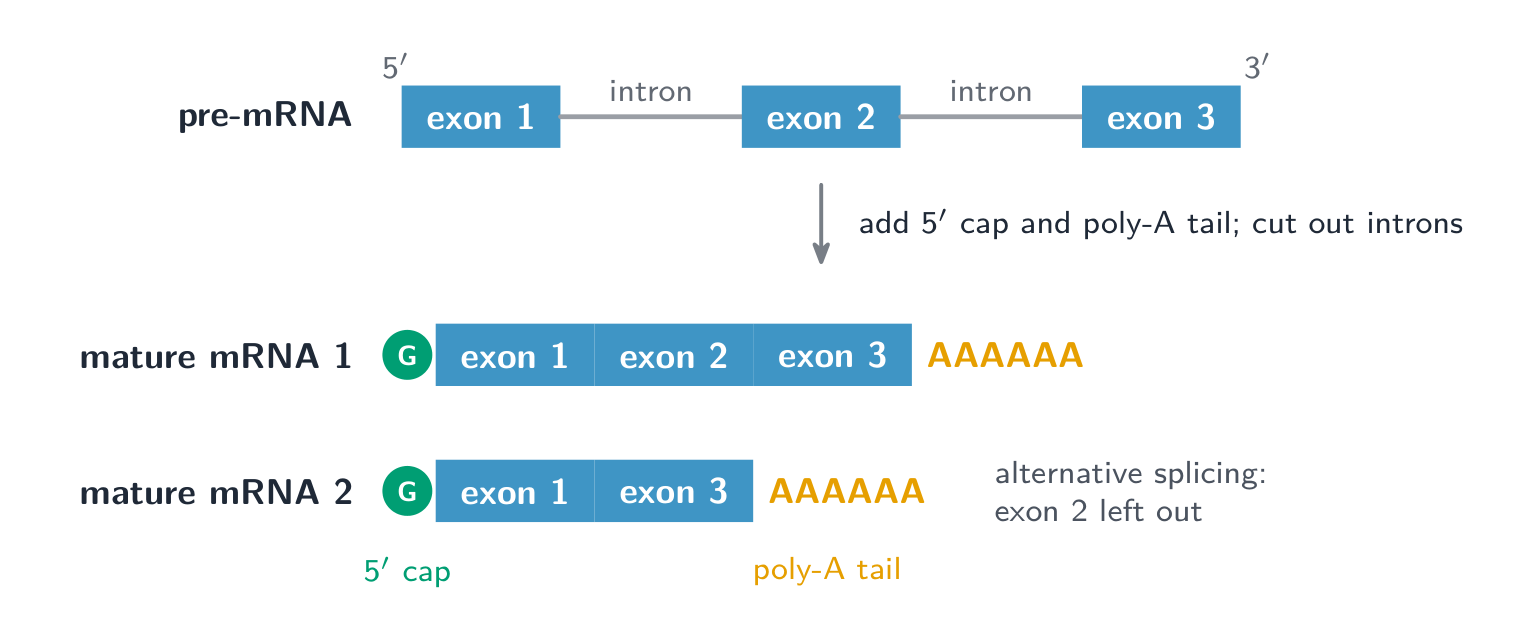
In eukaryotes, the mRNA is edited (processed) before it leaves the nucleus.
Difficulty 1/5 · 100 coins + a small bonus on first completion today
RNA processing trims and caps the mRNA so it is ready to be read by a ribosome.
Select all true statements about transcription.
Difficulty 2/5 · 140 coins + a small bonus on first completion today
Transcription copies one gene, not the whole genome. The other three are correct.
Match each processing step to its effect.
Difficulty 2/5 · 140 coins + a small bonus on first completion today
These are the three eukaryotic modifications named in the CED.
A gene has 4 exons. The first and last exons are always kept; each of the two middle exons can be kept or left out. How many different mature mRNAs are possible?
Difficulty 2/5 · 140 coins + a small bonus on first completion today
Each middle exon has 2 choices (in or out): 2 × 2 = 4 mRNAs.
Worked FRQ answer
(A) A DNA template strand reads 3′-TACCGT-5′. Give the mRNA sequence, with its ends labelled. 5′-AUGGCA-3′.
(B) A mutation stops a cell from adding poly-A tails. Predict the effect on protein production, and justify. Less protein is made. Without the poly-A tail, mRNA is less stable and is broken down faster, so each mRNA is translated fewer times.
(C) Explain how one gene can code for two different proteins in two different tissues. By alternative splicing: in each tissue, different exons are kept in the mature mRNA, so the mRNAs, and the proteins they code for, differ.
- Why it scores: (A) labels 5′ and 3′ and uses U, not T. (B) links the missing tail → less stable mRNA → less translation. (C) names the process and says what differs (the exons kept).
- RNA has U, not T. A DNA A pairs with RNA U.
- RNA is built 5′ → 3′, so the template is read 3′ → 5′. The mRNA is antiparallel to the template.
- Introns are removed; exons are expressed. Processing (cap, tail, splicing) happens in eukaryotes, not prokaryotes.
mRNA carries the message, tRNA brings amino acids (anticodon pairs with codon), rRNA builds ribosomes. In transcription, RNA polymerase reads the template strand 3′→5′ and builds RNA 5′→3′. In eukaryotes, pre-mRNA gets a 5′ cap (ribosome recognition), a poly-A tail (stability), and splicing removes introns; alternative splicing lets one gene make several proteins.
What went wrong? Only the site team sees this.