DNA and RNA Structure
Introduced| English |
|---|
| sugar-phosphate backbone/ˈʃʊɡə ˈfɒsfeɪt ˈbækbəʊn/ |
| nucleotide/ˈnjuːklɪɒtaɪd/ |
| base pair/beɪs peə/ |
A closer look at the code
- You have met DNA as the molecule of information.
- Now look closely at how it is built.
- Its structure is what lets it store a code and be copied exactly.
- The shape holds the secret of how genes work.
The sugar-phosphate backbone
- DNA is built from nucleotide 核苷酸 units, each a sugar, a phosphate, and a base.
- The sugars and phosphates link into a sugar-phosphate backbone 糖磷酸骨架.
- Two backbones form the long sides of a twisted ladder.
- The bases point inward, forming the rungs.
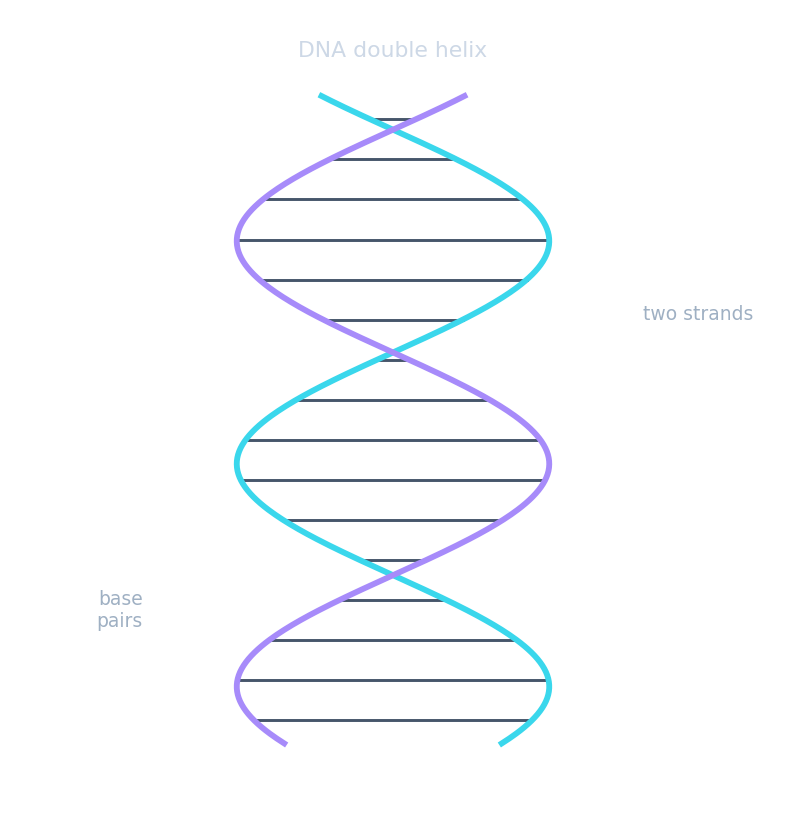
The two long sides of the DNA ladder are made of a repeating…
Each strand's backbone is an alternating sugar-phosphate chain; the bases stick out from it.
The repeating unit of a nucleic acid — a sugar, phosphate, and base — is a ____.
Each nucleotide is one sugar + one phosphate + one base; many joined make a strand.
Base pairs make the rungs
- Each rung is a base pair 碱基对 joining the two strands.
- A always pairs with T, and G always pairs with C.
- So the two strands carry matching, complementary information.
- Read one strand and you know the other exactly.
In a DNA base pair, guanine (G) always pairs with…
G pairs with C, and A pairs with T — the rungs of the DNA ladder are these base pairs.
How RNA differs
- RNA is usually a single strand, not a double helix.
- Its sugar is ribose, not the deoxyribose of DNA.
- It uses the base uracil (U) where DNA uses thymine (T).
- These differences suit RNA to its job of carrying copies of the code.
A DNA or an RNA feature?
Sort each structural feature by whether it belongs to DNA or RNA.
RNA is usually single-stranded and uses uracil instead of thymine.
RNA differs from DNA: single strand, ribose sugar, and uracil in place of thymine.
Select all true statements about DNA and RNA structure.
Nucleic acids are made of nucleotides, not amino acids. The other three are correct.
The base pairing rules are fixed: A–T and G–C in DNA (A–U and G–C when RNA is involved). A never pairs with G, and C never pairs with T. These strict rules are what make copying and reading the code reliable.
Writing the partner strand:
- Suppose one DNA strand reads $\text{G–C–A–T}$.
- Its partner must read $\text{C–G–T–A}$ — each base matched to its pair.
- This exact matching is why a cell can copy DNA without errors.
DNA is a double helix of two sugar-phosphate backbones, with nucleotide bases forming base pairs (A–T, G–C) as the rungs. RNA differs: it is usually single-stranded, uses ribose sugar, and has uracil in place of thymine. The structure is what lets the code be stored and copied exactly.