Duduk di ruangan seseorang sedang membuat kopi di sebelahnya. Segera Anda dapat menciumnya, bahkan dari seberang ruangan. Bagaimana? Segala sesuatu di sekitar Anda terdiri dari partikel kecil, jauh…
English narration · English + 中文 subtitles burned in · Narasi bahasa Inggris · Subtitle bahasa Inggris + 中文 disematkan langsung
1.1
The three states of matter · Tiga wujud zat
Syllabus · Silabus
English
Core
Supplement
1 State the distinguishing properties of solids, liquids and gases
2 Describe the structures of solids, liquids and gases in terms of particle separation, arrangement and motion
3 Describe changes of state in terms of melting, boiling, evaporating, freezing and condensing
5 Explain changes of state in terms of kinetic particle theory, including the interpretation of heating and cooling curves
4 Describe the effects of temperature and pressure on the volume of a gas
6 Explain, in terms of kinetic particle theory, the effects of temperature and pressure on the volume of a gas
Bahasa Indonesia
Inti
Tambahan
1 Nyatakan sifat-sifat pembeda dari padat, cair dan gas
2 Jelaskan struktur padat, cair, dan gas berdasarkan jarak antar partikel, susunan, dan gerak
3 Jelaskan perubahan wujud dalam hal peleburan, penguapan, penguapan permukaan, pembekuan dan pengembunan
5 Jelaskan perubahan wujud berdasarkan teori kinetik partikel, termasuk interpretasi kurva pemanasan dan pendinginan
4 Jelaskan efek suhu dan tekanan terhadap volume gas
6 Jelaskan, berdasarkan teori kinetik partikel, efek suhu dan tekanan terhadap volume gas
Source: Cambridge International syllabus · Sumber: Silabus Cambridge International
English
Solid, liquid, gas: particle motion
Everything around you is made of tiny particles 粒子 — these can be atoms 原子, molecules 分子, or ions 离子. The kinetic particle theory 粒子动理论 says these particles are always moving. How close the particles are, how they are arranged, and how they move decides whether matter is a solid 固体, a liquid 液体, or a gas 气体.
Properties you can observe
You do not need a microscope to tell the three states apart. They behave in different ways:
A solid has a fixed shape and a fixed volume 体积. It does not flow and you cannot compress 压缩 it (squeeze it smaller).
A liquid has a fixed volume but no fixed shape. It flows and takes the shape of its container. It is almost impossible to compress.
A gas has no fixed shape and no fixed volume. It flows and spreads out to fill the whole container. A gas is easy to compress.
The table below sums up these properties. Density 密度 means how much mass 质量 is packed into a given volume.
Property
Solid
Liquid
Gas
Shape
fixed
takes the shape of the container
fills the whole container
Volume
fixed
fixed
fills the whole container
Can it be compressed?
no
almost none
yes, easily
Does it flow?
no
yes
yes
Density
high
high
low
The particle picture
The kinetic particle theory explains these properties by looking at three things: the separation 间距 of the particles (how far apart they are), their arrangement 排列 (the pattern), and their motion 运动 (how they move).
Solid
Liquid
Gas
Separation
touching, very close
close together
far apart
Arrangement
regular 规则 pattern
random, no pattern
random, no pattern
Motion
vibrate 振动 about fixed positions
move and slide past each other
move quickly in all directions
Strong forces of attraction 引力 hold the particles together. In a solid these forces are strong enough to hold every particle in place, so a solid keeps its shape. In a liquid the forces are weaker, so particles can move around. In a gas the particles move so fast that the forces hardly act at all, so the gas spreads out.
Bahasa Indonesia
Padat, cair, gas: gerak partikel
Segala sesuatu di sekitarmu terbuat dari partikel kecil — ini bisa berupa atom, molekul, atau ion. Teori kinetik partikel menyatakan bahwa partikel-partikel ini selalu bergerak. Seberapa dekat partikelnya, bagaimana susunannya, dan bagaimana mereka bergerak menentukan apakah suatu zat adalah padat, cair, atau gas.
Sifat yang dapat diamati
Anda tidak perlu mikroskop untuk membedakan ketiga wujud tersebut. Mereka berperilaku berbeda-beda:
Zat padat memiliki bentuk tetap dan volume tetap. Zat padat tidak mengalir dan Anda tidak dapat memampatkannya (menyempitkannya).
Zat cair memiliki volume tetap tetapi tidak memiliki bentuk tetap. Zat cair mengalir dan mengikuti bentuk wadahnya. Sangat sulit untuk memampatkannya.
Gas tidak memiliki bentuk tetap dan tidak memiliki volume tetap. Gas mengalir dan menyebar untuk mengisi seluruh wadah. Gas mudah dimampatkan.
Tabel di bawah ini merangkum sifat-sifat ini. Kepadatan berarti berapa banyak massa yang terkandung dalam volume tertentu.
Sifat
Padat
Cair
Gas
Bentuk
tetap
mengikuti bentuk wadah
mengisi seluruh wadah
Volume
tetap
tetap
mengisi seluruh wadah
Dapat dipadamkan?
tidak
hampir tidak
ya, mudah
Apakah mengalir?
tidak
ya
ya
Kepadatan
tinggi
tinggi
rendah
Gambaran partikel
Teori kinetik partikel menjelaskan sifat-sifat ini dengan melihat tiga hal: jarak antar partikel (seberapa jauh jaraknya), susunan (pola), dan gerak (bagaimana mereka bergerak).
Padat
Cair
Gas
Jarak
saling bersentuhan, sangat dekat
berdekatan
berjauhan
Susunan
pola teratur
acak, tidak beraturan
acak, tidak beraturan
Gerak
bergetar pada posisi tetap
bergerak dan meluncur melewati satu sama lain
bergerak cepat ke segala arah
Gaya tarik-menarik yang kuat menahan partikel bersama. Dalam zat padat, gaya-gaya ini cukup kuat untuk menahan setiap partikel di tempatnya, sehingga zat padat mempertahankan bentuknya. Dalam zat cair, gayanya lebih lemah, sehingga partikel dapat bergerak bebas. Dalam gas, partikel bergerak begitu cepat sehingga gaya-gaya tariknya hampir tidak berpengaruh sama sekali, sehingga gas menyebar.
Partikel tersusun rapat dan teratur dalam padat, rapat dan acak dalam cair, serta berjauhan dalam gas
Explore · Jelajahi
States of matter · Keadaan materi
Heat the box and watch the particles break free: a vibrating solid melts to a flowing liquid, then spreads out as a gas. Same particles — just more energy. · Panaskan kotak dan saksikan partikel lepas: zat padat bergetar meleleh menjadi cairan mengalir, lalu menyebar sebagai gas. Partikel sama — hanya energi lebih banyak.
When you heat or cool a substance, it can change from one state to another. You must know the name of each change.
Change
What happens
Name
solid → liquid
melting 熔化
melting
liquid → solid
freezing 凝固
freezing
liquid → gas (at the surface, below the boiling point)
evaporating 蒸发
evaporation
liquid → gas (all through the liquid)
boiling 沸腾
boiling
gas → liquid
condensing 凝结
condensation
A pure solid melts at one fixed temperature, the melting point 熔点. A pure liquid boils at one fixed temperature, the boiling point 沸点. The same substance freezes at its melting point and condenses at its boiling point.
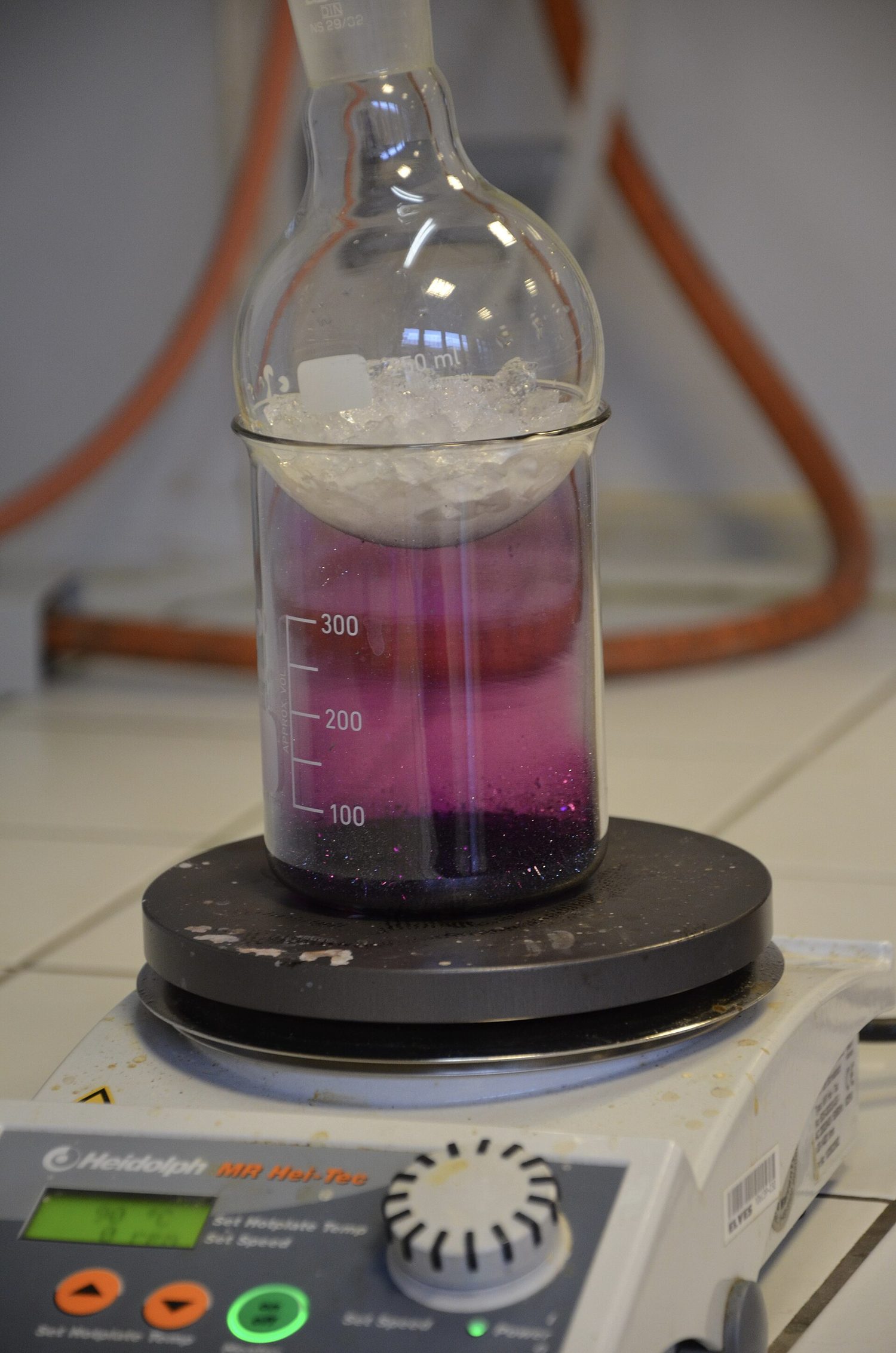
A few substances change straight from solid to gas without melting first. This is called sublimation 升华. In the photo below, warmed solid iodine in a beaker turns directly into a purple gas; the gas then cools on the round flask of ice above and turns back into a solid.
Explaining changes of state with the particle theory
Each change of state is really a change in the energy 能量 of the particles.
When you heat a solid, the particles gain energy and vibrate faster. At the melting point the particles have enough energy to break away from their fixed places and slide around — the solid melts.
When you heat a liquid, the particles move faster. At the boiling point they have enough energy to fully escape the forces of attraction and become a gas.
Cooling does the opposite. The particles lose energy, move more slowly, and the forces of attraction pull them back together.
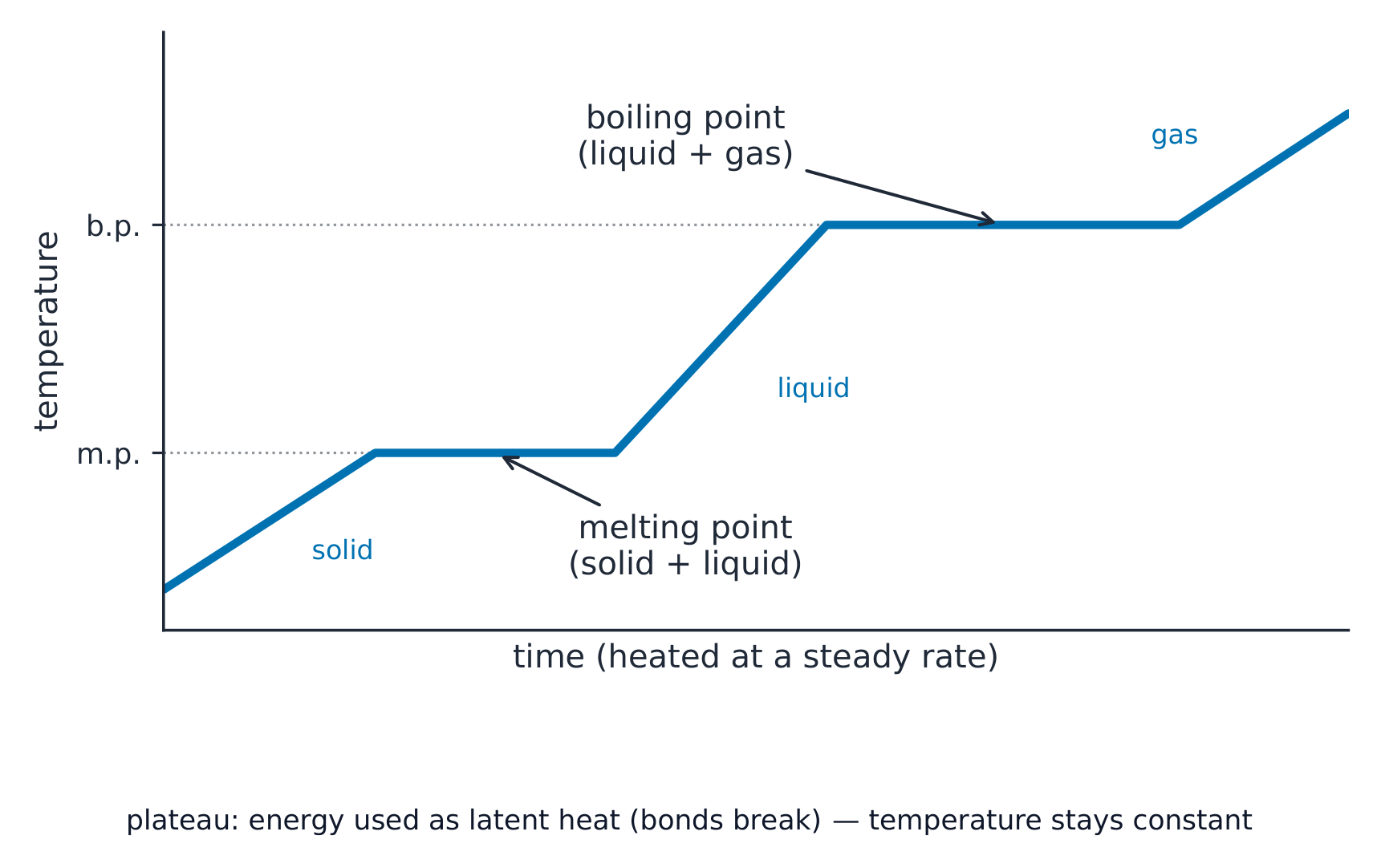
During a change of state the energy goes into breaking the forces of attraction, not into making the particles move faster. This is why the temperature stays the same while a substance is melting or boiling.
Heating and cooling curves
A heating curve 加热曲线 is a graph of temperature against time as you heat a substance steadily. A cooling curve 冷却曲线 is the same graph as the substance cools.
On a heating curve there are two flat (level) parts:
The first flat part is at the melting point. Here solid and liquid are both present. The heat energy breaks the forces holding the solid together, so the temperature does not rise.
The second flat part is at the boiling point. Here liquid and gas are both present, and the temperature again stays constant.
A cooling curve is the reverse. It has a flat part at the boiling point (the gas condenses) and a flat part at the melting point (the liquid freezes). As the particles slow down, thermal energy 热能 is released to the surroundings.
Bahasa Indonesia
Es mencair menjadi air: perubahan wujud saat zat padat memanaskan.
Ketika Anda memanaskan atau mendinginkan suatu zat, ia dapat berubah dari satu wujud ke wujud lainnya. Anda harus mengetahui nama setiap perubahan tersebut.
Perubahan
Apa yang terjadi
Nama
padat → cair
melebur
peleburan
cair → padat
membeku
pembekuan
cair → gas (di permukaan, di bawah titik didih)
menguap
penguapan
cair → gas (seluruh bagian zat cair)
mendidih
pendidihan
gas → cair
mengembun
pengembunan
Zat padat murni melebur pada suhu tetap tunggal, yaitu titik lebur. Zat cair murni mendidih pada suhu tetap tunggal, yaitu titik didih. Zat yang sama membeku pada titik leburnya dan mengembun pada titik didihnya.
Pemanasan: padat → cair → gas; pendinginan membalikkan setiap perubahan
Beberapa zat berubah langsung dari padat ke gas tanpa melebur terlebih dahulu. Ini disebut sublimasi. Di foto di bawah ini, iodin padat yang dihangatkan dalam beaker berubah langsung menjadi gas ungu; gas tersebut kemudian mendingin di atas labu bulat berisi es di atasnya dan berubah kembali menjadi padatan.
Iodin padat yang dipanaskan berubah langsung menjadi gas ungu (sublimasi)Contoh sehari-hari: dry ice adalah karbon dioksida padat, dan ia juga mengalami sublimasi — ia tidak pernah meninggalkan genangan air
Menjelaskan perubahan wujud dengan teori partikel
Setiap perubahan wujud sebenarnya adalah perubahan pada energi partikel.
Ketika Anda memanaskan zat padat, partikel memperoleh energi dan bergetar lebih cepat. Pada titik lebur, partikel memiliki cukup energi untuk melepaskan diri dari posisi tetap mereka dan meluncur-latar — zat padat melebur.
Ketika Anda memanaskan zat cair, partikel bergerak lebih cepat. Pada titik didih, mereka memiliki cukup energi untuk sepenuhnya keluar dari gaya tarik-menarik dan menjadi gas.
Pendinginan melakukan sebaliknya. Partikel kehilangan energi, bergerak lebih lambat, dan gaya tarik-menarik menarik mereka kembali bersama.
Selama perubahan wujud, energi digunakan untuk memecah gaya tarik-menarik, bukan untuk membuat partikel bergerak lebih cepat. Inilah mengapa suhu tetap konstan selama suatu zat melebur atau mendidih.
Kurva pemanasan dan pendinginan
Kurva pemanasan adalah grafik suhu terhadap waktu saat Anda memanaskan suatu zat secara terus-menerus. Kurva pendinginan adalah grafik yang sama ketika zat tersebut mendingin.
Pada kurva pemanasan terdapat dua bagian datar (horizontal):
Bagian datar pertama berada pada titik lebur. Di sini, zat padat dan cair keduanya ada. Energi panas mematahkan gaya yang mengikat partikel padat, sehingga suhu tidak naik.
Bagian datar kedua berada pada titik didih. Di sini, zat cair dan gas keduanya ada, dan suhu tetap konstan.
Kurva pendinginan adalah kebalikan dari kurva pemanasan. Kurva ini memiliki bagian datar pada titik didih (gas mengembun) dan bagian datar pada titik lebur (cair membeku). Saat partikel melambat, energi termal dilepaskan ke lingkungan sekitar.
Suhu tetap konstan pada titik lebur dan titik didih saat gaya tarik-menarik terputus
Explore · Jelajahi
Heating a substance through its states · Memanaskan suatu zat melalui keadaannya
Step up the temperature. Adding heat gives the particles more energy until they break free — and the temperature pauses at each change of state while the energy does that work. · Naikkan suhu. Menambahkan panas memberikan partikel lebih banyak energi hingga mereka terlepas — dan suhu berhenti sejenak pada setiap perubahan keadaan sementara energi melakukan pekerjaan itu.
Gases: temperature, pressure and volume · Gas: suhu, tekanan, dan volume
English
A gas pushes on the walls of its container. This push, spread over the area of the wall, is the pressure 压强 of the gas. Pressure comes from the gas particles hitting the walls.
Effect of temperature
If you heat a fixed mass of gas while keeping the pressure the same, its volume increases.
Using the particle theory: heating gives the particles more kinetic energy 动能, so they move faster. They hit the walls harder and more often. To keep the pressure the same, the gas must take up more space, so the volume gets bigger.
If instead the volume is fixed (a sealed, rigid container), heating the gas makes the pressure rise, because the faster particles collide 碰撞 with the walls harder and more often.
Effect of pressure
If you increase the pressure on a fixed mass of gas while keeping the temperature the same, its volume decreases. Squeezing the gas into a smaller space means the particles hit the walls more often, which is what a higher pressure means.
Bahasa Indonesia
Gas mendorong dinding wadahnya. Dorongan ini, yang tersebar luas di seluruh area dinding, disebut tekanan gas. Tekanan berasal dari partikel gas yang menabrak dinding.
Pengaruh suhu
Jika Anda memanaskan massa gas tertentu sementara tekanan dijaga sama, volumenya akan meningkat.
Gas dipanaskan: partikel bergerak lebih cepat menyebar dan memakan ruang lebih banyak
Menggunakan teori partikel: pemanasan memberikan partikel lebih banyak energi kinetik, sehingga mereka bergerak lebih cepat. Mereka menabrak dinding dengan lebih keras dan lebih sering. Untuk menjaga tekanan tetap sama, gas harus memakan ruang lebih besar, sehingga volumenya menjadi lebih besar.
Jika sebaliknya volumenya tetap (wadah kedap udara yang kaku), memanaskan gas membuat tekanannya naik, karena partikel yang bergerak lebih cepat bertumbukan dengan dinding dengan lebih keras dan lebih sering.
Efek tekanan
Jika Anda meningkatkan tekanan pada massa gas tertentu sementara suhu dijaga sama, volumenya akan berkurang. Memampatkan gas ke dalam ruang yang lebih kecil berarti partikel menabrak dinding lebih sering, yang merupakan makna dari tekanan yang lebih tinggi.
Memampatkan gas ke dalam volume yang lebih kecil membuat partikel menabrak dinding lebih sering, sehingga tekanan naik
1 Describe and explain diffusion in terms of kinetic particle theory
2 Describe and explain the effect of relative molecular mass on the rate of diffusion of gases
Bahasa Indonesia
Inti
Tambahan
1 Jelaskan dan uraikan difusi berdasarkan teori kinetik partikel
2 Jelaskan dan uraikan efek massa molekul relatif terhadap laju difusi gas
Source: Cambridge International syllabus · Sumber: Silabus Cambridge International
English
Diffusion: random motion, one-way flow
Diffusion 扩散 is the spreading of particles from a region where they are crowded to a region where they are spread out — that is, from high concentration 浓度 to low concentration. It happens because particles are always moving in random directions.
Diffusion explains why you can smell food from across a room: the smell particles move and mix with the air until they reach your nose. Diffusion happens in gases and in liquids, but not in solids, because solid particles cannot move from place to place.
Rate of diffusion and molecular mass
Lighter gas particles move faster than heavier ones at the same temperature. So a gas with a smaller relative molecular mass 相对分子质量 (a smaller mass for each molecule) has a faster rate 速率 of diffusion.
A classic experiment shows this. Cotton wool soaked in ammonia 氨气 ($\text{NH}_3$) is put at one end of a long glass tube. Cotton wool soaked in hydrogen chloride 氯化氢 ($\text{HCl}$) is put at the other end. Both gases diffuse along the tube and meet to form a white ring of ammonium chloride 氯化铵 ($\text{NH}_4\text{Cl}$).
Ammonia has $M_r = 17$ and hydrogen chloride has $M_r = 36.5$. Ammonia is lighter, so it diffuses faster and travels further along the tube. The white ring forms nearer the hydrogen chloride end.
Worked example. Bromine ($M_r = 160$) and ammonia ($M_r = 17$) are released at the same moment from opposite ends of a long tube. Which travels further before they meet? Compare the relative molecular masses. Ammonia's $M_r$ is far smaller, so its molecules move faster at the same temperature and it diffuses more quickly. Ammonia therefore travels the greater distance, and the two gases meet nearer the bromine end. The rule is always "lighter means faster" - argue from $M_r$, never from how big the formula looks on paper.
Bahasa Indonesia
Difusi: gerakan acak, aliran satu arah
Difusi adalah penyebaran partikel dari daerah yang padat ke daerah yang jarang—yakni, dari konsentrasi tinggi ke konsentrasi rendah. Hal ini terjadi karena partikel selalu bergerak secara acak.
Partikel berdifusi dari konsentrasi tinggi ke rendah hingga tersebar merata
Difusi menjelaskan mengapa Anda dapat mencium bau makanan dari seberang ruangan: partikel bau bergerak dan bercampur dengan udara hingga sampai ke hidung Anda. Difusi terjadi pada gas dan cairan, tetapi tidak pada zat padat, karena partikel zat padat tidak dapat berpindah tempat.
Laju difusi dan massa molekul
Partikel gas yang lebih ringan bergerak lebih cepat daripada yang lebih berat pada suhu yang sama. Jadi, gas dengan massa molekul relatif yang lebih kecil (massa per molekul lebih sedikit) memiliki laju difusi yang lebih cepat.
Eksperimen klasik menunjukkan hal ini. Kapas yang direndam dalam amonia ($\text{NH}_3$) diletakkan di salah satu ujung tabung kaca panjang. Kapas yang direndam dalam hidrogen klorida ($\text{HCl}$) diletakkan di ujung lainnya. Kedua gas berdifusi sepanjang tabung dan bertemu membentuk cincin putih amonium klorida ($\text{NH}_4\text{Cl}$).
Amonia memiliki $M_r = 17$ dan hidrogen klorida memiliki $M_r = 36.5$. Amonia lebih ringan, jadi ia berdifusi lebih cepat dan menempuh jarak lebih jauh di sepanjang tabung. Cincin putih terbentuk lebih dekat ke ujung hidrogen klorida.
Amonia ($M_r=17$) lebih ringan, jadi berdifusi lebih cepat dan lebih jauh; cincin putih terbentuk lebih dekat ke ujung HCl
Contoh kerja. Bromin ($M_r = 160$) dan amonia ($M_r = 17$) dilepaskan secara bersamaan dari ujung berlawanan tabung panjang. Mana yang menempuh jarak lebih jauh sebelum mereka bertemu? Bandingkan massa molekul relatifnya. Massa molekul relatif $M_r$ amonia jauh lebih kecil, sehingga molekulnya bergerak lebih cepat pada suhu yang sama dan berdifusi lebih cepat. Oleh karena itu, amonia menempuh jarak yang lebih besar, dan kedua gas bertemu lebih dekat ke ujung bromin. Aturannya selalu "lebih ringan berarti lebih cepat" - berikan argumen berdasarkan $M_r$, jangan berdasarkan seberapa besar rumus terlihat di kertas.
Explore · Jelajahi
Diffusion · Difusi
Release the cloud and the particles spread on their own from the crowded corner until they fill the box evenly — diffusion, sped up by heat. · Lepaskan awan dan partikel menyebar sendiri dari sudut padat hingga mengisi kotak secara merata — difusi, dipercepat oleh panas.
Explore · Jelajahi
Diffusion · Difusi
Set the concentration on each side. Particles spread from high to low concentration until evenly mixed. · Atur konsentrasi di masing-masing sisi. Partikel menyebar dari tinggi ke rendah konsentrasi hingga tercampur merata.
During melting and boiling the temperature stays constant (the flat parts of a heating curve), because the energy breaks the forces between particles instead of making them move faster.
Evaporation happens only at the surface and at any temperature; boiling happens throughout the liquid at one fixed temperature.
Explain gas behaviour with the particle theory: heating a gas at fixed volume raises the pressure because the particles hit the walls harder and more often — the particles themselves do not get bigger.
Diffusion is faster for lighter particles (smaller $M_r$) and cannot happen in solids. In the ammonia/hydrogen chloride tube the lighter ammonia travels further, so the white ring forms nearer the HCl end.
Bahasa Indonesia
Selama peleburan dan penguapan suhu tetap konstan (bagian datar pada kurva pemanasan), karena energi mematahkan gaya antarpartikel alih-alih membuatnya bergerak lebih cepat.
Penguapan hanya terjadi di permukaan dan pada suhu apa pun; mendidih terjadi di seluruh cairan pada satu suhu tetap.
Jelaskan perilaku gas dengan teori partikel: memanaskan gas pada volume tetap menaikkan tekanan karena partikel menabrak dinding dengan lebih keras dan lebih sering — partikel itu sendiri tidak membesar.
Difusi lebih cepat untuk partikel yang lebih ringan ($M_r$ yang lebih kecil) dan tidak dapat terjadi pada zat padat. Dalam tabung amonia/hidrogen klorida, amonia yang lebih ringan menempuh jarak lebih jauh, sehingga cincin putih terbentuk lebih dekat ke ujung HCl.
Interactive lessons on this topic · Pelajaran interaktif untuk topik ini
Work through it step by step, with instant-check exercises. · Kerjakan langkah demi langkah, dengan latihan pengecekan instan.
Pick one and the site follows you — notes, papers, videos and practice all open on it. · Pilih satu dan situs mengikuti Anda — catatan, kertas, video, dan latihan semua terbuka di sana.
Type to search notes, lessons, code, vocabulary and past-paper questions across every subject. · Ketik untuk mencari catatan, pelajaran, kode, kosakata, dan pertanyaan soal lama di setiap mata pelajaran.