Skip to content · ⁨Lompat ke konten⁩

Equilibria · ⁨Kesetimbangan⁩

A-Level Chemistry · ⁨Kimia A-Level⁩ · Topic 7 · ⁨Topik 7⁩

Video lesson for this topic · ⁨Pelajaran video untuk topik ini⁩ Open the video page · ⁨Buka halaman video⁩
10:12

Kesetimbangan

Beberapa reaksi reversibel tidak pernah selesai. Anda mencampur reaktan, warnanya berubah, lalu semuanya berhenti tiba-tiba — di tengah jalan. Biarkan selama seminggu dan tampilannya…

English narration · English + 中文 subtitles burned in · ⁨Narasi bahasa Inggris · Subtitle bahasa Inggris + 中文 disematkan langsung⁩

7.1

Reversible reactions and dynamic equilibrium · ⁨Reaksi reversibel dan kesetimbangan dinamis⁩

Syllabus · ⁨Silabus⁩
English
  1. (a) understand what is meant by a reversible reaction (b) understand what is meant by dynamic equilibrium in terms of the rate of forward and reverse reactions being equal and the concentration of reactants and products remaining constant (c) understand the need for a closed system in order to establish dynamic equilibrium
  2. define Le Chatelier’s principle as: if a change is made to a system at dynamic equilibrium, the position of equilibrium moves to minimise this change
  3. use Le Chatelier’s principle to deduce qualitatively (from appropriate information) the effects of changes in temperature, concentration, pressure or presence of a catalyst on a system at equilibrium
  4. deduce expressions for equilibrium constants in terms of concentrations, $K_c$
  5. use the terms mole fraction and partial pressure
  6. deduce expressions for equilibrium constants in terms of partial pressures, $K_p$ (use of the relationship between $K_p$ and $K_c$ is not required)
  7. use the $K_c$ and $K_p$ expressions to carry out calculations (such calculations will not require the solving of quadratic equations)
  8. calculate the quantities present at equilibrium, given appropriate data
  9. state whether changes in temperature, concentration or pressure or the presence of a catalyst affect the value of the equilibrium constant for a reaction
  10. describe and explain the conditions used in the Haber process and the Contact process, as examples of the importance of an understanding of dynamic equilibrium in the chemical industry and the application of Le Chatelier’s principle
Bahasa Indonesia
  1. (a) pahami apa yang dimaksud dengan reaksi reversibel (b) pahami apa yang dimaksud dengan keseimbangan dinamis dalam hal laju reaksi maju dan mundur yang sama serta konsentrasi reaktan dan produk tetap konstan (c) pahami perlunya sistem tertutup untuk mencapai keseimbangan dinamis
  2. definisikan prinsip Le Chatelier sebagai: jika perubahan dilakukan pada sistem pada keseimbangan dinamis, posisi kesetimbangan bergeser untuk meminimalkan perubahan tersebut
  3. gunakan prinsip Le Chatelier untuk menyimpulkan secara kualitatif (dari informasi yang sesuai) efek dari perubahan suhu, konsentrasi, tekanan atau kehadiran katalis terhadap sistem pada kesetimbangan
  4. turunkan ekspresi untuk konstanta kesetimbangan dalam bentuk konsentrasi, $K_c$
  5. gunakan istilah fraksi mol dan tekanan parsial
  6. turunkan ekspresi untuk konstanta kesetimbangan dalam bentuk tekanan parsial, $K_p$ (penggunaan hubungan antara $K_p$ dan $K_c$ tidak diperlukan)
  7. gunakan ekspresi $K_c$ dan $K_p$ untuk melakukan perhitungan (perhitungan semacam itu tidak akan memerlukan penyelesaian persamaan kuadrat)
  8. hitung jumlah zat yang ada pada kesetimbangan, diberikan data yang sesuai
  9. nyatakan apakah perubahan suhu, konsentrasi atau tekanan atau kehadiran katalis memengaruhi nilai konstanta kesetimbangan untuk suatu reaksi
  10. deskripsikan dan jelaskan kondisi yang digunakan dalam proses Haber dan proses Contact, sebagai contoh pentingnya pemahaman tentang keseimbangan dinamis dalam industri kimia dan penerapan prinsip Le Chatelier
Source: Cambridge International syllabus · ⁨Sumber: Silabus Cambridge International⁩

English
Le Chatelier's principle
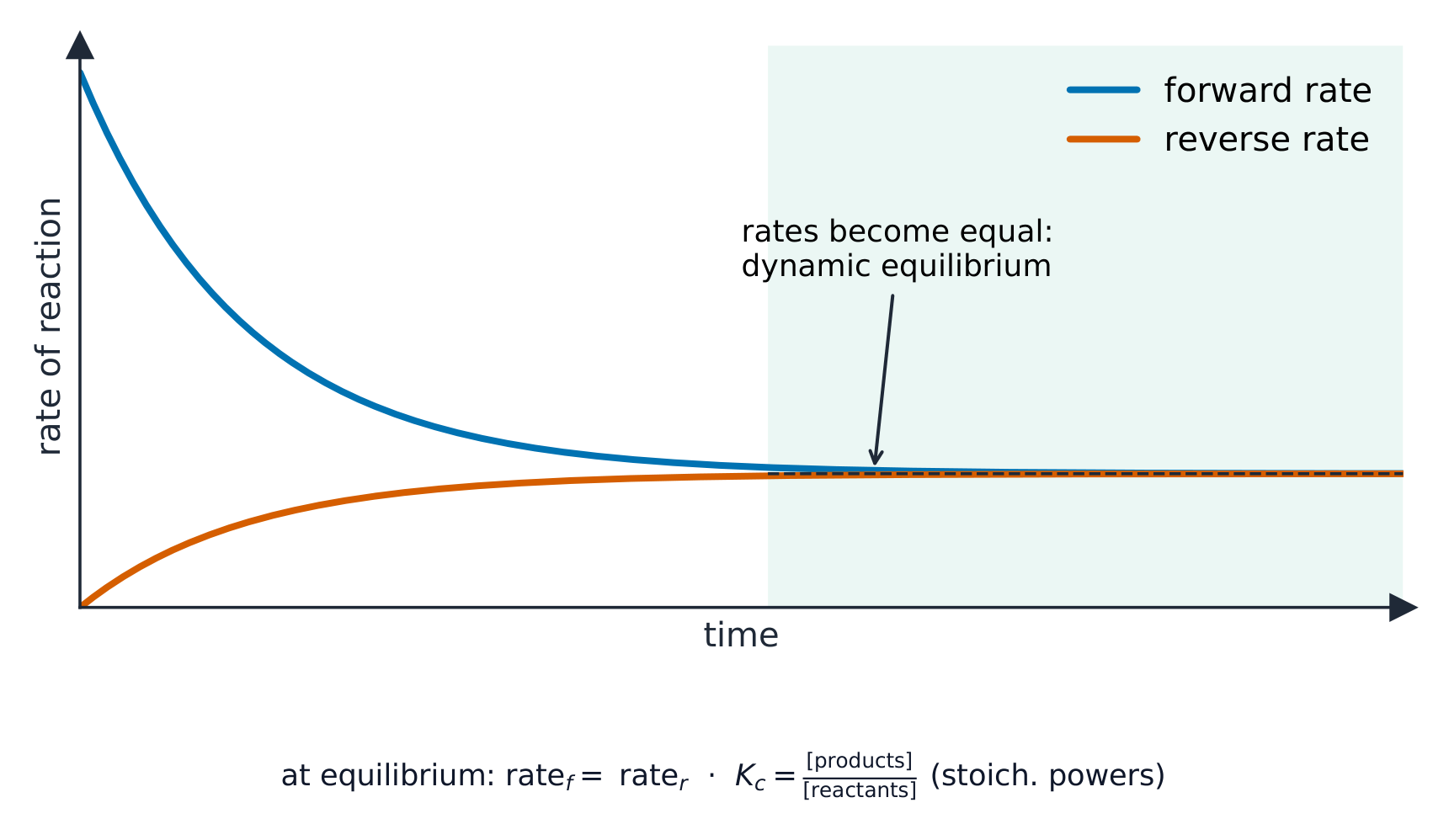
Dynamic equilibrium: the rates converge

A reversible reaction 可逆反应 can go both ways. The forward reaction 正反应 makes products; the reverse reaction 逆反应 turns products back into reactants. We show this with the sign $\rightleftharpoons$.

In a closed system 封闭系统 (nothing enters or leaves), the reaction reaches a dynamic equilibrium 动态平衡 when:

  • the rate of the forward reaction equals the rate of the reverse reaction.
  • the concentrations of reactants and products stay constant.

It is called dynamic because both reactions are still happening — they just cancel out. A closed system is needed, or products would escape and equilibrium could never be reached.

Bahasa Indonesia
Prinsip Le Chatelier
Kesetimbangan dinamis: lajunya konvergen
Larutan kobalt(II) klorida dengan warna berbeda-beda
Kobalt klorida berubah warna saat kesetimbangannya bergeser.

Reaksi reversibel dapat berjalan dua arah. Reaksi maju menghasilkan produk; reaksi balik mengubah produk kembali menjadi reaktan. Kita tunjukkan ini dengan tanda $\rightleftharpoons$.

Dalam sistem tertutup (tidak ada yang masuk atau keluar), reaksi mencapai kesetimbangan dinamis ketika:

  • laju reaksi maju sama dengan laju reaksi balik.
  • konsentrasi reaktan dan produk tetap konstan.

Disebut dinamis karena kedua reaksi masih berlangsung — hanya saja saling meniadakan. Sistem tertutup diperlukan, atau produk akan lolos dan kesetimbangan tidak pernah tercapai.

Graf di mana laju maju menurun dan laju mundur meningkat hingga keduanya bertemu dan tetap sama
Pada kesetimbangan dinamis laju maju dan balik telah menjadi sama, sehingga konsentrasi tetap konstan
Explore · ⁨Jelajahi⁩

Dynamic equilibrium · ⁨Kesetimbangan dinamis⁩

forward rate = reverse rate · ⁨laju maju = laju mundur⁩

At equilibrium the position can sit anywhere — change a condition and watch it shift. · ⁨Pada kesetimbangan, posisi bisa berada di mana pun — ubah suatu kondisi dan saksikan kesetimbangannya bergeser.⁩

Vocabulary · ⁨Kosa kata⁩ Train · ⁨Latih⁩
English Bahasa Indonesia
reversible reaction/rɪˈvɜːsɪbl rɪˈækʃn/ reaksi boleh balik
forward reaction/ˈfɔːwəd rɪˈækʃn/ reaksi maju
reverse reaction/rɪˈvɜːs rɪˈækʃn/ reaksi balik
closed system/kləʊzd ˈsɪstəm/ sistem tertutup
dynamic equilibrium/daɪˈnæmɪk ˌiːkwɪˈlɪbrɪəm/ keseimbangan dinamik
Le Chatelier's principle/lə ˈtʃeɪtlɪəz ˈprɪnsɪpl/ Prinsip Le Chatelier
equilibrium/ˌiːkwɪˈlɪbrɪəm/ kesetimbangan
catalyst/ˈkætəlɪst/ katalisator
equilibrium constant/ˌiːkwɪˈlɪbrɪəm ˈkɒnstənt/ pemalar keseimbangan
Watch lesson · ⁨Tonton pelajaran⁩
7.1

Le Chatelier's principle · ⁨Prinsip Le Chatelier⁩

English

Le Chatelier's principle 勒夏特列原理 says: if you change a system at equilibrium, the position of equilibrium 平衡 moves to oppose (reduce) that change.

Change you make Which way the equilibrium moves
increase concentration of a reactant towards the products
increase pressure towards the side with fewer gas molecules
increase temperature towards the endothermic direction
add a catalyst 催化剂 no shift (it speeds up both ways equally)

A catalyst lets equilibrium be reached faster, but it does not change the position of equilibrium.

Bahasa Indonesia

Prinsip Le Chatelier menyatakan: jika Anda mengubah sistem pada kesetimbangan, posisi kesetimbangan bergeser untuk melawan (mengurangi) perubahan tersebut.

Perubahan yang Anda buat Ke arah mana kesetimbangan bergerak
meningkatkan konsentrasi reaktan ke arah produk
meningkatkan tekanan ke sisi dengan jumlah molekul gas lebih sedikit
meningkatkan suhu ke arah endoterm
menambahkan katalisator tidak ada pergeseran (mempercepat kedua arah secara sama)

Katalisator memungkinkan kesetimbangan tercapai lebih cepat, tetapi tidak mengubah posisi kesetimbangan.

Tiga perubahan masing-masing dengan panah yang menunjukkan arah pergerakan kesetimbangan: menambah reaktan menuju produk, menaikkan tekanan ke sisi molekul-gas lebih sedikit, menaikkan suhu dalam arah endoterm
Prinsip Le Chatelier: kesetimbangan selalu bergeser untuk melawan perubahan yang Anda buat
Explore · ⁨Jelajahi⁩

Shifting an equilibrium · ⁨Menggeser kesetimbangan⁩

Change the temperature, pressure or concentration and watch the equilibrium shift to oppose your change — Le Chatelier's principle in action. · ⁨Ubah suhu, tekanan, atau konsentrasi dan saksikan kesetimbangan bergeser untuk melawan perubahan Anda — prinsip Le Chatelier yang sedang bekerja.⁩

7.1

Equilibrium constants · ⁨Konstanta kesetimbangan⁩

English

For a reaction at equilibrium, the equilibrium constant 平衡常数 links the amounts of products and reactants. For the reaction $a\text{A} + b\text{B} \rightleftharpoons c\text{C} + d\text{D}$:

$$K_c = \frac{[\text{C}]^c\,[\text{D}]^d}{[\text{A}]^a\,[\text{B}]^b}$$

where the square brackets mean concentration in $\text{mol dm}^{-3}$.

Worked example. At equilibrium the mixture $\text{H}_2 + \text{I}_2 \rightleftharpoons 2\text{HI}$ has $[\text{H}_2] = 0.20$, $[\text{I}_2] = 0.20$ and $[\text{HI}] = 1.6\ \text{mol dm}^{-3}$. Find $K_c$.

$$K_c = \frac{[\text{HI}]^2}{[\text{H}_2][\text{I}_2]} = \frac{1.6^2}{0.20 \times 0.20} = 64$$

(no units here, because the concentration powers cancel top and bottom).

Worked example (ICE table). $1.00\ \text{mol}$ each of $\text{H}_2$ and $\text{I}_2$ are sealed in a $1.00\ \text{dm}^3$ flask; at equilibrium $0.20\ \text{mol}$ of $\text{H}_2$ remains. Set out an ICE table (Initial, Change, Equilibrium):

$\text{H}_2$ $\text{I}_2$ $2\text{HI}$
Initial 1.00 1.00 0
Change $-0.80$ $-0.80$ $+1.60$
Equilibrium 0.20 0.20 1.60

$0.80\ \text{mol}$ of $\text{H}_2$ reacted, so $2\times0.80 = 1.60\ \text{mol}$ HI formed. In the $1.00\ \text{dm}^3$ flask the concentrations equal the moles, so $K_c = \dfrac{1.60^2}{0.20\times0.20} = 64$.

For reactions of gases, we use partial pressure 分压 instead of concentration. The partial pressure of a gas is the share of the total pressure that it provides. It is found from the mole fraction 摩尔分数 (the fraction of all the moles that are that gas):

$$\text{partial pressure} = \text{mole fraction} \times \text{total pressure}$$

The constant written with partial pressures is $K_p$.

Worked example. A gas mixture holds $2.0\ \text{mol}$ of $\text{N}_2$ and $6.0\ \text{mol}$ of $\text{H}_2$ at a total pressure of $200\ \text{kPa}$. Find the partial pressure of each gas.

There are $8.0\ \text{mol}$ in total, so

$$p(\text{N}_2) = \frac{2.0}{8.0} \times 200 = 50\ \text{kPa}, \qquad p(\text{H}_2) = \frac{6.0}{8.0} \times 200 = 150\ \text{kPa}.$$

Worked example (a numeric $K_p$). For $\text{N}_2 + 3\text{H}_2 \rightleftharpoons 2\text{NH}_3$ the equilibrium partial pressures are $p(\text{N}_2)=20$, $p(\text{H}_2)=40$ and $p(\text{NH}_3)=10\ \text{kPa}$. Then

$$K_p = \frac{p(\text{NH}_3)^2}{p(\text{N}_2)\,p(\text{H}_2)^3} = \frac{10^2}{20\times40^3} = 7.8\times10^{-5}\ \text{kPa}^{-2},$$
the units coming from $\dfrac{\text{kPa}^2}{\text{kPa}\times\text{kPa}^3}=\text{kPa}^{-2}$.

Only temperature changes the value of $K_c$ or $K_p$. Changing concentration or pressure shifts the position of equilibrium but leaves the constant unchanged; adding a catalyst changes neither the constant nor the position — it only makes equilibrium arrive faster.

Bahasa Indonesia

Untuk reaksi pada kesetimbangan, konstanta kesetimbangan menghubungkan jumlah produk dan reaktan. Untuk reaksi $a\text{A} + b\text{B} \rightleftharpoons c\text{C} + d\text{D}$:

$$K_c = \frac{[\text{C}]^c\,[\text{D}]^d}{[\text{A}]^a\,[\text{B}]^b}$$

di mana kurung siku berarti konsentrasi dalam $\text{mol dm}^{-3}$.

Contoh terpecahkan. Pada kesetimbangan campuran $\text{H}_2 + \text{I}_2 \rightleftharpoons 2\text{HI}$ memiliki $[\text{H}_2] = 0.20$, $[\text{I}_2] = 0.20$ dan $[\text{HI}] = 1.6\ \text{mol dm}^{-3}$. Temukan $K_c$.

$$K_c = \frac{[\text{HI}]^2}{[\text{H}_2][\text{I}_2]} = \frac{1.6^2}{0.20 \times 0.20} = 64$$

(tidak ada satuan di sini, karena pangkat konsentrasi saling menghilangkan atas dan bawah).

Contoh terpecahkan (tabel ICE). $1.00\ \text{mol}$ dari $\text{H}_2$ dan $\text{I}_2$ disegel dalam labu $1.00\ \text{dm}^3$; pada kesetimbangan $0.20\ \text{mol}$ dari $\text{H}_2$ tersisa. Susun tabel ICE (Awal, Perubahan, Kesetimbangan):

$\text{H}_2$ $\text{I}_2$ $2\text{HI}$
Awal 1.00 1.00 0
Perubahan $-0.80$ $-0.80$ $+1.60$
Kesetimbangan 0.20 0.20 1.60

$0.80\ \text{mol}$ dari $\text{H}_2$ bereaksi, sehingga $2\times0.80 = 1.60\ \text{mol}$ HI terbentuk. Dalam labu $1.00\ \text{dm}^3$, konsentrasi sama dengan mol, jadi $K_c = \dfrac{1.60^2}{0.20\times0.20} = 64$.

Untuk reaksi gas, kita menggunakan tekanan parsial alih-alih konsentrasi. Tekanan parsial suatu gas adalah bagian dari tekanan total yang disumbangkannya. Hal ini ditemukan dari fraksi mol (bagian dari semua mol yang merupakan gas tersebut):

$$\text{partial pressure} = \text{mole fraction} \times \text{total pressure}$$

Konstanta yang ditulis dengan tekanan parsial adalah $K_p$.

Contoh terpecahkan. Campuran gas berisi $2.0\ \text{mol}$ dari $\text{N}_2$ dan $6.0\ \text{mol}$ dari $\text{H}_2$ pada tekanan total $200\ \text{kPa}$. Temukan tekanan parsial setiap gas.

Ada $8.0\ \text{mol}$ secara total, sehingga

$$p(\text{N}_2) = \frac{2.0}{8.0} \times 200 = 50\ \text{kPa}, \qquad p(\text{H}_2) = \frac{6.0}{8.0} \times 200 = 150\ \text{kPa}.$$

Contoh terpecahkan ($K_p$ numerik). Untuk $\text{N}_2 + 3\text{H}_2 \rightleftharpoons 2\text{NH}_3$, tekanan parsial kesetimbangannya adalah $p(\text{N}_2)=20$, $p(\text{H}_2)=40$ dan $p(\text{NH}_3)=10\ \text{kPa}$. Maka

$$K_p = \frac{p(\text{NH}_3)^2}{p(\text{N}_2)\,p(\text{H}_2)^3} = \frac{10^2}{20\times40^3} = 7.8\times10^{-5}\ \text{kPa}^{-2},$$
satuan yang berasal dari $\dfrac{\text{kPa}^2}{\text{kPa}\times\text{kPa}^3}=\text{kPa}^{-2}$.

Hanya suhu yang mengubah nilai $K_c$ atau $K_p$. Mengubah konsentrasi atau tekanan menggeser posisi kesetimbangan tetapi meninggalkan konstanta tak berubah; menambahkan katalisator mengubah keduanya — baik konstanta maupun posisi — hanya membuat kesetimbangan tercapai lebih cepat.

Explore · ⁨Jelajahi⁩

Le Chatelier and Kc · ⁨Le Chatelier dan Kc⁩

Change temperature, pressure or concentration and watch the equilibrium shift to oppose it — Kc itself only changes with temperature. · ⁨Ubah suhu, tekanan, atau konsentrasi dan saksikan kesetimbangan bergeser untuk menentangnya — Kc sendiri hanya berubah karena suhu.⁩

Vocabulary · ⁨Kosa kata⁩ Train · ⁨Latih⁩
English Bahasa Indonesia
partial pressure/ˈpɑːʃl ˈpreʃə/ tekanan parsial
mole fraction/məʊl ˈfrækʃn/ pecahan mol
Haber process/ˈheɪbə ˈprəʊses/ Proses Haber
Contact process/ˈkɒntækt ˈprəʊses/ Proses Contact
7.1

The Haber and Contact processes · ⁨Proses Haber dan Contact⁩

English

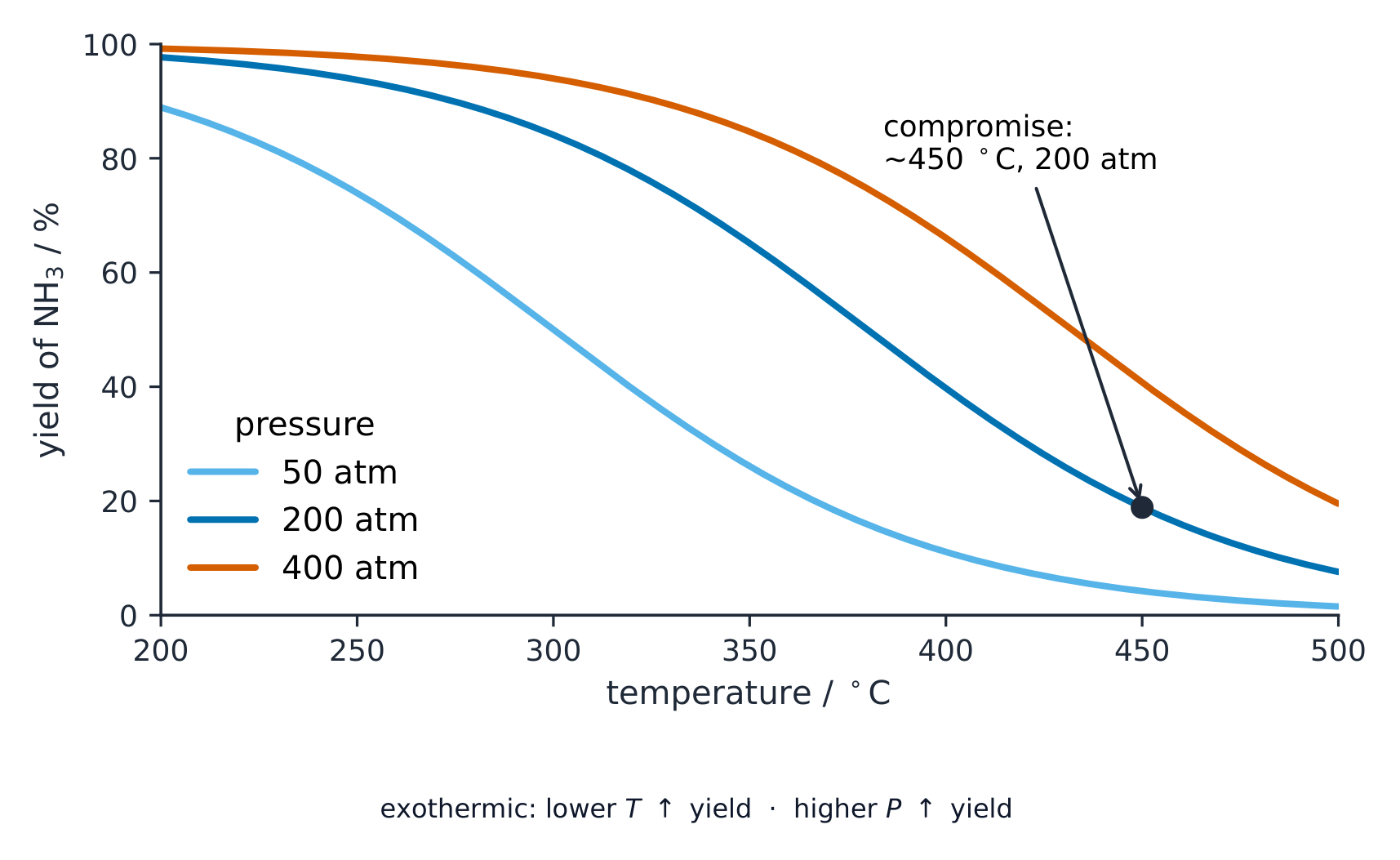
These two industrial processes are chosen by balancing yield, rate and cost using Le Chatelier's principle.

  • the Haber process 哈伯法 makes ammonia: $\text{N}_2 + 3\text{H}_2 \rightleftharpoons 2\text{NH}_3$ (exothermic). It uses about $450\,°\text{C}$, $200\ \text{atm}$ and an iron catalyst. A low temperature would give more ammonia but too slowly, so a moderate temperature is a compromise.
  • the Contact process 接触法 makes sulfur trioxide: $2\text{SO}_2 + \text{O}_2 \rightleftharpoons 2\text{SO}_3$ (exothermic). It uses about $450\,°\text{C}$, near $1$–$2\ \text{atm}$ and a vanadium(V) oxide catalyst.
Bahasa Indonesia
Kompleks kimia industri besar
Amonia untuk pupuk dibuat oleh proses Haber di pabrik industri besar seperti ini.

Dua proses industri ini dipilih dengan menyeimbangkan hasil, laju, dan biaya menggunakan prinsip Le Chatelier.

  • Proses Haber menghasilkan amonia: $\text{N}_2 + 3\text{H}_2 \rightleftharpoons 2\text{NH}_3$ (eksoterm). Menggunakan sekitar $450\,°\text{C}$, $200\ \text{atm}$ dan katalisator besi. Suhu rendah akan memberikan lebih banyak amonia tetapi terlalu lambat, sehingga suhu sedang merupakan kompromi.
  • Proses Contact menghasilkan sulfur trioksida: $2\text{SO}_2 + \text{O}_2 \rightleftharpoons 2\text{SO}_3$ (eksoterm). Menggunakan sekitar $450\,°\text{C}$, mendekati $1$–$2\ \text{atm}$ dan katalisator vanadium(V) oksida.
Graf hasil amonia terhadap suhu untuk tiga tekanan, hasil turun seiring kenaikan suhu dan naik seiring kenaikan tekanan, dengan titik operasi ditandai
Kesetimbangan Haber menghasilkan lebih banyak amonia pada suhu lebih rendah dan tekanan lebih tinggi; sekitar $450\,°$°C dan $200$ atm adalah kompromi operasional
Explore · ⁨Jelajahi⁩

The Haber & Contact processes · ⁨Proses Haber & Proses Contact⁩

compromise: yield vs rate · ⁨kompromi: hasil vs laju⁩

High pressure boosts yield; high temperature speeds it up but lowers yield — a compromise. · ⁨Tekanan tinggi meningkatkan hasil; suhu tinggi mempercepatnya tetapi menurunkan hasil — sebuah kompromi.⁩

7.2

Acids and bases: the Brønsted–Lowry theory · ⁨Asam dan basa: teori Brønsted–Lowry⁩

Syllabus · ⁨Silabus⁩
English
  1. state the names and formulas of the common acids, limited to hydrochloric acid, $\text{HCl}$, sulfuric acid, $\text{H}_2\text{SO}_4$, nitric acid, $\text{HNO}_3$, ethanoic acid, $\text{CH}_3\text{COOH}$
  2. state the names and formulas of the common alkalis, limited to sodium hydroxide, $\text{NaOH}$, potassium hydroxide, $\text{KOH}$, ammonia, $\text{NH}_3$
  3. describe the Brønsted–Lowry theory of acids and bases
  4. describe strong acids and strong bases as fully dissociated in aqueous solution and weak acids and weak bases as partially dissociated in aqueous solution
  5. appreciate that water has pH of 7, acid solutions pH of below 7 and alkaline solutions pH of above 7
  6. explain qualitatively the differences in behaviour between strong and weak acids including the reaction with a reactive metal and difference in pH values by use of a pH meter, universal indicator or conductivity
  7. understand that neutralisation reactions occur when $\text{H}^+(\text{aq})$ and $\text{OH}^-(\text{aq})$ form $\text{H}_2\text{O}(\text{l})$
  8. understand that salts are formed in neutralisation reactions
  9. sketch the pH titration curves of titrations using combinations of strong and weak acids with strong and weak alkalis
  10. select suitable indicators for acid-alkali titrations, given appropriate data ($\text{p}K_a$ values will not be used)
Bahasa Indonesia
  1. nyatakan nama dan rumus asam-asam umum, terbatas pada asam hidroklorik, $\text{HCl}$, asam sulfat, $\text{H}_2\text{SO}_4$, asam nitrat, $\text{HNO}_3$, asam etanoat, $\text{CH}_3\text{COOH}$
  2. nyatakan nama dan rumus alkali-alkali umum, terbatas pada natrium hidroksida, $\text{NaOH}$, kalium hidroksida, $\text{KOH}$, amonia, $\text{NH}_3$
  3. deskripsikan teori Brønsted–Lowry tentang asam dan basa
  4. deskripsikan asam kuat dan basa kuat sebagai terdisosiasi penuh dalam larutan akuatik dan asam lemah serta basa lemah sebagai terdisosiasi sebagian dalam larutan akuatik
  5. pahami bahwa air memiliki pH 7, larutan asam pH di bawah 7 dan larutan basa pH di atas 7
  6. jelaskan secara kualitatif perbedaan perilaku antara asam kuat dan lemah termasuk reaksi dengan logam reaktif dan perbedaan nilai pH menggunakan pH meter, indikator universal atau konduktivitas
  7. pahami bahwa reaksi netralisasi terjadi ketika $\text{H}^+(\text{aq})$ dan $\text{OH}^-(\text{aq})$ membentuk $\text{H}_2\text{O}(\text{l})$
  8. pahami bahwa garam terbentuk dalam reaksi netralisasi
  9. sketsa kurva titrasi pH dari titrasi menggunakan kombinasi asam kuat dan lemah dengan alkali kuat dan lemah
  10. pilih indikator yang sesuai untuk titrasi asam-alkali, diberikan data yang sesuai (nilai $\text{p}K_a$ tidak akan digunakan)

Source: Cambridge International syllabus · ⁨Sumber: Silabus Cambridge International⁩

English

A proton 质子 is simply an $\text{H}^+$ ion. The Brønsted–Lowry theory defines acids and bases by what they do with protons:

  • an acid 酸 is a proton donor 质子供体 (it gives away $\text{H}^+$).
  • a base 碱 is a proton acceptor 质子受体 (it takes $\text{H}^+$). A base that dissolves in water is called an alkali.

Common acids you must know: hydrochloric acid ($\text{HCl}$), sulfuric acid ($\text{H}_2\text{SO}_4$), nitric acid ($\text{HNO}_3$) and ethanoic acid ($\text{CH}_3\text{COOH}$). Common alkalis: sodium hydroxide ($\text{NaOH}$), potassium hydroxide ($\text{KOH}$) and ammonia ($\text{NH}_3$).

Bahasa Indonesia

Proton hanyalah ion $\text{H}^+$. Teori Brønsted–Lowry mendefinisikan asam dan basa berdasarkan apa yang mereka lakukan dengan proton:

  • asam adalah donor proton (memberikan $\text{H}^+$).
  • basa adalah penerima proton (menerima $\text{H}^+$). Basa yang larut dalam air disebut alkali.
Hidrogen klorida mendonorkan proton ke molekul air, membentuk ion hidronium dan ion klorida, dengan dua pasangan konjugat ditandai
Brønsted–Lowry: asam mendonorkan proton ($\text{H}^+$) ke basa, membentuk dua pasangan asam-basa konjugat

Asam umum yang harus Anda ketahui: asam klorida ($\text{HCl}$), asam sulfat ($\text{H}_2\text{SO}_4$), asam nitrat ($\text{HNO}_3$) dan asam etanoat ($\text{CH}_3\text{COOH}$). Alkali umum: natrium hidroksida ($\text{NaOH}$), kalium hidroksida ($\text{KOH}$) dan amonia ($\text{NH}_3$).

Explore · ⁨Jelajahi⁩

The pH scale · ⁨Skala pH⁩

Slide the pH or tap a substance — each step down in pH means ten times more H⁺ ions; acids are below 7, alkalis above. · ⁨Geser pH atau ketuk zat — setiap langkah turun dalam pH berarti sepuluh kali lebih banyak ion H⁺; asam berada di bawah 7, alkali di atasnya.⁩

Vocabulary · ⁨Kosa kata⁩ Train · ⁨Latih⁩
English Bahasa Indonesia
proton/ˈprəʊtɒn/ proton
Watch lesson · ⁨Tonton pelajaran⁩
7.2

Strong and weak acids and bases · ⁨Asam dan basa kuat serta lemah⁩

English

This is about how fully an acid or base splits up in water — not how concentrated it is.

  • a strong acid 强酸 or strong base 强碱 is fully dissociated 解离 in water (almost every molecule splits into ions).
  • a weak acid 弱酸 or weak base 弱碱 is only partly dissociated (most molecules stay whole).

The pH scale measures how acidic a solution is: pure water is pH 7, acids are below 7, and alkalis are above 7. A strong acid has a lower pH than a weak acid of the same concentration.

You can tell strong and weak acids apart by:

  • reaction with a reactive metal: a strong acid fizzes faster.
  • pH: measured with a pH meter or universal indicator 通用指示剂.
  • electrical conductivity: a strong acid conducts better, because it has more ions.
Bahasa Indonesia

Ini berkaitan dengan seberapa lengkap asam atau basa terurai dalam air — bukan berapa konsentrasinya.

  • asam kuat atau basa kuat sepenuhnya terdisosiasi dalam air (hampir setiap molekul terurai menjadi ion).
  • asam lemah atau basa lemah hanya sebagian terdisosiasi (sebagian besar molekul tetap utuh).
Dua gelas kimia dengan konsentrasi sama: asam kuat penuh dengan ion terpisah, asam lemah penuh dengan molekul utuh dengan hanya beberapa ion
Konsentrasi sama, ionisasi berbeda: asam kuat terdisosiasi sepenuhnya menjadi ion; asam lemah tetap sebagian besar sebagai molekul utuh

Skala pH mengukur seberapa asam sebuah larutan: air murni adalah pH 7, asam di bawah 7, dan alkali di atas 7. Asam kuat memiliki pH lebih rendah daripada asam lemah dengan konsentrasi yang sama.

Anda dapat membedakan asam kuat dan lemah melalui:

  • reaksi dengan logam reaktif: asam kuat berbusa lebih cepat.
  • pH: diukur dengan meter pH atau indikator universal.
  • konduktivitas listrik: asam kuat menghantarkan lebih baik, karena memiliki lebih banyak ion.
Explore · ⁨Jelajahi⁩

Strong vs weak acids · ⁨Asam kuat vs asam lemah⁩

A strong acid fully ionises (low pH); a weak acid only partly ionises, so at the same concentration its pH is higher. Slide to compare. · ⁨Asam kuat terionisasi sepenuhnya (pH rendah); asam lemah hanya terionisasi sebagian, sehingga pada konsentrasi yang sama pH-nya lebih tinggi. Geser untuk membandingkan.⁩

Vocabulary · ⁨Kosa kata⁩ Train · ⁨Latih⁩
English Bahasa Indonesia
acid/ˈæsɪd/ asam
proton donor/ˈprəʊtɒn ˈdəʊnə/ donor proton
base/beɪs/ basis
proton acceptor/ˈprəʊtɒn əkˈseptə/ akseptor proton
strong acid/strɒŋ ˈæsɪd/ asam kuat
strong base/strɒŋ beɪs/ basa kuat
dissociated/dɪˈsəʊsɪeɪtɪd/ terurai
weak acid/wiːk ˈæsɪd/ asam lemah
weak base/wiːk beɪs/ basa lemah
universal indicator/ˌjuːnɪˈvɜːsl ˈɪndɪkeɪtə/ indikator universal
Neutralisation/ˌnjuːtrəlaɪˈzeɪʃn/ Netralisasi
salt/sɒlt/ garam
7.2

Neutralisation, salts and titration curves · ⁨Penetralsiran, garam dan kurva titrasi⁩

English

Neutralisation 中和 happens when the hydrogen ions from an acid react with the hydroxide ions from an alkali:

$$\text{H}^+(\text{aq}) + \text{OH}^-(\text{aq}) \rightarrow \text{H}_2\text{O}(\text{l})$$

A salt 盐 is also formed, from the rest of the acid and base.

In a titration 滴定 you add one solution to another and follow the pH. The titration curve 滴定曲线 has a steep, almost vertical jump near the end point. The exact shape depends on whether each reactant is strong or weak.

To pick an indicator 指示剂, choose one whose colour change falls inside that steep jump. For a strong acid with a strong base most indicators work; for a weak acid with a strong base you need one that changes in the higher pH range.

Bahasa Indonesia

Penetralan terjadi ketika ion hidrogen dari asam bereaksi dengan ion hidroksida dari basa:

$$\text{H}^+(\text{aq}) + \text{OH}^-(\text{aq}) \rightarrow \text{H}_2\text{O}(\text{l})$$

Garam juga terbentuk dari sisa asam dan basa.

Dalam titrasi, Anda menambahkan satu larutan ke larutan lain dan memantau pH. Kurva titrasi memiliki lonjakan tajam, hampir vertikal di dekat titik akhir. Bentuk pastinya bergantung pada apakah setiap reaktan adalah kuat atau lemah.

Untuk memilih indikator, pilihlah yang perubahan warnanya berada dalam rentang lonjakan tajam tersebut. Untuk asam kuat dengan basa kuat, sebagian besar indikator dapat digunakan; untuk asam lemah dengan basa kuat, Anda memerlukan indikator yang berubah warna pada rentang pH yang lebih tinggi.

Dua kurva titrasi pH terhadap basa yang ditambahkan, masing-masing memiliki lonjakan tajam pada titik akhir; kurva asam lemah melonjak melalui rentang pH yang lebih tinggi, dengan pita indikator yang diarsir
Kurva titrasi masing-masing memiliki lonjakan pH yang tajam di titik akhir. Lonjakan asam-lemah berada lebih tinggi, sehingga indikator harus berubah warna pada rentang tersebut
Explore · ⁨Jelajahi⁩

A titration curve · ⁨Kurva titrasi⁩

Add alkali to acid and watch the pH climb. The steep jump is the equivalence point, where the acid is just neutralised. · ⁨Tambahkan alkali ke asam dan saksikan pH naik. Lonjakan curam adalah titik ekuivalensi, di mana asam baru saja dinetralkan.⁩

Vocabulary · ⁨Kosa kata⁩ Train · ⁨Latih⁩
English Bahasa Indonesia
titration/taɪˈtreɪʃn/ titrasi
titration curve/taɪˈtreɪʃn kɜːv/ kurva titrasi
indicator/ˈɪndɪkeɪtə/ indikator
7.2

Exam tips · ⁨Tips ujian⁩

English
  • Define dynamic equilibrium with all three points: forward and reverse rates equal, concentrations constant, closed system.
  • Answer Le Chatelier questions by stating the change, the direction of shift, and the reason; a catalyst does not shift the position (it speeds both rates).
  • Write $K_c$ as products over reactants, each raised to its balancing number; include state symbols to decide what appears.
  • Justify Haber/Contact conditions as a compromise between yield, rate and cost — do not just quote them.
  • Brønsted: acid = proton donor, base = proton acceptor; conjugate pairs differ by one $\text{H}^+$.
Bahasa Indonesia
  • Definisikan keseimbangan dinamis dengan ketiga poin: laju maju dan mundur sama, konsentrasi konstan, sistem tertutup.
  • Jawab pertanyaan Le Chatelier dengan menyatakan perubahan, arah pergeseran, dan alasannya; katalisator tidak menggeser posisi (katalisator mempercepat kedua laju).
  • Tulis $K_c$ sebagai produk di atas reaktan, masing-masing dipangkatkan dengan koefisien penyetara; sertakan simbol keadaan untuk menentukan apa yang masuk.
  • Justifikasikan kondisi Haber/Kontak sebagai kompromi antara hasil, laju, dan biaya — jangan hanya menghafalnya.
  • Brønsted: asam = donor proton, basa = penerima proton; pasangan konjugat berbeda oleh satu $\text{H}^+$.

Interactive lessons on this topic · ⁨Pelajaran interaktif untuk topik ini⁩

Work through it step by step, with instant-check exercises. · ⁨Kerjakan langkah demi langkah, dengan latihan pengecekan instan.⁩

Past Papers · ⁨Soal-Soil Masa Lalu⁩

More topics in A-Level Chemistry · ⁨Kimia A-Level⁩ · ⁨Topik lain dalam A-Level Chemistry · ⁨Kimia A-Level⁩⁩

Log in or create account · ⁨Masuk atau buat akun⁩

IGCSE, A-Level & AP