Skip to content · ⁨דלג לתוכן⁩

Industrialization and Its Effects, c. 1815 to c. 1914

AP European History · ⁨היסטוריה אירופאית - AP⁩ · Topic 6 · ⁨נושא 6⁩

Video lesson for this topic · ⁨שיעור וידאו לנושא זה⁩ Open the video page · ⁨פתח את עמוד הוידאו⁩
9:15

יחידה 6: תעשייה והשפעותיה

טענה אחת היא עמוד השדרה של יחידה זו. מהפכות פוליטיות ומורכבויות התעשייה גרמו למגוון של רעיונות, ממשלתיים ו…

English narration · English + 中文 subtitles burned in · ⁨קריאת קול באנגלית · תרגום אנגלי + סינית שרוף בתוך הסרטון⁩

6.1

Contextualizing Industrialization · ⁨הקשר למהפכה התעשייתית⁩

Syllabus · ⁨סיילבוס⁩
English

6.1 Contextualizing Industrialization and Its Origins and Effects

Learning Objective Unit 6.A: Explain the context in which industrialization originated, developed, and spread in Europe.

  • KC-3.1 The Industrial Revolution spread from Great Britain to the continent, where the state played a greater role in promoting industry.
    • KC-3.1.I Great Britain established its industrial dominance through the mechanization of textile production, iron and steel production, and new transportation systems in conjunction with uniquely favorable political and social climates.
    • KC-3.1.II Following the British example, industrialization took root in continental Europe, sometimes with state sponsorship.
  • KC-3.2 The experiences of everyday life were shaped by industrialization, depending on the level of industrial development in a particular location.
    • KC-3.2.I Industrialization promoted the development of new classes in the industrial regions of Europe.
    • KC-3.2.II Europe experienced rapid population growth and urbanization, leading to social dislocations.
    • KC-3.2.III Over time, the Industrial Revolution altered the family structure and relations for bourgeois and working-class families.
  • KC-3.3 Political revolutions and the complications resulting from industrialization triggered a range of ideological, governmental, and collective responses.
    • KC-3.3.I Ideologies developed and took root throughout society as a response to industrial and political revolutions.
    • KC-3.3.II Governments, at times based on the pressure of political or social organizations, responded to problems created or exacerbated by industrialization.
עברית

6.1 הקשרה של תעשייה וראשיתה והשפעותיה

מטרת הלמידה ליחידה 6.A: הסבר על ההקשר בו תעשייה החלה, התפתחה והתפשטה באירופה.

  • KC-3.1 המהפכה התעשייתית התפשטה מבריטניה ליבשת, שם המדינה שיחקה תפקיד גדול יותר בקידום התעשייה.
    • KC-3.1.I בריטניה ביססה את עליונותה התעשייתית באמצעות מכונות בייצור טקסטיל, ייצור ברזל ופלדה, ומערכות תחבורה חדשות בשילוב עם אקלים פוליטי וחברתי ייחודית נוח.
    • KC-3.1.II בהתאם לדוגמה הבריטית, התעשייה התיישבה באירופה היבשתית, לעיתים עם תמיכה ממשלתית.
  • KC-3.2 חוויות החיים היומיום עוצבו על ידי התעשייה, בהתאם לרמת הפיתוח התעשייתי במיקום ספציפי.
    • KC-3.2.I התעשייה קידמה את פיתוחן של שכבות חברתיות חדשות באזורים התעשייתיים של אירופה.
    • KC-3.2.II אירופה חוותה גידול אוכלוסייה מהיר ואורבניזציה, שהובילו למשברים חברתיים.
    • KC-3.2.III לאורך זמן, המהפכה התעשייתית שינתה את מבנה המשפחה והיחסים בתוך משפחות הבורגזיה ובין העובדים.
  • KC-3.3 מהפכות פוליטיות ומורכבויות הנובעות מהתעשייה הובילו למגוון תגובות אידיאולוגיות, ממשלתיות וקולקטיביות.
    • KC-3.3.I אידיאולוגיות פותחו והתבססו בכל רחבי החברה כתגובה למהפכות תעשייתיות ופוליטיות.
    • KC-3.3.II ממשלות, לעיתים מתחת ללחץ ארגונים פוליטיים או חברתיים, הגיבו לבעיות שנוצרו או חמרו על ידי התעשייה.
Source: College Board AP Course and Exam Description · ⁨מקור: תיאור הקורס והמבחן של College Board AP⁩

English

Unit 6 covers c. 1815 to c. 1914 and rests on three claims the CED states as key concepts:

  • The Industrial Revolution spread from Great Britain to the continent, where the state played a greater role in promoting industry.
  • Everyday experience was shaped by industrialisation depending on the level of industrial development in a particular location - so the answer to "what was life like" is always where, and how far along.
  • Political revolutions and the complications of industrialisation triggered a range of ideological, governmental, and collective responses.

That third claim is the unit's spine. Industrialisation created problems; the ideologies and reforms of the nineteenth century are the answers people proposed to them.

עברית

יחידה 6 מכסה כ-1815 ועד כ-1914 ומסתמכת על שלושה טיעונים שה-CED מציגה כמונחים מרכזיים:

  • המהפכה התעשייתית התפשטה מממלכת בריטניה ליבשה, שבה המדינה שיחקה תפקיד גדול יותר בקידום התעשייה.
  • החוויה היומיומית עוצבה על ידי התעשייה בהתאם למפלס הפיתוח התעשייתי במיקום ספציפי - כך שתשובה לשאלה "איך הייתה חיים" היא תמיד איפה, ובאיזו מידה.
  • מהפכות פוליטיות ומורכבויות של התעשייה הפעילו מגוון תגובות אידיאולוגיות, ממשלתיות וקולקטיביות.

הטענה השלישית הזו היא עמוד השדרות של היחידה. תעשייה יצרה בעיות; האידאולוגיות וה реформи של המאה התשע-עשרה הן התשובות שהאנשים הציעו להם.

Vocabulary · ⁨מילון מונחים⁩ Train · ⁨אימון⁩
English עברית
less social dislocation/les ˈsəʊʃl dɪsləʊˈkeɪʃn/ פחות פירוק חברתי
second industrial revolution/ˈsekənd ɪnˈdʌstrɪəl ˌrevəˈluːʃn/ המהפכה התעשייתית השנייה
railroads/ˈreɪlrəʊdz/ מסילות רכבת
promoted population growth/prəˈməʊtɪd ˌpɒpjʊˈleɪʃn ɡrəʊθ/ קידמו את צמיחת האוכלוסייה
heightened consumerism/ˈhaɪtnd kənˈsuːmərɪzəm/ חיזוק הצרכנות
Class identity/klæs aɪˈdentɪti/ זהות קלאסית
urban overcrowding/ˈɜːbən ˌəʊvəˈkraʊdɪŋ/ עומס יתר עירוני
cult of domesticity/kʌlt ɒv dəmɪˈstɪsɪti/ תרבות הבית
companionate marriage/kəmˈpænɪəneɪt ˈmærɪdʒ/ נישואים חברתיים-אופייניים
Concert of Europe/ˈkɒnsət ɒv ˈjʊərəp/ קונצרט אירופה
Conservatism/kənˈsɜːvətɪzəm/ שמרנות
revolutions of 1848/ˌrevəˈluːʃnz ɒv wɒn ˈθaʊznd ˈeɪthʌndrɪdn ˈfɔːti eɪt/ מהפכות שנת 1848
emancipation of the serfs/ɪˌmænsɪˈpeɪʃn ɒvðə sɜːfs/ שחרור העבדים
Liberals/ˈlɪbərəlz/ ליברלים
universal male suffrage/ˌjuːnɪˈvɜːsl meɪl ˈsʌfrɪdʒ/ זכות בחירה כללית לגברים
Socialists/ˈsəʊʃəlɪsts/ סוציאליסטים
Marx's scientific socialism/ˈmɑːksɪz saɪənˈtɪfɪk ˈsəʊʃəlɪzəm/ הסוציאליזם המדעי של מרקס
Anarchists/ˈænɑːkɪsts/ אנרכיסטים
compulsory public education/kəmˈpʌlsəri ˈpʌblɪk ˌedʒuːˈkeɪʃn/ חינוך ציבורי חובה
6.2

The Spread of Industry Throughout Europe · ⁨התפשטות התעשייה בכל רחבי אירופה⁩

Syllabus · ⁨סיילבוס⁩
English

6.2 The Spread of Industry Throughout Europe

Thematic Focus (ECD): Economic and Commercial Developments — Economic development, especially the development of capitalism, played an important role in Europe’s history, often having significant social, political, and cultural effects.

Learning Objective Unit 6.B: Explain the factors that influenced the development of industrialization in Europe from 1815 to 1914.

  • KC-3.1.I.A Britain’s ready supplies of coal, iron ore, and other essential raw materials promoted industrial growth.
  • KC-3.1.I Great Britain established its industrial dominance through the mechanization of textile production, iron and steel production, and new transportation systems in conjunction with uniquely favorable political and social climates.
  • KC-3.1.I.B Economic institutions and human capital such as engineers, inventors, and capitalists helped Britain lead the process of industrialization, largely through private initiative.
  • KC-3.1.I.C Britain’s parliamentary government promoted commercial and industrial interests because those interests were represented in Parliament.
  • KC-3.1.II.A France moved toward industrialization at a more gradual pace than Great Britain, with government support and with less dislocation of traditional methods of production.
  • KC-3.1.II.C A combination of factors, including geography, lack of resources, the dominance of traditional landed elites, the persistence of serfdom in some areas, and inadequate government sponsorship, accounted for eastern and southern Europe’s lag in industrial development.
  • KC-3.2.V Because of the continued existence of more primitive agricultural practices and land-owning patterns, some areas of Europe lagged in industrialization while facing famine, debt, and land shortages.

Illustrative examples:

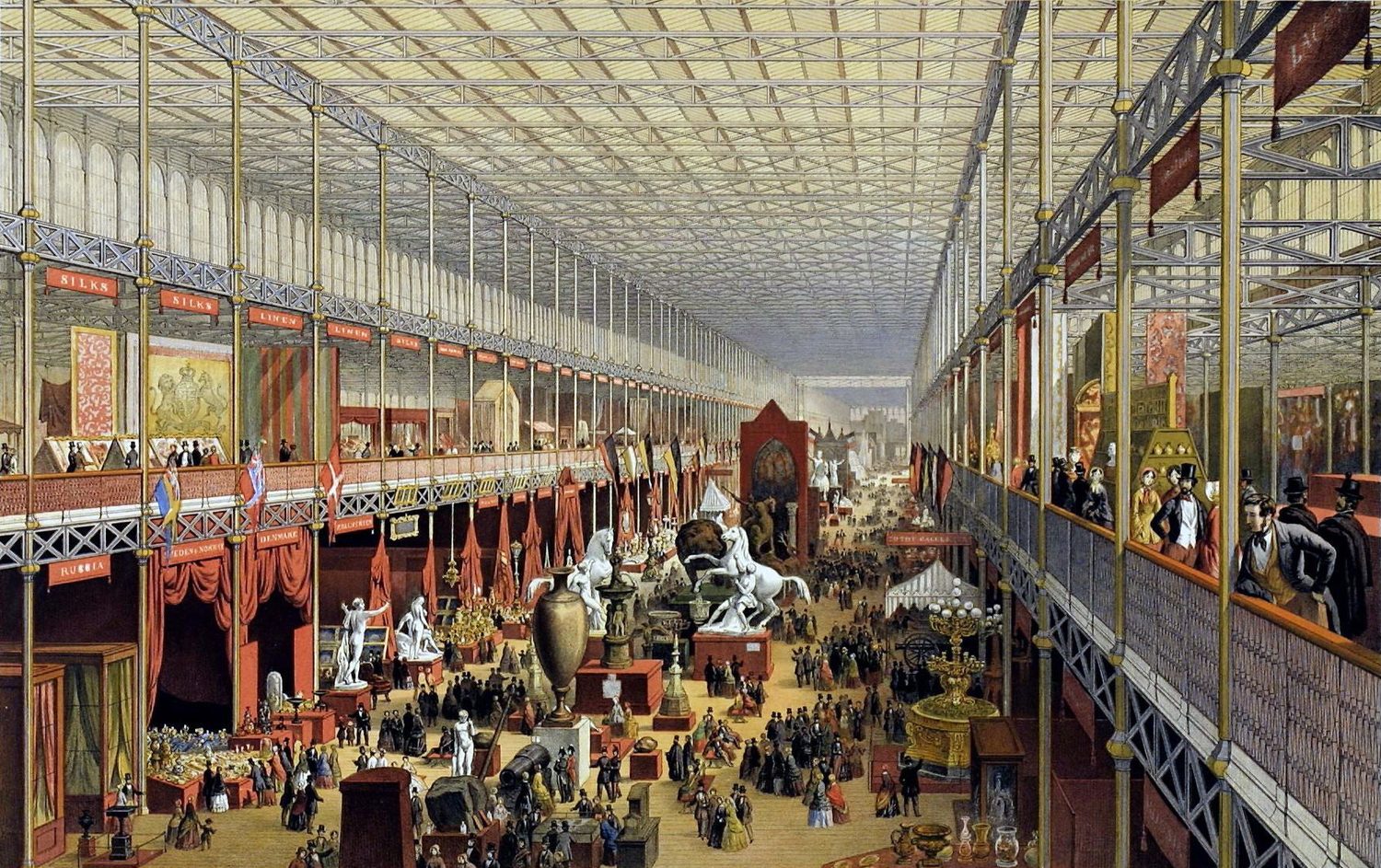
  • Britain’s leadership: §Bullet The Crystal Palace at the Great Exhibition of 1851 §Bullet Banks §Bullet Government financial awards to inventors Commercial interest in government: §Bullet Repeal of the Corn Laws Government support of industrialization: §Bullet Canals §Bullet Railroads §Bullet Trade agreements Geographic factors in eastern and southern Europe: §Bullet Lack of resources §Bullet Lack of adequate transportation Primitive agricultural practices and famines: §Bullet The “Hungry ’40s” §Bullet Irish potato famine §Bullet Russian serfdom
עברית

6.2 התפשטות התעשייה בכל רחבי אירופה

מיקוד נושא (ECD): פיתוחים כלכליים ומסחריים — פיתוח כלכלי, במיוחד פיתוח הקפיטליזם, שיחק תפקיד חשוב בהיסטוריה של אירופה, לעיתים קרובות עם השפעות חברתיות, פוליטיות ותרבותיות משמעותיות.

מטרות הלמידה ליחידה 6.B: הסבר הגורמים שהשפיעו על פיתוח ההתעשייה באירופה בין 1815 ל-1914.

  • KC-3.1.I.A אספקה זמינה של פחם, מי布鲁ט ברזל וחומרי גלם חיוניים אחרים קידמו צמיחה תעשייתית בבריטניה.
  • KC-3.1.I בריטניה ביססה את עליונותה התעשייתית באמצעות מכונות בייצור טקסטיל, ייצור ברזל ופלדה, ומערכות תחבורה חדשות בשילוב עם אקלים פוליטי וחברתי ייחודית נוח.
  • KC-3.1.I.B מוסדות כלכליים והון אנושי כגון מהנדסים, ממציאים וקפיטליסטים עזרו לבריטניה להוביל את תהליך ההתעשייה, בעיקר באמצעות יוזמה פרטית.
  • KC-3.1.I.C הממשל הפרלמנטרי בבריטניה קידם אינטרסים מסחריים ותעשייתיים מכיוון שאלו היו מיוצגים בפרלמנט.
  • KC-3.1.II.A צרפת נעה לעבר התעשייה בקצב איטי יותר מאשר בריטניה, עם תמיכה ממשלתית ועם פחות פגיעה בשיטות ייצור מסורתיות.
  • KC-3.1.II.C שילוב של גורמים, כגון גיאוגרפיה, מחסור במקורות, עליונות האליטים הקרקעיים המסורתיים, המשך הקושמאות באזורים מסוימים ותמיכה ממשלתית לא מספקת, הסבירו את פיגור אירופה המזרחית והדרומית בפיתוח תעשייתי.
  • KC-3.2.V בשל המשך קיום שיטות חקלאיות פשוטות יותר ותבניות בעלות אדמה, חלקים מסווינים באירופה נחגרו בתהליך התעשייה תוך שהם עומדים בפני רעב, חובות וחסר אדמות.

דוגמאות מדגמיות:

  • הובלתה של בריטניה: §ארמון הקריסטל בתערוכה הגדולה של 1851 §בנקים §פרסי כספיים ממשלתיים לממציאים עניין מסחרי בממשלה: §ביטול חוקי התבואה תמיכה ממשלתית בתעשייה: §תעלות §מסילות ברזל §הסכמי סחר גורמים גיאוגרפיים באירופה מזרחית ודרומית: §חוסר משאבים §חוסר תחבורה מתאימה מערכות חקלאיות ראשוניות ורעב: §ה"שנים הרעבות" 40 §הרעב באירלנד §העבדות בארץ הרוס

Source: College Board AP Course and Exam Description · ⁨מקור: תיאור הקורס והמבחן של College Board AP⁩

English

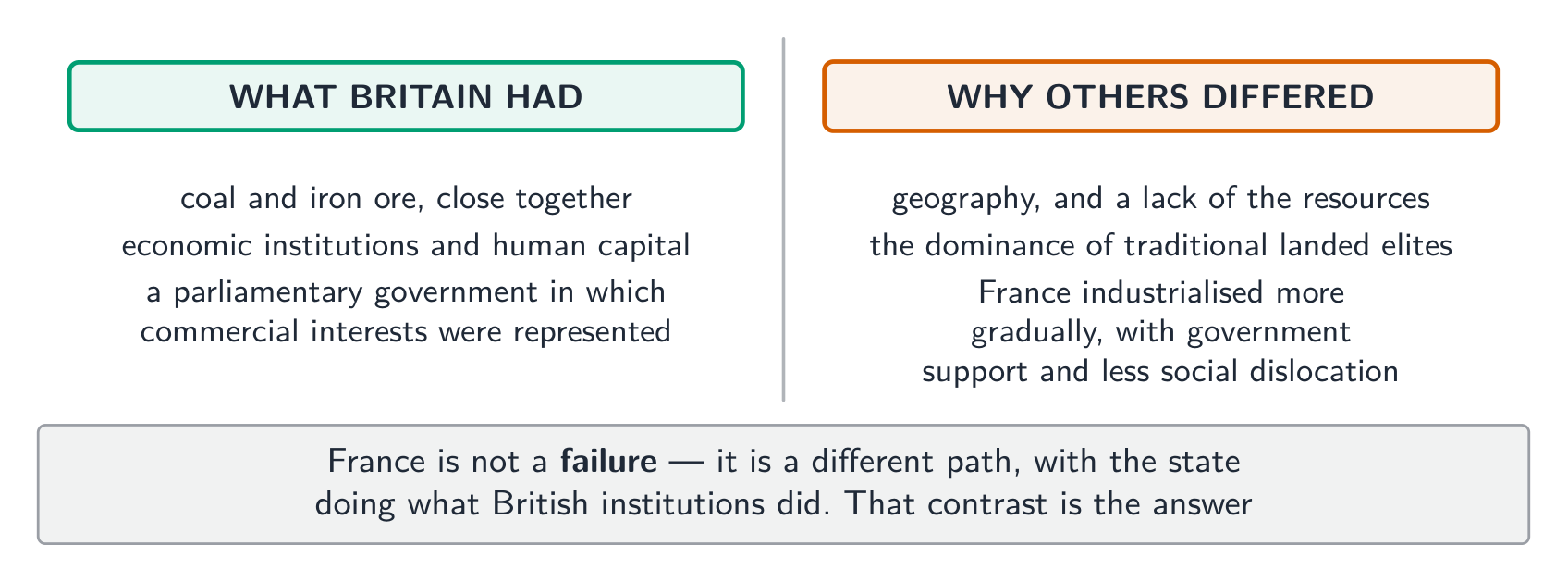
Britain led, and the CED gives the reasons as a set:

  • Ready supplies of coal, iron ore, and other raw materials.
  • Mechanisation of textile production, iron and steel, and the development of machine tools.
  • Economic institutions and human capital - engineers, inventors, and capitalists.
  • A parliamentary government that promoted commercial and industrial interests because those interests were represented in Parliament - the political condition, and the one students leave out.

The continent then diverged, which is the examinable comparison:

  • France industrialised more gradually, with government support and with less social dislocation 社会失序 than Britain.
  • Elsewhere, a combination of geography, lack of resources, the dominance of traditional landed elites, and the persistence of serf-like labour relations slowed industrialisation.
  • Because more primitive agricultural practices and landholding patterns persisted, some areas of Europe lagged behind entirely.
עברית

בריטניה הייתה בראש, וה-CED נותנת את הסיבות כסט:

  • אספקה זמינה של פחם, מינרל ברזל וחומרי גלם אחרים.
  • מכניזציה של ייצור טקסטיל, ברזל ופלדה, ופיתוח כלי מכונה.
  • מוסדות כלכליים והון אנושי - מהנדסים,ממציאים וקפיטליסטים.
  • ממשל פרלמנטרי שקידם אינטרסים מסחריים ותעשייתיים משום שהאינטרסים האלו יוצגו בפרלמנט - התנאי הפוליטי, והוא שאותו הסטודנטים מוותרים.

היבשה לאחר מכן הסתעפה, מה שהוא ההשוואה הנבחנת:

  • צרפת התעשייה בקצב איטי יותר, עם תמיכה ממשלתית ופחות הפרעה חברתית מאשר בריטניה.
  • באזורים אחרים, שילוב של גיאוגרפיה, חוסר משאבים, דומיננטיות של אלית אדמה מסורתית, והמשך של יחסי עבודה דמויי עבדים האט את התעשייה.
  • מכיוון ששיטות חקלאיות ומבני קרקע פחות מתקדמים המשיכו להתקיים, חלק מאירופה נשאר אחור.
שתי חצאי השאלה: מה בריטניה הייתה בעלת, ומה החזיק אחרים לאחור
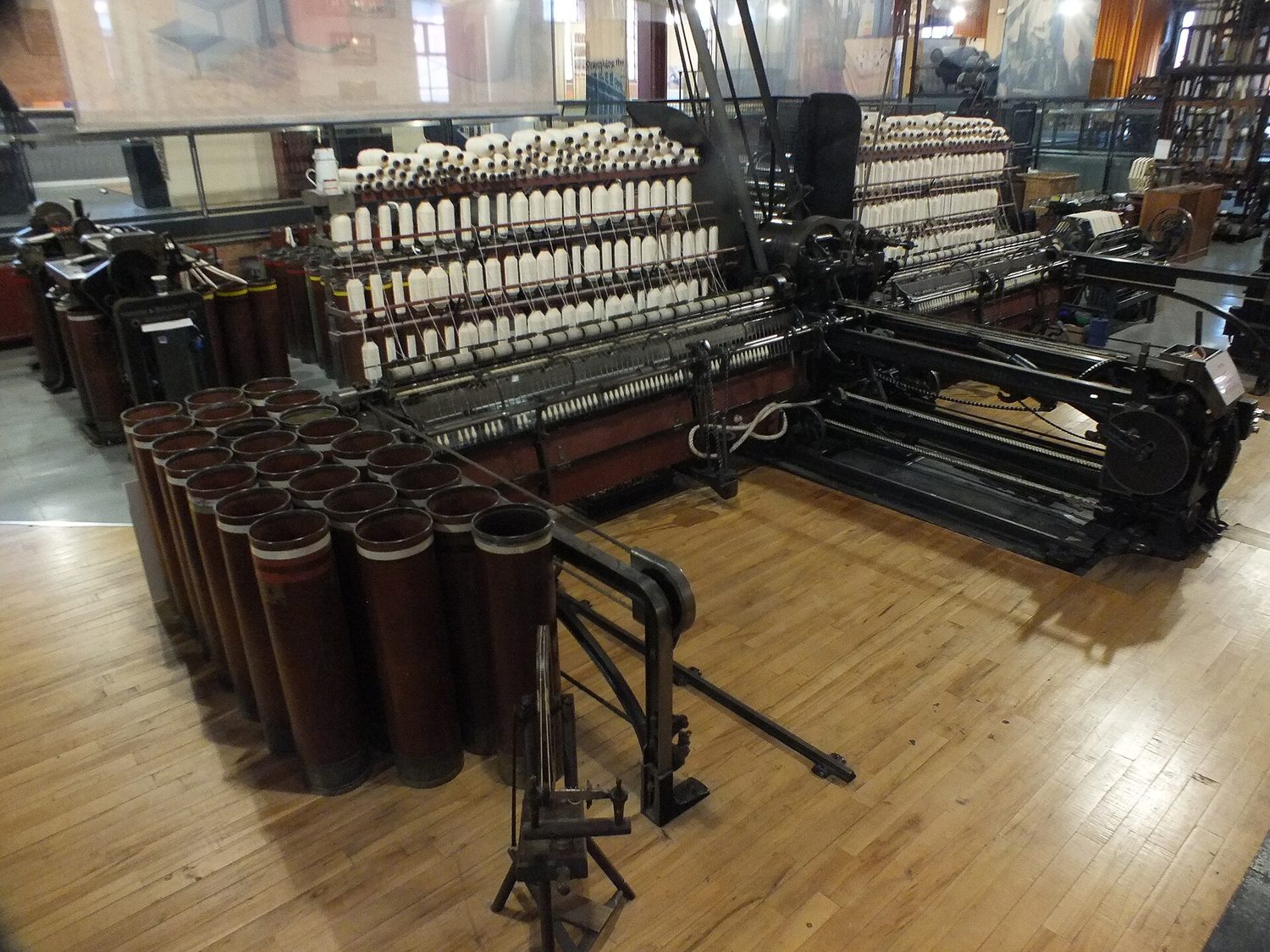
מולס מסתובב - מכונה אחת שמחליפה את עבודתם של סורגים רבים
Explore · ⁨חקור⁩

Sort each factor: British advantage or continental obstacle · ⁨סדר כל גורם: יתרון בריטי או מכשול יבשתי⁩

'Why Britain first' needs both halves. France is a different path, not a failure. · ⁨'מדוע בריטניה תחילה' דורשת את שני החלקים. צרפת היא מסלול אחר, ולא כשל.⁩

6.3

Second Wave Industrialization · ⁨התעשייה השנייה⁩

Syllabus · ⁨סיילבוס⁩
English

6.3 Second Wave Industrialization and Its Effects

Thematic Focus (TSI): Technological and Scientific Innovation — Scientific and technological innovations have increased efficiency, improved daily life, and shaped human development and interactions, having both intended and unintended consequences.

Thematic Focus (ECD): Economic and Commercial Developments — Economic development, especially the development of capitalism, played an important role in Europe’s history, often having significant social, political, and cultural effects.

Learning Objective Unit 6.C: Explain how innovations and advances in technology during the Industrial Revolutions led to economic and social change.

  • KC-3.1.III.A Mechanization and the factory system became the predominant modes of production by 1914.
  • KC-3.1.III.B New technologies and means of communication and transportation—including railroads— resulted in more fully integrated national economies, a higher level of urbanization, and a truly global economic network.
  • KC-3.2.IV.B New, efficient methods of transportation and other innovations created new industries, improved the distribution of goods, increased consumerism, and enhanced quality of life.

Learning Objective Unit 6.D: Explain how industrialization influenced economic and political development throughout the period from 1815 to 1914.

  • KC-3.1.III During the second industrial revolution (c. 1870–1914), more areas of Europe experienced industrial activity, and industrial processes increased in scale and complexity.
    • KC-3.1.III.C Volatile business cycles in the last quarter of the 19th century led corporations and governments to try to manage the market through a variety of methods, including monopolies, banking practices, and tariffs.
  • KC-3.2.II.A Along with better harvests caused in part by the commercialization of agriculture, industrialization promoted population growth, longer life expectancy, and lowered infant mortality.
  • KC-3.2.IV A heightened consumerism developed as a result of the second industrial revolution.
    • KC-3.2.IV.A Industrialization and mass marketing increased both the production and demand for a new range of consumer goods— including clothing, processed foods, and labor-saving devices—and created more leisure opportunities.
    • KC-3.2.IV.A Industrialization in Prussia allowed that state to become the leader of a unified Germany, which subsequently underwent rapid industrialization under government sponsorship.

Illustrative examples:

  • Factory production: §Bullet Manchester, England §Bullet The Krupp family (Essen, Germany) New technologies: §Bullet Bessemer process §Bullet Mass production §Bullet Electricity §Bullet Chemicals Developments in communication and transportation: §Bullet Telegraph §Bullet Steamship §Bullet Streetcars or trolley cars §Bullet Telephones §Bullet Internal combustion engine §Bullet Airplane §Bullet Radio New, efficient methods of transportation and other innovations: §Bullet Steamships §Bullet Railroads §Bullet Refrigerated rail cars §Bullet Ice boxes §Bullet Streetcars §Bullet Bicycles New industries: §Bullet Chemical industry §Bullet Electricity and utilities §Bullet Automobile §Bullet Leisure travel §Bullet Professional and leisure sport (CONT’D) Mass marketing: §Bullet Advertising §Bullet Department stores §Bullet Catalogs Industrialization in Prussia: §Bullet Zollverein §Bullet Investment in transportation network §Bullet Adoption of improved methods of manufacturing §Bullet Friedrich List’s National System
עברית

6.3 גל התעשייה השני והשפעותיו

מיקוד נושאי (TSI): חדשנות טכנולוגית ומדעית — חדשונות מדעיים וטכנולוגיים הגדילו את היעילות, שיפרו את החיים היומיומיים ועיצבו את הפיתוח והאינטראקציה האנושיים, עם תוצאות מתוכננות ולא מתוכננות.

מיקוד נושא (ECD): פיתוחים כלכליים ומסחריים — פיתוח כלכלי, במיוחד פיתוח הקפיטליזם, שיחק תפקיד חשוב בהיסטוריה של אירופה, לעיתים קרובות עם השפעות חברתיות, פוליטיות ותרבותיות משמעותיות.

מטרות למידה ליחידה 6.C: הסבר כיצד חדשות וקדמה טכנולוגית במהלך המהפכות התעשייתיות הביאו לשינויים כלכליים וחברתיים.

  • KC-3.1.III.A מכונאות ומערכת המפעל הפכו להיות דרכי הייצור הדומיננטיות עד שנת 1914.
  • KC-3.1.III.B טכנולוגיות חדשות ואמצעי תקשורת ותחבורה—כולל מסילות ברזל—הביאו לכלכלות לאומיות משולבות יותר, רמת אורבניזציה גבוהה יותר, ורשת כלכלית גלובלית באמת.
  • KC-3.2.IV.B שיטות תחבורה חדשות ויעילות וחדשות אחרות יצרו תעשיות חדשות, שיפרו את החלוקת הסחורות, הגבירו את הצריכה ושיפרו את איכות החיים.

מטרות למידה ליחידה 6.D: הסבר כיצד תעשייה השפיעה על ההתפתחות הכלכלית והמדינית לאורך התקופה מ-1815 עד 1914.

  • KC-3.1.III במהלך המהפכה התעשייתית השנייה (כ-1870–1914), אזורים נוספים באירופה חוו פעילות תעשייתית, ותהליכים תעשייתיים גדלו בקנה מידה ובמורכבות.
    • KC-3.1.III.C מחזורי עסקים תנודתיים ברבע האחרון של המאה ה-19 הובילו חברות וממשלות לנסות לשלוט בשוק באמצעות מגוון שיטות, כולל מונופולים, פרקטיקות בנקאיות ומכסים.
  • KC-3.2.II.A לצד יבולים טובים יותר שנגרמו חלקית ממסחר בחקלאות, התעשייה קידמה צמיחת אוכלוסייה, תוחלת חיים ארוכה יותר וירידה בשיעור תמותת תינוקות.
  • KC-3.2.IV צריכה מוגברת התפתחה כתוצאה מהמהפכה התעשייתית השנייה.
    • KC-3.2.IV.A תעשייה ושיווק המוני הגדילו גם את הייצור וגם את הביקוש למגוון חדש של מוצרי צריכה—כולל בגדים, מזון מעובד ומכשירים חוסכי עבודה—ויצרו הזדמנויות נוספות לבילוי.
    • KC-3.2.IV.A תעשייה בפרוסה אפשרה למדינה זו להפוך למנהיגה של גרמניה מאוחדת, שעברה בהמשך תעשייה מהירה תחת ספונסרות ממשלתית.

דוגמאות מדגמיות:

  • ייצור במפעלים: §Bullet מנצ'סטר, אנגליה §Bullet משפחת קרופ (אסן, גרמניה) טכנולוגיות חדשות: §Bullet תהליך בסמר §Bullet ייצור המוני §Bullet חשמל §Bullet כימיקלים התפתחויות בתקשורת ותחבורה: §Bullet טלגרף §Bullet ספינת קיטור §Bullet רכבות עירוניות §Bullet טלפונים §Bullet מנוע בעירה פנימית §Bullet מטוס §Bullet רדיו שיטות תחבורה חדשות ויעילות וחדשים אחרים: §Bullet ספינות קיטור §Bullet מסילות ברזל §Bullet קרון רכבת מקורר §Bullet קופסאות קרח §Bullet רכבות עירוניות §Bullet אופניים תעשיות חדשות: §Bullet תעשיית הכימיקלים §Bullet חשמל ותועלת ציבורית §Bullet רכב מנועי §Bullet תיירות פנאי §Bullet ספורט מקצועי ובילוי (בהמשך) שיווק המוני: §Bullet פרסום §Bullet חנויות כלליות §Bullet קטלוגים תעשייה בפרוסה: §Bullet זולוואיריין §Bullet השקעה בתשתית תחבורה §Bullet אימוץ שיטות ייצור משופרות §Bullet "המערכת הלאומית" של פרידריך ליסט

Source: College Board AP Course and Exam Description · ⁨מקור: תיאור הקורס והמבחן של College Board AP⁩

English

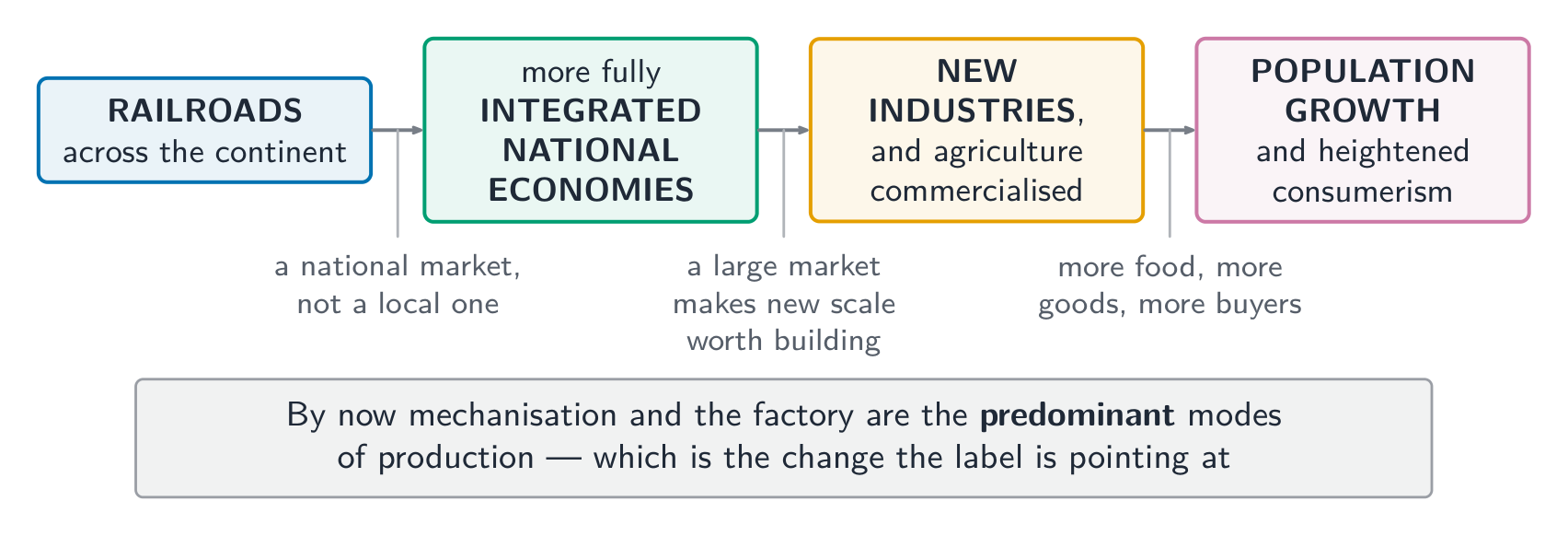
By 1914 mechanisation and the factory system had become the predominant modes of production. During the second industrial revolution 第二次工业革命 (c. 1870-1914) industrial activity spread across more of Europe, and:

  • New technologies and means of communication and transport - notably railroads 铁路 - produced more fully integrated national economies.
  • Efficient transport and other innovations created new industries and improved the distribution of goods.
  • Together with better harvests from the commercialisation of agriculture, industrialisation promoted population growth 人口增长.
  • A heightened consumerism 消费主义 developed.
עברית

עד שנת 1914 המכונאות והמערכת המפעלית הפכו לשיטות הייצור הדומיננטיות. במהלך המהפכה התעשייתית השנייה (כ-1870-1914) הפעילות התעשייתית התפשטה באירופה רחבה יותר, ו:

  • טכנולוגיות חדשות ואמצעי תקשורת ותחבורה – ובפרט רכבות – יצרו כלכלות לאומיות משולבות יותר.
  • תחבורה יעילה וחדשניות אחרות יצרו תעשיות חדשות ושפרו את חלוקת הסחורות.
  • יחד עם תוצרת טובה יותר מן המסחר בחקלאות, התעשייה קידמה גידול אוכלוסייה.
  • התפתחה צריכה מוגברת.
הגל השני כשרשרת: הרכבות משלבות שווקים, והיתר מגיע לאחר מכן
הארמון הקריסטלי, 1851 - ברזל וזכוכית בקנה מידה שאפשרה רק תעשייה
6.4

Social Effects of Industrialization · ⁨השפעות חברתיות של התעשייה⁩

Syllabus · ⁨סיילבוס⁩
English

6.4 Social Effects of Industrialization

Thematic Focus (SCD): Social Organization and Development — Economic, political, and cultural factors have influenced the form and status of family, class, and social groups in European history, which has, in turn, affected both the individual and society.

Learning Objective Unit 6.E: Explain the causes and consequences of social developments resulting from industrialization.

  • KC-3.2.I.A In industrialized areas of Europe (i.e., western and northern Europe), socioeconomic changes created divisions of labor that led to the development of self-conscious classes, including the proletariat and the bourgeoisie.
  • KC-3.2.I.B In some of the less industrialized areas of Europe, the dominance of agricultural elites continued into the 20th century.
  • KC-3.2.I.C Class identity developed and was reinforced through participation in philanthropic, political, and social associations among the middle classes, and in mutual aid societies and trade unions among the working classes.
  • KC-3.2.II.B With migration from rural to urban areas in industrialized regions, cities experienced overcrowding, while affected rural areas suffered declines in available labor as well as weakened communities.
  • KC-3.2.III.A Bourgeois families became focused on the nuclear family and the cult of domesticity, with distinct gender roles for men and women.
  • KC-3.2.III.B By the end of the century, higher wages, laws restricting the labor of children and women, social welfare programs, improved diet, and increased access to birth control affected the quality of life for the working class.
  • KC-3.2.III.C Economic motivations for marriage, while still important for all classes, diminished as the middle-class notion of companionate marriage began to be adopted by the working classes.
  • KC-3.2.III.D Leisure time centered increasingly on the family or small groups, concurrent with the development of activities and spaces to use that time.

Illustrative examples:

  • Laws restricting the labor of children and women: §Bullet Factory Act of 1833 §Bullet Mines Act of 1842 §Bullet Ten Hours Act of 1847 Leisure time activities and spaces: §Bullet Parks §Bullet Sports clubs and arenas §Bullet Beaches §Bullet Department stores §Bullet Museums §Bullet Theaters §Bullet Opera houses
עברית

6.4 השפעות חברתיות של תעשייה

מיקוד נושאי (SCD): ארגון חברתי ופיתוח — גורמים כלכליים, פוליטיים ותרבותיים השפיעו על צורתו ומעמדה של המשפחה, הקבוצה החברתית והמעמדות בהיסטוריה האירופית, מה ששימש בתורו כגורם השפעה גם על הפרט וגם על החברה.

מטרות למידה ליחידה 6.E: הסבר הסיבות והתוצאות של התפתחויות חברתיות הנובעות מתעשייה.

  • KC-3.2.I.A באזורים הממומחים באירופה (כלומר, אירופה המערבית והצפונית), שינויים סוציו-כלכליים יצרו חלוקת עבודה שהובילה להתפתחות של שכבות מודעות לעצמן, כולל הפרולטריה והבורגזיה.
  • KC-3.2.I.B בחלק מהאזורים הפחות ממומחים באירופה, הדומיננטיות של אלית החקלאות נמשכה עד המאה ה-20.
  • KC-3.2.I.C זהות שכבתית התפתחה והתחזקה דרך השתתפות ב associations פילנתרופיות, פוליטיות וחברתיות בקרב המעמד הבינוני, וב associations הדדיות ועובדים בקרב מעמד העובדים.
  • KC-3.2.II.B עקב ההגירה מאזורים כפריים לאזורים עירוניים באזורים תעשייתיים, הערים ספגו צפיפות יתר, בעוד שאזורים כפריים מושפעים סבלו מהיעדר עובדים ומהחלשת הקהילה.
  • KC-3.2.III.A משפחות הבורגות התמקדו במשפחה הגרעינית ובתרבות הבית, עם תפקידים מגדרים נפרדים לגברים ולנשים.
  • KC-3.2.III.B בסוף המאה, שכר גבוה יותר, חוקים המגבילים את העבודה של ילדים ונשים, תוכניות רווחה חברתית, שיפור בתזונה והגידול בגישה לאמצעי מניעת הריון השפיעו על איכות החיים בקרב מעמד העובדים.
  • KC-3.2.III.C הדחייה הכלכלית לנישואין, שסימלה עדיין חשיבות לכל השכבות, פחתה כאשר רעיון הנישואים השותפים של המעמד הבינוני החל להיות מאומץ על ידי מעמד העובדים.
  • KC-3.2.III.D זמן הפנאי התמקד increasingly במשפחה או בקבוצות קטנות, במקביל לפיתוח פעילויות ומרחבים לשימוש בזמן זה.

דוגמאות מדגמיות:

  • חוקים המגבילים את העבודה של ילדים ונשים: §Bullet חוק מפעלי הכדורים משנת 1833 §Bullet חוק מכרות הכדורים משנת 1842 §Bullet חוק עשר השעות משנת 1847 פעילויות וזמני פנאי: §Bullet פארקים §Bullet מועדוני ספורט ואולמות §Bullet חופים §Bullet חנויות כלליות §Bullet מוזיאונים §Bullet תיאטראות §Bullet בתי אופרה

Source: College Board AP Course and Exam Description · ⁨מקור: תיאור הקורס והמבחן של College Board AP⁩

English
  • In industrialised western and northern Europe, socioeconomic change created divisions of labour leading to an entrepreneurial and professional middle class and an industrial working class.
  • In less industrialised areas, the dominance of agricultural elites continued into the twentieth century.
  • Class identity 阶级认同 developed and was reinforced through participation in philanthropic, political, and social associations.
  • Rural-to-urban migration produced urban overcrowding 城市拥挤 while affected rural areas suffered population loss.
  • Bourgeois families focused on the nuclear family and the cult of domesticity 家庭崇拜, with distinct gender roles.
  • By the century's end, higher wages, laws restricting the labour of children and women, social welfare programmes, and improved diet raised living standards.
  • Economic motives for marriage diminished as the middle-class notion of companionate marriage 伴侣式婚姻 spread.
  • Leisure time centred increasingly on the family or small groups, with new activities and spaces built for it.
עברית
  • באירופה המערבית והצפונית המועסקת, שינוי סוציו-אקונומי יצר חלוקת עבודה המובילה למעמד ביניים עסקי ומקצועי ולמעמד עובדים תעשייתי.
  • באזורים פחות תעשייתיים, ההגמוניה של האליטות החקלאיות נמשכה גם למאה העשרים.
  • זהות מעמדית התפתחה וחוזקה באמצעות השתתפות בארגונים פילנתרופיים, פוליטיים וחברתיים.
  • הגירה מכפרי לערים יצרה עומס אורבני בעוד שהאזורים הכפריים הנפגעו סבלו מאובדן אוכלוסייה.
  • משפחות буржуазיה התמקדו במשפחה הגרעינית ובתרבות הבית, עם תפקידי מגדר נפרדים.
  • לקראת סוף המאה, שכירות גבוהות יותר, חוקים המגבילים את עבודתם של ילדים ונשים, תוכניות רווחה חברתית, ושיפור בתזונה העלו את רמת החיים.
  • הטעמים הכלכליים לנישואים צמצמו כשהמונח נישואי ליווי של המעמד הבינוני התפשט.
  • זמן פנאי התמקד יותר ויותר במשפחה או בקבוצות קטנות, עם פעילויות ומרחבים חדשים שנבנו לכך.
6.5

The Concert of Europe and European Conservatism · ⁨הקונצרט האירופי והשימורנות האירופית⁩

Syllabus · ⁨סיילבוס⁩
English

6.5 The Concert of Europe and European Conservatism

Thematic Focus (SOP): States and Other Institutions of Power — European states and nations developed governmental and civil institutions from 1450 to the present to organize society and consolidate political power, with a variety of social, cultural, and economic effects.

Learning Objective Unit 6.F: Explain how the European political order was maintained and challenged from 1815 to 1914.

  • KC-3.3.I.C Conservatives developed a new ideology in support of traditional political and religious authorities, which was based on the idea that human nature was not perfectible.
  • KC-3.4.I The Concert of Europe (or Congress System) sought to maintain the status quo through collective action and adherence to conservatism.
    • KC-3.4.I.A Metternich, architect of the Concert of Europe, used it to suppress nationalist and liberal revolutions.
    • KC-3.4.I.B Conservatives reestablished control in many European states and attempted to suppress movements for change and, in some areas, to strengthen adherence to religious authorities.

Illustrative examples:

  • Influential conservative influences: §Bullet Edmund Burke §Bullet Joseph de Maistre §Bullet Klemens von Metternich
עברית

6.5 הקונצרט האירופי והשמרנות באירופה

מיקוד נושאי (SOP): מדינות ומוסדות כוח אחרים — מדינות ואומות אירופיות פיתחו מוסדות ממשליים ואזרחיים משנת 1450 ועד היום כדי לארגן את החברה ולחזק את הכוח הפוליטי, עם מגוון השפעות חברתיות, תרבותיות וכלכליות.

מטרות למידה ליחידה 6.F: הסבר כיצד הסדר הפוליטי האירופי שמר והת挑战 מ-1815 עד 1914.

  • KC-3.3.I.C השמרנים פיתחו אידאולוגיה חדשה לתמיכה במוסדות פוליטיים ודתיים מסורתיים, שנבנתה על הרעיון שהטבע האנושי אינו מתשוב.
  • KC-3.4.I הקונצרט האירופי (או מערכת הקונגרסים) שאף לשמור על המצב הקיים דרך פעולה משותפת ושמירה על עקרונות שמרניים.
    • KC-3.4.I.A מיטלרכה, אדריכל הקונצרט האירופי, השתמש בו כדי לדכא מרידות לאומניות וליברליות.
    • KC-3.4.I.B השמרנים שבו לשלוט במדינות אירופיות רבות וניסו לדכא תנועות לשינוי, ובחלק מהאזורים ניסו לחזק את ההיצמדות למוסדות דתיים.

דוגמאות מדגמיות:

  • השפעות שמרניות משמעותיות: §Bullet אדמונד ברק §Bullet יוזף דה מאיסטר §Bullet קלמנס פון מיטלרכה

Source: College Board AP Course and Exam Description · ⁨מקור: תיאור הקורס והמבחן של College Board AP⁩

English

The Concert of Europe 欧洲协调, or Congress System, sought to maintain the status quo through collective action and adherence to conservative principles.

Conservatism 保守主义 in this period is a genuine ideology, not merely resistance: it supported traditional political and religious authorities on the ground that society is an organic whole with a natural hierarchy, which cannot be redesigned by abstract reason without harm.

עברית

הקונצרט האירופי, או מערכת הקונגרסים, שואף לשמירה על המצב הקיים באמצעות פעולה משותפת ומעקב עקבי עקרונות שימורניים.

שימורנות בתקופה זו היא אידיאולוגיה אמיתית, ולא רק התנגדות: היא תומכת בסמכויות פוליטיות ודתיות מסורתיות על בסיס הטענה שהחברה היא כול אורגני בעל היררכיה טבעית, שאין לעצב מחדש באמצעות סברת חוץ ללא גרימת נזק.

6.6

Reactions and Revolutions · ⁨תגובות מהפכות⁩

Syllabus · ⁨סיילבוס⁩
English

6.6 Reactions and Revolutions

Thematic Focus (SOP): States and Other Institutions of Power — European states and nations developed governmental and civil institutions from 1450 to the present to organize society and consolidate political power, with a variety of social, cultural, and economic effects.

Learning Objective Unit 6.G: Explain how and why various groups reacted against the existing order from 1815 to 1914.

  • KC-3.4.I.C In the first half of the 19th century, revolutionaries attempted to destroy the status quo.
  • KC-3.4.I.D The revolutions of 1848, triggered by economic hardship and discontent with the political status quo, challenged conservative politicians and governments and led to the breakdown of the Concert of Europe.
  • KC-3.4.II.D In Russia, autocratic leaders pushed through a program of reform and modernization, including the emancipation of the serfs, which gave rise to revolutionary movements and eventually the Russian Revolution of 1905.

Illustrative examples:

  • Early 19th-century political revolts: §Bullet War of Greek Independence §Bullet Decembrist revolt in Russia §Bullet Polish rebellion §Bullet July Revolution in France Reformers in Russia: §Bullet Alexander II §Bullet Sergei Witte §Bullet Peter Stolypin
עברית

6.6 תגובות ומהפכות

מיקוד נושאי (SOP): מדינות ומוסדות כוח אחרים — מדינות ואומות אירופיות פיתחו מוסדות ממשליים ואזרחיים משנת 1450 ועד היום כדי לארגן את החברה ולחזק את הכוח הפוליטי, עם מגוון השפעות חברתיות, תרבותיות וכלכליות.

מטרות למידה ליחידה 6.G: הסבר כיצד ומדוע קבוצות שונות הגיבו נגד הסדר הקיים מ-1815 עד 1914.

  • KC-3.4.I.C בחצי הראשון של המאה ה-19, מהפכנים ניסו להרוס את המצב הקיים.
  • KC-3.4.I.D המהפכות של 1848, שנגרמו מקשיים כלכליים ואי-שביעות רצון מהמצב הקיים, אתגרו פוליטיקאים ושלטונות שמרניים והובילו לקריסת הקונצרט האירופי.
  • KC-3.4.II.D ברוסיה, מנהיגים אוטוקראטיים דחפו תוכנית של реформ и модернизации, כולל שחרור העבדים, מה שהוביל לנשיאת תנועות מהפכניות ובסופו של דבר למהפכה הרוסית של 1905.

דוגמאות מדגמיות:

  • מרידות פוליטיות במאה ה-19: §Bullet מלחמת העצמאות היוונית §Bullet מרידת הדיצמברים ברוסיה §Bullet מרידת פולין §Bullet המהפכה ביולי בצרפת מחדשים ברוסיה: §Bullet אלכסנדר השני §Bullet סרגיי ויטה §Bullet פיוטר סטולפין

Source: College Board AP Course and Exam Description · ⁨מקור: תיאור הקורס והמבחן של College Board AP⁩

English

In the first half of the nineteenth century, revolutionaries attempted to destroy the status quo. The revolutions of 1848 1848年革命, triggered by economic hardship and discontent with the political order, challenged conservative power across Europe - and largely failed, which is itself examinable.

In Russia, autocratic leaders pushed through reform and modernisation from above, including the emancipation of the serfs 农奴解放 - reform used as an alternative to revolution rather than a concession to it.

עברית

בחצי הראשון של המאה התשע-עשרה, מהפכנים נסו להחריב את המצב הקיים. המהפכות של 1848 1848, שהופעלו על ידי קשיים כלכליים ותחושת אי-רווח מן הסדר הפוליטי, עמדו במבחן כוח השימורני בכל רחבי אירופה - ורובם נכשלו, דבר שמיועד לבחינות.

ברוסיה, מנהיגים אוטוקראטיים הכתיבו ** реформות ומודרניזציה** מלמעלה, כולל שחרור העבדים - רפורמה שהייתה מתוך חלופה למהפכה ולא ויתור עליה.

6.7

Ideologies of Change and Reform Movements · ⁨אידיאולוגיות שינוי ותנועות רפורמה⁩

Syllabus · ⁨סיילבוס⁩
English

6.7 Ideologies of Change and Reform Movements

Thematic Focus (CID): Cultural and Intellectual Developments — The creation and transmission of knowledge, including the relationship between traditional sources of authority and the development of differing world views, had significant political, intellectual, economic, cultural, and social effects on European and world societies.

Learning Objective Unit 6.H: Explain how and why different intellectual developments challenged the political and social order from 1815 to 1914.

  • KC-3.3.I.A Liberals emphasized popular sovereignty, individual rights, and enlightened self-interest but debated the extent to which all groups in society should actively participate in its governance.
  • KC-3.3.I.B Radicals in Britain and republicans on the continent demanded universal male suffrage and full citizenship without regard to wealth and property ownership; some argued that such rights should be extended to women.
  • KC-3.3.I.D Socialists called for the redistribution of society’s resources and wealth and evolved from a utopian to a Marxist scientific critique of capitalism.
  • KC-3.6.II.C Marx’s scientific socialism provided a systematic critique of capitalism and a deterministic analysis of society and historical evolution.
  • KC-3.3.I.E Anarchists asserted that all forms of governmental authority were unnecessary and should be overthrown and replaced with a society based on voluntary cooperation.

Illustrative examples:

  • Liberals: §Bullet Jeremy Bentham §Bullet Anti-Corn Law League §Bullet John Stuart Mill Advocates of suffrage: §Bullet Chartists §Bullet Flora Tristan Utopian socialists: §Bullet Henri de Saint-Simon §Bullet Charles Fourier §Bullet Robert Owen Marxists: §Bullet Friedrich Engels §Bullet Clara Zetkin §Bullet Rosa Luxemburg Anarchists: §Bullet Mikhail Bakunin §Bullet Georges Sorel
עברית

6.7 אידאולוגיות של שינוי ותנועות רפורמה

הדגשה נושאית (CID): התפתחויות תרבותיות ואינטלקטואליות — יצירת ומעבר המידע, כולל הקשר בין מקורות סמכות מסורתיים להתפתחות עולמות ראייה שונים, היו בעלי השפעה משמעותית על החברות האירופאיות והעולמיות בתחומים פוליטיים, אינטלקטואליים, כלכליים, תרבותיים וחברתיים.

מטרות למידה ליחידה 6.H: הסבר על האופן והסיבה שבהם פיתוחים אינטלקטואליים שונים עיכבו את הסדר הפוליטי והחברתי מ-1815 ועד 1914.

  • KC-3.3.I.A הליברלים הדגישו רצון עם, זכויות פרט ואינטרס עצמי מעורב, אך דנו בגודל ההשתתפות של כל הקבוצות בחברה בשלטונה.
  • KC-3.3.I.B הרדיקלים בבריטניה והרפובליקנים ביבשה דרשו זכות בחירה כללית לגברים ואזרחות מלאה ללא קשר לעושר או לבעלות נכסים; חלקם טענו כי זכויות אלו צריכות להורחב גם לנשים.
  • KC-3.3.I.D הסוציאליסטים דרשו לחלוק מחדש את המשאבים והעושר בחברה, והתפתחו מבביקורת אוטופית לקריטה מדעית מרקסיסטית של הקפיטליזם.
  • KC-3.6.II.C הסוציאליזם המדעי של מארקס סיפק ביקורת שיטתית על הקפיטליזם וניתוח דטרמיניסטי של החברה וההתפתחות ההיסטורית.
  • KC-3.3.I.E האנרכיסטים הצהירו שכל צורות סמכות ממשלתית הן מיותרות, יש להפיל אותן ולהחליף אותן בחברה המבוססת על שיתוף פעולה התנדבותי.

דוגמאות מדגמיות:

  • הליברלים: §Bullet ג'רימי בנת'ם §Bullet league נגד חוקי התבואה §Bullet ג'ון סטיוארט מייל תומכי זכות בחירה: §Bullet צ'ארטיסטים §Bullet פלורה טריסטן סוציאליסטים אוטופיים: §Bullet אנרי דה סן-סימון §Bullet שארל פורייה §Bullet רוברט אוונן מרקסיסטים: §Bullet פרידריך אנגלס §Bullet קלרה זטקין §Bullet רזה לוקסמבורג אנרכיסטים: §Bullet מיחיל בקונין §Bullet ז'ורז' סורל

Source: College Board AP Course and Exam Description · ⁨מקור: תיאור הקורס והמבחן של College Board AP⁩

English

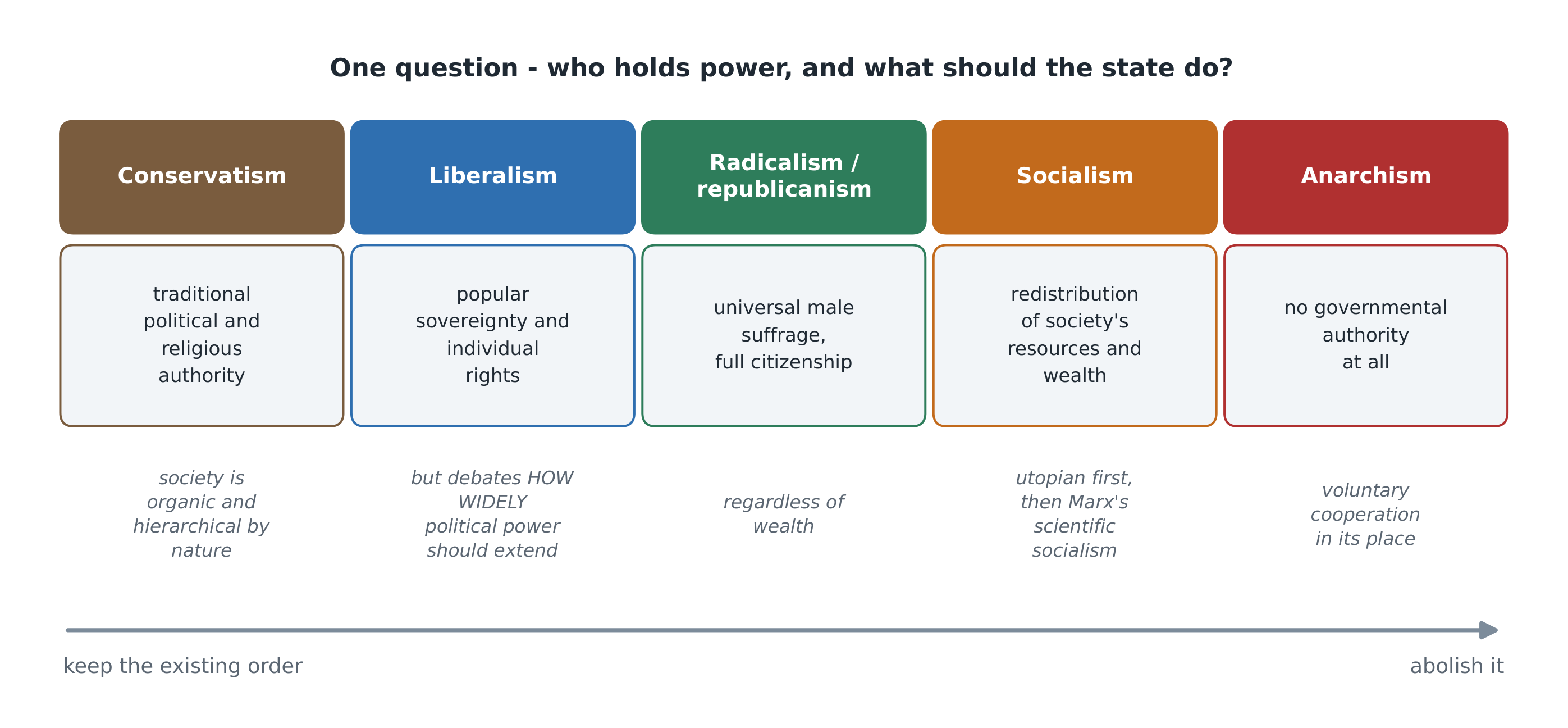
The CED names five positions, and they are best learned as answers to one question: who should hold power, and what should the state do?

  • Liberals 自由主义者 emphasised popular sovereignty, individual rights, and enlightened self-interest, but debated how far all groups should share political power.
  • Radicals in Britain and republicans on the continent demanded universal male suffrage 男性普选权 and full citizenship without regard to wealth.
  • Socialists 社会主义者 called for the redistribution of society's resources and wealth, evolving from utopian to Marxist scientific socialism.
  • Marx's scientific socialism 科学社会主义 provided a systematic critique of capitalism and a deterministic analysis of society and historical change.
  • Anarchists 无政府主义者 asserted that all forms of governmental authority were unnecessary and should be replaced by a society based on voluntary cooperation.
עברית
המחלוקת של המאה, המוצגת - כל אידיאולוגיה עונה על אותו שאלה בצורה שונה
השאלות מבקשות ממך להבדיל ביניהן, לכן לימוד אותן כסט הוא הטוב ביותר מאשר אחת אחת

ה-CED מונה חמישה עמדות, והן נלמדות טוב ביותר כתשובות לשאלה אחת: מי צריך להיות בשלטון, ומה צריך לעשות המדינה?

  • ליברלים הדגישו ריבונות לאומי, זכויות פרט ואינטרס עצמי מואר, אך דנו בעד כמה כל הקבוצות ישתתפו בכוח פוליטי.
  • רדיקלים בבריטניה ורפובליקנים ביבשה דרשו זכות בחירה כללית לגברים ואזרחות מלאה ללא קשר לעושר.
  • סוציאליסטים קראו לפיזור מחדש של המשאבים והעושר בחברה, התפתחו מסוציאליזם אופייני לסוציאליזם מדעי של מרקס.
  • הסוציאליזם המדעי של מרקס סיפק ביקורת מערכתית של הקפיטליזם וניתוח דטרמיניסטי של החברה ושינוי היסטורי.
  • אנרכיסטים טענו שכל צורות סמכות ממשלתית אינן נחוצות ועליהן להיות מוחלפות בחברה המבוססת על שיתוף פעולה וולונטרי.
6.8 6.9

19th-Century Social Reform and Institutional Responses · ⁨הרפורמה החברתית במאה ה19 והתגובות המוסדיות⁩

Syllabus · ⁨סיילבוס⁩
English

6.8 19th-Century Social Reform

Thematic Focus (SCD): Social Organization and Development — Economic, political, and cultural factors have influenced the form and status of family, class, and social groups in European history, which has, in turn, affected both the individual and society.

Learning Objective Unit 6.I: Explain the various movements and calls for social reform that resulted from intellectual developments from 1815 to 1914.

  • KC-3.3.III Political movements and social organizations responded to problems of industrialization.
    • KC-3.3.III.A Mass-based political parties emerged as sophisticated vehicles for social, economic, and political reform.
    • KC-3.3.III.B Workers established labor unions and movements promoting social and economic reforms that also developed into political parties.
    • KC-3.3.III.C Feminists pressed for legal, economic, and political rights for women as well as improved working conditions.
    • KC-3.3.III.D Various nongovernmental reform movements, many of them religious, assisted the poor and worked to end serfdom and slavery.

Illustrative examples:

  • Mass-based political parties: §Bullet Conservatives and Liberals in Great Britain §Bullet Conservatives and Socialists in France §Bullet Social Democratic Party in Germany Political parties representing workers: §Bullet German Social Democratic Party §Bullet British Labour Party §Bullet Russian Social Democratic Party Feminists and feminist movements: §Bullet Flora Tristan §Bullet British Women’s Social and Political Union §Bullet Pankhurst family §Bullet Barbara Smith Bodichon Reform movements and social reformers: §Bullet The Sunday School movement §Bullet The temperance movement §Bullet British abolitionist movement §Bullet Josephine Butler
עברית

6.8 רפורמות חברתיות במאה ה-19

מיקוד נושאי (SCD): ארגון חברתי ופיתוח — גורמים כלכליים, פוליטיים ותרבותיים השפיעו על צורתו ומעמדה של המשפחה, הקבוצה החברתית והמעמדות בהיסטוריה האירופית, מה ששימש בתורו כגורם השפעה גם על הפרט וגם על החברה.

מטרות למידה ליחידה 6.I: הסבר על המגמות השונות ודרישות הרפורמה החברתית שהתגבשו מתוך פיתוחים אינטלקטואליים מ-1815 ועד 1914.

  • KC-3.3.III תנועות פוליטיות וארגונים חברתיים הגיבו לבעיות הנובעות מהתעשייה.
    • KC-3.3.III.A מפלגות פוליטיות מבוססות קהל הופיעו ככלי מתקדם לרפורמה חברתית, כלכלית ופוליטית.
    • KC-3.3.III.B העובדים הקימו איגודים מקצועיים ותנועות המעודדות רפורמות חברתיות וכלכליות, שהתפתחו גם למפלגות פוליטיות.
    • KC-3.3.III.C הנציבות דרשו זכויות משפטיות, כלכליות ופוליטיות לנשים, כמו גם שיפור בתנאי העבודה.
    • KC-3.3.III.D תנועות רפורמה לא ממשלתיות שונות, רבות מהן דתיות, עזרו לעניים ועבדו לסיום העבדות ולעבדות.

דוגמאות מדגמיות:

  • מפלגות פוליטיות מבוססות קהל: §Bullet קונסרבטיבים וליברלים בבריטניה §Bullet קונסרבטיבים וסוציאליסטים בצרפת §Bullet המפלגה הדמוקרטית-סוציאלית בגרמניה מפלגות המייצגות עובדים: §Bullet המפלגה הדמוקרטית-סוציאלית בגרמניה §Bullet המפלגה העבודה הבריטית §Bullet המפלגה הדמוקרטית-סוציאלית הרוסית נציבות ותנועות נציבות: §Bullet פלורה טריסטן §Bullet האיחוד החברתי והפוליטי לנשים בבריטניה §Bullet משפחת פנקרסט §Bullet ברברה סמית' בודיכון תנועות רפורמה ומ реформаторs חברתיים: §Bullet תנועת הכיתות הבישיניות §Bullet תנועת ההימנעות מאלכוהול §Bullet תנועת הביטול הבריטית §Bullet יוזפיינה באטלר
English

6.9 Institutional Responses and Reform

Thematic Focus (SOP): States and Other Institutions of Power — European states and nations developed governmental and civil institutions from 1450 to the present to organize society and consolidate political power, with a variety of social, cultural, and economic effects.

Learning Objective Unit 6.J: Explain how and why governments and other institutions responded to challenges resulting from industrialization.

  • KC-3.3.II.A Liberalism shifted from laissez-faire to interventionist economic and social policies in response to the challenges of industrialization.
  • KC-3.3.II.B Reforms transformed unhealthy and overcrowded cities by modernizing infrastructure, regulating public health, reforming prisons, and establishing modern police forces. The reforms were enacted by governments motivated by such forces as public opinion, prominent individuals, and charity organizations.
  • KC-3.3.II.C Reformers promoted compulsory public education to advance the goals of public order, nationalism, and economic growth.

Illustrative examples:

  • Modernizing infrastructure: §Bullet Sewage and water systems §Bullet Public lighting §Bullet Public housing §Bullet Urban redesign §Bullet Parks §Bullet Public transportation §Bullet Edwin Chadwick §Bullet Georges Haussmann
עברית

6.9 תגובות מוסדיות ורפורמה

מיקוד נושאי (SOP): מדינות ומוסדות כוח אחרים — מדינות ואומות אירופיות פיתחו מוסדות ממשליים ואזרחיים משנת 1450 ועד היום כדי לארגן את החברה ולחזק את הכוח הפוליטי, עם מגוון השפעות חברתיות, תרבותיות וכלכליות.

מטרות למידה ליחידה 6.J: הסבר על האופן והסיבה שבהם ממשלות ומוסדות אחרים הגיבו לאתגרים הנובעים מהתעשייה.

  • KC-3.3.II.A הליברالية עברה מלייז-פאר (אינטראנציה) לפוליטיקות כלכליות וחברתיות אינטרונטיביות כתגובה לאתגרים של התעשייה.
  • KC-3.3.II.B הרפורמות שינו ערים בריאותיות ומצופפות על ידי מודרניזציה של תשתיות, ויסות בריאות ציבור, רפורמה בכלא והקמת כוחות משטרה מודרניים. הרפורמות אושרו על ידי ממשלות שהוגברו על ידי כוחות כמו דעת קהל, אישים בולטים וארגוני צדקה.
  • KC-3.3.II.C רפורמטורים קידמו חינוך ציבורי חובה כדי לקדם את מטרת הסדר הציבורי, הלאומיות והצמיחה הכלכלית.

דוגמאות מדגמיות:

  • חידוש תשתיות: §Bullet מערכות ביוב ומים §Bullet תאורה ציבורית §Bullet דיור ציבורי §Bullet עיצוב מחדש עירוני §Bullet פארקים §Bullet תחבורה ציבורית §Bullet אדווין צ'דוויק §Bullet ז'ורז' הוסמן

Source: College Board AP Course and Exam Description · ⁨מקור: תיאור הקורס והמבחן של College Board AP⁩

English

Political movements and social organisations responded to the problems of industrialisation. The institutional side is equally examinable:

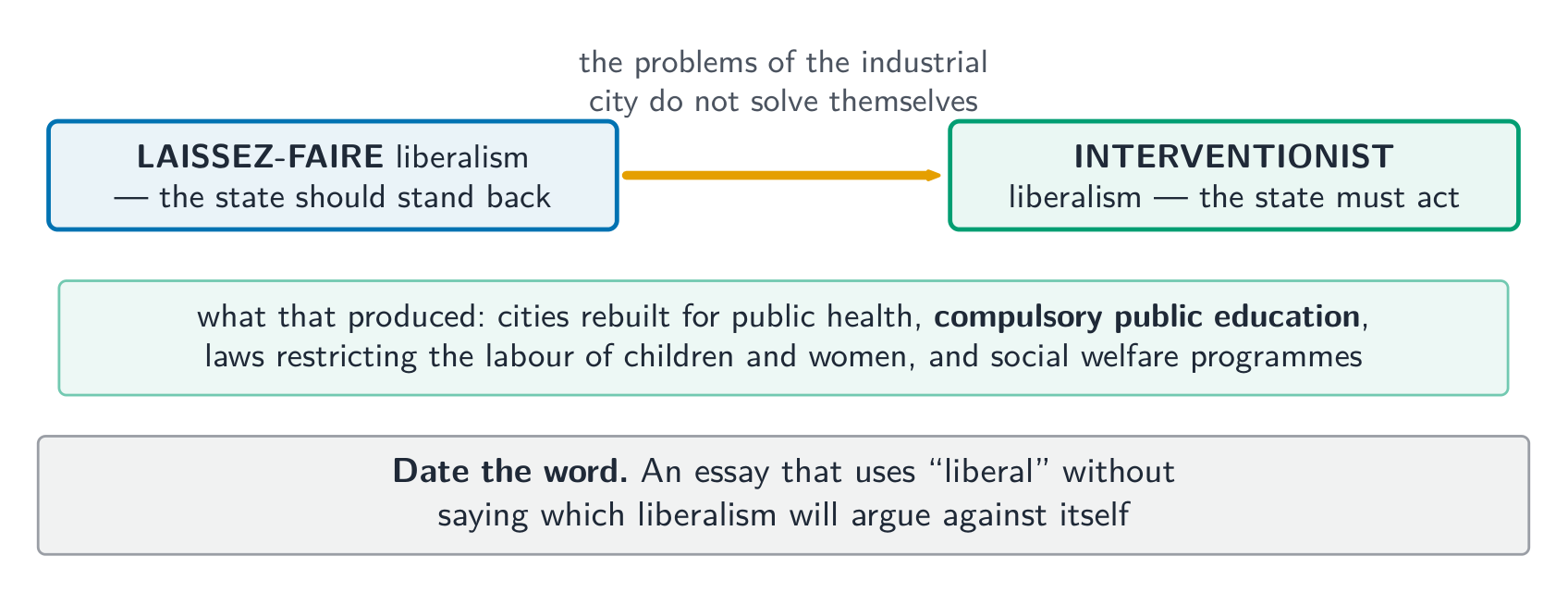
  • Liberalism shifted from laissez-faire to interventionist economic and social policies in response to industrialisation's challenges. This is the unit's most important intellectual change - the ideology that began by wanting the state out ended by using it.
  • Reforms transformed unhealthy and overcrowded cities by modernising infrastructure, regulating public health, and reforming prisons.
  • Reformers promoted compulsory public education 义务教育 to advance public order, nationalism, and economic growth. Note all three motives - the CED lists them, and none is purely benevolent.
עברית

תנועות פוליטיות וארגונים חברתיים הגיבו לבעיות של התעשייה. הצד המוסדי הוא גם כן מיועד לבחינות:

  • הליברالية עברה מלסז-פרר לסקס לפוליטיקות כלכליות וחברתיות מתערבות בתגובה לאתגרים של התעשייה. זהו השינוי האינטלקטואלי החשוב ביותר ביחידה - האידיאולוגיה שהתחילה רוצה את המדינה מחוץ לסכנה נגמרת בשימוש בה.
  • הרפורמות שינו ערים בלתי בריאות ומצופות על ידי מודרניזציה של תשתיות, ויסות רפואה ציבורית ורפורמה במכלאות.
  • מתקנים קידמו חינוך ציבורי חובה כדי לקדם את הסדר הציבורי, הלאומיות והצמיחה הכלכלית. שים לב לשלושה מניעים אלו - ה-CED מפרט אותם ואף אחד מהם אינו טהור או פילנתרופי.
אותה מילה, שתי מדיניות נגודיות - התאריך או הערך המוסד פולשים זה לזה
Explore · ⁨חקור⁩

Watch liberalism change sides · ⁨צפו לליברالية משנה צדדים⁩

'Liberal' in 1830 and in 1900 recommend contradictory things. Date the word or the essay will argue against itself. · ⁨'ליברלי' ב1830 וב1900 ממליץ על דברים סותרים. יש לתארך את המילה או שהמאמר יסתרב בעצמו.⁩

6.10

Causation in the Age of Industrialization · ⁨גורמיות בתקופת ההתעשייה⁩

Syllabus · ⁨סיילבוס⁩
English

6.10 Causation in the Age of Industrialization

Learning Objective Unit 6.K: Explain the influence of innovations and technological developments in Europe from 1815 to 1914.

  • KC-3.1 The Industrial Revolution spread from Great Britain to the continent, where the state played a greater role in promoting industry.
    • KC-3.1.I Great Britain established its industrial dominance through the mechanization of textile production, iron and steel production, and new transportation systems in conjunction with uniquely favorable political and social climates.
    • KC-3.1.II Following the British example, industrialization took root in continental Europe, sometimes with state sponsorship.
  • KC-3.2 The experiences of everyday life were shaped by industrialization, depending on the level of industrial development in a particular location.
    • KC-3.2.I Industrialization promoted the development of new classes in the industrial regions of Europe.
    • KC-3.2.II Europe experienced rapid population growth and urbanization, leading to social dislocations.
    • KC-3.2.III Over time, the Industrial Revolution altered the family structure and relations for bourgeois and working-class families.
  • KC-3.3 Political revolutions and the complications resulting from industrialization triggered a range of ideological, governmental, and collective responses.
    • KC-3.3.I Ideologies developed and took root throughout society as a response to industrial and political revolutions.
    • KC-3.3.II Governments, at times based on the pressure of political or social organizations, responded to problems created or exacerbated by industrialization.
עברית

6.10 סיבתיות בתקופת ההתעשייה

מטרות הלמידה ליחידה 6.K: הסבר השפעתם של חדשנות ופיתוחים טכנולוגיים באירופה בין 1815 ל-1914.

  • KC-3.1 המהפכה התעשייתית התפשטה מבריטניה ליבשת, שם המדינה שיחקה תפקיד גדול יותר בקידום התעשייה.
    • KC-3.1.I בריטניה ביססה את עליונותה התעשייתית באמצעות מכונות בייצור טקסטיל, ייצור ברזל ופלדה, ומערכות תחבורה חדשות בשילוב עם אקלים פוליטי וחברתי ייחודית נוח.
    • KC-3.1.II בהתאם לדוגמה הבריטית, התעשייה התיישבה באירופה היבשתית, לעיתים עם תמיכה ממשלתית.
  • KC-3.2 חוויות החיים היומיום עוצבו על ידי התעשייה, בהתאם לרמת הפיתוח התעשייתי במיקום ספציפי.
    • KC-3.2.I התעשייה קידמה את פיתוחן של שכבות חברתיות חדשות באזורים התעשייתיים של אירופה.
    • KC-3.2.II אירופה חוותה גידול אוכלוסייה מהיר ואורבניזציה, שהובילו למשברים חברתיים.
    • KC-3.2.III לאורך זמן, המהפכה התעשייתית שינתה את מבנה המשפחה והיחסים בתוך משפחות הבורגזיה ובין העובדים.
  • KC-3.3 מהפכות פוליטיות ומורכבויות הנובעות מהתעשייה הובילו למגוון תגובות אידיאולוגיות, ממשלתיות וקולקטיביות.
    • KC-3.3.I אידיאולוגיות פותחו והתבססו בכל רחבי החברה כתגובה למהפכות תעשייתיות ופוליטיות.
    • KC-3.3.II ממשלות, לעיתים מתחת ללחץ ארגונים פוליטיים או חברתיים, הגיבו לבעיות שנוצרו או חמרו על ידי התעשייה.
Source: College Board AP Course and Exam Description · ⁨מקור: תיאור הקורס והמבחן של College Board AP⁩

English

The unit's reasoning skill is causation.

Worked example (a real AP exam question). AP European History short-answer questions here ask, for example, to "Explain one way in which industrialisation contributed to the development of new political ideologies in the nineteenth century." A full-mark answer traces the link: "Industrialisation created a large urban working class with common conditions and no political representation, which gave socialists a constituency and an argument: that the wealth produced by industry was distributed by ownership rather than by labour. Marx's scientific socialism turned that observation into a systematic critique of capitalism, and the concentration of workers in factories and cities made organising around it possible." Notice that the answer explains why the idea found an audience, not only that it existed.

עברית

מיומנות ההסתדרות היחידה היא גורמים.

דוגמה מוצגת (שאלה אמיתית מבחן AP). בשאלות התשובה הקצרה להיסטוריה האירופאית AP נדרשים כאן, לדוגמה, ל*"הסביר דרך אחת שבה תעשייה תרמה לפיתוח אידאולוגיות פוליטיות חדשות במאה התשע עשרה."* תשובה מלאה נקבעת הקשר: "התעשייה יצרה מעמד עובדים עירוני גדול עם תנאים משותפים וללא נייצוג פוליטי, מה שסיפק לסוציאליסטים בסיס בחירות וארגון: שהעושר שנוצר על ידי התעשייה מתחלק על ידי בעלות ולא על ידי עבודה. הסוציאליזם המדעי של מארקס הפך תפיסה זו לביקורת שיטמטית על הקפיטליזם, והריכוז של העובדים במפעלים ובערים אפשר ארגון סביבה." שים לב שתשובה זו מסבירה למה הרעיון מצא אוהדים, ולא רק שהוא קיים.

6.10

Exam tips · ⁨טיפים לבחינות⁩

English
  • Britain's advantages include a political one - industrial interests were represented in Parliament. Most answers list only resources.
  • France industrialised gradually with state support and less dislocation. That contrast answers many comparison questions.
  • Learn the five ideologies as a set, distinguished by who holds power and what the state does.
  • Liberalism's shift from laissez-faire to intervention is the century's key ideological change. Name it.
  • Compulsory education had three motives - order, nationalism, growth. Give all three.
  • Living standards rose by the end of the century, after decades of hardship. Timing is the mark.
עברית
  • יתרונותיה של בריטניה כוללים יתרון פוליטי - האינטרסים התעשייתיים היו מיוצגים בפארלמנט. רוב התשובות מפרטות רק משאבים.
  • צרפת התעשייה בהדרגה עם תמיכה ממשלתית ומעט הפרעות. ניגוד זה עונה על הרבה שאלות השוואה.
  • יש ללמוד את חמישת הרעיונות ככלל, הנבדלים לפי מי שמחזיק בכוח ומה המדינה עושה.
  • השינוי בליברליזם מפילוסופיית לא עסקו (laissez-faire) לתערבות הוא השינוי הרעיוני המרכזי במאה זו. קראו לו שם.
  • החינוח החובה היה לשלושה מוטיבים - סדר, לאומיות, צמיחה. תנו את שלושתם.
  • רמות החיים עלו עד סוף המאה, לאחר עשורים של קשיים. הזמן הוא המקרה.

Interactive lessons on this topic · ⁨שיעורים אינטראקטיביים בנושא זה⁩

Work through it step by step, with instant-check exercises. · ⁨לעבור על הדברים צעד אחר צעד, עם תרגילים לבדיקה מיידית.⁩

Past Papers · ⁨מבחני עבר⁩

More topics in AP European History · ⁨היסטוריה אירופאית - AP⁩ · ⁨נושאים נוספים בAP European History · ⁨היסטוריה אירופאית - AP⁩⁩

Log in or create account · ⁨היכנס או צור חשבון⁩

IGCSE, A-Level & AP