4.1 Contextualizing the Scientific Revolution and the Enlightenment
| Learning Objective | Preview: Unit 4 Key Concepts |
|---|---|
Unit 4.A |
|
AP European History · Topic 4
 7:53
7:53
Unit 4: Scientific, Philosophical, and Political Developments
One sentence contains this entire unit, and it is worth learning in the CED's own words. The spread of Scientific Revolution concepts and practices, and the…
English narration · English + 中文 subtitles burned in
| Learning Objective | Preview: Unit 4 Key Concepts |
|---|---|
Unit 4.A |
|
Source: College Board AP Course and Exam Description
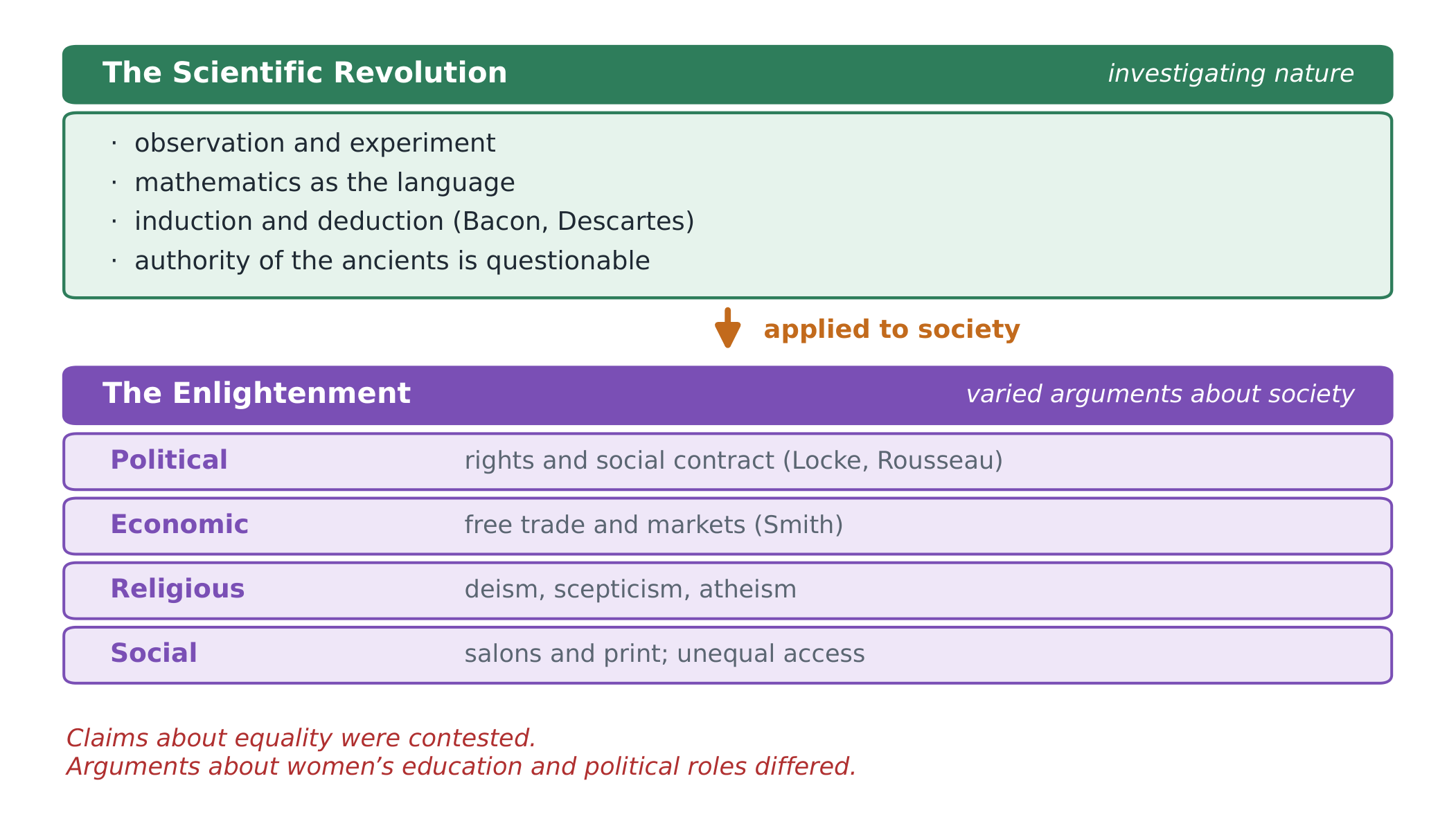
The Scientific Revolution 科学革命 developed new ways to investigate nature. The Enlightenment 启蒙运动 applied concepts and practices associated with these changes to political, social and ethical questions. This encouraged debate about the individual, government and society. It did not produce one method or one agreed political programme.
Observation, experiment, mathematics, reason and classical learning interacted. Religious belief and inherited authority remained important. Alongside intellectual change, developments in agriculture, disease, migration, consumption and family life changed everyday experience. This unit connects these processes without treating every social change as the direct result of a philosopher's ideas.
| English |
|---|
| Scientific Revolution/saɪənˈtɪfɪk ˌrevəˈluːʃn/ |
| Enlightenment/enˈlaɪtənmənt/ |
| Thematic Focus | Learning Objective | Historical Developments |
|---|---|---|
TSI | Unit 4.B |
|
Illustrative examples:
Source: College Board AP Course and Exam Description
Copernicus 哥白尼, Galileo 伽利略 and Newton 牛顿 contributed different ideas and evidence to changing understandings of the cosmos. A heliocentric model challenged an Earth-centred account. Mathematical explanation and observation helped challenge inherited authority; these thinkers did not all make the same discovery.
William Harvey 哈维 studied blood circulation and helped present the body as an integrated system 整体系统. This challenged inherited accounts associated with Galen. New anatomical and medical knowledge did not instantly remove every older practice.
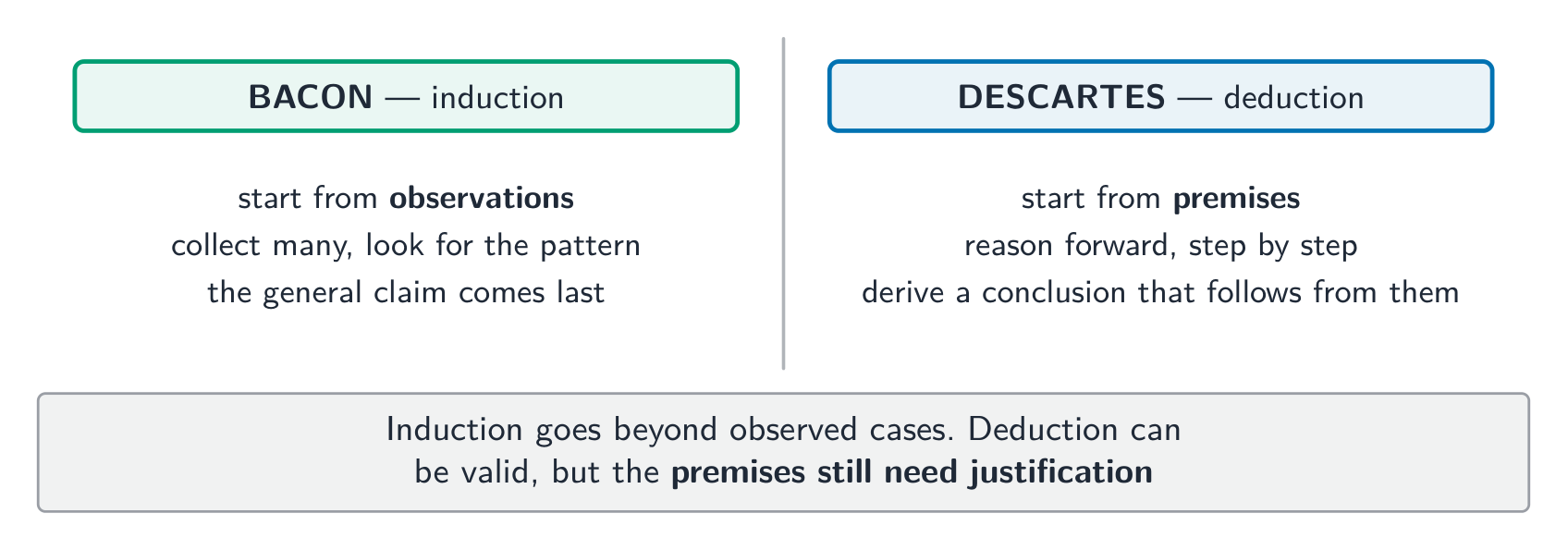
Francis Bacon 培根 and René Descartes 笛卡尔 are associated with contrasting approaches to inductive and deductive reasoning 归纳与演绎推理. Bacon emphasised observation and systematic investigation; Descartes stressed methodical doubt and reasoning from clear principles. Neither invented all reasoning of that kind. Both contributed to debates about reliable knowledge.
Original logic example: several observed heated metal samples become longer. Generalising from these observations is induction; the sample does not prove every material behaves that way. For deduction, assume all objects in box X are metal and object A is in box X. A must be metal if the premises are true and the reasoning is valid. Deduction does not establish the factual truth of the premises by itself.
Alchemy and astrology continued to appeal to some natural philosophers and elites. They shared an interest in a knowable, ordered universe with newer investigations; belief in spiritual forces also continued. This is evidence of continuity, not proof that all older claims were scientifically valid.
Distinguish generalisation from observations and inference from premises.
| English |
|---|
| Copernicus/ˈkəʊpənɪkəs/ |
| Galileo/ˌɡælɪˈleɪəʊ/ |
| Newton/ˈnjuːtn/ |
| William Harvey/ˈwɪlɪəm ˈhɑːvi/ |
| integrated system/ˈɪntɪɡreɪtɪd ˈsɪstəm/ |
| Francis Bacon/ˈfrænsɪs ˈbeɪkən/ |
| inductive and deductive reasoning/ɪnˈdʌktɪv ænd dɪˈdʌktɪv ˈriːzənɪŋ/ |
| René Descartes/rɪˈneɪ dɪˈskɑːts/ |
| Thematic Focus | Learning Objective | Historical Developments |
|---|---|---|
CID | Unit 4.C |
|
Unit 4.D |
|
Illustrative examples:
Source: College Board AP Course and Exam Description
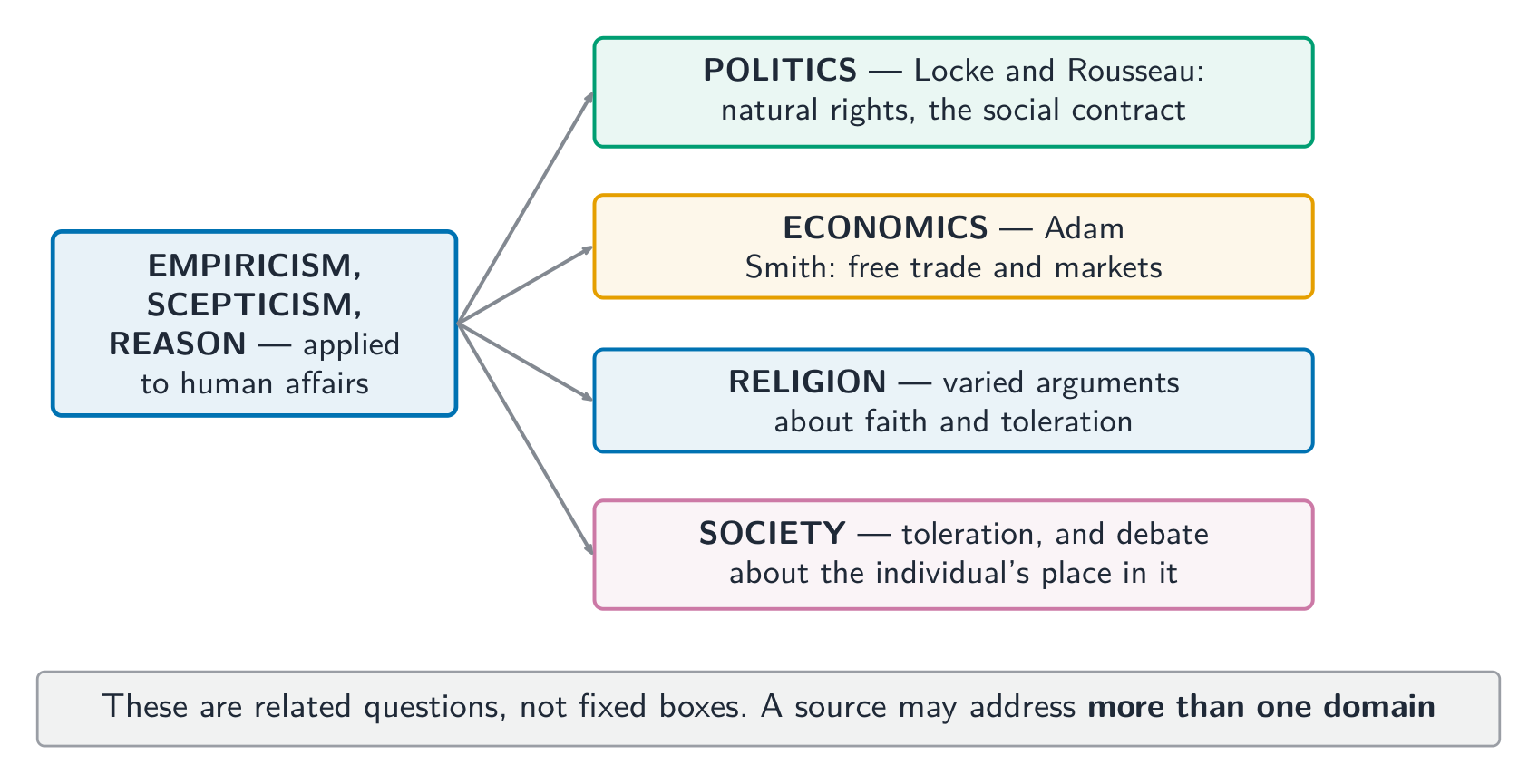
Empiricism 经验主义 stresses observation and experience; rationalism 理性主义 stresses reasoning; scepticism 怀疑主义 questions claims and grounds for belief. These approaches overlapped and differed. Enlightenment thinkers did not simply follow one laboratory procedure to reach identical answers about society.
Political arguments included Locke 洛克 and Rousseau 卢梭 on natural rights 天赋权利 and the social contract 社会契约. Locke connected legitimate government with consent and protection of rights, challenging authority based only on divine right or tradition. Rousseau's model was different; sharing the idea of a contract did not make their accounts identical.
Adam Smith's 亚当·斯密 arguments supported free trade 自由贸易 and markets against mercantilist restrictions. This does not mean that Smith rejected every governmental function. Voltaire 伏尔泰 and Diderot 狄德罗 illustrate intellectual challenges to religious authority. Deism, scepticism, and atheism 自然神论、怀疑主义与无神论 were distinct positions; not every thinker held all three. Religion was increasingly discussed as a private concern, but public religious institutions remained powerful.
Salons 沙龙, coffeehouses, academies, lending libraries and Masonic lodges spread ideas through conversation and print. Access varied by wealth, literacy, gender and location. A broader public was not the entire population.
Claims about equality were contested. Rousseau argued for women's exclusion from political life; Mary Wollstonecraft 玛丽·沃斯通克拉夫特 challenged unequal education and restrictions on women's development as rational people. Her A Vindication of the Rights of Woman (1792) offers an example of debate within this intellectual world, not simply opposition between reason and unreason.
These are useful examples, not a requirement to cite every name or memorise one title per thinker. Montesquieu 孟德斯鸠, in The Spirit of the Laws, analysed the distribution of political power. Cesare Beccaria 贝卡里亚, in On Crimes and Punishments, criticised torture and argued for proportionate punishment. Anne Robert Jacques Turgot 杜尔哥 attempted economic reforms, including freer grain trade, from inside the French monarchy. Their examples help explain institutional criticism or reform when relevant to a prompt.
The revival of German Pietism 虔敬主义 stressed personal devotion and religious experience. It offers evidence that a greater emphasis on reason coexisted with emotional and spiritual religion. It should not be reduced to a purely anti-rational reaction or treated as the answer every question about the Enlightenment requires.
| English |
|---|
| Locke/lɒk/ |
| Rousseau/ˈraʊsəʊ/ |
| natural rights/ˈnætʃərəl raɪts/ |
| social contract/ˈsəʊʃl ˈkɒntrækt/ |
| Adam Smith's/ˈædəm smɪθz/ |
| free trade/friː treɪd/ |
| Voltaire/vəʊlˈteə/ |
| Diderot/ˈdaɪdrɒt/ |
| deism, scepticism, and atheism/ˈdeɪzəm ˈskeptɪsɪzəm ænd ˈeɪθɪɪzəm/ |
| salons/ˈsælɒnz/ |
| Montesquieu/ˈmɒntɪskwɪuː/ |
| Cesare Beccaria/ˈseseə beˈkeərɪə/ |
| Anne Robert Jacques Turgot/æn ˈrɒbət ʒæk ˈtɜːɡət/ |
| revival of German Pietism/rɪˈvaɪvl ɒv ˈdʒɜːmən ˈpaɪətɪzəm/ |
| empiricism/emˈpɪrɪsɪzəm/ |
| rationalism/ˈræʃənəlɪzəm/ |
| scepticism/ˈskeptɪsɪzəm/ |
| Mary Wollstonecraft/ˈmeəri ˈwəʊlstəʊŋkræft/ |
| Thematic Focus | Learning Objective | Historical Developments |
|---|---|---|
SCD | Unit 4.E |
|
Illustrative examples:
Source: College Board AP Course and Exam Description
In the seventeenth century, small holdings, low agricultural productivity, poor transport and adverse weather could disrupt food supplies and cause subsistence crises. Higher productivity and improved transport later increased food availability and reduced the frequency of such crises. Changes were uneven.
Disease patterns also mattered: plague declined as a major epidemic disease, and smallpox inoculation 接种 reduced mortality. Lady Mary Wortley Montagu promoted variolation after learning about it in the Ottoman Empire. Variolation deliberately exposed people to smallpox material and carried serious risks. Jenner's later vaccination used a different approach. They should not be treated as the same procedure or as the sole cause of European population growth.
The European marriage pattern 欧洲婚姻模式, involving late marriage and a significant proportion never marrying, limited births. In some areas birth-control methods also mattered. Falling infant and child mortality and increasing commercial wealth encouraged greater resources for children, education and domestic comfort.
Agricultural change could reduce demand for rural labour, while cities offered work. Migration increased urban populations, strained services and created challenges over housing, health, poverty and policing. People did not migrate for one identical reason.
Original fictional evidence: a town's population rises from 10,000 to 12,000 over a decade. Records report more rural arrivals and better grain deliveries. This supports migration and food supply as possible explanations. It does not isolate birth and death rates or establish the size of each cause. More records are needed.
| English |
|---|
| European marriage pattern/ˌjʊərəˈpɪən ˈmærɪdʒ ˈpætn/ |
| inoculation/ɪˌnɒkjʊˈleɪʃn/ |
| Thematic Focus | Learning Objective | Historical Developments |
|---|---|---|
CID | Unit 4.F |
|
Illustrative examples:
Source: College Board AP Course and Exam Description
Despite censorship 审查, newspapers, books, pamphlets and periodicals reached a growing literate public 识字公众 and helped form public opinion. A public sphere 公共领域 developed through discussion and print, but unequal access and censorship continued. Representations of peoples outside Europe could challenge accepted norms; they could also reflect European assumptions rather than give neutral descriptions.
Baroque art and music often promoted religious feeling or royal power. Eighteenth-century art and literature increasingly represented private life and commercial society. Neoclassicism expressed ideals of citizenship and political participation. These trends overlapped; religious and royal themes did not suddenly disappear.
The consumer revolution 消费革命 increased goods for homes, including porcelain, textiles, mirrors and prints. A growing concern for privacy 隐私 shaped domestic spaces and reading about private emotions. Coffeehouses, taverns, theatres and opera houses provided leisure venues. Access to goods and leisure varied with income and social position.
| English |
|---|
| censorship/ˈsensəʃɪp/ |
| literate public/ˈlɪtərət ˈpʌblɪk/ |
| consumer revolution/kənˈsuːmə ˌrevəˈluːʃn/ |
| privacy/ˈprɪvəsi/ |
| public sphere/ˈpʌblɪk sfɪə/ |
| Thematic Focus | Learning Objective | Historical Developments |
|---|---|---|
SOP | Unit 4.G |
|
Unit 4.H |
|
Illustrative examples:
Source: College Board AP Course and Exam Description
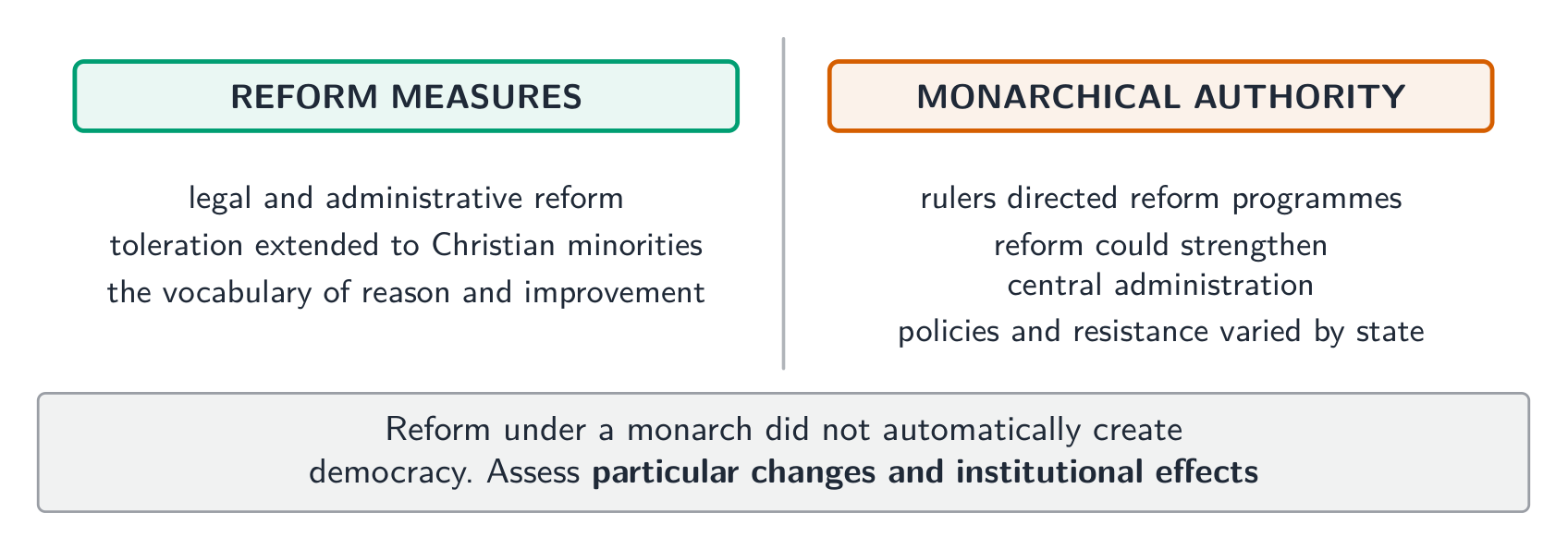
Enlightened absolutism 开明专制 describes experiments in Enlightenment-inspired reform under rulers who retained monarchical authority. Frederick II of Prussia and Joseph II of Austria are illustrative cases. Legal, administrative, educational or toleration measures could serve improvement and strengthen the state. Policies varied and met resistance; reform should not automatically be called democratisation, nor assumed to have no effects on existing institutions.
By 1800 most governments in western and central Europe had extended toleration to Christian minorities; some states extended civil equality to Jews. Toleration and civil equality are different, and neither means that all groups immediately received equal rights everywhere.
After Westphalia, limits on imperial authority formed part of the context in which Prussia rose to power 普鲁士崛起 and the Habsburgs shifted their focus eastward. This was a longer political development, not a direct consequence of Enlightenment philosophy alone.
Explain why reform under a monarch does not automatically establish representative government.
| English |
|---|
| enlightened absolutism/enˈlaɪtnd ˈæbsəluːtɪzəm/ |
| Prussia rose to power/ˈprʌʃə rəʊz tə ˈpaʊə/ |
| Learning Objective | Review: Unit 4 Key Concepts |
|---|---|
Unit 4.I |
|
Source: College Board AP Course and Exam Description
Original practice, not an authentic past-paper item: explain how Locke's account of consent and rights could challenge a claim that royal authority rests on divine right. Model reasoning: if government is justified by consent and its protection of rights, a ruler's divine claim alone cannot establish legitimacy. The challenge concerns the basis of authority. It does not show that all people immediately gained a vote or that the idea automatically caused a revolution.
For causal explanation, identify the idea or process, explain a link to the outcome, and use specific evidence. Distinguish intellectual challenge from immediate institutional change. Multiple causes can interact; a population total alone does not prove a medical intervention caused the change.
Answer the actual command with relevant evidence. Distinguish claim, observation and inference. Explain connections instead of listing names. Discuss continuity, disagreements or limits when they answer the prompt, rather than treating them as automatic scoring additions. Analyse a source's purpose and audience before assuming that its claim describes everyone's experience.
Scope: local College Board AP European History Course and Exam Description, topics 4.1–4.7, PDF pages 103–113 and the topic continuation. Practice examples and models are original teaching material. Classroom reasoning examples and town figures are fictional.
Historical checks: Royal College of Physicians: Harvey's experiments in circulation; National Library of Medicine: variolation; Jenner Institute: Edward Jenner; Wollstonecraft's 1792 text, public-domain transcription. Teaching paraphrases are labelled and are not quotations from these works.
Work through it step by step, with instant-check exercises.
Loading subjects…