7.1 Contextualizing 19th-Century Perspectives and Political Developments
| Learning Objective | Preview: Unit 7 Key Concepts |
|---|---|
Unit 7.A |
|
AP European History · Topic 7
 8:32
8:32
Unit 7: 19th-Century Perspectives and Political Developments
Contextualizing nineteenth-century perspectives covers about eighteen hundred and fifteen to nineteen hundred and fourteen. If you learn one thing from this…
English narration · English + 中文 subtitles burned in
| Learning Objective | Preview: Unit 7 Key Concepts |
|---|---|
Unit 7.A |
|
Source: College Board AP Course and Exam Description
Unit 7 runs over the same years as Unit 6 - c. 1815 to c. 1914 - but follows politics, empire, and ideas rather than industry. Three key concepts frame it:
That third tension is the unit's cultural thread, and it explains why Romanticism, realism, positivism, and modern art all belong in the same unit rather than in a separate art history.
| English |
|---|
| subjectivity and individual expression/ˌsʌbdʒɪkˈtɪvɪti ænd ˌɪndɪˈvɪdʒuːəl ekˈspreʃn/ |
| Thematic Focus | Learning Objective | Historical Developments |
|---|---|---|
NEI | Unit 7.B |
|
Illustrative examples:
Source: College Board AP Course and Exam Description
Nationalists encouraged loyalty to the nation in a variety of ways, including romantic idealism 浪漫主义理想, liberal reform, political unification, and racialism - so nationalism has no single political colour and can be attached to very different programmes.
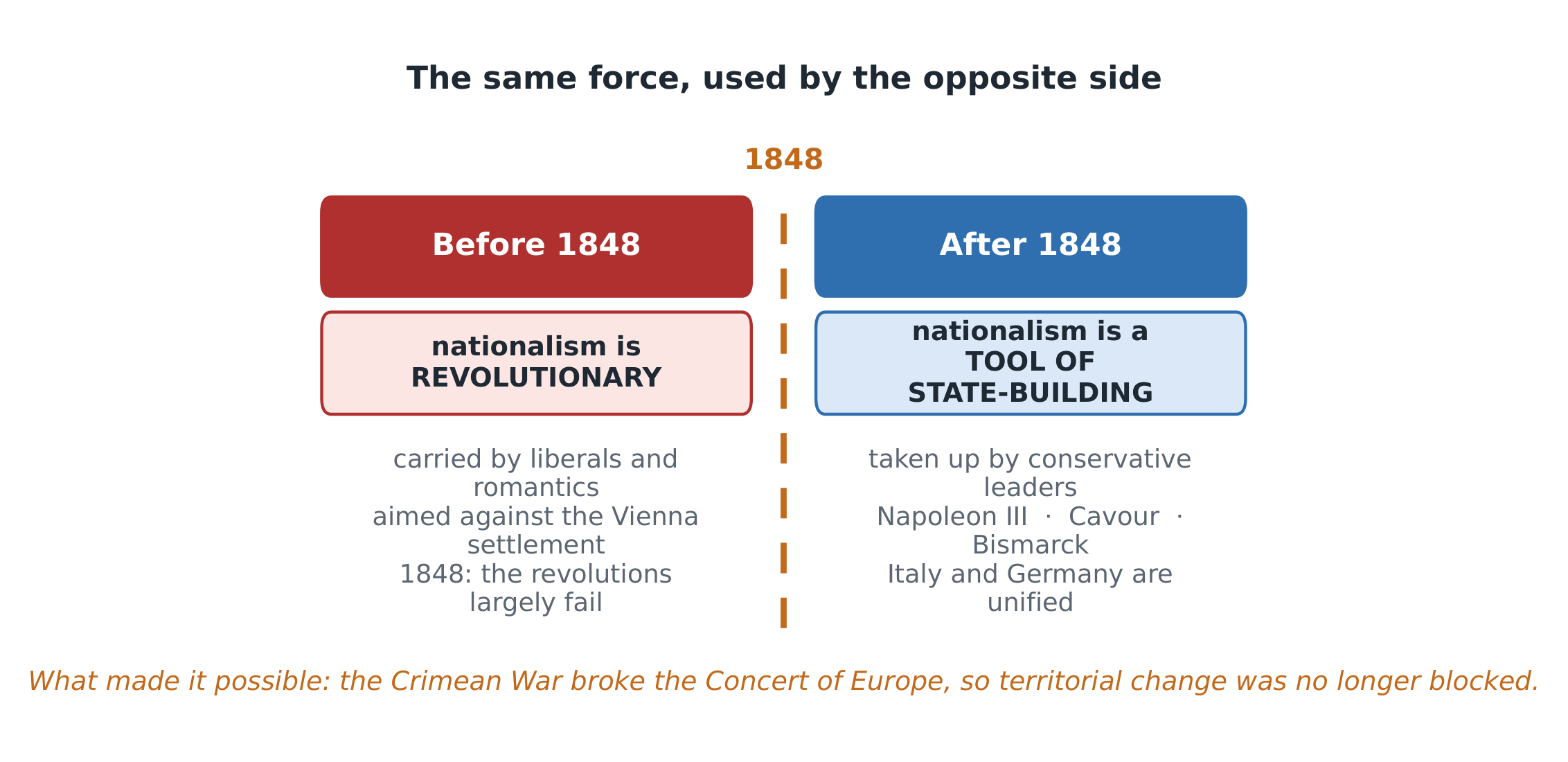
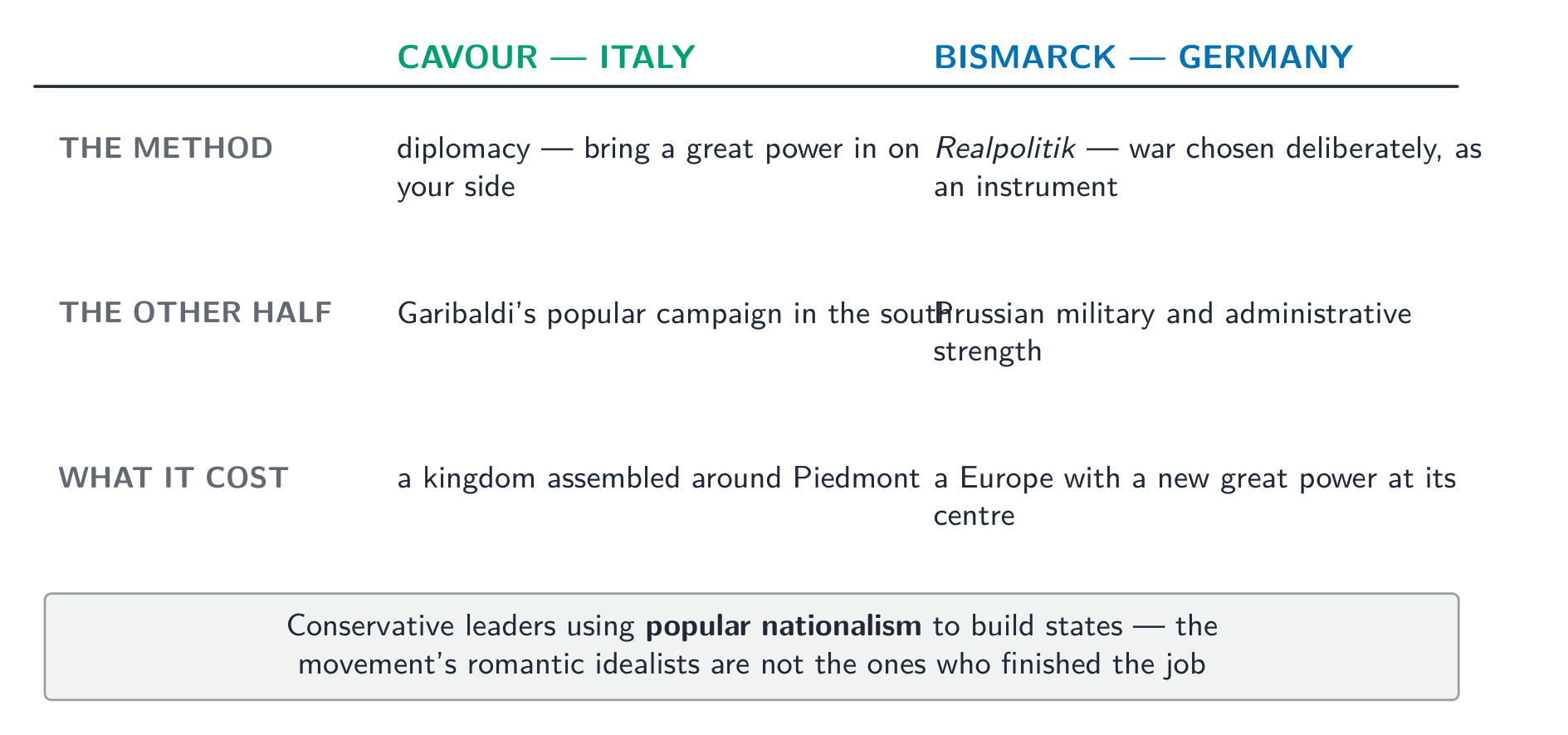
The turn that matters most: a new generation of conservative leaders, including Napoleon III 拿破仑三世, Cavour 加富尔, and Bismarck 俾斯麦, used popular nationalism to create or strengthen states. Before 1848 nationalism was mainly a revolutionary threat to the settlement of Vienna; after 1848 it became a tool of state-building in conservative hands. If you learn one thing from this unit, learn that reversal.
Two further points are examinable:
| English |
|---|
| romantic idealism/rəʊˈmæntɪk aɪˈdɪəlɪzəm/ |
| Napoleon III/nəˈpəʊliən ðə θɜːd/ |
| Cavour/kəˈvɜː/ |
| Bismarck/ˈbɪsmɑːk/ |
| Zionism/ˈzaɪənɪzəm/ |
| dual monarchy of Austria-Hungary/ˈdjuːəl ˈmɒnəki ɒv ˈɒstrɪə ˈhʌŋɡəri/ |
| Thematic Focus | Learning Objective | Historical Developments |
|---|---|---|
SOP | Unit 7.C |
|
Unit 7.D |
|
Illustrative examples:
Source: College Board AP Course and Exam Description
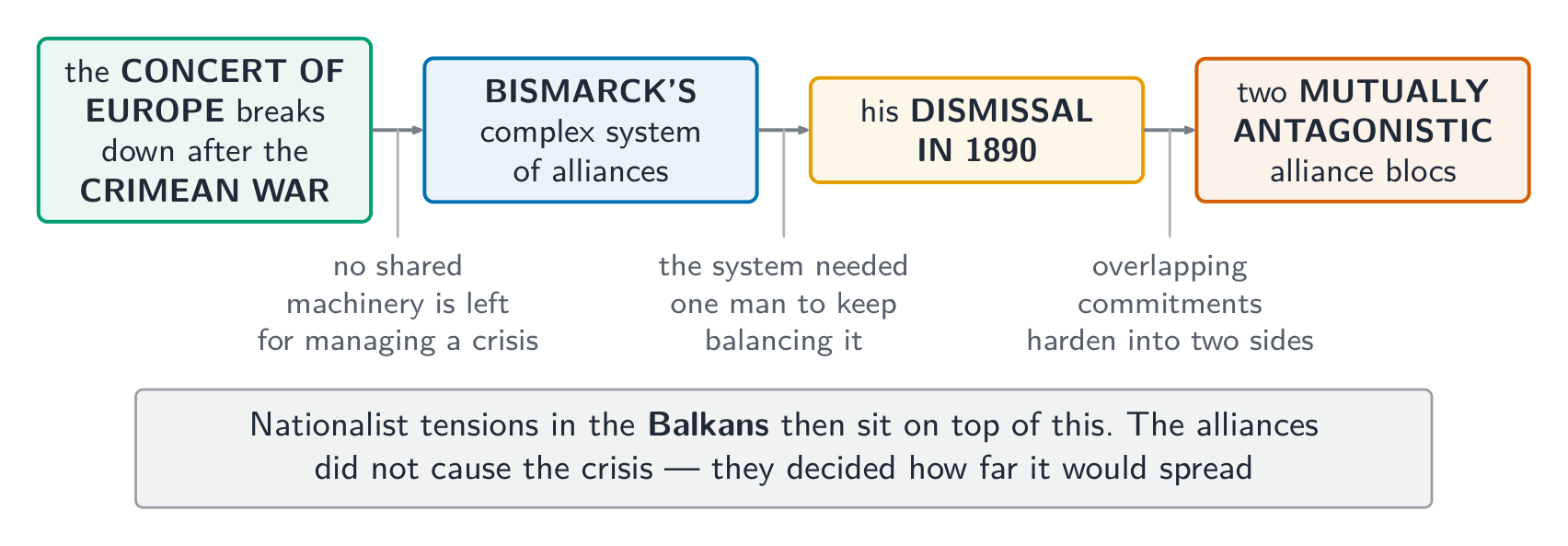
The Crimean War 克里米亚战争 demonstrated the weakness of the Ottoman Empire and contributed to the breakdown of the Concert of Europe - which is what made unification possible, because the system designed to prevent territorial change no longer functioned.
Then the diplomatic consequences, which run directly into Unit 8:
Bismarck's alliances were built to prevent a general war. The turning point is a dismissal, not a treaty.
| English |
|---|
| Crimean War/kraɪˈmɪən wɔː/ |
| Garibaldi's/ˌɡɑːrɪˈbɔːldiz/ |
| Bismarck used Realpolitik/ˈbɪsmɑːk juːzd ˈrɪəlpəlɪtɪk/ |
| complex system of alliances/ˈkɒmpleks ˈsɪstəm ɒv əˈlaɪənsɪz/ |
| mutually antagonistic alliances/ˈmjuːtʃuːəli ænˈtæɡənɪstɪk əˈlaɪənsɪz/ |
| Thematic Focus | Learning Objective | Historical Developments |
|---|---|---|
TSI | Unit 7.E |
|
Source: College Board AP Course and Exam Description
Charles Darwin 达尔文 provided a scientific and material account of biological change and of the development of human beings as a species.
His theory was then applied well beyond biology. Social Darwinism 社会达尔文主义 took the language of competition and selection and used it to justify racial, national, and class hierarchies - and, in the next topic, imperial expansion. Keep the distinction sharp in an essay: Darwin's biology and Social Darwinism are not the same claim, and the second does not follow from the first.
| English |
|---|
| Charles Darwin/tʃɑːlz ˈdɑːwɪn/ |
| Social Darwinism/ˈsəʊʃl ˈdɑːwɪnɪzəm/ |
| Thematic Focus | Learning Objective | Historical Developments |
|---|---|---|
TSI | Unit 7.F |
|
Illustrative examples:
Source: College Board AP Course and Exam Description
Positivism 实证主义 - the philosophy that science alone provides knowledge - emphasised the rational and scientific analysis of nature and human affairs, and represents the confident pole of the century's thinking.
Then, in the later nineteenth century, a new relativism in values 价值相对主义 and a loss of confidence in the objectivity of knowledge led to modernism 现代主义. The two together are the tension named in 7.1: the same culture produced both the belief that science would explain everything and the suspicion that objectivity itself was an illusion.
| English |
|---|
| Positivism/ˈpɒzɪtɪvɪzəm/ |
| new relativism in values/njuː ˈrelətɪvɪzəm ɪn ˈvæljuːz/ |
| modernism/ˈmɒdənɪzəm/ |
| Thematic Focus | Learning Objective | Historical Developments |
|---|---|---|
TSI | Unit 7.G |
|
Unit 7.H |
|
Illustrative examples:
Source: College Board AP Course and Exam Description
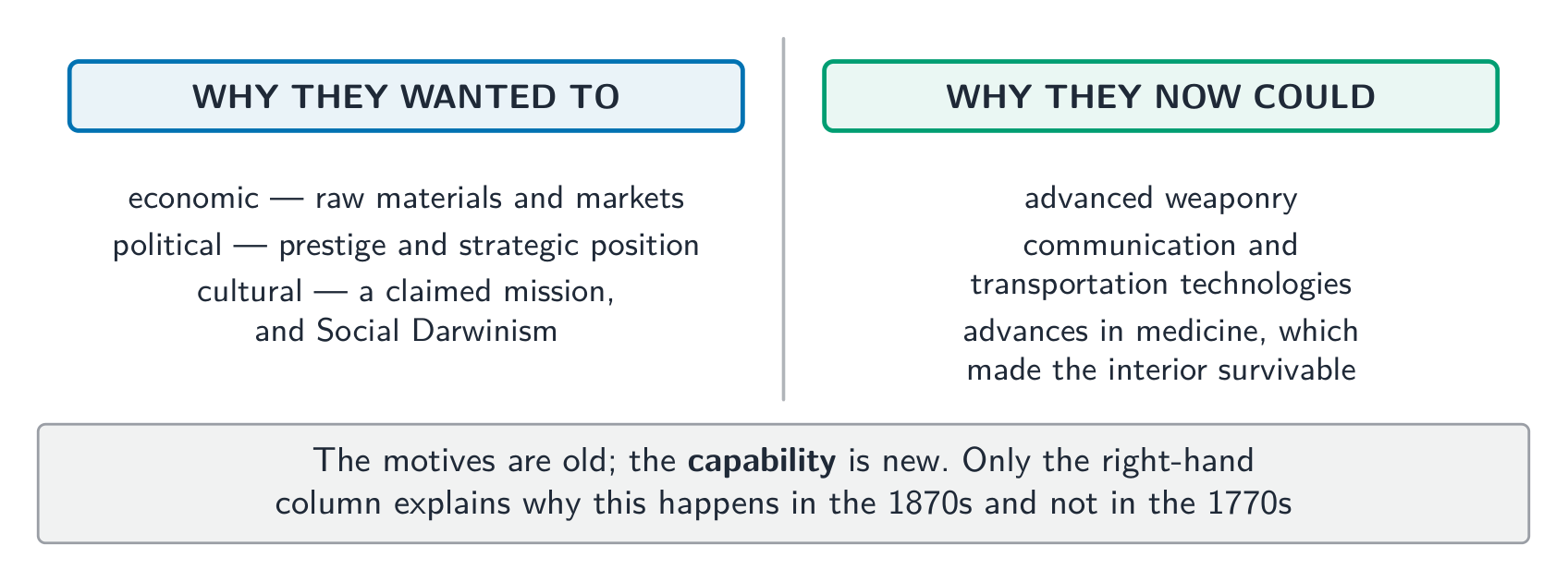
European nations were driven by economic, political, and cultural motivations in their new imperial ventures in Asia and Africa.
The CED then gives the enabling technologies separately, and there are exactly three:
Motives for empire are old; capability is new. Only the second column explains why this happens in the 1870s.
| English |
|---|
| Communication and transportation technologies/kəˌmjuːnɪˈkeɪʃn ænd trænspɔːˈteɪʃn tekˈnɒlədʒiz/ |
| Advances in medicine/ədˈvænsɪz ɪn ˈmedsn/ |
| Thematic Focus | Learning Objective | Historical Developments |
|---|---|---|
INT | Unit 7.I |
|
Illustrative examples:
Source: College Board AP Course and Exam Description
Imperial endeavours significantly affected society, diplomacy, and culture in Europe, and created resistance to foreign control abroad.
Both directions matter. In Europe, empire fed nationalism, shaped popular culture, and turned colonial disputes into Great Power crises. Abroad, it produced organised resistance. An answer that treats imperialism as something Europe did to other places, with no return effect and no response, is incomplete on both counts.
| Thematic Focus | Learning Objective | Historical Developments |
|---|---|---|
CID | Unit 7.J |
|
Illustrative examples:
Source: College Board AP Course and Exam Description
The century's art tracks its intellectual tension exactly:
| English |
|---|
| Realist and materialist/ˈrɪəlɪst ænd məˈtɪərɪəlɪst/ |
| Impressionism, Post-Impressionism, and Cubism/ɪmˈpreʃənɪzəm pəʊst ɪmˈpreʃənɪzəm ænd ˈkjuːbɪzəm/ |
| Learning Objective | Review: Unit 7 Key Concepts |
|---|---|
Unit 7.K |
|
Source: College Board AP Course and Exam Description
The unit's reasoning skill is causation.
Worked example (a real AP exam question). AP European History short-answer questions here ask, for example, to "Explain one way in which nationalism contributed to the unification of Germany or Italy in the nineteenth century." A full-mark answer names the mechanism rather than the sentiment: "Bismarck used popular nationalist feeling as an instrument of Prussian state-building: by presenting wars against Denmark, Austria, and France as national causes, he made the smaller German states' rulers politically unable to resist unification under Prussia, and turned a dynastic expansion into a national one." Notice the shape: nationalism is shown doing something, not merely existing.
Work through it step by step, with instant-check exercises.
Loading subjects…