2.1 Contextualizing 16th- and 17th-Century Challenges and Developments
| Learning Objective | Preview: Unit 2 Key Concepts |
|---|---|
Unit 2.A |
|
AP European History · Topic 2
 8:01
8:01
Unit 2: Age of Reformation
There is one way students reliably lose marks in this unit, and it is a study habit rather than a gap in knowledge. They keep religion and politics in separate…
English narration · English + 中文 subtitles burned in
| Learning Objective | Preview: Unit 2 Key Concepts |
|---|---|
Unit 2.A |
|
Source: College Board AP Course and Exam Description
Unit 2 covers the Reformation and the wars of religion, and the CED frames the whole period around one claim: religious pluralism challenged the concept of a unified Europe.
Two other threads run alongside it and are examined together with religion - the reshaping of daily life by commercial and agricultural capitalism, and the struggle for sovereignty producing varying degrees of political centralisation. The unit's characteristic question asks how religious change and political change acted on each other, so keeping them in separate mental boxes is the main way students lose marks here.
| Thematic Focus | Learning Objective | Historical Developments |
|---|---|---|
CID | Unit 2.B |
|
Illustrative examples:
Source: College Board AP Course and Exam Description
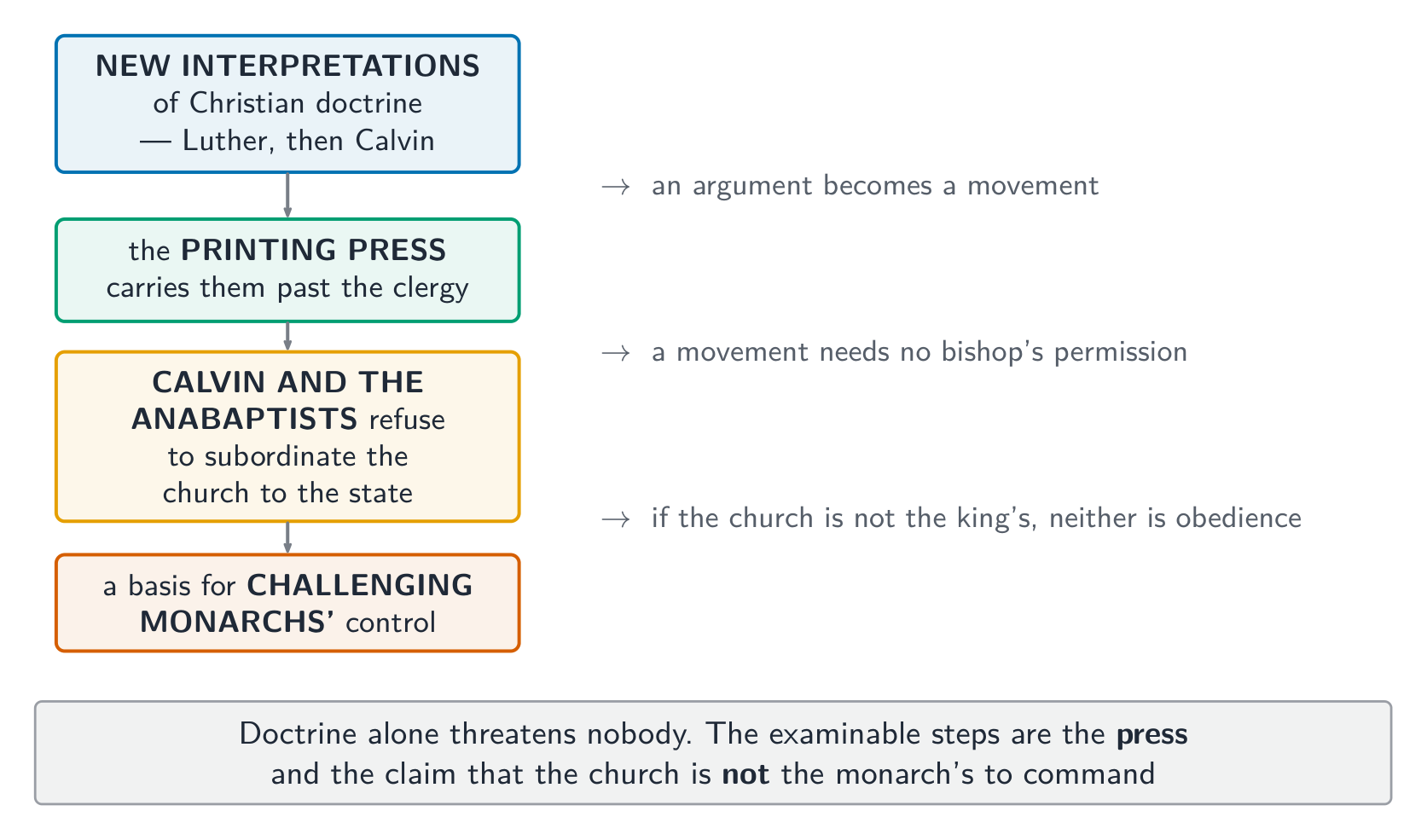
Reformers Martin Luther 马丁·路德 and John Calvin 加尔文 criticised Catholic abuses and established new interpretations of Christian doctrine and practice. The CED's emphasis is on interpretation: what changed was not only conduct but the account of how salvation works and where religious authority lies.
A second, more social claim is examinable and often forgotten: some Protestant groups sanctioned the notion that the accumulation of wealth was a sign of God's favour and a reward for hard work. That is the link between the Reformation and the commercial developments of Unit 1, and it is worth having ready for economic questions.
| English |
|---|
| Martin Luther/ˈmɑːtɪn ˈluːðə/ |
| John Calvin/dʒɒn ˈkælvɪn/ |
| Thematic Focus | Learning Objective | Historical Developments |
|---|---|---|
CID | Unit 2.B |
|
Illustrative examples:
Source: College Board AP Course and Exam Description
Three developments carry the Reformation past its first generation:
The last two are political claims dressed in religious language, and the CED treats them that way. Once religious authority is contestable, so is the authority of whoever claims to control it.
Doctrine alone threatens nobody. The press and the claim that the church is not the monarch's are the examinable steps.
| English |
|---|
| used the printing press/juːzd ðə ˈprɪntɪŋ pres/ |
| Calvin and the Anabaptists/ˈkælvɪn ænd ðɪ ˈænəbæptɪsts/ |
| Thematic Focus | Learning Objective | Historical Developments |
|---|---|---|
SOP | Unit 2.C |
|
Illustrative examples:
Source: College Board AP Course and Exam Description
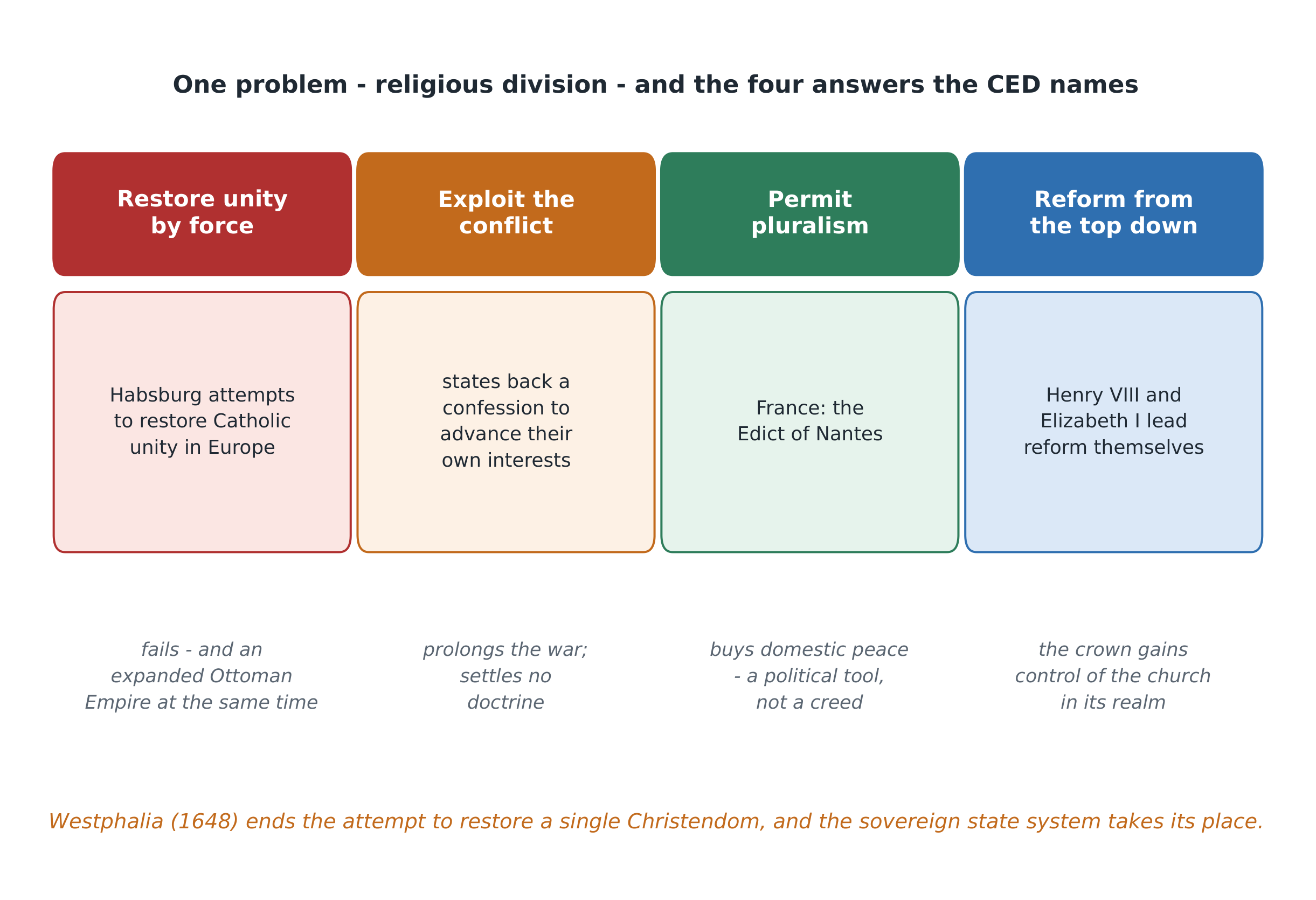
The CED gives four state responses to religious division, and a strong answer treats them as a set:
Religious reform also exacerbated conflicts between monarchy and nobility, as in the French wars of religion - religion supplied the language, and existing political rivalry supplied the force.
The settlement matters as much as the wars: the Peace of Westphalia (1648) 威斯特伐利亚和约 marked the effective end of the medieval ideal of universal Christendom 普世基督教世界 and accelerated the decline of the Holy Roman Empire. That is the hinge on which Unit 3 opens.
Four answers, and they are strategies rather than degrees of tolerance.
| English |
|---|
| expanded Ottoman Empire/ekˈspændɪd ˈɒtəmən ˈempaɪə/ |
| Edict of Nantes/ˈiːdɪkt ɒv nænts/ |
| Peace of Westphalia (1648)/piːs ɒv westˈfeɪlɪə/ |
| universal Christendom/ˌjuːnɪˈvɜːsl ˈkrɪsəndəm/ |
| Thematic Focus | Learning Objective | Historical Developments |
|---|---|---|
CID | Unit 2.D |
|
Illustrative examples:
Source: College Board AP Course and Exam Description
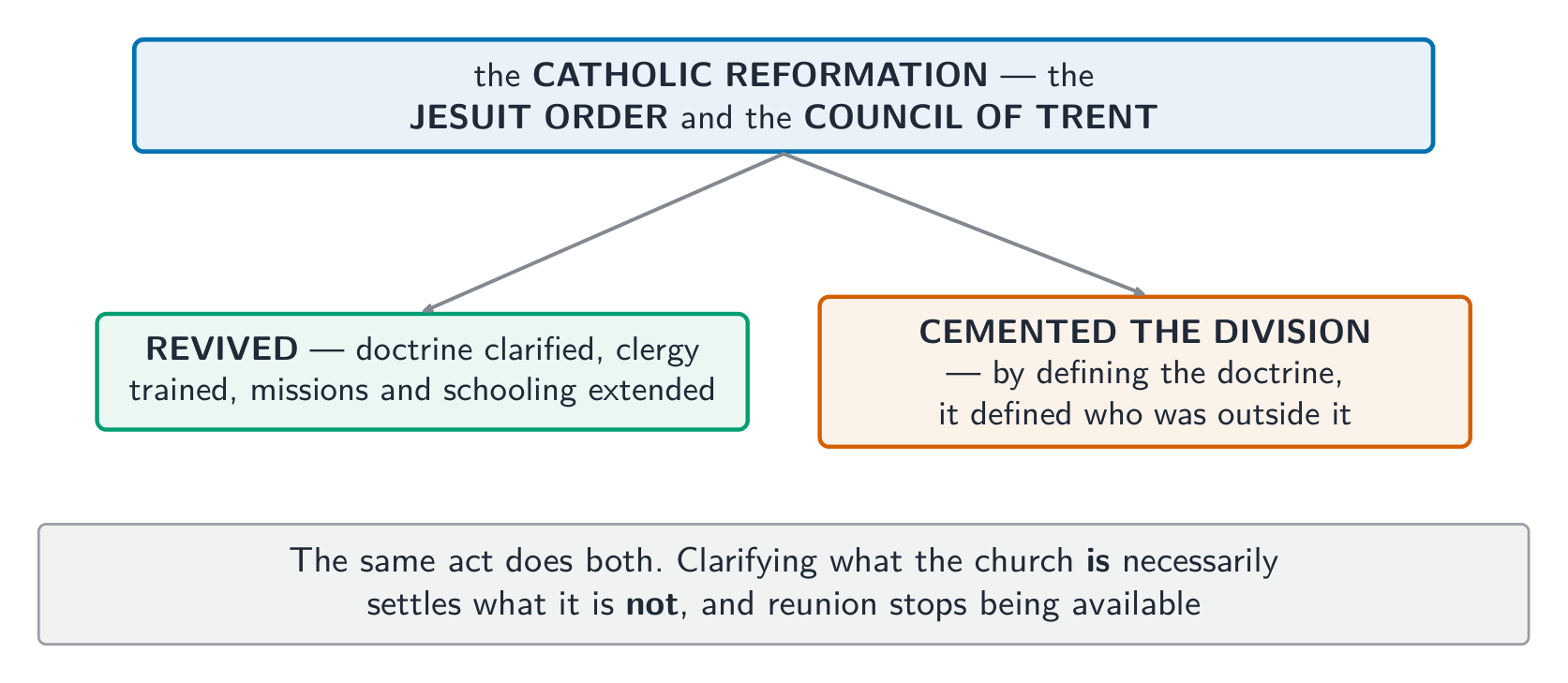
The Catholic Reformation 天主教改革, exemplified by the Jesuit Order 耶稣会 and the Council of Trent 特伦特会议, revived the church but cemented the division within Christianity.
Both halves of that sentence are the answer to a continuity-and-change question. The Church renewed its institutions, doctrine, education, and missionary reach - and in defining its doctrine precisely, it made reunion impossible. Revival and permanent division were the same act.
| English |
|---|
| Catholic Reformation/ˈkæθlɪk rɪfɔːˈmeɪʃn/ |
| Jesuit Order/ˈdʒezjuːɪt ˈɔːdə/ |
| Council of Trent/ˈkaʊnsl ɒv trent/ |
| Thematic Focus | Learning Objective | Historical Developments |
|---|---|---|
SCD | Unit 2.E |
|
Illustrative examples:
Source: College Board AP Course and Exam Description
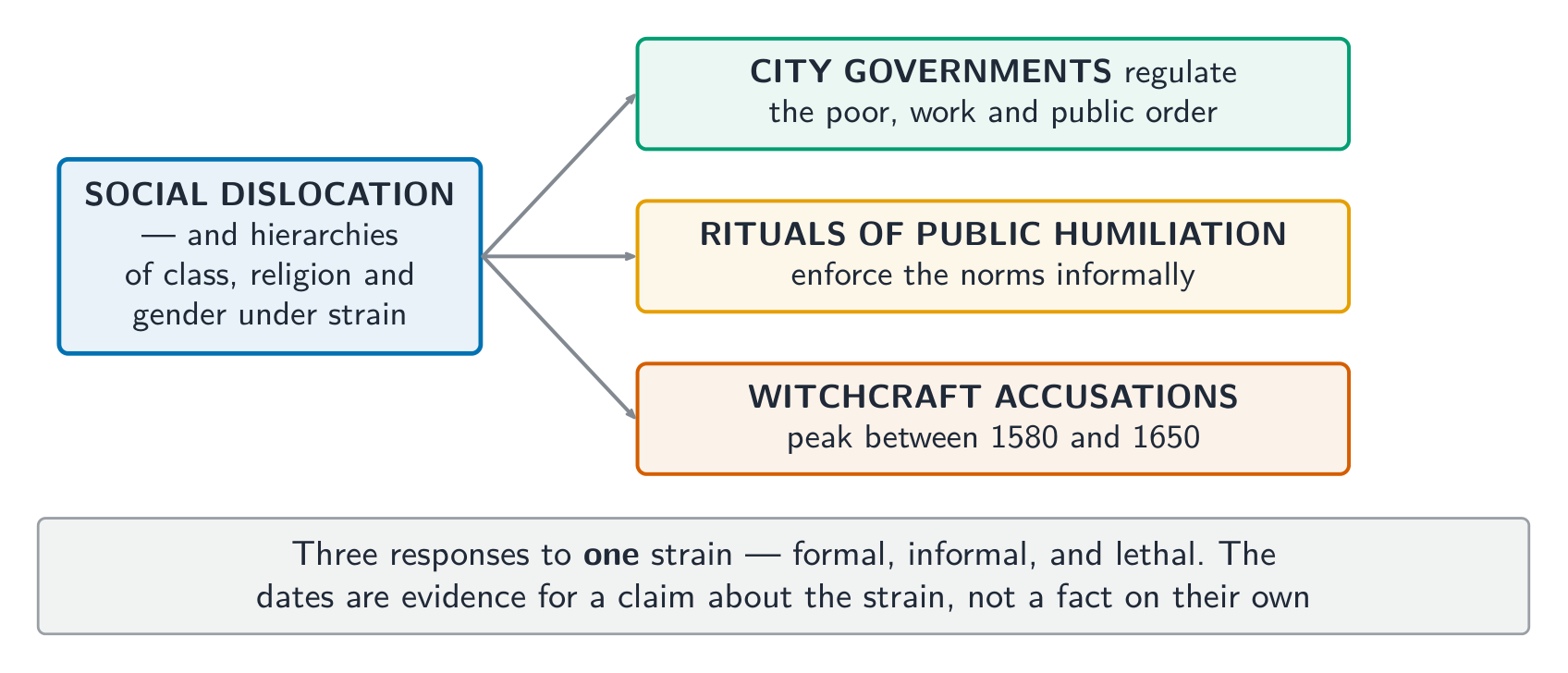
This is the unit's social-history topic, and it is dense with examinable content that essays rarely use:
The witchcraft peak is worth holding precisely because of its dates: it coincides with the period of maximum religious conflict and economic strain, which is what makes it usable as evidence rather than as an anecdote.
| English |
|---|
| separate but complementary tasks/ˈseprət bʌt ˌkɒmplɪˈmentəri tæsks/ |
| Social dislocation/ˈsəʊʃl dɪsləʊˈkeɪʃn/ |
| rituals of public humiliation/ˈrɪtʃuːəlz ɒv ˈpʌblɪk ˌhjuːmɪlɪˈeɪʃn/ |
| Thematic Focus | Learning Objective | Historical Developments |
|---|---|---|
CID | Unit 2.F |
|
Illustrative examples:
Source: College Board AP Course and Exam Description
Mannerist and Baroque 手法主义与巴洛克 artists employed distortion, drama, and illusion 变形、戏剧性与幻觉. Monarchies, city-states, and the church commissioned these works.
The examinable point is the same as in Unit 1, one step further: art was commissioned to persuade. Baroque drama in a Catholic church and Baroque grandeur at a royal court are doing the same work in different directions - asserting the authority of the patron in an age when authority was contested.
| English |
|---|
| Mannerist and Baroque/ˈmænərɪst ænd bəˈrəʊk/ |
| distortion, drama, and illusion/dɪˈstɔːʃn ˈdrɑːmə ænd ɪˈluːʒn/ |
| Learning Objective | Review: Unit 2 Key Concepts |
|---|---|
Unit 2.G |
|
Source: College Board AP Course and Exam Description
The unit's reasoning skill is causation.
Worked example (a real AP exam question). AP European History short-answer questions here ask, for example, to "Explain one way in which political developments in the sixteenth century were influenced by religious change." A full-mark answer names both sides of the influence: "Religious reform gave the nobility a language and a justification for resisting royal authority, as in the French wars of religion, where noble families used confessional allegiance to organise opposition to the crown. The monarchy's response - eventually the Edict of Nantes - was therefore a political settlement of a religious dispute, granting toleration in order to restore royal control." Notice that the answer moves in both directions, because the CED's own framing does.
Work through it step by step, with instant-check exercises.
Loading subjects…