Contextualizing state building starts with one phrase: the struggle for sovereignty kept producing varying degrees of political centralisation. Everything in…
English narration · English + 中文 subtitles burned in
3.1
Contextualizing State Building
Syllabus
3.1 Contextualizing State Building
Learning Objective
Preview: Unit 3 Key Concepts
Unit 3.A
Explain the context in which different forms of political power developed from 1648 to 1815.
KC-1.5 The struggle for sovereignty within and among states resulted in varying degrees of political centralization.
KC-1.5.I The new concept of the sovereign state and secular systems of law played a central role in the creation of new political institutions.
KC-1.5.III The competition for power between monarchs and corporate and minority language groups produced different distributions of governmental authority in European states.
KC-1.5.III.B Monarchies seeking enhanced power faced challenges from nobles who wished to retain traditional forms of shared governance and regional autonomy.
KC-1.5.III.C Within states, minority local and regional identities based on language and culture led to resistance against the dominant national group.
KC-2.1 Different models of political sovereignty affected the relationship among states and between states and individuals.
KC-2.1.I In much of Europe, absolute monarchy was established over the course of the 17th and 18th centuries.
KC-2.1.II Challenges to absolutism resulted in alternative political systems.
Illustrative examples:
Competition between monarchs and nobles:
Louis XIII and Cardinal Richelieu §Bullet
The Fronde in France
The Catalan Revolts in Spain
Competition between minority and dominant national groups:
Celtic regions of Scotland, Ireland, and France
Dutch resistance in the Spanish Netherlands
Czech identity in the Holy Roman Empire/ Jan Hus/Defenestration
Source: College Board AP Course and Exam Description
Unit 3 covers 1648 to 1815. Different models of political sovereignty 政治主权 changed relations among states and between rulers and their subjects. Earlier conflicts, including the English Civil War, provide necessary background.
Rulers sought revenue, armies and greater control. Nobles, regional groups and representative bodies defended their own powers. The Peace of Westphalia is an important context, but it did not instantly produce a uniform system of modern nation-states. Centralisation remained uneven. Religion remained politically important even as dynastic, state and colonial interests became more prominent in diplomacy.
3.2 The English Civil War and the Glorious Revolution
Thematic Focus
Learning Objective
Historical Developments
SOP States and Other Institutions of Power — European states and nations developed governmental and civil institutions from 1450 to the present to organize society and consolidate political power, with a variety of social, cultural, and economic effects.
Unit 3.B
Explain the causes and consequences of the English Civil War.
KC-1.5.III.A The English Civil War—a conflict among the monarchy, Parliament, and other elites over their respective roles in the political structure— exemplified the competition for power among monarchs and competing groups.
KC-2.1.II.A The outcome of the English Civil War and the Glorious Revolution protected the rights of gentry and aristocracy from absolutism through assertions of the rights of Parliament.
Illustrative examples:
Competitors for power in the English Civil War:
James I
Charles I
Oliver Cromwell
Outcomes of the English Civil War and the Glorious Revolution:
English Bill of Rights
Parliamentary sovereignty
Source: College Board AP Course and Exam Description
The English Civil War 英国内战 involved struggles among the monarchy, Parliament 议会 and other elites over taxation, religion and political authority. Charles I's efforts to govern and raise revenue without Parliament increased conflict. The wars also involved soldiers, local communities and religious groups. The CED's focus on elite institutions does not mean ordinary people played no part: the Putney Debates of 1647 included soldiers and Levellers arguing about wider voting rights.
The civil-war period did not lead directly to a stable constitutional monarchy: the monarchy was abolished, later restored, and challenged again. The Glorious Revolution 光荣革命 of 1688 and the Bill of Rights of 1689 strengthened Parliament's position. The crown could not levy taxation without parliamentary grant. This limited royal authority and protected the gentry and aristocracy against absolutism. It did not establish universal voting rights or equal political participation.
Worked comparison: Charles I's conflicts with Parliament concerned whether the crown could act without parliamentary consent. The 1689 settlement strengthened parliamentary control, including over taxation. This changed the institutional limits on royal action; it did not give every adult a vote.
3.3 Continuities and Changes to Economic Practice and Development
Thematic Focus
Learning Objective
Historical Developments
ECD Economic and Commercial Developments — Economic development, especially the development of capitalism, played an important role in Europe’s history, often having significant social, political, and cultural effects.
Unit 3.C
Explain the continuities and changes in commercial and economic developments from 1648 to 1815.
KC-2.2.I.B The Agricultural Revolution raised productivity and increased the supply of food and other agricultural products.
KC-2.2.II.D The importation and transplantation of agricultural products from the Americas contributed to an increase in the food supply in Europe.
KC-2.2.I.A Labor and trade in commodities were increasingly freed from traditional restrictions imposed by governments and corporate entities.
KC-2.2.I.C The putting-out system, or cottage industry, expanded as increasing numbers of laborers in homes or workshops produced for markets through merchant intermediaries or workshop owners.
KC-2.2.I.D The development of the market economy led to new financial practices and institutions.
KC-2.2.I Early modern Europe developed a market economy that provided the foundation for its global role.
Illustrative examples:
New financial practices and institutions: § Insurance § Banking institutions for turning private savings into venture capital § New definitions of property rights and protections against confiscation § Bank of England
Source: College Board AP Course and Exam Description
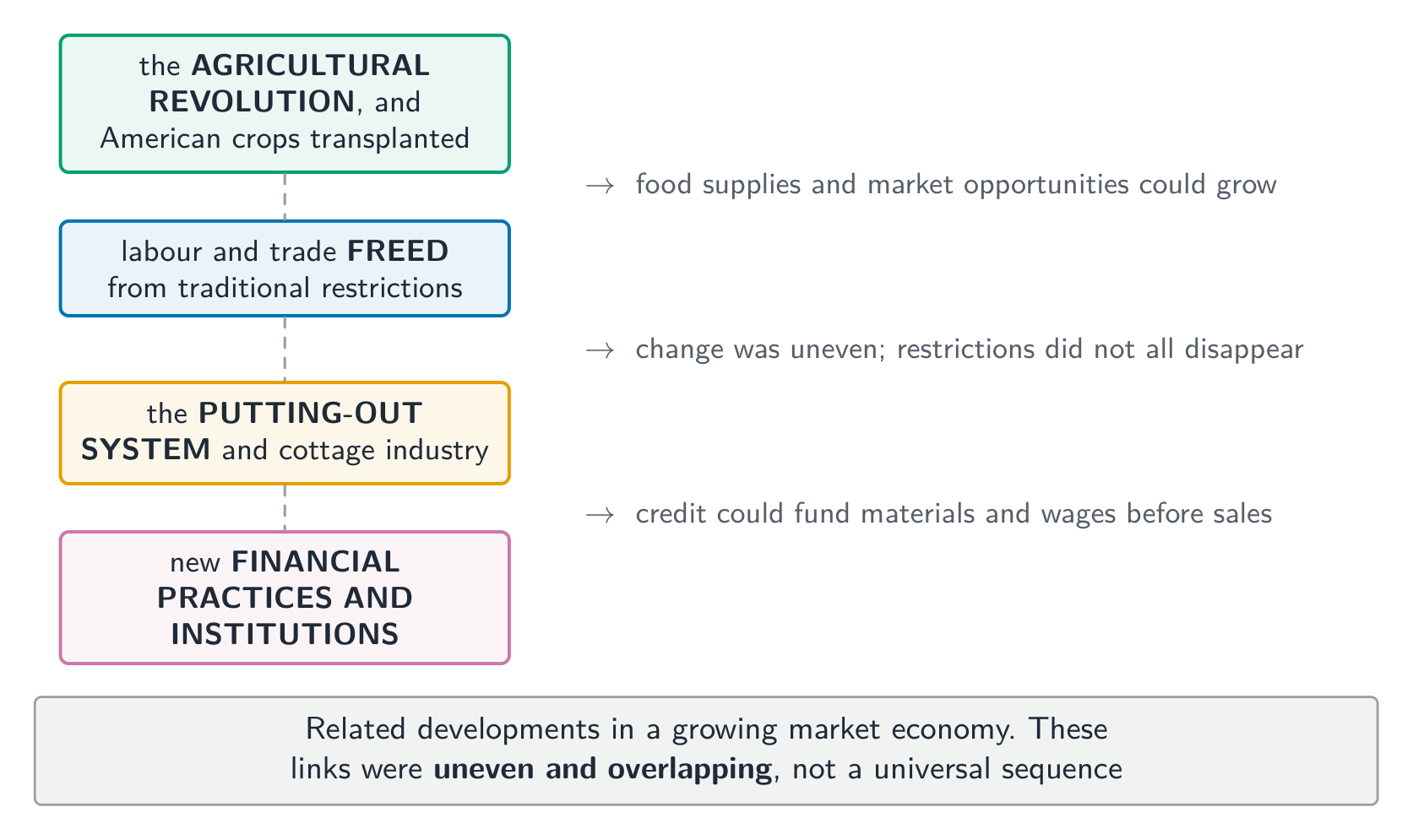
A market economy 市场经济 expanded as more goods and labour were exchanged through markets. Important developments included the Agricultural Revolution 农业革命, American crops, changes to traditional restrictions, cottage production and new finance. These developments overlapped and varied by region; they were not an inevitable four-stage sequence.
Agricultural improvements raised productivity and food supply. Crops brought from the Americas added to European food supplies. Labour and trade were increasingly freed from traditional restrictions 摆脱传统限制 in some settings, but guild rules, legal privileges and dependent labour did not disappear everywhere.
In the putting-out system 外包生产制, also called cottage industry 家庭手工业, a merchant supplied materials to workers in homes or workshops, collected their output and sold it. This expanded production for markets outside the factory system. Banking, credit and insurance helped merchants fund production and manage risk. Rural work and older social hierarchies continued alongside these changes.
Worked mechanism: a cloth merchant supplies wool to households, pays for spinning and weaving, and sells the cloth. Credit helps pay workers before sales income arrives. This connects cottage production and finance without claiming that every household became a factory worker.
Explore
Connect changes in market production
Explain a possible connection while recognising uneven regional change.
freed from traditional restrictions/friːd frɒm trəˈdɪʃənl rɪˈstrɪkʃnz/
cottage industry/ˈkɒtɪdʒ ˈɪndʌstri/
market economy/ˈmɑːkɪt ɪˈkɒnəmi/
putting-out system/ˈpʊtɪŋ aʊt ˈsɪstəm/
3.4
Economic Development and Mercantilism
Syllabus
3.4 Economic Development and Mercantilism
Thematic Focus
Learning Objective
Historical Developments
ECD Economic and Commercial Developments — Economic development, especially the development of capitalism, played an important role in Europe’s history, often having significant social, political, and cultural effects.
Unit 3.C
Explain the continuities and changes in commercial and economic developments from 1648 to 1815.
KC-2.2.II The European-dominated worldwide economic network contributed to the agricultural, industrial, and consumer revolutions in Europe.
KC-2.2.II.A European states followed mercantilist policies by drawing resources from colonies in the New World and elsewhere.
KC-2.2.II.B The transatlantic slave-labor system expanded in the 17th and 18th centuries as demand for New World products increased.
KC-2.2.II.C Overseas products and influences contributed to the development of a consumer culture in Europe.
KC-2.2.II.D The importation and transplantation of agricultural products from the Americas contributed to an increase in the food supply in Europe.
KC-2.2.II.E Foreign lands provided raw materials, finished goods, laborers, and markets for the commercial and industrial enterprises in Europe.
Illustrative examples:
Transatlantic slave-labor systems:
Middle Passage
Triangle trade
Overseas products:
Sugar
Tea
Silks and other fabrics
Tobacco
Rum
Coffee
Source: College Board AP Course and Exam Description
Mercantilism 重商主义 describes policies through which states sought wealth and power by regulating trade, encouraging exports and drawing resources from colonies. Tariffs, navigation laws and chartered companies were possible tools. Policies varied; the label does not mean every government used every tool.
Overseas networks supplied raw materials, finished goods, labour and markets. Sugar, tea, coffee and tobacco contributed to European consumer culture. The expansion of plantation products also depended on the growing transatlantic slave-labour system 奴隶劳动制度. Enslaved people were forcibly transported and made to produce goods for overseas markets. Consumer growth must be explained together with coercion and unequal benefits.
Original practice: explain how European demand for plantation sugar could affect both colonial production and European consumption. Check: rising demand encouraged plantation expansion and exploitation of enslaved labour; imported sugar entered European consumption. This is a causal connection, not a claim that every European benefited equally.
SOP States and Other Institutions of Power — European states and nations developed governmental and civil institutions from 1450 to the present to organize society and consolidate political power, with a variety of social, cultural, and economic effects.
Unit 3.D
Explain the factors that contributed to the development of the Dutch Republic.
KC-2.1.II.B The Dutch Republic, established by a Protestant revolt against the Habsburg monarchy, developed an oligarchy of urban gentry and rural landholders to promote trade and protect traditional rights.
Source: College Board AP Course and Exam Description
The Dutch Republic 荷兰共和国 emerged from revolt against Habsburg rule. Its political system was an oligarchy 寡头政治 dominated by urban gentry and rural landholders. It protected traditional rights and promoted trade. Commercial shipping, finance and merchant networks supported its economic role.
The republic is an alternative to royal absolutism, but a republic is not automatically a democracy. Power remained concentrated among elites. Religious toleration was comparatively broad in some settings, but it was not universal equality. Use this case to separate political form, social inclusion and commercial success.
SOP States and Other Institutions of Power — European states and nations developed governmental and civil institutions from 1450 to the present to organize society and consolidate political power, with a variety of social, cultural, and economic effects.
Unit 3.E
Explain how European states attempted to establish and maintain a balance of power on the continent throughout the period from 1648 to 1815.
KC-1.5.II The competitive state system led to new patterns of diplomacy and new forms of warfare.
KC-1.5.II.A Following the Peace of Westphalia, religion declined in importance as a cause for warfare among European states; the concept of the balance of power played an important role in structuring diplomatic and military objectives.
KC-2.1.I.D The inability of the Polish monarchy to consolidate its authority over the nobility led to Poland’s partition by Prussia, Russia, and Austria, and its disappearance from the map of Europe.
KC-2.1.III After 1648, dynastic and state interests, along with Europe’s expanding colonial empires, influenced the diplomacy of European states and frequently led to war.
KC-2.1.III.B After the Austrian defeat of the Turks in 1683 at the Battle of Vienna, the Ottomans ceased their westward expansion.
KC-2.1.III.C Louis XIV’s nearly continuous wars, pursuing both dynastic and state interests, provoked a coalition of European powers opposing him. HISTORICAL DEVELOPMENTS
Unit 3.F
Explain how advances in technology contributed to a developing balance of power on the continent throughout the period from 1648 to 1815.
KC-1.5.II.B Advances in military technology led to new forms of warfare, including greater reliance on infantry, firearms, mobile cannon, and more elaborate fortifications, all financed by heavier taxation and requiring a larger bureaucracy. New military techniques and institutions (i.e., the military revolution) tipped the balance of power toward states able to marshal sufficient resources for the new military environment.
Illustrative examples:
Louis XIV’s nearly continuous wars:
Dutch War
Nine Years’ War
War of the Spanish Succession
States that benefited from the military revolution:
Spain under the Habsburgs §Bullet Sweden under Gustavus Adolphus §Bullet France
Source: College Board AP Course and Exam Description
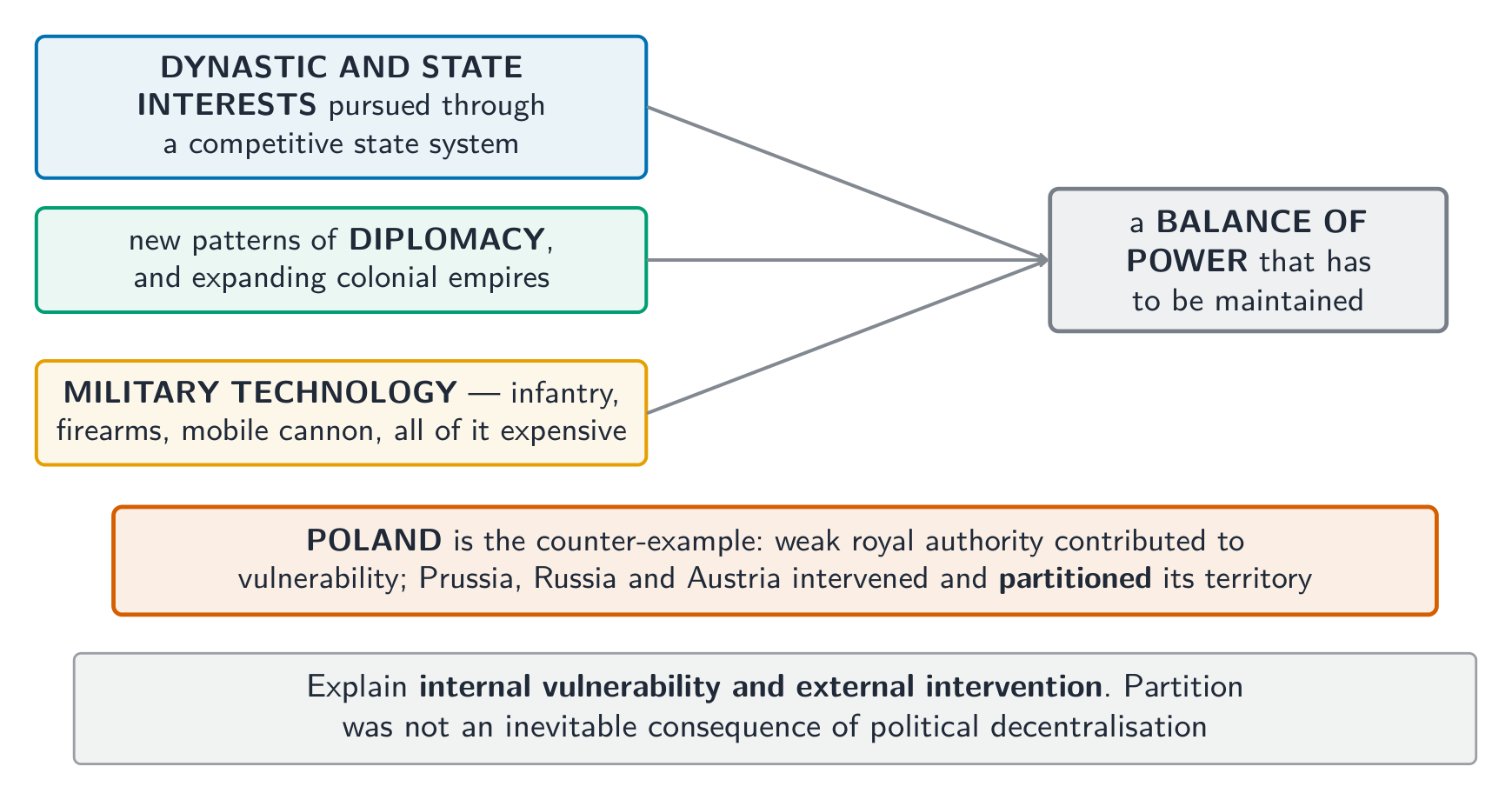
The competitive state system 竞争性国家体系 encouraged diplomacy, alliances and costly warfare. A balance of power 均势 means preventing one state from becoming dominant. Louis XIV's expansion and dynastic ambitions provoked opposing coalitions. After the Ottoman defeat at Vienna in 1683, Ottoman westward expansion ceased; this did not mean the Ottoman Empire disappeared.
Military changes included greater reliance on infantry, firearms, mobile cannon and elaborate fortifications. These required resources, heavier taxation and larger bureaucracies. States able to mobilise resources gained advantages; this was not a rule that only absolute monarchies could maintain armies.
Poland's monarchy struggled to consolidate authority over its nobility. This weakened its capacity to resist neighbouring powers. Poland's partition 波兰被瓜分 was carried out by Prussia, Russia and Austria. Explain both internal vulnerability and the intervention of those powers; partition was not an automatic punishment for failing to become absolutist.
competitive state system/kəmˈpetɪtɪv steɪt ˈsɪstəm/
Poland's partition/ˈpəʊləndz pɑːˈtɪʃn/
balance of power/ˈbæləns ɒv ˈpaʊə/
3.7
Absolutist Approaches to Power
Syllabus
3.7 Absolutist Approaches to Power
Thematic Focus
Learning Objective
Historical Developments
SOP States and Other Institutions of Power — European states and nations developed governmental and civil institutions from 1450 to the present to organize society and consolidate political power, with a variety of social, cultural, and economic effects.
Unit 3.G
Explain how absolutist forms of rule affected social and political development from 1648 to 1815.
KC-2.1.I.A Absolute monarchies limited the nobility’s participation in governance but preserved the aristocracy’s social position and legal privileges.
KC-2.1.I.B Louis XIV and his finance minister, Jean-Baptiste Colbert, extended the administrative, financial, military, and religious control of the central state over the French population.
KC-2.1.I.E Peter the Great “westernized” the Russian state and society, transforming political, religious, and cultural institutions; Catherine the Great continued this process.
Illustrative examples:
Absolute monarchs:
James I of England
Peter the Great of Russia
Philip II, III, and IV of Spain
Extended power of the state: §Bullet Intendants §Bullet Modernized, state-controlled military Russian westernization: §Bullet Russian Academy of Sciences §Bullet Education §Bullet Western fashion §Bullet Expanded military
Source: College Board AP Course and Exam Description
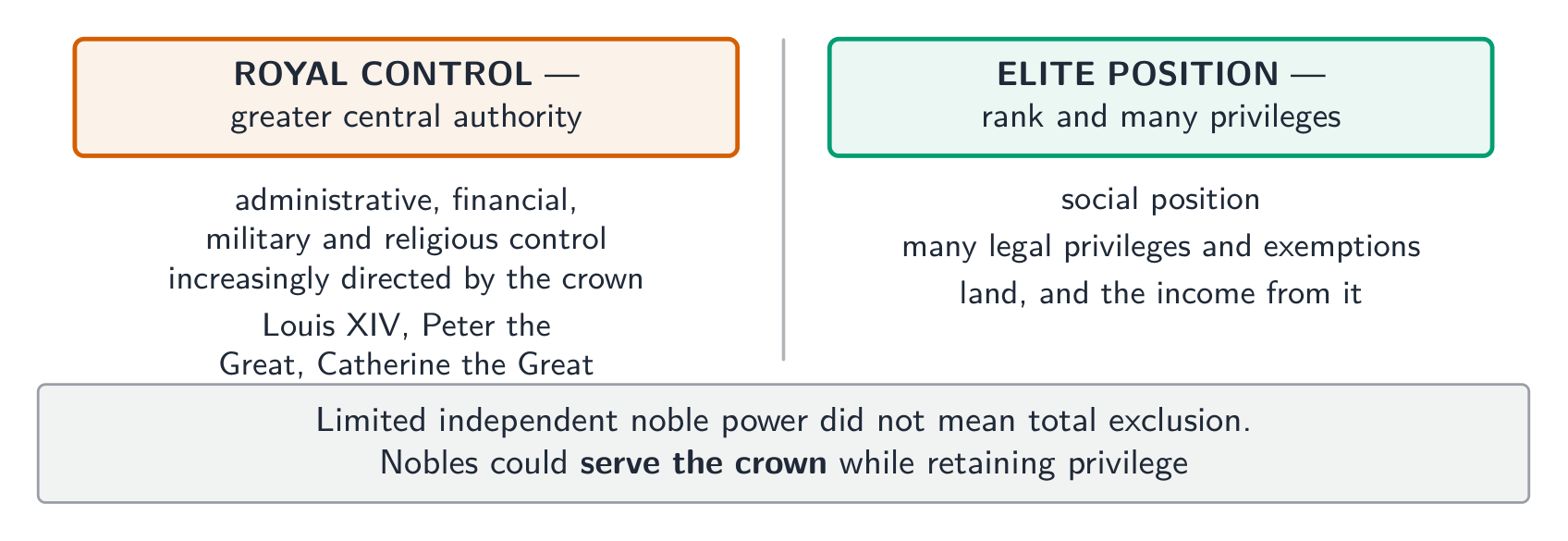
Absolutism 绝对主义 concentrated authority in the monarchy. Louis XIV 路易十四 and Jean-Baptiste Colbert 柯尔贝尔 extended the French state's administrative, financial, military and religious control. Royal agents, revenue policies, armed forces and court patronage helped make that authority effective.
Absolute monarchs limited independent noble participation in governance while preserving aristocratic social position and many legal privileges. Nobles could still hold offices and serve the monarchy. Absolutism therefore did not mean the complete removal of nobles from government or the elimination of every institutional limit.
Peter the Great 彼得大帝 transformed Russia's military, political, religious and cultural institutions through westernisation. Catherine the Great 叶卡捷琳娜大帝 continued aspects of this process. Reform strengthened the state while elite privilege and dependent labour remained important.
Explore
Distinguish royal control and noble privilege
Explain how stronger royal control coexisted with noble service and privilege.
3.8 Comparison in the Age of Absolutism and Constitutionalism
Learning Objective
Review: Unit 3 Key Concepts
Unit 3.H
Compare the different forms of political power that developed in Europe from 1648 to 1815.
KC-1.5 The struggle for sovereignty within and among states resulted in varying degrees of political centralization.
KC-1.5.I The new concept of the sovereign state and secular systems of law played a central role in the creation of new political institutions.
KC-1.5.III The competition for power between monarchs and corporate and minority language groups produced different distributions of governmental authority in European states.
KC-1.5.III.B Monarchies seeking enhanced power faced challenges from nobles who wished to retain traditional forms of shared governance and regional autonomy.
KC-1.5.III.C Within states, minority local and regional identities based on language and culture led to resistance against the dominant national group.
KC-2.1 Different models of political sovereignty affected the relationship among states and between states and individuals.
KC-2.1.I In much of Europe, absolute monarchy was established over the course of the 17th and 18th centuries.
KC-2.1.II Challenges to absolutism resulted in alternative political systems.
KC-2.2 The expansion of European commerce accelerated the growth of a worldwide economic network.
KC-2.2.I Early modern Europe developed a market economy that provided the foundation for its global role.
KC-2.2.II The European-dominated worldwide economic network contributed to the agricultural, industrial, and consumer revolutions in Europe.
Source: College Board AP Course and Exam Description
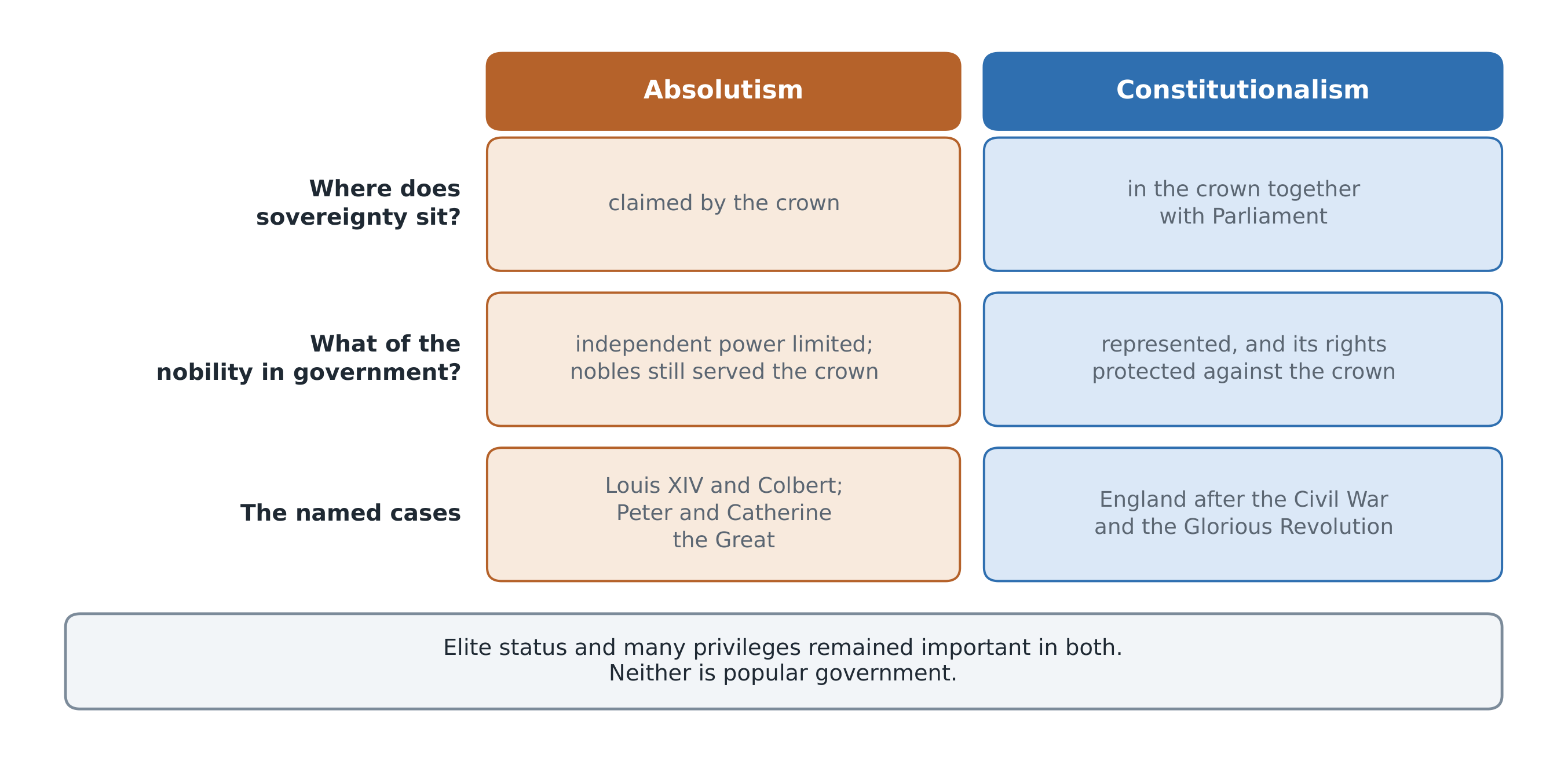
Compare cases using a shared question: who constrains the ruler, who participates in government, or how resources are raised? Give evidence for both cases and explain the relationship. A third case is useful only when it helps answer the prompt; there is no rule that every answer needs three states.
Original practice, not an authentic past-paper question: explain one difference and one similarity between France under Louis XIV and England after 1689. Use these facts: Louis XIV extended central state control; the English crown required parliamentary grant for taxation; aristocratic privilege remained important in both societies.
Model reasoning: both governments retained elite social privilege, so stronger institutions did not necessarily mean wider equality. They differed in the constraints on the crown: Louis XIV extended royal control, whereas England's settlement strengthened Parliament's ability to limit royal taxation. The comparison uses the same institutional question for both cases. It is an illustrative response, not a guaranteed mark award.
3.8
Exam tips
Read the command and evidence supplied. Explain a mechanism rather than listing unrelated names. Distinguish royal authority from unlimited practical control, a republic from democracy, and a contributing cause from an inevitable outcome. When interpreting an image, state what is visible before explaining what it may suggest; architecture alone cannot prove that a ruler faced no limits.
3.8
Sources and practice provenance
Scope: local College Board AP European History Course and Exam Description, Unit 3 topics 3.1–3.8, PDF pages 86–96 (and the continuation of 3.8). Examples and practice above are authored teaching material, not reproduced exam items.