5.1 Contextualizing 18th-Century States
| Learning Objective | Preview: Unit 5 Key Concepts |
|---|---|
Unit 5.A |
|
AP European History · Topic 5
 7:22
7:22
Unit 5: Conflict, Crisis, and Reaction
Contextualizing eighteenth-century states means holding four things together: global commercial competition, the French Revolution, Napoleon, and the…
English narration · English + 中文 subtitles burned in
| Learning Objective | Preview: Unit 5 Key Concepts |
|---|---|
Unit 5.A |
|
Source: College Board AP Course and Exam Description
Why could a government promise equal rights and then punish political opponents? Unit 5 follows changes in authority during commercial rivalry, revolution, Napoleon's rule and the settlement of 1815. Political sovereignty 政治主权 means the source of a government's authority. Monarchs, elected representatives and an emperor offered different answers to who should rule.
European trade linked distant regions and helped states fund wars. Enlightenment arguments questioned inherited privilege. Yet trade, debt and new ideas did not automatically produce a revolution everywhere. In France, these developments interacted with unequal privileges, resistance to tax reform, bread shortages and political choices.
| English |
|---|
| political sovereignty/pəˈlɪtɪkl ˈsɒvərɪnti/ |
| Thematic Focus | Learning Objective | Historical Developments |
|---|---|---|
ECD | Unit 5.B |
|
Source: College Board AP Course and Exam Description
European commerce accelerated a worldwide economic network. Atlantic rivalry connected ports, colonies, plantation goods and the forced labour of enslaved people. States protected trade with fleets and sought colonies and trading advantages; commercial rivalry influenced diplomacy and war. Do not describe this network as free or equal exchange for everyone.
In Asia, Portuguese, Dutch, French and British interests competed. British power became dominant in India, while the Dutch controlled the East Indies. These outcomes developed over time; they do not mean Europeans controlled all Asian trade or territory. Overseas influence mattered alongside land warfare and alliances within Europe.
Original practice. A fictional minister proposes paying for warships to protect colonial trade. Explain a connection between commerce and state power, and identify a limit of the claim that commerce always benefits the state.
Worked reasoning. Naval protection can defend routes and commercial income, helping a state compete with rivals. But fleets and wars cost money. Increased commerce can coexist with higher state debt; benefits to merchants do not prove that the treasury or enslaved workers benefited.
| Thematic Focus | Learning Objective | Historical Developments |
|---|---|---|
SOP | Unit 5.C |
|
Illustrative examples:
Source: College Board AP Course and Exam Description
Rivalry between Britain and France produced wars in Europe and overseas. The Seven Years' War strengthened Britain's colonial and naval position. France later supported the American Revolution against Britain. This helped weaken Britain's position in North America but added to French war costs. Britain's growing commercial power did not make every war a British victory.
France entered the 1780s with a fiscal crisis 财政危机: the government could not readily meet its financial commitments. War debt mattered, but privileges and resistance to changes in taxation also limited the government's options. These pressures connect international rivalry to the political crisis in France without making debt a complete explanation of revolution.
| English |
|---|
| fiscal crisis/ˈfɪskl ˈkraɪsɪs/ |
| Thematic Focus | Learning Objective | Historical Developments |
|---|---|---|
SOP | Unit 5.D |
|
Illustrative examples:
Source: College Board AP Course and Exam Description
The Revolution had several interacting causes. Long-term social and political grievances concerned privileges, taxation and representation. Enlightenment ideas supplied arguments about rights and legitimate authority. Short-term fiscal and economic crises intensified these tensions: state debt obstructed government action, while expensive or scarce bread increased popular distress. A short-term crisis is a cause too; calling it a trigger does not remove its causal importance.
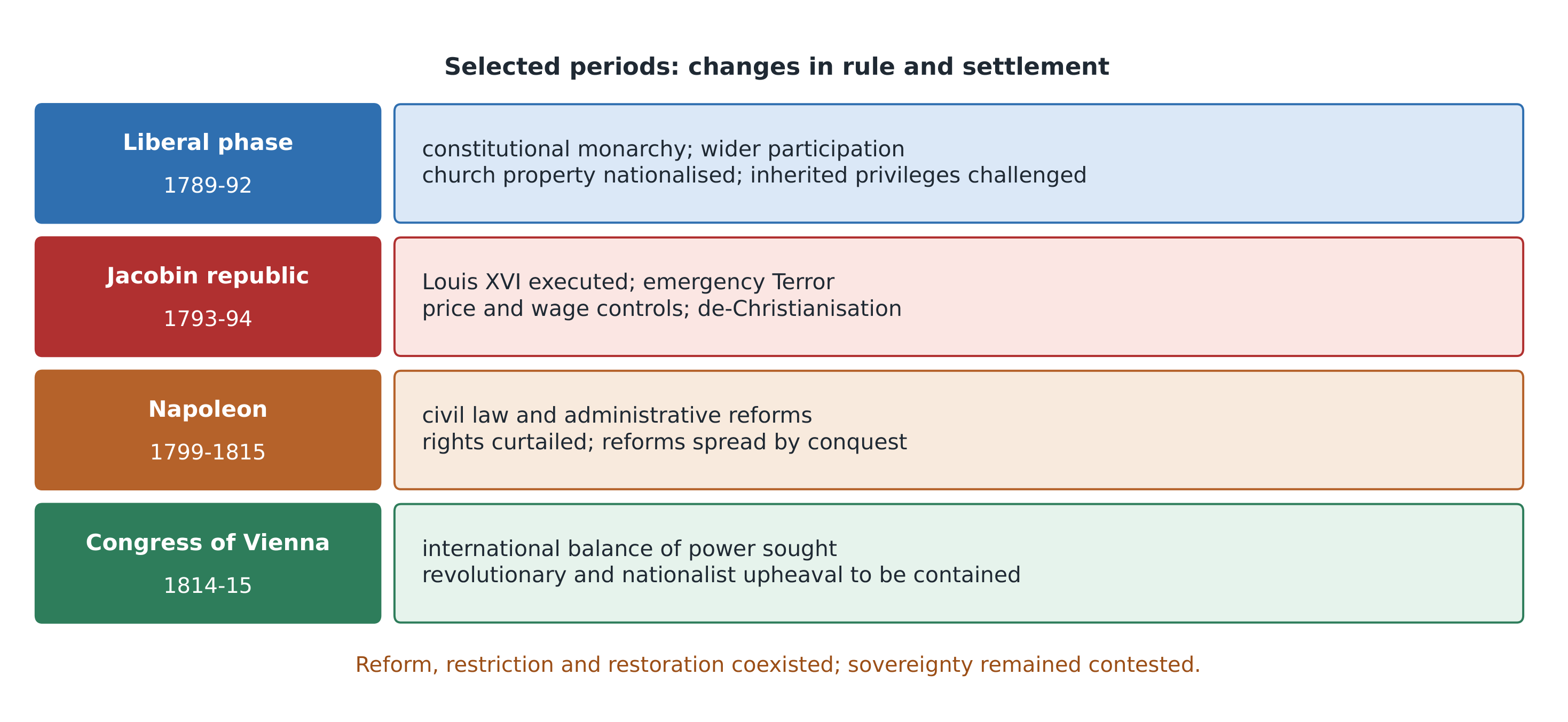
The first, or liberal, phase 自由派阶段 began in 1789. The National Assembly challenged inherited privilege and issued the Declaration of the Rights of Man and of the Citizen. Church property was nationalised, and the Civil Constitution of the Clergy brought the Church under new state arrangements. The Constitution of 1791 established a constitutional monarchy 君主立宪. Participation expanded, but political equality was limited: women lacked equal political rights, and voting arrangements distinguished between men by property or tax qualifications. Abolishing hereditary privileges 世袭特权 did not abolish all social inequality.
The monarchy fell and a republic was established in 1792; Louis XVI was executed in January 1793. In 1793–1794 the radical Jacobin republic 雅各宾共和国, associated with Robespierre 罗伯斯庇尔 and the Committee of Public Safety, faced foreign war and internal opposition. The Reign of Terror 恐怖统治 used emergency coercion against suspected opponents. Price and wage controls and de-Christianisation 去基督教化 were also features of the radical period. Revolutionary promises and actual political freedoms could conflict.
Mass conscription 大规模征兵, including the levée en masse of 1793, mobilised people and resources for war. Revolutionary armies defended France and carried changes into other territories. Conquest could spread reforms and also provoke resistance. After Robespierre's fall in 1794, the Directory governed from 1795 to 1799. Napoleon's coup in 1799 led to the Consulate and later the Empire; these were not simply another Jacobin government.
Women took active roles. The October 1789 march on Versailles joined concerns about bread with pressure on royal authority. Olympe de Gouges demanded recognition of women's rights in 1791. Some legal changes, including revolutionary divorce provisions, improved women's options briefly. However, women did not gain equal national political citizenship, and women's political clubs were closed in 1793. Participation in political action is different from possession of equal formal political rights.
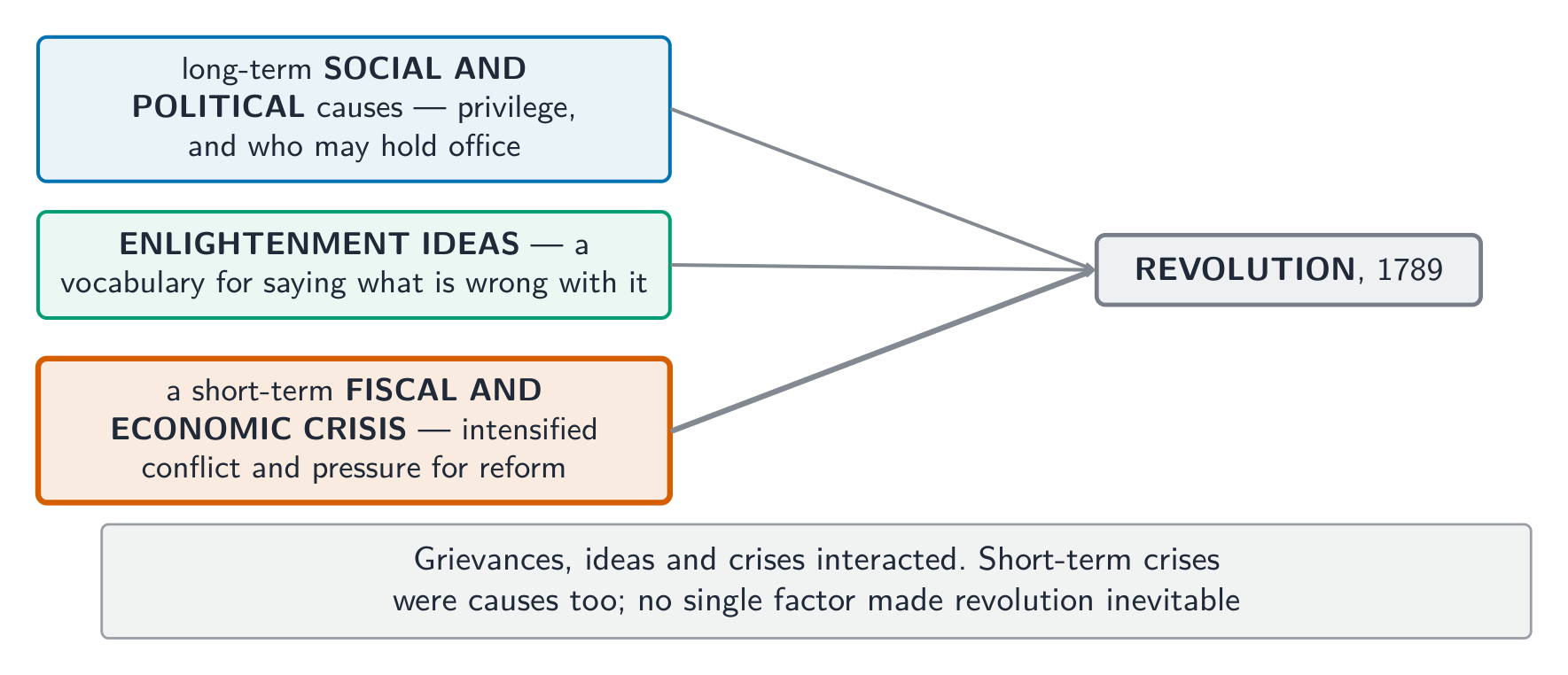
Original causation task. Use three pieces of evidence: inherited privileges shaped taxation and access to power; French support for the American Revolution added to state debt; bread shortages increased distress. Explain how two factors interacted. Do not merely list them.
Worked reasoning. Debt increased pressure to change taxation, while privileged groups' resistance made reform politically difficult. Bread distress widened popular anger beyond the government's finances. This connects institutional barriers and economic pressures. It does not show that every indebted state had to experience the same revolution.
Explain how long-term grievances, ideas and short-term crises interacted.
| English |
|---|
| first, or liberal, phase/fɜːst ɔː ˈlɪbərəl feɪz/ |
| constitutional monarchy/ˌkɒnstɪˈtjuːʃənl ˈmɒnəki/ |
| hereditary privileges/həˈredɪtəri ˈprɪvɪlɪdʒɪz/ |
| radical Jacobin republic/ˈrædɪkl ˈdʒækəbɪn rɪˈpʌblɪk/ |
| Robespierre/ˈrəʊbspɪeə/ |
| Reign of Terror/reɪn ɒv ˈterə/ |
| de-Christianisation/də ˌkrɪstʃənaɪˈzeɪʃn/ |
| mass conscription/mæs kɒnˈskrɪpʃn/ |
| Thematic Focus | Learning Objective | Historical Developments |
|---|---|---|
SCD | Unit 5.E |
|
Illustrative examples:
Source: College Board AP Course and Exam Description
Revolutionary ideals of equality and human rights inspired supporters and exposed exclusions. In Saint-Domingue, the French colony that became Haiti, enslaved people fought for freedom in a revolt beginning in 1791. Toussaint L'Ouverture 卢维杜尔 became a leading figure in a struggle involving local groups and foreign powers. Haiti became independent in 1804. Do not reduce this result to French ideas alone: enslaved people's organisation, military resistance and decisions were essential. Nor should Toussaint be described as the person who declared independence in 1804.
Supporters welcomed challenges to hereditary privilege and arbitrary authority. Critics such as Edmund Burke condemned revolutionary violence and attacks on inherited institutions. The events strengthened conservative arguments, but did not invent every defence of tradition. Different observers could support some reforms and reject other actions.
Original source-comparison practice. These are author-written paraphrases, not quotations: A, the 1789 Declaration connects government with equal rights and liberty; B, de Gouges's 1791 declaration argues that women should receive rights denied in practice. Identify a shared principle and a difference in the problem each addresses.
Worked comparison. Both use a language of rights to judge political authority. A proclaims general principles against the old order; B challenges the exclusion of women from the revolutionary settlement. B shows that a general promise is not evidence that every group already enjoyed it. The author's position helps explain the emphasis, but does not by itself prove or disprove the claim.
| English |
|---|
| Toussaint L'Ouverture/ˈtaʊseɪnt ˈeluːvɜːtʃə/ |
| Thematic Focus | Learning Objective | Historical Developments |
|---|---|---|
SOP | Unit 5.F |
|
Unit 5.G |
|
Illustrative examples:
Source: College Board AP Course and Exam Description
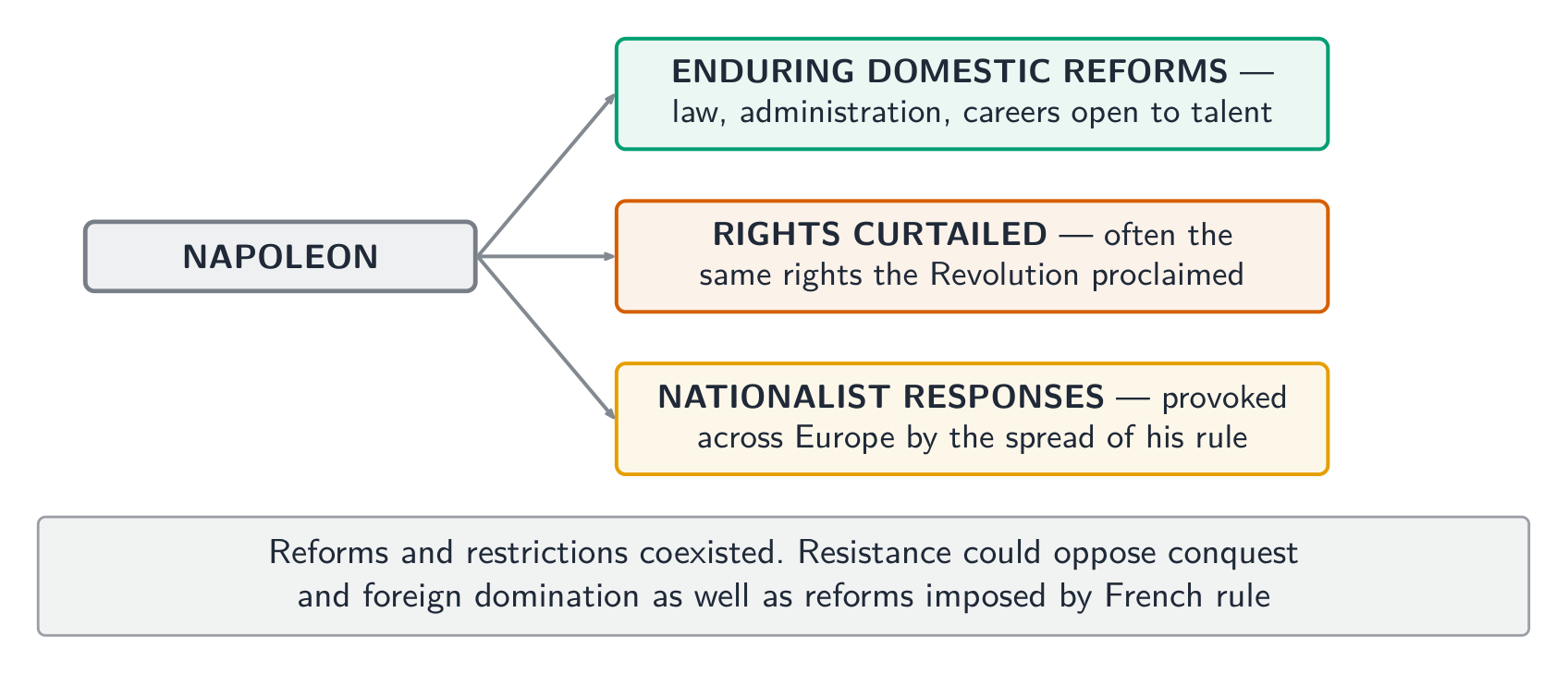
As first consul and then emperor, Napoleon 拿破仑 introduced enduring domestic reforms 持久的国内改革. The Civil Code of 1804 unified civil law and protected property. Central administration, education and careers based on ability strengthened state institutions. The Concordat of 1801 reached a settlement with the Catholic Church. These measures preserved or adapted some revolutionary changes.
At the same time, censorship, secret police and controlled representative institutions limited political liberty. The Civil Code strengthened husbands' authority and restricted married women's legal autonomy. Legal uniformity therefore did not mean equal rights for every person. Reforms and restrictions coexisted, but each needs a specific example and explanation.
Military organisation and tactics helped Napoleon impose direct or indirect control over much of continental Europe. French rule carried legal and administrative reforms, but conquest, demands for resources and foreign domination could provoke opposition. Nationalist responses included resistance in Spain and the German states. Not every opponent had identical aims, and nationalism was not caused by legal reform alone. The Russian campaign and subsequent coalition warfare weakened French power; Napoleon was defeated in 1814 and finally in 1815.
Original evaluation task. Assess the claim that Napoleon simply ended the Revolution. Evidence supplied: Civil Code and protection of property; censorship and secret police; restrictions on married women; legal changes introduced into conquered territories.
Worked judgement. Napoleon preserved and spread some legal and property changes while restricting political liberty and reinforcing unequal family authority. The claim is too broad because it treats all revolutionary aims as one thing. A defensible answer distinguishes legal reform from political participation and uses the evidence to explain each.
Distinguish legal reforms, restrictions and resistance using specific evidence.
| English |
|---|
| Napoleon/nəˈpəʊlɪən/ |
| enduring domestic reforms/enˈdjʊərɪŋ dəˈmestɪk rɪˈfɔːmz/ |
| Thematic Focus | Learning Objective | Historical Developments |
|---|---|---|
SOP | Unit 5.H |
|
Source: College Board AP Course and Exam Description
After Napoleon's defeat by a coalition, the Congress of Vienna (1814-1815) 维也纳会议 sought a balance of power and the containment of revolutionary or nationalist upheaval. Balance of power 均势 means arranging relations so no single state can easily dominate the others. Territorial settlements and cooperation among major powers served this purpose. Restored dynasties also asserted traditional legitimacy.
These aims were related but distinct. Preventing another dominant empire was not the same as granting a population national self-government. The settlement did not erase all revolutionary reforms or nationalist ideas, and later challenges did not make every part of it an immediate failure. Do not place Vienna inside a sequence of French revolutionary governments: it was an international settlement.
Original practice. A hypothetical delegate supports a stronger neighbouring state to restrain France and rejects a demand for national self-government. Explain how these decisions can serve two different aims of the settlement.
Worked reasoning. Strengthening a neighbour can help balance French power. Rejecting self-government can defend dynastic authority and contain nationalism. The two decisions are consistent with the settlement's aims even though a nationalist critic might oppose them.
| English |
|---|
| Congress of Vienna (1814-1815)/ˈkɒŋɡres ɒv vɪˈenə/ |
| balance of power/ˈbæləns ɒv ˈpaʊə/ |
| Thematic Focus | Learning Objective | Historical Developments |
|---|---|---|
CID | Unit 5.I |
|
Source: College Board AP Course and Exam Description
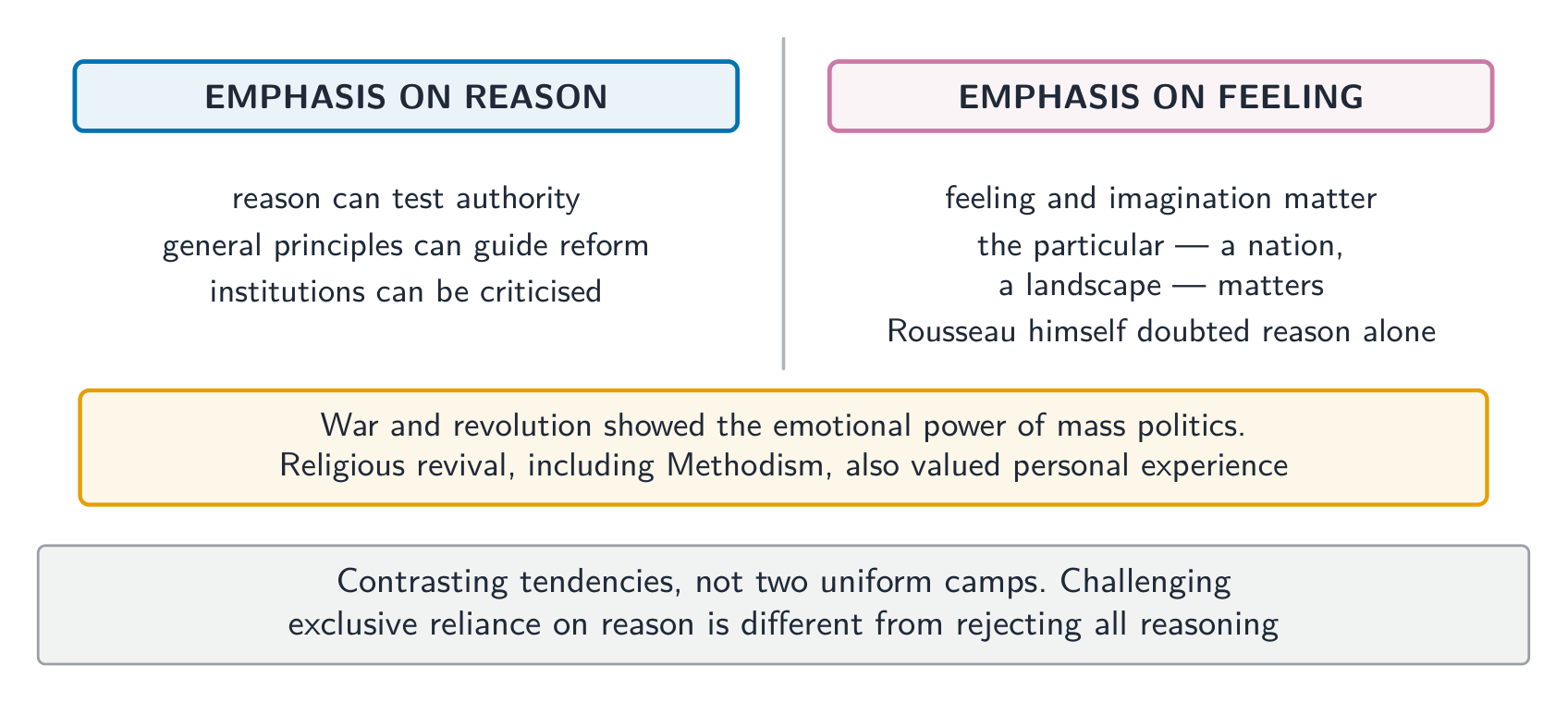
Romanticism 浪漫主义 offered a challenge to Enlightenment rationality 对启蒙理性的挑战 by valuing emotions 情感, imagination, nature and particular historical or national traditions. Rousseau questioned exclusive reliance on reason and stressed feeling in moral improvement. This shows debate within eighteenth-century thought, not a complete separation of two uniform camps. Romanticism also involved art and literature; it was not only a political argument.
Religious revival 宗教复兴 included Methodism 循道宗, associated with John Wesley. Personal religious experience and communal devotion challenged accounts of human life based only on rational calculation. Such movements overlapped in time with Enlightenment thought; they were not all caused by the French Revolution. War, revolution and rebellion also showed the emotional power of mass politics and nationalism. This is a historical context, not proof that emotion always produces sound political judgement.
Original interpretation task. Two invented classroom positions are given: A says institutions should be judged by general rational principles; B says moral judgement must also consider feeling and a community's history. Explain a difference and why it does not prove that B rejects all reasoning.
Worked reasoning. A stresses general standards; B gives more weight to emotion and particular experience. Saying reason is insufficient is different from saying it is worthless. Connect this distinction to Rousseau and Romanticism, rather than claiming either invented every use of feeling.
| English |
|---|
| Romanticism/rəʊˈmæntɪsɪzəm/ |
| challenge to Enlightenment rationality/ˈtʃælɪndʒ tʊ enˈlaɪtənmənt ˌræʃəˈnælɪti/ |
| emotions/ɪˈməʊʃnz/ |
| religious revival/rɪˈlɪdʒəs rɪˈvaɪvl/ |
| Methodism/ˈmeθəʊdɪzəm/ |
| Learning Objective | Review: Unit 5 Key Concepts |
|---|---|
Unit 5.J |
|
Source: College Board AP Course and Exam Description
Compare a defined starting situation with a later one. Specify the dimension: political participation, legal privilege, state administration, religion or national identity. Change in one dimension can coexist with continuity in another. A question about change does not always require survival beyond its stated end date; follow the actual prompt.
Original practice, not a past-paper quotation. Explain one political change and one continuity in France between the old regime and Napoleon's rule. Evidence supplied: challenges to hereditary privilege from 1789; the Civil Code; censorship under Napoleon; continued strong central government.
Worked response. Legal distinctions based on inherited privilege were challenged and replaced by a more uniform civil code, changing the legal basis of authority. Strong central control nevertheless continued, now under a different regime, and censorship limited political expression. This is a comparison of specific features, not a claim that all monarchs and emperors governed identically or that national sovereignty became universally accepted by 1815.
Identify the prompt's period and task. Select relevant evidence and explain how it supports your claim. For a source question, connect purpose or perspective to the source's actual situation; a name alone is not an explanation. Distinguish a promise from its implementation. Use phase labels to organise chronology when useful, not as a guaranteed scoring formula. A short teaching model is not a complete DBQ or a promise of full marks.
Scope: local AP European History CED, topics 5.1–5.9, PDF pages 120–131 (printed 112–123). Local 2025 set 1 FRQ and scoring guidelines were spot-checked: SAQ 2 asks about purpose, context and consequences of Spanish resistance to Napoleon; DBQ 1 evaluates revolutionary ideals in 1789–1794 through contrasting documents. The original practice above supports these skills without reproducing a complete exam task or claiming exhaustive paper coverage. Historical paper files and bank entries were not changed.
Further grounding: Office of the Historian: Haitian Revolution, Fondation Napoléon: Civil Code, Château de Versailles: the Revolution at Versailles. The Office of the Historian page is an archived institutional overview.
Work through it step by step, with instant-check exercises.
Loading subjects…