2 صف هياكل المواد الصلبة والسائلة والغازية من حيث تباعد الجسيمات وترتيبها وحركتها
3 صف تغيرات الحالة من حيث الانصهار، والغليان، والتبخر، والتجمد، والتكثف
5 اشرح تغيرات الحالة من حيث نظرية الجسيمات الحركية، بما في ذلك تفسير منحنيات التسخين والتبريد
4 صف تأثيرات درجة الحرارة والضغط على حجم الغاز
6 اشرح، من حيث نظرية الجسيمات الحركية، تأثيرات درجة الحرارة والضغط على حجم الغاز
Source: Cambridge International syllabus · المصدر: منهج كامبريدج الدولي
English
Solid, liquid, gas: particle motion
Everything around you is made of tiny particles 粒子 — these can be atoms 原子, molecules 分子, or ions 离子. The kinetic particle theory 粒子动理论 says these particles are always moving. How close the particles are, how they are arranged, and how they move decides whether matter is a solid 固体, a liquid 液体, or a gas 气体.
Properties you can observe
You do not need a microscope to tell the three states apart. They behave in different ways:
A solid has a fixed shape and a fixed volume 体积. It does not flow and you cannot compress 压缩 it (squeeze it smaller).
A liquid has a fixed volume but no fixed shape. It flows and takes the shape of its container. It is almost impossible to compress.
A gas has no fixed shape and no fixed volume. It flows and spreads out to fill the whole container. A gas is easy to compress.
The table below sums up these properties. Density 密度 means how much mass 质量 is packed into a given volume.
Property
Solid
Liquid
Gas
Shape
fixed
takes the shape of the container
fills the whole container
Volume
fixed
fixed
fills the whole container
Can it be compressed?
no
almost none
yes, easily
Does it flow?
no
yes
yes
Density
high
high
low
The particle picture
The kinetic particle theory explains these properties by looking at three things: the separation 间距 of the particles (how far apart they are), their arrangement 排列 (the pattern), and their motion 运动 (how they move).
Solid
Liquid
Gas
Separation
touching, very close
close together
far apart
Arrangement
regular 规则 pattern
random, no pattern
random, no pattern
Motion
vibrate 振动 about fixed positions
move and slide past each other
move quickly in all directions
Strong forces of attraction 引力 hold the particles together. In a solid these forces are strong enough to hold every particle in place, so a solid keeps its shape. In a liquid the forces are weaker, so particles can move around. In a gas the particles move so fast that the forces hardly act at all, so the gas spreads out.
العربية
صلب، سائل، غاز: حركة الجسيمات
كل ما حولك مصنوع من جسيمات صغيرة جداً — وهي يمكن أن تكون ذرات أو جزيئات أو أيونات. تنص نظرية الجسيمات الحركية على أن هذه الجسيمات في حالة حركة دائمة. إن مدى قرب الجسيمات من بعضها، وتوزيعها، وحركتها هو ما يحدد ما إذا كانت المادة صلبة أم سائلة أم غازية.
خصائص يمكنك ملاحظتها
لا تحتاج إلى مجهر لتمييز الحالات الثلاث عن بعضها. فكل منها يتصرف بطريقة مختلفة:
الصلبة لها شكل ثابت وحجم ثابت. لا تتدفق ولا يمكن ضغطها (تقليص حجمها).
السائل له حجم ثابت لكن ليس له شكل ثابت. يتدفق ويأخذ شكل وعائه. ومن شبه المستحيل ضغطه.
الغاز ليس له شكل ثابت ولا حجم ثابت. يتدفق وينتشر ليملأ الوعاء بأكمله. الغاز سهل الضغط.
يلخص الجدول أدناه هذه الخصائص. الكثافة تعني مقدار الكتلة المكدسة في حجم معين.
الخاصية
الصلب
السائل
الغاز
الشكل
ثابت
يأخذ شكل الوعاء
يملأ الوعاء بالكامل
الحجم
ثابت
ثابت
يملأ الوعاء بالكامل
هل يمكن ضغطه؟
لا
شبه مستحيل
نعم، بسهولة
هل يتدفق؟
لا
نعم
نعم
الكثافة
عالية
عالية
منخفضة
صورة الجسيمات
تشرح نظرية الجسيمات الحركية هذه الخصائص من خلال النظر إلى ثلاثة أمور: الفصل بين الجسيمات (مدى تباعدها)، وترتيبها (النمط)، وحركتها (كيف تتحرك).
الصلب
السائل
الغاز
الفصل
متلامسة، قريبة جداً
متقاربة
متباعدة
الترتيب
نمط منتظم
عشوائي، بدون نمط
عشوائي، بدون نمط
الحركة
تهتز حول مواضع ثابتة
تتحرك وتنزلق فوق بعضها البعض
تتحرك بسرعة في جميع الاتجاهات
تمسك قوى التجاذب القوية الجسيمات معاً. في الحالة الصلبة تكون هذه القوى قوية بما يكفي لتثبيت كل جسيم في مكانه، لذلك يحافظ الصلب على شكله. أما في السائل فتكون القوى أضعف، مما يسمح للجسيمات بالحركة. وفي الغاز تتحرك الجسيمات بسرعة كبيرة لدرجة أن القوى几乎 لا تؤثر، لذا ينتشر الغاز.
الجسيمات مكتظة ومنتظمة في الصلب، قريبة وعشوائية في السائل، ومتباعدة في الغاز
Explore · استكشف
States of matter · حالات المادة
Heat the box and watch the particles break free: a vibrating solid melts to a flowing liquid, then spreads out as a gas. Same particles — just more energy. · سخّن الصندوق ولاحظ الجسيمات تتحرر: صلب متذبذب يذوب ليصبح سائلًا متدفقًا، ثم ينتشر كغاز. نفس الجسيمات — فقط طاقة أكبر.
When you heat or cool a substance, it can change from one state to another. You must know the name of each change.
Change
What happens
Name
solid → liquid
melting 熔化
melting
liquid → solid
freezing 凝固
freezing
liquid → gas (at the surface, below the boiling point)
evaporating 蒸发
evaporation
liquid → gas (all through the liquid)
boiling 沸腾
boiling
gas → liquid
condensing 凝结
condensation
A pure solid melts at one fixed temperature, the melting point 熔点. A pure liquid boils at one fixed temperature, the boiling point 沸点. The same substance freezes at its melting point and condenses at its boiling point.
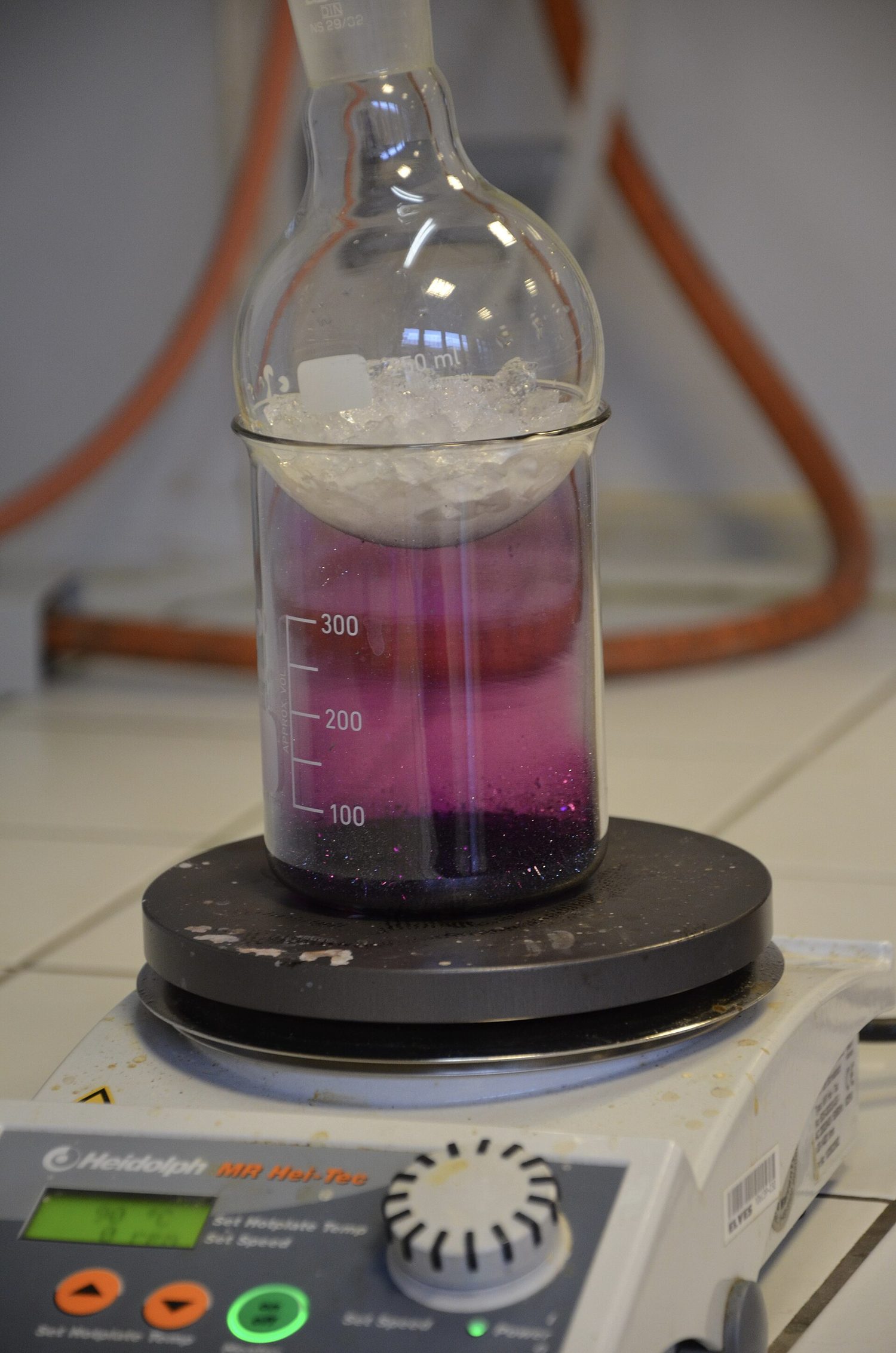
A few substances change straight from solid to gas without melting first. This is called sublimation 升华. In the photo below, warmed solid iodine in a beaker turns directly into a purple gas; the gas then cools on the round flask of ice above and turns back into a solid.
Explaining changes of state with the particle theory
Each change of state is really a change in the energy 能量 of the particles.
When you heat a solid, the particles gain energy and vibrate faster. At the melting point the particles have enough energy to break away from their fixed places and slide around — the solid melts.
When you heat a liquid, the particles move faster. At the boiling point they have enough energy to fully escape the forces of attraction and become a gas.
Cooling does the opposite. The particles lose energy, move more slowly, and the forces of attraction pull them back together.
During a change of state the energy goes into breaking the forces of attraction, not into making the particles move faster. This is why the temperature stays the same while a substance is melting or boiling.
Heating and cooling curves
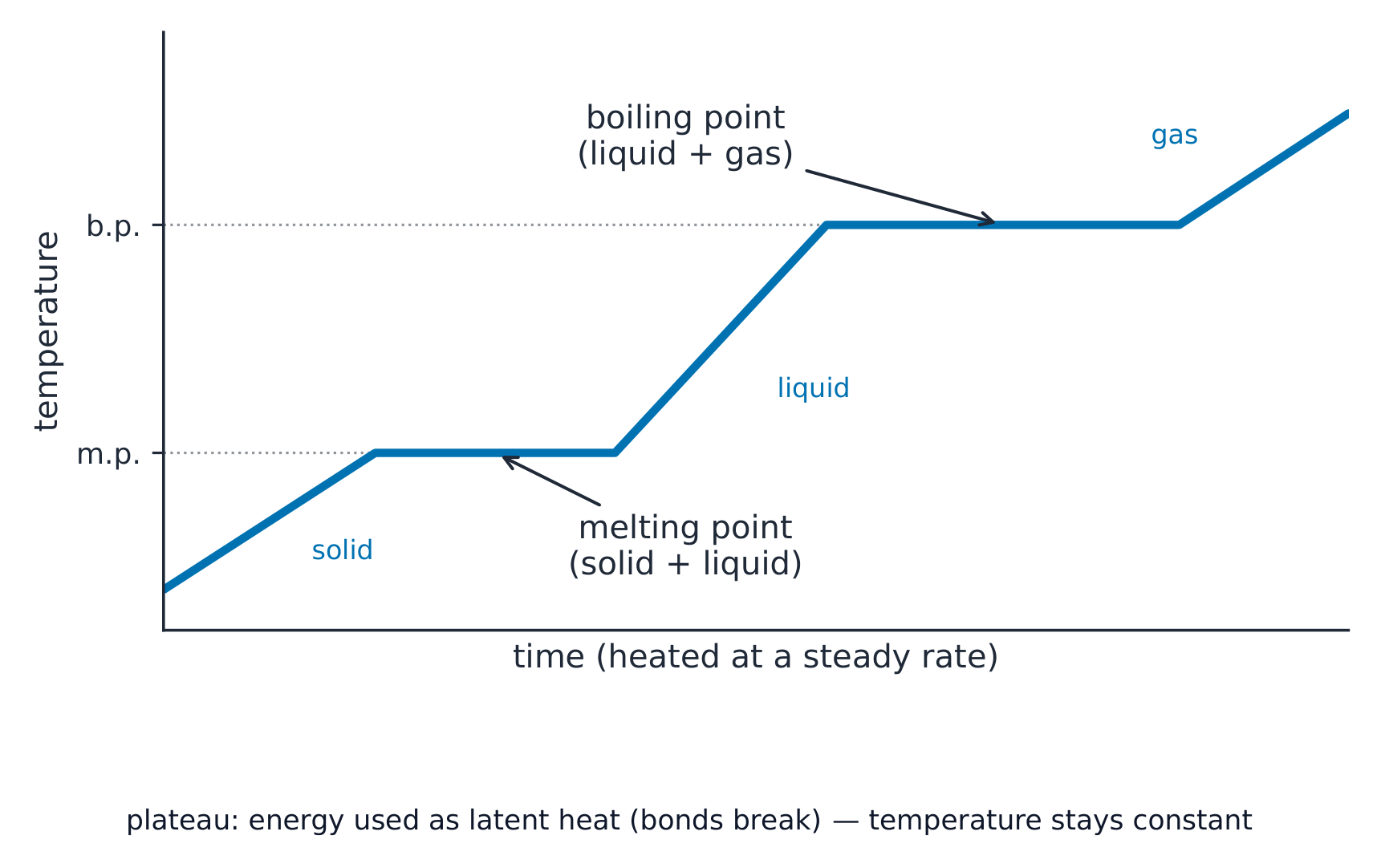
A heating curve 加热曲线 is a graph of temperature against time as you heat a substance steadily. A cooling curve 冷却曲线 is the same graph as the substance cools.
On a heating curve there are two flat (level) parts:
The first flat part is at the melting point. Here solid and liquid are both present. The heat energy breaks the forces holding the solid together, so the temperature does not rise.
The second flat part is at the boiling point. Here liquid and gas are both present, and the temperature again stays constant.
A cooling curve is the reverse. It has a flat part at the boiling point (the gas condenses) and a flat part at the melting point (the liquid freezes). As the particles slow down, thermal energy 热能 is released to the surroundings.
العربية
ذوبان الثلج إلى ماء: تغير في الحالة عندما تدفئ الصلب.
عند تسخين أو تبريد مادة معينة، يمكن أن تتحول من حالة إلى أخرى. يجب أن تعرف اسم كل تغير.
التغير
ماذا يحدث
الاسم
صلب ← سائل
ذوبان
ذوبان
سائل ← صلب
تجمد
تجمد
سائل ← غاز (على السطح، تحت درجة الغليان)
تبخر
تبخر
سائل ← غاز (عبر كامل السائل)
غليان
غليان
غاز ← سائل
تكثف
تكثف
يذوب الصلب النقي عند درجة حرارة ثابتة واحدة، وهي درجة الانصهار. يغلي السائل النقي عند درجة حرارة ثابتة واحدة، وهي درجة الغليان. نفس المادة تتجمد عند درجة انصهارها وتتكاثر عند درجة غليانها.
التسخين: صلب ← سائل ← غاز؛ التبريد يعكس كل تغير
بعض المواد القليلة تتحول مباشرة من صلب إلى غاز دون أن تذوب أولاً. يسمى هذا التسامي. في الصورة أدناه، يتحول اليود الصلب الدافئ في الكوب زجاجياً مباشرة إلى غاز بنفسجي؛ ثم يبرد الغاز على الدائرة الزجاجية المليئة بالثلج الموجودة أعلاه ويعود إلى الحالة الصلبة.
اليود الصلب المسخن يتحول مباشرة إلى غاز بنفسجي (تسامي)المثال اليومي: الثلج الجاف هو ثاني أكسيد الكربون الصلب، ويتسامى أيضاً — فلا يترك بركة مائية أبداً
شرح تغيرات الحالة بنظرية الجسيمات
كل تغير في الحالة هو في الواقع تغيير في طاقة الجسيمات.
عند تسخين صلب، تكتسب الجسيمات طاقة وتتهز بشكل أسرع. وعند درجة الانصهار تصبح لدى الجسيمات طاقة كافية للتحرر من أماكنها الثابتة والانزلاق حول بعضها — فيذوب الصلب.
عند تسخين سائل، تتحرك الجسيمات بشكل أسرع. وعند درجة الغليان تصبح لديها طاقة كافية للهروب تماماً من قوى التجاذب وتتحول إلى غاز.
التبريد يقوم بالعكس. تفقد الجسيمات الطاقة، وتتحرك ببطء أكبر، وتجذبها قوى التجاذب نحو بعضها البعض مرة أخرى.
خلال تغير الحالة، تذهب الطاقة إلى كسر قوى التجاذب، وليس إلى زيادة سرعة حركة الجسيمات. ولهذا السبب تظل درجة الحرارة ثابتة أثناء ذوبان المادة أو غليانها.
منحنيات التسخين والتبريد
منحنى التسخين هو رسم بياني لدرجة الحرارة مقابل الوقت أثناء تسخين مادة بشكل مستمر. منحنى التبريد هو نفس الرسم البياني ولكن للمادة وهي تبرد.
في منحنى التسخين هناك جزآن مسطحيان (أفقيان):
الجزء المسطح الأول هو عند درجة الانصهار. هنا يكون المادة في الحالتين الصلبة والسائلة معًا. تُكسر الطاقة الحرارية القوى التي تربط جزيئات المادة الصلبة، لذا لا ترتفع درجة الحرارة.
الجزء المسطح الثاني هو عند درجة الغليان. هنا تكون المادة في الحالتين السائلة والغازية معًا، وتظل درجة الحرارة ثابتة مرة أخرى.
منحنى التبريد هو العكس. يحتوي على جزء مسطح عند درجة الغليان (يتكثف الغاز) وجزء مسطح عند درجة الانصهار (تتجمد السائلة). ومع تباطؤ الجسيمات، يُطلق الطاقة الحرارية إلى المحيط المحيط بها.
تبقى درجة الحرارة ثابتة عند درجتي الانصهار والغليان بينما تُكسر قوى التجاذب
Explore · استكشف
Heating a substance through its states · تسخين مادة عبر حالاتها
Step up the temperature. Adding heat gives the particles more energy until they break free — and the temperature pauses at each change of state while the energy does that work. · ارفع درجة الحرارة. إضافة الحرارة تعطي الجسيمات طاقة أكبر حتى تتحرر — وتتوقف درجة الحرارة مؤقتًا عند كل تغير حالة بينما تقوم الطاقة بهذا العمل.
Gases: temperature, pressure and volume · الغازات: درجة الحرارة والضغط والحجم
English
A gas pushes on the walls of its container. This push, spread over the area of the wall, is the pressure 压强 of the gas. Pressure comes from the gas particles hitting the walls.
Effect of temperature
If you heat a fixed mass of gas while keeping the pressure the same, its volume increases.
Using the particle theory: heating gives the particles more kinetic energy 动能, so they move faster. They hit the walls harder and more often. To keep the pressure the same, the gas must take up more space, so the volume gets bigger.
If instead the volume is fixed (a sealed, rigid container), heating the gas makes the pressure rise, because the faster particles collide 碰撞 with the walls harder and more often.
Effect of pressure
If you increase the pressure on a fixed mass of gas while keeping the temperature the same, its volume decreases. Squeezing the gas into a smaller space means the particles hit the walls more often, which is what a higher pressure means.
العربية
يُمارس الغاز ضغطًا على جدران وعائه. هذا الضغط، الموزع على مساحة الجدار، هو ضغط الغاز. ينشأ الضغط نتيجة اصطدام جسيمات الغاز بالجدران.
تأثير درجة الحرارة
إذا قمت بتسخين كتلة ثابتة من الغاز مع الحفاظ على ثبات الضغط، فإن حجمه يزداد.
غاز مسخن: جسيمات أسرع تتباعد وتشغل مساحة أكبر
باستخدام نظرية الجسيمات: يعطي التسخين للجسيمات المزيد من الطاقة الحركية، فتتحرك بسرعة أكبر. وتصطدم بالجدران بقوة أكبر وبشكل متكرر أكثر. وللمحافظة على ثبات الضغط، يجب أن يشغل الغاز مساحة أكبر، مما يجعل الحجم يتضخم.
إذا كان الحجم ثابتًا عوضًا عن ذلك (وعاء مغلق وصلب)، فإن تسخين الغاز يؤدي إلى ارتفاع الضغط، لأن الجسيمات الأسرع تتصادم بجدران الوعاء بقوة أكبر وبشكل متكرر أكثر.
تأثير الضغط
إذا زدت الضغط على كتلة ثابتة من الغاز مع الحفاظ على ثبات درجة الحرارة، فإن حجمه يقل. إن ضغط الغاز في حيز أصغر يعني أن الجسيمات تصطدم بالجدران بشكل متكرر أكثر، وهو ما يمثل ارتفاع الضغط.
ضغط الغاز في حجم أصغر يجعل الجسيمات تصطدم بالجدران بشكل متكرر أكثر، مما يرفع الضغط
1 Describe and explain diffusion in terms of kinetic particle theory
2 Describe and explain the effect of relative molecular mass on the rate of diffusion of gases
العربية
أساسي
تكميلي
1 صف واشرح الانتشار من حيث نظرية الجسيمات الحركية
2 صف واشرح تأثير الكتلة الجزيئية النسبية على معدل انتشار الغازات
Source: Cambridge International syllabus · المصدر: منهج كامبريدج الدولي
English
Diffusion: random motion, one-way flow
Diffusion 扩散 is the spreading of particles from a region where they are crowded to a region where they are spread out — that is, from high concentration 浓度 to low concentration. It happens because particles are always moving in random directions.
Diffusion explains why you can smell food from across a room: the smell particles move and mix with the air until they reach your nose. Diffusion happens in gases and in liquids, but not in solids, because solid particles cannot move from place to place.
Rate of diffusion and molecular mass
Lighter gas particles move faster than heavier ones at the same temperature. So a gas with a smaller relative molecular mass 相对分子质量 (a smaller mass for each molecule) has a faster rate 速率 of diffusion.
A classic experiment shows this. Cotton wool soaked in ammonia 氨气 ($\text{NH}_3$) is put at one end of a long glass tube. Cotton wool soaked in hydrogen chloride 氯化氢 ($\text{HCl}$) is put at the other end. Both gases diffuse along the tube and meet to form a white ring of ammonium chloride 氯化铵 ($\text{NH}_4\text{Cl}$).
Ammonia has $M_r = 17$ and hydrogen chloride has $M_r = 36.5$. Ammonia is lighter, so it diffuses faster and travels further along the tube. The white ring forms nearer the hydrogen chloride end.
Worked example. Bromine ($M_r = 160$) and ammonia ($M_r = 17$) are released at the same moment from opposite ends of a long tube. Which travels further before they meet? Compare the relative molecular masses. Ammonia's $M_r$ is far smaller, so its molecules move faster at the same temperature and it diffuses more quickly. Ammonia therefore travels the greater distance, and the two gases meet nearer the bromine end. The rule is always "lighter means faster" - argue from $M_r$, never from how big the formula looks on paper.
العربية
الانتشار: حركة عشوائية، تدفق أحادي الاتجاه
الانتشار هو انتشار الجسيمات من منطقة كثيفة إلى منطقة منتشرة — أي من تركيز عالٍ إلى تركيز منخفض. يحدث الانتشار لأن الجسيمات تتحرك دائمًا في اتجاهات عشوائية.
تنتشر الجسيمات من التركيز العالي إلى المنخفض حتى تنتشر بالتساوي
يشرح الانتشار لماذا يمكنك شم رائحة الطعام عبر الغرفة: جسيمات الرائحة تتحرك وتتداخل مع الهواء حتى تصل إلى أنفك. يحدث الانتشار في الغازات والسوائل، لكن ليس في المواد الصلبة، لأن جسيمات المواد الصلبة لا يمكنها الانتقال من مكان إلى آخر.
معدل الانتشار والكتلة الجزيئية
تتحرك جسيمات الغاز الخفيفة أسرع من الثقيلة عند نفس درجة الحرارة. لذلك، فإن الغاز الذي له كتلة جزيئية نسبية أصغر (كتلة أقل لكل جزيء) يكون له معدل انتشار أسرع.
تُظهر تجربة كلاسيكية ذلك. قطن مبلّ بـ الأمونيا ($\text{NH}_3$) يُوضع عند أحد طرفي أنبوب زجاجي طويل. وقطن مبلّ بـ كلوريد الهيدروجين ($\text{HCl}$) يُوضع عند الطرف الآخر. ينتشر كلا الغازين على طول الأنبوب ويلتقيان لتكوين حلقة بيضاء من كلوريد الأمونيوم ($\text{NH}_4\text{Cl}$).
الأمونيا لها $M_r = 17$ وكلوريد الهيدروجين له $M_r = 36.5$. الأمونا أخف، لذا تنتشر أسرع وتقطع مسافة أطول على طول الأنبوب. تتشكل الحلقة البيضاء أقرب إلى طرف كلوريد الهيدروجين.
الأمونيا ($M_r=17$) أخف، لذا تنتشر أسرع وأبعد؛ تتشكل الحلقة البيضاء أقرب إلى طرف HCl
مثال محلول. يُطلاق البروم ($M_r = 160$) والأمونيا ($M_r = 17$) في نفس اللحظة من طرفي أنبوب طويل. أيهما يقطع مسافة أطول قبل أن يلتقيا؟ قارن الكتل الجزيئية النسبية. كتلة Ammonia الجزيئية $M_r$ أصغر بكثير، لذا تتحرك جزيئاتها بسرعة أكبر عند نفس درجة الحرارة وتنتشر بشكل أسرع. لذلك قطعت الأمونيا مسافة أكبر، والتقى الغازان أقرب إلى طرف البروم. القاعدة هي دائمًا "الأخف أسرع" - استدل بناءً على $M_r$، ولا تستند إلى حجم الصيغة على الورق.
Explore · استكشف
Diffusion · الانتشار
Release the cloud and the particles spread on their own from the crowded corner until they fill the box evenly — diffusion, sped up by heat. · أطلق السحب وستنتشر الجسيمات من تلقاء نفسها من الزاوية المكتظة حتى تمتلئ الصندوق بالتساوي — الانتشار، المسرع بالحرارة.
Explore · استكشف
Diffusion · الانتشار
Set the concentration on each side. Particles spread from high to low concentration until evenly mixed. · حدد التركيز على كل جانب. الجسيمات تنتشر من مرتفع إلى منخفض التركيز حتى تختلط بالتساوي.
During melting and boiling the temperature stays constant (the flat parts of a heating curve), because the energy breaks the forces between particles instead of making them move faster.
Evaporation happens only at the surface and at any temperature; boiling happens throughout the liquid at one fixed temperature.
Explain gas behaviour with the particle theory: heating a gas at fixed volume raises the pressure because the particles hit the walls harder and more often — the particles themselves do not get bigger.
Diffusion is faster for lighter particles (smaller $M_r$) and cannot happen in solids. In the ammonia/hydrogen chloride tube the lighter ammonia travels further, so the white ring forms nearer the HCl end.
العربية
أثناء الانصهار والغليان تظل درجة الحرارة ثابتة (الأجزاء المسطحة لمنحنى التسخين)، لأن الطاقة تكسر القوى بين الجسيمات بدلاً من زيادة سرعتها.
التبخر يحدث فقط عند السطح وعند أي درجة حرارة؛ أما الغليان فيحدث داخل السائل بالكامل عند درجة حرارة ثابتة واحدة.
اشرح سلوك الغاز باستخدام نظرية الجسيمات: تسخين الغاز عند حجم ثابت يرفع الضغط لأن الجسيمات تصطدم بالجدران بقوة أكبر وبشكل متكرر أكثر — الجسيمات نفسها لا تكبر.
الانتشار يكون أسرع للجسيمات الخفيفة (أصغر $M_r$) ولا يمكن أن يحدث في المواد الصلبة. في أنبوب الأمونيا/كلوريد الهيدروجين، قطعت الأمونا الخفيفة مسافة أطول، لذا تتشكل الحلقة البيضاء أقرب إلى طرف HCl.
Interactive lessons on this topic · دروس تفاعلية حول هذا الموضوع
Work through it step by step, with instant-check exercises. · ا-working عليه خطوة بخطوة، مع تمارين تحقق فوري.
Pick one and the site follows you — notes, papers, videos and practice all open on it. · اختر واحدًا وسيتبعك الموقع — الملاحظات، الأوراق، الفيديوهات والتدريب جميعها تفتح عليه.
Type to search notes, lessons, code, vocabulary and past-paper questions across every subject. · اكتب للبحث عن ملاحظات، دروس، أكواد، مفردات وأسئلة امتحانات سابقة عبر جميع المواد.