| Core | Supplement |
|---|---|
| 1 Describe the forces between magnetic poles and between magnets and magnetic materials, including the use of the terms north pole (N pole), south pole (S pole), attraction and repulsion, magnetised and unmagnetised | 10 Explain that magnetic forces are due to interactions between magnetic fields |
| 2 Describe induced magnetism | |
| 3 State the differences between the properties of temporary magnets (made of soft iron) and the properties of permanent magnets (made of steel | |
| 4 State the difference between magnetic and non-magnetic materials | |
| 5 Describe a magnetic field as a region in which a magnetic pole experiences a force | |
| 6 Draw the pattern and direction of magnetic field lines around a bar magnet | 11 Know that the relative strength of a magnetic field is represented by the spacing of the magnetic field lines |
| 7 State that the direction of a magnetic field at a point is the direction of the force on the N pole of a magnet at that point | |
| 8 Describe the plotting of magnetic field lines with a compass or iron filings and the use of a compass to determine the direction of the magnetic field | |
| 9 Describe the uses of permanent magnets and electromagnets |
电与磁
IGCSE 物理 · 第 4 主题
 31:58
31:58
Electricity & Magnetism
Flick a switch and a light comes on. Hold a magnet near iron and it pulls. These two forces — electricity and magnetism — look separate, but they are deeply…
英文讲解 · 内嵌中英文字幕
4.1
简单磁现象
大纲
来源:剑桥国际大纲
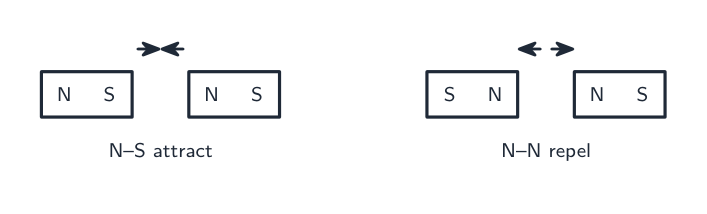
一个磁体(magnet)能吸引一些金属。每个磁体有两端,叫磁极(poles):一个北极(north pole,N 极)和一个南极(south pole,S 极)。
两个磁极的规则像电荷的规则:
- 相同的磁极(N 和 N,或 S 和 S)排斥(repel,推开):这是排斥力(repulsion)。
- 不同的磁极(N 和 S)吸引(attract,拉近):这是吸引力(attraction)。
一个磁体吸引一个磁性材料(magnetic material),如铁、钢、钴和镍。其他材料(铜、塑料、木头)是非磁性的,不感受力。
Induced magnetism
把一块铁放在一个磁体附近或接触它,铁本身变成一个磁体。这是感应磁性(induced magnetism)。最靠近磁体的铁端获得相反的磁极,所以两者随即吸引。
Temporary and permanent magnets
- 软铁(soft iron)容易被磁化(magnetise)但很快失去它的磁性。它被用于一个临时磁体(temporary magnet)。
- 钢(steel)更难被磁化但保持它的磁性。它被用于一个永磁体(permanent magnet)。
所以一块未磁化(unmagnetised)的软铁是一个电磁铁最好的铁芯,而钢最适合一个条形磁体。
Magnetic fields
一个磁场(magnetic field)是一个磁极感受力的区域(region)。我们用磁场线(magnetic field lines)画它:
- 线从 N 极出来、进入 S 极。
- 一个点的场方向是放在那里的一个小测试磁体 N 极上力的方向。
- 线靠近的地方场强;线相隔远的地方场弱。

你可以通过在一个磁体上方的纸上撒铁屑(iron filings),或通过在它周围移动一个小的绘图指南针(compass,指针沿场指)来显示这个图案。

Uses of magnets
- 永磁体:冰箱门扣、指南针指针、扬声器。
- 电磁铁(electromagnets,只在电流流动时有磁性):举废铁的起重机、电铃、继电器。一个电磁铁能被开关并被做得更强,这是一个永磁体不能的。
磁力发生是因为两个磁体的场互相推和拉。
探索
Make the magnetic field visible
Compass needles trace the field from N to S; switch between attract and repel and watch the whole pattern reorganise, with a neutral point appearing for like poles.
词汇表
训练
| 英文 | 中文 | 拼音 |
|---|---|---|
| magnet/ˈmæɡnɪt/ | 磁体 | cí tǐ |
| poles/pəʊlz/ | 磁极 | cí jí |
| north pole/nɔːθ pəʊl/ | 北极 | běi jí |
| south pole/saʊθ pəʊl/ | 南极 | nán jí |
| repel/rɪˈpel/ | 排斥 | pái chì |
| repulsion/rɪˈpʌlʃn/ | 排斥力 | pái chì lì |
| attract/əˈtrækt/ | 吸引 | xī yǐn |
| attraction/əˈtrækʃn/ | 吸引力 | xī yǐn lì |
| magnetic material/mæɡˈnetɪk məˈtɪərɪəl/ | 磁性材料 | cí xìng cái liào |
| induced magnetism/ɪnˈdjuːst ˈmæɡnɪtɪzəm/ | 感应磁性 | gǎn yìng cí xìng |
| soft iron/sɒft ˈaɪən/ | 软铁 | ruǎn tiě |
| magnetise/ˈmæɡnɪtaɪz/ | 磁化 | cí huà |
| temporary magnet/ˈtemprəri ˈmæɡnɪt/ | 临时磁体 | lín shí cí tǐ |
| steel/stiːl/ | 钢 | gāng |
| permanent magnet/ˈpɜːmənənt ˈmæɡnɪt/ | 永磁体 | yǒng cí tǐ |
| unmagnetised/ʌnˈmæɡnɪtaɪzd/ | 未磁化 | wèi cí huà |
| magnetic field/mæɡˈnetɪk fiːld/ | 磁场 | cí chǎng |
| region/ˈriːdʒn/ | 区域 | qū yù |
| magnetic field lines/mæɡˈnetɪk fiːld laɪnz/ | 磁场线 | cí chǎng xiàn |
| iron filings/ˈaɪən ˈfaɪlɪŋz/ | 铁屑 | tiě xiè |
| compass/ˈkʌmpəs/ | 指南针 | zhǐ nán zhēn |
| electromagnet/ɪˌlektrəʊˈmæɡnɪt/ | 电磁铁 | diàn cí tiě |
4.2
电学量

大纲
4.2.1 Electric charge
| Core | Supplement |
|---|---|
| 1 State that there are positive and negative charges | 7 State that charge is measured in coulombs |
| 2 State that positive charges repel other positive charges, negative charges repel other negative charges, but positive charges attract negative charges | 8 Describe an electric field as a region in which an electric charge experiences a force |
| 3 Describe simple experiments to show the production of electrostatic charges by friction and to show the detection of electrostatic charges | 9 State that the direction of an electric field at a point is the direction of the force on a positive charge at that point |
| 4 Explain that charging of solids by friction involves only a transfer of negative charge (electrons) | 10 Describe simple electric field patterns, including the direction of the field: (a) around a point charge (b) around a charged conducting sphere (c) between two oppositely charged parallel conducting plates (end effects will not be examined) |
| 5 Describe an experiment to distinguish between electrical conductors and insulators | |
| 6 Recall and use a simple electron model to explain the difference between electrical conductors and insulators and give typical examples |
4.2.2 Electric current
| Core | Supplement |
|---|---|
| 1 Know that electric current is related to the flow of charge | 5 Define electric current as the charge passing a point per unit time; recall and use the equation $I = \frac{Q}{t}$ |
| 2 Describe the use of ammeters (analogue and digital) with different ranges | |
| 3 Describe electrical conduction in metals in terms of the movement of free electrons | 6 State that conventional current is from positive to negative and that the flow of free electrons is from negative to positive |
| 4 Know the difference between direct current (d.c.) and alternating current (a.c.) |
4.2.3 Electromotive force and potential difference
| Core | Supplement |
|---|---|
| 1 Define electromotive force (e.m.f.) as the electrical work done by a source in moving a unit charge around a complete circuit | 6 Recall and use the equation for e.m.f. $E = \frac{W}{Q}$ |
| 2 Know that e.m.f. is measured in volts (V) | |
| 3 Define potential difference (p.d.) as the work done by a unit charge passing through a component | 7 Recall and use the equation for p.d. $V = \frac{W}{Q}$ |
| 4 Know that the p.d. between two points is measured in volts (V) | |
| 5 Describe the use of voltmeters (analogue and digital) with different ranges |
4.2.4 Resistance
| Core | Supplement |
|---|---|
| 1 Recall and use the equation for resistance $R = \frac{V}{I}$ | 4 Sketch and explain the current–voltage graphs for a resistor of constant resistance, a filament lamp and a diode |
| 2 Describe an experiment to determine resistance using a voltmeter and an ammeter and do the appropriate calculations | |
| 3 State, qualitatively, the relationship of the resistance of a metallic wire to its length and to its cross-sectional area | 5 Recall and use the following relationship for a metallic electrical conductor: (a) resistance is directly proportional to length (b) resistance is inversely proportional to cross-sectional area |
4.2.5 Electrical energy and electrical power
| Core | Supplement |
|---|---|
| 1 Understand that electric circuits transfer energy from a source of electrical energy, such as an electrical cell or mains supply, to the circuit components and then into the surroundings | |
| 2 Recall and use the equation for electrical power $P = IV$ | |
| 3 Recall and use the equation for electrical energy $E = IVt$ | |
| 4 Define the kilowatt-hour (kWh) and calculate the cost of using electrical appliances where the energy unit is the kWh |
来源:剑桥国际大纲
有两种电荷(electric charge):正电荷(positive charge)和负电荷(negative charge)。规则像磁极的规则——同电荷排斥,异电荷吸引。
Charging by friction
当你把两个不同的材料摩擦在一起时,电子(electrons,微小的负粒子)从一个移到另一个。这是摩擦起电(charging by friction)。
- 获得电子的材料变成负的。
- 失去电子的材料变成正的。
只有负电子移动;正电荷保持在原位。例如,一根用布摩擦的塑料棒变成负的,因为电子从布移到棒上,留下布正的。
检测电荷。 一根带电的棒能吸起小纸片,并使水龙头流出的一股细水流弯曲。把一根带电的棒用线悬挂起来,再把另一根带电的棒靠近它:若两者带同一种电荷,悬挂的棒摆开。排斥是电荷唯一可靠的检验,因为不带电的物体也会发生吸引。
Conductors and insulators
- 一个导体(conductor,铜和其他金属)让电荷容易地流过它,因为它有能移动的自由电子。
- 一个绝缘体(insulator,塑料、橡胶、玻璃)不让电荷流动,因为它的电子不能自由移动。
要测试一个材料,把它与一个灯和一个电池连在一个电路里:灯只对一个导体点亮。
Electric fields and ions
电荷以库仑(coulombs,C)测量。一个电场(electric field)是一个电荷感受力的区域。它在一个点的方向是一个正电荷上力的方向。简单的场图案(箭头显示方向):
- 一个点电荷(point charge)周围:直线,从一个正电荷指出、朝一个负电荷指;
- 一个带电球周围:相同,四周均匀地铺开;
- 两个带相反电荷的平行板之间:从正板到负板的直的、均匀间隔的线。
一个原子通常是中性的。若它失去电子它变成一个正离子(ion);若它获得电子它变成一个负离子。
探索
Rub a balloon and watch it charge
Rubbing moves electrons onto the balloon, making it negative — then it attracts a neutral wall or your hair, but repels another negative balloon.
词汇表
训练
| 英文 | 中文 | 拼音 |
|---|---|---|
| electric charge/ɪˈlektrɪk tʃɑːdʒ/ | 电荷 | diàn hè |
| positive charge/ˈpɒzɪtɪv tʃɑːdʒ/ | 正电荷 | zhèng diàn hè |
| negative charge/ˈneɡətɪv tʃɑːdʒ/ | 负电荷 | fù diàn hè |
| electron/ɪˈlektrɒn/ | 电子 | diàn zi |
| charging by friction/ˈtʃɑːdʒɪŋ baɪ ˈfrɪkʃn/ | 摩擦起电 | mó cā qǐ diàn |
| insulator/ˈɪnsjuːleɪtə/ | 绝缘体 | jué yuán tǐ |
| coulomb/ˈkuːlɒm/ | 库仑 | kù lún |
| electric field/ɪˈlektrɪk fiːld/ | 电场 | diàn chǎng |
| point charge/pɔɪnt tʃɑːdʒ/ | 点电荷 | diǎn diàn hè |
| ion/ˈaɪɒn/ | 离子 | lí zi |
4.2
电流
一个电流(electric current)是电荷的一个流动。它用一个电流表(ammeter)以安培(amperes,A)测量,在电路中串联。
一个模拟(analogue)电流表有一根在刻度上移动的指针;一个数字(digital)电流表把读数显示为一个数。两者都有不同的量程(ranges)。选择刚好在你预期的最大电流之上的量程,这样读数准确:对约 0.4 A 的电流用 0–1 A 的量程,对几毫安用 0–100 mA 的量程。
电流是每秒通过一个点的电荷:
$$I = \frac{Q}{t}$$
这里 $I$ 是电流(A),$Q$ 是电荷(C),而 $t$ 是时间(s)。重排,$Q = It$。
例题。 一个 $3.0\ \text{A}$ 的电流流过一个灯 $20\ \text{s}$。有多少电荷通过它?
$$Q = It = 3.0 \times 20 = 60\ \text{C}$$
在一个金属中电流是自由电子(free electrons)的一个流动。有两个"方向"要知道:
- 常规电流(conventional current)被取为在电池外围从 + 到 − 流动。
- 自由电子真的向另一个方向漂移,从 − 到 +。
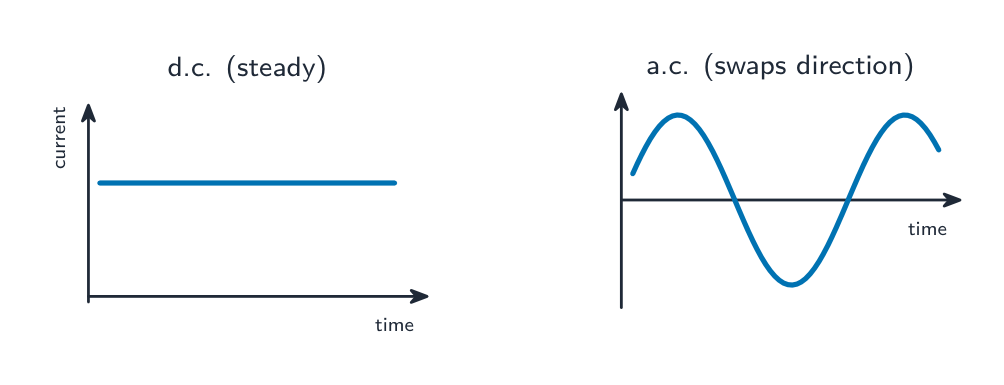
一个直流电(direct current,d.c.)总是往一个方向流,如来自一个电池。一个交流电(alternating current,a.c.)每秒多次不断交换方向,如来自市电(mains supply)。
词汇表
训练
| 英文 | 中文 | 拼音 |
|---|---|---|
| electric current/ɪˈlektrɪk ˈkʌrənt/ | 电流 | diàn liú |
| ampere/ˈæmpeə/ | 安培 | ān péi |
| ammeter/ˈæmiːtə/ | 电流表 | diàn liú biǎo |
| analogue/ˈænəlɒɡ/ | 模拟 | mó nǐ |
| digital/ˈdɪdʒɪtl/ | 数字 | shù zì |
| ranges/ˈreɪndʒɪz/ | 量程 | liáng chéng |
| free electrons/friː ɪˈlektrɒnz/ | 自由电子 | zì yóu diàn zi |
| conventional current/kənˈvenʃənl ˈkʌrənt/ | 常规电流 | cháng guī diàn liú |
| direct current/daɪˈrekt ˈkʌrənt/ | 直流电 | zhí liú diàn |
| alternating current/ˈɔːltəneɪtɪŋ ˈkʌrənt/ | 交流电 | jiāo liú diàn |
| mains supply/meɪnz səˈplaɪ/ | 市电 | shì diàn |
4.2
电动势与电势差

一个电池给通过它移动的电荷能量(energy)。两个量描述这个,而且都以伏特(volts,V)测量。
- 一个源的电动势(electromotive force,e.m.f.)是它驱动单位电荷绕一个完整电路(circuit)一整圈做的电功。
- 一个元件两端的电势差(potential difference,p.d.)是单位电荷通过那个元件时做的功。
一个电压表(voltmeter)测量 e.m.f. 或 p.d.。它并联(在元件两端)。像电流表一样,电压表有模拟的和数字的,并有不同的量程:选刚好在你预期的最大电压之上的量程。
两者都是单位电荷做的功:
$$E = \frac{W}{Q}, \qquad V = \frac{W}{Q}$$
其中 $W$ 是转移的能量(J),而 $Q$ 是电荷(C)。例如,若一个电池做 $120\ \text{J}$ 的功移动 $60\ \text{C}$ 的电荷绕一个电路,它的 e.m.f. 是 $120 / 60 = 2\ \text{V}$。
词汇表
训练
| 英文 | 中文 | 拼音 |
|---|---|---|
| energy/ˈenədʒi/ | 能量 | néng liàng |
| volt/vəʊlt/ | 伏特 | fú tè |
| electromotive force/ɪˌlektrəʊˈməʊtɪv fɔːs/ | 电动势 | diàn dòng shì |
| circuit/ˈsɜːkɪt/ | 电路 | diàn lù |
| potential difference/pəˈtenʃl ˈdɪfrəns/ | 电势差 | diàn shì chā |
| voltmeter/ˈvəʊltmiːtə/ | 电压表 | diàn yā biǎo |
4.2
电阻

电阻(resistance)测量电流流动有多难。一个更大的电阻给一个更小的电流。它以欧姆(ohms,Ω)测量。
$$R = \frac{V}{I}$$
测量电阻。 把元件与一个电池、一个开关、一个电流表和一个可变电阻器(variable resistor)串联,并在元件两端并联一个电压表。闭合开关,读 $I$ 和 $V$,然后改变可变电阻器以得到另外几对读数。要么对每一对计算 $R = V/I$ 并取平均,要么以 $V$ 对 $I$ 作图:对于恒定温度的金属线,图是一条通过原点的直线,它的斜率是 $R$。
例题。 一个 $12\ \text{V}$ 的电池驱动一个 $0.50\ \text{A}$ 的电流通过一个灯。求灯的电阻。
$$R = \frac{V}{I} = \frac{12}{0.50} = 24\ \Omega$$
对于一根恒定温度的金属线:
- 一根更长的线有一个更大的电阻——电阻与长度成正比(directly proportional),$R \propto l$;
- 一根更粗的线有一个更小的电阻——电阻与横截面积(cross-sectional area)成反比(inversely proportional),$R \propto \dfrac{1}{A}$。
所以把长度翻倍使电阻翻倍;把面积翻倍使它减半。(面积取决于直径的平方,所以直径的一个小变化大大改变电阻。)
电流-电压图显示三个元件如何表现:
| 元件 | I–V 图的形状 | 它告诉你什么 |
|---|---|---|
| 电阻器(resistor,固定) | 通过原点的直线 | 电阻恒定,所以 $I \propto V$ |
| 灯丝灯泡(filament lamp) | S 形,随 $V$ 上升变得更平 | 线变热,所以它的电阻上升 |
| 二极管(diode) | 电流只往一个方向 | "错误"方向非常高的电阻 |
探索
Ohm's law
V = IR
For an ohmic conductor the current is proportional to the voltage — the gradient is 1/resistance.
探索
I–V characteristics
A resistor gives a straight line; a filament lamp and a diode do not. Pick a component and read I and R off the curve.
探索
Resistance
V = R·I
Ohm's law: voltage is proportional to current — the gradient is the resistance R.
词汇表
训练
| 英文 | 中文 | 拼音 |
|---|---|---|
| resistance/rɪˈzɪstəns/ | 电阻 | diàn zǔ |
| ohm/əʊm/ | 欧姆 | ōu mǔ |
| variable resistor/ˈveərɪəbl rɪˈzɪstə/ | 可变电阻器 | kě biàn diàn zǔ qì |
| directly proportional/daɪˈrektli prəˈpɔːʃənl/ | 成正比 | chéng zhèng bǐ |
| inversely proportional/ɪnˈvɜːsli prəˈpɔːʃənl/ | 成反比 | chéng fǎn bǐ |
| cross-sectional area/krɒs ˈsekʃənl ˈeərɪə/ | 横截面积 | héng jié miàn jī |
| resistor/rɪˈzɪstə/ | 电阻器 | diàn zǔ qì |
| filament lamp/ˈfɪləmənt læmp/ | 灯丝灯泡 | dēng sī dēng pào |
| diode/ˈdaɪəʊd/ | 二极管 | èr jí guǎn |
4.2
电能与电功率
一个电路把能量从一个源(一个电池或市电)转移到元件,然后到周围环境(常常作为热、光或声音)。
电功率(electrical power)是每秒转移的能量,以瓦特(watts,W)测量:
$$P = IV$$
在一个时间 $t$ 内转移的电能(electrical energy),以焦耳(joules,J)测量,是:
$$E = IVt$$
例题。 一个 $12\ \text{V}$ 的马达取一个 $2.0\ \text{A}$ 的电流。求它的功率,以及它在 $30\ \text{s}$ 内转移的能量。
$$P = IV = 2.0 \times 12 = 24\ \text{W}$$
$$E = Pt = 24 \times 30 = 720\ \text{J}$$
The kilowatt-hour
家庭电费用一个更大的能量单位,千瓦时(kilowatt-hour,kWh)。一千瓦时是一个 $1\ \text{kW}$ 的电器(appliance)在 $1$ 小时使用的能量。
$$\text{energy (kWh)} = \text{power (kW)} \times \text{time (h)}$$
$$\text{cost} = \text{energy (kWh)} \times \text{price per kWh}$$
例如,一个 $2\ \text{kW}$ 的加热器(heater)使用 $3$ 小时用 $2 \times 3 = 6\ \text{kWh}$。若一 kWh 花 $20$ 分,成本是 $6 \times 20 = 120$ 分。
词汇表
训练
| 英文 | 中文 | 拼音 |
|---|---|---|
| electrical power/ɪˈlektrɪkl ˈpaʊə/ | 电功率 | diàn gōng lǜ |
| watt/wɒt/ | 瓦特 | wǎ tè |
| electrical energy/ɪˈlektrɪkl ˈenədʒi/ | 电能 | diàn néng |
| joule/dʒuːl/ | 焦耳 | jiāo ěr |
| kilowatt-hour/ˈkɪləwɒt ˈaʊə/ | 千瓦时 | qiān wǎ shí |
| appliance/əˈplaɪəns/ | 电器 | diàn qì |
| heater/ˈhiːtə/ | 加热器 | jiā rè qì |
4.3
电路
大纲
4.3.1 Circuit diagrams and circuit components
| Core | Supplement |
|---|---|
| 1 Draw and interpret circuit diagrams containing cells, batteries, power supplies, generators, potential dividers, switches, resistors (fixed and variable), heaters, thermistors (NTC only), light-dependent resistors (LDRs), lamps, motors, bells, ammeters, voltmeters, magnetising coils, transformers, fuses and relays and know how these components behave in the circuit | 2 Draw and interpret circuit diagrams containing diodes and light-emitting diodes (LEDs) and know how these components behave in the circuit |
4.3.2 Series and parallel circuits
| Core | Supplement |
|---|---|
| 1 Know that the current at every point in a series circuit is the same | 8 Recall and use in calculations, the fact that: (a) the sum of the currents entering a junction in a parallel circuit is equal to the sum of the currents that leave the junction (b) the total p.d. across the components in a series circuit is equal to the sum of the individual p.d.s across each component (c) the p.d. across an arrangement of parallel resistances is the same as the p.d. across one branch in the arrangement of the parallel resistances |
| 2 Know how to construct and use series and parallel circuits | |
| 3 Calculate the combined e.m.f. of several sources in series | |
| 4 Calculate the combined resistance of two or more resistors in series | |
| 5 State that, for a parallel circuit, the current from the source is larger than the current in each branch | 9 Explain that the sum of the currents into a junction is the same as the sum of the currents out of the junction |
| 6 State that the combined resistance of two resistors in parallel is less than that of either resistor by itself | 10 Calculate the combined resistance of two resistors in parallel |
| 7 State the advantages of connecting lamps in parallel in a lighting circuit |
4.3.3 Action and use of circuit components
| Core | Supplement |
|---|---|
| 1 Know that the p.d. across an electrical conductor increases as its resistance increases for a constant current | 2 Describe the action of a variable potential divider |
| 3 Recall and use the equation for two resistors used as a potential divider $$\frac{R_1}{R_2} = \frac{V_1}{V_2}$$ |
来源:剑桥国际大纲
Circuit components
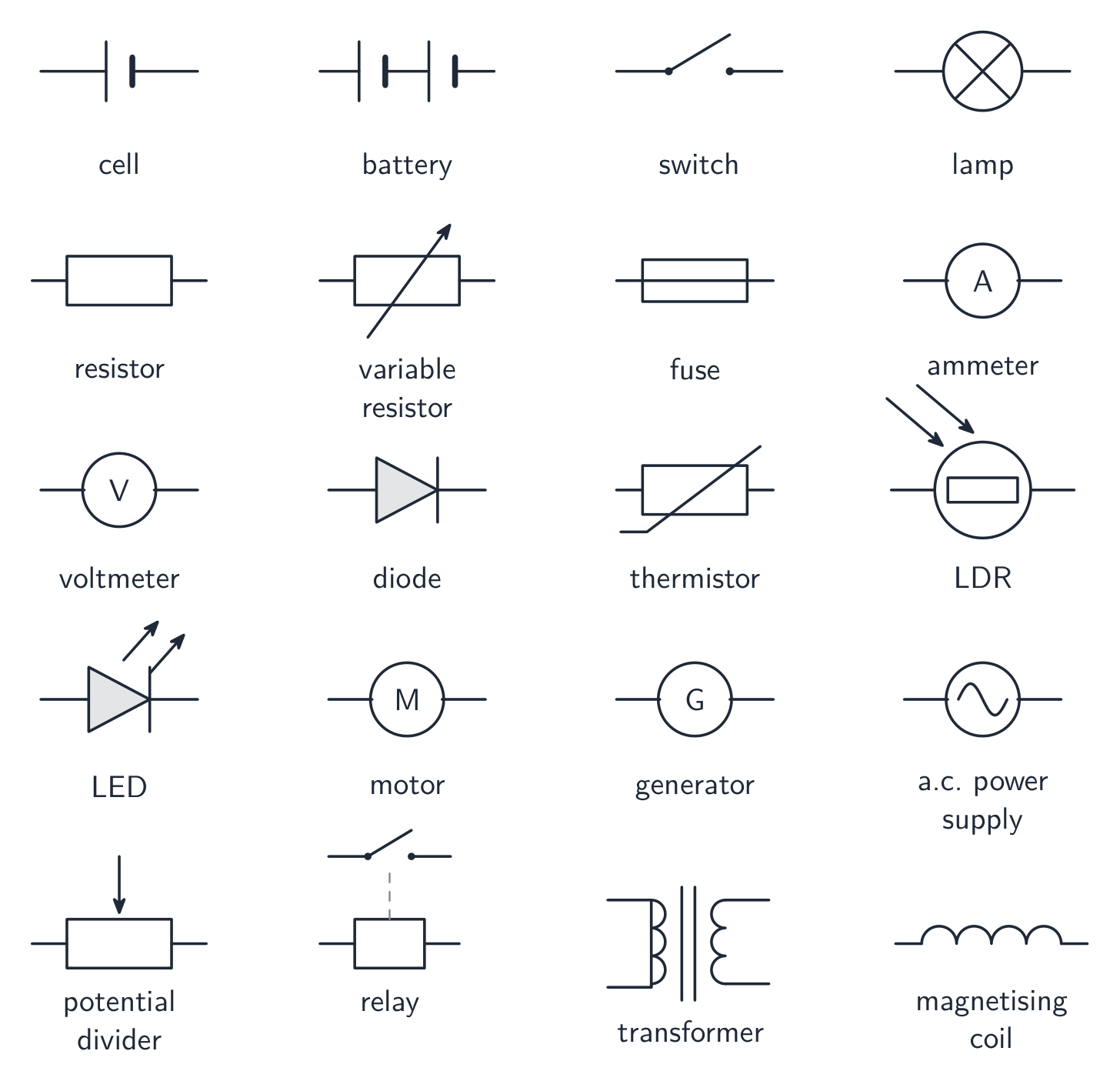
你应当知道这些元件以及它们如何表现:
| 元件 | 它做什么 |
|---|---|
| 电池(cell)/ 电池组(battery) | 驱动电流绕电路(一个电池组是两个或更多电池) |
| 电源(power supply) | 一个 d.c. 或 a.c. 的源 |
| 开关(switch) | 断开或接通电路 |
| 电阻器(固定) | 给一个固定的电阻 |
| 可变电阻器(variable resistor) | 一个你能改变的电阻,以控制电流 |
| 保险丝(fuse) | 若电流太大就熔化并断开电路 |
| 灯 / 加热器 | 把电能变成光 / 变成热 |
| 热敏电阻(thermistor) | 它的电阻随它变热而下降 |
| 光敏电阻(light-dependent resistor,LDR) | 它的电阻随光变亮而下降 |
| 二极管 / 发光二极管(light-emitting diode,LED) | 只让电流往一个方向;一个 LED 也放出光 |
| 继电器(relay) | 一个由一个电磁铁工作的开关(小电流控制一个大的) |
| 电动机(motor) | 把电能变成运动 |
| 电铃(bell) | 制造一个声音 |
| 变压器(transformer) | 改变一个 a.c. 电压的大小 |
Series and parallel
在一个串联(series)电路中各部分构成一个单一的回路:
- 电流在每个点都相同;
- 电源 p.d. 在元件之间分享;
- 串联的电池加它们的 e.m.f.(当它们指向同一个方向时);
- 串联的电阻器加起来:$R_{\text{total}} = R_1 + R_2 + \dots$
在一个并联(parallel)电路中各部分在分开的支路上:
- 每个支路得到完整的电源 p.d.;
- 电流分裂,所以来自源的电流比任何一个支路中的电流大;
- 总电阻(total resistance)小于最小的单一电阻。
一个家里的灯并联布线:每个得到完整的电压,而若一个失效其他的保持点亮。

对于计算(用上面的规则):
- 在一个节点(junction),流入的总电流等于流出的总电流;
- 在串联中,电源 p.d. 等于元件两端 p.d. 之和;
- 在并联中,每个支路两端的 p.d. 相同;
- 两个并联的电阻器组合成
$$\frac{1}{R_{\text{total}}} = \frac{1}{R_1} + \frac{1}{R_2}$$
例题。 一个 $6\ \Omega$ 的电阻器和一个 $3\ \Omega$ 的电阻器并联连接。求它们组合的电阻。
$$\frac{1}{R_{\text{total}}} = \frac{1}{6} + \frac{1}{3} = \frac{1}{6} + \frac{2}{6} = \frac{3}{6} = \frac{1}{2} \quad\Rightarrow\quad R_{\text{total}} = 2\ \Omega$$
注意组合的电阻($2\ \Omega$)比两个电阻器中较小的更小。
Potential dividers
两个串联的电阻器分享电源电压。这是一个分压器(potential divider)。对于相同的电流,一个更大的电阻两端有一个更大的 p.d.,所以更大的电阻取更大的份额:
$$\frac{R_1}{R_2} = \frac{V_1}{V_2}$$
一个可变分压器(或一个可变电阻器)让你平滑地改变输出电压,例如从 $0\ \text{V}$ 到完整的电源。若你用一个热敏电阻或一个 LDR 作为电阻器之一,输出电压随温度或光改变——便于自动地开关一个加热器或一个灯。
探索
Build the current with Ohm's law
Turn up the voltage and the electrons speed up and the bulb glows brighter; add resistance and the current drops. I = V/R, brightness = power.
词汇表
训练
| 英文 | 中文 | 拼音 |
|---|---|---|
| cell/sel/ | 电池 | diàn chí |
| battery/ˈbætəri/ | 电池组 | diàn chí zǔ |
| power supply/ˈpaʊə səˈplaɪ/ | 电源 | diàn yuán |
| switch/swɪtʃ/ | 开关 | kāi guān |
| fuse/fjuːz/ | 保险丝 | bǎo xiǎn sī |
| thermistor/ˈθɜːmɪstə/ | 热敏电阻 | rè mǐn diàn zǔ |
| light-dependent resistor/laɪt dɪˈpendənt rɪˈzɪstə/ | 光敏电阻 | guāng mǐn diàn zǔ |
| light-emitting diode/laɪt ɪˈmɪtɪŋ ˈdaɪəʊd/ | 发光二极管 | fā guāng èr jí guǎn |
| relay/ˈriːleɪ/ | 继电器 | jì diàn qì |
| motor/ˈməʊtə/ | 电动机 | diàn dòng jī |
| bell/bel/ | 电铃 | diàn líng |
| series/ˈsɪəriːz/ | 串联 | chuàn lián |
| parallel/ˈpærəlel/ | 并联 | bìng lián |
| total resistance/ˈtəʊtl rɪˈzɪstəns/ | 总电阻 | zǒng diàn zǔ |
| junction/ˈdʒʌŋkʃn/ | 节点 | jié diǎn |
| potential divider/pəˈtenʃl dɪˈvaɪdə/ | 分压器 | fēn yā qì |
4.4
用电安全
大纲
| Core | Supplement |
|---|---|
| 1 State the hazards of: (a) damaged insulation (b) overheating cables (c) damp conditions (d) excess current from overloading of plugs, extension leads, single and multiple sockets when using a mains supply | |
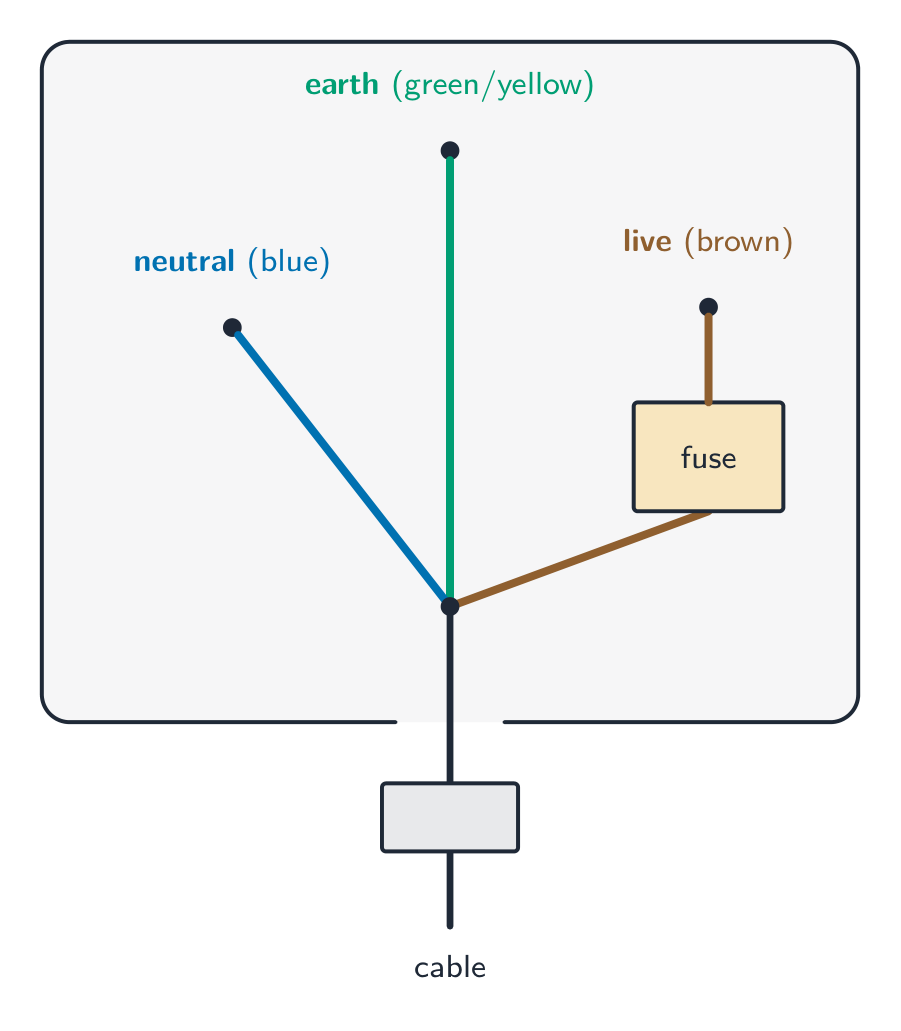
| 2 Know that a mains circuit consists of a live wire (line wire), a neutral wire and an earth wire and explain why a switch must be connected to the live wire for the circuit to be switched off safely | |
| 3 Explain the use and operation of trip switches and fuses and choose appropriate fuse ratings and trip switch settings | |
| 4 Explain why the outer casing of an electrical appliance must be either non-conducting (double-insulated) or earthed | |
| 5 State that a fuse without an earth wire protects the circuit and the cabling for a double-insulated appliance |
来源:剑桥国际大纲
一个家由市电供电。若被错误地使用,市电是危险的。
Hazards
这些是市电的危险(hazards):
- 损坏的绝缘层(insulation)——裸线能给一个电击或引起火灾;
- 过热(overheating)的电缆——太多的电流使一根电缆热,它能引起火灾;
- 潮湿(damp)的条件——水让电流进入一个人,提高电击的风险;
- 过载(overloading)——把太多的电器插进一个插座(socket)取太多的电流。
Live, neutral and earth
一根市电电缆有三根线:
- 火线(live wire)携带高电压;
- 零线(neutral wire)在约零电压完成电路;
- 地线(earth wire)是一根连到地面的安全线。
一个开关(和一个保险丝)必须安装在火线中。然后,当开关关闭时,电器与高电压切断,可以安全地触摸。
Fuses, trip switches and earthing
一个保险丝是一根细线,若电流变得太大就熔化,在电缆过热之前断开电路。选择一个刚好在正常工作电流之上的额定值(fuse rating)——例如给一个正常用约 $10\ \text{A}$ 的电器一个 $13\ \text{A}$ 的保险丝。
一个跳闸开关(trip switch,断路器)做同样的工作但作用更快,而且能被重置而不是替换。
一个电器的金属外壳(casing)必须以两种方式之一被做得安全:
- 接地(earthed):外壳连到地线。若一根火线接触外壳,一个大电流流到地并熔断保险丝。
- 双重绝缘(double-insulated):外壳是塑料,所以它永不能带电。这样一个电器不需要地线;它的保险丝仍保护电缆。
探索
Electrical safety route
Follow fault current and see how safety devices protect people.
词汇表
训练
| 英文 | 中文 | 拼音 |
|---|---|---|
| hazard/ˈhæzəd/ | 危险 | wēi xiǎn |
| insulation/ˌɪnsjuːˈleɪʃn/ | 绝缘层 | jué yuán céng |
| overheating/ˌəʊvəˈhiːtɪŋ/ | 过热 | guò rè |
| damp/dæmp/ | 潮湿 | cháo shī |
| overloading/ˌəʊvəˈləʊdɪŋ/ | 过载 | guò zài |
| socket/ˈsɒkɪt/ | 插座 | chā zuò |
| live wire/laɪv ˈwaɪə/ | 火线 | huǒ xiàn |
| neutral wire/ˈnjuːtrəl ˈwaɪə/ | 零线 | líng xiàn |
| earth wire/ɜːθ ˈwaɪə/ | 地线 | dì xiàn |
| fuse rating/fjuːz ˈreɪtɪŋ/ | 额定值 | é dìng zhí |
| trip switch/trɪp swɪtʃ/ | 跳闸开关 | tiào zhá kāi guān |
| casing/ˈkeɪsɪŋ/ | 外壳 | wài ké |
| earthed/ɜːθt/ | 接地 | jiē dì |
| double-insulated/ˈdʌbl ˈɪnsjuːleɪtɪd/ | 双重绝缘 | shuāng chóng jué yuán |
4.5
电磁效应

大纲
4.5.1 Electromagnetic induction
| Core | Supplement |
|---|---|
| 1 Know that a conductor moving across a magnetic field or a changing magnetic field linking with a conductor can induce an e.m.f. in the conductor | 4 Know that the direction of an induced e.m.f. opposes the change causing it |
| 2 Describe an experiment to demonstrate electromagnetic induction | 5 State and use the relative directions of force, field and induced current |
| 3 State the factors affecting the magnitude of an induced e.m.f. |
4.5.2 The a.c. generator
| Core | Supplement |
|---|---|
| 1 Describe a simple form of a.c. generator (rotating coil or rotating magnet) and the use of slip rings and brushes where needed | |
| 2 Sketch and interpret graphs of e.m.f. against time for simple a.c. generators and relate the position of the generator coil to the peaks, troughs and zeros of the e.m.f. |
4.5.3 Magnetic effect of a current
| Core | Supplement |
|---|---|
| 1 Describe the pattern and direction of the magnetic field due to currents in straight wires and in solenoids | 4 State the qualitative variation of the strength of the magnetic field around straight wires and solenoids |
| 2 Describe an experiment to identify the pattern of the magnetic field (including direction) due to currents in straight wires and in solenoids | |
| 3 Describe how the magnetic effect of a current is used in relays and loudspeakers and give examples of their application | 5 Describe the effect on the magnetic field around straight wires and solenoids of changing the magnitude and direction of the current |
4.5.4 Force on a current-carrying conductor
| Core | Supplement |
|---|---|
| 1 Describe an experiment to show that a force acts on a current-carrying conductor in a magnetic field, including the effect of reversing: (a) the current (b) the direction of the field | 2 Recall and use the relative directions of force, magnetic field and current |
| 3 Determine the direction of the force on beams of charged particles in a magnetic field |
4.5.5 The d.c. motor
| Core | Supplement |
|---|---|
| 1 Know that a current-carrying coil in a magnetic field may experience a turning effect and that the turning effect is increased by increasing: (a) the number of turns on the coil (b) the current (c) the strength of the magnetic field | 2 Describe the operation of an electric motor, including the action of a split-ring commutator and brushes |
4.5.6 The transformer
| Core | Supplement |
|---|---|
| 1 Describe the construction of a simple transformer with a soft-iron core, as used for voltage transformations | 6 Explain the principle of operation of a simple iron-cored transformer |
| 2 Use the terms primary, secondary, step-up and step-down | |
| 3 Recall and use the equation $$\frac{V_p}{V_s} = \frac{N_p}{N_s}$$ where p and s refer to primary and secondary |
7 Recall and use the equation for 100% efficiency in a transformer $$I_p V_p = I_s V_s$$ where p and s refer to primary and secondary |
| 4 Describe the use of transformers in high-voltage transmission of electricity | |
| 5 State the advantages of high-voltage transmission | 8 Recall and use the equation $$P = I^2 R$$ to explain why power losses in cables are smaller when the voltage is greater |
来源:剑桥国际大纲
The magnetic effect of a current
一根线中的一个电流在它周围构成一个磁场。
- 一根直线周围的磁场线是线周围的圆;场在靠近线处更强。反转电流而场反转。
- 一个螺线管(solenoid,一个长的线线圈(coil))构成一个正像一个条形磁体的场,一端一个 N 极、另一端一个 S 极。里面的场强而均匀。
你可以用铁屑或一个绘图指南针显示两个图案。若你增加电流、加更多匝,或在里面放一个软铁芯,场就变得更强。
磁效应被用于一个继电器和一个扬声器。在一个继电器中,一个线圈中的小电流使一个软铁芯磁化,它把第二个电路中的一个开关拉闭合。第二个电路可以携带一个大电流,所以一个小开关或一个传感器能安全地控制一个电动机或一个加热器(例如,一辆车的点火开关通过一个继电器启动它的马达)。在一个扬声器(loudspeaker)中,一个线圈中变化的电流使线圈推和拉一个纸锥,它移动空气并制造声音。
Electromagnetic induction
当一根线横过一个磁场移动、或穿过一个线圈的场改变时,一个 e.m.f. 在线中被感应。若线是一个完整电路的一部分,这个 e.m.f. 驱动一个电流。这是电磁感应(electromagnetic induction)。
要显示它:把一个磁体移进和移出一个连到一个灵敏仪表的线圈,并观察指针弹动。当你用一个更强的磁体、移动更快,或在线圈上用更多匝时,感应的 e.m.f. 更大。感应的 e.m.f. 总是作用来反对引起它的改变。感应电流的方向由弗莱明右手定则(Fleming's right-hand rule)给出:把右手的拇指、食指和中指互相成直角地伸开;拇指指向导线的运动方向,食指指向磁场(N 到 S),中指就给出感应电流。
The a.c. generator
一个交流发电机(a.c. generator)把运动变成电。一个线圈在一个磁场中被旋转(或一个磁体在一个线圈附近被旋转)。随着它转,穿过线圈的场不断改变,所以一个交变的 e.m.f. 被感应。
- 滑环(slip rings)和碳电刷(brushes)在线圈不断转的时候把电流带出到电路。
- 当线圈平躺(横过场移动最快)时 e.m.f. 最大,当线圈直立(沿场移动)时为零。所以 e.m.f.-时间图是一个波:峰、零、相反的峰、零,每一圈。

Force on a current-carrying conductor
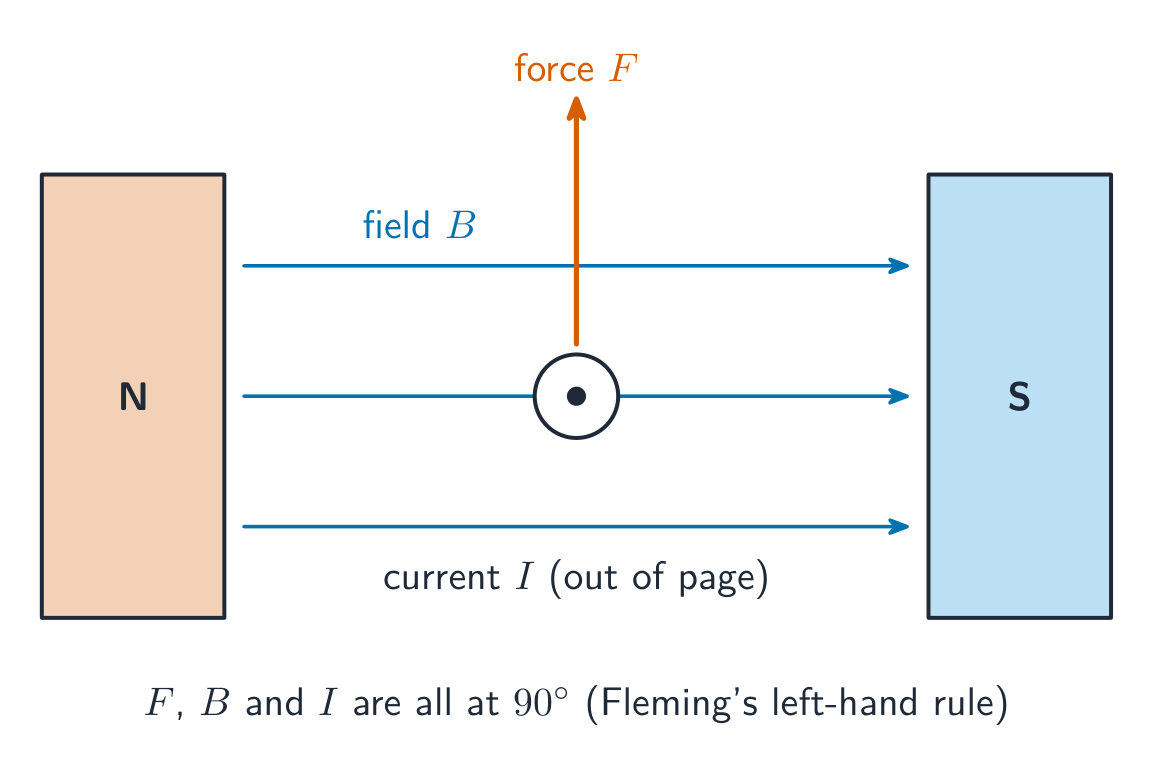
当一根载流线位于一个磁场中时,线的场和磁体的场互相推,所以线感受一个力。这是电动机效应(motor effect)。
- 反转电流,或反转场,而力反转。
- 使电流更大或场更强,而力更大。
力、场和电流互相成直角。你可以用弗莱明左手定则(Fleming's left-hand rule)求力的方向:拇指 = 力(运动),食指 = 场(N 到 S),中指 = 电流。
显示这个力。 把一根硬的铜线(或一条铝箔)放在一个 U 形磁体的两极之间,并通过一个开关把它连到一个电池。当电流流动时,导线向上或向下跳。把电池反接,导线往另一个方向跳;把磁体翻转,它又反转。更大的电流或更强的磁体给出更大的跳动。
一个运动的带电粒子流是一个电流,所以一个磁场也把它推向一边——它使束偏转(deflects)。(记住电子流动与常规电流相反。)
The d.c. motor
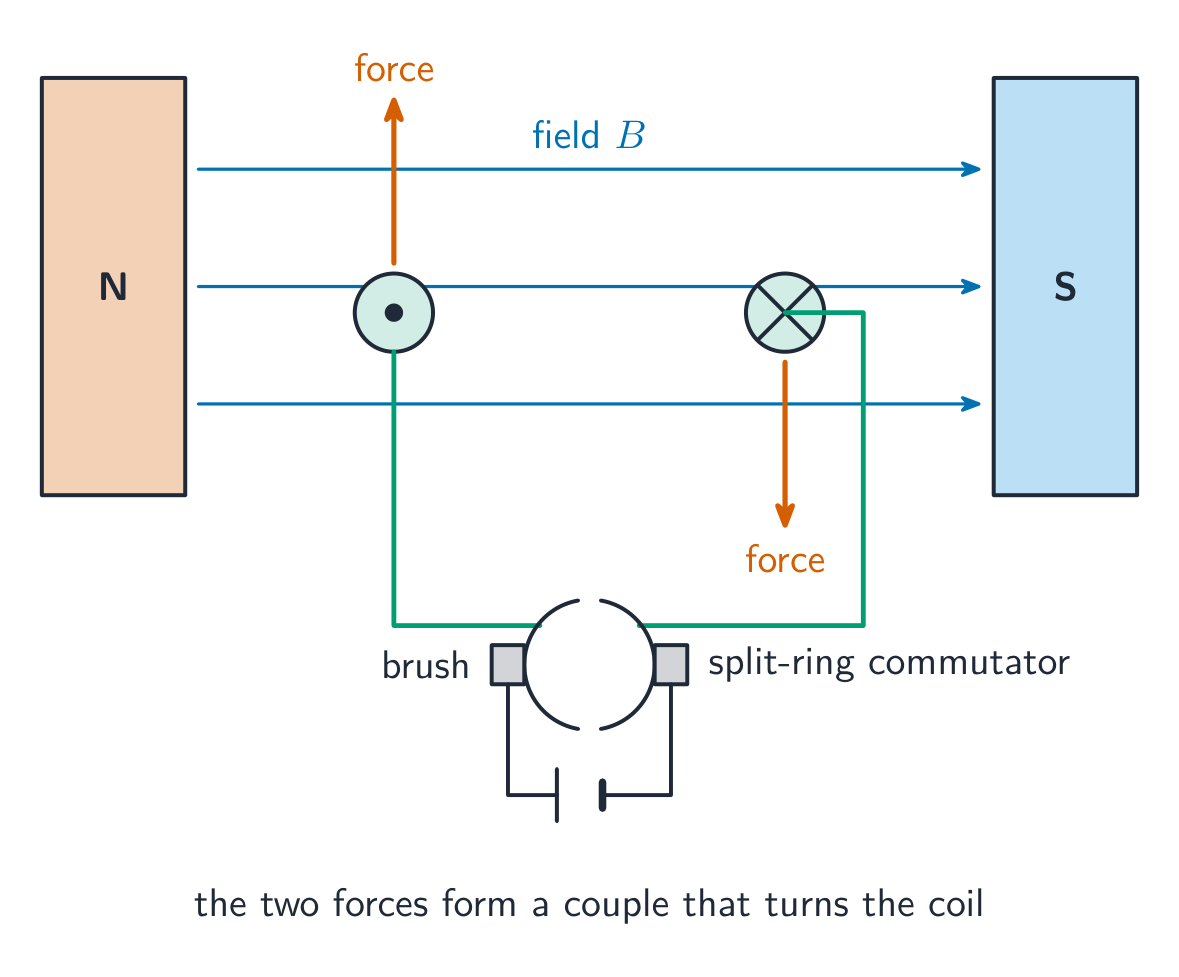
一个磁场中一个载流线圈感受一个转动效应(turning effect),因为它两侧上的力向相反的方向作用。这是一个直流电动机(d.c. motor)。用线圈上更多的匝、一个更大的电流,或一个更强的场,转动效应更大。
一个换向器(split-ring commutator)每半圈交换线圈中的电流方向。这使线圈保持往同一个方向转,而不是在半圈后停止。
The transformer
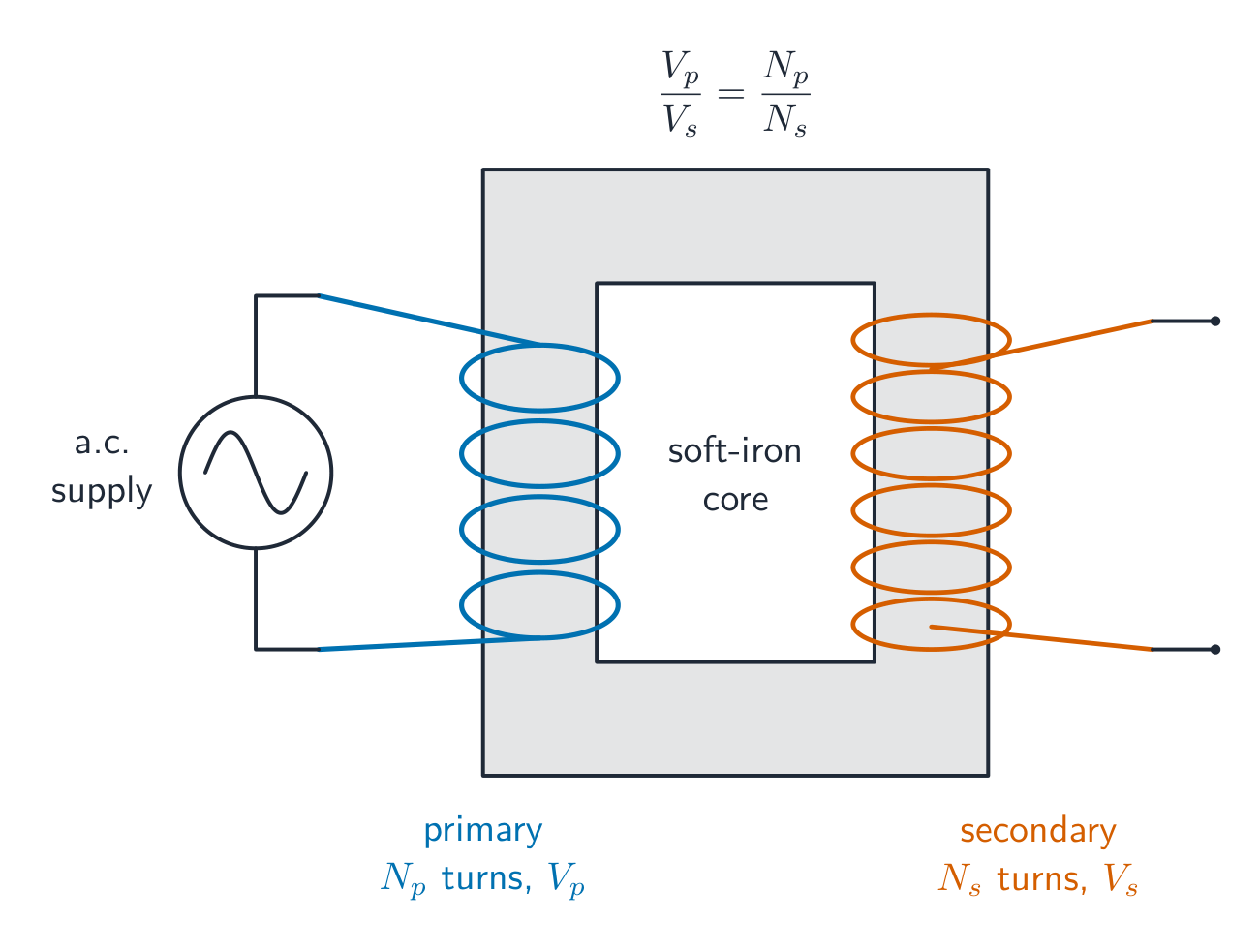
一个变压器(transformer)改变一个 a.c. 电压的大小。它有两个绕在一个软铁芯(soft-iron core)上的线圈:
- 原线圈(primary coil)吸入 a.c. 电压;
- 副线圈(secondary coil)给出改变的电压。
原线圈中的 a.c. 在铁芯中构成一个变化的磁场。铁芯把这个场带到副线圈,它在那里感应一个 a.c. e.m.f.。电压和匝数由以下联系:
$$\frac{V_p}{V_s} = \frac{N_p}{N_s}$$
例题。 一个变压器在原线圈有 $1200$ 匝、在副线圈有 $100$ 匝。原线圈连到一个 $240\ \text{V}$ 的 a.c. 电源。求副线圈电压。
$$\frac{240}{V_s} = \frac{1200}{100} = 12 \quad\Rightarrow\quad V_s = \frac{240}{12} = 20\ \text{V}$$
副线圈上更少的匝,所以这是一个降压变压器。

若副线圈有更多的匝,它是一个升压(step-up)变压器(电压上升);更少的匝构成一个降压(step-down)变压器(电压下降)。例如,一个把 $240\ \text{V}$ 变成 $12\ \text{V}$ 的变压器是一个降压型,而原线圈有副线圈 $20$ 倍那么多的匝。
若一个变压器 100% 高效,输入的功率等于输出的功率:
$$I_p V_p = I_s V_s$$
所以一个升压变压器提高电压但降低电流。
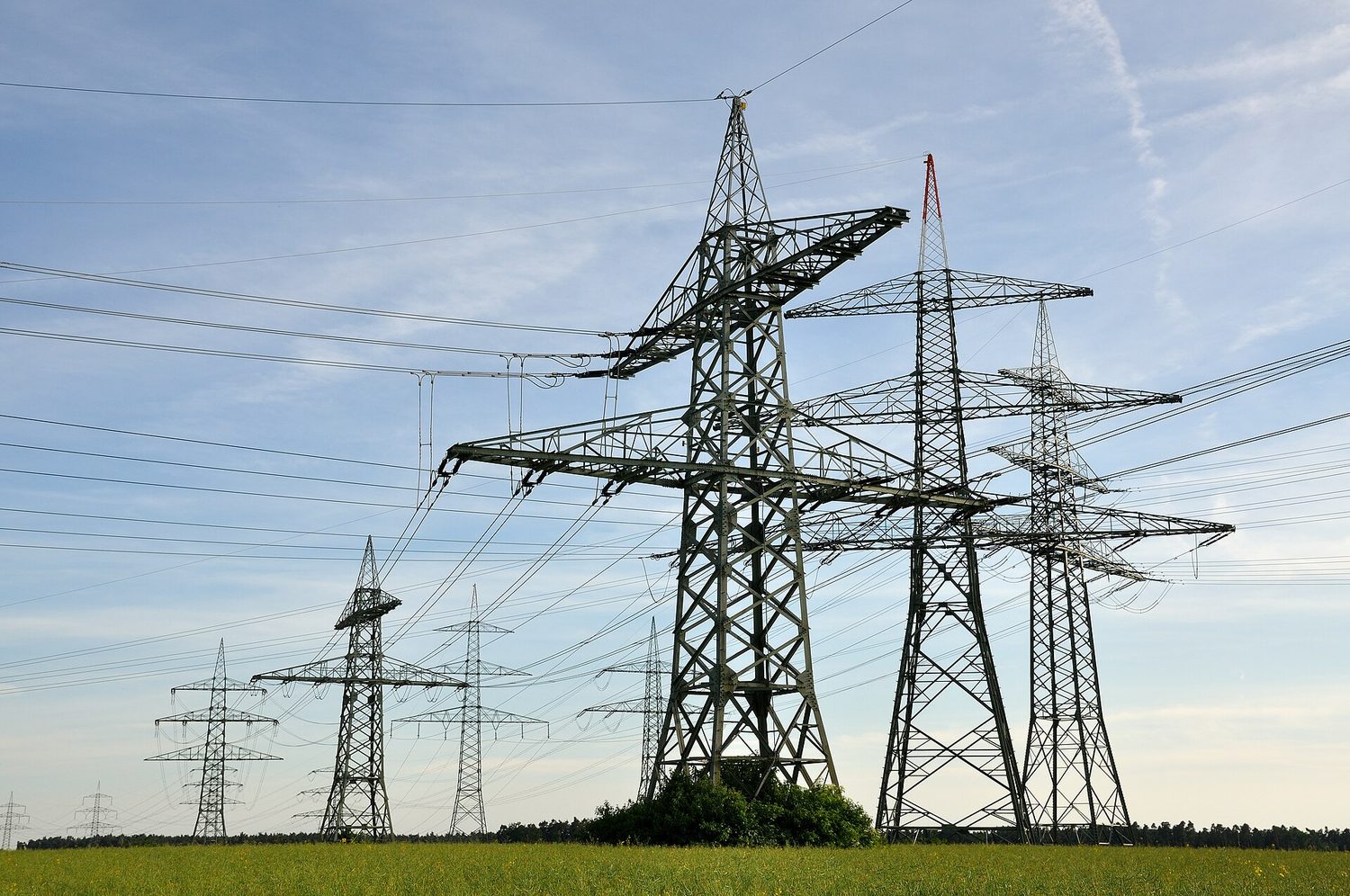
Why we use high voltage to send power
电通过高压输电(high-voltage transmission)跨全国被发送。在电缆中作为热损失的功率是
$$P = I^2 R$$
其中 $R$ 是电缆的电阻。一个升压变压器提高电压,从而对相同的功率降低电流($P = IV$)。一个更小的电流意味着在电缆中浪费的功率少得多。一个降压变压器随即在它到达家庭之前把电压再次降到一个安全的值。
探索
The force that spins a motor
A current in a magnetic field is pushed at right angles to both — reverse the current or flip the magnet and it pushes the other way. That is what turns a motor.
探索
The generator
V = a sin(bt)
A spinning coil induces a sinusoidal voltage — the AC output.
探索
Transformer
Add turns to the secondary to step the voltage up, fewer to step it down — Vs/Vp = Ns/Np, exactly how the grid moves power efficiently.
词汇表
训练
| 英文 | 中文 | 拼音 |
|---|---|---|
| conductor/kənˈdʌktə/ | 导体 | dǎo tǐ |
| transformer/trænsˈfɔːmə/ | 变压器 | biàn yā qì |
| solenoid/ˈsəʊlənɔɪd/ | 螺线管 | luó xiàn guǎn |
| coil/kɔɪl/ | 线圈 | xiàn quān |
| loudspeaker/ˈlaʊdspiːkə/ | 扬声器 | yáng shēng qì |
| electromagnetic induction/ɪˌlektrəʊməɡˈnetɪk ɪnˈdʌkʃn/ | 电磁感应 | diàn cí gǎn yìng |
| Fleming's right-hand rule/ˈflemɪŋz raɪt hænd ruːl/ | 弗莱明右手定则 | fú lái míng yòu shǒu dìng zé |
| a.c. generator/ˌeɪ ˈsiː ˈdʒenəreɪtə/ | 交流发电机 | jiāo liú fā diàn jī |
| slip rings/slɪp rɪŋz/ | 滑环 | huá huán |
| brushes/ˈbrʌʃɪz/ | 电刷 | diàn shuā |
| Fleming's left-hand rule/ˈflemɪŋz left hænd ruːl/ | 弗莱明左手定则 | fú lái míng zuǒ shǒu dìng zé |
| deflect/dɪˈflekt/ | 偏转 | piān zhuǎn |
| turning effect/ˈtɜːnɪŋ ɪˈfekt/ | 转动效应 | zhuǎn dòng xiào yìng |
| d.c. motor/ˌdiː ˈsiː ˈməʊtə/ | 直流电动机 | zhí liú diàn dòng jī |
| split-ring commutator/splɪt rɪŋ ˈkɒmjuːteɪtə/ | 换向器 | huàn xiàng qì |
| soft-iron core/sɒft ˈaɪən kɔː/ | 软铁芯 | ruǎn tiě xīn |
| primary coil/ˈpraɪməri kɔɪl/ | 原线圈 | yuán xiàn quān |
| secondary coil/ˈsekəndəri kɔɪl/ | 副线圈 | fù xiàn quān |
| step-up/step ʌp/ | 升压 | shēng yā |
| step-down/step daʊn/ | 降压 | jiàng yā |
| high-voltage transmission/haɪ ˈvəʊltɪdʒ trænˈsmɪʃn/ | 高压输电 | gāo yā shū diàn |
4.5
考试技巧
- 电流在一个串联电路中处处相同;在一个并联电路中它在支路之间分裂。电压(p.d.)在串联中被分享,但在每个并联支路两端相同。
- 在串联中加电阻器增加总电阻($R_1 + R_2$);在并联中加它们使总电阻比最小的单一电阻更小。
- 一个电流表放在串联中,有非常低的电阻;一个电压表在一个元件两端并联,有非常高的电阻。
- 在一个变压器中 $\dfrac{V_p}{V_s} = \dfrac{N_p}{N_s}$:副线圈上更多的匝把电压升,更少的把它降。变压器只对 a.c. 起作用。
- 电以高电压跨全国发送,所以电流——和电缆中浪费的热,$P = I^2R$——小。
- 把开关和保险丝装在火线中,并选择一个刚好在电器正常工作电流之上的保险丝额定值。
本主题的互动课程
逐步学习,并即时检测练习。