| English | 释义 | 拼音 |
|---|---|---|
| magnet/ˈmæɡnɪt/ | 磁体 | cí tǐ |
| poles/pəʊlz/ | 磁极 | cí jí |
| magnetic field/mæɡˈnetɪk fiːld/ | 磁场 | cí chǎng |
| permanent magnet/ˈpɜːmənənt ˈmæɡnɪt/ | 永磁体 | yǒng cí tǐ |
| induced magnetism/ɪnˈdjuːst ˈmæɡnɪtɪzəm/ | 感应磁性 | gǎn yìng cí xìng |
| soft iron/sɒft ˈaɪən/ | 软铁 | ruǎn tiě |
| field lines/fiːld laɪnz/ | 磁感线 | cí gǎn xiàn |
| electromagnets/ɪˌlektrəʊˈmæɡnɪts/ | 电磁铁 | diàn cí tiě |
The pull of a magnet 磁体
- A fridge magnet sticks; a compass needle always swings to point north.
- A magnet has two ends, called poles 磁极: a north (N) and a south (S).
- Let's see the rules magnets follow — and how to picture their invisible field.
Poles and magnetic materials
- The pole rule is like the charge rule:
- Same poles (N–N or S–S) repel (push apart).
- Different poles (N–S) attract (pull together).
- A magnet attracts magnetic materials: iron, steel, cobalt, nickel. Copper, plastic and wood are not magnetic.
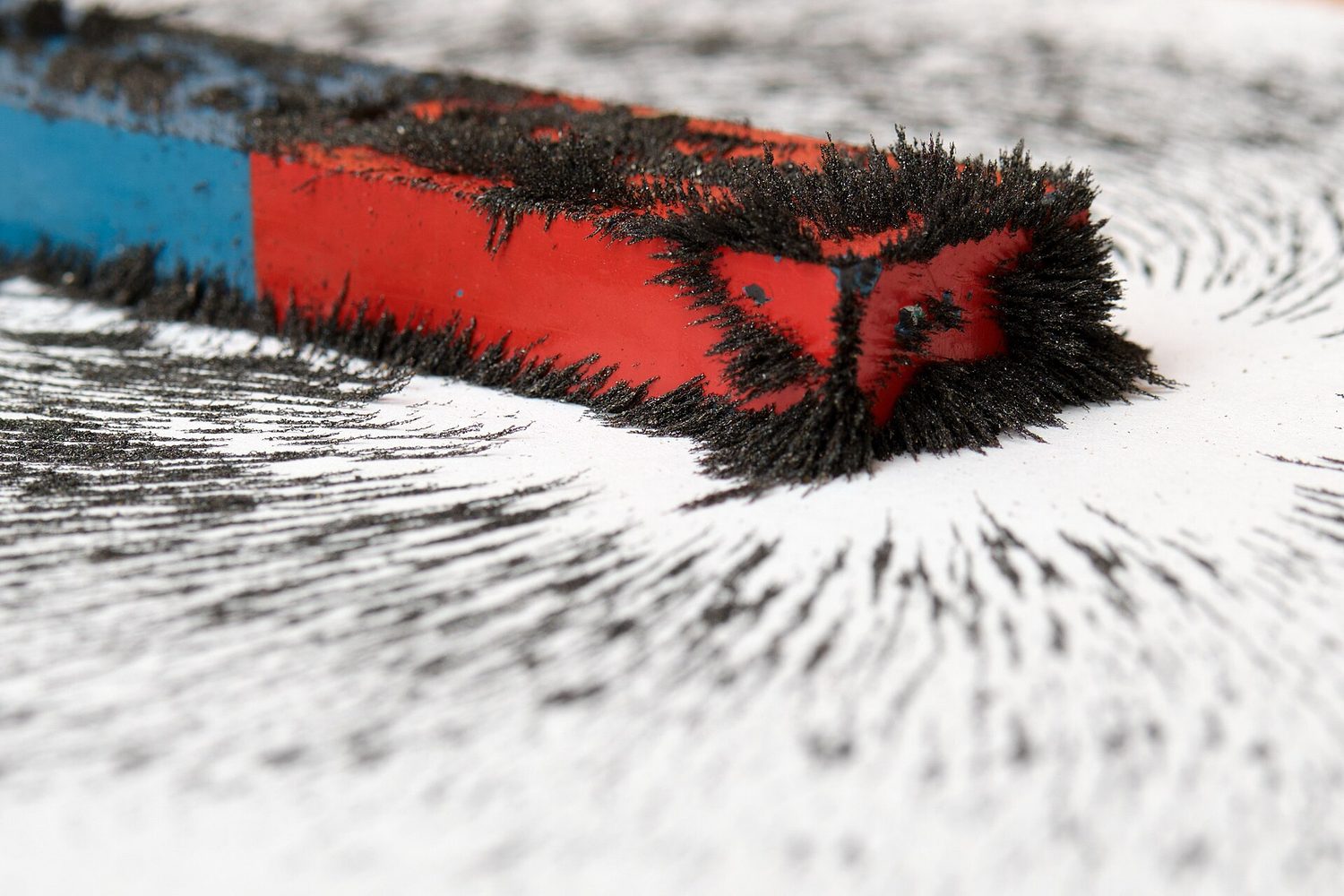
Iron filings line up along the magnetic field 磁场 of a bar magnet
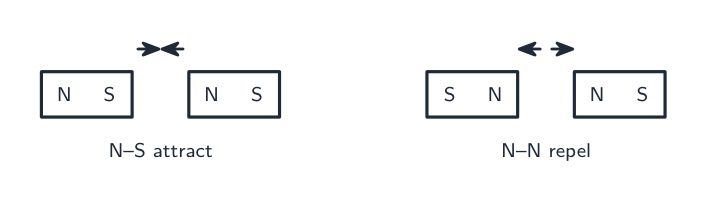
Like poles repel; unlike poles attract
让磁场可见
罗盘针描出从 N 到 S 的磁场;在吸引和排斥之间切换,观察整个图案重组,同极之间出现中性点。
两个北极被靠近放在一起。它们:
难度 1/5 · 今日首次完成可获 100 金币及少量额外奖励
同极排斥。只有不同的磁极(N 和 S)吸引。
这些中哪个是一种磁性材料(被一块磁铁吸引)?
难度 1/5 · 今日首次完成可获 100 金币及少量额外奖励
铁(还有钢、钴、镍)是磁性的。铜、塑料和木头不是。
Induced, temporary and permanent magnets 永磁体
- Put iron near a magnet and the iron becomes a magnet itself — induced magnetism 感应磁性. The near end gains the opposite pole, so they attract.
- Soft iron 软铁 magnetises easily but loses it quickly → a temporary magnet (great for electromagnet cores).
- Steel is harder to magnetise but keeps it → a permanent magnet (great for bar magnets).
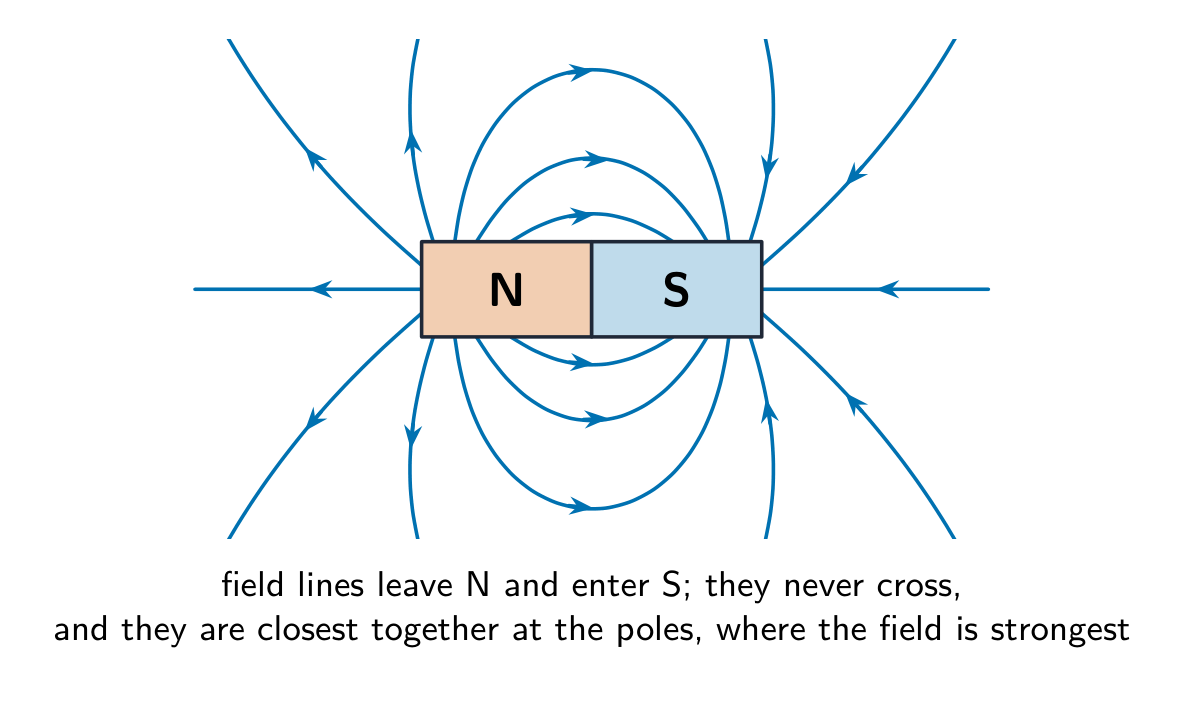
The magnetic field of a bar magnet
哪种材料最适合一个永久磁铁?
难度 1/5 · 今日首次完成可获 100 金币及少量额外奖励
钢难以磁化但保持它,所以它做一个永久磁铁。软铁很快失去磁性,所以它适合临时磁铁和电磁铁芯。
把每个磁性想法与它的含义配对。
难度 2/5 · 今日首次完成可获 140 金币及少量额外奖励
每一项把术语链接到它正确的含义。
Magnetic fields
- A magnetic field is a region where a magnetic pole feels a force.
- We draw it with field lines 磁感线 that come out of N and go into S.
- Where the lines are close together, the field is strong.
- Show the pattern with iron filings or a small plotting compass (the needle points along the field).
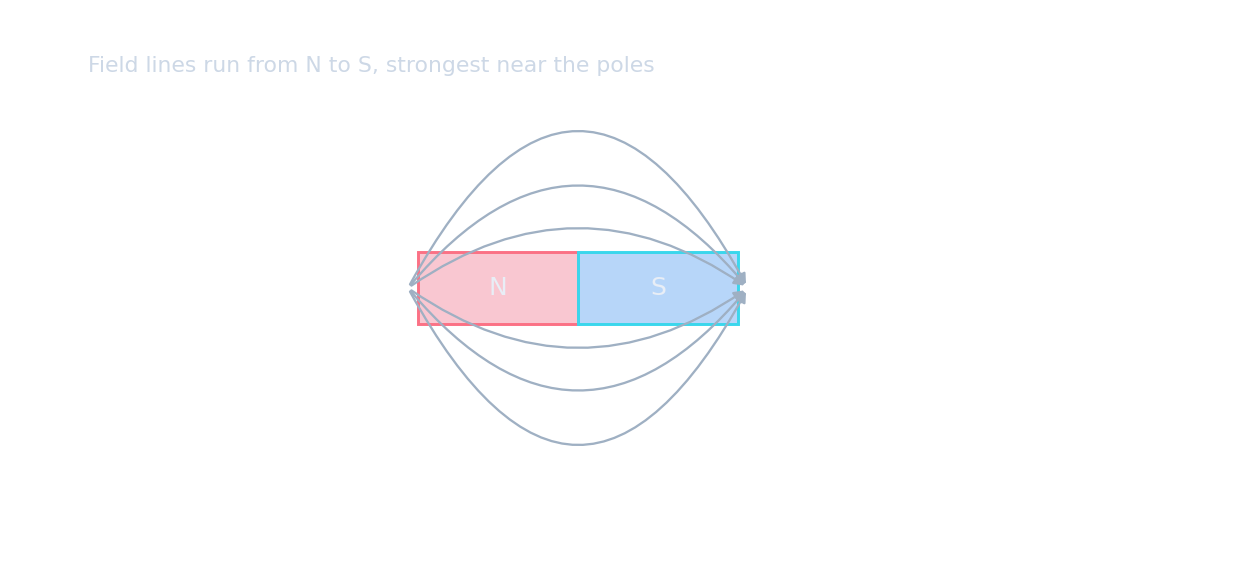
条形磁铁周围的磁感线指向:
难度 1/5 · 今日首次完成可获 100 金币及少量额外奖励
按惯例,场线从 N 出来并进入 S;它们越靠近,场越强。
场线更靠近的地方,磁场更强。
难度 1/5 · 今日首次完成可获 100 金币及少量额外奖励
紧密间隔的场线意味着一个强场——这就是为什么场在磁极附近最强。
Uses of magnets
- Permanent magnets: fridge catches, compass needles, loudspeakers.
- Electromagnets 电磁铁 (magnetic only while a current flows): scrap-yard cranes, electric bells, relays.
- An electromagnet's big advantage: you can switch it on and off and make it stronger — a permanent magnet cannot.
一个电磁铁能做什么一个永久磁铁不能做的?
难度 1/5 · 今日首次完成可获 100 金币及少量额外奖励
一个电磁铁只在电流流动时有磁性,所以它能被开/关并通过增加电流或匝数被做得更强。
Worked examples
1. Is an iron bar a magnet? Bring one end near the N pole of a magnet. If it repels, the bar is a magnet. If it only attracts, it may just be a magnetic material, because a magnet attracts unmagnetised iron too.
2. A plotting compass is put at a point near a bar magnet. Its needle's N end points along the field line there, away from the N pole and towards the S pole.
Attraction does not prove a magnet. Only repulsion does. Field lines go from N to S outside a magnet, and they never cross.
You've got it
- like poles repel, unlike poles attract; magnetic materials = iron, steel, cobalt, nickel
- soft iron = temporary magnet; steel = permanent magnet
- field lines go out of N, into S; closer lines = stronger field
- electromagnets can be switched on/off and made stronger
Write from the data given
- One bar magnet is cut into 2 pieces.
- Say how many poles there are. Say why an electromagnet core is soft iron rather than steel.
将一根条形磁铁切成2块。总共有多少个磁极?为什么电磁铁的铁芯要用软铁制作?
两个磁铁各有两个磁极。磁感线从北极发出并进入南极。
将磁铁切成2块会产生什么结果?
难度 1/5 · 今日首次完成可获 100 金币及少量额外奖励
2乘以2等于4个磁极,且每一块仍然同时具有两个磁极。