| Core | Supplement |
|---|---|
| 1 Describe the use of rulers and measuring cylinders to find a length or a volume | |
| 2 Describe how to measure a variety of time intervals using clocks and digital timers | |
| 3 Determine an average value for a small distance and for a short interval of time by measuring multiples (including the period of oscillation of a pendulum) | |
| 4 Understand that a scalar quantity has magnitude (size) only and that a vector quantity has magnitude and direction | |
| 5 Know that the following quantities are scalars: distance, speed, time, mass, energy and temperature | |
| 6 Know that the following quantities are vectors: force, weight, velocity, acceleration, momentum, electric field strength and gravitational field strength | |
| 7 Determine, by calculation or graphically, the resultant of two vectors at right angles, limited to forces or velocities only |
IGCSE 物理
学习建议
IGCSE 物理(0625)有六个主题:运动、力与能量;热学;波;电与磁;核物理;空间物理。
先确认你的层次。试卷共六个卷种,你考哪几个取决于报的是 Core 还是 Extended。Extended 专属内容占考纲很大一部分,如果你考 Core,复习它们就是浪费。
最常见的失分最容易补救:漏写单位、有效数字位数不对、只给数值却不写出所用公式。定义按原文措辞评分——请照写的记,不要照印象记。
-
1
运动、力与能量
1.1
物理量与测量技术

大纲
来源:剑桥国际大纲
把一个矢量分解成分量 Length and volume
用一把直尺(ruler)测量长度。眼睛正对刻度线读刻度以避免一个读数错误。
一个不规则固体推上去的水给出它的体积 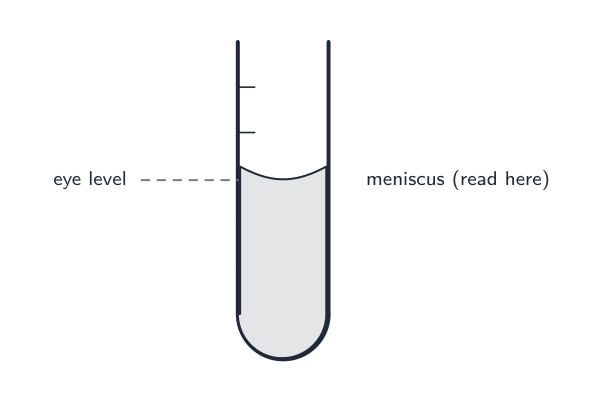
在弯月面底部读一个量筒,你的眼睛与它平齐 用一个量筒(measuring cylinder)测量一个液体的体积。在弯曲表面(弯月面(meniscus))的底部读刻度,你的眼睛与它平齐。
Measuring time
用一个秒表(stopwatch)或一个数字计时器(digital timer)测量一个时间间隔。对于长的时间(几分钟或几小时),一个钟就够了。一个秒表是用手启动和停止的,所以每个读数有约 0.2 s 的反应时间(reaction time)误差。要让这个误差影响更小,给一个长的间隔计时,或者给许多次重复计时再相除(见下面)。
Measuring small amounts
一个单一的小长度或一个短时间难以很好地测量。诀窍是测多个再相除:
- 要求一页的厚度,测量 100 页并除以 100。
- 要求一个摆(pendulum)一次摆动的时间,测量 20 次摆动的时间并除以 20。一次完整的摆动叫周期(period)。
这使不确定度(uncertainty,误差的大小)小得多。
Scalars and vectors
一个标量(scalar quantity)只有大小(大小(magnitude))。一个矢量(vector quantity)有大小和方向。
- 标量:距离、速率、时间、质量(mass)、能量(energy)、温度(temperature)。
- 矢量:力(force)、重力(weight)、速度(velocity)、加速度(acceleration)、动量(momentum)、电场强度(electric field strength)、重力场强度(gravitational field strength)。
要把两个成直角(90°)的矢量相加,把它们画成一个矩形的两条边。合矢量(resultant)是对角线。用勾股定理求它的大小,用三角学求它的方向。
$$R = \sqrt{a^2 + b^2}$$
两个成直角的矢量相加成一个合矢量 $R$,矩形的对角线 探索Scalars & vectors
resultant = a + b
Add two vectors tip-to-tail to find the resultant.
词汇表 训练英文 中文 拼音 measurement/ˈmeʒəmənt/ 测量 cè liáng ruler/ˈruːlə/ 直尺 zhí chǐ measuring cylinder/ˈmeʒərɪŋ ˈsɪlɪndə/ 量筒 liáng tǒng meniscus/ˈmenɪskəs/ 弯月面 wān yuè miàn stopwatch/ˈstɒpwɒtʃ/ 秒表 miǎo biǎo digital timer/ˈdɪdʒɪtl ˈtaɪmə/ 数字计时器 shù zì jì shí qì reaction time/rɪˈækʃn taɪm/ 反应时间 fǎn yìng shí jiān measure many and divide/ˈmeʒə ˈmeni ænd dɪˈvaɪd/ 测多个再相除 cè duō gè zài xiāng chú pendulum/ˈpendjʊləm/ 摆 bǎi period/ˈpɪərɪəd/ 周期 zhōu qī uncertainty/ʌnˈsɜːtənti/ 不确定度 bù què dìng dù scalar quantity/ˈskeɪlə ˈkwɒntɪti/ 标量 biāo liàng magnitude/ˈmæɡnɪtjuːd/ 大小 dà xiǎo vector quantity/ˈvektə ˈkwɒntɪti/ 矢量 shǐ liàng mass/mæs/ 质量 zhì liàng energy/ˈenədʒi/ 能量 néng liàng temperature/ˈtemprɪtʃə/ 温度 wēn dù force/fɔːs/ 力 lì weight/weɪt/ 重力 zhòng lì velocity/vəˈlɒsɪti/ 速度 sù dù acceleration/əkˌseləˈreɪʃn/ 加速度 jiā sù dù momentum/məʊˈmentəm/ 动量 dòng liàng electric field strength/ɪˈlektrɪk fiːld streŋθ/ 电场强度 diàn chǎng qiáng dù gravitational field strength/ˌɡrævɪˈteɪʃənl fiːld streŋθ/ 重力场强度 zhòng lì chǎng qiáng dù resultant/rɪˈzʌltənt/ 合矢量 hé shǐ liàng moment/ˈməʊmənt/ 力矩 lì jǔ 1.2
运动
大纲
Core Supplement 1 Define speed as distance travelled per unit time; recall and use the equation $$v = \frac{s}{t}$$2 Define velocity as speed in a given direction 3 Recall and use the equation $$\text{average speed} = \frac{\text{total distance travelled}}{\text{total time taken}}$$9 Define acceleration as change in velocity per unit time; recall and use the equation $$a = \frac{\Delta v}{\Delta t}$$4 Sketch, plot and interpret distance–time and speed–time graphs 5 Determine, qualitatively, from given data or the shape of a distance–time graph or speed–time graph when an object is: (a) at rest (b) moving with constant speed (c) accelerating (d) decelerating 10 Determine from given data or the shape of a speed–time graph when an object is moving with: (a) constant acceleration (b) changing acceleration 6 Calculate speed from the gradient of a straight-line section of a distance–time graph 11 Calculate acceleration from the gradient of a speed–time graph 7 Calculate the area under a speed–time graph to determine the distance travelled for motion with constant speed or constant acceleration 12 Know that a deceleration is a negative acceleration and use this in calculations 8 State that the acceleration of free fall $g$ for an object near to the surface of the Earth is approximately constant and is approximately $9.8\text{ m/s}^2$ 13 Describe the motion of objects falling in a uniform gravitational field with and without air/ liquid resistance, including reference to terminal velocity 来源:剑桥国际大纲
Speed and velocity
速率(speed)是单位时间行进的距离。
$$v = \frac{s}{t}$$速度(velocity)是一个陈述方向上的速率。所以速度是一个矢量,而速率是一个标量。
$$\text{average speed} = \frac{\text{total distance}}{\text{total time}}$$Acceleration
加速度(acceleration)是单位时间速度的变化。
$$a = \frac{\Delta v}{\Delta t}$$这里 $\Delta v$ 意味着"速度的变化"。一个减速(deceleration,变慢)是一个负加速度。
例题。 一辆车在 $4.0\ \text{s}$ 内从 $8\ \text{m/s}$ 加速到 $20\ \text{m/s}$。求它的加速度。
$$a = \frac{\Delta v}{\Delta t} = \frac{20 - 8}{4.0} = 3.0\ \text{m/s}^2$$Motion graphs
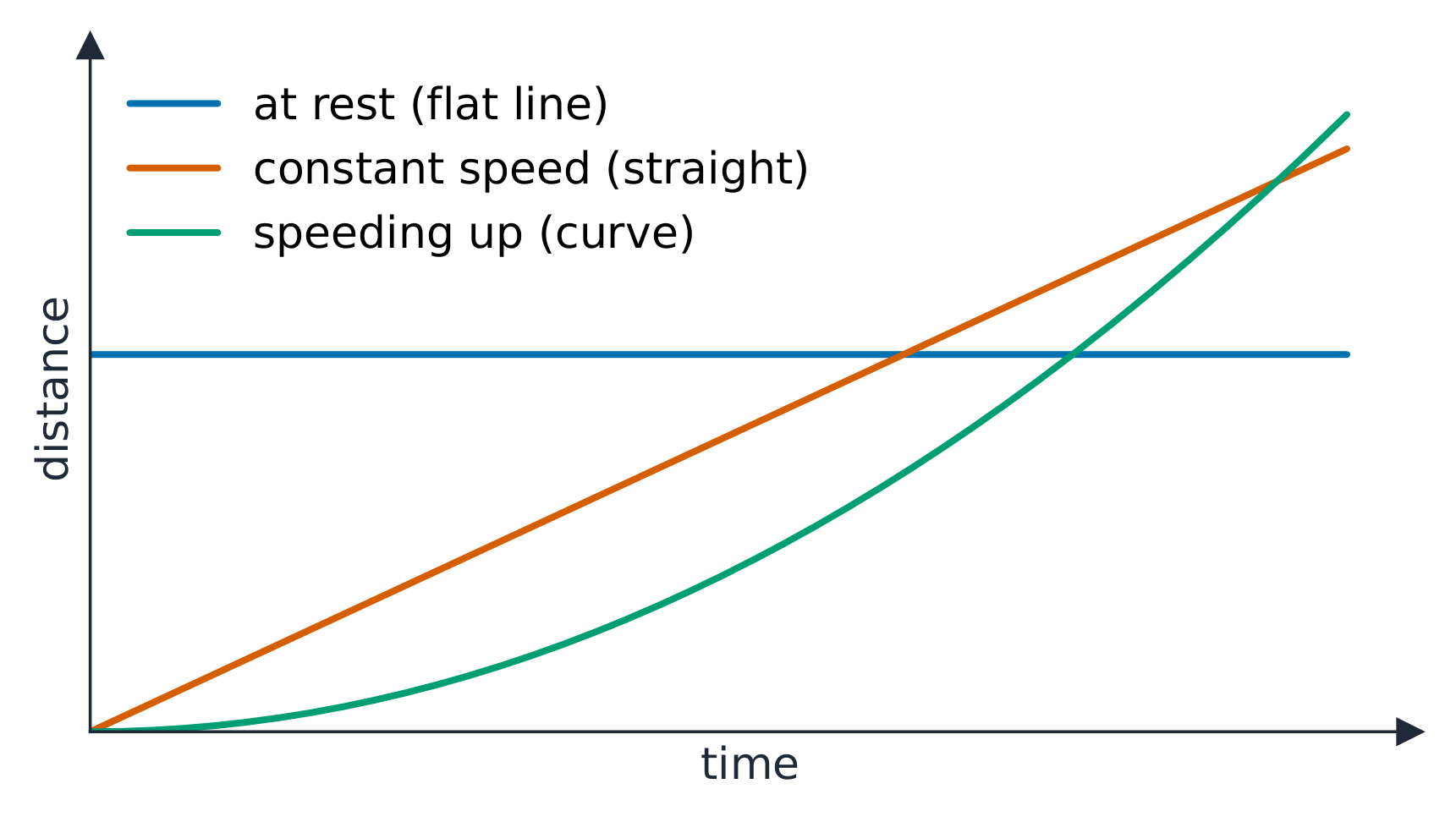
一个距离-时间图(distance–time graph)显示一个物体走了多远:
- 一条平(水平)线意味着物体静止(at rest)。
- 一个直的斜坡意味着恒定的速率。斜率(gradient,陡度)是速率。
- 一条变得更陡的曲线意味着物体在加速。
一条距离-时间线的形状:平是静止、一个直斜坡是恒定速率、一条上升的曲线是加速 一个速度-时间图(speed–time graph)显示一个物体走得多快:
- 一条平线意味着恒定的速率。
- 一个直的斜坡意味着恒定的加速度。斜率是加速度。
- 线下面积(area under the line)是行进的距离。
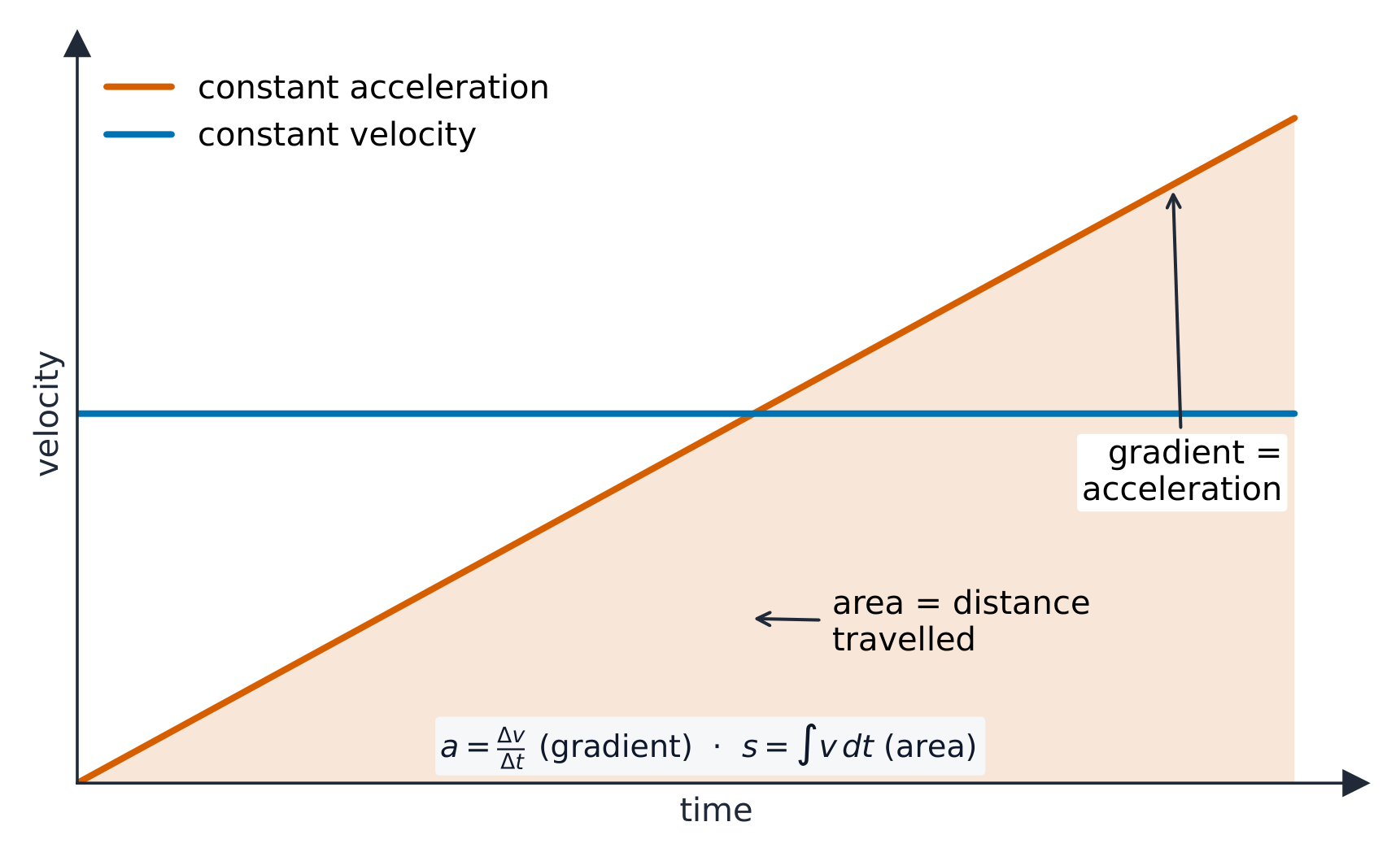
在一个速度-时间图上,斜率是加速度,而线下面积是行进的距离 Falling objects
在地球附近重力场是均匀(uniform)的(处处同样强),所以所有物体在下落时以同样的速率加速。这是自由落体加速度(acceleration of free fall),$g \approx 9.8\ \text{m/s}^2$。
当一个物体穿过空气下落时,空气阻力(air resistance,一个阻力)向上作用。随着它加速,空气阻力增长。当空气阻力等于重力时,合力为零,而物体停止加速。它随即以一个稳定的收尾速度(terminal velocity)下落。
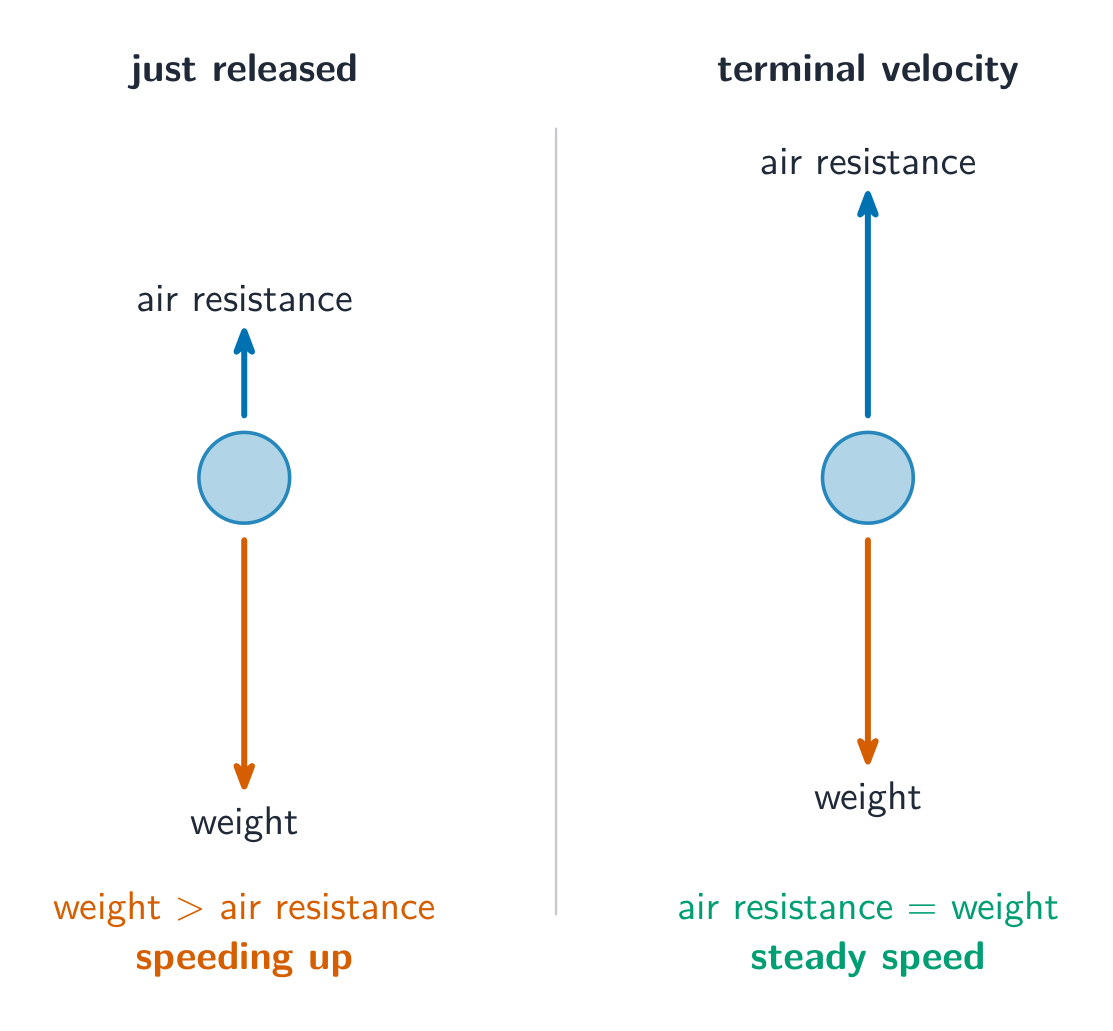
起初重力比空气阻力大,所以物体加速;在收尾速度时两者相等而速率稳定 探索Velocity–time graph
Change u and a. The gradient is the acceleration; the area under the line is the distance travelled.
词汇表 训练英文 中文 拼音 motion/ˈməʊʃn/ 运动 yùn dòng speed/spiːd/ 速率 sù lǜ deceleration/dɪˌseləˈreɪʃn/ 减速 jiǎn sù distance–time graph/ˈdɪstəns taɪm ɡræf/ 距离-时间图 jù lí - shí jiān tú at rest/æt rest/ 静止 jìng zhǐ gradient/ˈɡreɪdɪənt/ 斜率 xié lǜ speed–time graph/spiːd taɪm ɡræf/ 速度-时间图 sù dù - shí jiān tú area under the line/ˈeərɪə ˈʌndə ðə laɪn/ 线下面积 xiàn xià miàn jī uniform/ˈjuːnɪfɔːm/ 均匀 jūn yún acceleration of free fall/əkˌseləˈreɪʃn ɒv friː fɔːl/ 自由落体加速度 zì yóu luò tǐ jiā sù dù air resistance/eə rɪˈzɪstəns/ 空气阻力 kōng qì zǔ lì terminal velocity/ˈtɜːmɪnl vəˈlɒsɪti/ 收尾速度 shōu wěi sù dù 1.3
质量与重量
大纲
Core Supplement 1 State that mass is a measure of the quantity of matter in an object at rest relative to the observer 2 State that weight is a gravitational force on an object that has mass 5 Describe, and use the concept of, weight as the effect of a gravitational field on a mass 3 Define gravitational field strength as force per unit mass; recall and use the equation $$g = \frac{W}{m}$$and know that this is equivalent to the acceleration of free fall4 Know that weights (and masses) may be compared using a balance 来源:剑桥国际大纲
质量(mass)是一个物体中物质(matter)的量。它以千克(kg)测量,而且在你移动物体时不改变。
重力(weight)是一个质量上重力的力。它以牛顿(N)测量。重力能改变:它在月球上更小,因为月球的重力更弱。
重力场强度(gravitational field strength)是单位质量的力:
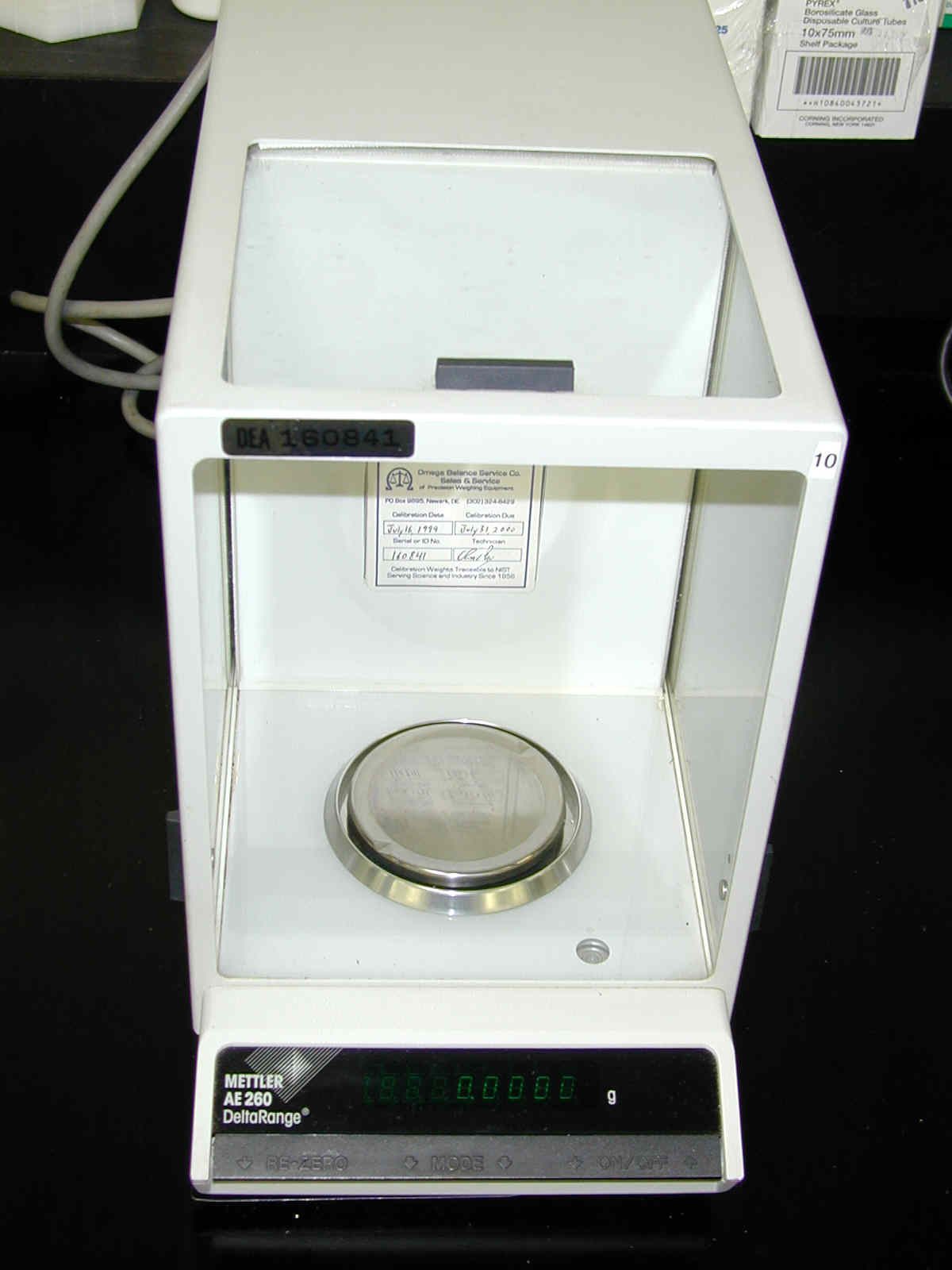
$$g = \frac{W}{m}$$这个 $g$ 有与自由落体加速度相同的值($\approx 9.8\ \text{N/kg}$)。你可以用一台天平(balance)比较质量。
A laboratory balance measures mass; weight is the gravitational force on that mass 探索Weight and mass
W = mg
Weight is proportional to mass — the gradient is the gravitational field strength g (about 10 N/kg on Earth).
词汇表 训练英文 中文 拼音 matter/ˈmætə/ 物质 wù zhì balance/ˈbæləns/ 天平 tiān píng 1.4
密度

大纲
Core Supplement 1 Define density as mass per unit volume; recall and use the equation $$\rho = \frac{m}{V}$$2 Describe how to determine the density of a liquid, of a regularly shaped solid and of an irregularly shaped solid which sinks in a liquid (volume by displacement), including appropriate calculations 3 Determine whether an object floats based on density data 4 Determine whether one liquid will float on another liquid based on density data given that the liquids do not mix 来源:剑桥国际大纲
密度(density)是单位体积的质量。
$$\rho = \frac{m}{V}$$符号 $\rho$ 是希腊字母"rho"。单位是 $\text{kg/m}^3$ 或 $\text{g/cm}^3$。
要求密度:用一台天平测量质量、求体积,然后相除。
- 规则固体(regular solid,像一个盒子):测量边并计算体积。
- 不规则固体(irregular solid,一个奇怪的形状):把它放进一个量筒里的水中。水位的上升是它的体积。这是排水法(displacement method)。
- 液体(liquid):把一个空的量筒放在天平上并读它的质量。倒入液体,在量筒上读体积,再读一次质量。液体的质量是两个质量读数之差。
若一个物体的密度小于液体的密度,它漂浮(floats)。若它的密度更大,它下沉。同样地,当一种液体的密度更低时,它漂浮在另一种液体之上(如果两者不混合):油浮在水上。
例题。 一块质量 $54\ \text{g}$ 的石头被放进一个量筒。水位从 $20\ \text{cm}^3$ 上升到 $40\ \text{cm}^3$。求石头的密度。
石头的体积是水位的上升,$40 - 20 = 20\ \text{cm}^3$,所以
$$\rho = \frac{m}{V} = \frac{54}{20} = 2.7\ \text{g/cm}^3$$An iceberg floats with most of its volume hidden: ice is slightly less dense than water 探索Floating and density
Change the object's density and the liquid: it floats if it's less dense, and the denser it is the more sits underwater. Iron sinks in water but floats on mercury.
词汇表 训练英文 中文 拼音 density/ˈdensɪti/ 密度 mì dù regular solid/ˈreɡjʊlə ˈsɒlɪd/ 规则固体 guī zé gù tǐ irregular solid/ɪˈreɡjʊlə ˈsɒlɪd/ 不规则固体 bù guī zé gù tǐ displacement method/dɪˈspleɪsmənt ˈmeθəd/ 排水法 pái shuǐ fǎ floats/fləʊts/ 漂浮 piāo fú 1.5
力
大纲
1.5.1 Effects of forces
Core Supplement 1 Know that forces may produce changes in the size and shape of an object 9 Define the spring constant as force per unit extension; recall and use the equation $$k = \frac{F}{x}$$2 Sketch, plot and interpret load–extension graphs for an elastic solid and describe the associated experimental procedures 10 Define and use the term ‘limit of proportionality’ for a load–extension graph and identify this point on the graph (an understanding of the elastic limit is not required) 3 Determine the resultant of two or more forces acting along the same straight line 11 Recall and use the equation $F = ma$ and know that the force and the acceleration are in the same direction 4 Know that an object either remains at rest or continues in a straight line at constant speed unless acted on by a resultant force 5 State that a resultant force may change the velocity of an object by changing its direction of motion or its speed 12 Describe, qualitatively, motion in a circular path due to a force perpendicular to the motion as: (a) speed increases if force increases, with mass and radius constant (b) radius decreases if force increases, with mass and speed constant (c) an increased mass requires an increased force to keep speed and radius constant ($F = \frac{mv^2}{r}$ is not required) 6 Describe solid friction as the force between two surfaces that may impede motion and produce heating 7 Know that friction (drag) acts on an object moving through a liquid 8 Know that friction (drag) acts on an object moving through a gas (e.g. air resistance) 1.5.2 Turning effect of forces
Core Supplement 1 Describe the moment of a force as a measure of its turning effect and give everyday examples 2 Define the moment of a force as $\text{moment} = \text{force} \times \text{perpendicular distance from the pivot}$; recall and use this equation 3 Apply the principle of moments to situations with one force each side of the pivot, including balancing of a beam 5 Apply the principle of moments to other situations, including those with more than one force each side of the pivot 4 State that, when there is no resultant force and no resultant moment, an object is in equilibrium 6 Describe an experiment to demonstrate that there is no resultant moment on an object in equilibrium 1.5.3 Centre of gravity
Core Supplement 1 State what is meant by centre of gravity 2 Describe an experiment to determine the position of the centre of gravity of an irregularly shaped plane lamina 3 Describe, qualitatively, the effect of the position of the centre of gravity on the stability of simple objects 来源:剑桥国际大纲
力矩原理 胡克定律和弹性极限 一个力是一个推或一个拉。一个力能改变一个物体的形状(shape)、速率或方向。
Stretching (Hooke's law)
当你在一个弹簧上挂一个负载时,它伸展。伸展叫伸长量(extension)。
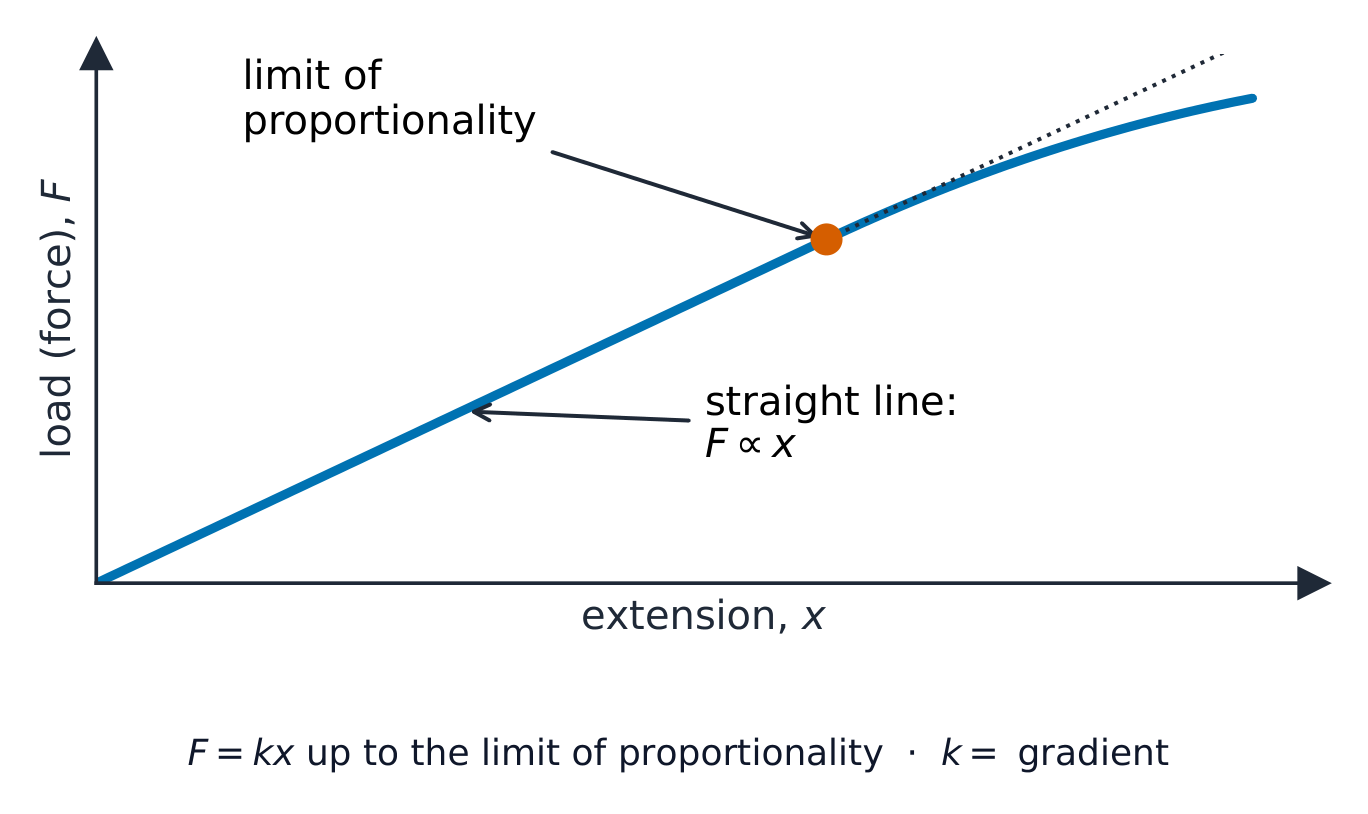
在一个载荷-伸长图(load–extension graph)上,线起初是直的:伸长量与载荷成正比。线停止是直的的那个点是比例极限(limit of proportionality)。
载荷与伸长量成正比,直到比例极限,然后线弯曲 实验。 把弹簧挂在一个夹子上,在它旁边立一把直尺。在没有负载时读弹簧底端的位置:这是原始长度。一次加一个负载(例如每次 1 N),每次记录新的长度。伸长量是新长度减原始长度。以载荷为 y 轴、伸长量为 x 轴作图。
弹簧常数(spring constant)是单位伸长量的力:
$$k = \frac{F}{x}$$一个大的 $k$ 意味着一个硬的弹簧。
Resultant force and Newton's laws
把一条直线上的力相加以得到合力(resultant force,一个方向的力为正,另一个方向为负)。
- 若合力为零,物体保持静止或以恒定速率沿直线继续运动。(牛顿第一定律。)
- 若合力不为零,物体沿力的方向加速:
$$F = ma$$
一个自由体图把盒子上的每个力显示为一个标注的箭头 例题。 一辆 $1200\ \text{kg}$ 的车有一个 $3000\ \text{N}$ 的驱动力和 $600\ \text{N}$ 的摩擦。求它的加速度。
首先求合力:$3000 - 600 = 2400\ \text{N}$。然后
$$a = \frac{F}{m} = \frac{2400}{1200} = 2.0\ \text{m/s}^2$$Motion in a circle
一个与运动成直角的合力不改变速率。它改变方向,所以物体以稳定的速率做圆周运动。这是圆周运动(circular motion)。这个力总是指向圆心:绳子对旋转的球的拉力,或太阳对行星的引力。
对于一个做圆周运动的物体:
- 要让同样的质量在同样半径(radius)的圆上以更高的速率运动,需要更大的力;
- 更大的力使同样的质量在同样的速率下沿更小的圆(更小的半径)运动;
- 更大的质量需要更大的力来保持同样的速率和同样的半径。
Friction
摩擦力(friction)是两个接触表面之间的力。它试图阻止运动并使东西发热。阻力(一个液体或气体中的摩擦,如空气阻力)也使物体变慢。
Moments — the turning effect
一个力的力矩(moment)是它关于一个支点(pivot)的转动效果。
$$\text{moment} = \text{force} \times \text{perpendicular distance from the pivot}$$单位是牛顿米(N m)。
力矩原理(principle of moments):当一个物体平衡(处于平衡(equilibrium))时,
$$\text{total clockwise moment} = \text{total anticlockwise moment}$$当没有合力且没有合力矩时,一个物体处于平衡。
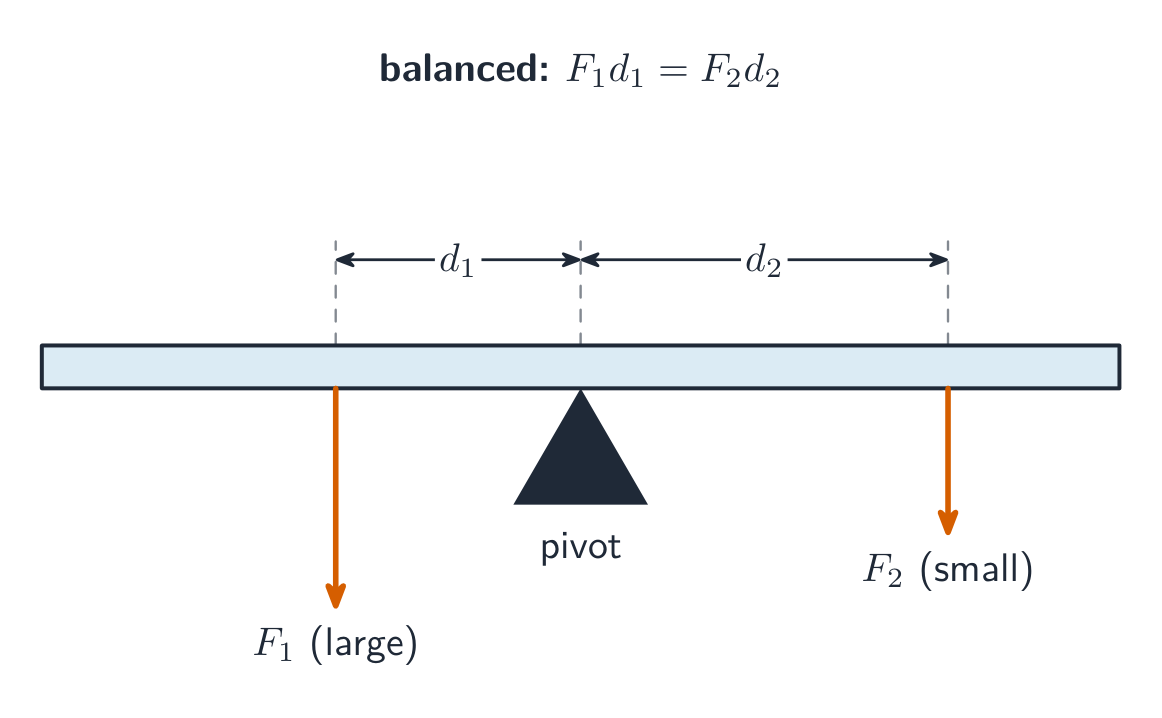
当顺时针力矩等于逆时针力矩时梁平衡 例题。 一个 $30\ \text{N}$ 的重物坐在一个支点左边 $0.20\ \text{m}$。一个 $20\ \text{N}$ 的重物必须坐在右边多远以平衡梁?
平衡,所以逆时针力矩 $=$ 顺时针力矩:
$$30 \times 0.20 = 20 \times d \quad\Rightarrow\quad d = \frac{6.0}{20} = 0.30\ \text{m}$$用实验检验这个原理。 把一把米尺在它的中心平衡在一个支点上。在每一侧挂一个已知的重物,并移动它们直到尺再次平衡。测量每个到支点的距离。左边的力 × 距离等于右边的力 × 距离(在小的测量误差之内),所以一个平衡的物体上没有合力矩。
Centre of gravity
重心(centre of gravity)是一个物体所有重力似乎作用的单一点。
对一个平的形状(薄片(lamina)),把它从一根针悬挂并让它稳定;用一根铅垂线从针往下画一条竖直线。从另一个点重复。重心是这些线交叉的地方。
一个物体的稳定性(stability)取决于它的重心在哪里。当一个物体的重心低、它的底宽时,它更稳定(stable)。当从重心竖直向下的一条线越过底之外时,它翻倒。
探索Forces & Newton's laws
F = ma (resultant)
The resultant force sets the acceleration; balanced forces ⇒ none.
词汇表 训练英文 中文 拼音 shape/ʃeɪp/ 形状 xíng zhuàng extension/ekˈstenʃn/ 伸长量 shēn cháng liàng load–extension graph/ləʊd ekˈstenʃn ɡræf/ 载荷-伸长图 zài hè - shēn cháng tú limit of proportionality/ˈlɪmɪt ɒv prəˌpɔːʃəˈnælɪti/ 比例极限 bǐ lì jí xiàn spring constant/sprɪŋ ˈkɒnstənt/ 弹簧常数 tán huáng cháng shù resultant force/rɪˈzʌltənt fɔːs/ 合力 hé lì circular motion/ˈsɜːkjʊlə ˈməʊʃn/ 圆周运动 yuán zhōu yùn dòng radius/ˈreɪdɪəs/ 半径 bàn jìng friction/ˈfrɪkʃn/ 摩擦力 mó cā lì pivot/ˈpɪvət/ 支点 zhī diǎn principle of moments/ˈprɪnsɪpl ɒv ˈməʊmənts/ 力矩原理 lì jǔ yuán lǐ equilibrium/ˌiːkwɪˈlɪbrɪəm/ 平衡 píng héng centre of gravity/ˈsentə ɒv ˈɡrævɪti/ 重心 zhòng xīn lamina/ˈlæmɪnə/ 薄片 báo piàn stability/stəˈbɪlɪti/ 稳定性 wěn dìng xìng stable/ˈsteɪbl/ 稳定 wěn dìng 1.6
动量
大纲
Core Supplement 1 Define momentum as mass $\times$ velocity; recall and use the equation $p = mv$ 2 Define impulse as force $\times$ time for which force acts; recall and use the equation $\text{impulse} = F\Delta t = \Delta(mv)$ 3 Apply the principle of the conservation of momentum to solve simple problems in one dimension 4 Define resultant force as the change in momentum per unit time; recall and use the equation $F = \frac{\Delta p}{\Delta t}$ 来源:剑桥国际大纲
一次碰撞中的动量守恒 动量(momentum)是质量乘速度。它是一个矢量。
$$p = mv$$冲量(impulse)是力乘它作用的时间,而它等于动量的变化:
$$\text{impulse} = F\,\Delta t = \Delta(mv)$$所以合力是单位时间动量的变化:
$$F = \frac{\Delta p}{\Delta t}$$动量守恒(conservation of momentum):当物体碰撞而没有外力作用时,之前的总动量等于之后的总动量。
$$m_1 u_1 + m_2 u_2 = m_1 v_1 + m_2 v_2$$(这里 $u$ 是之前的速度,而 $v$ 是之后的速度。)
例题。 一辆 $2.0\ \text{kg}$、以 $3.0\ \text{m/s}$ 运动的小车撞上一辆静止的 $1.0\ \text{kg}$ 小车,它们粘在一起。求它们之后共同的速度。
总动量守恒,所以
$$(2.0 \times 3.0) + (1.0 \times 0) = (2.0 + 1.0)\,v \quad\Rightarrow\quad v = \frac{6.0}{3.0} = 2.0\ \text{m/s}$$探索Momentum in a collision
Set the masses and speeds and collide them. Total momentum is conserved.
词汇表 训练英文 中文 拼音 impulse/ˈɪmpʌls/ 冲量 chōng liàng conservation of momentum/ˌkɒnsəˈveɪʃn ɒv məʊˈmentəm/ 动量守恒 dòng liàng shǒu héng 1.7
能量、功与功率
大纲
1.7.1 Energy
Core Supplement 1 State that energy may be stored as kinetic, gravitational potential, chemical, elastic (strain), nuclear, electrostatic and internal (thermal) 2 Describe how energy is transferred between stores during events and processes, including examples of transfer by forces (mechanical work done), electrical currents (electrical work done), heating, and by electromagnetic, sound and other waves 4 Recall and use the equation for kinetic energy $E_k = \frac{1}{2}mv^2$ 5 Recall and use the equation for the change in gravitational potential energy $\Delta E_p = mg\Delta h$ 3 Know the principle of the conservation of energy and apply this principle to simple examples including the interpretation of simple flow diagrams 6 Know the principle of the conservation of energy and apply this principle to complex examples involving multiple stages, including the interpretation of Sankey diagrams 1.7.2 Work
Core Supplement 1 Understand that mechanical or electrical work done is equal to the energy transferred 2 Recall and use the equation for mechanical working $W = Fd = \Delta E$ 1.7.3 Energy resources
Core Supplement 1 Describe how useful energy may be obtained, or electrical power generated, from: (a) chemical energy stored in fossil fuels (b) chemical energy stored in biofuels (c) water, including the energy stored in waves, in tides and in water behind hydroelectric dams (d) geothermal resources (e) nuclear fuel (f) light from the Sun to generate electrical power (solar cells) (g) infrared and other electromagnetic waves from the Sun to heat water (solar panels) and be the source of wind energy including references to a boiler, turbine and generator where they are used 4 Know that radiation from the Sun is the main source of energy for all our energy resources except geothermal, nuclear and tidal 2 Describe advantages and disadvantages of each method in terms of renewability, availability, reliability, scale and environmental impact 5 Know that energy is released by nuclear fusion in the Sun 6 Know that research is being carried out to investigate how energy released by nuclear fusion can be used to produce electrical energy on a large scale 3 Understand, qualitatively, the concept of efficiency of energy transfer 7 Define efficiency as: (a) $(\%) \text{ efficiency} = \frac{\text{(useful energy output)}}{\text{(total energy input)}} (\times 100\%)$ (b) $(\%) \text{ efficiency} = \frac{\text{(useful power output)}}{\text{(total power input)}} (\times 100\%)$ recall and use these equations 1.7.4 Power
Core Supplement 1 Define power as work done per unit time and also as energy transferred per unit time; recall and use the equations (a) $P = \frac{W}{t}$ (b) $P = \frac{\Delta E}{t}$ 来源:剑桥国际大纲
Energy stores
能量能以不同的方式储存(stored):动能(kinetic)、重力势能(gravitational potential)、化学能(chemical)、弹性(应变)势能(elastic (strain))、核能(nuclear)、静电能(electrostatic),和内(热)能(internal (thermal))。
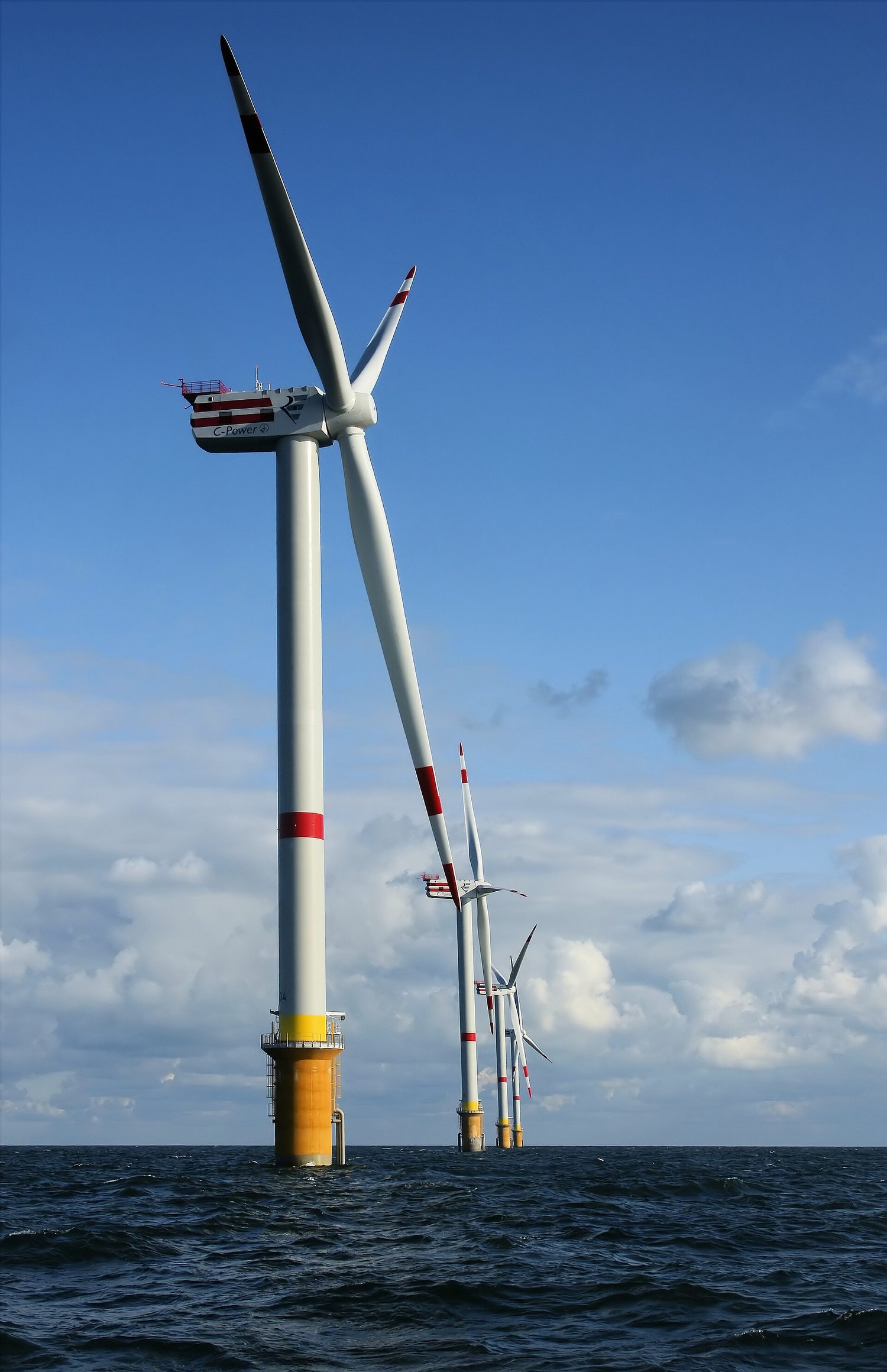
能量通过力(机械功)、通过电流、通过加热,以及通过波(如光和声音)在储存之间被转移(transferred)。
风力涡轮机把能量从移动空气的动能储存转移到电 Kinetic and potential energy
动能(kinetic energy)是一个运动物体的能量:
$$E_k = \frac{1}{2}mv^2$$当一个物体上升或下降一个高度 $\Delta h$ 时重力势能(gravitational potential energy)的变化:
$$\Delta E_p = mg\,\Delta h$$Conservation of energy
能量守恒定律(principle of conservation of energy)说能量从不被制造或摧毁;它只在储存之间移动。一个下落的物体把重力势能变成动能。一个桑基图(Sankey diagram)显示输入能量如何分成有用能量和浪费(wasted)的能量。
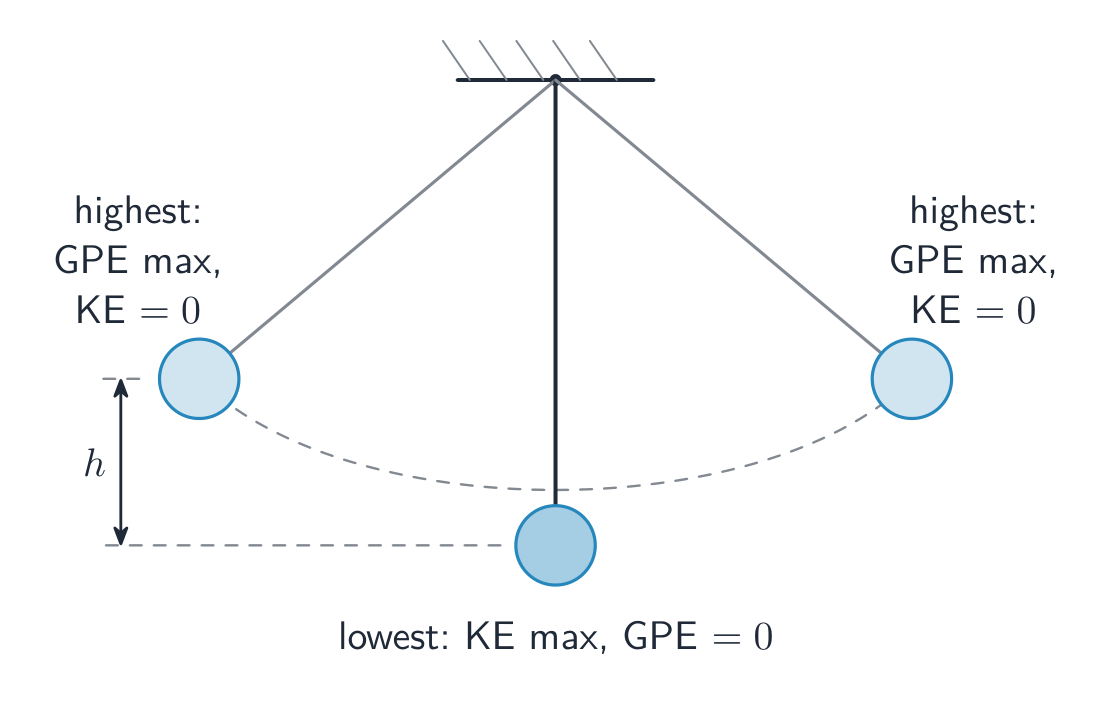
能量在重力势能(在最高点)和动能(在最低点)之间移动 
在一个过山车上,储存在山顶的重力势能随着车加速下降变成动能 例题。 一个 $0.50\ \text{kg}$ 的球从 $1.8\ \text{m}$ 的高度落下。忽略空气阻力,求它刚好在着陆前的速率。(取 $g = 10\ \text{m/s}^2$。)
所有的重力势能变成动能,所以 $\tfrac{1}{2}mv^2 = mg\,\Delta h$。质量抵消,剩下 $v^2 = 2g\,\Delta h$:
$$v = \sqrt{2 \times 10 \times 1.8} = \sqrt{36} = 6.0\ \text{m/s}$$因为质量抵消,从这个高度落下的每个物体都会以同样的速率着陆。
Work
做功(work done)等于转移的能量。当一个力移动一个物体时:
$$W = Fd = \Delta E$$功和能量的单位是焦耳(joule,J)。
Power
功率(power)是单位时间做的功(或转移的能量)。
$$P = \frac{W}{t} = \frac{\Delta E}{t}$$单位是瓦特(watt,W)。$1\ \text{W} = 1\ \text{J/s}$。
Efficiency
效率(efficiency)告诉你多少输入能量变成有用能量。
$$\text{efficiency} = \frac{\text{useful energy output}}{\text{total energy input}} \times 100\%$$效率总是小于 100%,因为总是有一些能量被浪费(通常作为热)。同样的想法也适用于功率:
$$\text{efficiency} = \frac{\text{useful power output}}{\text{total power input}} \times 100\%$$例题。 一个马达被供应 $200\ \text{J}$ 的电能并举起一个负载,给它 $150\ \text{J}$ 的重力势能。求它的效率。
$$\text{efficiency} = \frac{150}{200} \times 100\% = 75\%$$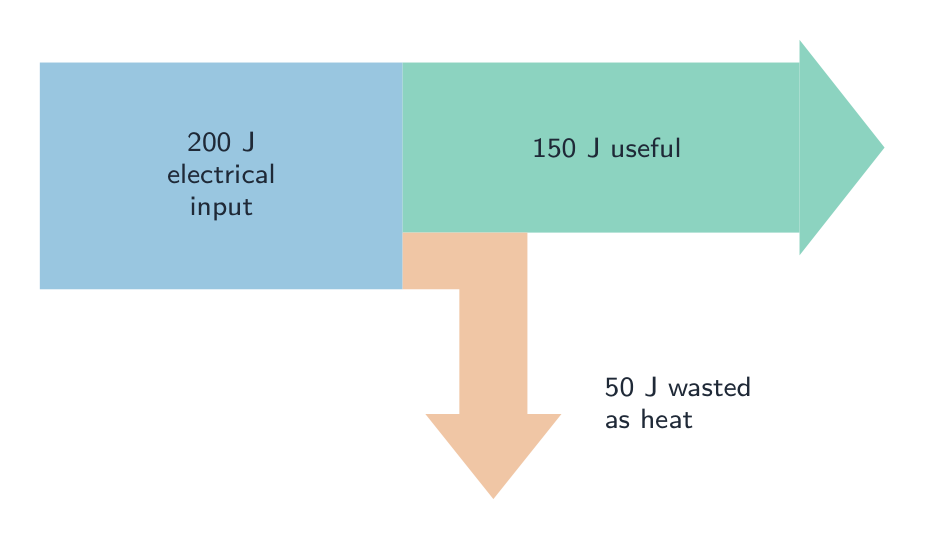
这个马达的一个桑基图:带宽与能量成正比,所以 200 J 的输入分成 150 J 有用和 50 J 作为热浪费 Energy resources
我们从许多能量资源发电。大多数转动一个涡轮机来驱动一个发电机——常常通过烧水产生蒸汽(化石燃料、核燃料、地热、生物燃料),或直接通过移动水或空气(水电、波浪、潮汐、风)。太阳能电池直接从阳光发电;太阳能板加热水。
Resource Renewable? Notes fossil fuels (coal, oil, gas) no reliable, high output, but CO₂ and pollution nuclear fuel no huge output, no CO₂, but radioactive waste biofuels yes roughly carbon-neutral if replanted hydroelectric yes reliable, but a dam floods land wind yes clean, but intermittent solar yes clean, but only in daylight geothermal / tidal yes reliable but limited to certain places 比较资源时,用这五个想法:可再生性(renewability,它会用完吗?)、可用性(availability,它总是在吗?风会停,太阳会落)、可靠性(reliability,它给出稳定的输出吗?)、规模(scale,它能供应多少能量?)和环境影响(environmental impact,污染、二氧化碳、被水坝淹没的土地)。
这些大多数可追溯到太阳(化石燃料是古代储存的阳光;风和波浪来自太阳加热)——例外是地热、核能和潮汐能。太阳本身由核聚变(nuclear fusion)驱动,把氢原子核合并成氦。科学家正在研究如何在地球上的发电站里利用核聚变,但还没有一个聚变反应堆放出的电能比它消耗的多。
探索Energy flow & efficiency
Input energy splits into useful output and wasted energy; efficiency is the useful fraction, and the total is always conserved.
探索Conservation of energy
Drop the object: GPE turns into KE, and the total stays the same when there's no friction.
词汇表 训练英文 中文 拼音 stored/stɔːd/ 储存 chǔ cún kinetic/kɪˈnetɪk/ 动能 dòng néng gravitational potential/ˌɡrævɪˈteɪʃənl pəˈtenʃl/ 重力势能 zhòng lì shì néng chemical/ˈkemɪkl/ 化学能 huà xué néng elastic (strain)/ɪˈlæstɪk/ 弹性势能 tán xìng shì néng nuclear/ˈnjuːklɪə/ 核能 hé néng electrostatic/ɪˌlektrəʊˈstætɪk/ 静电能 jìng diàn néng internal (thermal)/ɪnˈtɜːnl/ 内能 nèi néng transferred/trænsˈfɜːd/ 转移 zhuǎn yí principle of conservation of energy/ˈprɪnsɪpl ɒv ˌkɒnsəˈveɪʃn ɒv ˈenədʒi/ 能量守恒定律 néng liàng shǒu héng dìng lǜ Sankey diagram/ˈsæŋki ˈdaɪəɡræm/ 桑基图 sāng jī tú wasted/ˈweɪstɪd/ 浪费 làng fèi work done/wɜːk dʌn/ 做功 zuò gōng joule/dʒuːl/ 焦耳 jiāo ěr power/ˈpaʊə/ 功率 gōng lǜ watt/wɒt/ 瓦特 wǎ tè efficiency/ɪˈfɪʃənsi/ 效率 xiào lǜ renewability/rɪˌnjuːəˈbɪlɪti/ 可再生性 kě zài shēng xìng availability/əˌveɪləˈbɪlɪti/ 可用性 kě yòng xìng reliability/rɪˌlaɪəˈbɪlɪti/ 可靠性 kě kào xìng scale/skeɪl/ 规模 guī mó environmental impact/enˌvaɪrənˈmentl ˈɪmpækt/ 环境影响 huán jìng yǐng xiǎng nuclear fusion/ˈnjuːklɪə ˈfjuːʒn/ 核聚变 hé jù biàn 1.8
压强
大纲
Core Supplement 1 Define pressure as force per unit area; recall and use the equation $p = \frac{F}{A}$ 2 Describe how pressure varies with force and area in the context of everyday examples 3 Describe, qualitatively, how the pressure beneath the surface of a liquid changes with depth and density of the liquid 4 Recall and use the equation for the change in pressure beneath the surface of a liquid $\Delta p = \rho g \Delta h$ 来源:剑桥国际大纲
压强(pressure)是单位面积的力。
$$p = \frac{F}{A}$$单位是帕斯卡(pascal,Pa)。$1\ \text{Pa} = 1\ \text{N/m}^2$。
一个小的面积给一个大的压强(一把锋利的刀切得好)。一个大的面积给一个小的压强(雪鞋阻止你下陷)。
Pressure in a liquid
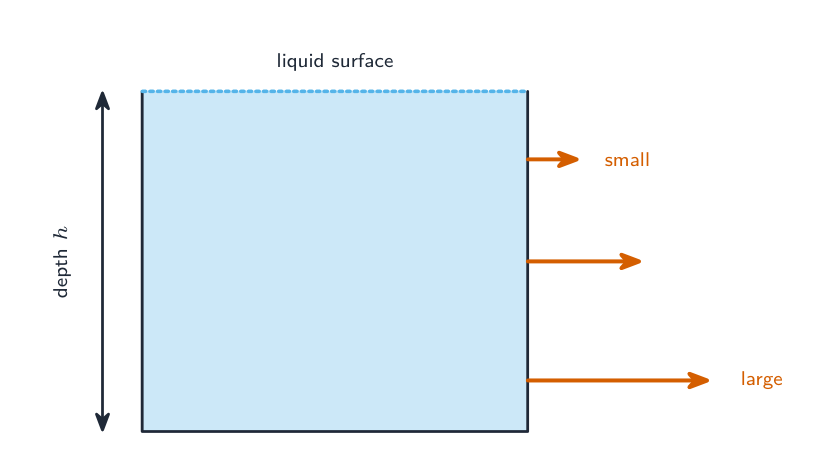
在一个液体中,压强随深度(depth)和液体的密度增加:
$$\Delta p = \rho g \,\Delta h$$这就是为什么一座水坝在底部——水压最大的地方——建得更厚。液体中的压强向所有方向作用。
液体越深,压强越大,所以对壁的向外的推随深度增长 例题。 求水中 $2.0\ \text{m}$ 深处的额外压强(密度 $1000\ \text{kg/m}^3$,$g = 10\ \text{N/kg}$)。
$$\Delta p = \rho g\,\Delta h = 1000 \times 10 \times 2.0 = 20\,000\ \text{Pa}$$探索Pressure
p = ρg·h
Pressure in a liquid is proportional to depth.
词汇表 训练英文 中文 拼音 pressure/ˈpreʃə/ 压强 yā qiáng pascal/ˈpæskl/ 帕斯卡 pà sī kǎ depth/depθ/ 深度 shēn dù 1.8
考试技巧
- 在一个距离-时间图上斜率是速率;在一个速度-时间图上斜率是加速度,而线下的面积是行进的距离。绝不把一个图当作另一个来读。
- 质量(kg)是物质的量,处处相同;重力(N)是重力的力,$W = mg$。在月球上你的质量不变但你的重力更小。
- 速率是一个标量;速度是一个矢量。以稳定速率绕一条曲线运动的东西仍在加速,因为它的方向一直在改变。
- 在胡克定律中,载荷只与伸长量成正比,直到比例极限。用伸长量(伸展的长度 − 原始长度),绝不用整个长度。
- 动量 $p = mv$ 在一次碰撞中守恒。在你把它们相加之前给每个速度一个 $+$ 或 $-$ 符号表示它的方向。
- 先转换单位(cm → m,g → kg)。对一个压在一个表面上的固体用 $p = F/A$,但对一个液体内部的压强用 $p = \rho g h$——它们是不同的公式。
-
2
热学
2.1
物质的微粒动理模型
大纲
2.1.1 States of matter
Core Supplement 1 Know the distinguishing properties of solids, liquids and gases 2 Know the terms for the changes in state between solids, liquids and gases (gas to solid and solid to gas transfers are not required) 2.1.2 Particle model
Core Supplement 1 Describe the particle structure of solids, liquids and gases in terms of the arrangement, separation and motion of the particles and represent these states using simple particle diagrams 6 Know that the forces and distances between particles (atoms, molecules, ions and electrons) and the motion of the particles affects the properties of solids, liquids and gases 2 Describe the relationship between the motion of particles and temperature, including the idea that there is a lowest possible temperature ($-273\,{}^{\circ}\text{C}$), known as absolute zero, where the particles have least kinetic energy 3 Describe the pressure and the changes in pressure of a gas in terms of the motion of its particles and their collisions with a surface 7 Describe the pressure and the changes in pressure of a gas in terms of the forces exerted by particles colliding with surfaces, creating a force per unit area 4 Know that the random motion of microscopic particles in a suspension is evidence for the kinetic particle model of matter 8 Know that microscopic particles may be moved by collisions with light fast-moving molecules and correctly use the terms atoms or molecules as distinct from microscopic particles 5 Describe and explain this motion (sometimes known as Brownian motion) in terms of random collisions between the microscopic particles in a suspension and the particles of the gas or liquid 2.1.3 Gases and the absolute scale of temperature
Core Supplement 1 Describe qualitatively, in terms of particles, the effect on the pressure of a fixed mass of gas of: (a) a change of temperature at constant volume (b) a change of volume at constant temperature 3 Recall and use the equation $pV = \text{constant}$ for a fixed mass of gas at constant temperature, including a graphical representation of this relationship 2 Convert temperatures between kelvin and degrees Celsius; recall and use the equation $T\text{ (in K)} = \theta\text{ (in }^{\circ}\text{C)} + 273$ 来源:剑桥国际大纲
分子动理论:气体压强 物质以三种状态存在:固体(solid)、液体(liquid)和气体(gas)。
状态 形状 体积 粒子 固体 固定 固定 靠近,在一个规则的图案中,振动 液体 取容器的形状 固定 靠近,没有图案,能互相滑过 气体 填满容器 改变 相隔远,快,随机运动 物态变化是:熔化(固体 → 液体)、沸腾/蒸发(液体 → 气体)、凝结(condensation,气体 → 液体)和凝固(solidification,液体 → 固体)。在凝结中,气体粒子变慢并靠近在一起形成一个液体。在凝固中,液体粒子失去能量并安定在固定的位置。
词汇表 训练英文 中文 拼音 states of matter/steɪts ɒv ˈmætə/ 物态 wù tài solid/ˈsɒlɪd/ 固体 gù tǐ liquid/ˈlɪkwɪd/ 液体 yè tǐ condensation/kɒndenˈseɪʃn/ 凝结 níng jié solidification/səˌlɪdɪfɪˈkeɪʃn/ 凝固 níng gù kinetic particle model/kɪˈnetɪk ˈpɑːtɪkl ˈmɒdl/ 分子动理论 fèn zǐ dòng lǐ lùn 2.1
分子动理论模型
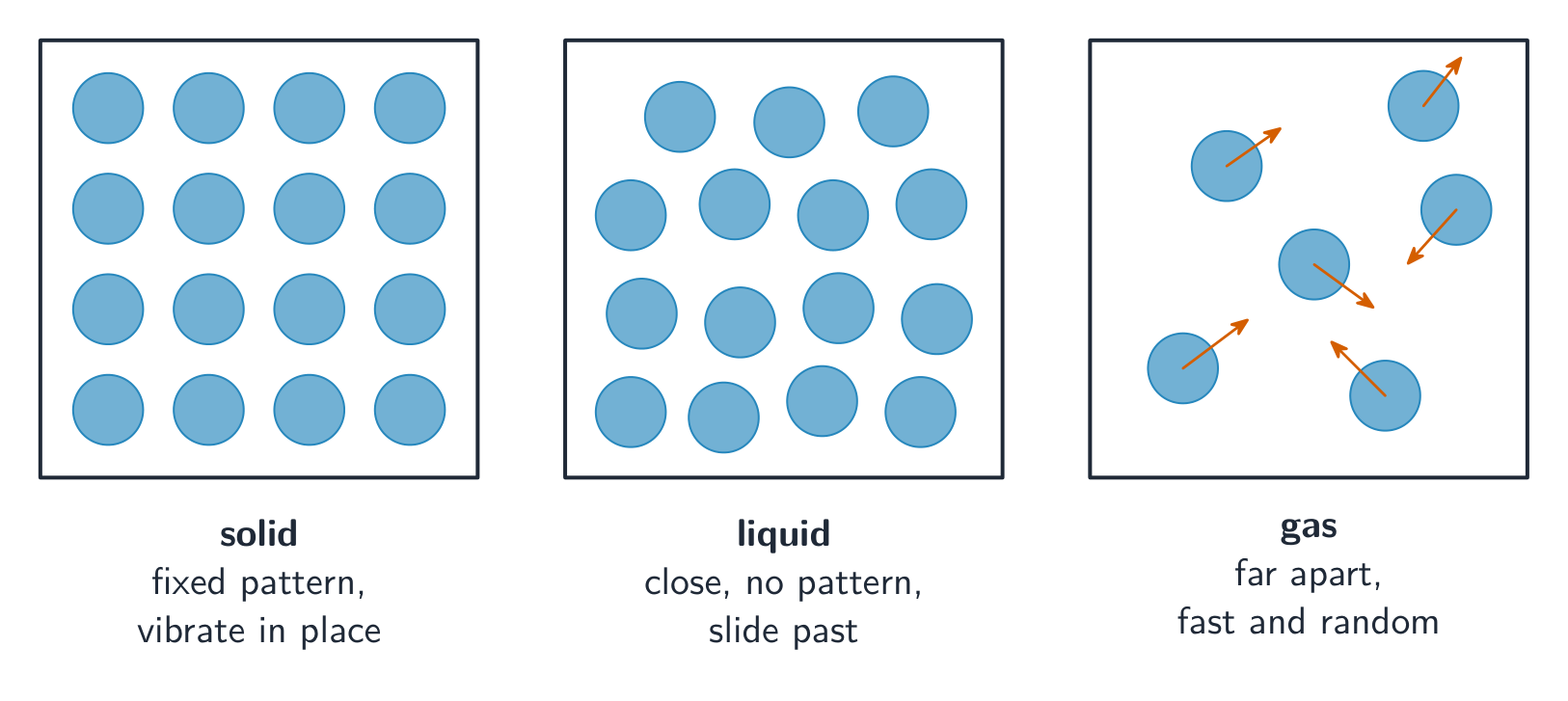
所有物质由一直在运动的微小粒子(particles)构成。这是分子动理论。
- 在一个固体中,粒子只在固定位置周围振动(vibrate)。
- 在一个液体中它们仍靠近但能互相滑过。
- 在一个气体中它们相隔远,并在随机方向上快速运动。
同样的粒子在三种状态中:在一个固体中固定而有序、在一个液体中靠近但无序、在一个气体中相隔远而快 Temperature and particle energy
当你加热一个物质时,它的粒子移动更快,所以它们有更多的动能(kinetic energy)。温度(temperature)是粒子平均动能的一个量度。
可能最低的温度是绝对零度(absolute zero),$-273\,{}^{\circ}\text{C}$。在这一点粒子有可能最少的能量。
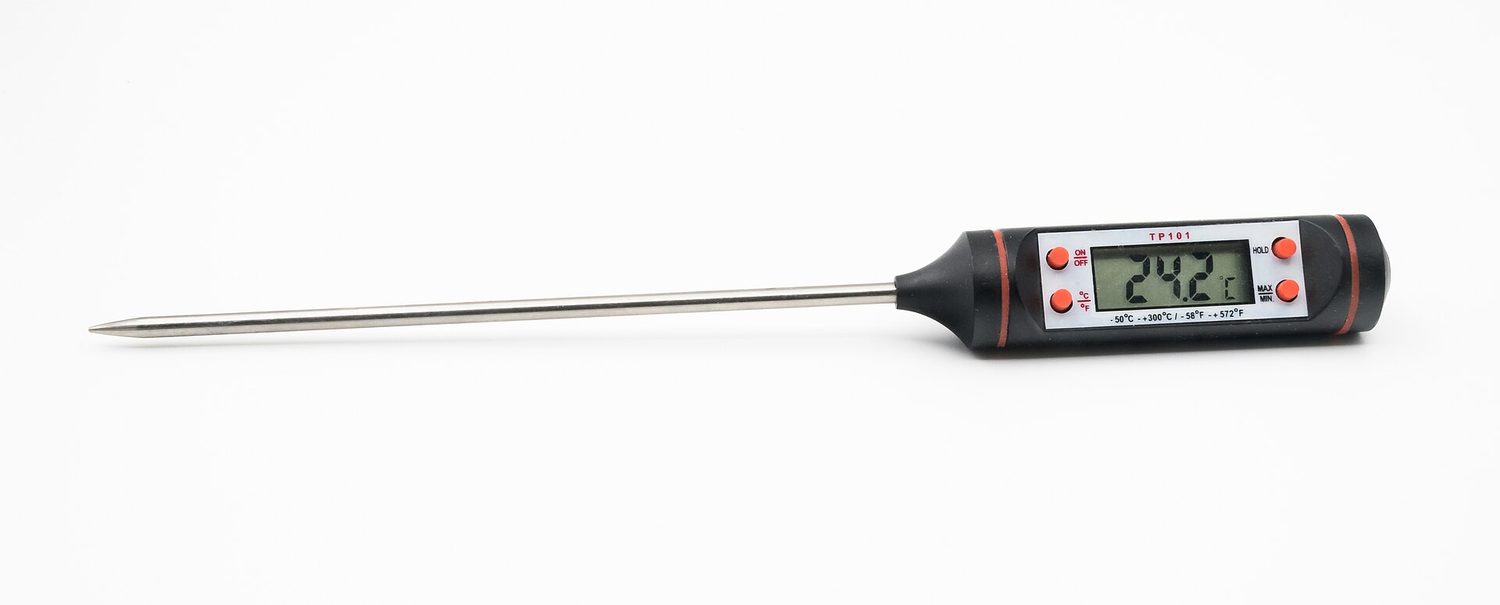
一个数字温度计通过感知它接触的粒子的动能来测量温度 Gas pressure
气体粒子撞击它们容器的壁。每次撞击是一个微小的推。气体的压强(pressure)是这些撞击每单位面积的总力。

气体压强是无数粒子撞击在壁每单位面积上的总力 - 加热一个气体(在恒定体积)使粒子移动更快、撞击更用力、更频繁,所以压强上升。
- 把一个气体挤进一个更小的体积(在恒定温度)意味着每单位面积每秒更多的撞击,所以压强上升。
对于恒定温度的一个固定质量的气体:
$$pV = \text{constant}$$所以若体积减半,压强翻倍。

在恒定温度,压强-体积图是一条曲线:体积减半而压强翻倍,所以 $pV$ 保持不变 例题。 一个气体在 $100\ \text{kPa}$ 的压强下有 $200\ \text{cm}^3$ 的体积。它在恒定温度被挤到 $50\ \text{cm}^3$。求新压强。
因为 $pV$ 保持不变,$p_1 V_1 = p_2 V_2$:
$$100 \times 200 = p_2 \times 50 \quad\Rightarrow\quad p_2 = \frac{20\,000}{50} = 400\ \text{kPa}$$Brownian motion
若你在显微镜下看空气中的烟,你看到微小的斑点以一种颠簸、随机的方式运动。这是布朗运动(Brownian motion)。这些斑点被快速、看不见的空气粒子撞击它们而被推动。它是分子动理论的强证据。
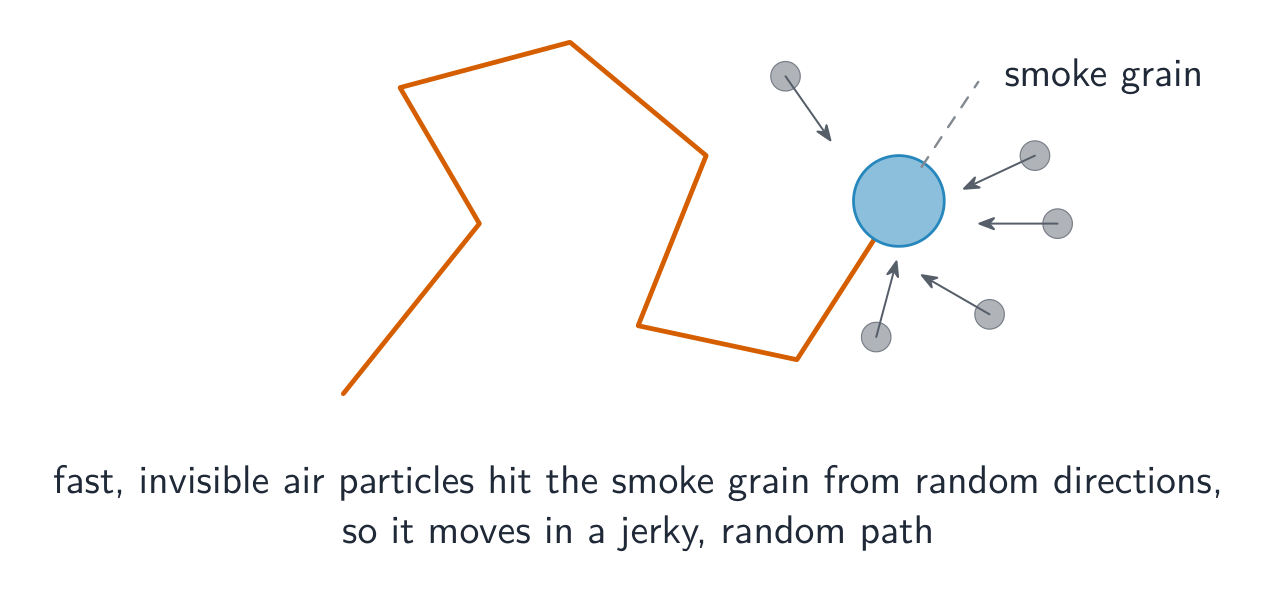
来自快速空气粒子的随机撞击把一个烟粒沿一条颠簸、随机的路径推动 The kelvin scale
科学家常常用开尔文(kelvin,K)温度标度,它从绝对零度开始。要转换:
$$T\text{ (in K)} = \theta\text{ (in }^{\circ}\text{C}) + 273$$所以 $0\,{}^{\circ}\text{C} = 273\ \text{K}$。
例题。 把 $25\,{}^{\circ}\text{C}$ 转换成开尔文,把 $200\ \text{K}$ 转换成摄氏度。
$$25 + 273 = 298\ \text{K}, \qquad 200 - 273 = -73\,{}^{\circ}\text{C}$$探索Squeeze a gas (Boyle's law)
Slide the piston in to shrink the volume. The same particles get crammed into less space, so they hit the walls more often and the pressure climbs — while pressure × volume stays constant.
词汇表 训练英文 中文 拼音 gas/ɡæs/ 气体 qì tǐ particle/ˈpɑːtɪkl/ 粒子 lì zi vibrate/vaɪˈbreɪt/ 振动 zhèn dòng kinetic energy/kɪˈnetɪk ˈenədʒi/ 动能 dòng néng temperature/ˈtemprɪtʃə/ 温度 wēn dù absolute zero/ˈæbsəluːt ˈzɪərəʊ/ 绝对零度 jué duì líng dù pressure/ˈpreʃə/ 压强 yā qiáng Brownian motion/ˈbraʊnɪən ˈməʊʃn/ 布朗运动 bù lǎng yùn dòng kelvin/ˈkelvɪn/ 开尔文 kāi ěr wén thermometer/θɜːˈmɒmɪtə/ 温度计 wēn dù jì 2.2
热学性质与温度
大纲
2.2.1 Thermal expansion of solids, liquids and gases
Core Supplement 1 Describe, qualitatively, the thermal expansion of solids, liquids and gases at constant pressure 3 Explain, in terms of the motion and arrangement of particles, the relative order of magnitudes of the expansion of solids, liquids and gases as their temperatures rise 2 Describe some of the everyday applications and consequences of thermal expansion 2.2.2 Specific heat capacity
Core Supplement 1 Know that a rise in the temperature of an object increases its internal energy 2 Describe an increase in temperature of an object in terms of an increase in the average kinetic energies of all of the particles in the object 3 Define specific heat capacity as the energy required per unit mass per unit temperature increase; recall and use the equation $$c = \frac{\Delta E}{m\Delta\theta}$$4 Describe experiments to measure the specific heat capacity of a solid and a liquid 2.2.3 Melting, boiling and evaporation
Core Supplement 1 Describe melting and boiling in terms of energy input without a change in temperature 6 Describe the differences between boiling and evaporation 2 Know the melting and boiling temperatures for water at standard atmospheric pressure 3 Describe condensation and solidification in terms of particles 4 Describe evaporation in terms of the escape of more-energetic particles from the surface of a liquid 7 Describe how temperature, surface area and air movement over a surface affect evaporation 5 Know that evaporation causes cooling of a liquid 8 Explain the cooling of an object in contact with an evaporating liquid 来源:剑桥国际大纲
当物质被加热时,它的粒子运动更多并占据更多的空间,所以材料膨胀。气体膨胀最多,然后液体,然后固体。这个顺序来自粒子之间的力:在一个固体中粒子被紧紧地固定在一个晶格(lattice,一个固定的图案)中,所以它们只能振动得稍微多一点;在一个液体中它们被固定得没那么紧;在一个气体中力非常弱,所以粒子铺开得多得多。
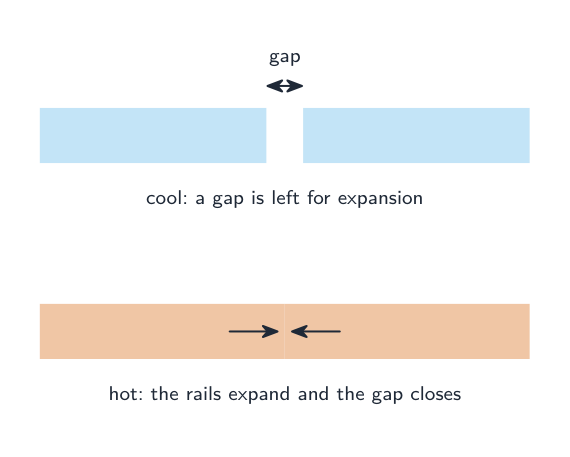
日常例子:铁轨之间留有间隙;桥坐在滚轮上;一个紧的金属盖在被加热时松开。
铁轨之间凉时留一个小间隙,所以当它们在热中膨胀时间隙闭合而不是使轨道弯曲 探索Heating and specific heat capacity
Q = mcΔT
The heat energy needed is proportional to the temperature rise for a given mass of material.
词汇表 训练英文 中文 拼音 thermal expansion/ˈθɜːml ekˈspænʃn/ 热膨胀 rè péng zhàng lattice/ˈlætɪs/ 晶格 jīng gé 2.2
内能与比热容

一个物体的内能(internal energy)是它所有粒子的总能量。加热一个物体提高它的内能,而且通常它的温度。
比热容(specific heat capacity)是把 1 kg 的一个材料的温度提高 1 °C 所需的能量。
$$c = \frac{\Delta E}{m\,\Delta\theta}$$一个有高比热容的材料(像水)需要很多能量来升温,而且冷却缓慢。
例题。 把 $2.0\ \text{kg}$ 的水从 $20\,{}^{\circ}\text{C}$ 加热到 $70\,{}^{\circ}\text{C}$ 需要多少能量?水的比热容是 $4200\ \text{J/(kg}\,{}^{\circ}\text{C)}$。
重排 $c = \frac{\Delta E}{m\,\Delta\theta}$ 给出 $\Delta E = mc\,\Delta\theta$,其中 $\Delta\theta = 70 - 20 = 50\,{}^{\circ}\text{C}$:
$$\Delta E = 2.0 \times 4200 \times 50 = 420\,000\ \text{J} = 420\ \text{kJ}$$测量比热容。 对于一个固体,用一个有两个孔的金属块:一个孔放一个电加热器(heater),一个孔放一个温度计(thermometer)。测量金属块的质量 $m$。把加热器打开一段测量过的时间 $t$,并记录电流 $I$ 和电压 $V$,这样供应的能量是 $E = IVt$(或从一个焦耳计读出能量)。记录温度上升 $\Delta\theta$。然后 $c = \dfrac{E}{m\,\Delta\theta}$。对于一个液体,在一个容器里加热一个测量过质量的液体并搅拌它,使温度处处相同。把金属块或容器包上隔热材料(insulating material),这样逃到空气中的能量更少。
Boiling water: internal energy rises with temperature; specific heat capacity is energy per kg per °C 词汇表 训练英文 中文 拼音 internal energy/ɪnˈtɜːnl ˈenədʒi/ 内能 nèi néng specific heat capacity/spəˈsɪfɪk hiːt kəˈpæsɪti/ 比热容 bǐ rè róng heater/ˈhiːtə/ 加热器 jiā rè qì insulating material/ˈɪnsjuːleɪtɪŋ məˈtɪərɪəl/ 隔热材料 gé rè cái liào boiling/ˈbɔɪlɪŋ/ 沸腾 fèi téng 2.2
熔化、沸腾与蒸发
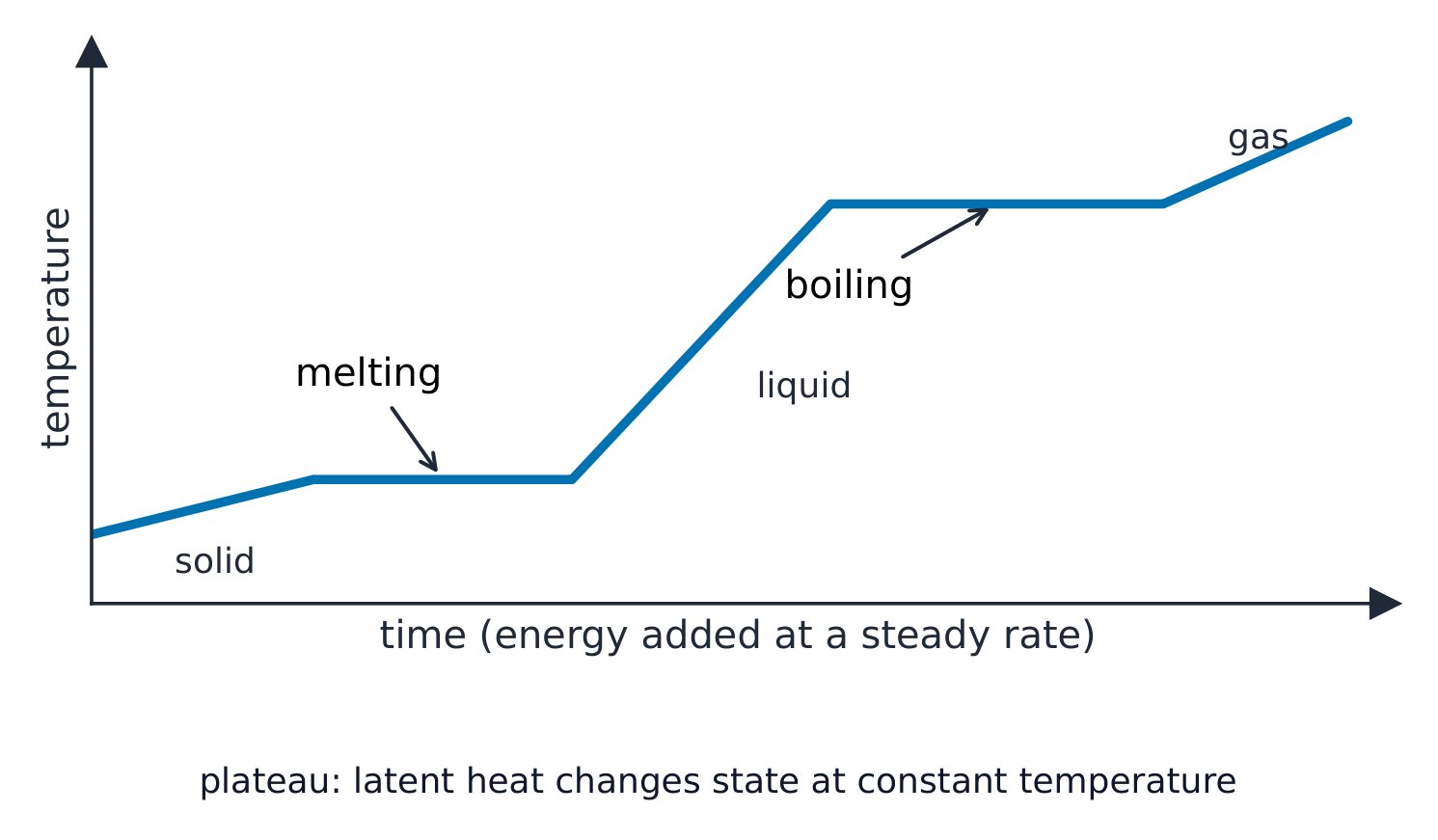
熔化(melting)和沸腾(boiling)需要能量,但在状态变化时温度保持不变。这个能量打破粒子之间的力。对于正常气压下的水,熔化在 $0\,{}^{\circ}\text{C}$、沸腾在 $100\,{}^{\circ}\text{C}$。
当物质熔化时和当它沸腾时温度保持平坦,即使能量仍在被添加 蒸发(evaporation)是当一个液体在它的表面、低于沸点变成一个气体时。最快的粒子从表面逃逸。因为最快(最有能量)的粒子离开,留下的那些的平均能量下降,所以液体冷却(cools down)。一个接触正在蒸发的液体的物体也冷却,因为液体从它那里取走能量:这就是为什么汗液使你的皮肤凉下来。
蒸发在温度更高、表面积更大,以及表面上有更多空气流动时更快。
探索The heating curve — watch the temperature pause
While the substance is melting or boiling the temperature stays flat, even though heat is still going in — the energy breaks bonds instead of warming it.
词汇表 训练英文 中文 拼音 melting/ˈmeltɪŋ/ 熔化 róng huà evaporation/ɪˌvæpəˈreɪʃn/ 蒸发 zhēng fā cools down/kuːlz daʊn/ 冷却 lěng què transfer of thermal energy/ˈtrænsfɜː ɒv ˈθɜːml ˈenədʒi/ 热能传递 rè néng chuán dì 2.3
热能的传递

大纲
2.3.1 Conduction
Core Supplement 1 Describe experiments to demonstrate the properties of good thermal conductors and bad thermal conductors (thermal insulators) 2 Describe thermal conduction in all solids in terms of atomic or molecular lattice vibrations and also in terms of the movement of free (delocalised) electrons in metallic conductors 3 Describe, in terms of particles, why thermal conduction is bad in gases and most liquids 4 Know that there are many solids that conduct thermal energy better than thermal insulators but do so less well than good thermal conductors 2.3.2 Convection
Core Supplement 1 Know that convection is an important method of thermal energy transfer in liquids and gases 2 Explain convection in liquids and gases in terms of density changes and describe experiments to illustrate convection 2.3.3 Radiation
Core Supplement 1 Know that thermal radiation is infrared radiation and that all objects emit this radiation 2 Know that thermal energy transfer by thermal radiation does not require a medium 4 Know that for an object to be at a constant temperature it needs to transfer energy away from the object at the same rate that it receives energy 3 Describe the effect of surface colour (black or white) and texture (dull or shiny) on the emission, absorption and reflection of infrared radiation 5 Know what happens to an object if the rate at which it receives energy is less or more than the rate at which it transfers energy away from the object 6 Know how the temperature of the Earth is affected by factors controlling the balance between incoming radiation and radiation emitted from the Earth’s surface 7 Describe experiments to distinguish between good and bad emitters of infrared radiation 8 Describe experiments to distinguish between good and bad absorbers of infrared radiation 9 Describe how the rate of emission of radiation depends on the surface temperature and surface area of an object 2.3.4 Consequences of thermal energy transfer
Core Supplement 1 Explain some of the basic everyday applications and consequences of conduction, convection and radiation, including: (a) heating objects such as kitchen pans (b) heating a room by convection 2 Explain some of the complex applications and consequences of conduction, convection and radiation where more than one type of thermal energy transfer is significant, including: (a) a fire burning wood or coal (b) a radiator in a car 来源:剑桥国际大纲
热能以三种方式从更热的地方移动到更冷的地方。
Conduction
热传导(conduction)是热能穿过一个材料而材料不移动的传递。一个固体中的粒子坐在一个晶格中。被加热的粒子振动更多并把能量传给它们的邻居。在金属中,自由(离域)电子(delocalised electrons,自由电子)快速携带能量,所以金属是好的热导体(thermal conductors)。
导得差的材料(像空气、木头和塑料)是热绝缘体(thermal insulators)。
测试导体。 用一点蜡把一枚图钉固定在铜、铁、玻璃和木头棒的一端,并同等地加热另一端。图钉最先从铜棒掉下,然后是铁棒,最后(或永远不)从玻璃和木头掉下:金属是最好的导体。一根拿在火焰里的金属棒很快感觉热;一根木棒不会。
气体和大多数液体是差的导体,因为它们的粒子相隔远,只在碰巧碰撞时才传递能量。没有晶格,也没有自由电子。
在热传导中振动的粒子把能量传给它们的邻居,所以能量从热的一端流向凉的一端 Convection
对流(convection)在液体和气体中发生。当一个流体被加热时它膨胀、变得密度更小,并上升。更凉、密度更大的流体下沉以取代它的位置。这个移动流体的循环是一个对流。
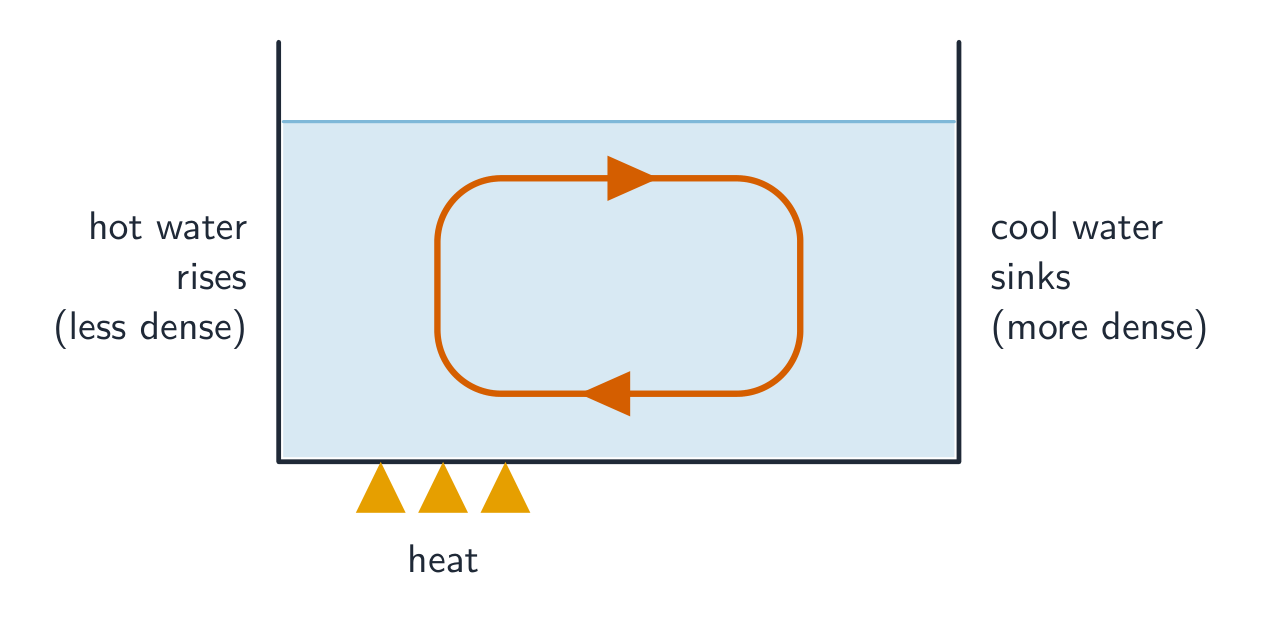
被加热的流体上升,而更凉的流体下沉,建立一个对流 显示对流。 把一粒紫色的高锰酸钾(potassium permanganate)晶体放进一个烧杯的水中,并在晶体下方轻轻加热烧杯。一股有颜色的水流在加热处上方上升、在顶部铺开,并在两侧下沉。在空气中,一个烟箱的一个烟囱下方点燃的蜡烛把烟从另一个烟囱拉下去,再从火焰上方拉上来。
对流不能在一个固体中发生,因为粒子不能从一个地方移动到另一个。
Radiation
热辐射(thermal radiation)是红外线(infrared)波携带的能量。所有物体发射它,而它不需要材料来穿过——它能越过空的空间(这就是能量如何从太阳到达我们)。
一个暗淡(dull)而黑的表面是一个好的红外线发射体(emitter)和好的吸收体(absorber)。一个闪亮而白的表面是一个差的发射体和好的反射体(reflector)。

一个暗淡的黑色表面发射(并吸收)红外线比一个闪亮、白的好得多 比较表面。 把两个罐子,一个暗淡的黑色、一个闪亮的银色,装满同样温度的热水,并在每个里放一个温度计。黑色的罐子冷却得更快,所以它是更好的发射体。然后把同样的两个罐子装满冷水,放在离一个加热器相等的距离处。黑色的罐子变暖得更快,所以它是更好的吸收体。一个莱斯利立方体(Leslie cube,一个每一面是一种不同表面的金属盒)显示同样的事。

一台热(红外)相机把一只温暖的手放出的红外线变成一张图;更亮意味着更热 当一个物体以与它吸收能量相同的速率发射能量时,它保持在一个恒定的温度。当表面更热、更大时发射速率更大。若一个物体吸收能量比它发射得快,它的温度上升;若它发射得比吸收快,它的温度下降。
地球的温度。 地球吸收来自太阳的辐射,并把红外辐射发射回太空。只有当两个速率相等时,它的平均温度才保持恒定。任何改变这个平衡的东西都改变温度。大气(atmosphere)中的气体(如二氧化碳)吸收一些发射出的红外线并把一部分送回地面,所以这些气体越多,地球越暖。云和冰反射入射的阳光,所以冰越少,被吸收的能量越多,地球进一步变暖。
Everyday examples
- 一个平底锅有一个把能量快速传导给食物的金属底,和一个作为绝缘体的塑料或木头把手,所以你能拿住它。
- 一个散热器(radiator)通过对流给一个房间加热:挨着它的空气变暖、上升,更凉的空气流进来取代它的位置,所以整个房间变暖。
- 坐在一堆火旁边,你立刻在脸上感觉到它的辐射;你和火之间的空气是差的导体。
- 一个保温瓶(vacuum flask)通过阻止全部三种传递来保持一杯饮料热:它双层壁之间的真空阻止传导和对流,而它闪亮的银色表面阻止辐射。
探索Heat transfer lab
Compare the routes by which thermal energy moves.
词汇表 训练英文 中文 拼音 conduction/kənˈdʌkʃn/ 热传导 rè chuán dǎo delocalised electrons/dɪˈlɒkəlaɪzd ɪˈlektrɒnz/ 自由电子 zì yóu diàn zi thermal conductor/ˈθɜːml kənˈdʌktə/ 热导体 rè dǎo tǐ thermal insulator/ˈθɜːml ˈɪnsjuːleɪtə/ 热绝缘体 rè jué yuán tǐ convection/kənˈvekʃn/ 对流 duì liú potassium permanganate/pəˈtæsɪəm pəˈmæŋɡəneɪt/ 高锰酸钾 gāo měng suān jiǎ thermal radiation/ˈθɜːml ˌreɪdɪˈeɪʃn/ 热辐射 rè fú shè infrared/ˌɪnfrəˈred/ 红外线 hóng wài xiàn dull/dʌl/ 暗淡 àn dàn emitter/ɪˈmɪtə/ 发射体 fā shè tǐ absorber/əbˈsɔːbə/ 吸收体 xī shōu tǐ reflector/rɪˈflektə/ 反射体 fǎn shè tǐ Leslie cube/ˈlesli kjuːb/ 莱斯利立方体 lái sī lì lì fāng tǐ atmosphere/ˈætməsfɪə/ 大气 dà qì radiator/ˈreɪdɪeɪtə/ 散热器 sàn rè qì vacuum flask/ˈvækjuːm flæsk/ 保温瓶 bǎo wēn píng 2.3
考试技巧
- 在分子动理论中,加热一个气体使它的粒子移动更快、更用力、更频繁地撞击壁,所以压强上升。粒子本身不变大。
- 蒸发只在表面、在任何温度发生;沸腾在一个固定的温度贯穿整个液体发生。蒸发使留下的液体冷却,因为最快的粒子逃逸。
- 在熔化和沸腾期间温度保持恒定,即使能量仍在被供应——那个能量打破粒子之间的力。
- 对于比热容用 $\Delta E = mc\,\Delta\theta$,其中 $\Delta\theta$ 是温度的变化,不是最终温度。
- 暗淡的黑色表面是红外线的最好发射体和吸收体;闪亮、浅色的表面是最好的反射体。对流需要一个流体流动,所以它不能在一个固体中发生。
-
3
波
3.1
波的一般性质

大纲
Core Supplement 1 Know that waves transfer energy without transferring matter 2 Describe what is meant by wave motion as illustrated by vibrations in ropes and springs, and by experiments using water waves 3 Describe the features of a wave in terms of wavefront, wavelength, frequency, crest (peak), trough, amplitude and wave speed 4 Recall and use the equation for wave speed $v = f \lambda$ 5 Know that for a transverse wave, the direction of vibration is at right angles to the direction of propagation and understand that electromagnetic radiation, water waves and seismic S-waves (secondary) can be modelled as transverse 6 Know that for a longitudinal wave, the direction of vibration is parallel to the direction of propagation and understand that sound waves and seismic P-waves (primary) can be modelled as longitudinal 7 Describe how waves can undergo: (a) reflection at a plane surface (b) refraction due to a change of speed (c) diffraction through a narrow gap 9 Describe how wavelength and gap size affects diffraction through a gap 8 Describe the use of a ripple tank to show: (a) reflection at a plane surface (b) refraction due to a change in speed caused by a change in depth (c) diffraction due to a gap (d) diffraction due to an edge 10 Describe how wavelength affects diffraction at an edge 来源:剑桥国际大纲
横波对纵波 一个波(wave)把能量(energy)从一处带到另一处而不携带物质。例如,一个水波使一个漂浮的软木塞上下浮动,但软木塞不随波行进。你可以通过上下摇一根绳子的一端在绳子上做出一个波,或通过前后推一根长弹簧的一端在弹簧上做出一个波。在一个波纹水槽(ripple tank,一个浅的水盘,上方有一盏灯)中,你可以在下方的屏幕上观察水波。
Describing a wave
- 波前(wavefront):连接一个波上一起运动的点的一条线(例如,一个涟漪的顶部)
- 波长(wavelength,$\lambda$):两个相邻波前之间的距离(一个完整的波)
- 频率(frequency,$f$):每秒通过一个点的波的数目,以赫兹(Hz)测量
- 波峰(crest,也叫 peak,顶)和波谷(trough,底)
- 振幅(amplitude):一个点从它静止位置移动的最大距离
- 波速(wave speed,$v$):一个波前行进得多快
一个波的各部分:波长、振幅、波峰和波谷 这些由波动方程联系:
$$v = f\lambda$$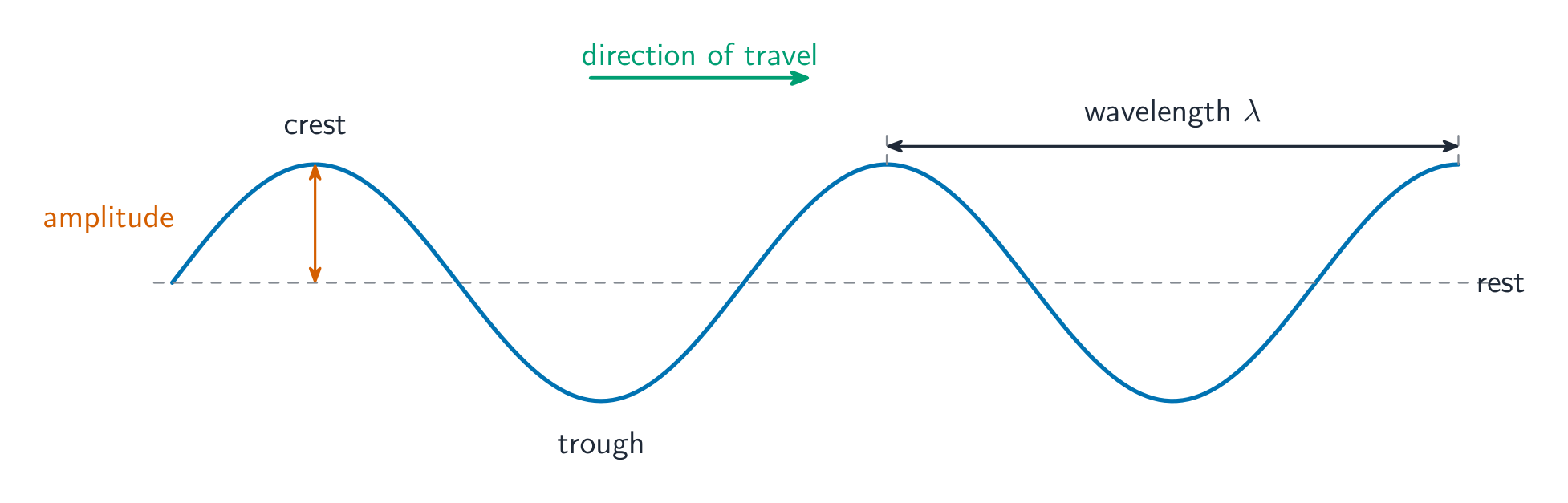
波长是两个波峰之间的距离;振幅是从静止位置到一个波峰的高度 例题。 一个声波以 $340\ \text{m/s}$ 行进,有 $170\ \text{Hz}$ 的频率。求它的波长。
重排 $v = f\lambda$ 给出 $\lambda = \dfrac{v}{f}$:
$$\lambda = \frac{340}{170} = 2.0\ \text{m}$$Two types of wave
- 在一个横波(transverse wave)中,粒子在与波行进(它的传播(propagation))成直角(90°)的方向振动。光、水波和地震 S 波(地震中横向的晃动)是横波。
- 在一个纵波(longitudinal wave)中,粒子沿波行进的同一个方向振动。声音和地震 P 波是纵波。
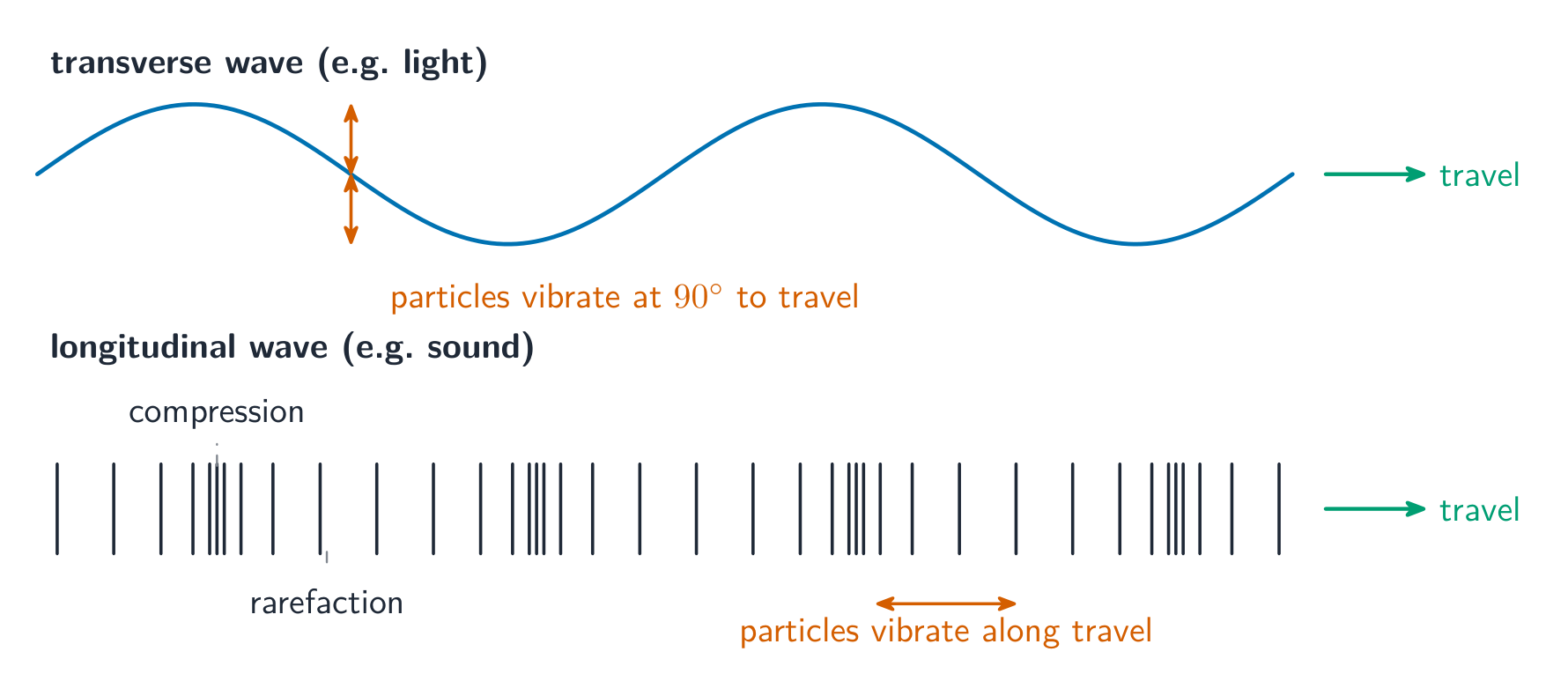
在一个横波中粒子横过行进方向振动;在一个纵波中它们沿它振动,构成压缩和稀疏 Wave behaviour
所有的波都能显示三种行为,你可以在一个波纹水槽(ripple tank)中看到:
- 反射(reflection):波从一个表面弹回。
- 折射(refraction):波在进入一个不同的材料或深度时改变速率(而且通常方向)。
- 衍射(diffraction):波在通过一个间隙或绕一个边缘之后铺开。当间隙约与波长同样大小时铺开最大。

通过一个窄间隙的平面波铺成弯曲的波——当间隙约一个波长宽时衍射最强 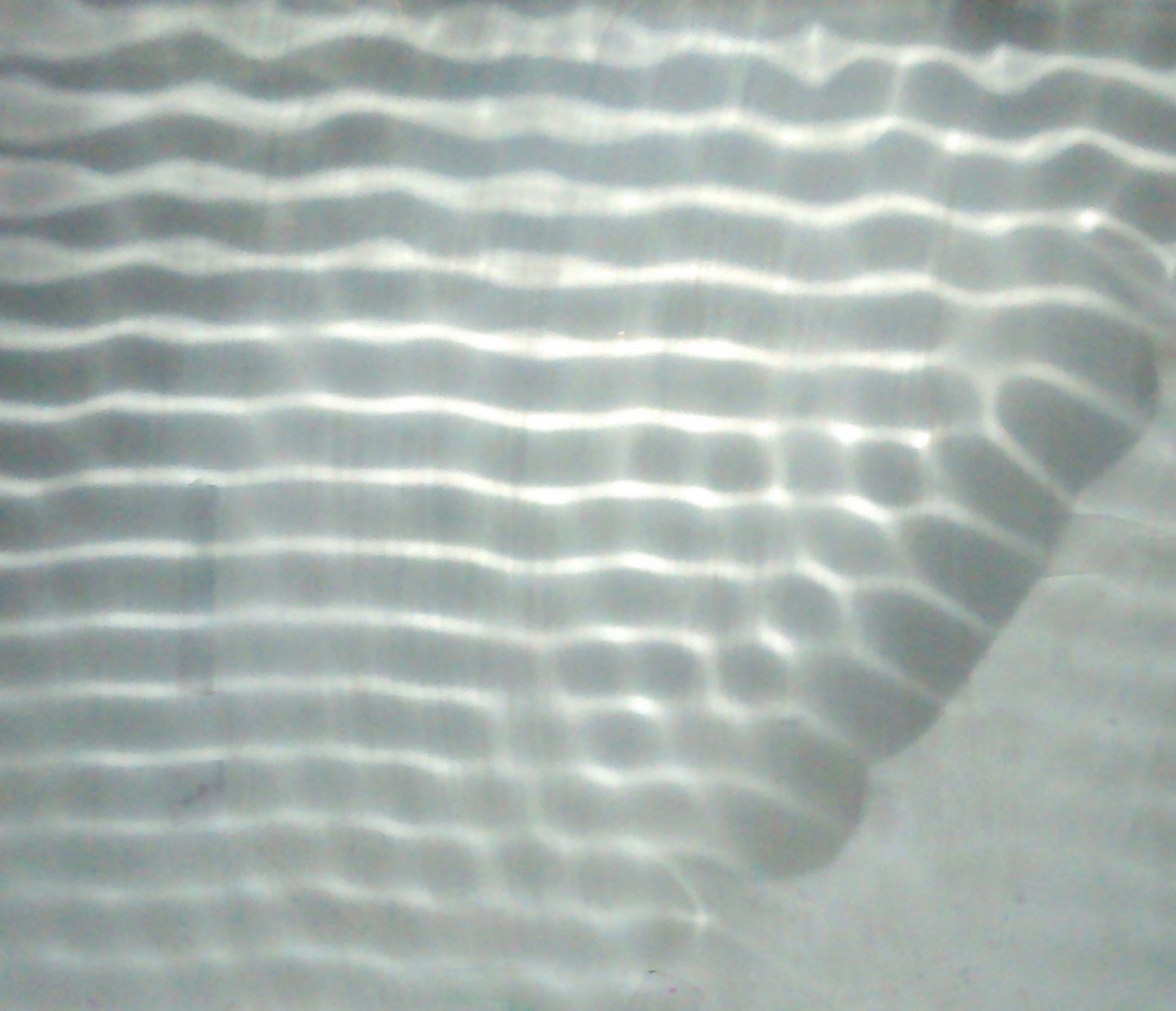
波纹水槽里的平面波从一个直的障碍物反射:反射的波前以它们到达时同样的角离开 探索Properties of waves
y = a sin(bx + c)
A wave: a is amplitude, b sets the wavelength.
探索Transverse & longitudinal waves
Flip between a transverse wave (particles bob up and down, like water and light) and a longitudinal one (particles slide back and forth, bunching into compressions, like sound). The wave moves; the particles stay put.
探索Two waves overlapping
Change the second wave. Where waves meet they add — sometimes reinforcing, sometimes cancelling.
词汇表 训练英文 中文 拼音 wave/weɪv/ 波 bō energy/ˈenədʒi/ 能量 néng liàng ripple tank/ˈrɪpl tæŋk/ 波纹水槽 bō wén shuǐ cáo wavefront/ˈweɪvfrʌnt/ 波前 bō qián wavelength/ˈweɪvleŋθ/ 波长 bō cháng frequency/ˈfriːkwənsi/ 频率 pín lǜ crest/krest/ 波峰 bō fēng peak/piːk/ 峰 fēng trough/trɒf/ 波谷 bō gǔ amplitude/ˈæmplɪtjuːd/ 振幅 zhèn fú wave speed/weɪv spiːd/ 波速 bō sù transverse wave/trænsˈvɜːs weɪv/ 横波 héng bō propagation/ˌprɒpəˈɡeɪʃn/ 传播 chuán bō longitudinal wave/ˌlɒŋɡɪˈtjuːdɪnl weɪv/ 纵波 zòng bō diffraction/dɪˈfrækʃn/ 衍射 yǎn shè light/laɪt/ 光 guāng 3.2
光
大纲
3.2.1 Reflection of light
Core Supplement 1 Define and use the terms normal, angle of incidence and angle of reflection 2 Describe the formation of an optical image by a plane mirror and give its characteristics, i.e. same size, same distance from mirror, virtual 3 State that for reflection, the angle of incidence is equal to the angle of reflection; recall and use this relationship 4 Use simple constructions, measurements and calculations for reflection by plane mirrors 3.2.2 Refraction of light
Core Supplement 1 Define and use the terms normal, angle of incidence and angle of refraction 2 Describe an experiment to show refraction of light by transparent blocks of different shapes 6 Define refractive index, $n$, as the ratio of the speeds of a wave in two different regions 3 Describe the passage of light through a transparent material (limited to the boundaries between two mediums only) 7 Recall and use the equation $$n = \frac{\sin i}{\sin r}$$4 State the meaning of critical angle 8 Recall and use the equation $$n = \frac{1}{\sin c}$$5 Describe internal reflection and total internal reflection using both experimental and everyday examples 9 Describe the use of optical fibres, particularly in telecommunications 3.2.3 Thin lenses
Core Supplement 1 Describe the action of thin converging and thin diverging lenses on a parallel beam of light 2 Define and use the terms focal length, principal axis and principal focus (focal point) 3 Draw and use ray diagrams for the formation of a real image by a converging lens 6 Draw and use ray diagrams for the formation of a virtual image by a converging lens 4 Describe the characteristics of an image using the terms enlarged/same size/diminished, upright/inverted and real/virtual 7 Describe the use of a single lens as a magnifying glass 5 Know that a virtual image is formed when diverging rays are extrapolated backwards and does not form a visible projection on a screen 8 Describe the use of converging and diverging lenses to correct long-sightedness and short-sightedness 3.2.4 Dispersion of light
Core Supplement 1 Describe the dispersion of light as illustrated by the refraction of white light by a glass prism 2 Know the traditional seven colours of the visible spectrum in order of frequency and in order of wavelength 3 Recall that visible light of a single frequency is described as monochromatic 来源:剑桥国际大纲
一个凸透镜构成一个像 全反射 Reflection
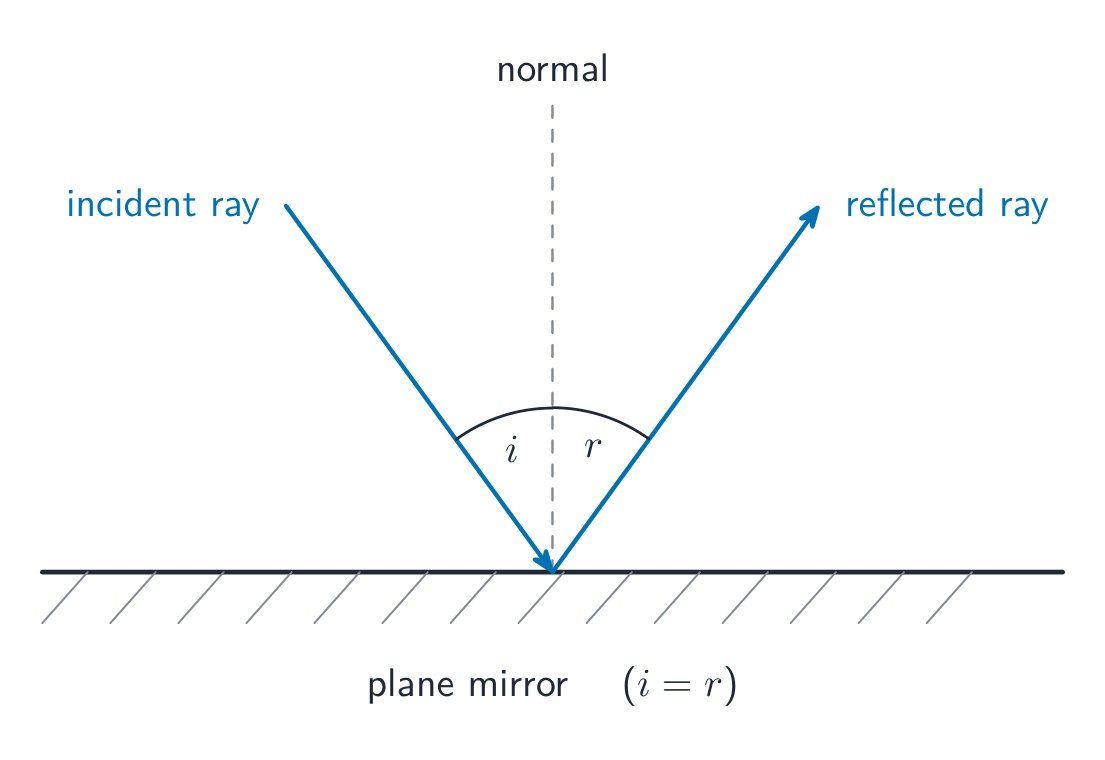
当光撞击一面镜子时,它反射。我们从法线(normal,一条与表面成 90° 的线)测量角。
反射定律:入射角(angle of incidence)等于反射角(angle of reflection)。
一面平面镜(plane mirror)构成一个像,它与物体同样大小、在镜子后面同样的距离,而且是虚的(它不能在一个屏幕上被接住)。
在一面平面镜,入射角 $i$ 等于反射角 $r$,两者都从法线测量 Refraction
当光从一个材料进入另一个时,它改变速率并弯曲。第二个材料中的角是折射角(angle of refraction)。
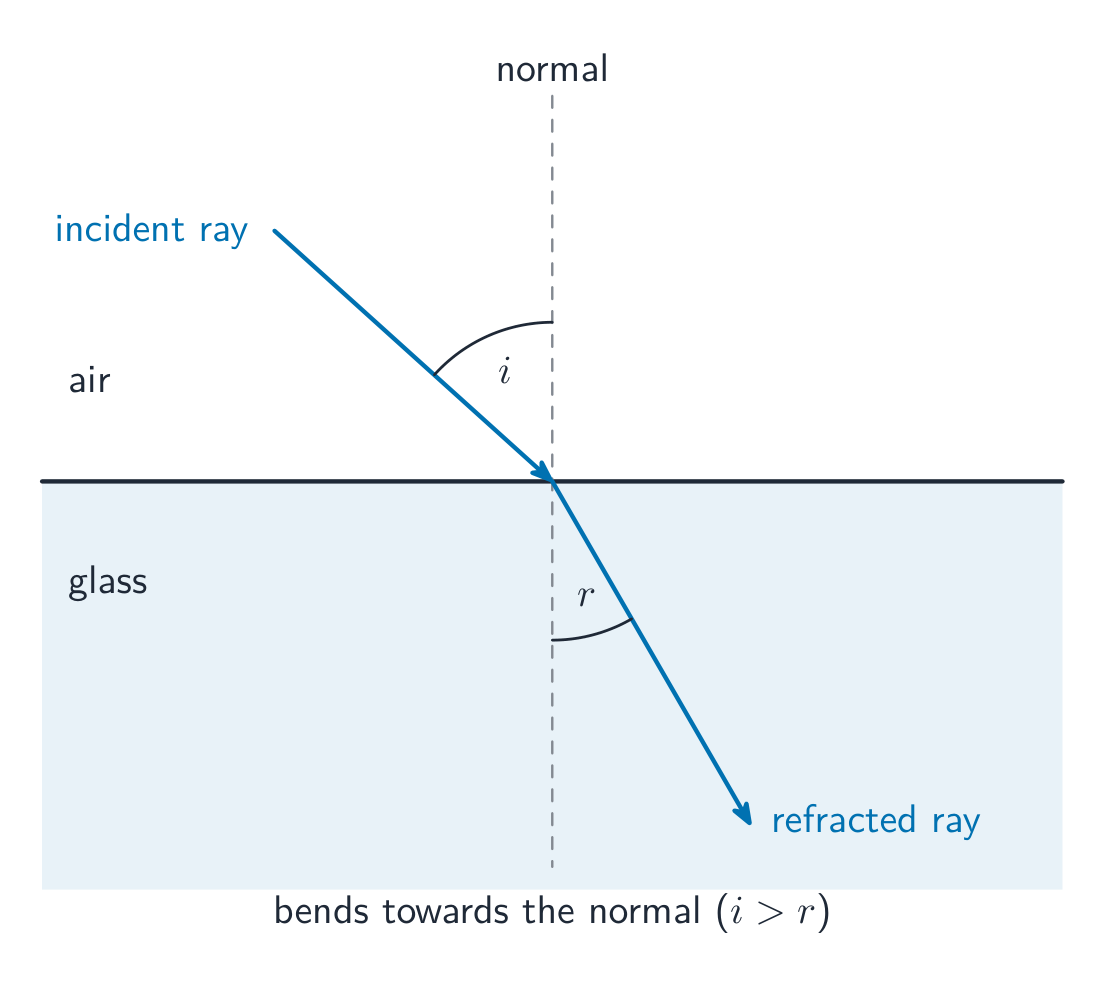
从空气进入玻璃,光减速并朝法线弯曲,所以 $i > r$ 看见折射。 从一个光线盒(ray box)射一条窄的光线,进入一个立在纸上的矩形玻璃块。标记进去的光线和出来的光线,拿走玻璃块,把标记连起来画出玻璃里的光线。在光线进入处画法线,并用量角器测量入射角和折射角。用一个半圆形玻璃块或一个棱镜重复:光线在进入玻璃时总是朝法线弯曲,在离开时远离法线。
折射率(refractive index)$n$ 比较光在两个材料中的速率:
$$n = \frac{\sin i}{\sin r}$$例题。 一条光线从空气进入玻璃。入射角是 60° 而折射角是 35°。求玻璃的折射率。(取 $\sin i = 0.87$ 和 $\sin r = 0.57$。)
$$n = \frac{\sin i}{\sin r} = \frac{0.87}{0.57} = 1.5$$当光试图离开玻璃或水而角太大时,它不能出去,而是完全反射。这是全反射(total internal reflection)。它在内部的角比临界角(critical angle)$c$ 大时发生:
$$n = \frac{1}{\sin c}$$
在临界角之下光折射出去;在它之上光被全反射 这个效果被用于光纤(optical fibres),为电话和互联网携带光信号的细玻璃丝。

全反射使光沿每根纤维不断弹跳,直到它在尖端照出去 Lenses
一个凸透镜(converging lens,中间胖)把平行光线向内弯到一个叫焦点(principal focus)的点。主光轴(principal axis)是通过透镜中心并与它成直角的直线;焦点位于这条轴上。从透镜中心到焦点的距离是焦距(focal length)。一个凹透镜(diverging lens,中间薄)把平行光线铺开,好像它们来自入射一侧的一个焦点。
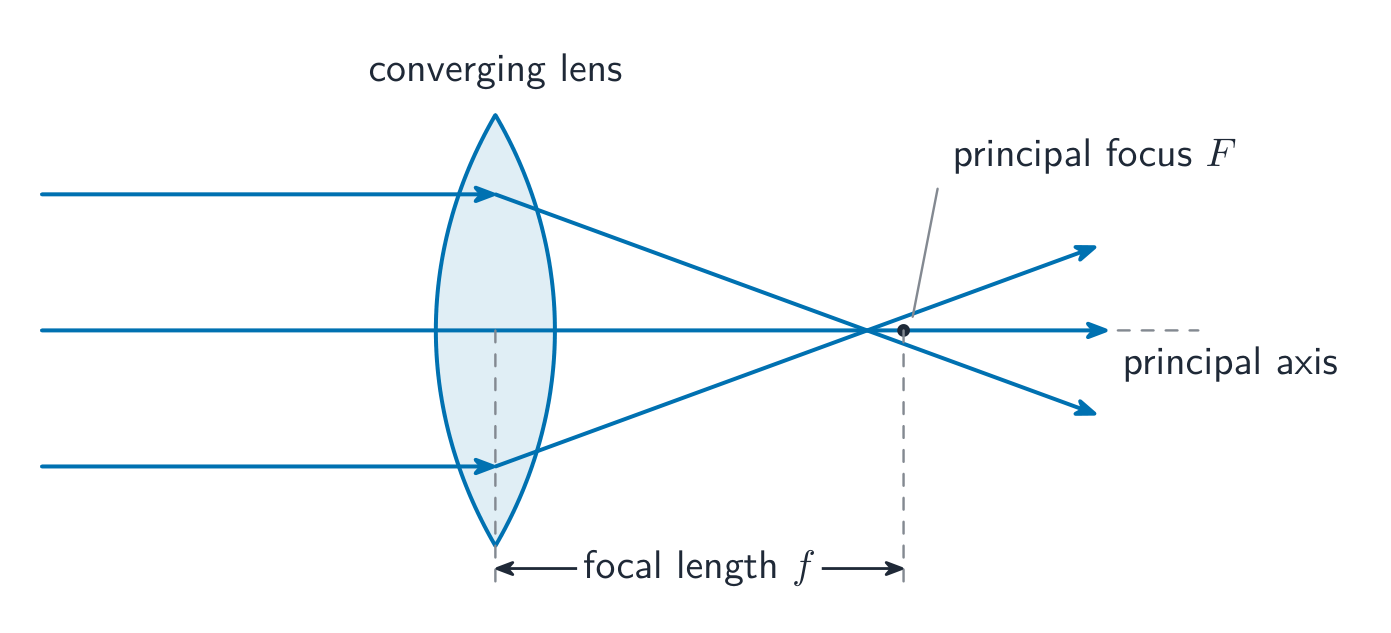
一个凸透镜把平行光线弯曲以在焦点相遇;焦距 $f$ 是透镜到焦点的距离 一个凸透镜能构成一个实像(real image,光线真的相遇;能在一个屏幕上显示)或,当物体非常近时,一个虚像(virtual image,光线只是似乎来自它)。在眼睛附近使用,一个凸透镜是一个放大镜(magnifying glass)。
用三对词描述一个像:放大的(enlarged)或缩小的(diminished)(或同样大小)、正立(upright)或倒立(inverted,上下颠倒),以及实的或虚的。一个远在焦点之外的物体给出一个缩小的、倒立的实像(如在一台相机中)。一个在焦点和透镜之间的物体给出一个放大的、正立的虚像(一个放大镜)。
矫正视力。 一个近视(short-sightedness)的人看近处清楚但远处模糊:眼睛把光聚焦在视网膜(retina,眼睛的后部)前面。眼前的一个凹透镜先把光线铺开,这样它们聚焦在视网膜上。一个远视(long-sightedness)的人看远处清楚但近处模糊:眼睛把光聚焦在视网膜后面。一个凸透镜在光线进入眼睛前先把它们稍微会聚。
Dispersion
一个玻璃棱镜(prism)把白光分裂成光谱(spectrum)的颜色。这个分裂叫色散(dispersion)。

一个棱镜把紫光折射最多、红光最少,所以白光铺成一个光谱 颜色的顺序是红、橙、黄、绿、蓝、靛、紫。红光有最长的波长和最低的频率;紫是相反的。单一频率(一种纯颜色)的光是单色(monochromatic)的。

进入一个真实玻璃棱镜的白光铺成完整的颜色光谱 探索Bend a light ray
Shine light into water, glass or diamond and change the angle. The ray slows and bends toward the normal — the denser the material (higher n), the more it bends. That bending is why a straw looks broken in a glass, and why diamonds sparkle.
探索Image formation by a converging lens
Trace the three special rays from the object — where they meet is the image. Move the object closer than the focal point to flip it into a magnifying glass.
词汇表 训练英文 中文 拼音 reflection/rɪˈflekʃn/ 反射 fǎn shè refraction/rɪˈfrækʃn/ 折射 zhé shè normal/ˈnɔːml/ 法线 fǎ xiàn angle of incidence/ˈæŋɡl ɒv ˈɪnsɪdəns/ 入射角 rù shè jiǎo angle of reflection/ˈæŋɡl ɒv rɪˈflekʃn/ 反射角 fǎn shè jiǎo plane mirror/pleɪn ˈmɪrə/ 平面镜 píng miàn jìng angle of refraction/ˈæŋɡl ɒv rɪˈfrækʃn/ 折射角 zhé shè jiǎo ray box/reɪ bɒks/ 光线盒 guāng xiàn hé refractive index/rɪˈfræktɪv ˈɪndeks/ 折射率 zhé shè lǜ total internal reflection/ˈtəʊtl ɪnˈtɜːnl rɪˈflekʃn/ 全反射 quán fǎn shè critical angle/ˈkrɪtɪkl ˈæŋɡl/ 临界角 lín jiè jiǎo optical fibre/ˈɒptɪkl ˈfaɪbə/ 光纤 guāng xiān converging lens/kənˈvɜːdʒɪŋ lenz/ 凸透镜 tū tòu jìng principal focus/ˈprɪnsɪpl ˈfəʊkəs/ 焦点 jiāo diǎn principal axis/ˈprɪnsɪpl ˈæksɪs/ 主光轴 zhǔ guāng zhóu focal length/ˈfəʊkl leŋθ/ 焦距 jiāo jù diverging lens/daɪˈvɜːdʒɪŋ lenz/ 凹透镜 āo tòu jìng real image/rɪəl ˈɪmɪdʒ/ 实像 shí xiàng virtual image/ˈvɜːtʃuːəl ˈɪmɪdʒ/ 虚像 xū xiàng magnifying glass/ˈmæɡnɪfaɪɪŋ ɡlæs/ 放大镜 fàng dà jìng enlarged/enˈlɑːdʒd/ 放大的 fàng dà de diminished/dɪˈmɪnɪʃt/ 缩小的 suō xiǎo de upright/ˈʌpraɪt/ 正立 zhèng lì inverted/ɪnˈvɜːtɪd/ 倒立 dào lì short-sightedness/ʃɔːt ˈsaɪtɪdnəs/ 近视 jìn shì retina/ˈretɪnə/ 视网膜 shì wǎng mó long-sightedness/lɒŋ ˈsaɪtɪdnəs/ 远视 yuǎn shì prism/ˈprɪzəm/ 棱镜 léng jìng spectrum/ˈspektrəm/ 光谱 guāng pǔ dispersion/dɪˈspɜːʃn/ 色散 sè sàn monochromatic/ˌmɒnəʊkrəʊˈmætɪk/ 单色 dān sè 3.3
电磁波谱
大纲
Core Supplement 1 Know the main regions of the electromagnetic spectrum in order of frequency and in order of wavelength 2 Know that all electromagnetic waves travel at the same high speed in a vacuum 6 Know that the speed of electromagnetic waves in a vacuum is $3.0 \times 10^8\text{ m/s}$ and is approximately the same in air 3 Describe typical uses of the different regions of the electromagnetic spectrum including: (a) radio waves; radio and television transmissions, astronomy, radio frequency identification (RFID) (b) microwaves; satellite television, mobile phones (cell phones), microwave ovens (c) infrared; electric grills, short range communications such as remote controllers for televisions, intruder alarms, thermal imaging, optical fibres (d) visible light; vision, photography, illumination (e) ultraviolet; security marking, detecting fake bank notes, sterilising water (f) X-rays; medical scanning, security scanners (g) gamma rays; sterilising food and medical equipment, detection of cancer and its treatment 4 Describe the harmful effects on people of excessive exposure to electromagnetic radiation, including: (a) microwaves; internal heating of body cells (b) infrared; skin burns (c) ultraviolet; damage to surface cells and eyes, leading to skin cancer and eye conditions (d) X-rays and gamma rays; mutation or damage to cells in the body 5 Know that communication with artificial satellites is mainly by microwaves: (a) some satellite phones use low orbit artificial satellites (b) some satellite phones and direct broadcast satellite television use geostationary satellites 7 Know that many important systems of communications rely on electromagnetic radiation including: (a) mobile phones (cell phones) and wireless internet use microwaves because microwaves can penetrate some walls and only require a short aerial for transmission and reception (b) Bluetooth uses radio waves because radio waves pass through walls but the signal is weakened on doing so (c) optical fibres (visible light or infrared) are used for cable television and high-speed broadband because glass is transparent to visible light and some infrared; visible light and short wavelength infrared can carry high rates of data 8 Know the difference between a digital and analogue signal 9 Know that a sound can be transmitted as a digital or analogue signal 10 Explain the benefits of digital signalling including increased rate of transmission of data and increased range due to accurate signal regeneration 来源:剑桥国际大纲
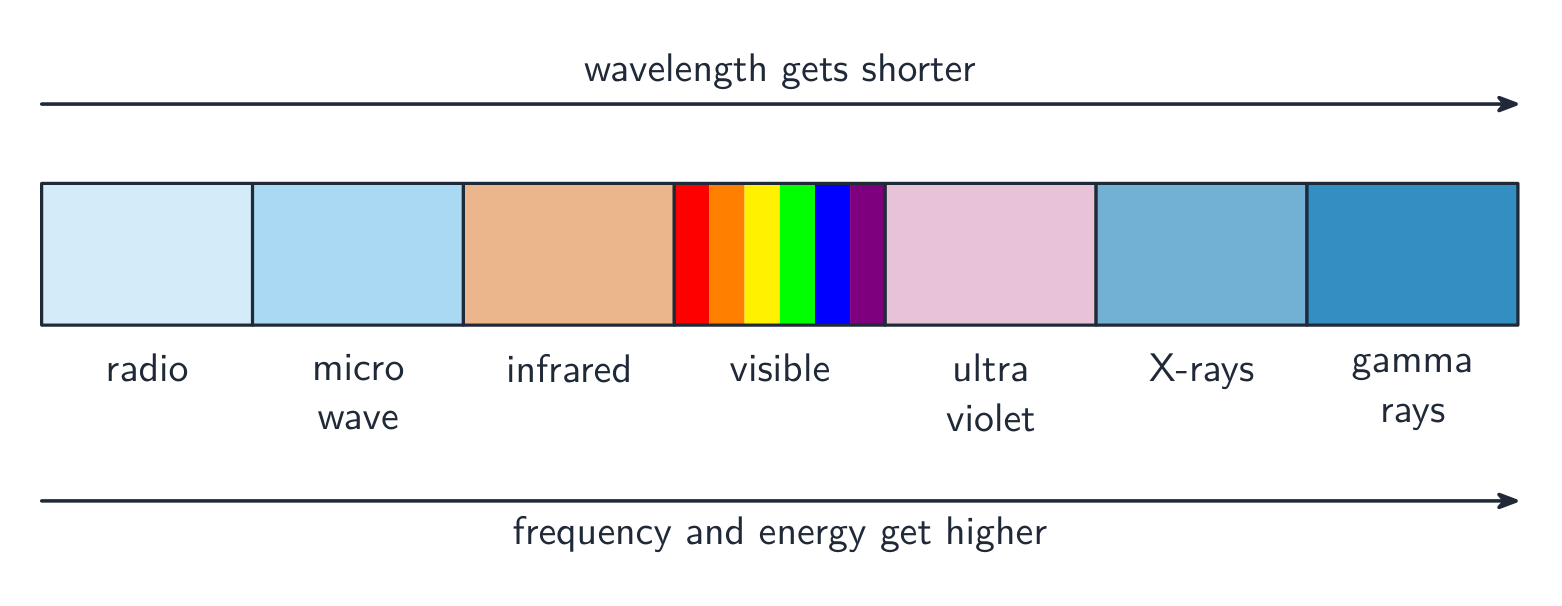
电磁波谱(electromagnetic spectrum)是一族波,它们在真空(vacuum)中都以同样的高速行进,$3.0 \times 10^8\ \text{m/s}$。按从最长波长(最低频率)到最短的顺序:
区域 一个典型的用途 太多的危险 无线电波(radio waves) 无线电和电视信号、天文学、RFID 标签 — 微波(microwaves) 手机、卫星电视、烹饪 身体细胞的加热 红外线(infrared) 遥控器、热成像、烤架、光纤 皮肤烧伤 可见光 看见、摄影 — 紫外线(ultraviolet) 净化水、检查钞票 皮肤癌、眼睛损伤 X射线(X-rays) 医疗和安全扫描 对细胞的损伤 伽马射线(gamma rays) 消毒设备、治疗癌症 细胞的突变 随着你从无线电波到伽马射线,频率上升、波长下降,而能量(和危险)上升。电磁波在空气中的速率与在真空中几乎相同。
卫星。 与人造卫星(artificial satellites)的通信主要用微波,因为微波能穿过大气。一些卫星电话用低轨道(low orbit)上靠近地球的卫星。其他卫星电话,以及直播卫星电视,用地球静止轨道(geostationary orbit)上的卫星,它们停留在地球上同一点的上方。
从无线电波到伽马射线,波长下降,而频率和能量上升 数字信号与模拟信号
无线电波和微波把信息作为信号来携带,而一个信号要么是模拟(analogue)的,要么是数字(digital)的。一个模拟信号是连续变化的,可以取任何值;一个数字信号是只有两个值(开或关,
1或0)的流。声音可以作为任一种信号发送:一个麦克风给出一个模拟信号,它可以被变成一个数字信号。现代通信偏好数字信号,原因有两个,考试会问到:
- 更高的数据传输速率;
- 更大的范围:一个微弱的数字信号能被精确地再生回干净的
1/0,因为只需要分辨两个电平,所以沿途拾取的噪声被去除。一个模拟信号无法这样被清理,所以它的噪声会累积。
探索Slide across the spectrum
Radio waves, visible light and gamma rays are all the same wave — only the wavelength changes, and with it the frequency, photon energy and everyday use.
词汇表 训练英文 中文 拼音 electromagnetic spectrum/ɪˌlektrəʊməɡˈnetɪk ˈspektrəm/ 电磁波谱 diàn cí bō pǔ vacuum/ˈvækjuːm/ 真空 zhēn kōng radio waves/ˈreɪdɪəʊ weɪvz/ 无线电波 wú xiàn diàn bō microwave/ˈmaɪkrəʊweɪv/ 微波 wēi bō infrared/ˌɪnfrəˈred/ 红外线 hóng wài xiàn ultraviolet/ˌʊltrəˈvaɪəlɪt/ 紫外线 zǐ wài xiàn X-rays/eks reɪz/ X射线 X shè xiàn gamma rays/ˈɡæmə reɪz/ 伽马射线 gā mǎ shè xiàn artificial satellites/ˌɑːtɪˈfɪʃl ˈsætəlaɪts/ 人造卫星 rén zào wèi xīng low orbit/ləʊ ˈɔːbɪt/ 低轨道 dī guǐ dào geostationary orbit/ˌdʒiːəʊˈsteɪʃənəri ˈɔːbɪt/ 地球静止轨道 dì qiú jìng zhǐ guǐ dào analogue/ˈænəlɒɡ/ 模拟 mó nǐ digital/ˈdɪdʒɪtl/ 数字 shù zì 3.4
声

大纲
Core Supplement 1 Describe the production of sound by vibrating sources 2 Describe the longitudinal nature of sound waves 10 Describe compression and rarefaction 3 State the approximate range of frequencies audible to humans as 20Hz to 20000Hz 4 Know that a medium is needed to transmit sound waves 5 Know that the speed of sound in air is approximately 330–350m/s 11 Know that, in general, sound travels faster in solids than in liquids and faster in liquids than in gases 6 Describe a method involving a measurement of distance and time for determining the speed of sound in air 7 Describe how changes in amplitude and frequency affect the loudness and pitch of sound waves 8 Describe an echo as the reflection of sound waves 9 Define ultrasound as sound with a frequency higher than 20kHz 12 Describe the uses of ultrasound in non-destructive testing of materials, medical scanning of soft tissue and sonar including calculation of depth or distance from time and wave speed 来源:剑桥国际大纲
声音(sound)由一个振动的物体制造。它是一个纵波:空气被挤进一个压缩(compression,粒子靠近)并被拉进一个稀疏(rarefaction,粒子相隔远)。
- 声音需要一个介质(medium,一个材料)来穿过,所以它不能穿过一个真空。
- 人类能听到约从 $20\ \text{Hz}$ 到 $20\,000\ \text{Hz}$ 的频率。
- 声音行进比光慢得多(空气中约 $340\ \text{m/s}$),而且在液体和固体中比在气体中更快。
- 一个更大的振幅使声音更响(更大的响度(loudness));一个更高的频率使音调(pitch)更高。所以海豚快速的咔嗒声是高音调的,而一记重的鼓击(大振动)是响的。
一个反射的声音是一个回声(echo)。
测量声速。 两个学生站在一个已知的距离之外,例如用卷尺或测距轮量出的 500 m。一个把两块木块撞在一起。另一个在看见木块相撞时启动秒表,在听到撞击声时停止它。光几乎立刻到达,所以测得的时间就是声音花的时间,而速率 = 距离 ÷ 时间。重复并取平均以减小反应时间误差。回声法只需要一个人:在离一堵大墙已知距离处拍手,并给反射的声音计时,记住声音来回走了两趟。
例题。 一个学生站在离一堵大墙 85 m 处并拍手一次。回声 0.50 s 后返回。求声速。
声音行进到墙并返回,一个距离 $2 \times 85 = 170\ \text{m}$,在 $0.50\ \text{s}$ 中:
$$v = \frac{s}{t} = \frac{170}{0.50} = 340\ \text{m/s}$$超声波(ultrasound)是高于 $20\,000\ \text{Hz}$ 的声音——太高,人类听不到。它的用途依赖反射:声呐测量水深、医学扫描成像一个胎儿或软组织,而无损检测在不切开的情况下找出金属内部的裂缝。像回声一样,一个超声波脉冲来回行进,所以把总距离减半才到物体。
例题。 一个声呐脉冲在发出 $0.10\ \text{s}$ 后从海床返回;声音在水中以 $1500\ \text{m/s}$ 行进。脉冲来回行进 $s = v\times t = 1500\times0.10 = 150\ \text{m}$,所以海深 $150/2 = 75\ \text{m}$。
A microphone converts sound vibrations in air into an electrical signal 探索Sound
y = a sin(bt + c)
Louder = bigger amplitude; higher pitch = higher frequency.
词汇表 训练英文 中文 拼音 sound/saʊnd/ 声音 shēng yīn compression/kəmˈpreʃn/ 压缩 yā suō rarefaction/ˌreərɪˈfækʃn/ 稀疏 xī shū medium/ˈmiːdɪəm/ 介质 jiè zhì loudness/ˈlaʊdnəs/ 响度 xiǎng dù pitch/pɪtʃ/ 音调 yīn diào echo/ˈekəʊ/ 回声 huí shēng Ultrasound/ˌʊltrəˈsaʊnd/ 超声波 chāo shēng bō 3.4
考试技巧
- 学习 $v = f\lambda$ 并准备好重排它。从法线(与表面成 90° 的线)测量所有的入射、反射和折射角,绝不从表面本身。
- 横波横过行进方向振动(光、水);纵波沿它振动(声音)。声音需要一个介质,所以它不能越过一个真空;光能。
- 全反射只在光从一个较密的材料行进到一个不那么密的材料且内部的角比临界角大时发生。
- 按顺序知道电磁波谱——无线电、微波、红外线、可见、紫外线、X射线、伽马。都在真空中以同样的速率行进;频率和能量从无线电到伽马上升。
- 进入一个较密的材料(空气 → 玻璃)光减速并朝法线弯曲;离开它(玻璃 → 空气)光加速并远离弯曲。
-
4
电与磁
讲义 双页 词汇表 双页 词汇测验 3 双页 词汇测验 9 双页 词汇测验 10 双页 词汇测验 11 双页 词汇测验 12 双页 词汇测验 13 双页 词汇测验 14 双页 词汇测验 18 双页 观看视频课4.1
简单磁现象
大纲
Core Supplement 1 Describe the forces between magnetic poles and between magnets and magnetic materials, including the use of the terms north pole (N pole), south pole (S pole), attraction and repulsion, magnetised and unmagnetised 10 Explain that magnetic forces are due to interactions between magnetic fields 2 Describe induced magnetism 3 State the differences between the properties of temporary magnets (made of soft iron) and the properties of permanent magnets (made of steel 4 State the difference between magnetic and non-magnetic materials 5 Describe a magnetic field as a region in which a magnetic pole experiences a force 6 Draw the pattern and direction of magnetic field lines around a bar magnet 11 Know that the relative strength of a magnetic field is represented by the spacing of the magnetic field lines 7 State that the direction of a magnetic field at a point is the direction of the force on the N pole of a magnet at that point 8 Describe the plotting of magnetic field lines with a compass or iron filings and the use of a compass to determine the direction of the magnetic field 9 Describe the uses of permanent magnets and electromagnets 来源:剑桥国际大纲
一个磁体(magnet)能吸引一些金属。每个磁体有两端,叫磁极(poles):一个北极(north pole,N 极)和一个南极(south pole,S 极)。
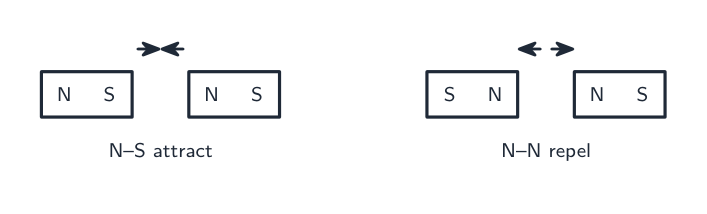
同名磁极排斥;异名磁极吸引 两个磁极的规则像电荷的规则:
- 相同的磁极(N 和 N,或 S 和 S)排斥(repel,推开):这是排斥力(repulsion)。
- 不同的磁极(N 和 S)吸引(attract,拉近):这是吸引力(attraction)。
一个磁体吸引一个磁性材料(magnetic material),如铁、钢、钴和镍。其他材料(铜、塑料、木头)是非磁性的,不感受力。
Induced magnetism
把一块铁放在一个磁体附近或接触它,铁本身变成一个磁体。这是感应磁性(induced magnetism)。最靠近磁体的铁端获得相反的磁极,所以两者随即吸引。
Temporary and permanent magnets
- 软铁(soft iron)容易被磁化(magnetise)但很快失去它的磁性。它被用于一个临时磁体(temporary magnet)。
- 钢(steel)更难被磁化但保持它的磁性。它被用于一个永磁体(permanent magnet)。
所以一块未磁化(unmagnetised)的软铁是一个电磁铁最好的铁芯,而钢最适合一个条形磁体。
Magnetic fields
一个磁场(magnetic field)是一个磁极感受力的区域(region)。我们用磁场线(magnetic field lines)画它:
- 线从 N 极出来、进入 S 极。
- 一个点的场方向是放在那里的一个小测试磁体 N 极上力的方向。
- 线靠近的地方场强;线相隔远的地方场弱。

一个条形磁体的磁场线从 N 极出来、进入 S 极 你可以通过在一个磁体上方的纸上撒铁屑(iron filings),或通过在它周围移动一个小的绘图指南针(compass,指针沿场指)来显示这个图案。

铁屑沿磁场线排列,显示一个条形磁体的场图案 Uses of magnets
- 永磁体:冰箱门扣、指南针指针、扬声器。
- 电磁铁(electromagnets,只在电流流动时有磁性):举废铁的起重机、电铃、继电器。一个电磁铁能被开关并被做得更强,这是一个永磁体不能的。
磁力发生是因为两个磁体的场互相推和拉。
探索Make the magnetic field visible
Compass needles trace the field from N to S; switch between attract and repel and watch the whole pattern reorganise, with a neutral point appearing for like poles.
词汇表 训练英文 中文 拼音 magnet/ˈmæɡnɪt/ 磁体 cí tǐ poles/pəʊlz/ 磁极 cí jí north pole/nɔːθ pəʊl/ 北极 běi jí south pole/saʊθ pəʊl/ 南极 nán jí repel/rɪˈpel/ 排斥 pái chì repulsion/rɪˈpʌlʃn/ 排斥力 pái chì lì attract/əˈtrækt/ 吸引 xī yǐn attraction/əˈtrækʃn/ 吸引力 xī yǐn lì magnetic material/mæɡˈnetɪk məˈtɪərɪəl/ 磁性材料 cí xìng cái liào induced magnetism/ɪnˈdjuːst ˈmæɡnɪtɪzəm/ 感应磁性 gǎn yìng cí xìng soft iron/sɒft ˈaɪən/ 软铁 ruǎn tiě magnetise/ˈmæɡnɪtaɪz/ 磁化 cí huà temporary magnet/ˈtemprəri ˈmæɡnɪt/ 临时磁体 lín shí cí tǐ steel/stiːl/ 钢 gāng permanent magnet/ˈpɜːmənənt ˈmæɡnɪt/ 永磁体 yǒng cí tǐ unmagnetised/ʌnˈmæɡnɪtaɪzd/ 未磁化 wèi cí huà magnetic field/mæɡˈnetɪk fiːld/ 磁场 cí chǎng region/ˈriːdʒn/ 区域 qū yù magnetic field lines/mæɡˈnetɪk fiːld laɪnz/ 磁场线 cí chǎng xiàn iron filings/ˈaɪən ˈfaɪlɪŋz/ 铁屑 tiě xiè compass/ˈkʌmpəs/ 指南针 zhǐ nán zhēn electromagnet/ɪˌlektrəʊˈmæɡnɪt/ 电磁铁 diàn cí tiě 4.2
电学量

大纲
4.2.1 Electric charge
Core Supplement 1 State that there are positive and negative charges 7 State that charge is measured in coulombs 2 State that positive charges repel other positive charges, negative charges repel other negative charges, but positive charges attract negative charges 8 Describe an electric field as a region in which an electric charge experiences a force 3 Describe simple experiments to show the production of electrostatic charges by friction and to show the detection of electrostatic charges 9 State that the direction of an electric field at a point is the direction of the force on a positive charge at that point 4 Explain that charging of solids by friction involves only a transfer of negative charge (electrons) 10 Describe simple electric field patterns, including the direction of the field: (a) around a point charge (b) around a charged conducting sphere (c) between two oppositely charged parallel conducting plates (end effects will not be examined) 5 Describe an experiment to distinguish between electrical conductors and insulators 6 Recall and use a simple electron model to explain the difference between electrical conductors and insulators and give typical examples 4.2.2 Electric current
Core Supplement 1 Know that electric current is related to the flow of charge 5 Define electric current as the charge passing a point per unit time; recall and use the equation $I = \frac{Q}{t}$ 2 Describe the use of ammeters (analogue and digital) with different ranges 3 Describe electrical conduction in metals in terms of the movement of free electrons 6 State that conventional current is from positive to negative and that the flow of free electrons is from negative to positive 4 Know the difference between direct current (d.c.) and alternating current (a.c.) 4.2.3 Electromotive force and potential difference
Core Supplement 1 Define electromotive force (e.m.f.) as the electrical work done by a source in moving a unit charge around a complete circuit 6 Recall and use the equation for e.m.f. $E = \frac{W}{Q}$ 2 Know that e.m.f. is measured in volts (V) 3 Define potential difference (p.d.) as the work done by a unit charge passing through a component 7 Recall and use the equation for p.d. $V = \frac{W}{Q}$ 4 Know that the p.d. between two points is measured in volts (V) 5 Describe the use of voltmeters (analogue and digital) with different ranges 4.2.4 Resistance
Core Supplement 1 Recall and use the equation for resistance $R = \frac{V}{I}$ 4 Sketch and explain the current–voltage graphs for a resistor of constant resistance, a filament lamp and a diode 2 Describe an experiment to determine resistance using a voltmeter and an ammeter and do the appropriate calculations 3 State, qualitatively, the relationship of the resistance of a metallic wire to its length and to its cross-sectional area 5 Recall and use the following relationship for a metallic electrical conductor: (a) resistance is directly proportional to length (b) resistance is inversely proportional to cross-sectional area 4.2.5 Electrical energy and electrical power
Core Supplement 1 Understand that electric circuits transfer energy from a source of electrical energy, such as an electrical cell or mains supply, to the circuit components and then into the surroundings 2 Recall and use the equation for electrical power $P = IV$ 3 Recall and use the equation for electrical energy $E = IVt$ 4 Define the kilowatt-hour (kWh) and calculate the cost of using electrical appliances where the energy unit is the kWh 来源:剑桥国际大纲
有两种电荷(electric charge):正电荷(positive charge)和负电荷(negative charge)。规则像磁极的规则——同电荷排斥,异电荷吸引。
Charging by friction
当你把两个不同的材料摩擦在一起时,电子(electrons,微小的负粒子)从一个移到另一个。这是摩擦起电(charging by friction)。
- 获得电子的材料变成负的。
- 失去电子的材料变成正的。
只有负电子移动;正电荷保持在原位。例如,一根用布摩擦的塑料棒变成负的,因为电子从布移到棒上,留下布正的。
检测电荷。 一根带电的棒能吸起小纸片,并使水龙头流出的一股细水流弯曲。把一根带电的棒用线悬挂起来,再把另一根带电的棒靠近它:若两者带同一种电荷,悬挂的棒摆开。排斥是电荷唯一可靠的检验,因为不带电的物体也会发生吸引。
Conductors and insulators
- 一个导体(conductor,铜和其他金属)让电荷容易地流过它,因为它有能移动的自由电子。
- 一个绝缘体(insulator,塑料、橡胶、玻璃)不让电荷流动,因为它的电子不能自由移动。
要测试一个材料,把它与一个灯和一个电池连在一个电路里:灯只对一个导体点亮。
Electric fields and ions
电荷以库仑(coulombs,C)测量。一个电场(electric field)是一个电荷感受力的区域。它在一个点的方向是一个正电荷上力的方向。简单的场图案(箭头显示方向):
- 一个点电荷(point charge)周围:直线,从一个正电荷指出、朝一个负电荷指;
- 一个带电球周围:相同,四周均匀地铺开;
- 两个带相反电荷的平行板之间:从正板到负板的直的、均匀间隔的线。
电场线从一个正电荷指开、朝一个负的;在平行板之间场是均匀的 一个原子通常是中性的。若它失去电子它变成一个正离子(ion);若它获得电子它变成一个负离子。
探索Rub a balloon and watch it charge
Rubbing moves electrons onto the balloon, making it negative — then it attracts a neutral wall or your hair, but repels another negative balloon.
词汇表 训练英文 中文 拼音 electric charge/ɪˈlektrɪk tʃɑːdʒ/ 电荷 diàn hè positive charge/ˈpɒzɪtɪv tʃɑːdʒ/ 正电荷 zhèng diàn hè negative charge/ˈneɡətɪv tʃɑːdʒ/ 负电荷 fù diàn hè electron/ɪˈlektrɒn/ 电子 diàn zi charging by friction/ˈtʃɑːdʒɪŋ baɪ ˈfrɪkʃn/ 摩擦起电 mó cā qǐ diàn insulator/ˈɪnsjuːleɪtə/ 绝缘体 jué yuán tǐ coulomb/ˈkuːlɒm/ 库仑 kù lún electric field/ɪˈlektrɪk fiːld/ 电场 diàn chǎng point charge/pɔɪnt tʃɑːdʒ/ 点电荷 diǎn diàn hè ion/ˈaɪɒn/ 离子 lí zi 4.2
电流
一个电流(electric current)是电荷的一个流动。它用一个电流表(ammeter)以安培(amperes,A)测量,在电路中串联。
一个模拟(analogue)电流表有一根在刻度上移动的指针;一个数字(digital)电流表把读数显示为一个数。两者都有不同的量程(ranges)。选择刚好在你预期的最大电流之上的量程,这样读数准确:对约 0.4 A 的电流用 0–1 A 的量程,对几毫安用 0–100 mA 的量程。
电流是每秒通过一个点的电荷:
$$I = \frac{Q}{t}$$这里 $I$ 是电流(A),$Q$ 是电荷(C),而 $t$ 是时间(s)。重排,$Q = It$。
例题。 一个 $3.0\ \text{A}$ 的电流流过一个灯 $20\ \text{s}$。有多少电荷通过它?
$$Q = It = 3.0 \times 20 = 60\ \text{C}$$在一个金属中电流是自由电子(free electrons)的一个流动。有两个"方向"要知道:
- 常规电流(conventional current)被取为在电池外围从 + 到 − 流动。
- 自由电子真的向另一个方向漂移,从 − 到 +。
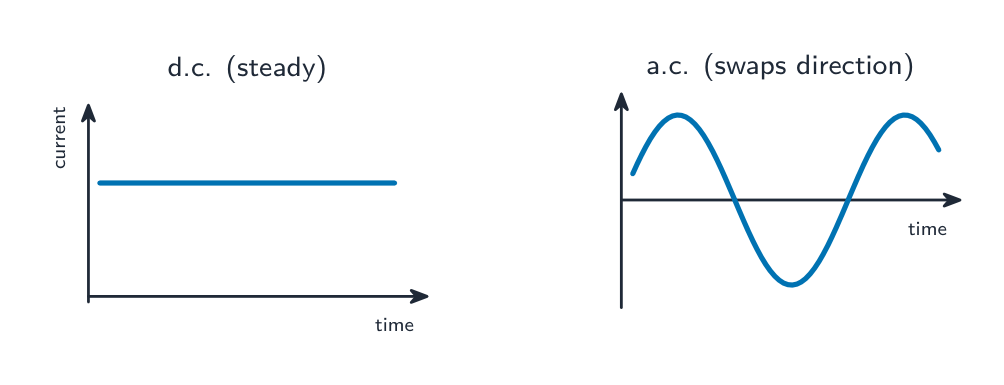
一个直流电(direct current,d.c.)总是往一个方向流,如来自一个电池。一个交流电(alternating current,a.c.)每秒多次不断交换方向,如来自市电(mains supply)。
直流电在一个方向上稳定;交流电不断交换方向,每秒多次穿过零 词汇表 训练英文 中文 拼音 electric current/ɪˈlektrɪk ˈkʌrənt/ 电流 diàn liú ampere/ˈæmpeə/ 安培 ān péi ammeter/ˈæmiːtə/ 电流表 diàn liú biǎo analogue/ˈænəlɒɡ/ 模拟 mó nǐ digital/ˈdɪdʒɪtl/ 数字 shù zì ranges/ˈreɪndʒɪz/ 量程 liáng chéng free electrons/friː ɪˈlektrɒnz/ 自由电子 zì yóu diàn zi conventional current/kənˈvenʃənl ˈkʌrənt/ 常规电流 cháng guī diàn liú direct current/daɪˈrekt ˈkʌrənt/ 直流电 zhí liú diàn alternating current/ˈɔːltəneɪtɪŋ ˈkʌrənt/ 交流电 jiāo liú diàn mains supply/meɪnz səˈplaɪ/ 市电 shì diàn 4.2
电动势与电势差

一个电池给通过它移动的电荷能量(energy)。两个量描述这个,而且都以伏特(volts,V)测量。
- 一个源的电动势(electromotive force,e.m.f.)是它驱动单位电荷绕一个完整电路(circuit)一整圈做的电功。
- 一个元件两端的电势差(potential difference,p.d.)是单位电荷通过那个元件时做的功。
一个电压表(voltmeter)测量 e.m.f. 或 p.d.。它并联(在元件两端)。像电流表一样,电压表有模拟的和数字的,并有不同的量程:选刚好在你预期的最大电压之上的量程。
一个电压表在电池两端读 e.m.f.(每库仑被给的能量);一个电压表在灯两端读 p.d.(每库仑在那里花的能量)。 两者都是单位电荷做的功:
$$E = \frac{W}{Q}, \qquad V = \frac{W}{Q}$$其中 $W$ 是转移的能量(J),而 $Q$ 是电荷(C)。例如,若一个电池做 $120\ \text{J}$ 的功移动 $60\ \text{C}$ 的电荷绕一个电路,它的 e.m.f. 是 $120 / 60 = 2\ \text{V}$。
词汇表 训练英文 中文 拼音 energy/ˈenədʒi/ 能量 néng liàng volt/vəʊlt/ 伏特 fú tè electromotive force/ɪˌlektrəʊˈməʊtɪv fɔːs/ 电动势 diàn dòng shì circuit/ˈsɜːkɪt/ 电路 diàn lù potential difference/pəˈtenʃl ˈdɪfrəns/ 电势差 diàn shì chā voltmeter/ˈvəʊltmiːtə/ 电压表 diàn yā biǎo 4.2
电阻

电阻(resistance)测量电流流动有多难。一个更大的电阻给一个更小的电流。它以欧姆(ohms,Ω)测量。
$$R = \frac{V}{I}$$测量电阻。 把元件与一个电池、一个开关、一个电流表和一个可变电阻器(variable resistor)串联,并在元件两端并联一个电压表。闭合开关,读 $I$ 和 $V$,然后改变可变电阻器以得到另外几对读数。要么对每一对计算 $R = V/I$ 并取平均,要么以 $V$ 对 $I$ 作图:对于恒定温度的金属线,图是一条通过原点的直线,它的斜率是 $R$。
例题。 一个 $12\ \text{V}$ 的电池驱动一个 $0.50\ \text{A}$ 的电流通过一个灯。求灯的电阻。
$$R = \frac{V}{I} = \frac{12}{0.50} = 24\ \Omega$$对于一根恒定温度的金属线:
- 一根更长的线有一个更大的电阻——电阻与长度成正比(directly proportional),$R \propto l$;
- 一根更粗的线有一个更小的电阻——电阻与横截面积(cross-sectional area)成反比(inversely proportional),$R \propto \dfrac{1}{A}$。
所以把长度翻倍使电阻翻倍;把面积翻倍使它减半。(面积取决于直径的平方,所以直径的一个小变化大大改变电阻。)
电流-电压图显示三个元件如何表现:
元件 I–V 图的形状 它告诉你什么 电阻器(resistor,固定) 通过原点的直线 电阻恒定,所以 $I \propto V$ 灯丝灯泡(filament lamp) S 形,随 $V$ 上升变得更平 线变热,所以它的电阻上升 二极管(diode) 电流只往一个方向 "错误"方向非常高的电阻 一个电阻器给一条直线;一个灯丝灯泡随它变热弯曲;一个二极管只让电流往一个方向通过 探索Ohm's law
V = IR
For an ohmic conductor the current is proportional to the voltage — the gradient is 1/resistance.
探索I–V characteristics
A resistor gives a straight line; a filament lamp and a diode do not. Pick a component and read I and R off the curve.
探索Resistance
V = R·I
Ohm's law: voltage is proportional to current — the gradient is the resistance R.
词汇表 训练英文 中文 拼音 resistance/rɪˈzɪstəns/ 电阻 diàn zǔ ohm/əʊm/ 欧姆 ōu mǔ variable resistor/ˈveərɪəbl rɪˈzɪstə/ 可变电阻器 kě biàn diàn zǔ qì directly proportional/daɪˈrektli prəˈpɔːʃənl/ 成正比 chéng zhèng bǐ inversely proportional/ɪnˈvɜːsli prəˈpɔːʃənl/ 成反比 chéng fǎn bǐ cross-sectional area/krɒs ˈsekʃənl ˈeərɪə/ 横截面积 héng jié miàn jī resistor/rɪˈzɪstə/ 电阻器 diàn zǔ qì filament lamp/ˈfɪləmənt læmp/ 灯丝灯泡 dēng sī dēng pào diode/ˈdaɪəʊd/ 二极管 èr jí guǎn 4.2
电能与电功率
一个电路把能量从一个源(一个电池或市电)转移到元件,然后到周围环境(常常作为热、光或声音)。
电功率(electrical power)是每秒转移的能量,以瓦特(watts,W)测量:
$$P = IV$$在一个时间 $t$ 内转移的电能(electrical energy),以焦耳(joules,J)测量,是:
$$E = IVt$$例题。 一个 $12\ \text{V}$ 的马达取一个 $2.0\ \text{A}$ 的电流。求它的功率,以及它在 $30\ \text{s}$ 内转移的能量。
$$P = IV = 2.0 \times 12 = 24\ \text{W}$$$$E = Pt = 24 \times 30 = 720\ \text{J}$$The kilowatt-hour
家庭电费用一个更大的能量单位,千瓦时(kilowatt-hour,kWh)。一千瓦时是一个 $1\ \text{kW}$ 的电器(appliance)在 $1$ 小时使用的能量。
$$\text{energy (kWh)} = \text{power (kW)} \times \text{time (h)}$$$$\text{cost} = \text{energy (kWh)} \times \text{price per kWh}$$例如,一个 $2\ \text{kW}$ 的加热器(heater)使用 $3$ 小时用 $2 \times 3 = 6\ \text{kWh}$。若一 kWh 花 $20$ 分,成本是 $6 \times 20 = 120$ 分。
词汇表 训练英文 中文 拼音 electrical power/ɪˈlektrɪkl ˈpaʊə/ 电功率 diàn gōng lǜ watt/wɒt/ 瓦特 wǎ tè electrical energy/ɪˈlektrɪkl ˈenədʒi/ 电能 diàn néng joule/dʒuːl/ 焦耳 jiāo ěr kilowatt-hour/ˈkɪləwɒt ˈaʊə/ 千瓦时 qiān wǎ shí appliance/əˈplaɪəns/ 电器 diàn qì heater/ˈhiːtə/ 加热器 jiā rè qì 4.3
电路
大纲
4.3.1 Circuit diagrams and circuit components
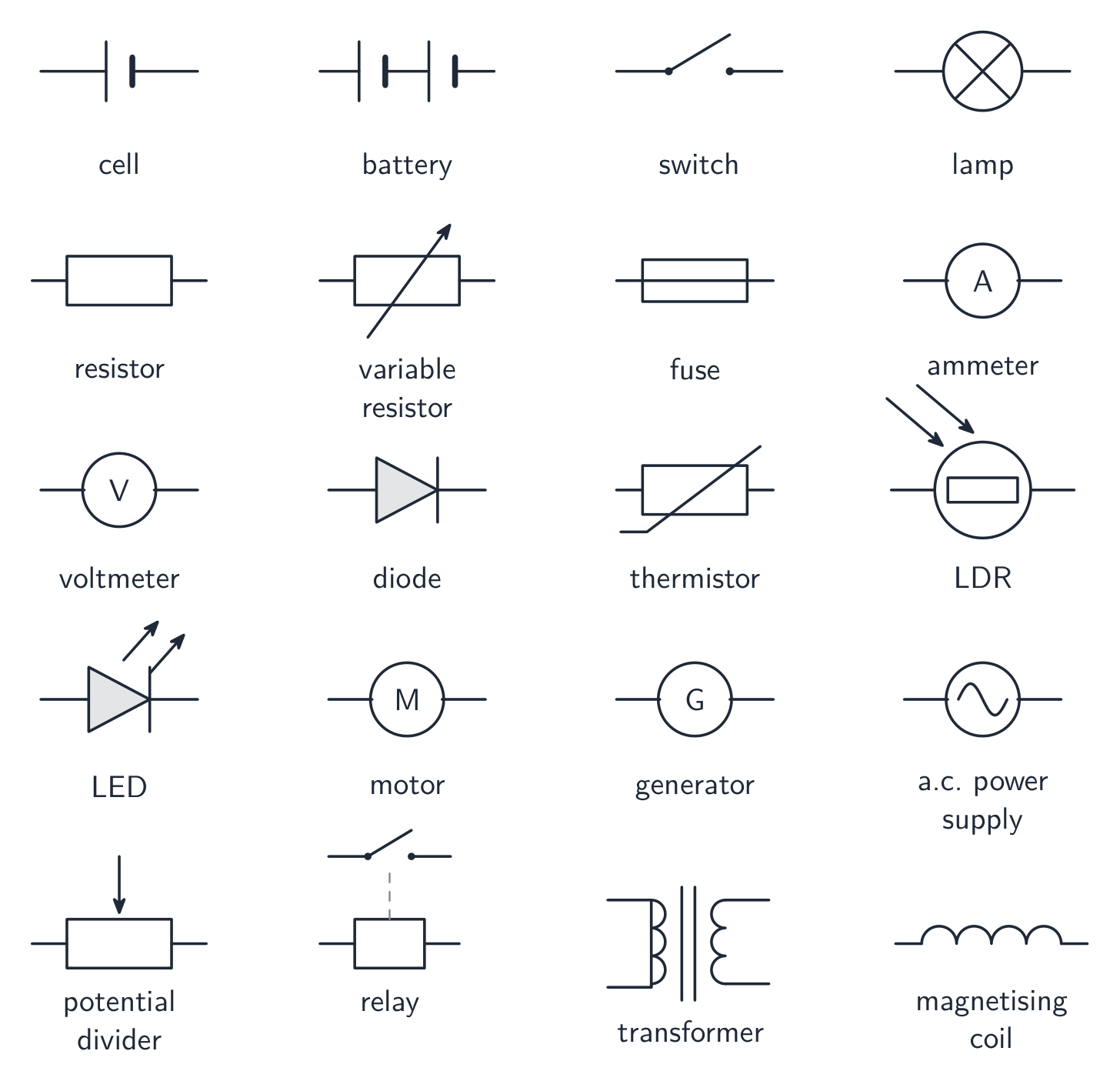
Core Supplement 1 Draw and interpret circuit diagrams containing cells, batteries, power supplies, generators, potential dividers, switches, resistors (fixed and variable), heaters, thermistors (NTC only), light-dependent resistors (LDRs), lamps, motors, bells, ammeters, voltmeters, magnetising coils, transformers, fuses and relays and know how these components behave in the circuit 2 Draw and interpret circuit diagrams containing diodes and light-emitting diodes (LEDs) and know how these components behave in the circuit 4.3.2 Series and parallel circuits
Core Supplement 1 Know that the current at every point in a series circuit is the same 8 Recall and use in calculations, the fact that: (a) the sum of the currents entering a junction in a parallel circuit is equal to the sum of the currents that leave the junction (b) the total p.d. across the components in a series circuit is equal to the sum of the individual p.d.s across each component (c) the p.d. across an arrangement of parallel resistances is the same as the p.d. across one branch in the arrangement of the parallel resistances 2 Know how to construct and use series and parallel circuits 3 Calculate the combined e.m.f. of several sources in series 4 Calculate the combined resistance of two or more resistors in series 5 State that, for a parallel circuit, the current from the source is larger than the current in each branch 9 Explain that the sum of the currents into a junction is the same as the sum of the currents out of the junction 6 State that the combined resistance of two resistors in parallel is less than that of either resistor by itself 10 Calculate the combined resistance of two resistors in parallel 7 State the advantages of connecting lamps in parallel in a lighting circuit 4.3.3 Action and use of circuit components
Core Supplement 1 Know that the p.d. across an electrical conductor increases as its resistance increases for a constant current 2 Describe the action of a variable potential divider 3 Recall and use the equation for two resistors used as a potential divider $$\frac{R_1}{R_2} = \frac{V_1}{V_2}$$来源:剑桥国际大纲
Circuit components
你应当知道这些元件以及它们如何表现:
元件 它做什么 电池(cell)/ 电池组(battery) 驱动电流绕电路(一个电池组是两个或更多电池) 电源(power supply) 一个 d.c. 或 a.c. 的源 开关(switch) 断开或接通电路 电阻器(固定) 给一个固定的电阻 可变电阻器(variable resistor) 一个你能改变的电阻,以控制电流 保险丝(fuse) 若电流太大就熔化并断开电路 灯 / 加热器 把电能变成光 / 变成热 热敏电阻(thermistor) 它的电阻随它变热而下降 光敏电阻(light-dependent resistor,LDR) 它的电阻随光变亮而下降 二极管 / 发光二极管(light-emitting diode,LED) 只让电流往一个方向;一个 LED 也放出光 继电器(relay) 一个由一个电磁铁工作的开关(小电流控制一个大的) 电动机(motor) 把电能变成运动 电铃(bell) 制造一个声音 变压器(transformer) 改变一个 a.c. 电压的大小 用来画电路图的标准符号 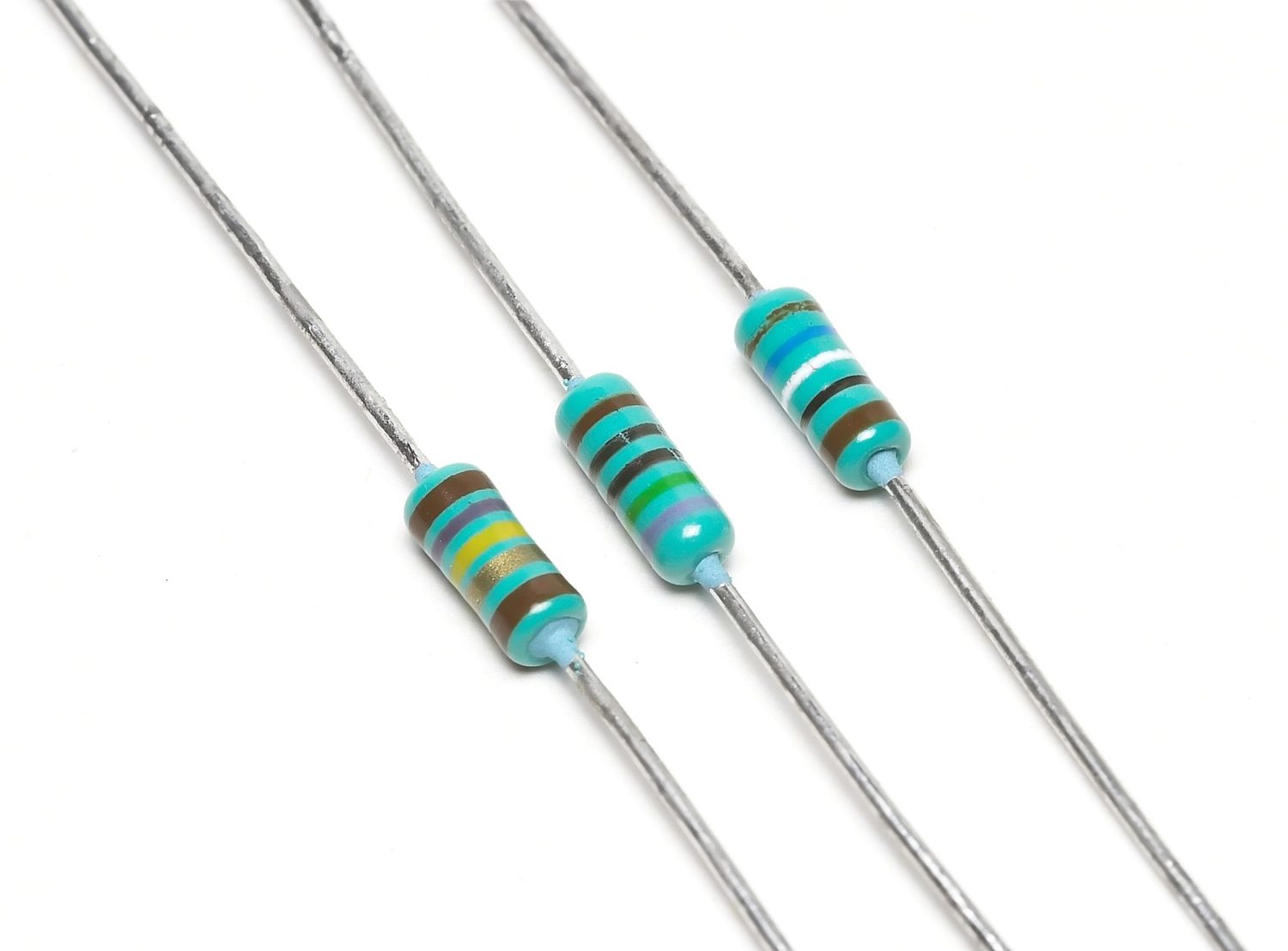
真实的电阻器:彩色带给出每个以欧姆计的电阻 Series and parallel
在一个串联(series)电路中各部分构成一个单一的回路:
- 电流在每个点都相同;
- 电源 p.d. 在元件之间分享;
- 串联的电池加它们的 e.m.f.(当它们指向同一个方向时);
- 串联的电阻器加起来:$R_{\text{total}} = R_1 + R_2 + \dots$
在一个并联(parallel)电路中各部分在分开的支路上:
- 每个支路得到完整的电源 p.d.;
- 电流分裂,所以来自源的电流比任何一个支路中的电流大;
- 总电阻(total resistance)小于最小的单一电阻。
一个家里的灯并联布线:每个得到完整的电压,而若一个失效其他的保持点亮。

在一个串联电路中元件共享一个回路;在一个并联电路中每个灯有它自己的支路 对于计算(用上面的规则):
- 在一个节点(junction),流入的总电流等于流出的总电流;
- 在串联中,电源 p.d. 等于元件两端 p.d. 之和;
- 在并联中,每个支路两端的 p.d. 相同;
- 两个并联的电阻器组合成
$$\frac{1}{R_{\text{total}}} = \frac{1}{R_1} + \frac{1}{R_2}$$例题。 一个 $6\ \Omega$ 的电阻器和一个 $3\ \Omega$ 的电阻器并联连接。求它们组合的电阻。
$$\frac{1}{R_{\text{total}}} = \frac{1}{6} + \frac{1}{3} = \frac{1}{6} + \frac{2}{6} = \frac{3}{6} = \frac{1}{2} \quad\Rightarrow\quad R_{\text{total}} = 2\ \Omega$$注意组合的电阻($2\ \Omega$)比两个电阻器中较小的更小。
Potential dividers
两个串联的电阻器分享电源电压。这是一个分压器(potential divider)。对于相同的电流,一个更大的电阻两端有一个更大的 p.d.,所以更大的电阻取更大的份额:
$$\frac{R_1}{R_2} = \frac{V_1}{V_2}$$一个可变分压器(或一个可变电阻器)让你平滑地改变输出电压,例如从 $0\ \text{V}$ 到完整的电源。若你用一个热敏电阻或一个 LDR 作为电阻器之一,输出电压随温度或光改变——便于自动地开关一个加热器或一个灯。
探索Build the current with Ohm's law
Turn up the voltage and the electrons speed up and the bulb glows brighter; add resistance and the current drops. I = V/R, brightness = power.
词汇表 训练英文 中文 拼音 cell/sel/ 电池 diàn chí battery/ˈbætəri/ 电池组 diàn chí zǔ power supply/ˈpaʊə səˈplaɪ/ 电源 diàn yuán switch/swɪtʃ/ 开关 kāi guān fuse/fjuːz/ 保险丝 bǎo xiǎn sī thermistor/ˈθɜːmɪstə/ 热敏电阻 rè mǐn diàn zǔ light-dependent resistor/laɪt dɪˈpendənt rɪˈzɪstə/ 光敏电阻 guāng mǐn diàn zǔ light-emitting diode/laɪt ɪˈmɪtɪŋ ˈdaɪəʊd/ 发光二极管 fā guāng èr jí guǎn relay/ˈriːleɪ/ 继电器 jì diàn qì motor/ˈməʊtə/ 电动机 diàn dòng jī bell/bel/ 电铃 diàn líng series/ˈsɪəriːz/ 串联 chuàn lián parallel/ˈpærəlel/ 并联 bìng lián total resistance/ˈtəʊtl rɪˈzɪstəns/ 总电阻 zǒng diàn zǔ junction/ˈdʒʌŋkʃn/ 节点 jié diǎn potential divider/pəˈtenʃl dɪˈvaɪdə/ 分压器 fēn yā qì 4.4
用电安全
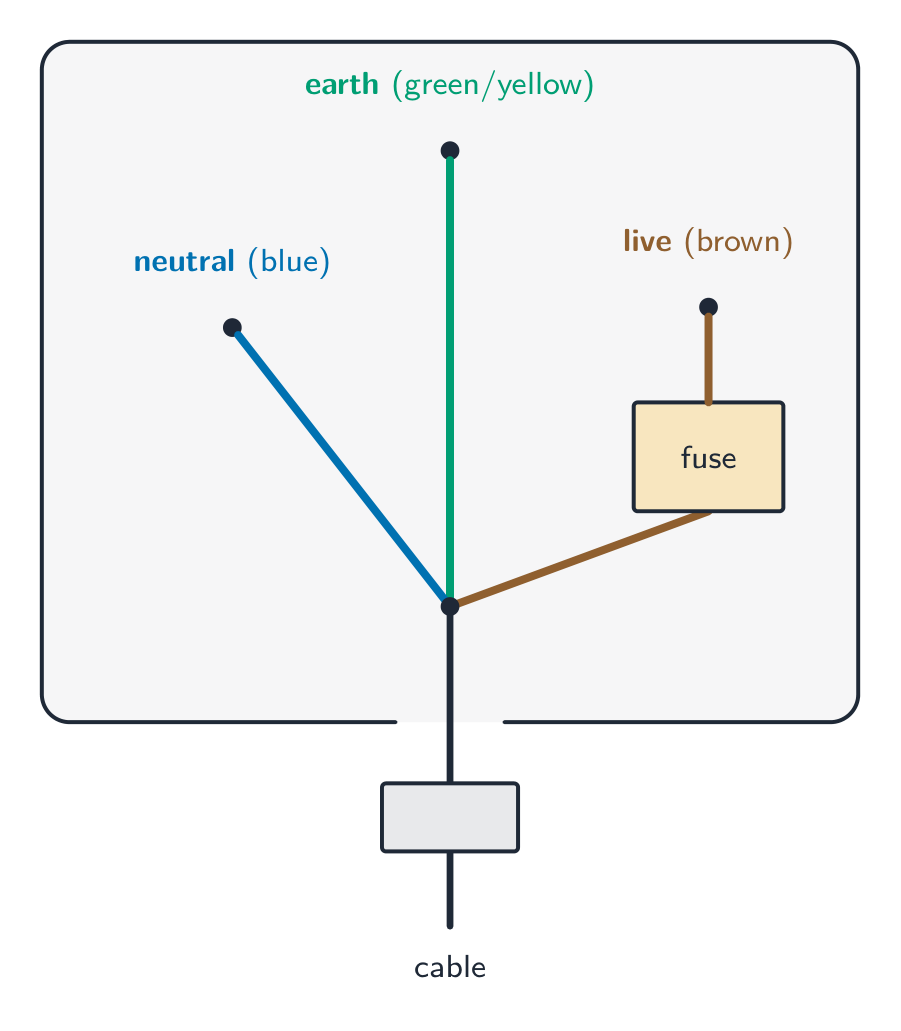
大纲
Core Supplement 1 State the hazards of: (a) damaged insulation (b) overheating cables (c) damp conditions (d) excess current from overloading of plugs, extension leads, single and multiple sockets when using a mains supply 2 Know that a mains circuit consists of a live wire (line wire), a neutral wire and an earth wire and explain why a switch must be connected to the live wire for the circuit to be switched off safely 3 Explain the use and operation of trip switches and fuses and choose appropriate fuse ratings and trip switch settings 4 Explain why the outer casing of an electrical appliance must be either non-conducting (double-insulated) or earthed 5 State that a fuse without an earth wire protects the circuit and the cabling for a double-insulated appliance 来源:剑桥国际大纲
一个家由市电供电。若被错误地使用,市电是危险的。
Hazards
这些是市电的危险(hazards):
- 损坏的绝缘层(insulation)——裸线能给一个电击或引起火灾;
- 过热(overheating)的电缆——太多的电流使一根电缆热,它能引起火灾;
- 潮湿(damp)的条件——水让电流进入一个人,提高电击的风险;
- 过载(overloading)——把太多的电器插进一个插座(socket)取太多的电流。
Live, neutral and earth
一根市电电缆有三根线:
- 火线(live wire)携带高电压;
- 零线(neutral wire)在约零电压完成电路;
- 地线(earth wire)是一根连到地面的安全线。
一个开关(和一个保险丝)必须安装在火线中。然后,当开关关闭时,电器与高电压切断,可以安全地触摸。
在一个三针插头中,火线(棕)和零线(蓝)携带电流,地线(绿/黄)是安全线,而保险丝总是坐在火线中。 Fuses, trip switches and earthing
一个保险丝是一根细线,若电流变得太大就熔化,在电缆过热之前断开电路。选择一个刚好在正常工作电流之上的额定值(fuse rating)——例如给一个正常用约 $10\ \text{A}$ 的电器一个 $13\ \text{A}$ 的保险丝。
一个跳闸开关(trip switch,断路器)做同样的工作但作用更快,而且能被重置而不是替换。
一个电器的金属外壳(casing)必须以两种方式之一被做得安全:
- 接地(earthed):外壳连到地线。若一根火线接触外壳,一个大电流流到地并熔断保险丝。
- 双重绝缘(double-insulated):外壳是塑料,所以它永不能带电。这样一个电器不需要地线;它的保险丝仍保护电缆。
探索Electrical safety route
Follow fault current and see how safety devices protect people.
词汇表 训练英文 中文 拼音 hazard/ˈhæzəd/ 危险 wēi xiǎn insulation/ˌɪnsjuːˈleɪʃn/ 绝缘层 jué yuán céng overheating/ˌəʊvəˈhiːtɪŋ/ 过热 guò rè damp/dæmp/ 潮湿 cháo shī overloading/ˌəʊvəˈləʊdɪŋ/ 过载 guò zài socket/ˈsɒkɪt/ 插座 chā zuò live wire/laɪv ˈwaɪə/ 火线 huǒ xiàn neutral wire/ˈnjuːtrəl ˈwaɪə/ 零线 líng xiàn earth wire/ɜːθ ˈwaɪə/ 地线 dì xiàn fuse rating/fjuːz ˈreɪtɪŋ/ 额定值 é dìng zhí trip switch/trɪp swɪtʃ/ 跳闸开关 tiào zhá kāi guān casing/ˈkeɪsɪŋ/ 外壳 wài ké earthed/ɜːθt/ 接地 jiē dì double-insulated/ˈdʌbl ˈɪnsjuːleɪtɪd/ 双重绝缘 shuāng chóng jué yuán 4.5
电磁效应

大纲
4.5.1 Electromagnetic induction
Core Supplement 1 Know that a conductor moving across a magnetic field or a changing magnetic field linking with a conductor can induce an e.m.f. in the conductor 4 Know that the direction of an induced e.m.f. opposes the change causing it 2 Describe an experiment to demonstrate electromagnetic induction 5 State and use the relative directions of force, field and induced current 3 State the factors affecting the magnitude of an induced e.m.f. 4.5.2 The a.c. generator
Core Supplement 1 Describe a simple form of a.c. generator (rotating coil or rotating magnet) and the use of slip rings and brushes where needed 2 Sketch and interpret graphs of e.m.f. against time for simple a.c. generators and relate the position of the generator coil to the peaks, troughs and zeros of the e.m.f. 4.5.3 Magnetic effect of a current
Core Supplement 1 Describe the pattern and direction of the magnetic field due to currents in straight wires and in solenoids 4 State the qualitative variation of the strength of the magnetic field around straight wires and solenoids 2 Describe an experiment to identify the pattern of the magnetic field (including direction) due to currents in straight wires and in solenoids 3 Describe how the magnetic effect of a current is used in relays and loudspeakers and give examples of their application 5 Describe the effect on the magnetic field around straight wires and solenoids of changing the magnitude and direction of the current 4.5.4 Force on a current-carrying conductor
Core Supplement 1 Describe an experiment to show that a force acts on a current-carrying conductor in a magnetic field, including the effect of reversing: (a) the current (b) the direction of the field 2 Recall and use the relative directions of force, magnetic field and current 3 Determine the direction of the force on beams of charged particles in a magnetic field 4.5.5 The d.c. motor
Core Supplement 1 Know that a current-carrying coil in a magnetic field may experience a turning effect and that the turning effect is increased by increasing: (a) the number of turns on the coil (b) the current (c) the strength of the magnetic field 2 Describe the operation of an electric motor, including the action of a split-ring commutator and brushes 4.5.6 The transformer
Core Supplement 1 Describe the construction of a simple transformer with a soft-iron core, as used for voltage transformations 6 Explain the principle of operation of a simple iron-cored transformer 2 Use the terms primary, secondary, step-up and step-down 3 Recall and use the equation $$\frac{V_p}{V_s} = \frac{N_p}{N_s}$$where p and s refer to primary and secondary7 Recall and use the equation for 100% efficiency in a transformer $$I_p V_p = I_s V_s$$where p and s refer to primary and secondary4 Describe the use of transformers in high-voltage transmission of electricity 5 State the advantages of high-voltage transmission 8 Recall and use the equation $$P = I^2 R$$to explain why power losses in cables are smaller when the voltage is greater来源:剑桥国际大纲
变压器:匝数比 电磁感应 The magnetic effect of a current
一根线中的一个电流在它周围构成一个磁场。
- 一根直线周围的磁场线是线周围的圆;场在靠近线处更强。反转电流而场反转。
- 一个螺线管(solenoid,一个长的线线圈(coil))构成一个正像一个条形磁体的场,一端一个 N 极、另一端一个 S 极。里面的场强而均匀。
你可以用铁屑或一个绘图指南针显示两个图案。若你增加电流、加更多匝,或在里面放一个软铁芯,场就变得更强。
一个电流在一根直线周围构成圆形磁场线,并为一个螺线管构成一个像条形磁体的场 磁效应被用于一个继电器和一个扬声器。在一个继电器中,一个线圈中的小电流使一个软铁芯磁化,它把第二个电路中的一个开关拉闭合。第二个电路可以携带一个大电流,所以一个小开关或一个传感器能安全地控制一个电动机或一个加热器(例如,一辆车的点火开关通过一个继电器启动它的马达)。在一个扬声器(loudspeaker)中,一个线圈中变化的电流使线圈推和拉一个纸锥,它移动空气并制造声音。
Electromagnetic induction
当一根线横过一个磁场移动、或穿过一个线圈的场改变时,一个 e.m.f. 在线中被感应。若线是一个完整电路的一部分,这个 e.m.f. 驱动一个电流。这是电磁感应(electromagnetic induction)。
要显示它:把一个磁体移进和移出一个连到一个灵敏仪表的线圈,并观察指针弹动。当你用一个更强的磁体、移动更快,或在线圈上用更多匝时,感应的 e.m.f. 更大。感应的 e.m.f. 总是作用来反对引起它的改变。感应电流的方向由弗莱明右手定则(Fleming's right-hand rule)给出:把右手的拇指、食指和中指互相成直角地伸开;拇指指向导线的运动方向,食指指向磁场(N 到 S),中指就给出感应电流。
The a.c. generator
一个交流发电机(a.c. generator)把运动变成电。一个线圈在一个磁场中被旋转(或一个磁体在一个线圈附近被旋转)。随着它转,穿过线圈的场不断改变,所以一个交变的 e.m.f. 被感应。
- 滑环(slip rings)和碳电刷(brushes)在线圈不断转的时候把电流带出到电路。
- 当线圈平躺(横过场移动最快)时 e.m.f. 最大,当线圈直立(沿场移动)时为零。所以 e.m.f.-时间图是一个波:峰、零、相反的峰、零,每一圈。

转动线圈感应一个交变的 e.m.f.;滑环把 a.c. 带出到电路 Force on a current-carrying conductor
当一根载流线位于一个磁场中时,线的场和磁体的场互相推,所以线感受一个力。这是电动机效应(motor effect)。
- 反转电流,或反转场,而力反转。
- 使电流更大或场更强,而力更大。
力、场和电流互相成直角。你可以用弗莱明左手定则(Fleming's left-hand rule)求力的方向:拇指 = 力(运动),食指 = 场(N 到 S),中指 = 电流。
显示这个力。 把一根硬的铜线(或一条铝箔)放在一个 U 形磁体的两极之间,并通过一个开关把它连到一个电池。当电流流动时,导线向上或向下跳。把电池反接,导线往另一个方向跳;把磁体翻转,它又反转。更大的电流或更强的磁体给出更大的跳动。
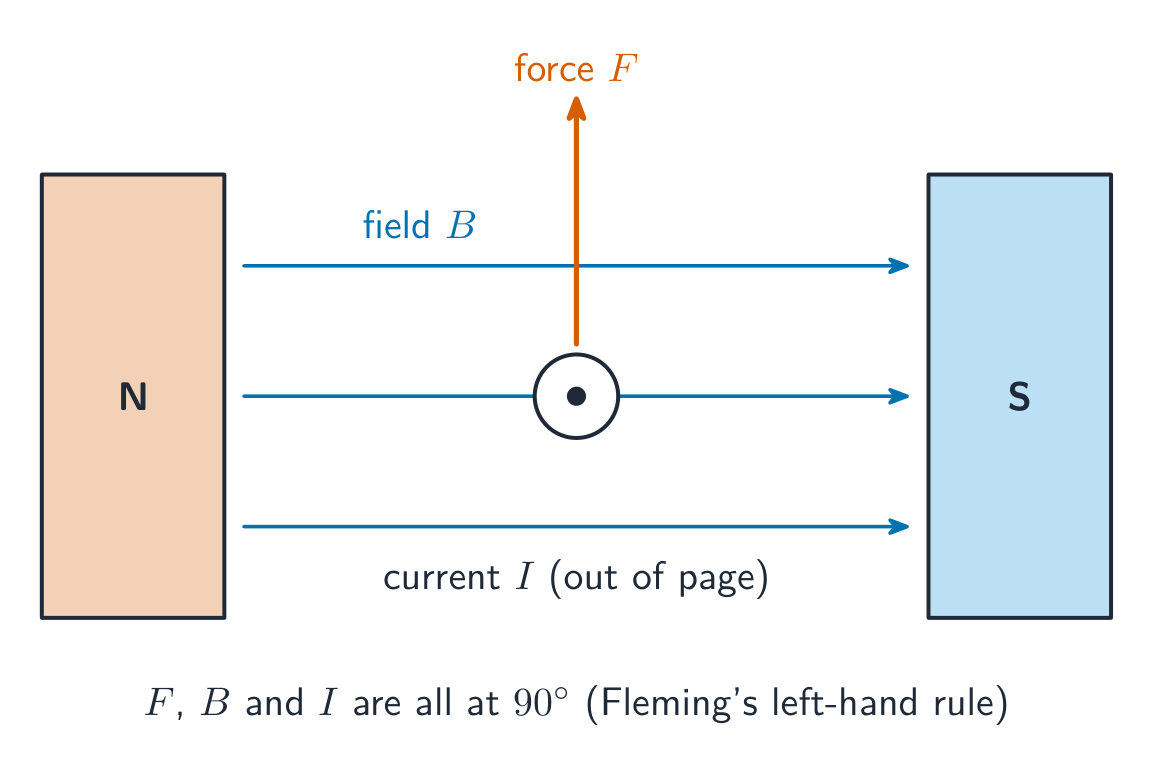
一个磁场中的一根载流线感受一个与场和电流两者都成直角的力 一个运动的带电粒子流是一个电流,所以一个磁场也把它推向一边——它使束偏转(deflects)。(记住电子流动与常规电流相反。)
The d.c. motor
一个磁场中一个载流线圈感受一个转动效应(turning effect),因为它两侧上的力向相反的方向作用。这是一个直流电动机(d.c. motor)。用线圈上更多的匝、一个更大的电流,或一个更强的场,转动效应更大。
一个换向器(split-ring commutator)每半圈交换线圈中的电流方向。这使线圈保持往同一个方向转,而不是在半圈后停止。
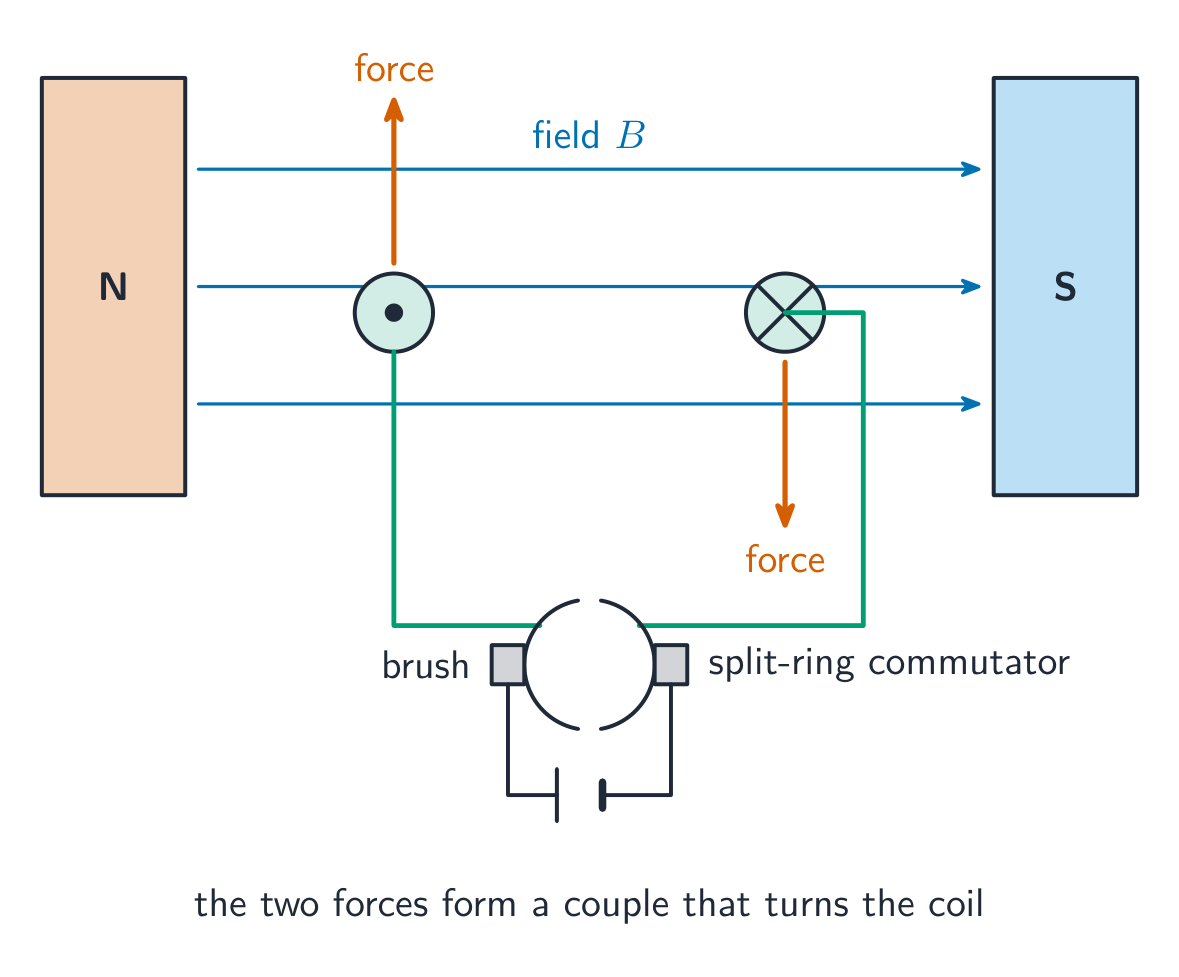
线圈两侧上的力构成一个力偶;换向器使它往一个方向转 The transformer
一个变压器(transformer)改变一个 a.c. 电压的大小。它有两个绕在一个软铁芯(soft-iron core)上的线圈:
- 原线圈(primary coil)吸入 a.c. 电压;
- 副线圈(secondary coil)给出改变的电压。
原线圈中的 a.c. 在铁芯中构成一个变化的磁场。铁芯把这个场带到副线圈,它在那里感应一个 a.c. e.m.f.。电压和匝数由以下联系:
$$\frac{V_p}{V_s} = \frac{N_p}{N_s}$$例题。 一个变压器在原线圈有 $1200$ 匝、在副线圈有 $100$ 匝。原线圈连到一个 $240\ \text{V}$ 的 a.c. 电源。求副线圈电压。
$$\frac{240}{V_s} = \frac{1200}{100} = 12 \quad\Rightarrow\quad V_s = \frac{240}{12} = 20\ \text{V}$$副线圈上更少的匝,所以这是一个降压变压器。
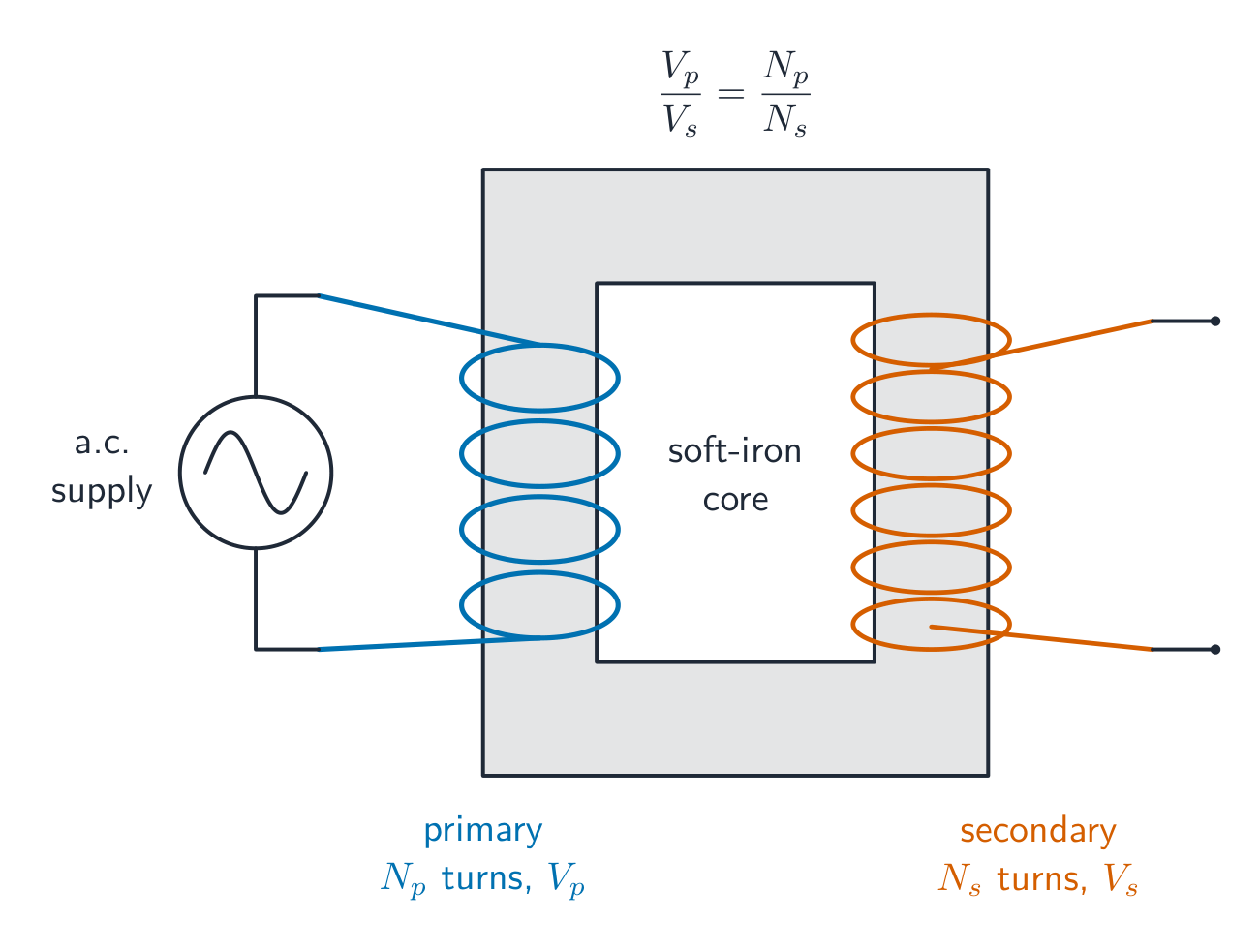
铁芯中变化的场连接两个线圈;电压比等于匝数比 
电线杆上一个真实的变压器把电缆中的高电压降到一个对家庭更安全的电压 若副线圈有更多的匝,它是一个升压(step-up)变压器(电压上升);更少的匝构成一个降压(step-down)变压器(电压下降)。例如,一个把 $240\ \text{V}$ 变成 $12\ \text{V}$ 的变压器是一个降压型,而原线圈有副线圈 $20$ 倍那么多的匝。
若一个变压器 100% 高效,输入的功率等于输出的功率:
$$I_p V_p = I_s V_s$$所以一个升压变压器提高电压但降低电流。
Why we use high voltage to send power
电通过高压输电(high-voltage transmission)跨全国被发送。在电缆中作为热损失的功率是
$$P = I^2 R$$其中 $R$ 是电缆的电阻。一个升压变压器提高电压,从而对相同的功率降低电流($P = IV$)。一个更小的电流意味着在电缆中浪费的功率少得多。一个降压变压器随即在它到达家庭之前把电压再次降到一个安全的值。
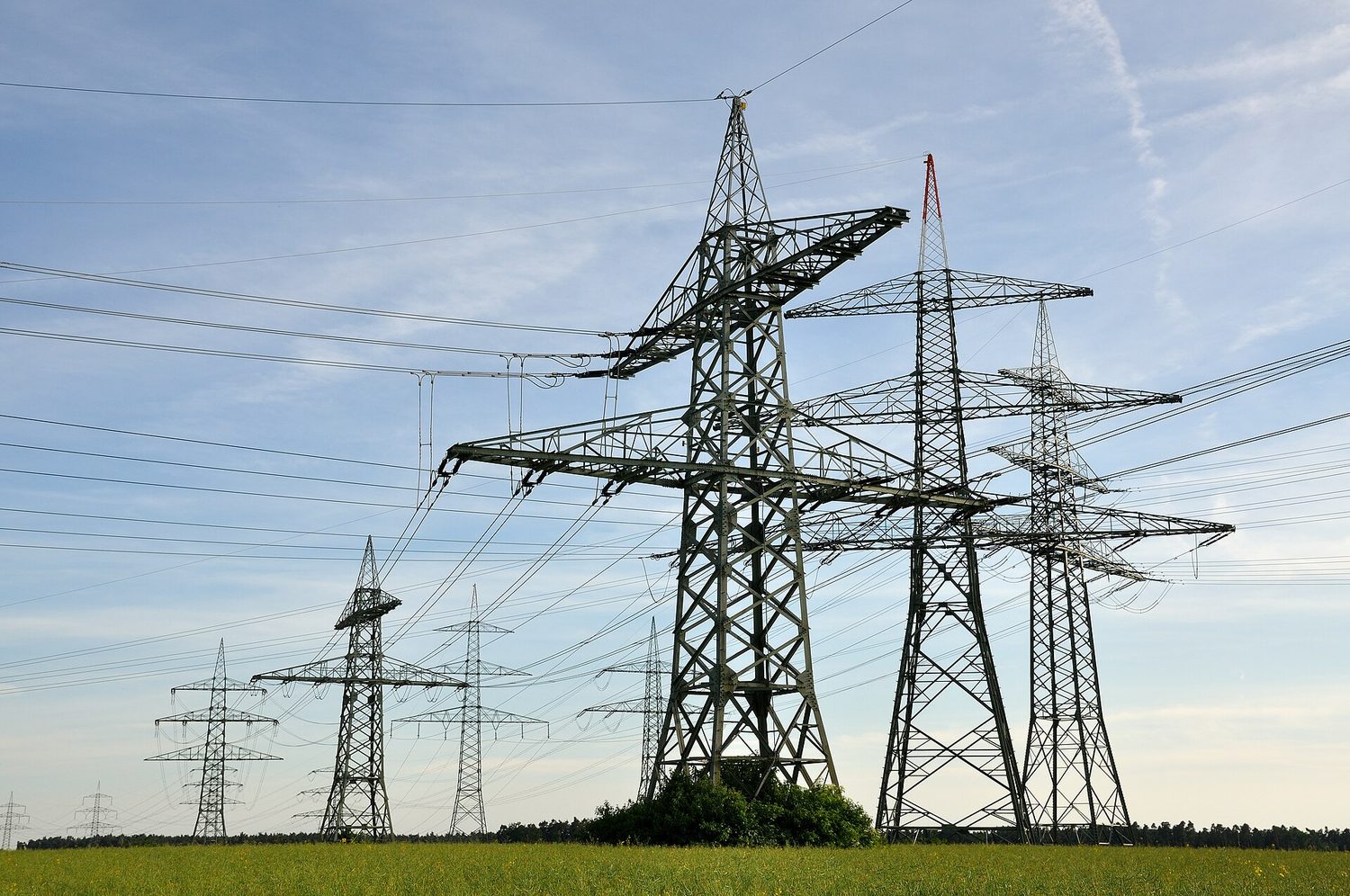
塔架握着以非常高的电压携带电的电缆,这使电流——和浪费的功率——低 探索The force that spins a motor
A current in a magnetic field is pushed at right angles to both — reverse the current or flip the magnet and it pushes the other way. That is what turns a motor.
探索The generator
V = a sin(bt)
A spinning coil induces a sinusoidal voltage — the AC output.
探索Transformer
Add turns to the secondary to step the voltage up, fewer to step it down — Vs/Vp = Ns/Np, exactly how the grid moves power efficiently.
词汇表 训练英文 中文 拼音 conductor/kənˈdʌktə/ 导体 dǎo tǐ transformer/trænsˈfɔːmə/ 变压器 biàn yā qì solenoid/ˈsəʊlənɔɪd/ 螺线管 luó xiàn guǎn coil/kɔɪl/ 线圈 xiàn quān loudspeaker/ˈlaʊdspiːkə/ 扬声器 yáng shēng qì electromagnetic induction/ɪˌlektrəʊməɡˈnetɪk ɪnˈdʌkʃn/ 电磁感应 diàn cí gǎn yìng Fleming's right-hand rule/ˈflemɪŋz raɪt hænd ruːl/ 弗莱明右手定则 fú lái míng yòu shǒu dìng zé a.c. generator/ˌeɪ ˈsiː ˈdʒenəreɪtə/ 交流发电机 jiāo liú fā diàn jī slip rings/slɪp rɪŋz/ 滑环 huá huán brushes/ˈbrʌʃɪz/ 电刷 diàn shuā Fleming's left-hand rule/ˈflemɪŋz left hænd ruːl/ 弗莱明左手定则 fú lái míng zuǒ shǒu dìng zé deflect/dɪˈflekt/ 偏转 piān zhuǎn turning effect/ˈtɜːnɪŋ ɪˈfekt/ 转动效应 zhuǎn dòng xiào yìng d.c. motor/ˌdiː ˈsiː ˈməʊtə/ 直流电动机 zhí liú diàn dòng jī split-ring commutator/splɪt rɪŋ ˈkɒmjuːteɪtə/ 换向器 huàn xiàng qì soft-iron core/sɒft ˈaɪən kɔː/ 软铁芯 ruǎn tiě xīn primary coil/ˈpraɪməri kɔɪl/ 原线圈 yuán xiàn quān secondary coil/ˈsekəndəri kɔɪl/ 副线圈 fù xiàn quān step-up/step ʌp/ 升压 shēng yā step-down/step daʊn/ 降压 jiàng yā high-voltage transmission/haɪ ˈvəʊltɪdʒ trænˈsmɪʃn/ 高压输电 gāo yā shū diàn 4.5
考试技巧
- 电流在一个串联电路中处处相同;在一个并联电路中它在支路之间分裂。电压(p.d.)在串联中被分享,但在每个并联支路两端相同。
- 在串联中加电阻器增加总电阻($R_1 + R_2$);在并联中加它们使总电阻比最小的单一电阻更小。
- 一个电流表放在串联中,有非常低的电阻;一个电压表在一个元件两端并联,有非常高的电阻。
- 在一个变压器中 $\dfrac{V_p}{V_s} = \dfrac{N_p}{N_s}$:副线圈上更多的匝把电压升,更少的把它降。变压器只对 a.c. 起作用。
- 电以高电压跨全国发送,所以电流——和电缆中浪费的热,$P = I^2R$——小。
- 把开关和保险丝装在火线中,并选择一个刚好在电器正常工作电流之上的保险丝额定值。
-
5
核物理
5.1
原子的核式模型

大纲
5.1.1 The atom
Core Supplement 1 Describe the structure of an atom in terms of a positively charged nucleus and negatively charged electrons in orbit around the nucleus 3 Describe how the scattering of alpha ($\alpha$) particles by a sheet of thin metal supports the nuclear model of the atom, by providing evidence for: (a) a very small nucleus surrounded by mostly empty space (b) a nucleus containing most of the mass of the atom (c) a nucleus that is positively charged 2 Know how atoms may form positive ions by losing electrons or form negative ions by gaining electrons 5.1.2 The nucleus
Core Supplement 1 Describe the composition of the nucleus in terms of protons and neutrons 6 Describe the processes of nuclear fission and nuclear fusion as the splitting or joining of nuclei, to include the nuclide equation and qualitative description of mass and energy changes without values 2 State the relative charges of protons, neutrons and electrons as +1, 0 and –1 respectively 3 Define the terms proton number (atomic number) $Z$ and nucleon number (mass number) $A$ and be able to calculate the number of neutrons in a nucleus 7 Know the relationship between the proton number and the relative charge on a nucleus 8 Know the relationship between the nucleon number and the relative mass of a nucleus 4 Use the nuclide notation $^{A}_{Z}\text{X}$ 5 Explain what is meant by an isotope and state that an element may have more than one isotope 来源:剑桥国际大纲
一个原子(atom)由一个微小的中央原子核(nucleus)加上围绕它运动的电子(electrons,在轨道(orbit)上,像行星围绕太阳)构成。
- 原子核有一个正电荷(charge)。
- 电子有一个负电荷。
- 整个原子是中性的,因为正负电荷相等。
几乎所有的质量(mass)都在原子核中,但原子核与整个原子相比非常小。所以一个原子大多是空的空间。
核式原子:一个微小致密的质子和中子的原子核,电子在它周围的轨道上 Ions
一个原子是中性的,但它能获得或失去电子以变成一个离子(ion)。
- 失去一个或多个电子 → 一个正离子(现在质子比电子多)。
- 获得一个或多个电子 → 一个负离子。
The alpha-scattering experiment
这个实验给出了核式模型的证据。α粒子(alpha particles,小、快、正)被射向一片非常薄的金箔(gold foil),而散射(scattering,它们弹开的方式)被观察。
结果以及它们告诉我们什么:
- 几乎所有的 α粒子直接穿过。→ 原子大多是空的空间。
- 少数被偏转(deflected)小角度。→ 原子核有一个正电荷,它把正的 α粒子推开。
- 极少数几乎直接弹回。→ 原子核非常小而非常重,并容纳原子的大部分质量。

大多数 α粒子直接穿过;少数被偏转,而极少数从微小致密的原子核弹回 探索Inside the atom
A tiny dense nucleus sits at the centre with electrons in shells around it — drag the proton number and watch the shells fill outward.
词汇表 训练英文 中文 拼音 atom/ˈætəm/ 原子 yuán zi nucleus/ˈnjuːklɪəs/ 原子核 yuán zǐ hé electron/ɪˈlektrɒn/ 电子 diàn zi orbit/ˈɔːbɪt/ 轨道 guǐ dào charge/tʃɑːdʒ/ 电荷 diàn hè mass/mæs/ 质量 zhì liàng ion/ˈaɪɒn/ 离子 lí zi alpha particle/ˈælfə ˈpɑːtɪkl/ α粒子 α lì zi gold foil/ɡəʊld fɔɪl/ 金箔 jīn bó scattering/ˈskætərɪŋ/ 散射 sǎn shè deflected/dɪˈflektɪd/ 偏转 piān zhuǎn 5.1
原子核内部
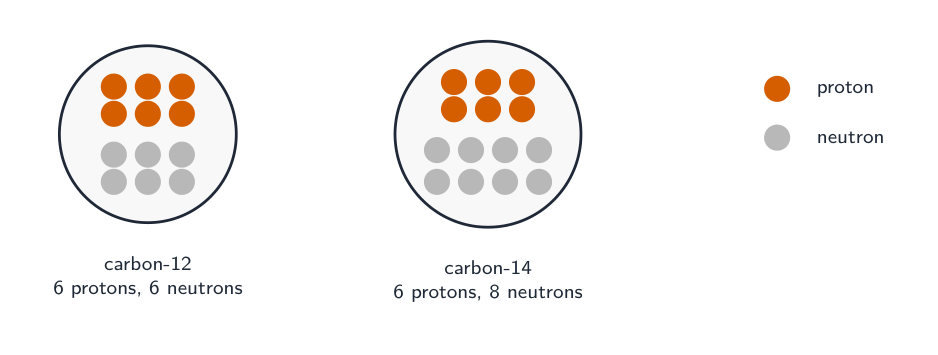
原子核由两种粒子构成,合起来叫核子(nucleons):
- 质子(protons),它们有一个 $+1$ 的相对(relative)电荷;
- 中子(neutrons),它们有一个 $0$ 的相对电荷(它们是中性的)。
一个电子有一个 $-1$ 的相对电荷。一个质子和一个中子各有一个约 $1$ 的相对质量;相比之下一个电子几乎无质量。
两个数描述一个原子核:
- 质子数(proton number)$Z$(也叫原子序数)——质子的数目;
- 核子数(nucleon number)$A$(也叫质量数)——质子加中子的数目。
所以中子的数目是 $A - Z$。
我们用核素(nuclide)记号写一个原子核:
$$^{A}_{Z}\text{X}$$其中 X 是化学符号。例如,$^{197}_{\ 79}\text{Au}$ 有 $79$ 个质子和 $197 - 79 = 118$ 个中子。整个原子核的相对电荷只是 $+Z$(这里 $+79$),而它的相对质量约是 $A$。
Isotopes
同位素(isotopes)是同一个元素(同样的 $Z$)但有不同数目中子(不同的 $A$)的原子。它们在化学中表现相同,但在原子核中不同。例如,$^{12}_{\ 6}\text{C}$ 和 $^{14}_{\ 6}\text{C}$ 都是碳。
碳的同位素有同样的六个质子但不同数目的中子,所以它们是同一个元素带一个不同的质量 Nuclear fission and fusion
在核裂变(nuclear fission)中,一个重原子核吸收一个中子,然后分裂成两个更小的原子核,放出两三个中子和大量的能量(energy):
$$^{235}_{\ 92}\text{U} + ^{1}_{0}\text{n} \rightarrow\ ^{141}_{\ 56}\text{Ba} + ^{92}_{36}\text{Kr} + 3\,{}^{1}_{0}\text{n}$$
一个中子把一个 U-235 原子核分裂成两个更小的原子核,释放更多的中子和能量 顶部的数(核子数)在两边平衡,底部的数(质子数)也平衡。你可以用这个来求一个缺失的数——例如,释放多少个中子。
在核聚变(nuclear fusion)中,两个轻原子核结合以制造一个更重的,也放出能量。这就是太阳如何制造它的能量,结合氢(hydrogen)原子核以制造氦(helium)。下面的反应——两种重的氢(氘和氚)结合成氦——是地球上聚变反应堆所用的那种:
$$^{2}_{1}\text{H} + ^{3}_{1}\text{H} \rightarrow\ ^{4}_{2}\text{He} + ^{1}_{0}\text{n}$$
在聚变中两个轻原子核结合成一个更重的,释放一个中子和能量——聚变反应堆所用的氘–氚反应 在裂变和聚变两者中,一小份质量被损失并变成能量。

一个核电站用来自裂变的能量制造电;塔以蒸汽释放废热 探索The fission chain reaction
A neutron splits a uranium nucleus, which releases energy AND more neutrons — those split more nuclei, and so on.
词汇表 训练英文 中文 拼音 nucleon/ˈnjuːklɪən/ 核子 hé zǐ proton/ˈprəʊtɒn/ 质子 zhì zi relative/ˈrelətɪv/ 相对 xiāng duì neutron/ˈnjuːtrɒn/ 中子 zhōng zǐ proton number/ˈprəʊtɒn ˈnʌmbə/ 质子数 zhì zǐ shù nucleon number/ˈnjuːklɪən ˈnʌmbə/ 核子数 hé zǐ shù nuclide/ˈnjuːklaɪd/ 核素 hé sù isotope/ˈaɪsətəʊp/ 同位素 tóng wèi sù nuclear fission/ˈnjuːklɪə ˈfɪʃn/ 核裂变 hé liè biàn energy/ˈenədʒi/ 能量 néng liàng nuclear fusion/ˈnjuːklɪə ˈfjuːʒn/ 核聚变 hé jù biàn hydrogen/ˈhaɪdrədʒn/ 氢 qīng helium/ˈhiːlɪəm/ 氦 hài 5.2
放射性
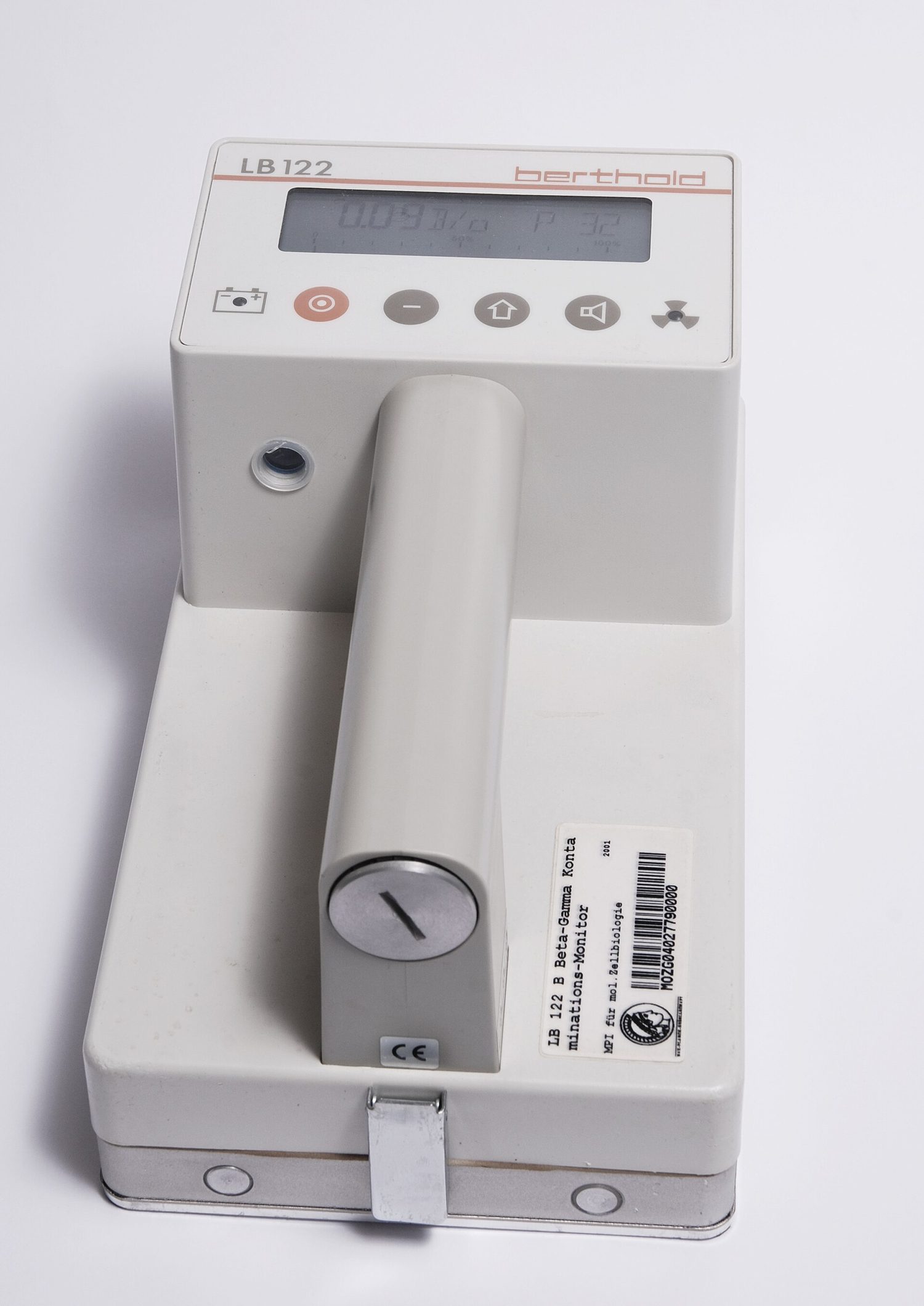
大纲
5.2.1 Detection of radioactivity
Core Supplement 1 Know what is meant by background radiation 2 Know the sources that make a significant contribution to background radiation including: (a) radon gas (in the air) (b) rocks and buildings (c) food and drink (d) cosmic rays 3 Know that ionising nuclear radiation can be measured using a detector connected to a counter 4 Use count rate measured in counts / s or counts / minute 5 Use measurements of background radiation to determine a corrected count rate 5.2.2 The three types of nuclear emission
Core Supplement 1 Describe the emission of radiation from a nucleus as spontaneous and random in direction 2 Identify alpha ($\alpha$), beta ($\beta$) and gamma ($\gamma$) emissions from the nucleus by recalling: (a) their nature (b) their relative ionising effects (c) their relative penetrating abilities ($\beta^+$ are not included, $\beta$-particles will be taken to refer to $\beta^-$) 3 Describe the deflection of $\alpha$-particles, $\beta$-particles and $\gamma$-radiation in electric fields and magnetic fields 4 Explain their relative ionising effects with reference to: (a) kinetic energy (b) electric charge 5.2.3 Radioactive decay
Core Supplement 1 Know that radioactive decay is a change in an unstable nucleus that can result in the emission of $\alpha$-particles or $\beta$-particles and/or $\gamma$-radiation and know that these changes are spontaneous and random 3 Know that isotopes of an element may be radioactive due to an excess of neutrons in the nucleus and/or the nucleus being too heavy 2 State that during $\alpha$-decay or $\beta$-decay, the nucleus changes to that of a different element 4 Describe the effect of $\alpha$-decay, $\beta$-decay and $\gamma$-emissions on the nucleus, including an increase in stability and a reduction in the number of excess neutrons; the following change in the nucleus occurs during $\beta$-emission neutron $\rightarrow$ proton + electron 5 Use decay equations, using nuclide notation, to show the emission of $\alpha$-particles, $\beta$-particles and $\gamma$-radiation 5.2.4 Half-life
Core Supplement 1 Define the half-life of a particular isotope as the time taken for half the nuclei of that isotope in any sample to decay; recall and use this definition in simple calculations, which might involve information in tables or decay curves (calculations will not include background radiation) 2 Calculate half-life from data or decay curves from which background radiation has not been subtracted 3 Explain how the type of radiation emitted and the half-life of an isotope determine which isotope is used for applications including: (a) household fire (smoke) alarms (b) irradiating food to kill bacteria (c) sterilisation of equipment using gamma rays (d) measuring and controlling thicknesses of materials with the choice of radiations used linked to penetration and absorption (e) diagnosis and treatment of cancer using gamma rays 5.2.5 Safety precautions
Core Supplement 1 State the effects of ionising nuclear radiations on living things, including cell death, mutations and cancer 2 Describe how radioactive materials are moved, used and stored in a safe way 3 Explain safety precautions for all ionising radiation in terms of reducing exposure time, increasing distance between source and living tissue and using shielding to absorb radiation 来源:剑桥国际大纲
放射性衰变和半衰期 一个不稳定(unstable)的原子核迟早会分解并放出辐射(radiation)。这是放射性(radioactive)衰变(decay)。一个原子核可能不稳定,因为它有太多的中子,或因为它太重。
衰变是自发(spontaneous,它自己发生,而你不能加速或减慢它)和随机(random,你不能说哪个原子核接下来会衰变,或确切在什么时候)的。
Background radiation
一些辐射一直在我们周围。这是背景辐射(background radiation)。它的主要来源是:
- 空气中的氡(radon)气(通常是最大的来源);
- 岩石和建筑;
- 食物和饮料;
- 来自太空的宇宙射线(cosmic rays)。
Measuring radiation
辐射能用一个连到一个计数器(counter)的探测器(detector)测量。计数率(count rate)是每秒(或每分钟)的计数数目。
要从一个源求真实的计数率,先单独测量背景计数率,然后减去它。答案是修正(corrected)的计数率:
$$\text{corrected count rate} = \text{measured count rate} - \text{background count rate}$$例题。 一个放在一个源旁边的探测器读 $250$ counts/min。拿走源后,背景计数率是 $30$ counts/min。求修正的计数率。
$$250 - 30 = 220\ \text{counts/min}$$一个便携式盖革计数器检测电离辐射并在它的屏幕上显示计数率 探索Radioactive decay
N = N₀·bᵗ
The number of unstable nuclei decays exponentially.
词汇表 训练英文 中文 拼音 unstable/ʌnˈsteɪbl/ 不稳定 bù wěn dìng radiation/ˌreɪdɪˈeɪʃn/ 辐射 fú shè radioactive/ˌreɪdɪəʊˈæktɪv/ 放射性 fàng shè xìng decay/dɪˈkeɪ/ 衰变 shuāi biàn spontaneous/spɒnˈteɪnɪəs/ 自发 zì fā random/ˈrændəm/ 随机 suí jī background radiation/ˈbækɡraʊnd ˌreɪdɪˈeɪʃn/ 背景辐射 bèi jǐng fú shè radon/ˈreɪdɒn/ 氡 dōng cosmic rays/ˈkɒzmɪk reɪz/ 宇宙射线 yǔ zhòu shè xiàn detector/dɪˈtektə/ 探测器 tàn cè qì counter/ˈkaʊntə/ 计数器 jì shù qì count rate/kaʊnt reɪt/ 计数率 jì shù lǜ corrected/kəˈrektɪd/ 修正 xiū zhèng stable/ˈsteɪbl/ 稳定 wěn dìng 5.2
三种射线

辐射能是三种类型之一。每种类型都是电离(ionising)的,这意味着它能把它路径中原子的电子撞掉。
类型 它是什么 电离效应 被……阻挡 alpha (α) 一个氦原子核:2 个质子 + 2 个中子,电荷 $+2$ 最强 一张纸,或几 cm 的空气 beta (β) 一个快速运动的电子,电荷 $-1$ 中等 几 mm 的铝(aluminium) gamma (γ) 一个高能电磁波(electromagnetic wave),没有电荷 最弱 厚的铅(lead)或混凝土(只减弱,从不完全阻挡) 所以一个 α粒子是最电离(ionising)的但最不穿透(penetrating,它容易被吸收(absorbed))。一个 β粒子(beta particle)在中间。γ射线(gamma radiation)是最不电离的但最穿透的。
纸阻挡 alpha,几毫米的铝阻挡 beta,而厚铅只减弱 gamma 我们可以从电荷和动能(kinetic energy)解释电离效应:一个 α粒子有一个大电荷($+2$),并且慢而重,所以它强烈地拉它经过的电子并电离很多。一个 β粒子有一个更小的电荷并移动更快,所以它电离更少。
Deflection in fields
因为 α 和 β 粒子带电,它们被一个电场(electric field)和一个磁场(magnetic field)偏转。它们向相反的方向弯曲,因为它们的电荷有相反的符号,而更轻的 β粒子弯曲更多。γ射线没有电荷,所以它们根本不被偏转。

alpha 和 beta 向相反的方向弯曲;更轻的 beta 弯曲更多,而不带电的 gamma 不被偏转 词汇表 训练英文 中文 拼音 ionising/ˈaɪənaɪzɪŋ/ 电离 diàn lí aluminium/ˌæljʊˈmɪnɪəm/ 铝 lǚ electromagnetic wave/ɪˌlektrəʊməɡˈnetɪk weɪv/ 电磁波 diàn cí bō lead/liːd/ 铅 qiān penetrating/ˈpenɪtreɪtɪŋ/ 穿透 chuān tòu absorbed/əbˈsɔːbd/ 吸收 xī shōu beta particle/ˈbiːtə ˈpɑːtɪkl/ β粒子 β lì zi gamma radiation/ˈɡæmə ˌreɪdɪˈeɪʃn/ γ射线 γ shè xiàn kinetic energy/kɪˈnetɪk ˈenədʒi/ 动能 dòng néng electric field/ɪˈlektrɪk fiːld/ 电场 diàn chǎng magnetic field/mæɡˈnetɪk fiːld/ 磁场 cí chǎng 5.2
衰变方程
当一个原子核衰变时,核子数和质子数必须在两边平衡。
Alpha 衰变——原子核失去 2 个质子和 2 个中子,所以 $A$ 降 $4$ 而 $Z$ 降 $2$。它变成一个不同的元素:
$$^{A}_{Z}\text{X} \rightarrow\ ^{A-4}_{Z-2}\text{Y} + ^{4}_{2}\alpha$$例题。 一个镭原子核 $^{226}_{\ 88}\text{Ra}$ 发射一个 α粒子。求新原子核的核子数和质子数。
Alpha 衰变把 $A$ 降 $4$、$Z$ 降 $2$:
$$^{226}_{\ 88}\text{Ra} \rightarrow\ ^{222}_{\ 86}\text{Rn} + ^{4}_{2}\alpha$$所以新原子核(氡)有核子数 $222$ 和质子数 $86$。
Beta 衰变——在原子核内部一个中子变成一个质子加一个电子:
$$\text{neutron} \rightarrow \text{proton} + \text{electron}$$快电子作为 β粒子离开。所以 $A$ 保持不变但 $Z$ 升 $1$,给出一个不同的元素:
$$^{24}_{11}\text{Na} \rightarrow\ ^{24}_{12}\text{Mg} + ^{\ \ 0}_{-1}\beta$$Gamma 发射——原子核只失去能量,所以 $A$ 和 $Z$ 不改变。Alpha 和 beta 衰变使原子核更稳定(stable);gamma 常常同时被放出以带走多余的能量。
5.2
半衰期

因为衰变是随机的,我们不能跟随一个原子核。而是我们用它的半衰期描述一个大的样品(sample)。
一个同位素的半衰期(half-life)是一个样品中一半的不稳定原子核衰变所花的时间。在每个半衰期之后,计数率(或剩下的不稳定原子核的数目)降到一半。
例如,若一个源有一个 $800$ counts/min 的计数率和一个 $3$ 小时的半衰期:
时间 / 小时 0 3 6 9 计数率 / (counts/min) 800 400 200 100 在 $6$ 小时(两个半衰期)之后计数率减半两次:$800 \to 400 \to 200$。你可以通过求计数率从任何值降到它一半的时间从一条衰变图读出一个半衰期。
例题。 一个源的活度从 $800$ counts/min 降到 $100$ counts/min。它的半衰期是 $5$ 天。这花了多长时间?
数减半的次数:$800 \to 400 \to 200 \to 100$ 是三个半衰期,所以时间是 $3 \times 5 = 15\ \text{days}$。
每个半衰期 $T$ 计数率减半:$N_0 \to N_0/2 \to N_0/4 \to N_0/8$ 探索Half-life — watch the nuclei decay
Each nucleus has a fixed chance of decaying, at random. Move time forward: about half the remaining nuclei decay every half-life — so the count halves, then halves again.
词汇表 训练英文 中文 拼音 sample/ˈsæmpl/ 样品 yàng pǐn half-life/hɑːf laɪf/ 半衰期 bàn shuāi qī 5.2
放射性的应用
为一件工作选择的同位素取决于它的辐射类型和它的半衰期:
- 烟雾报警器(smoke alarms)用一个 alpha 源(alpha 容易被阻挡,所以它在报警器外面安全,而一个长半衰期意味着它持续多年);
- 对食物或设备使用辐射杀死细菌(bacteria)和病菌——这需要穿透的 gamma 射线来消毒(sterilise)密封的物品;
- 测量和控制纸或金属片的厚度用一个 beta 源(通过的量随厚度改变);
- 一个医用示踪剂(medical tracer)是少量注射进身体的、发射伽马射线且半衰期短的同位素:身体外的一个探测器跟踪它去了哪里,伽马射线容易从身体逃出,而放射性活度很快下降到一个安全的水平;
- gamma 射线被用来在体内寻找和治疗癌症(cancer),因为它们能穿出(或穿入)身体。
词汇表 训练英文 中文 拼音 smoke alarm/sməʊk əˈlɑːm/ 烟雾报警器 yān wù bào jǐng qì bacteria/bækˈtɪərɪə/ 细菌 xì jūn sterilise/ˈsterəlaɪz/ 消毒 xiāo dú medical tracer/ˈmedɪkl ˈtreɪsə/ 医用示踪剂 yī yòng shì zōng jì cancer/ˈkænsə/ 癌症 ái zhèng 5.2
安全
电离辐射伤害细胞(living cells)。它能引起细胞死亡、突变(mutations,基因的改变)和癌症。
当用放射源工作时,通过以下保持剂量(dose,接收的辐射量)低:
- 减少照射(exposure)时间——尽可能少地在源附近待;
- 增加你和源之间的距离;
- 在源和你的身体之间用屏蔽(shielding),如铅。
放射源应当用钳子(不是裸手)处理、保持指向远离人,并存储在一个铅衬的盒子里。
词汇表 训练英文 中文 拼音 living cells/ˈlɪvɪŋ selz/ 细胞 xì bāo mutation/mjuːˈteɪʃn/ 突变 tū biàn dose/dəʊs/ 剂量 jì liàng exposure/ekˈspəʊʒə/ 照射 zhào shè shielding/ˈʃiːldɪŋ/ 屏蔽 píng bì 5.2
考试技巧
- 核子数(顶)是质子 + 中子;质子数(底)只是质子。中子的数目 = 核子数 − 质子数。
- 同位素有同样的质子数但不同的核子数——同一个元素带一个不同数目的中子。
- 以两种方式给辐射排名:alpha 是最电离的但最不穿透的(被纸阻挡);gamma 是最不电离的但最穿透的(需要厚铅)。Beta 在中间(被几 mm 的铝阻挡)。
- 在每个衰变方程中顶部的数必须平衡,底部的数必须平衡。Alpha 衰变:$A-4$、$Z-2$。Beta 衰变:$A$ 不变、$Z+1$。
- 在用一个源的读数之前总是减去背景计数率。在 $n$ 个半衰期之后计数率减半 $n$ 次——数减半的次数而不是从总时间猜。
-
6
空间物理
6.1
地球与太阳系
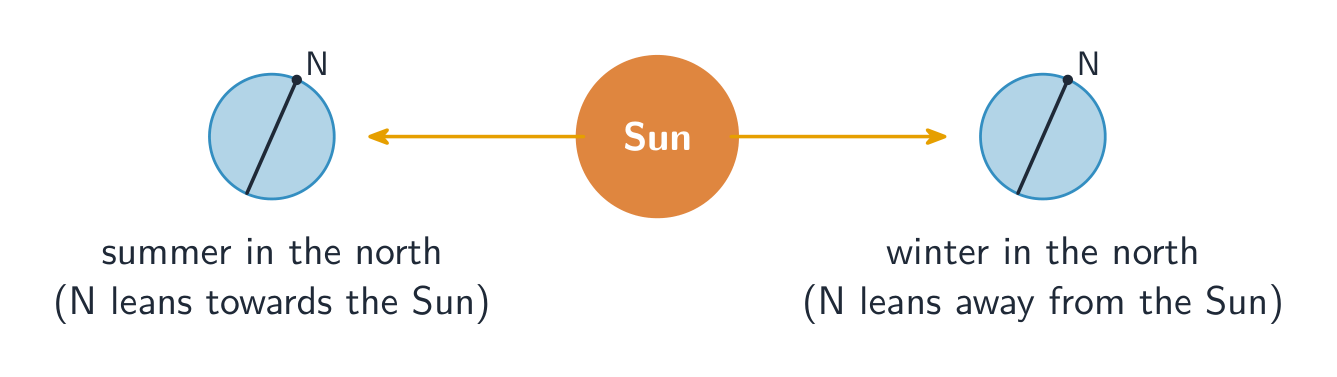
大纲
6.1.1 The Earth
Core Supplement 1 Know that the Earth is a planet that rotates on its axis, which is tilted, once in approximately 24 hours, and use this to explain observations of the apparent daily motion of the Sun and the periodic cycle of day and night 2 Know that the Earth orbits the Sun once in approximately 365 days and use this to explain the periodic nature of the seasons 4 Define average orbital speed from the equation $v = \frac{2\pi r}{T}$ where $r$ is the average radius of the orbit and $T$ is the orbital period; recall and use this equation 3 Know that it takes approximately one month for the Moon to orbit the Earth and use this to explain the periodic nature of the Moon’s cycle of phases 6.1.2 The Solar System
Core Supplement 1 Describe the Solar System as containing: (a) one star, the Sun (b) the eight named planets and know their order from the Sun (c) minor planets that orbit the Sun, including dwarf planets such as Pluto and asteroids in the asteroid belt (d) moons, that orbit the planets (e) smaller Solar System bodies, including comets and natural satellites 7 Know that planets, minor planets and comets have elliptical orbits, and recall that the Sun is not at the centre of the elliptical orbit, except when the orbit is approximately circular 8 Analyse and interpret planetary data about orbital distance, orbital duration, density, surface temperature and uniform gravitational field strength at the planet’s surface 2 Know that, in comparison to each other, the four planets nearest the Sun are rocky and small and the four planets furthest from the Sun are gaseous and large, and explain this difference by referring to an accretion model for Solar System formation, to include: (a) the model’s dependence on gravity (b) the presence of many elements in interstellar clouds of gas and dust (c) the rotation of material in the cloud and the formation of an accretion disc 3 Know that the strength of the gravitational field (a) at the surface of a planet depends on the mass of the planet (b) around a planet decreases as the distance from the planet increases 4 Calculate the time it takes light to travel a significant distance such as between objects in the Solar System 5 Know that the Sun contains most of the mass of the Solar System and this explains why the planets orbit the Sun 6 Know that the force that keeps an object in orbit around the Sun is the gravitational attraction of the Sun 9 Know that the strength of the Sun’s gravitational field decreases and that the orbital speeds of the planets decrease as the distance from the Sun increases 10 Know that an object in an elliptical orbit travels faster when closer to the Sun and explain this using the conservation of energy 来源:剑桥国际大纲
地球在它的轴(axis)上旋转(自转(rotates))约每 $24$ 小时一次。轴是倾斜(tilted)的(不是笔直向上)。这个旋转给我们白天和黑夜,并使太阳(Sun)看起来每天在天空中移动。
地球也在一个轨道(orbit)中围绕太阳移动,约每 $365$ 天一次(一年)。因为轴是倾斜的,地球的不同部分在一年的不同时候朝太阳倾斜。这给出季节(seasons):在朝太阳倾斜的地球那一半是夏天。
轴一整年保持同样的倾斜,所以每个半球在轨道的一半朝太阳倾斜、另一半倾斜离开 月球(Moon)围绕地球约每一个月一次。随着它绕行,我们看到它被照亮的一侧的不同的量,这给出月球的月相(phases,新月、半月、满月)。

月球被照亮的一半总是面朝太阳,所以随着它绕行我们看到它的不同的量:在我们和太阳之间是一个新月、太阳对面是一个满月,而中间是半月 所以,从最短到最长:一天(地球的旋转)< 一个月(月球的轨道)< 一年(地球的轨道)。

满月,地球的天然卫星 探索Why the Moon changes shape
The Sun always lights half the Moon; the phase is simply how much of that lit half faces us as the Moon orbits — it is not Earth's shadow.
词汇表 训练英文 中文 拼音 rotate/rəʊˈteɪt/ 自转 zì zhuàn axis/ˈæksɪs/ 轴 zhóu tilted/ˈtɪltɪd/ 倾斜 qīng xié Sun/sʌn/ 太阳 tài yáng seasons/ˈsiːznz/ 季节 jì jié Moon/muːn/ 月球 yuè qiú phases/ˈfeɪzɪz/ 月相 yuè xiàng 6.1
轨道速度

对一个绕一个圆运动的物体,一个完整轨道的距离是周长(circumference)$2\pi r$,其中 $r$ 是轨道的半径。轨道速率(orbital speed)是这个距离除以周期(period)$T$(一个轨道的时间):
$$v = \frac{2\pi r}{T}$$同样的方程对行星、卫星和人造卫星都有效。
例题。 一个空间站在 $r = 7000\ \text{km}$ 的半径围绕地球运行,一个轨道花 $T = 5800\ \text{s}$。求它的轨道速率。
先把半径转换成米:$7000\ \text{km} = 7.0 \times 10^6\ \text{m}$。然后
$$v = \frac{2\pi r}{T} = \frac{2\pi \times 7.0 \times 10^6}{5800} \approx 7600\ \text{m/s}$$The ISS in orbit: orbital speed is the speed that keeps a satellite in free-fall circular motion 词汇表 训练英文 中文 拼音 circumference/sɜːˈkʌmfrəns/ 周长 zhōu cháng orbital speed/ˈɔːbɪtl spiːd/ 轨道速率 guǐ dào sù lǜ period/ˈpɪərɪəd/ 周期 zhōu qī satellite/ˈsætəlaɪt/ 卫星 wèi xīng 6.1
太阳系

太阳系(Solar System)在它的中心有一颗恒星,太阳。围绕它移动的是八颗行星(planets)。从太阳按顺序它们是:水星、金星、地球、火星、木星、土星、天王星和海王星。
- 最靠近太阳的四颗行星小而岩石(rocky)。
- 离太阳最远的四颗行星大而气态(gaseous)——它们大多由气体(gas)构成,没有可站立的固体表面。
- 两颗较近的巨行星,木星和土星,是气态巨行星(gas giants)。两颗外围的巨行星,天王星和海王星,是冰巨行星(ice giants):它们容纳多得多的冰,所以它们不是真正的气态巨行星。
太阳和它按顺序的八颗行星:四颗小的岩石行星,然后小行星带,然后四颗大的气态行星——气态巨行星木星和土星以及冰巨行星天王星和海王星(不按比例) 
火星,红色行星,岩石内行星之一 
木星,最大的行星,带它旋涡状的气体带 
土星和它的环,由卡西尼号飞船拍摄 太阳系也含有:
- 小行星,如冥王星等矮行星(dwarf planets),和小行星(asteroids,大多位于火星和木星之间的小行星带);
- 围绕行星运行的卫星(天然卫星(satellites));
- 彗星(comets)和其他小天体。
Orbits and gravity
太阳容纳太阳系的大部分质量。它的引力(gravity,引力拉力)伸出去并把行星保持在它们的轨道中。这个力是太阳的引力吸引。
重力场强度(gravitational field strength)告诉你引力有多强:
- 在一颗行星的表面,对一颗质量更大的行星它更大;
- 在一颗行星周围,随着你移动更远它变弱。
以同样的方式,太阳的引力在更远处变弱,所以外行星比内行星移动得更慢(更小的轨道速率)。
Planetary data
考试题常常给出一个像这样的表,并要求你从中读出一个规律。
行星 到太阳的距离 / 百万 km 公转周期 密度 / g/cm³ 表面温度 / °C 表面 $g$ / N/kg 水星 58 88 天 5.4 170 3.7 金星 108 225 天 5.2 460 8.9 地球 150 365 天 5.5 15 9.8 火星 228 687 天 3.9 −60 3.7 木星 779 11.9 年 1.3 −110 23 土星 1430 29.5 年 0.7 −140 9.0 天王星 2870 84 年 1.3 −195 8.7 海王星 4500 165 年 1.6 −200 11 要注意的规律:一颗行星离太阳越远,它的公转周期越长、表面温度越低。四颗内行星密度大(岩石和金属),而四颗外行星密度低(气体和冰)。表面的重力场强度取决于行星的质量和大小,而不是它到太阳的距离。
Elliptical orbits
大多数轨道不是完美的圆,而是椭圆(ellipses,一个拉长的圆),而太阳不在椭圆的中心。一颗彗星有一个非常拉长的轨道。一个椭圆轨道中的物体在它更靠近太阳时移动更快。我们用能量守恒(conservation of energy)解释这个——总能量(energy)保持不变,所以随着物体的重力势能(gravitational potential energy)下降(靠近),它的动能(kinetic energy)上升(它加速)。

太阳坐在椭圆的一个焦点;行星在靠近时加速、在远离时减速 Light travel time
太空中的距离是巨大的,所以我们常常算出光穿过它们要花多长时间。光以 $3.0 \times 10^8\ \text{m/s}$ 行进。用 $\text{time} = \dfrac{\text{distance}}{\text{speed}}$,来自太阳(约 $1.5 \times 10^{11}\ \text{m}$ 远)的光花约 $500\ \text{s}$,大约是 $8$ 分钟,到达地球。
探索Watch the planets race
The closer a planet is to the Sun, the faster it orbits — Mercury in 88 days, Jupiter in 12 years — because the Sun's gravity is stronger close in.
词汇表 训练英文 中文 拼音 orbit/ˈɔːbɪt/ 轨道 guǐ dào Solar System/ˈsəʊlə ˈsɪstəm/ 太阳系 tài yáng xì planet/ˈplænɪt/ 行星 xíng xīng rocky/ˈrɒki/ 岩石 yán shí gaseous/ˈɡeɪsɪəs/ 气态 qì tài gas/ɡæs/ 气体 qì tǐ gas giant/ɡæs ˈdʒaɪənt/ 气态巨行星 qì tài jù xíng xīng ice giant/aɪs ˈdʒaɪənt/ 冰巨行星 bīng jù xíng xīng dwarf planet/dwɔːf ˈplænɪt/ 矮行星 ǎi xíng xīng asteroid/ˈæstərɔɪd/ 小行星 xiǎo xíng xīng comet/ˈkɒmɪt/ 彗星 huì xīng gravity/ˈɡrævɪti/ 引力 yǐn lì gravitational field strength/ˌɡrævɪˈteɪʃənl fiːld streŋθ/ 重力场强度 zhòng lì chǎng qiáng dù ellipse/ɪˈlɪps/ 椭圆 tuǒ yuán conservation of energy/ˌkɒnsəˈveɪʃn ɒv ˈenədʒi/ 能量守恒 néng liàng shǒu héng energy/ˈenədʒi/ 能量 néng liàng gravitational potential energy/ˌɡrævɪˈteɪʃənl pəˈtenʃl ˈenədʒi/ 重力势能 zhòng lì shì néng kinetic energy/kɪˈnetɪk ˈenədʒi/ 动能 dòng néng 6.1
太阳系是如何形成的
行星从太空中一个气体(gas)和尘埃(dust)的巨大云形成,它含有许多化学元素(elements)。这是吸积(accretion)模型:
- 引力把云拉在一起;
- 云在旋转,所以它扁平成一个旋转的吸积盘(accretion disc);
- 大部分物质落到中心并变成太阳,而行星从盘中剩下的材料成长。
在炎热的年轻太阳附近,只有岩石和金属能保持固体,所以内行星是岩石的。远在外围,那里冷,气体也能聚集,所以外行星长得大而气态。
词汇表 训练英文 中文 拼音 dust/dʌst/ 尘埃 chén āi element/ˈelɪmənt/ 元素 yuán sù accretion/əˈkreʃn/ 吸积 xī jī accretion disc/əˈkreʃn dɪsk/ 吸积盘 xī jī pán 6.2
恒星与宇宙

大纲
6.2.1 The Sun as a star
Core Supplement 1 Know that the Sun is a star of medium size, consisting mostly of hydrogen and helium, and that it radiates most of its energy in the infrared, visible light and ultraviolet regions of the electromagnetic spectrum 2 Know that stars are powered by nuclear reactions that release energy and that in stable stars the nuclear reactions involve the fusion of hydrogen into helium 6.2.2 Stars
Core Supplement 1 State that: (a) galaxies are each made up of many billions of stars (b) the Sun is a star in the galaxy known as the Milky Way (c) other stars that make up the Milky Way are much further away from the Earth than the Sun is from the Earth (d) astronomical distances can be measured in light-years, where one light-year is the distance travelled in (the vacuum of) space by light in one year 2 Know that one light-year is equal to $9.5 \times 10^{15}$ m 3 Describe the life cycle of a star: (a) a star is formed from interstellar clouds of gas and dust that contain hydrogen (b) a protostar is an interstellar cloud collapsing and increasing in temperature as a result of its internal gravitational attraction (c) a protostar becomes a stable star when the inward force of gravitational attraction is balanced by an outward force due to the high temperature in the centre of the star (d) all stars eventually run out of hydrogen as fuel for the nuclear reaction (e) most stars expand to form red giants and more massive stars expand to form red supergiants when most of the hydrogen in the centre of the star has been converted to helium (f) a red giant from a less massive star forms a planetary nebula with a white dwarf star at its centre (g) a red supergiant explodes as a supernova, forming a nebula containing hydrogen and new heavier elements, leaving behind a neutron star or a black hole at its centre (h) the nebula from a supernova may form new stars with orbiting planets 6.2.3 The Universe
Core Supplement 1 Know that the Milky Way is one of many billions of galaxies making up the Universe and that the diameter of the Milky Way is approximately 100 000 light-years 2 Describe redshift as an increase in the observed wavelength of electromagnetic radiation emitted from receding stars and galaxies 3 Know that the light emitted from distant galaxies appears redshifted in comparison with light emitted on the Earth 4 Know that redshift in the light from distant galaxies is evidence that the Universe is expanding and supports the Big Bang Theory 5 Know that microwave radiation of a specific frequency is observed at all points in space around us and is known as cosmic microwave background radiation (CMBR) 6 Explain that the CMBR was produced shortly after the Universe was formed and that this radiation has been expanded into the microwave region of the electromagnetic spectrum as the Universe expanded 7 Know that the speed $v$ at which a galaxy is moving away from the Earth can be found from the change in wavelength of the galaxy’s starlight due to redshift 8 Know that the distance $d$ of a far galaxy can be determined using the brightness of a supernova in that galaxy 9 Define the Hubble constant $H_0$ as the ratio of the speed at which the galaxy is moving away from the Earth to its distance from the Earth; recall and use the equation $$H_0 = \frac{v}{d}$$10 Know that the current estimate for $H_0$ is $2.2 \times 10^{-18}$ per second 11 Know that the equation $$\frac{d}{v} = \frac{1}{H_0}$$represents an estimate for the age of the Universe and that this is evidence for the idea that all the matter in the Universe was present at a single point来源:剑桥国际大纲
太阳是一颗中等大小的恒星(star),大多由氢(hydrogen)和氦(helium)构成。它在电磁波谱(electromagnetic spectrum)的红外线、可见光和紫外线(ultraviolet)部分辐射它大部分的能量(energy)。
一颗恒星由它核心的核反应(nuclear reactions)供能。在一颗稳定的恒星中,反应是核聚变(nuclear fusion):氢原子核结合以制造氦,释放巨大的能量。
太阳,我们最近的恒星,以紫外光看到 词汇表 训练英文 中文 拼音 star/stɑː/ 恒星 héng xīng hydrogen/ˈhaɪdrədʒn/ 氢 qīng helium/ˈhiːlɪəm/ 氦 hài ultraviolet/ˌʊltrəˈvaɪəlɪt/ 紫外线 zǐ wài xiàn electromagnetic spectrum/ɪˌlektrəʊməɡˈnetɪk ˈspektrəm/ 电磁波谱 diàn cí bō pǔ nuclear reaction/ˈnjuːklɪə rɪˈækʃn/ 核反应 hé fǎn yìng nuclear fusion/ˈnjuːklɪə ˈfjuːʒn/ 核聚变 hé jù biàn 6.2
恒星、星系与宇宙
一个星系(galaxy)是由引力保持在一起的许多十亿颗恒星的一个群。我们的太阳是叫银河系(Milky Way)的星系中的一颗恒星。银河系中所有其他的恒星都比太阳离地球远得多得多。
一个螺旋星系:由引力保持在一起的数十亿颗恒星 恒星之间的距离如此大,以至于我们以光年(light-years)测量它们。一光年是光在一年内(在太空的真空中)行进的距离,它约是 $9.5 \times 10^{15}\ \text{m}$。
银河系约 $100\,000$ 光年宽(它的直径(diameter))。它只是数十亿个星系中的一个。所有这些星系一起构成宇宙(Universe)。

一台巨型望远镜研究夜空;激光帮助它制作遥远恒星的清晰图像 词汇表 训练英文 中文 拼音 galaxy/ˈɡæləksi/ 星系 xīng xì Milky Way/ˈmɪlki weɪ/ 银河系 yín hé xì light-year/laɪt jɪə/ 光年 guāng nián diameter/daɪˈæmɪtə/ 直径 zhí jìng 6.2
恒星的生命周期
一颗恒星在一段非常长的时间里诞生、生活并死亡:
- 一颗恒星从一个含有氢的气体和尘埃的星际云(interstellar cloud)形成。
- 引力把云向内拉,而它升温。这个塌缩、升温的云是一个原恒星(protostar)。
- 当引力的向内拉力被它中心非常高的温度引起的向外的推平衡时,原恒星变成一颗稳定(stable)的恒星。
- 及时,每颗恒星都用完聚变的氢燃料(fuel)。
接下来发生什么取决于恒星的质量:
- 一颗中等的恒星(像太阳)膨胀成一个红巨星(red giant)。它随即把它的外层作为一个叫行星状星云(nebula)的发光云抛掉,在中心留下一个小的、热的白矮星(white dwarf)。
- 一颗重得多的恒星膨胀成一个红超巨星(red supergiant),然后作为一个超新星(supernova)爆炸。这次爆炸铺开一个含有氢和新的、更重元素的星云,并留下一个中子星(neutron star)或一个黑洞(black hole)。
每颗恒星都在一个星云中开始;它如何结束取决于它的质量 来自一个超新星的星云能后来形成新恒星,带围绕它们运行的行星——所以我们自己的太阳系来自更早的恒星。
探索The life cycle of a star
Gravity pulls a gas cloud together; fusion lights the star; when its fuel runs low it swells and finally fades.
探索The life cycle of a Sun-like star
Step through how a star like our Sun is born, lives and dies.
词汇表 训练英文 中文 拼音 interstellar cloud/ˌɪntəˈstelə klaʊd/ 星际云 xīng jì yún protostar/ˈprəʊtəʊstɑː/ 原恒星 yuán héng xīng stable/ˈsteɪbl/ 稳定 wěn dìng fuel/ˈfjuːəl/ 燃料 rán liào red giant/red ˈdʒaɪənt/ 红巨星 hóng jù xīng nebula/ˈnebjʊlə/ 星云 xīng yún white dwarf/waɪt dwɔːf/ 白矮星 bái ǎi xīng red supergiant/red ˈsuːpədʒaɪənt/ 红超巨星 hóng chāo jù xīng supernova/ˌsuːpəˈnəʊvə/ 超新星 chāo xīn xīng neutron star/ˈnjuːtrɒn stɑː/ 中子星 zhōng zi xīng black hole/blæk həʊl/ 黑洞 hēi dòng 6.2
膨胀的宇宙

当一颗恒星或星系远离我们移动时(它在退行(receding)),我们从它接收的光有一个比正常更长的波长(wavelength)——它朝光谱的红端移动。这是红移(redshift)。
一个遥远星系光谱中的暗线朝红端移动——这是红移 来自遥远星系的光被红移,而一个星系越远,它的红移越大。这告诉我们星系在互相远离:宇宙在膨胀(expanding)。把这个倒回去,一切曾经在一个单一的点一起——这是大爆炸(Big Bang)理论的证据。
每个星系都在远离我们移动,而更远的移动得更快——宇宙在膨胀 More evidence and the age of the Universe
微弱的微波(microwave)辐射(radiation)被发现从太空的每个方向来。这是宇宙微波背景辐射(cosmic microwave background radiation,CMBR)。它在大爆炸后不久作为高能辐射被制造,并随着宇宙膨胀被拉伸到光谱的微波部分。
对一个遥远的星系:
- 它远离移动的速度 $v$ 能从它星光的红移求得;
- 它的距离 $d$ 能从在它里面看到的一个超新星的亮度求得。
哈勃常数(Hubble constant)$H_0$ 联系这两个:
$$H_0 = \frac{v}{d}$$它今天的值约是每秒 $2.2 \times 10^{-18}$。把这个反过来给出宇宙年龄的一个估计:
$$\frac{d}{v} = \frac{1}{H_0}$$例题。 哈勃常数约是 $H_0 = 2.2 \times 10^{-18}$ 每秒。估计宇宙的年龄。
$$\frac{1}{H_0} = \frac{1}{2.2 \times 10^{-18}} \approx 4.5 \times 10^{17}\ \text{s}$$那大约是 $14$ 十亿年。
这有效是因为每个星系似乎在同一时间从同一个单一的点开始——对大爆炸的更多支持。
探索The expanding Universe
v = H₀·d
Galaxies recede faster the farther they are — speed is proportional to distance.
词汇表 训练英文 中文 拼音 Universe/ˈjuːnɪvɜːs/ 宇宙 yǔ zhòu receding/rɪˈsiːdɪŋ/ 退行 tuì xíng wavelength/ˈweɪvleŋθ/ 波长 bō cháng redshift/ˈredʃɪft/ 红移 hóng yí expanding/ekˈspændɪŋ/ 膨胀 péng zhàng Big Bang/bɪɡ bæŋ/ 大爆炸 dà bào zhà microwave/ˈmaɪkrəʊweɪv/ 微波 wēi bō radiation/ˌreɪdɪˈeɪʃn/ 辐射 fú shè cosmic microwave background radiation/ˈkɒzmɪk ˈmaɪkrəʊweɪv ˈbækɡraʊnd ˌreɪdɪˈeɪʃn/ 宇宙微波背景辐射 yǔ zhòu wēi bō bèi jǐng fú shè Hubble constant/ˈhʌbl ˈkɒnstənt/ 哈勃常数 hā bó cháng shù 6.2
考试技巧
- 在 $v = \dfrac{2\pi r}{T}$ 中,$r$ 是轨道半径,而 $T$ 是一个完整轨道以秒计的时间——先把 km 转换成 m、把小时转换成秒。
- 更靠近太阳的行星感受更强的引力,所以它们运行得更快、花更少的时间。在一个椭圆轨道中一个物体在它接近太阳时加速(重力势能变成动能)。
- 一个光年是一个距离,不是一个时间——光在一年内行进多远。
- 当引力的向内拉力被它核心聚变释放的能量的向外的推平衡时,一颗恒星是稳定的。当它的燃料用完时它变成什么取决于它的质量。
- 红移——来自遥远星系的光移到更长(更红)的波长,越远移动越大——是宇宙在膨胀的证据,它支持大爆炸。