| Core | Supplement |
|---|---|
| 1 Describe the use of rulers and measuring cylinders to find a length or a volume | |
| 2 Describe how to measure a variety of time intervals using clocks and digital timers | |
| 3 Determine an average value for a small distance and for a short interval of time by measuring multiples (including the period of oscillation of a pendulum) | |
| 4 Understand that a scalar quantity has magnitude (size) only and that a vector quantity has magnitude and direction | |
| 5 Know that the following quantities are scalars: distance, speed, time, mass, energy and temperature | |
| 6 Know that the following quantities are vectors: force, weight, velocity, acceleration, momentum, electric field strength and gravitational field strength | |
| 7 Determine, by calculation or graphically, the resultant of two vectors at right angles, limited to forces or velocities only |
运动、力与能量
IGCSE 物理 · 第 1 主题
 23:51
23:51
Motion, Forces & Energy
Look around you. A car speeds up. A ball drops. A cup sits still on a table. Physics can describe every one of these — exactly, using numbers. And it all rests…
英文讲解 · 内嵌中英文字幕
1.1
物理量与测量技术

大纲
来源:剑桥国际大纲
Length and volume
用一把直尺(ruler)测量长度。眼睛正对刻度线读刻度以避免一个读数错误。
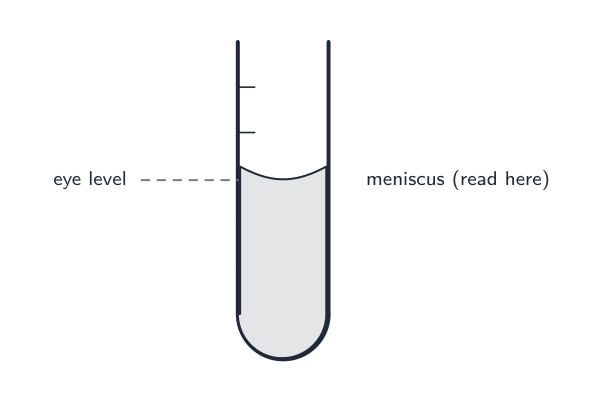
用一个量筒(measuring cylinder)测量一个液体的体积。在弯曲表面(弯月面(meniscus))的底部读刻度,你的眼睛与它平齐。
Measuring time
用一个秒表(stopwatch)或一个数字计时器(digital timer)测量一个时间间隔。对于长的时间(几分钟或几小时),一个钟就够了。一个秒表是用手启动和停止的,所以每个读数有约 0.2 s 的反应时间(reaction time)误差。要让这个误差影响更小,给一个长的间隔计时,或者给许多次重复计时再相除(见下面)。
Measuring small amounts
一个单一的小长度或一个短时间难以很好地测量。诀窍是测多个再相除:
- 要求一页的厚度,测量 100 页并除以 100。
- 要求一个摆(pendulum)一次摆动的时间,测量 20 次摆动的时间并除以 20。一次完整的摆动叫周期(period)。
这使不确定度(uncertainty,误差的大小)小得多。
Scalars and vectors
一个标量(scalar quantity)只有大小(大小(magnitude))。一个矢量(vector quantity)有大小和方向。
- 标量:距离、速率、时间、质量(mass)、能量(energy)、温度(temperature)。
- 矢量:力(force)、重力(weight)、速度(velocity)、加速度(acceleration)、动量(momentum)、电场强度(electric field strength)、重力场强度(gravitational field strength)。
要把两个成直角(90°)的矢量相加,把它们画成一个矩形的两条边。合矢量(resultant)是对角线。用勾股定理求它的大小,用三角学求它的方向。
$$R = \sqrt{a^2 + b^2}$$

探索
Scalars & vectors
resultant = a + b
Add two vectors tip-to-tail to find the resultant.
词汇表
训练
| 英文 | 中文 | 拼音 |
|---|---|---|
| measurement/ˈmeʒəmənt/ | 测量 | cè liáng |
| ruler/ˈruːlə/ | 直尺 | zhí chǐ |
| measuring cylinder/ˈmeʒərɪŋ ˈsɪlɪndə/ | 量筒 | liáng tǒng |
| meniscus/ˈmenɪskəs/ | 弯月面 | wān yuè miàn |
| stopwatch/ˈstɒpwɒtʃ/ | 秒表 | miǎo biǎo |
| digital timer/ˈdɪdʒɪtl ˈtaɪmə/ | 数字计时器 | shù zì jì shí qì |
| reaction time/rɪˈækʃn taɪm/ | 反应时间 | fǎn yìng shí jiān |
| measure many and divide/ˈmeʒə ˈmeni ænd dɪˈvaɪd/ | 测多个再相除 | cè duō gè zài xiāng chú |
| pendulum/ˈpendjʊləm/ | 摆 | bǎi |
| period/ˈpɪərɪəd/ | 周期 | zhōu qī |
| uncertainty/ʌnˈsɜːtənti/ | 不确定度 | bù què dìng dù |
| scalar quantity/ˈskeɪlə ˈkwɒntɪti/ | 标量 | biāo liàng |
| magnitude/ˈmæɡnɪtjuːd/ | 大小 | dà xiǎo |
| vector quantity/ˈvektə ˈkwɒntɪti/ | 矢量 | shǐ liàng |
| mass/mæs/ | 质量 | zhì liàng |
| energy/ˈenədʒi/ | 能量 | néng liàng |
| temperature/ˈtemprɪtʃə/ | 温度 | wēn dù |
| force/fɔːs/ | 力 | lì |
| weight/weɪt/ | 重力 | zhòng lì |
| velocity/vəˈlɒsɪti/ | 速度 | sù dù |
| acceleration/əkˌseləˈreɪʃn/ | 加速度 | jiā sù dù |
| momentum/məʊˈmentəm/ | 动量 | dòng liàng |
| electric field strength/ɪˈlektrɪk fiːld streŋθ/ | 电场强度 | diàn chǎng qiáng dù |
| gravitational field strength/ˌɡrævɪˈteɪʃənl fiːld streŋθ/ | 重力场强度 | zhòng lì chǎng qiáng dù |
| resultant/rɪˈzʌltənt/ | 合矢量 | hé shǐ liàng |
| moment/ˈməʊmənt/ | 力矩 | lì jǔ |
1.2
运动
大纲
| Core | Supplement |
|---|---|
| 1 Define speed as distance travelled per unit time; recall and use the equation $$v = \frac{s}{t}$$ |
|
| 2 Define velocity as speed in a given direction | |
| 3 Recall and use the equation $$\text{average speed} = \frac{\text{total distance travelled}}{\text{total time taken}}$$ |
9 Define acceleration as change in velocity per unit time; recall and use the equation $$a = \frac{\Delta v}{\Delta t}$$ |
| 4 Sketch, plot and interpret distance–time and speed–time graphs | |
| 5 Determine, qualitatively, from given data or the shape of a distance–time graph or speed–time graph when an object is: (a) at rest (b) moving with constant speed (c) accelerating (d) decelerating | 10 Determine from given data or the shape of a speed–time graph when an object is moving with: (a) constant acceleration (b) changing acceleration |
| 6 Calculate speed from the gradient of a straight-line section of a distance–time graph | 11 Calculate acceleration from the gradient of a speed–time graph |
| 7 Calculate the area under a speed–time graph to determine the distance travelled for motion with constant speed or constant acceleration | |
| 12 Know that a deceleration is a negative acceleration and use this in calculations | |
| 8 State that the acceleration of free fall $g$ for an object near to the surface of the Earth is approximately constant and is approximately $9.8\text{ m/s}^2$ | 13 Describe the motion of objects falling in a uniform gravitational field with and without air/ liquid resistance, including reference to terminal velocity |
来源:剑桥国际大纲
Speed and velocity
速率(speed)是单位时间行进的距离。
$$v = \frac{s}{t}$$
速度(velocity)是一个陈述方向上的速率。所以速度是一个矢量,而速率是一个标量。
$$\text{average speed} = \frac{\text{total distance}}{\text{total time}}$$
Acceleration
加速度(acceleration)是单位时间速度的变化。
$$a = \frac{\Delta v}{\Delta t}$$
这里 $\Delta v$ 意味着"速度的变化"。一个减速(deceleration,变慢)是一个负加速度。
例题。 一辆车在 $4.0\ \text{s}$ 内从 $8\ \text{m/s}$ 加速到 $20\ \text{m/s}$。求它的加速度。
$$a = \frac{\Delta v}{\Delta t} = \frac{20 - 8}{4.0} = 3.0\ \text{m/s}^2$$
Motion graphs
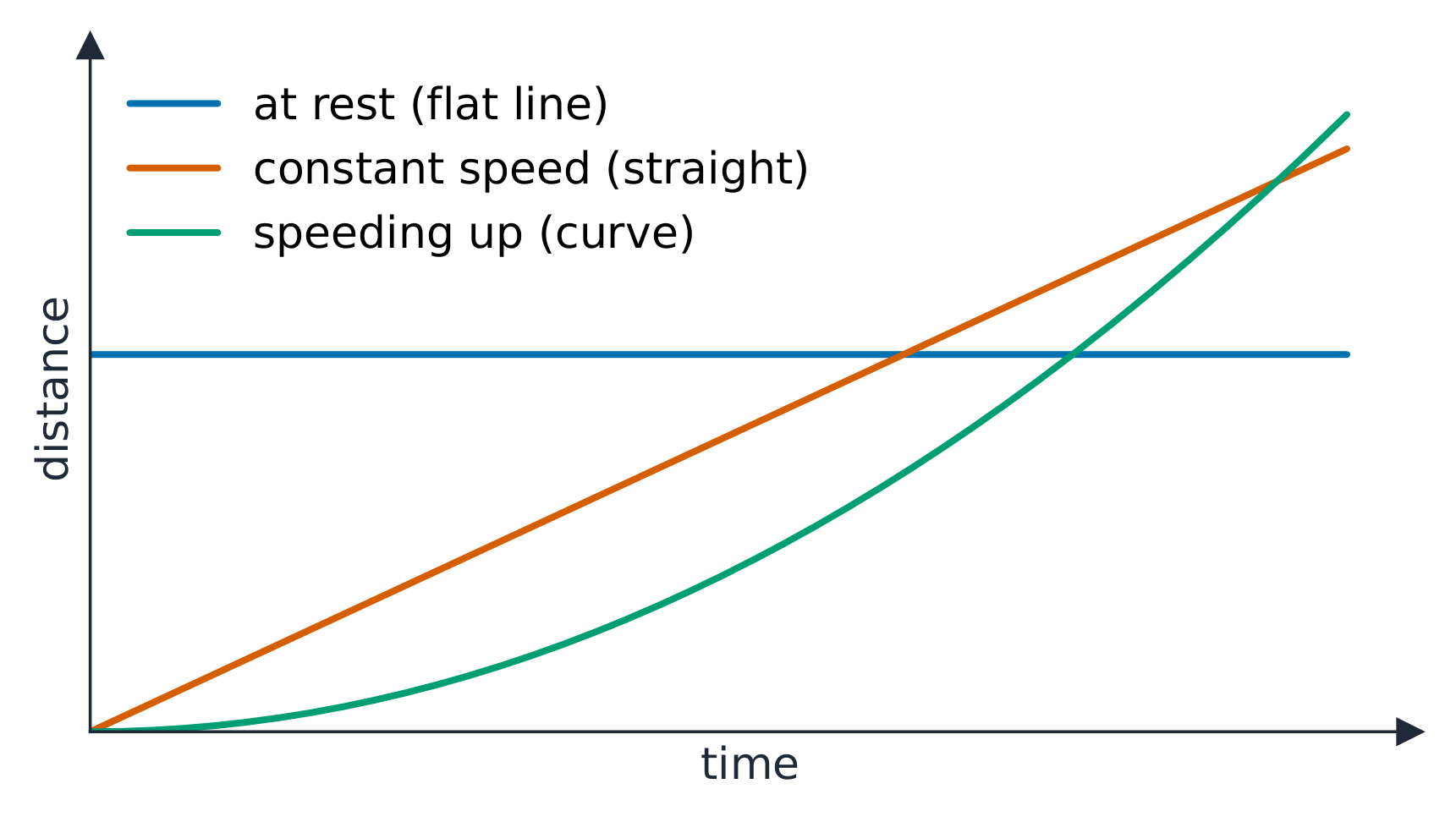
一个距离-时间图(distance–time graph)显示一个物体走了多远:
- 一条平(水平)线意味着物体静止(at rest)。
- 一个直的斜坡意味着恒定的速率。斜率(gradient,陡度)是速率。
- 一条变得更陡的曲线意味着物体在加速。
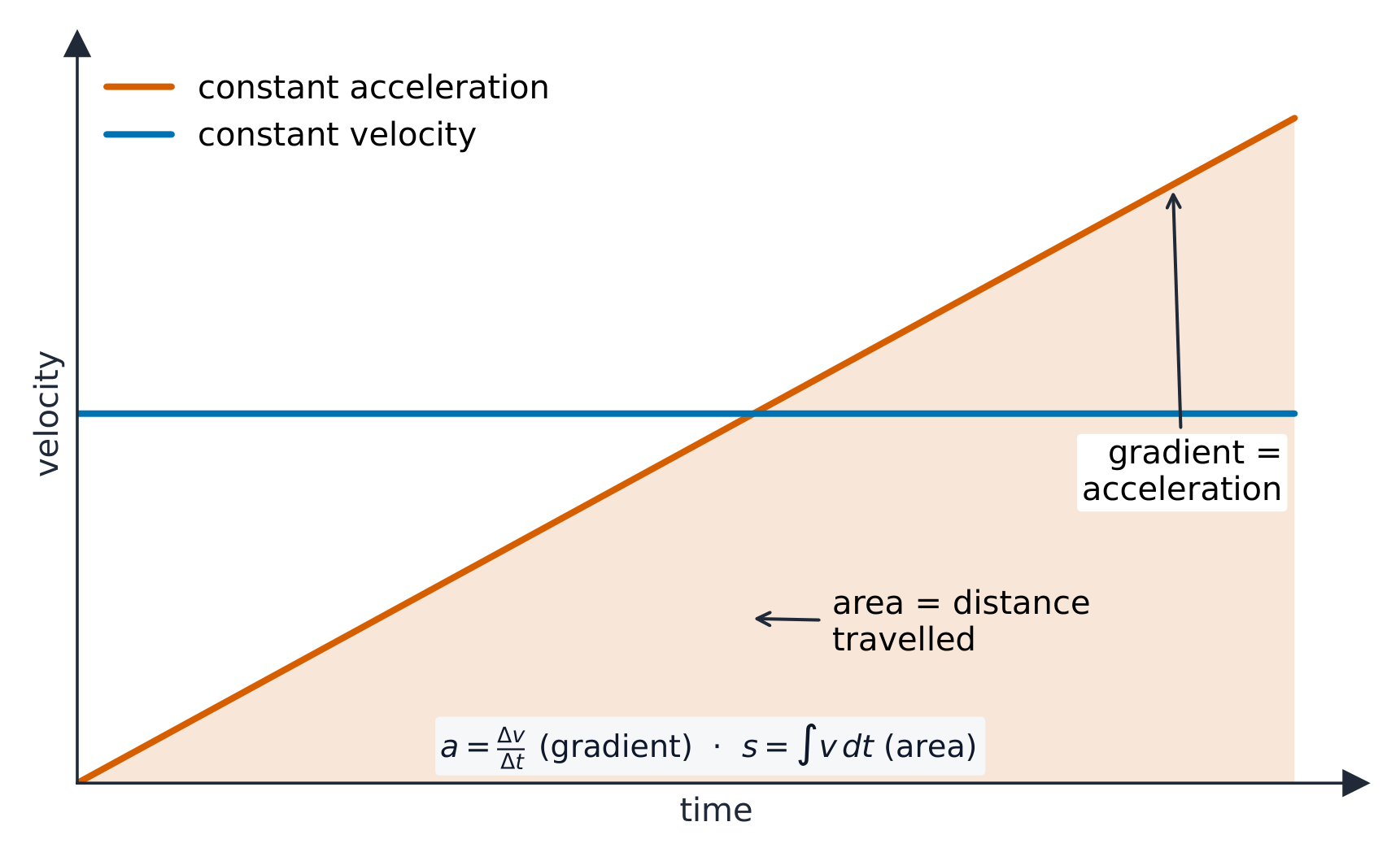
一个速度-时间图(speed–time graph)显示一个物体走得多快:
- 一条平线意味着恒定的速率。
- 一个直的斜坡意味着恒定的加速度。斜率是加速度。
- 线下面积(area under the line)是行进的距离。
Falling objects
在地球附近重力场是均匀(uniform)的(处处同样强),所以所有物体在下落时以同样的速率加速。这是自由落体加速度(acceleration of free fall),$g \approx 9.8\ \text{m/s}^2$。
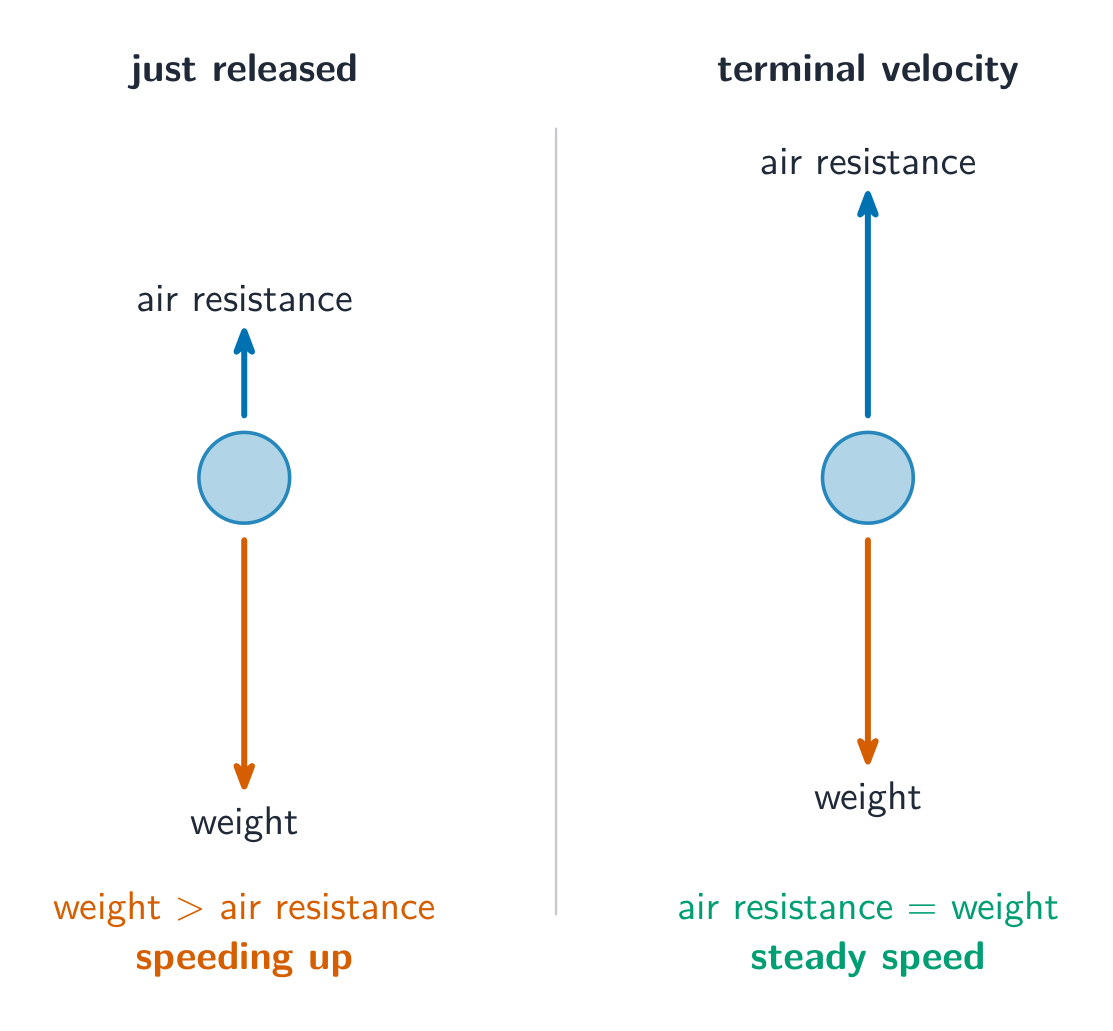
当一个物体穿过空气下落时,空气阻力(air resistance,一个阻力)向上作用。随着它加速,空气阻力增长。当空气阻力等于重力时,合力为零,而物体停止加速。它随即以一个稳定的收尾速度(terminal velocity)下落。
探索
Velocity–time graph
Change u and a. The gradient is the acceleration; the area under the line is the distance travelled.
词汇表
训练
| 英文 | 中文 | 拼音 |
|---|---|---|
| motion/ˈməʊʃn/ | 运动 | yùn dòng |
| speed/spiːd/ | 速率 | sù lǜ |
| deceleration/dɪˌseləˈreɪʃn/ | 减速 | jiǎn sù |
| distance–time graph/ˈdɪstəns taɪm ɡræf/ | 距离-时间图 | jù lí - shí jiān tú |
| at rest/æt rest/ | 静止 | jìng zhǐ |
| gradient/ˈɡreɪdɪənt/ | 斜率 | xié lǜ |
| speed–time graph/spiːd taɪm ɡræf/ | 速度-时间图 | sù dù - shí jiān tú |
| area under the line/ˈeərɪə ˈʌndə ðə laɪn/ | 线下面积 | xiàn xià miàn jī |
| uniform/ˈjuːnɪfɔːm/ | 均匀 | jūn yún |
| acceleration of free fall/əkˌseləˈreɪʃn ɒv friː fɔːl/ | 自由落体加速度 | zì yóu luò tǐ jiā sù dù |
| air resistance/eə rɪˈzɪstəns/ | 空气阻力 | kōng qì zǔ lì |
| terminal velocity/ˈtɜːmɪnl vəˈlɒsɪti/ | 收尾速度 | shōu wěi sù dù |
1.3
质量与重量
大纲
| Core | Supplement |
|---|---|
| 1 State that mass is a measure of the quantity of matter in an object at rest relative to the observer | |
| 2 State that weight is a gravitational force on an object that has mass | 5 Describe, and use the concept of, weight as the effect of a gravitational field on a mass |
| 3 Define gravitational field strength as force per unit mass; recall and use the equation $$g = \frac{W}{m}$$ and know that this is equivalent to the acceleration of free fall |
|
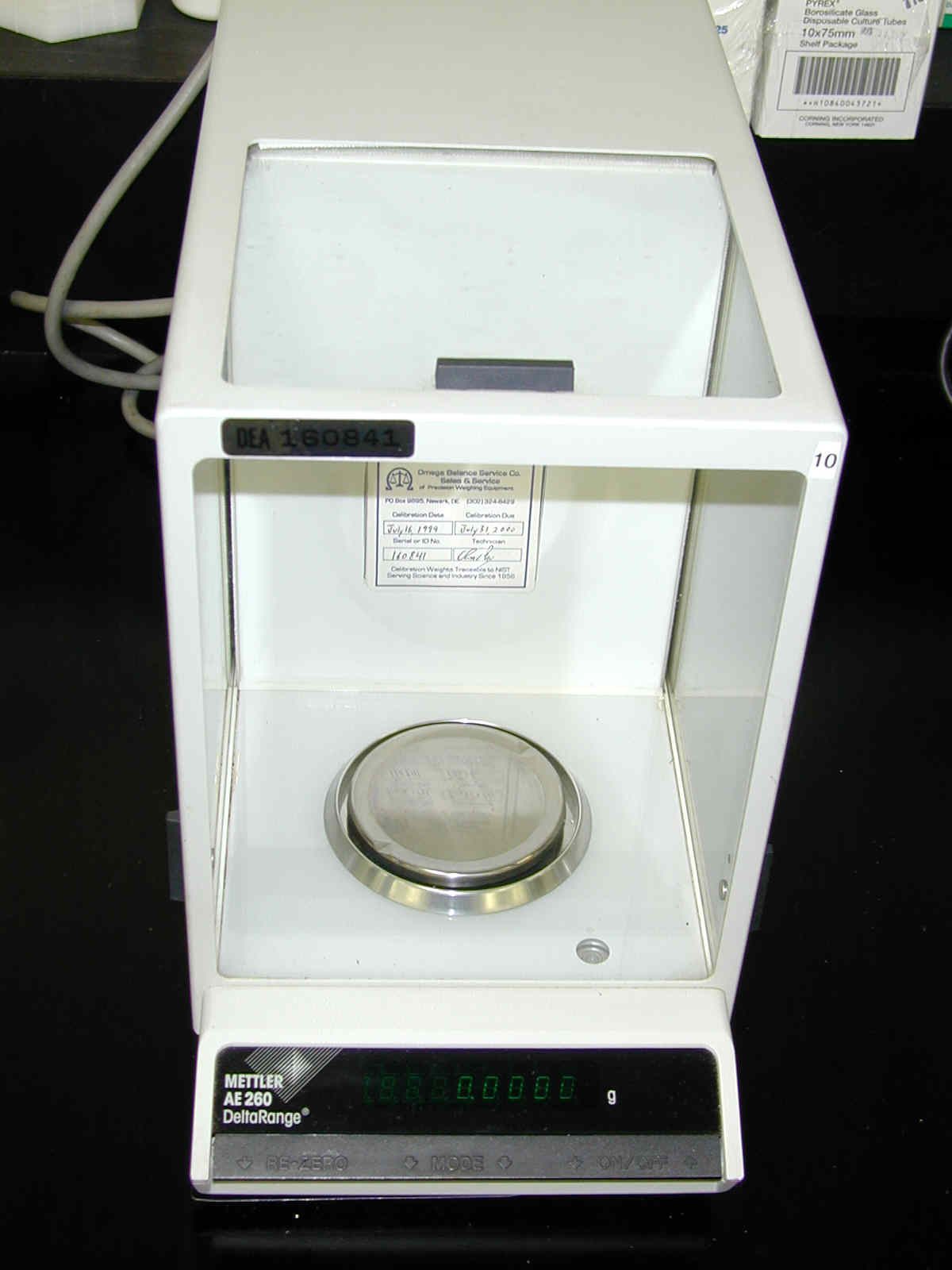
| 4 Know that weights (and masses) may be compared using a balance |
来源:剑桥国际大纲
质量(mass)是一个物体中物质(matter)的量。它以千克(kg)测量,而且在你移动物体时不改变。
重力(weight)是一个质量上重力的力。它以牛顿(N)测量。重力能改变:它在月球上更小,因为月球的重力更弱。
重力场强度(gravitational field strength)是单位质量的力:
$$g = \frac{W}{m}$$
这个 $g$ 有与自由落体加速度相同的值($\approx 9.8\ \text{N/kg}$)。你可以用一台天平(balance)比较质量。
探索
Weight and mass
W = mg
Weight is proportional to mass — the gradient is the gravitational field strength g (about 10 N/kg on Earth).
词汇表
训练
| 英文 | 中文 | 拼音 |
|---|---|---|
| matter/ˈmætə/ | 物质 | wù zhì |
| balance/ˈbæləns/ | 天平 | tiān píng |
1.4
密度

大纲
| Core | Supplement |
|---|---|
| 1 Define density as mass per unit volume; recall and use the equation $$\rho = \frac{m}{V}$$ |
|
| 2 Describe how to determine the density of a liquid, of a regularly shaped solid and of an irregularly shaped solid which sinks in a liquid (volume by displacement), including appropriate calculations | |
| 3 Determine whether an object floats based on density data | 4 Determine whether one liquid will float on another liquid based on density data given that the liquids do not mix |
来源:剑桥国际大纲
密度(density)是单位体积的质量。
$$\rho = \frac{m}{V}$$
符号 $\rho$ 是希腊字母"rho"。单位是 $\text{kg/m}^3$ 或 $\text{g/cm}^3$。
要求密度:用一台天平测量质量、求体积,然后相除。
- 规则固体(regular solid,像一个盒子):测量边并计算体积。
- 不规则固体(irregular solid,一个奇怪的形状):把它放进一个量筒里的水中。水位的上升是它的体积。这是排水法(displacement method)。
- 液体(liquid):把一个空的量筒放在天平上并读它的质量。倒入液体,在量筒上读体积,再读一次质量。液体的质量是两个质量读数之差。
若一个物体的密度小于液体的密度,它漂浮(floats)。若它的密度更大,它下沉。同样地,当一种液体的密度更低时,它漂浮在另一种液体之上(如果两者不混合):油浮在水上。
例题。 一块质量 $54\ \text{g}$ 的石头被放进一个量筒。水位从 $20\ \text{cm}^3$ 上升到 $40\ \text{cm}^3$。求石头的密度。
石头的体积是水位的上升,$40 - 20 = 20\ \text{cm}^3$,所以
$$\rho = \frac{m}{V} = \frac{54}{20} = 2.7\ \text{g/cm}^3$$
探索
Floating and density
Change the object's density and the liquid: it floats if it's less dense, and the denser it is the more sits underwater. Iron sinks in water but floats on mercury.
词汇表
训练
| 英文 | 中文 | 拼音 |
|---|---|---|
| density/ˈdensɪti/ | 密度 | mì dù |
| regular solid/ˈreɡjʊlə ˈsɒlɪd/ | 规则固体 | guī zé gù tǐ |
| irregular solid/ɪˈreɡjʊlə ˈsɒlɪd/ | 不规则固体 | bù guī zé gù tǐ |
| displacement method/dɪˈspleɪsmənt ˈmeθəd/ | 排水法 | pái shuǐ fǎ |
| floats/fləʊts/ | 漂浮 | piāo fú |
1.5
力
大纲
1.5.1 Effects of forces
| Core | Supplement |
|---|---|
| 1 Know that forces may produce changes in the size and shape of an object | 9 Define the spring constant as force per unit extension; recall and use the equation $$k = \frac{F}{x}$$ |
| 2 Sketch, plot and interpret load–extension graphs for an elastic solid and describe the associated experimental procedures | 10 Define and use the term ‘limit of proportionality’ for a load–extension graph and identify this point on the graph (an understanding of the elastic limit is not required) |
| 3 Determine the resultant of two or more forces acting along the same straight line | 11 Recall and use the equation $F = ma$ and know that the force and the acceleration are in the same direction |
| 4 Know that an object either remains at rest or continues in a straight line at constant speed unless acted on by a resultant force | |
| 5 State that a resultant force may change the velocity of an object by changing its direction of motion or its speed | 12 Describe, qualitatively, motion in a circular path due to a force perpendicular to the motion as: (a) speed increases if force increases, with mass and radius constant (b) radius decreases if force increases, with mass and speed constant (c) an increased mass requires an increased force to keep speed and radius constant ($F = \frac{mv^2}{r}$ is not required) |
| 6 Describe solid friction as the force between two surfaces that may impede motion and produce heating | |
| 7 Know that friction (drag) acts on an object moving through a liquid | |
| 8 Know that friction (drag) acts on an object moving through a gas (e.g. air resistance) |
1.5.2 Turning effect of forces
| Core | Supplement |
|---|---|
| 1 Describe the moment of a force as a measure of its turning effect and give everyday examples | |
| 2 Define the moment of a force as $\text{moment} = \text{force} \times \text{perpendicular distance from the pivot}$; recall and use this equation | |
| 3 Apply the principle of moments to situations with one force each side of the pivot, including balancing of a beam | 5 Apply the principle of moments to other situations, including those with more than one force each side of the pivot |
| 4 State that, when there is no resultant force and no resultant moment, an object is in equilibrium | 6 Describe an experiment to demonstrate that there is no resultant moment on an object in equilibrium |
1.5.3 Centre of gravity
| Core | Supplement |
|---|---|
| 1 State what is meant by centre of gravity | |
| 2 Describe an experiment to determine the position of the centre of gravity of an irregularly shaped plane lamina | |
| 3 Describe, qualitatively, the effect of the position of the centre of gravity on the stability of simple objects |
来源:剑桥国际大纲
一个力是一个推或一个拉。一个力能改变一个物体的形状(shape)、速率或方向。
Stretching (Hooke's law)
当你在一个弹簧上挂一个负载时,它伸展。伸展叫伸长量(extension)。
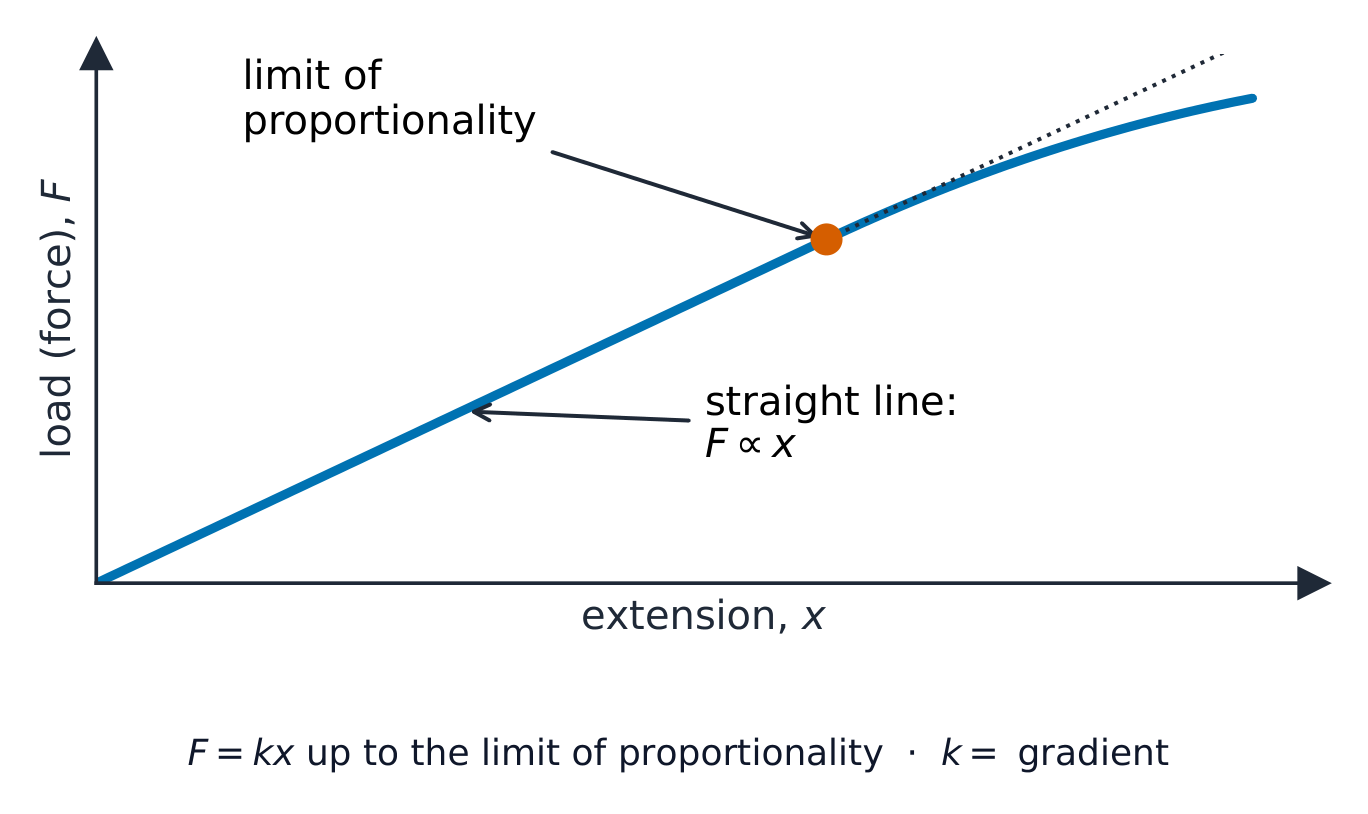
在一个载荷-伸长图(load–extension graph)上,线起初是直的:伸长量与载荷成正比。线停止是直的的那个点是比例极限(limit of proportionality)。
实验。 把弹簧挂在一个夹子上,在它旁边立一把直尺。在没有负载时读弹簧底端的位置:这是原始长度。一次加一个负载(例如每次 1 N),每次记录新的长度。伸长量是新长度减原始长度。以载荷为 y 轴、伸长量为 x 轴作图。
弹簧常数(spring constant)是单位伸长量的力:
$$k = \frac{F}{x}$$
一个大的 $k$ 意味着一个硬的弹簧。
Resultant force and Newton's laws
把一条直线上的力相加以得到合力(resultant force,一个方向的力为正,另一个方向为负)。
- 若合力为零,物体保持静止或以恒定速率沿直线继续运动。(牛顿第一定律。)
- 若合力不为零,物体沿力的方向加速:
$$F = ma$$

例题。 一辆 $1200\ \text{kg}$ 的车有一个 $3000\ \text{N}$ 的驱动力和 $600\ \text{N}$ 的摩擦。求它的加速度。
首先求合力:$3000 - 600 = 2400\ \text{N}$。然后
$$a = \frac{F}{m} = \frac{2400}{1200} = 2.0\ \text{m/s}^2$$
Motion in a circle
一个与运动成直角的合力不改变速率。它改变方向,所以物体以稳定的速率做圆周运动。这是圆周运动(circular motion)。这个力总是指向圆心:绳子对旋转的球的拉力,或太阳对行星的引力。
对于一个做圆周运动的物体:
- 要让同样的质量在同样半径(radius)的圆上以更高的速率运动,需要更大的力;
- 更大的力使同样的质量在同样的速率下沿更小的圆(更小的半径)运动;
- 更大的质量需要更大的力来保持同样的速率和同样的半径。
Friction
摩擦力(friction)是两个接触表面之间的力。它试图阻止运动并使东西发热。阻力(一个液体或气体中的摩擦,如空气阻力)也使物体变慢。
Moments — the turning effect
一个力的力矩(moment)是它关于一个支点(pivot)的转动效果。
$$\text{moment} = \text{force} \times \text{perpendicular distance from the pivot}$$
单位是牛顿米(N m)。
力矩原理(principle of moments):当一个物体平衡(处于平衡(equilibrium))时,
$$\text{total clockwise moment} = \text{total anticlockwise moment}$$
当没有合力且没有合力矩时,一个物体处于平衡。
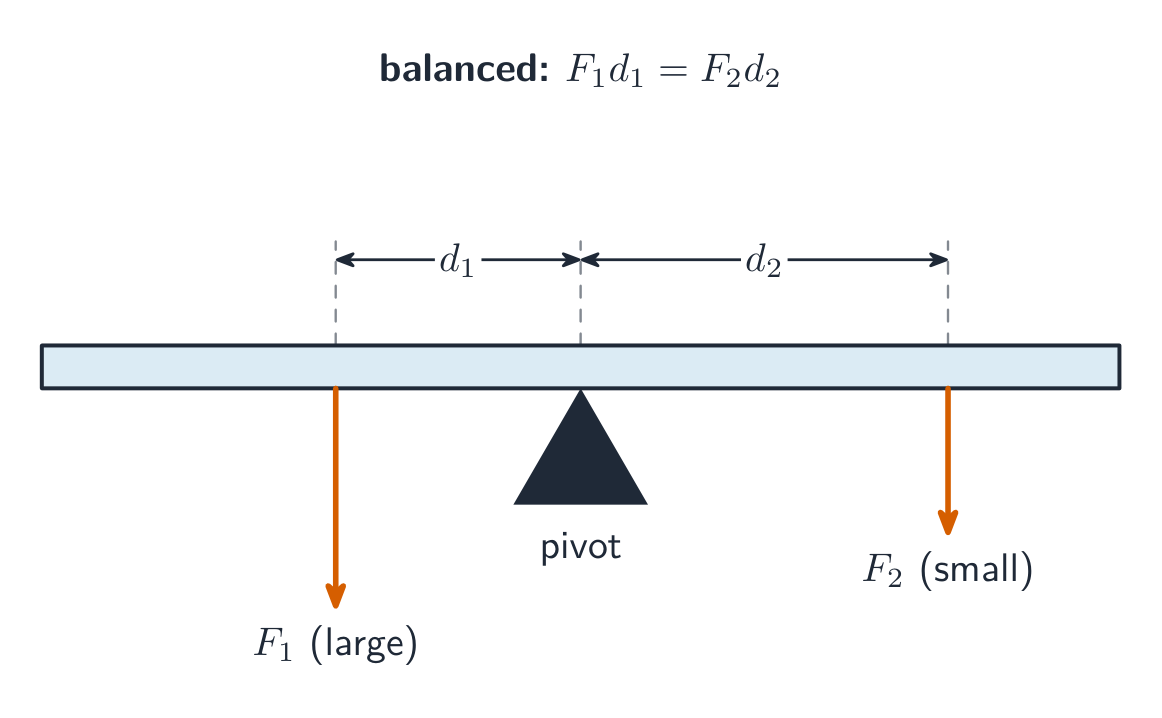
例题。 一个 $30\ \text{N}$ 的重物坐在一个支点左边 $0.20\ \text{m}$。一个 $20\ \text{N}$ 的重物必须坐在右边多远以平衡梁?
平衡,所以逆时针力矩 $=$ 顺时针力矩:
$$30 \times 0.20 = 20 \times d \quad\Rightarrow\quad d = \frac{6.0}{20} = 0.30\ \text{m}$$
用实验检验这个原理。 把一把米尺在它的中心平衡在一个支点上。在每一侧挂一个已知的重物,并移动它们直到尺再次平衡。测量每个到支点的距离。左边的力 × 距离等于右边的力 × 距离(在小的测量误差之内),所以一个平衡的物体上没有合力矩。
Centre of gravity
重心(centre of gravity)是一个物体所有重力似乎作用的单一点。
对一个平的形状(薄片(lamina)),把它从一根针悬挂并让它稳定;用一根铅垂线从针往下画一条竖直线。从另一个点重复。重心是这些线交叉的地方。
一个物体的稳定性(stability)取决于它的重心在哪里。当一个物体的重心低、它的底宽时,它更稳定(stable)。当从重心竖直向下的一条线越过底之外时,它翻倒。
探索
Forces & Newton's laws
F = ma (resultant)
The resultant force sets the acceleration; balanced forces ⇒ none.
词汇表
训练
| 英文 | 中文 | 拼音 |
|---|---|---|
| shape/ʃeɪp/ | 形状 | xíng zhuàng |
| extension/ekˈstenʃn/ | 伸长量 | shēn cháng liàng |
| load–extension graph/ləʊd ekˈstenʃn ɡræf/ | 载荷-伸长图 | zài hè - shēn cháng tú |
| limit of proportionality/ˈlɪmɪt ɒv prəˌpɔːʃəˈnælɪti/ | 比例极限 | bǐ lì jí xiàn |
| spring constant/sprɪŋ ˈkɒnstənt/ | 弹簧常数 | tán huáng cháng shù |
| resultant force/rɪˈzʌltənt fɔːs/ | 合力 | hé lì |
| circular motion/ˈsɜːkjʊlə ˈməʊʃn/ | 圆周运动 | yuán zhōu yùn dòng |
| radius/ˈreɪdɪəs/ | 半径 | bàn jìng |
| friction/ˈfrɪkʃn/ | 摩擦力 | mó cā lì |
| pivot/ˈpɪvət/ | 支点 | zhī diǎn |
| principle of moments/ˈprɪnsɪpl ɒv ˈməʊmənts/ | 力矩原理 | lì jǔ yuán lǐ |
| equilibrium/ˌiːkwɪˈlɪbrɪəm/ | 平衡 | píng héng |
| centre of gravity/ˈsentə ɒv ˈɡrævɪti/ | 重心 | zhòng xīn |
| lamina/ˈlæmɪnə/ | 薄片 | báo piàn |
| stability/stəˈbɪlɪti/ | 稳定性 | wěn dìng xìng |
| stable/ˈsteɪbl/ | 稳定 | wěn dìng |
1.6
动量
大纲
| Core | Supplement |
|---|---|
| 1 Define momentum as mass $\times$ velocity; recall and use the equation $p = mv$ | |
| 2 Define impulse as force $\times$ time for which force acts; recall and use the equation $\text{impulse} = F\Delta t = \Delta(mv)$ | |
| 3 Apply the principle of the conservation of momentum to solve simple problems in one dimension | |
| 4 Define resultant force as the change in momentum per unit time; recall and use the equation $F = \frac{\Delta p}{\Delta t}$ |
来源:剑桥国际大纲
动量(momentum)是质量乘速度。它是一个矢量。
$$p = mv$$
冲量(impulse)是力乘它作用的时间,而它等于动量的变化:
$$\text{impulse} = F\,\Delta t = \Delta(mv)$$
所以合力是单位时间动量的变化:
$$F = \frac{\Delta p}{\Delta t}$$
动量守恒(conservation of momentum):当物体碰撞而没有外力作用时,之前的总动量等于之后的总动量。
$$m_1 u_1 + m_2 u_2 = m_1 v_1 + m_2 v_2$$
(这里 $u$ 是之前的速度,而 $v$ 是之后的速度。)
例题。 一辆 $2.0\ \text{kg}$、以 $3.0\ \text{m/s}$ 运动的小车撞上一辆静止的 $1.0\ \text{kg}$ 小车,它们粘在一起。求它们之后共同的速度。
总动量守恒,所以
$$(2.0 \times 3.0) + (1.0 \times 0) = (2.0 + 1.0)\,v \quad\Rightarrow\quad v = \frac{6.0}{3.0} = 2.0\ \text{m/s}$$
探索
Momentum in a collision
Set the masses and speeds and collide them. Total momentum is conserved.
词汇表
训练
| 英文 | 中文 | 拼音 |
|---|---|---|
| impulse/ˈɪmpʌls/ | 冲量 | chōng liàng |
| conservation of momentum/ˌkɒnsəˈveɪʃn ɒv məʊˈmentəm/ | 动量守恒 | dòng liàng shǒu héng |
1.7
能量、功与功率
大纲
1.7.1 Energy
| Core | Supplement |
|---|---|
| 1 State that energy may be stored as kinetic, gravitational potential, chemical, elastic (strain), nuclear, electrostatic and internal (thermal) | |
| 2 Describe how energy is transferred between stores during events and processes, including examples of transfer by forces (mechanical work done), electrical currents (electrical work done), heating, and by electromagnetic, sound and other waves | |
| 4 Recall and use the equation for kinetic energy $E_k = \frac{1}{2}mv^2$ | |
| 5 Recall and use the equation for the change in gravitational potential energy $\Delta E_p = mg\Delta h$ | |
| 3 Know the principle of the conservation of energy and apply this principle to simple examples including the interpretation of simple flow diagrams | 6 Know the principle of the conservation of energy and apply this principle to complex examples involving multiple stages, including the interpretation of Sankey diagrams |
1.7.2 Work
| Core | Supplement |
|---|---|
| 1 Understand that mechanical or electrical work done is equal to the energy transferred | |
| 2 Recall and use the equation for mechanical working $W = Fd = \Delta E$ |
1.7.3 Energy resources
| Core | Supplement |
|---|---|
| 1 Describe how useful energy may be obtained, or electrical power generated, from: (a) chemical energy stored in fossil fuels (b) chemical energy stored in biofuels (c) water, including the energy stored in waves, in tides and in water behind hydroelectric dams (d) geothermal resources (e) nuclear fuel (f) light from the Sun to generate electrical power (solar cells) (g) infrared and other electromagnetic waves from the Sun to heat water (solar panels) and be the source of wind energy including references to a boiler, turbine and generator where they are used | 4 Know that radiation from the Sun is the main source of energy for all our energy resources except geothermal, nuclear and tidal |
| 2 Describe advantages and disadvantages of each method in terms of renewability, availability, reliability, scale and environmental impact | 5 Know that energy is released by nuclear fusion in the Sun |
| 6 Know that research is being carried out to investigate how energy released by nuclear fusion can be used to produce electrical energy on a large scale | |
| 3 Understand, qualitatively, the concept of efficiency of energy transfer | 7 Define efficiency as: (a) $(\%) \text{ efficiency} = \frac{\text{(useful energy output)}}{\text{(total energy input)}} (\times 100\%)$ (b) $(\%) \text{ efficiency} = \frac{\text{(useful power output)}}{\text{(total power input)}} (\times 100\%)$ recall and use these equations |
1.7.4 Power
| Core | Supplement |
|---|---|
| 1 Define power as work done per unit time and also as energy transferred per unit time; recall and use the equations (a) $P = \frac{W}{t}$ (b) $P = \frac{\Delta E}{t}$ |
来源:剑桥国际大纲
Energy stores
能量能以不同的方式储存(stored):动能(kinetic)、重力势能(gravitational potential)、化学能(chemical)、弹性(应变)势能(elastic (strain))、核能(nuclear)、静电能(electrostatic),和内(热)能(internal (thermal))。
能量通过力(机械功)、通过电流、通过加热,以及通过波(如光和声音)在储存之间被转移(transferred)。
Kinetic and potential energy
动能(kinetic energy)是一个运动物体的能量:
$$E_k = \frac{1}{2}mv^2$$
当一个物体上升或下降一个高度 $\Delta h$ 时重力势能(gravitational potential energy)的变化:
$$\Delta E_p = mg\,\Delta h$$
Conservation of energy
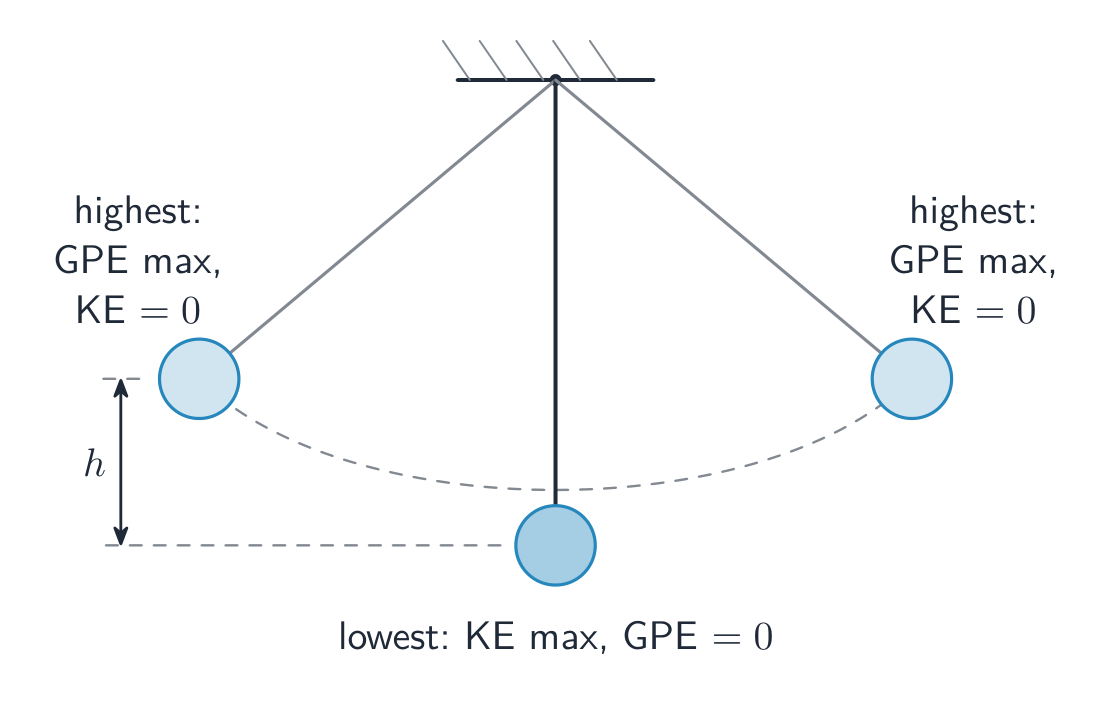
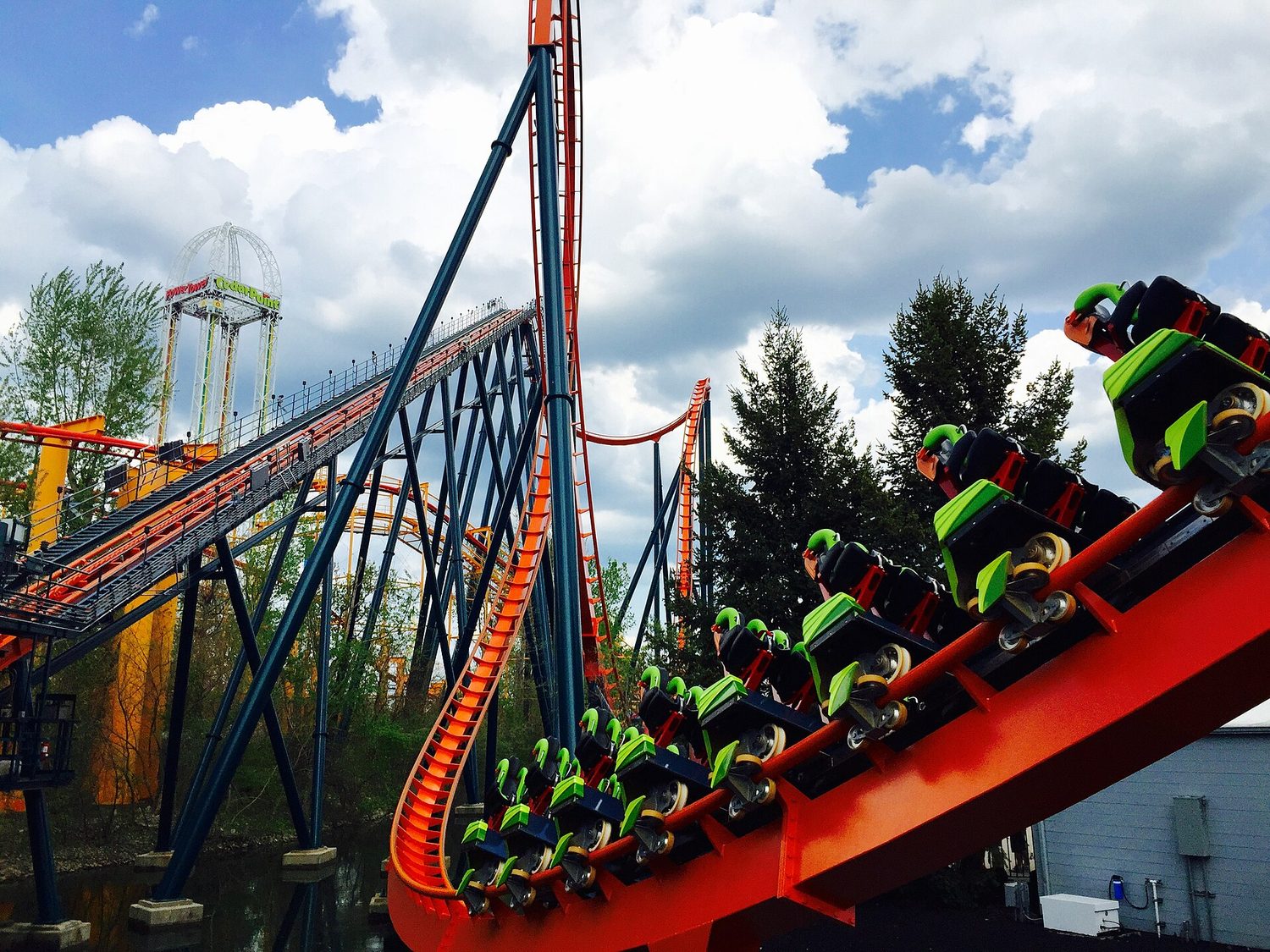
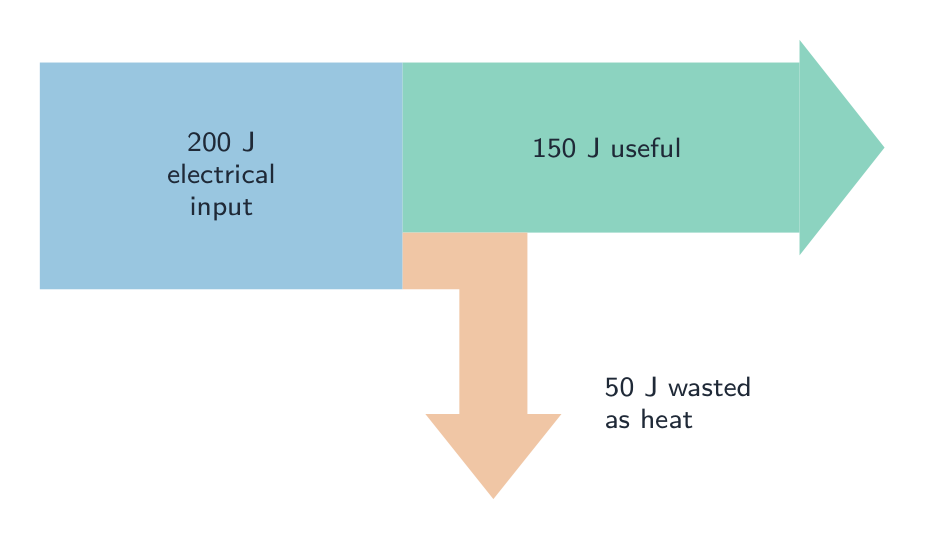
能量守恒定律(principle of conservation of energy)说能量从不被制造或摧毁;它只在储存之间移动。一个下落的物体把重力势能变成动能。一个桑基图(Sankey diagram)显示输入能量如何分成有用能量和浪费(wasted)的能量。
例题。 一个 $0.50\ \text{kg}$ 的球从 $1.8\ \text{m}$ 的高度落下。忽略空气阻力,求它刚好在着陆前的速率。(取 $g = 10\ \text{m/s}^2$。)
所有的重力势能变成动能,所以 $\tfrac{1}{2}mv^2 = mg\,\Delta h$。质量抵消,剩下 $v^2 = 2g\,\Delta h$:
$$v = \sqrt{2 \times 10 \times 1.8} = \sqrt{36} = 6.0\ \text{m/s}$$
因为质量抵消,从这个高度落下的每个物体都会以同样的速率着陆。
Work
做功(work done)等于转移的能量。当一个力移动一个物体时:
$$W = Fd = \Delta E$$
功和能量的单位是焦耳(joule,J)。
Power
功率(power)是单位时间做的功(或转移的能量)。
$$P = \frac{W}{t} = \frac{\Delta E}{t}$$
单位是瓦特(watt,W)。$1\ \text{W} = 1\ \text{J/s}$。
Efficiency
效率(efficiency)告诉你多少输入能量变成有用能量。
$$\text{efficiency} = \frac{\text{useful energy output}}{\text{total energy input}} \times 100\%$$
效率总是小于 100%,因为总是有一些能量被浪费(通常作为热)。同样的想法也适用于功率:
$$\text{efficiency} = \frac{\text{useful power output}}{\text{total power input}} \times 100\%$$
例题。 一个马达被供应 $200\ \text{J}$ 的电能并举起一个负载,给它 $150\ \text{J}$ 的重力势能。求它的效率。
$$\text{efficiency} = \frac{150}{200} \times 100\% = 75\%$$
Energy resources
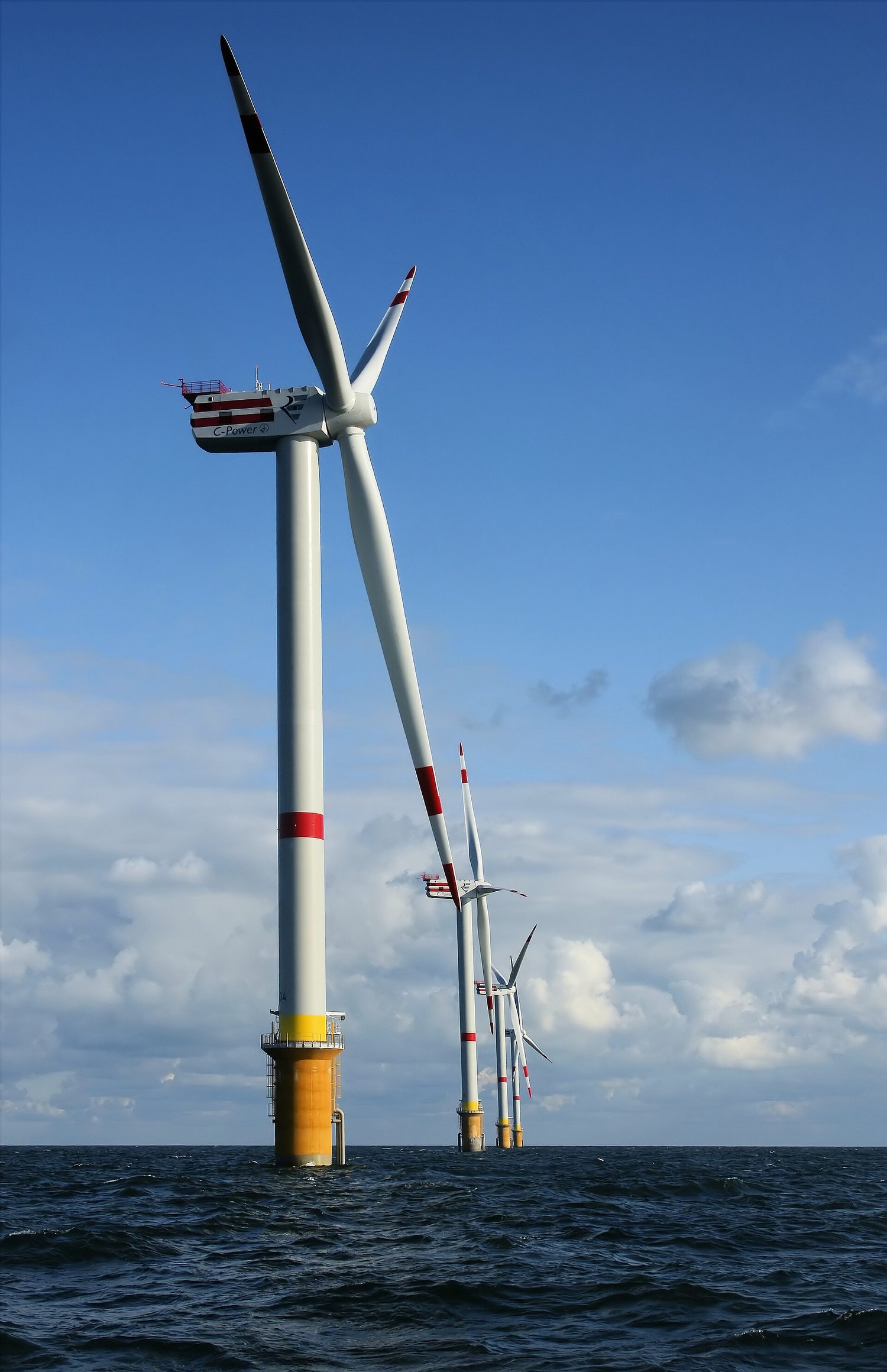
我们从许多能量资源发电。大多数转动一个涡轮机来驱动一个发电机——常常通过烧水产生蒸汽(化石燃料、核燃料、地热、生物燃料),或直接通过移动水或空气(水电、波浪、潮汐、风)。太阳能电池直接从阳光发电;太阳能板加热水。
| Resource | Renewable? | Notes |
|---|---|---|
| fossil fuels (coal, oil, gas) | no | reliable, high output, but CO₂ and pollution |
| nuclear fuel | no | huge output, no CO₂, but radioactive waste |
| biofuels | yes | roughly carbon-neutral if replanted |
| hydroelectric | yes | reliable, but a dam floods land |
| wind | yes | clean, but intermittent |
| solar | yes | clean, but only in daylight |
| geothermal / tidal | yes | reliable but limited to certain places |
比较资源时,用这五个想法:可再生性(renewability,它会用完吗?)、可用性(availability,它总是在吗?风会停,太阳会落)、可靠性(reliability,它给出稳定的输出吗?)、规模(scale,它能供应多少能量?)和环境影响(environmental impact,污染、二氧化碳、被水坝淹没的土地)。
这些大多数可追溯到太阳(化石燃料是古代储存的阳光;风和波浪来自太阳加热)——例外是地热、核能和潮汐能。太阳本身由核聚变(nuclear fusion)驱动,把氢原子核合并成氦。科学家正在研究如何在地球上的发电站里利用核聚变,但还没有一个聚变反应堆放出的电能比它消耗的多。
探索
Energy flow & efficiency
Input energy splits into useful output and wasted energy; efficiency is the useful fraction, and the total is always conserved.
探索
Conservation of energy
Drop the object: GPE turns into KE, and the total stays the same when there's no friction.
词汇表
训练
| 英文 | 中文 | 拼音 |
|---|---|---|
| stored/stɔːd/ | 储存 | chǔ cún |
| kinetic/kɪˈnetɪk/ | 动能 | dòng néng |
| gravitational potential/ˌɡrævɪˈteɪʃənl pəˈtenʃl/ | 重力势能 | zhòng lì shì néng |
| chemical/ˈkemɪkl/ | 化学能 | huà xué néng |
| elastic (strain)/ɪˈlæstɪk/ | 弹性势能 | tán xìng shì néng |
| nuclear/ˈnjuːklɪə/ | 核能 | hé néng |
| electrostatic/ɪˌlektrəʊˈstætɪk/ | 静电能 | jìng diàn néng |
| internal (thermal)/ɪnˈtɜːnl/ | 内能 | nèi néng |
| transferred/trænsˈfɜːd/ | 转移 | zhuǎn yí |
| principle of conservation of energy/ˈprɪnsɪpl ɒv ˌkɒnsəˈveɪʃn ɒv ˈenədʒi/ | 能量守恒定律 | néng liàng shǒu héng dìng lǜ |
| Sankey diagram/ˈsæŋki ˈdaɪəɡræm/ | 桑基图 | sāng jī tú |
| wasted/ˈweɪstɪd/ | 浪费 | làng fèi |
| work done/wɜːk dʌn/ | 做功 | zuò gōng |
| joule/dʒuːl/ | 焦耳 | jiāo ěr |
| power/ˈpaʊə/ | 功率 | gōng lǜ |
| watt/wɒt/ | 瓦特 | wǎ tè |
| efficiency/ɪˈfɪʃənsi/ | 效率 | xiào lǜ |
| renewability/rɪˌnjuːəˈbɪlɪti/ | 可再生性 | kě zài shēng xìng |
| availability/əˌveɪləˈbɪlɪti/ | 可用性 | kě yòng xìng |
| reliability/rɪˌlaɪəˈbɪlɪti/ | 可靠性 | kě kào xìng |
| scale/skeɪl/ | 规模 | guī mó |
| environmental impact/enˌvaɪrənˈmentl ˈɪmpækt/ | 环境影响 | huán jìng yǐng xiǎng |
| nuclear fusion/ˈnjuːklɪə ˈfjuːʒn/ | 核聚变 | hé jù biàn |
1.8
压强
大纲
| Core | Supplement |
|---|---|
| 1 Define pressure as force per unit area; recall and use the equation $p = \frac{F}{A}$ | |
| 2 Describe how pressure varies with force and area in the context of everyday examples | |
| 3 Describe, qualitatively, how the pressure beneath the surface of a liquid changes with depth and density of the liquid | 4 Recall and use the equation for the change in pressure beneath the surface of a liquid $\Delta p = \rho g \Delta h$ |
来源:剑桥国际大纲
压强(pressure)是单位面积的力。
$$p = \frac{F}{A}$$
单位是帕斯卡(pascal,Pa)。$1\ \text{Pa} = 1\ \text{N/m}^2$。
一个小的面积给一个大的压强(一把锋利的刀切得好)。一个大的面积给一个小的压强(雪鞋阻止你下陷)。
Pressure in a liquid
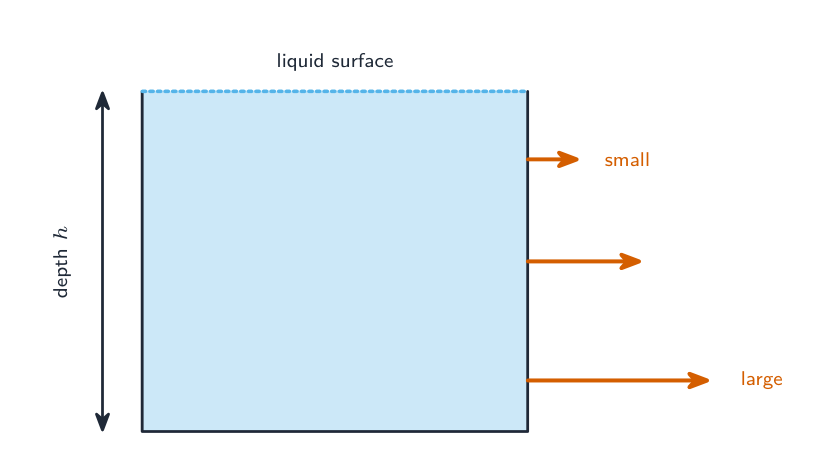
在一个液体中,压强随深度(depth)和液体的密度增加:
$$\Delta p = \rho g \,\Delta h$$
这就是为什么一座水坝在底部——水压最大的地方——建得更厚。液体中的压强向所有方向作用。
例题。 求水中 $2.0\ \text{m}$ 深处的额外压强(密度 $1000\ \text{kg/m}^3$,$g = 10\ \text{N/kg}$)。
$$\Delta p = \rho g\,\Delta h = 1000 \times 10 \times 2.0 = 20\,000\ \text{Pa}$$
探索
Pressure
p = ρg·h
Pressure in a liquid is proportional to depth.
词汇表
训练
| 英文 | 中文 | 拼音 |
|---|---|---|
| pressure/ˈpreʃə/ | 压强 | yā qiáng |
| pascal/ˈpæskl/ | 帕斯卡 | pà sī kǎ |
| depth/depθ/ | 深度 | shēn dù |
1.8
考试技巧
- 在一个距离-时间图上斜率是速率;在一个速度-时间图上斜率是加速度,而线下的面积是行进的距离。绝不把一个图当作另一个来读。
- 质量(kg)是物质的量,处处相同;重力(N)是重力的力,$W = mg$。在月球上你的质量不变但你的重力更小。
- 速率是一个标量;速度是一个矢量。以稳定速率绕一条曲线运动的东西仍在加速,因为它的方向一直在改变。
- 在胡克定律中,载荷只与伸长量成正比,直到比例极限。用伸长量(伸展的长度 − 原始长度),绝不用整个长度。
- 动量 $p = mv$ 在一次碰撞中守恒。在你把它们相加之前给每个速度一个 $+$ 或 $-$ 符号表示它的方向。
- 先转换单位(cm → m,g → kg)。对一个压在一个表面上的固体用 $p = F/A$,但对一个液体内部的压强用 $p = \rho g h$——它们是不同的公式。
本主题的互动课程
逐步学习,并即时检测练习。