Energy, work and power
Introduced| English | Meaning |
|---|---|
| kinetic energy/kɪˈnetɪk ˈenədʒi/ | The energy an object has because of its motion. |
| gravitational potential energy/ˌɡrævɪˈteɪʃənl pəˈtenʃl ˈenədʒi/ | Energy stored because of an object’s position in a gravitational field. |
| conservation of energy/ˌkɒnsəˈveɪʃn ɒv ˈenədʒi/ | The principle that energy cannot be created or destroyed, only transferred or transformed. |
| Sankey diagram/ˈsæŋki ˈdaɪəɡræm/ | An energy-flow diagram with arrow widths proportional to the amounts transferred. |
| work done/wɜːk dʌn/ | Energy transferred when a force acts through a displacement. |
| joule/dʒuːl/ | The SI unit of energy and work. |
| power/ˈpaʊə/ | The rate of energy transfer or work done. |
| efficiency/ɪˈfɪʃənsi/ | The fraction of total energy or power input converted to useful output. |
| watt/wɒt/ | The SI unit of power, equal to one joule per second. |
Energy never disappears
- At the top of a roller-coaster hill the car is slow but high; at the bottom it is fast but low.
- The energy did not vanish — it just moved from one store to another.
- This is the big idea of this lesson: energy is stored, transferred, and always conserved.
Energy stores and transfers
- Energy can be stored as: kinetic, gravitational potential, chemical, elastic (strain), nuclear, electrostatic, and internal (thermal).
- It is transferred between stores by: forces (mechanical work), electric currents, heating, and waves (such as light and sound).
- "Using energy" really means moving it from one store to another.
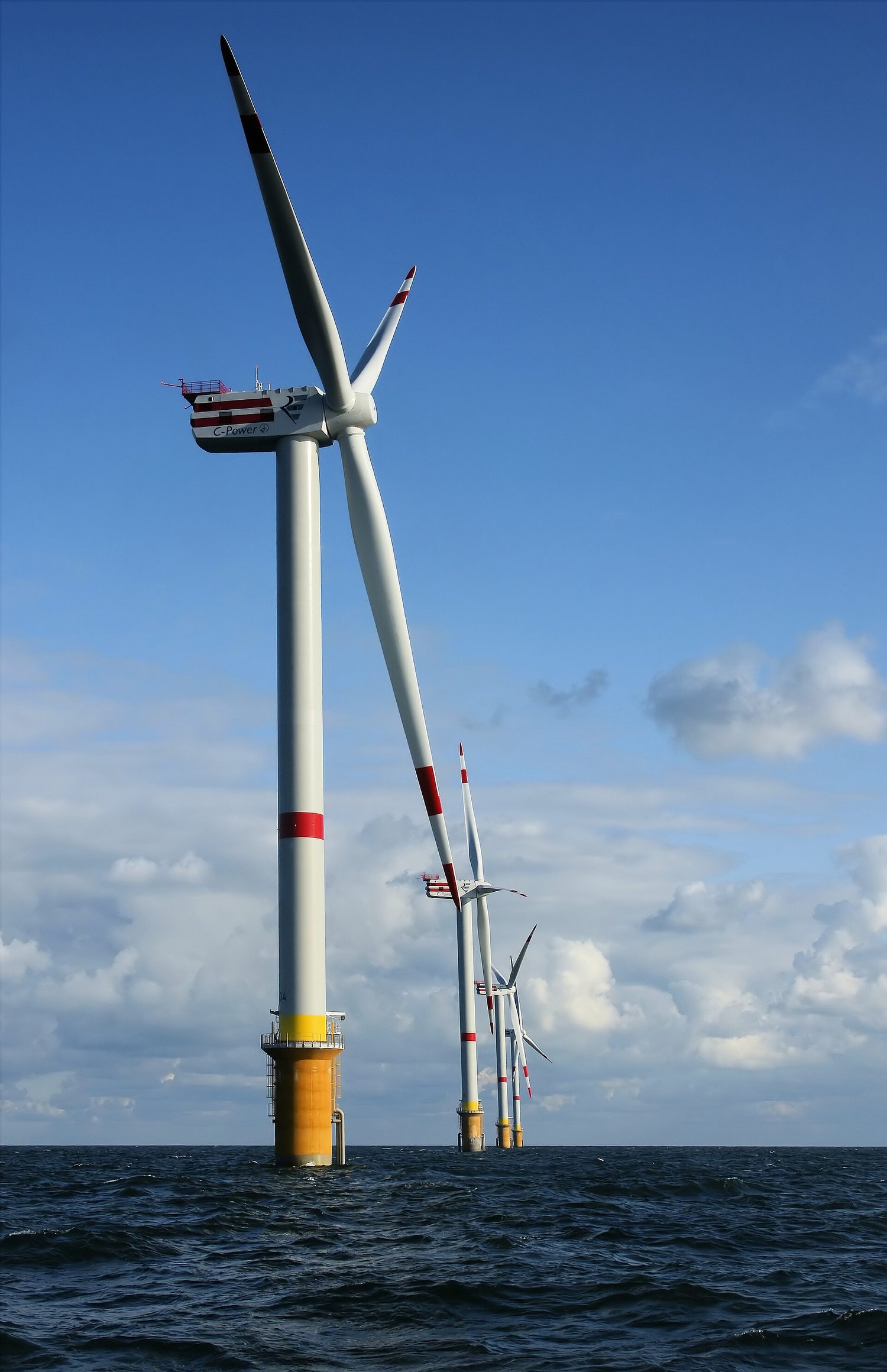
Wind turbines transfer energy from moving air to electricity
Energy flow & efficiency
Input energy splits into useful output and wasted energy; efficiency is the useful fraction, and the total is always conserved.
Energy, work & power
PE + KE = constant
As an object falls, potential energy becomes kinetic — total fixed.
Select all of these that are energy stores.
Difficulty 2/5 · 140 coins + a small bonus on first completion today
Kinetic, chemical and gravitational potential are energy stores. "Loud" and "fast" describe things, but they are not energy stores.
Kinetic and potential energy
- Kinetic energy 动能 is the energy of a moving object:
- Lifting a mass by a height $\Delta h$ changes its gravitational potential energy 重力势能:
- A falling object turns gravitational PE into kinetic energy.

A $2.0\ \text{kg}$ ball moves at $3.0\ \text{m/s}$. What is its kinetic energy, in J?
Difficulty 2/5 · 140 coins + a small bonus on first completion today
$E_k = \tfrac{1}{2}mv^2 = \tfrac{1}{2} \times 2.0 \times 3.0^2 = 9.0\ \text{J}$.
Conservation of energy 能量守恒
- The principle of conservation of energy: energy is never made or destroyed — it only moves between stores.
- Some energy is always wasted — usually spread out as heat to the surroundings.
- A Sankey diagram 桑基图 shows the input energy splitting into useful energy and wasted energy.
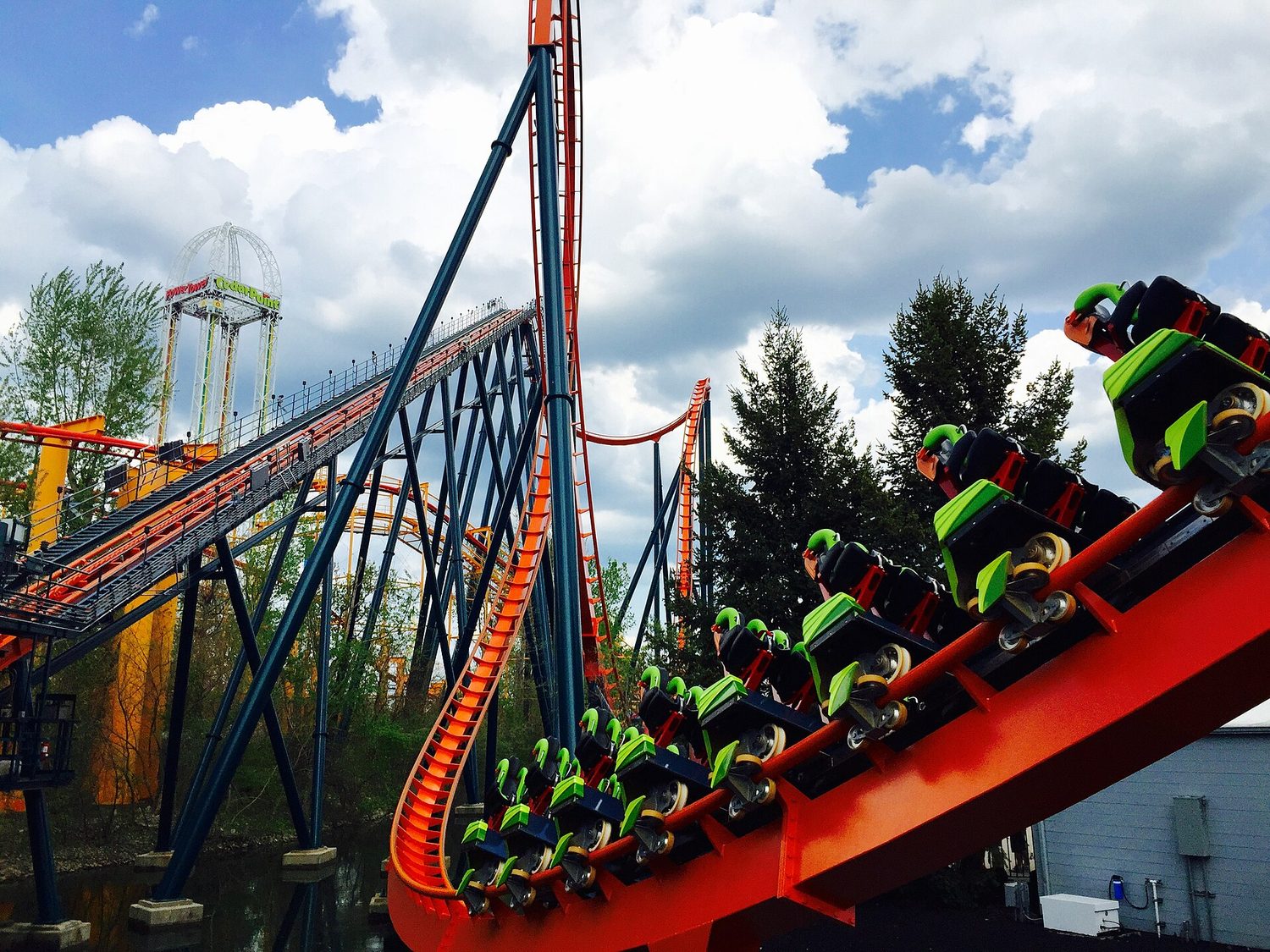
On a roller-coaster, stored energy at the top becomes kinetic energy lower down
When a machine wastes energy, where does the wasted energy usually go?
Difficulty 1/5 · 100 coins + a small bonus on first completion today
Energy is conserved — it is never destroyed. Wasted energy is usually spread out as heat, which is hard to use again.
Work
- Work done 做功 equals the energy transferred. When a force moves an object along its direction:
- The unit of work and energy is the joule 焦耳 (J).
- Lifting a heavier load, or moving it further, does more work.
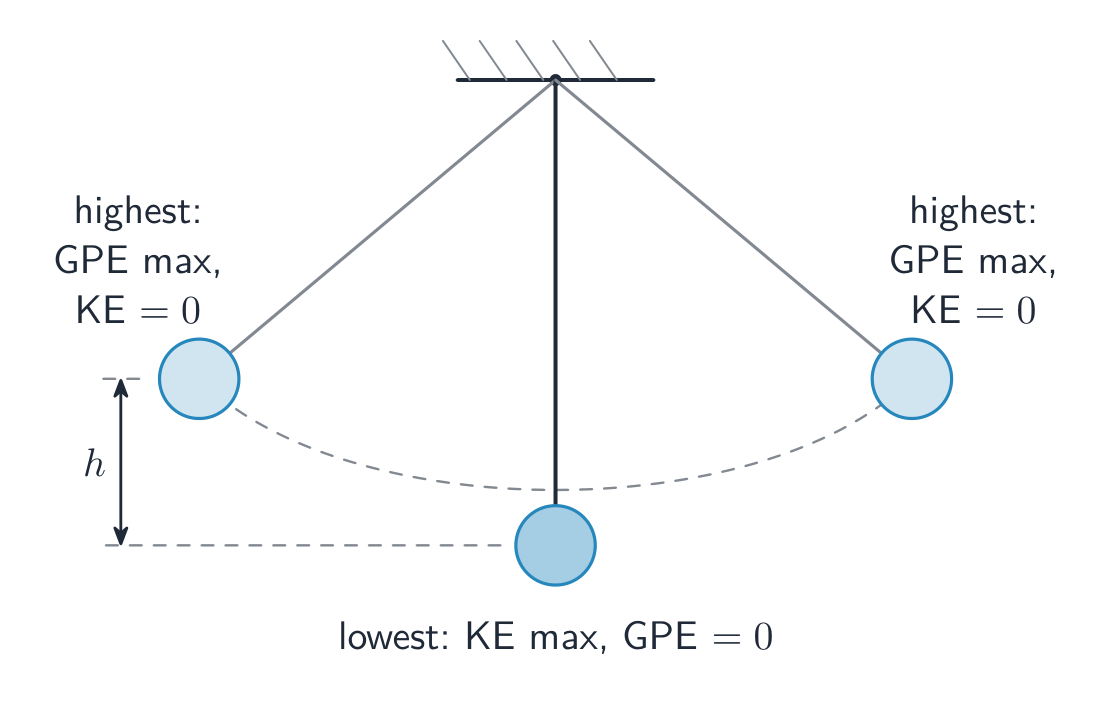
A swinging pendulum trades gravitational potential energy for kinetic energy and back
A force of $50\ \text{N}$ pushes a box $4.0\ \text{m}$ along the floor. How much work is done, in J?
Difficulty 2/5 · 140 coins + a small bonus on first completion today
$W = Fd = 50 \times 4.0 = 200\ \text{J}$.
Power 功率 and efficiency 效率
- Power is the work done (energy transferred) each second:
- The unit is the watt 瓦特 (W); $1\ \text{W} = 1\ \text{J/s}$.
- Efficiency is how much of the input energy becomes useful:
- It is always less than $100\%$ because some energy is always wasted.
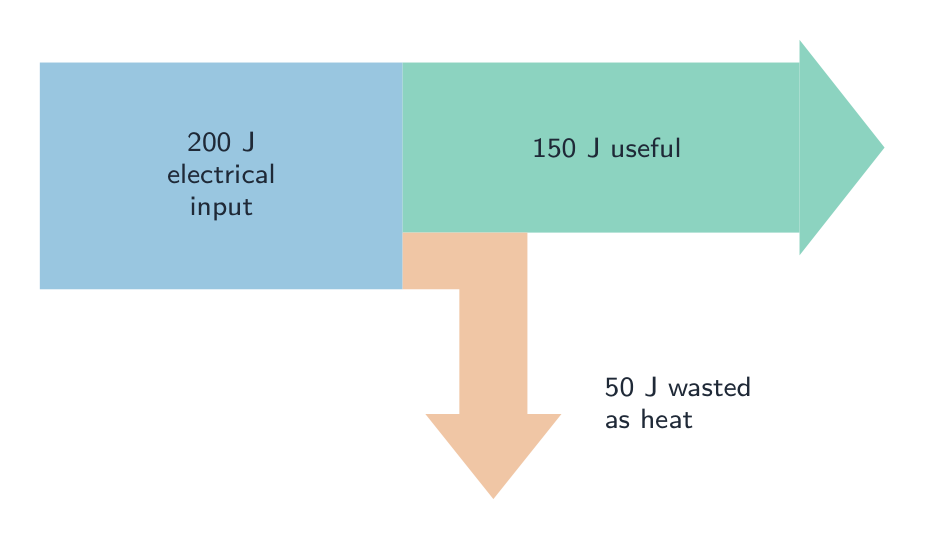
A Sankey diagram: the band widths are proportional to the energy, so the input splits into useful output and wasted heat
A motor does $200\ \text{J}$ of work in $10\ \text{s}$. What is its power, in W?
Difficulty 2/5 · 140 coins + a small bonus on first completion today
$P = \dfrac{W}{t} = \dfrac{200}{10} = 20\ \text{W}$.
A lamp takes in $50\ \text{J}$ of electrical energy and gives out $30\ \text{J}$ of useful light. What is its efficiency, in %?
Difficulty 2/5 · 140 coins + a small bonus on first completion today
efficiency $= \dfrac{\text{useful}}{\text{total}} \times 100\% = \dfrac{30}{50} \times 100\% = 60\%$.
Worked examples
1. A $2.0\ \text{kg}$ box is lifted $1.5\ \text{m}$ onto a shelf in $3.0\ \text{s}$. $\Delta E_p = mg\Delta h = 2.0 \times 9.8 \times 1.5 = 29.4\ \text{J}$, and the power is $P = \dfrac{\Delta E}{t} = \dfrac{29.4}{3.0} = 9.8\ \text{W}$.
2. A lamp takes in $60\ \text{J}$ of electrical energy and gives out $12\ \text{J}$ as light. Efficiency $= \dfrac{12}{60} \times 100\% = 20\%$; the other $48\ \text{J}$ heats the surroundings.
A 4 kg ball moves at 4 metres per second. What is its kinetic energy, and by what factor does that energy change if the speed doubles?
One half of 4 times 16 is 32 joules. The square of 2 is 4, so the energy becomes four times as large.
What is the kinetic energy?
Difficulty 1/5 · 100 coins + a small bonus on first completion today
One half times 4 times 16 is 32 joules.
You've got it
- $E_k = \tfrac{1}{2}mv^2$ · $\Delta E_p = mg\,\Delta h$
- energy is conserved — wasted energy usually ends up as heat
- work $W = Fd$ (joule); power $P = \dfrac{W}{t}$ (watt)
- efficiency $= \dfrac{\text{useful}}{\text{total}} \times 100\%$, always below $100\%$
Write from a kinetic energy of 32 joules
- A 4 kg ball moves at 4 metres per second.
- Find the kinetic energy. Say what happens to that energy if the speed doubles.