Pressure
Introduced| English | Meaning |
|---|---|
| pressure/ˈpreʃə/ | Force acting normally per unit area. |
| pascal/ˈpæskl/ | The SI unit of pressure, equal to one newton per square metre. |
| fluids/ˈfluːɪdz/ | A substance that can flow, including liquids and gases. |
Why a sharp knife cuts
- Press a blunt stick into your hand — nothing happens. A sharp pin at the same push hurts.
- The force is the same; what changed is the area it acts on.
- That idea is pressure 压强 — and it explains knives, snowshoes, and the deep sea.
What is pressure?
- Pressure is the force pressing on each unit of area:
- The unit is the pascal 帕斯卡 (Pa); $1\ \text{Pa} = 1\ \text{N/m}^2$.
- Same force, smaller area → bigger pressure.
Pressure
p = ρg·h
Pressure in a liquid is proportional to depth.
A box pushes down with a force of $200\ \text{N}$ over an area of $0.50\ \text{m}^2$. What is the pressure, in Pa?
Difficulty 2/5 · 140 coins + a small bonus on first completion today
$p = \dfrac{F}{A} = \dfrac{200}{0.50} = 400\ \text{Pa}$.
Why area matters
- A sharp knife or a drawing pin has a tiny area, so it makes a huge pressure and cuts or pierces easily.
- Snowshoes and tractor tyres have a large area, so they make a small pressure and do not sink in.
- Camels' wide feet work the same way on soft sand.

Same force, different area → different pressure. The narrow base sinks; the wide base stays on top.
Worked example. A 600 N person stands on one foot (area $0.02\ \text{m}^2$). Pressure $= \dfrac{600}{0.02} = 30\,000\ \text{Pa}$. On both feet (area $0.04\ \text{m}^2$): pressure $= 15\,000\ \text{Pa}$ — half as much.
Pressure acts in all directions in fluids 流体. When you dive deep, water pushes on your ears from every side — not just from above. The formula $\Delta p = \rho g\,\Delta h$ gives the pressure at that depth in all directions.
Why does a sharp knife cut better than a blunt one (with the same push)?
Difficulty 1/5 · 100 coins + a small bonus on first completion today
Same force on a tiny area means a very large pressure ($p = F/A$), so it cuts easily.
Snowshoes stop you sinking into snow because they:
Difficulty 1/5 · 100 coins + a small bonus on first completion today
A larger area means a smaller pressure for the same weight, so you do not sink in.
Pressure in a liquid
- In a liquid, pressure increases with depth and with the liquid's density:
- It acts in all directions, not just downward.
- This is why a dam is built thicker at the bottom, where the water pressure is greatest, and why your ears hurt deep underwater.
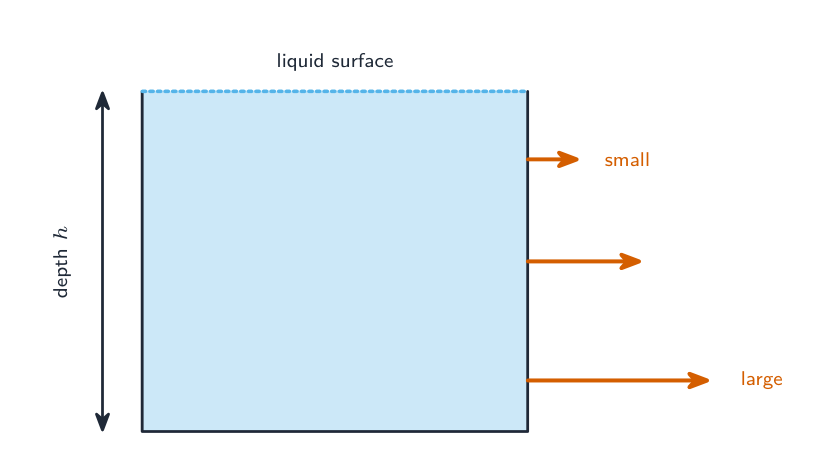
The deeper the liquid, the greater the pressure, so the outward push on the wall grows with depth
Pressure in a liquid acts in all directions, not just downward.
Difficulty 1/5 · 100 coins + a small bonus on first completion today
A liquid pushes equally in all directions at a given depth — that is why it presses on the sides of a container too.
Find the extra pressure $2.0\ \text{m}$ deep in water ($\rho = 1000\ \text{kg/m}^3$, $g = 9.8\ \text{N/kg}$), in Pa.
Difficulty 2/5 · 140 coins + a small bonus on first completion today
$\Delta p = \rho g\,\Delta h = 1000 \times 9.8 \times 2.0 = 19\,600\ \text{Pa}$.
You've got it
- pressure $p = \dfrac{F}{A}$, unit the pascal ($1\ \text{Pa} = 1\ \text{N/m}^2$)
- small area → big pressure (knife); large area → small pressure (snowshoes)
- in a liquid, pressure rises with depth and density: $\Delta p = \rho g\,\Delta h$, acting in all directions