The kinetic particle model
Introduced| English | Meaning |
|---|---|
| particles/ˈpɑːtɪklz/ | Small units of matter, such as atoms, molecules, ions or subatomic entities. |
| kinetic particle model/kɪˈnetɪk ˈpɑːtɪkl ˈmɒdl/ | The model that explains matter as tiny moving particles, linking temperature to particle energy. |
| solid/ˈsɒlɪd/ | A state of matter with fixed shape and volume; particles vibrate about fixed positions. |
| liquid/ˈlɪkwɪd/ | A state of matter with a definite volume but no fixed shape, which flows to fit its container. |
| gas/ɡæs/ | A state of matter with neither a fixed shape nor a fixed volume, which expands to fill its container. |
| temperature/ˈtemprɪtʃə/ | A measure of how hot or cold something is. |
| absolute zero/ˈæbsəluːt ˈzɪərəʊ/ | The lowest temperature on the thermodynamic temperature scale, equal to zero kelvin. |
| kelvin/ˈkelvɪn/ | The SI unit of thermodynamic temperature, with zero at absolute zero. |
| Brownian motion/ˈbraʊnɪən ˈməʊʃn/ | The random motion of tiny visible particles caused by collisions with invisible fast-moving molecules; evidence for the particle model. |
Everything is made of particles 粒子
- Look closely enough and all matter is tiny particles that never stop moving.
- This one idea — the kinetic particle model 分子动理论 — explains solids 固体, liquids 液体, gases 气体, heat and pressure.
- Let's see what the particles are doing.
The three states of matter
- Solid — particles packed in a regular pattern, only vibrating. Fixed shape and volume.
- Liquid — particles still close but jumbled; they slide past each other. Fixed volume, takes the container's shape.
- Gas — particles far apart, fast and random. Fills the whole container.

Squeeze a gas (Boyle's law)
Slide the piston in to shrink the volume. The same particles get crammed into less space, so they hit the walls more often and the pressure climbs — while pressure × volume stays constant.
In which state are the particles far apart, fast, and moving in random directions?
Difficulty 1/5 · 100 coins + a small bonus on first completion today
Gas particles are far apart and move quickly in random directions, filling the container. Solids only vibrate; liquids slide past each other.
Temperature 温度 and particle energy
- Heat a substance and its particles move faster — they gain kinetic energy.
- Temperature is a measure of the average kinetic energy of the particles.
- The lowest possible temperature is absolute zero 绝对零度, $-273\ {}^{\circ}\text{C}$ — particles have the least energy.
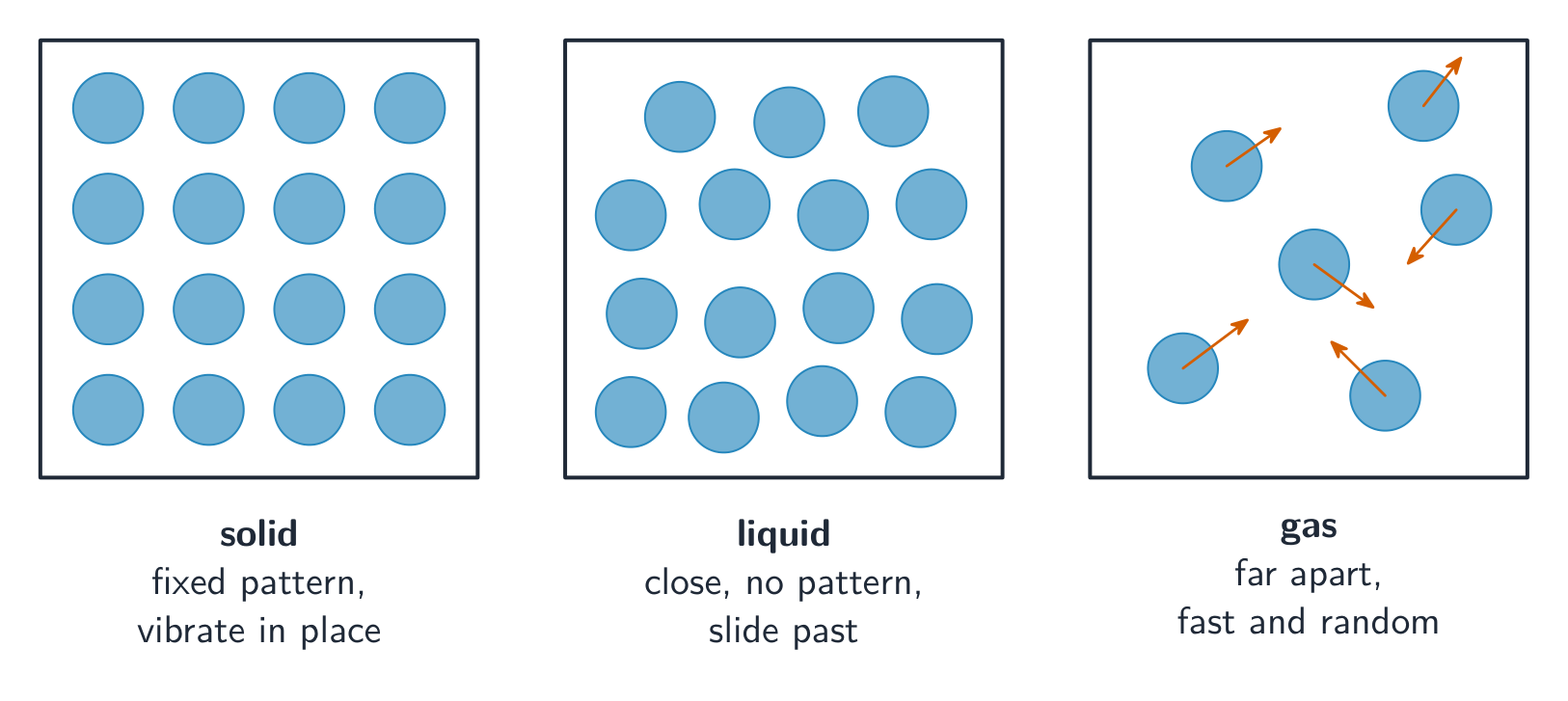
The particle model of solids, liquids and gases
Temperature is a measure of:
Difficulty 1/5 · 100 coins + a small bonus on first completion today
Hotter means the particles move faster, so temperature measures their average kinetic energy.
The kelvin 开尔文 scale
- Scientists often measure temperature in kelvin (K), starting from absolute zero.
- To convert:
- So $0\ {}^{\circ}\text{C} = 273\ \text{K}$ and $27\ {}^{\circ}\text{C} = 300\ \text{K}$.

Convert $27\ {}^{\circ}\text{C}$ to kelvin.
Difficulty 2/5 · 140 coins + a small bonus on first completion today
$T = \theta + 273 = 27 + 273 = 300\ \text{K}$.
Gas pressure
- Gas particles constantly hit the walls of their container. Each hit is a tiny push.
- The pressure is the total force of these hits on each unit of area.
- Heat the gas (fixed volume) → faster, harder, more frequent hits → higher pressure.
- Squeeze it smaller (fixed temperature) → more hits per second on each area → higher pressure.
- For a fixed mass of gas at constant temperature, $pV = \text{constant}$ (halve the volume → double the pressure).

A gas has a volume of $200\ \text{cm}^3$ at $100\ \text{kPa}$. It is squeezed to $100\ \text{cm}^3$ at constant temperature. What is the new pressure, in kPa?
Difficulty 2/5 · 140 coins + a small bonus on first completion today
$pV$ is constant: $100 \times 200 = p \times 100$, so $p = 200\ \text{kPa}$. Halving the volume doubles the pressure.
Heating a gas in a sealed, fixed-volume can increases its pressure.
Difficulty 1/5 · 100 coins + a small bonus on first completion today
Hotter particles move faster and hit the walls harder and more often, so the pressure rises.
Brownian motion 布朗运动
- Under a microscope, smoke specks in air jiggle along jerky, random paths.
- This is Brownian motion: the big specks are knocked about by fast, invisible air particles.
- It is strong evidence that matter really is made of moving particles.
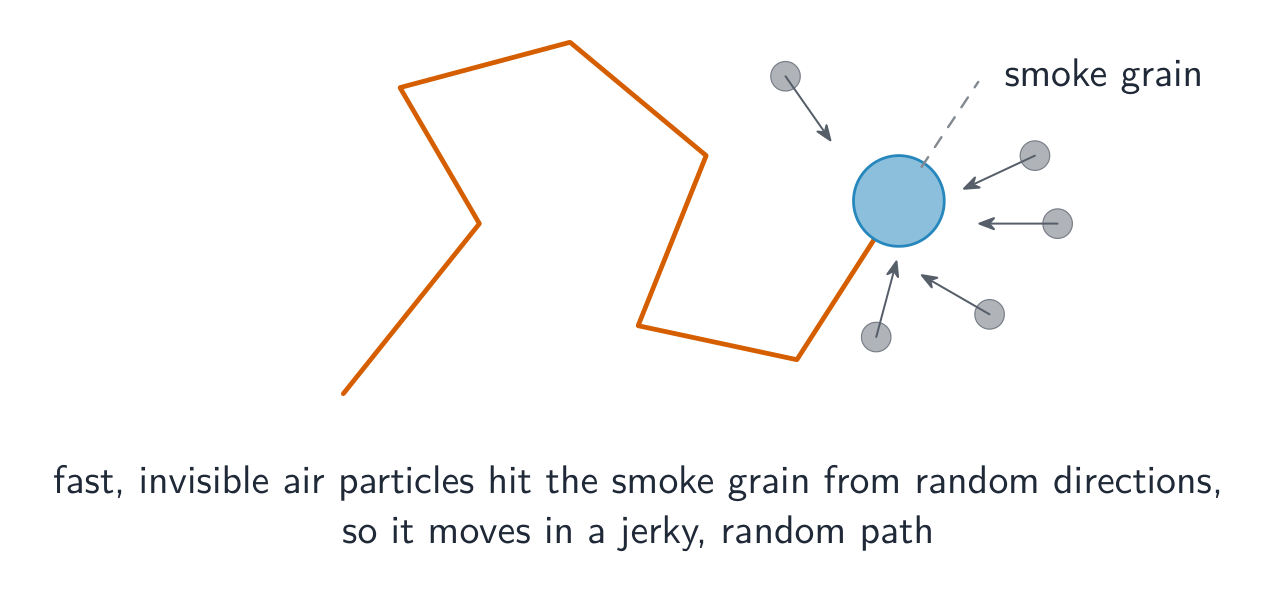
Random hits from fast, invisible air particles push a smoke grain along a jerky, random path
Smoke specks seen under a microscope jiggle randomly. This is because:
Difficulty 1/5 · 100 coins + a small bonus on first completion today
Brownian motion: tiny fast air particles knock the larger smoke specks about, evidence for moving particles.
You've got it
- solid (fixed, vibrating) · liquid (close, sliding) · gas (far apart, fast)
- temperature = average kinetic energy of particles; absolute zero $= -273\ {}^{\circ}\text{C}$
- $T\,(\text{K}) = \theta\,({}^{\circ}\text{C}) + 273$
- gas pressure = particle hits per unit area; at constant temperature $pV = \text{constant}$