跳到主要内容

空间物理

IGCSE 物理 · 第 6 主题

训练
讲义 词汇表
6.1

地球与太阳系

大纲

6.1.1 The Earth

Core Supplement
1 Know that the Earth is a planet that rotates on its axis, which is tilted, once in approximately 24 hours, and use this to explain observations of the apparent daily motion of the Sun and the periodic cycle of day and night
2 Know that the Earth orbits the Sun once in approximately 365 days and use this to explain the periodic nature of the seasons 4 Define average orbital speed from the equation $v = \frac{2\pi r}{T}$ where $r$ is the average radius of the orbit and $T$ is the orbital period; recall and use this equation
3 Know that it takes approximately one month for the Moon to orbit the Earth and use this to explain the periodic nature of the Moon’s cycle of phases

6.1.2 The Solar System

Core Supplement
1 Describe the Solar System as containing: (a) one star, the Sun (b) the eight named planets and know their order from the Sun (c) minor planets that orbit the Sun, including dwarf planets such as Pluto and asteroids in the asteroid belt (d) moons, that orbit the planets (e) smaller Solar System bodies, including comets and natural satellites 7 Know that planets, minor planets and comets have elliptical orbits, and recall that the Sun is not at the centre of the elliptical orbit, except when the orbit is approximately circular
8 Analyse and interpret planetary data about orbital distance, orbital duration, density, surface temperature and uniform gravitational field strength at the planet’s surface
2 Know that, in comparison to each other, the four planets nearest the Sun are rocky and small and the four planets furthest from the Sun are gaseous and large, and explain this difference by referring to an accretion model for Solar System formation, to include: (a) the model’s dependence on gravity (b) the presence of many elements in interstellar clouds of gas and dust (c) the rotation of material in the cloud and the formation of an accretion disc
3 Know that the strength of the gravitational field (a) at the surface of a planet depends on the mass of the planet (b) around a planet decreases as the distance from the planet increases
4 Calculate the time it takes light to travel a significant distance such as between objects in the Solar System
5 Know that the Sun contains most of the mass of the Solar System and this explains why the planets orbit the Sun
6 Know that the force that keeps an object in orbit around the Sun is the gravitational attraction of the Sun 9 Know that the strength of the Sun’s gravitational field decreases and that the orbital speeds of the planets decrease as the distance from the Sun increases
10 Know that an object in an elliptical orbit travels faster when closer to the Sun and explain this using the conservation of energy

来源:剑桥国际大纲

地球在它的(axis)上旋转(自转(rotates))约每 $24$ 小时一次。轴是倾斜(tilted)的(不是笔直向上)。这个旋转给我们白天和黑夜,并使太阳(Sun)看起来每天在天空中移动。

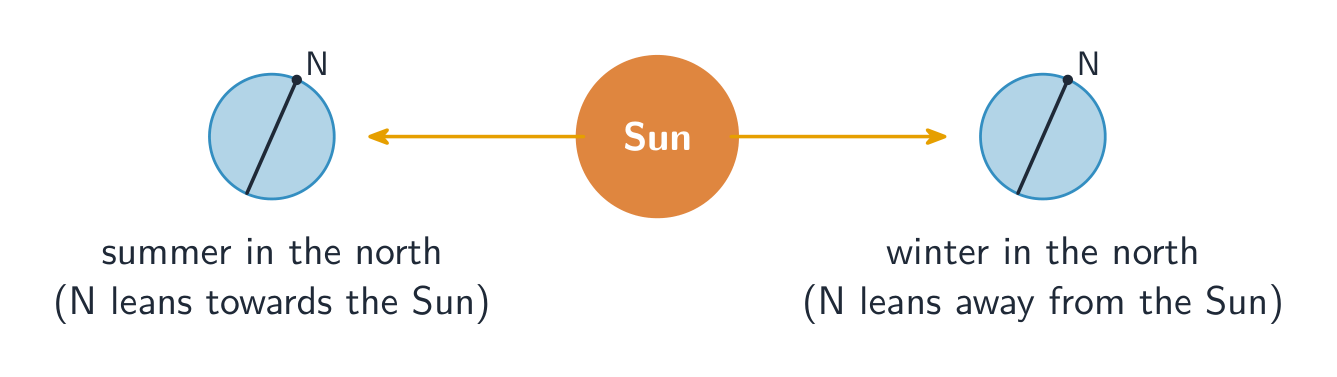
地球也在一个轨道(orbit)中围绕太阳移动,约每 $365$ 天一次(一年)。因为轴是倾斜的,地球的不同部分在一年的不同时候朝太阳倾斜。这给出季节(seasons):在朝太阳倾斜的地球那一半是夏天。

倾斜的地球在它轨道上的两个点:北朝太阳倾斜,而半年后倾斜离开
轴一整年保持同样的倾斜,所以每个半球在轨道的一半朝太阳倾斜、另一半倾斜离开

月球(Moon)围绕地球约每一个月一次。随着它绕行,我们看到它被照亮的一侧的不同的量,这给出月球的月相(phases,新月、半月、满月)。

月球在它绕地球轨道的四个点,每个面朝太阳的一半被照亮
月球被照亮的一半总是面朝太阳,所以随着它绕行我们看到它的不同的量:在我们和太阳之间是一个新月、太阳对面是一个满月,而中间是半月

所以,从最短到最长:一天(地球的旋转)< 一个月(月球的轨道)< 一年(地球的轨道)。

月球满的灰色圆盘,覆盖着深色斑块和明亮的陨石坑,在黑色太空的背景下
满月,地球的天然卫星
探索

Why the Moon changes shape

The Sun always lights half the Moon; the phase is simply how much of that lit half faces us as the Moon orbits — it is not Earth's shadow.

词汇表 训练
英文 中文 拼音
rotate 自转 zì zhuàn
axis zhóu
tilted 倾斜 qīng xié
Sun 太阳 tài yáng
orbit 轨道 guǐ dào
seasons 季节 jì jié
Moon 月球 yuè qiú
phases 月相 yuè xiàng
6.1

轨道速度

对一个绕一个圆运动的物体,一个完整轨道的距离是周长(circumference)$2\pi r$,其中 $r$ 是轨道的半径。轨道速率(orbital speed)是这个距离除以周期(period)$T$(一个轨道的时间):

$$v = \frac{2\pi r}{T}$$

同样的方程对行星、卫星和人造卫星都有效。

例题。 一个空间站在 $r = 7000\ \text{km}$ 的半径围绕地球运行,一个轨道花 $T = 5800\ \text{s}$。求它的轨道速率。

先把半径转换成米:$7000\ \text{km} = 7.0 \times 10^6\ \text{m}$。然后

$$v = \frac{2\pi r}{T} = \frac{2\pi \times 7.0 \times 10^6}{5800} \approx 7600\ \text{m/s}$$
The ISS in orbit: orbital speed is the speed that keeps a satellite in free-fall circular motion
词汇表 训练
英文 中文 拼音
circumference 周长 zhōu cháng
orbital speed 轨道速率 guǐ dào sù lǜ
period 周期 zhōu qī
satellite 卫星 wèi xīng
6.1

太阳系

太阳系(Solar System)在它的中心有一颗恒星,太阳。围绕它移动的是八颗行星(planets)。从太阳按顺序它们是:水星、金星、地球、火星、木星、土星、天王星和海王星。

  • 最靠近太阳的四颗行星小而岩石(rocky)。
  • 离太阳最远的四颗行星大而气态(gaseous)——它们大多由气体(gas)构成,没有可站立的固体表面。
  • 两颗较近的巨行星,木星和土星,是气态巨行星(gas giants)。两颗外围的巨行星,天王星和海王星,是冰巨行星(ice giants):它们容纳多得多的冰,所以它们不是真正的气态巨行星。
太阳,带水星、金星、地球和火星,然后小行星带,然后木星、土星、天王星和海王星
太阳和它按顺序的八颗行星:四颗小的岩石行星,然后小行星带,然后四颗大的气态行星——气态巨行星木星和土星以及冰巨行星天王星和海王星(不按比例)
火星满的红色圆盘,在黑色太空的背景下,带更深的表面标记和一层薄的极地雾
火星,红色行星,岩石内行星之一
木星满的圆盘,显示棕色和白色的云带和橙色的大红斑
木星,最大的行星,带它旋涡状的气体带
土星和它宽的、扁平的环系统,由卡西尼号飞船从侧面拍摄
土星和它的环,由卡西尼号飞船拍摄

太阳系也含有:

  • 小行星,如冥王星等矮行星(dwarf planets),和小行星(asteroids,大多位于火星和木星之间的小行星带);
  • 围绕行星运行的卫星(天然卫星(satellites));
  • 彗星(comets)和其他小天体。

Orbits and gravity

太阳容纳太阳系的大部分质量。它的引力(gravity,引力拉力)伸出去并把行星保持在它们的轨道中。这个力是太阳的引力吸引。

重力场强度(gravitational field strength)告诉你引力有多强:

  • 在一颗行星的表面,对一颗质量更大的行星它更大;
  • 在一颗行星周围,随着你移动更远它变弱。

以同样的方式,太阳的引力在更远处变弱,所以外行星比内行星移动得更慢(更小的轨道速率)。

大多数轨道不是完美的圆,而是椭圆(ellipses,一个拉长的圆),而太阳不在椭圆的中心。一颗彗星有一个非常拉长的轨道。一个椭圆轨道中的物体在它更靠近太阳时移动更快。我们用能量守恒(conservation of energy)解释这个——总能量(energy)保持不变,所以随着物体的重力势能(gravitational potential energy)下降(靠近),它的动能(kinetic energy)上升(它加速)。

一个椭圆轨道,太阳在一个焦点,行星靠近时移动快、远离时慢
太阳坐在椭圆的一个焦点;行星在靠近时加速、在远离时减速

Light travel time

太空中的距离是巨大的,所以我们常常算出光穿过它们要花多长时间。光以 $3.0 \times 10^8\ \text{m/s}$ 行进。用 $\text{time} = \dfrac{\text{distance}}{\text{speed}}$,来自太阳(约 $1.5 \times 10^{11}\ \text{m}$ 远)的光花约 $500\ \text{s}$,大约是 $8$ 分钟,到达地球。

探索

Watch the planets race

The closer a planet is to the Sun, the faster it orbits — Mercury in 88 days, Jupiter in 12 years — because the Sun's gravity is stronger close in.

词汇表 训练
英文 中文 拼音
Solar System 太阳系 tài yáng xì
planet 行星 xíng xīng
rocky 岩石 yán shí
gaseous 气态 qì tài
gas 气体 qì tǐ
gas giant 气态巨行星 qì tài jù xíng xīng
ice giant 冰巨行星 bīng jù xíng xīng
dwarf planet 矮行星 ǎi xíng xīng
asteroid 小行星 xiǎo xíng xīng
comet 彗星 huì xīng
gravity 引力 yǐn lì
gravitational field strength 重力场强度 zhòng lì chǎng qiáng dù
ellipse 椭圆 tuǒ yuán
conservation of energy 能量守恒 néng liàng shǒu héng
energy 能量 néng liàng
gravitational potential energy 重力势能 zhòng lì shì néng
kinetic energy 动能 dòng néng
6.1

太阳系是如何形成的

行星从太空中一个气体(gas)和尘埃(dust)的巨大云形成,它含有许多化学元素(elements)。这是吸积(accretion)模型:

  • 引力把云拉在一起;
  • 云在旋转,所以它扁平成一个旋转的吸积盘(accretion disc);
  • 大部分物质落到中心并变成太阳,而行星从盘中剩下的材料成长。

在炎热的年轻太阳附近,只有岩石和金属能保持固体,所以内行星是岩石的。远在外围,那里冷,气体也能聚集,所以外行星长得大而气态。

词汇表 训练
英文 中文 拼音
dust 尘埃 chén āi
element 元素 yuán sù
accretion 吸积 xī jī
accretion disc 吸积盘 xī jī pán
6.2

恒星与宇宙

大纲

6.2.1 The Sun as a star

Core Supplement
1 Know that the Sun is a star of medium size, consisting mostly of hydrogen and helium, and that it radiates most of its energy in the infrared, visible light and ultraviolet regions of the electromagnetic spectrum 2 Know that stars are powered by nuclear reactions that release energy and that in stable stars the nuclear reactions involve the fusion of hydrogen into helium

6.2.2 Stars

Core Supplement
1 State that: (a) galaxies are each made up of many billions of stars (b) the Sun is a star in the galaxy known as the Milky Way (c) other stars that make up the Milky Way are much further away from the Earth than the Sun is from the Earth (d) astronomical distances can be measured in light-years, where one light-year is the distance travelled in (the vacuum of) space by light in one year
2 Know that one light-year is equal to $9.5 \times 10^{15}$ m
3 Describe the life cycle of a star: (a) a star is formed from interstellar clouds of gas and dust that contain hydrogen (b) a protostar is an interstellar cloud collapsing and increasing in temperature as a result of its internal gravitational attraction (c) a protostar becomes a stable star when the inward force of gravitational attraction is balanced by an outward force due to the high temperature in the centre of the star (d) all stars eventually run out of hydrogen as fuel for the nuclear reaction (e) most stars expand to form red giants and more massive stars expand to form red supergiants when most of the hydrogen in the centre of the star has been converted to helium (f) a red giant from a less massive star forms a planetary nebula with a white dwarf star at its centre (g) a red supergiant explodes as a supernova, forming a nebula containing hydrogen and new heavier elements, leaving behind a neutron star or a black hole at its centre (h) the nebula from a supernova may form new stars with orbiting planets

6.2.3 The Universe

Core Supplement
1 Know that the Milky Way is one of many billions of galaxies making up the Universe and that the diameter of the Milky Way is approximately 100 000 light-years
2 Describe redshift as an increase in the observed wavelength of electromagnetic radiation emitted from receding stars and galaxies
3 Know that the light emitted from distant galaxies appears redshifted in comparison with light emitted on the Earth
4 Know that redshift in the light from distant galaxies is evidence that the Universe is expanding and supports the Big Bang Theory
5 Know that microwave radiation of a specific frequency is observed at all points in space around us and is known as cosmic microwave background radiation (CMBR)
6 Explain that the CMBR was produced shortly after the Universe was formed and that this radiation has been expanded into the microwave region of the electromagnetic spectrum as the Universe expanded
7 Know that the speed $v$ at which a galaxy is moving away from the Earth can be found from the change in wavelength of the galaxy’s starlight due to redshift
8 Know that the distance $d$ of a far galaxy can be determined using the brightness of a supernova in that galaxy
9 Define the Hubble constant $H_0$ as the ratio of the speed at which the galaxy is moving away from the Earth to its distance from the Earth; recall and use the equation
$$H_0 = \frac{v}{d}$$
10 Know that the current estimate for $H_0$ is $2.2 \times 10^{-18}$ per second
11 Know that the equation
$$\frac{d}{v} = \frac{1}{H_0}$$
represents an estimate for the age of the Universe and that this is evidence for the idea that all the matter in the Universe was present at a single point

来源:剑桥国际大纲

太阳是一颗中等大小的恒星(star),大多由(hydrogen)和(helium)构成。它在电磁波谱(electromagnetic spectrum)的红外线、可见光和紫外线(ultraviolet)部分辐射它大部分的能量(energy)。

一颗恒星由它核心的核反应(nuclear reactions)供能。在一颗稳定的恒星中,反应是核聚变(nuclear fusion):氢原子核结合以制造氦,释放巨大的能量。

太阳显示为一个发光的橙色圆盘,边缘有一个明亮的日珥,由 NASA 的太阳动力学天文台以紫外光成像
太阳,我们最近的恒星,以紫外光看到
词汇表 训练
英文 中文 拼音
star 恒星 héng xīng
hydrogen qīng
helium hài
ultraviolet 紫外线 zǐ wài xiàn
electromagnetic spectrum 电磁波谱 diàn cí bō pǔ
nuclear reaction 核反应 hé fǎn yìng
nuclear fusion 核聚变 hé jù biàn
6.2

恒星、星系与宇宙

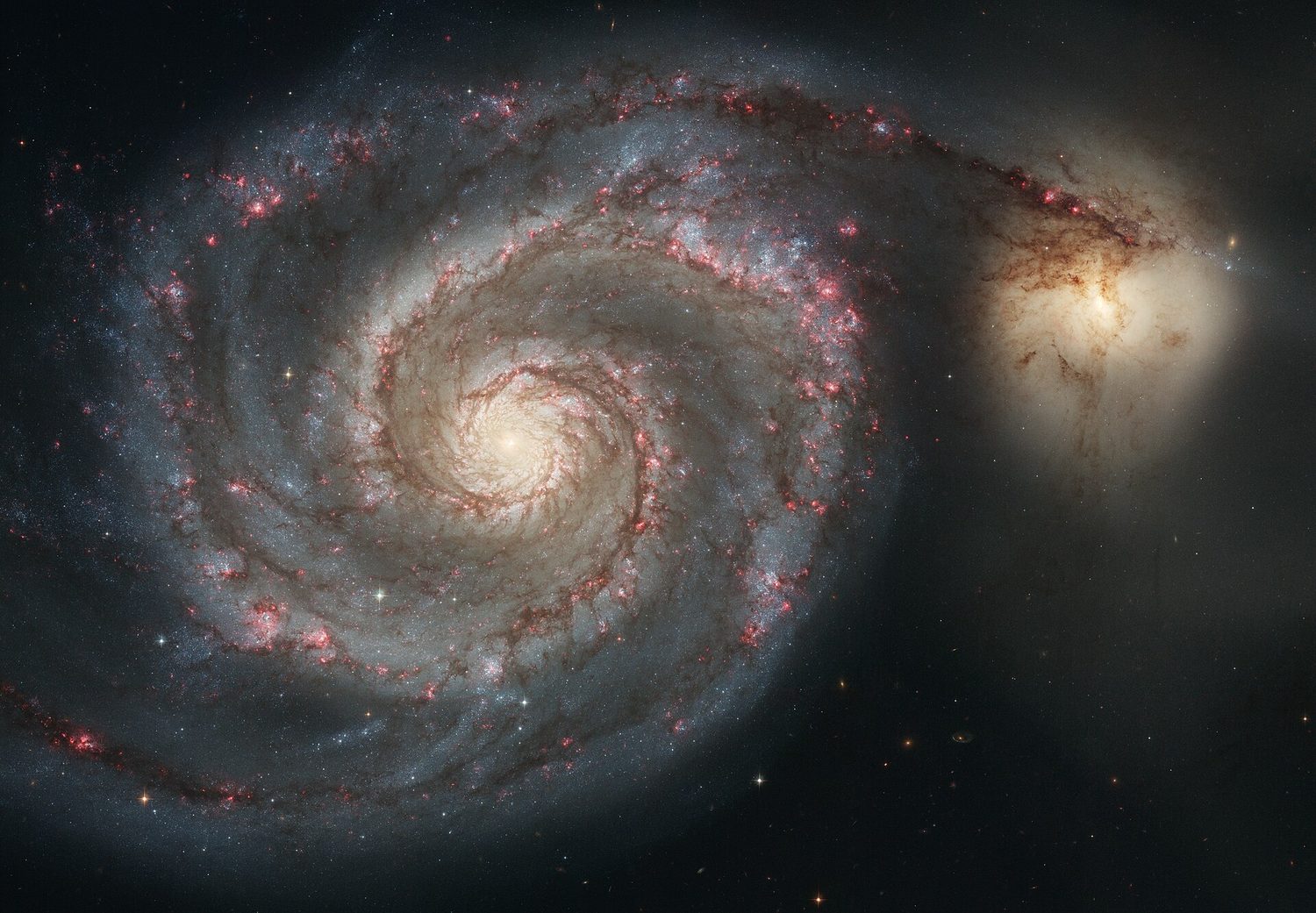
一个星系(galaxy)是由引力保持在一起的许多十亿颗恒星的一个群。我们的太阳是叫银河系(Milky Way)的星系中的一颗恒星。银河系中所有其他的恒星都比太阳离地球远得多得多。

一个正面看到的螺旋星系,弯曲的恒星臂从一个明亮的中心蜿蜒出来,边缘一个更小的伴星系
一个螺旋星系:由引力保持在一起的数十亿颗恒星

恒星之间的距离如此大,以至于我们以光年(light-years)测量它们。一光年是光在一年内(在太空的真空中)行进的距离,它约是 $9.5 \times 10^{15}\ \text{m}$

银河系约 $100\,000$ 光年宽(它的直径(diameter))。它只是数十亿个星系中的一个。所有这些星系一起构成宇宙(Universe)。

夜晚一座山上的一台大望远镜向着银河系发光的带笔直向上发射一束细的黄色激光
一台巨型望远镜研究夜空;激光帮助它制作遥远恒星的清晰图像
词汇表 训练
英文 中文 拼音
galaxy 星系 xīng xì
Milky Way 银河系 yín hé xì
light-year 光年 guāng nián
diameter 直径 zhí jìng
6.2

恒星的生命周期

一颗恒星在一段非常长的时间里诞生、生活并死亡:

  1. 一颗恒星从一个含有氢的气体和尘埃的星际云(interstellar cloud)形成。
  2. 引力把云向内拉,而它升温。这个塌缩、升温的云是一个原恒星(protostar)。
  3. 当引力的向内拉力被它中心非常高的温度引起的向外的推平衡时,原恒星变成一颗稳定(stable)的恒星。
  4. 及时,每颗恒星都用完聚变的氢燃料(fuel)。

接下来发生什么取决于恒星的质量:

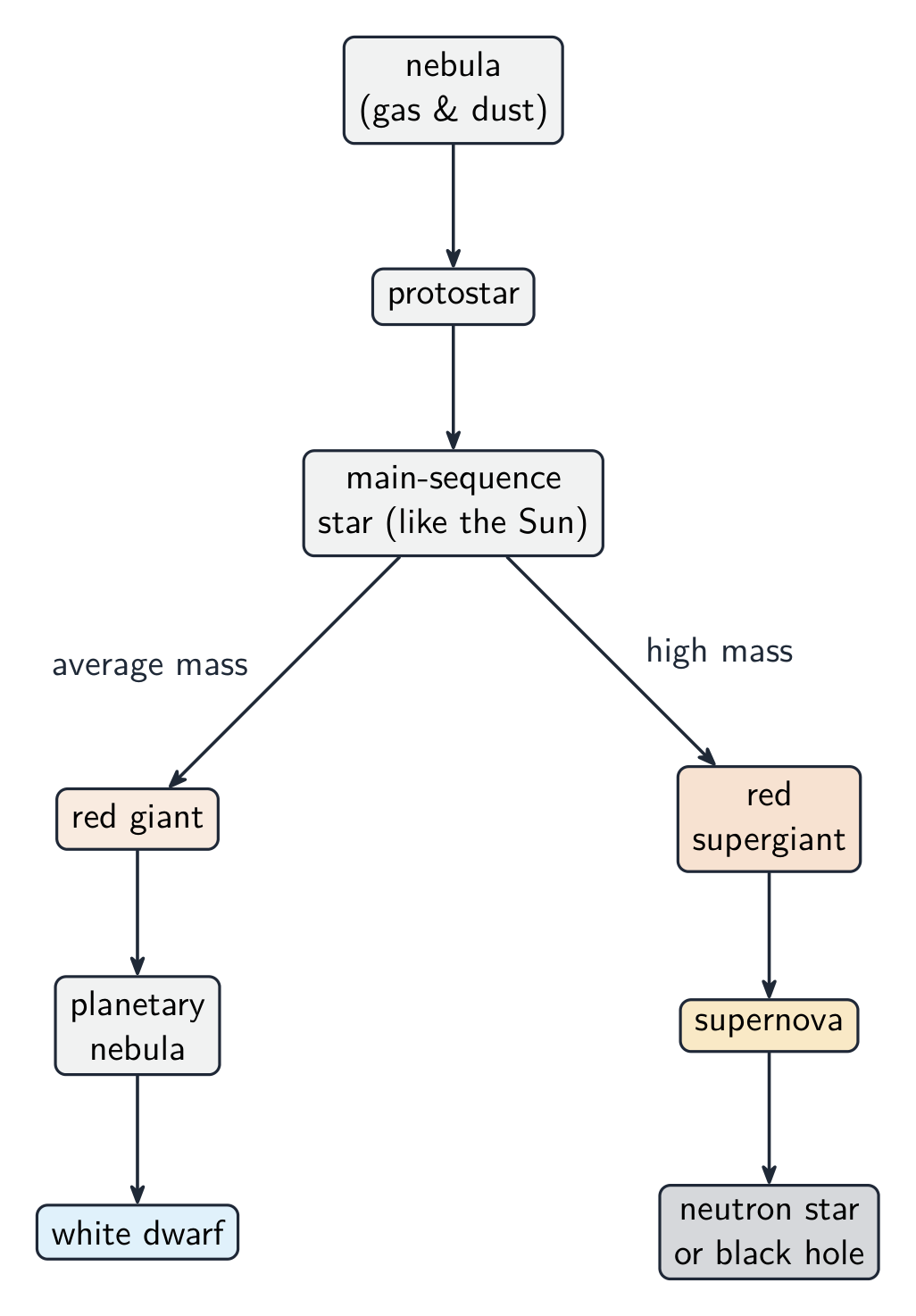
  • 一颗中等的恒星(像太阳)膨胀成一个红巨星(red giant)。它随即把它的外层作为一个叫行星状星云(nebula)的发光云抛掉,在中心留下一个小的、热的白矮星(white dwarf)。
  • 一颗重得多的恒星膨胀成一个红超巨星(red supergiant),然后作为一个超新星(supernova)爆炸。这次爆炸铺开一个含有氢和新的、更重元素的星云,并留下一个中子星(neutron star)或一个黑洞(black hole)。
一颗恒星生命的流程图,按质量分支到红巨星和红超巨星路径
每颗恒星都在一个星云中开始;它如何结束取决于它的质量

来自一个超新星的星云能后来形成新恒星,带围绕它们运行的行星——所以我们自己的太阳系来自更早的恒星。

探索

The life cycle of a star

Gravity pulls a gas cloud together; fusion lights the star; when its fuel runs low it swells and finally fades.

探索

The life cycle of a Sun-like star

Step through how a star like our Sun is born, lives and dies.

词汇表 训练
英文 中文 拼音
interstellar cloud 星际云 xīng jì yún
protostar 原恒星 yuán héng xīng
stable 稳定 wěn dìng
fuel 燃料 rán liào
red giant 红巨星 hóng jù xīng
nebula 星云 xīng yún
white dwarf 白矮星 bái ǎi xīng
red supergiant 红超巨星 hóng chāo jù xīng
supernova 超新星 chāo xīn xīng
neutron star 中子星 zhōng zi xīng
black hole 黑洞 hēi dòng
6.2

膨胀的宇宙

当一颗恒星或星系远离我们移动时(它在退行(receding)),我们从它接收的光有一个比正常更长的波长(wavelength)——它朝光谱的红端移动。这是红移(redshift)。

两个光谱:一个遥远星系的线与一个附近的相比朝红端移动
一个遥远星系光谱中的暗线朝红端移动——这是红移

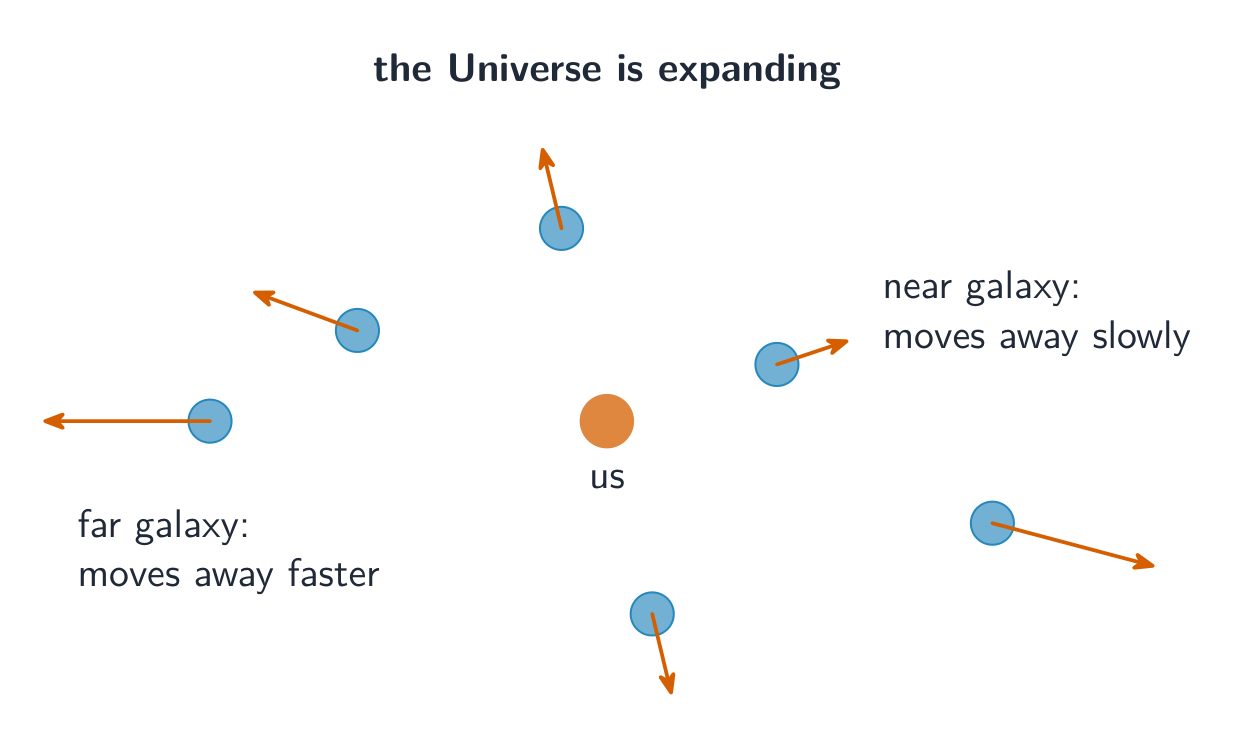
来自遥远星系的光被红移,而一个星系越远,它的红移越大。这告诉我们星系在互相远离:宇宙在膨胀(expanding)。把这个倒回去,一切曾经在一个单一的点一起——这是大爆炸(Big Bang)理论的证据。

我们周围的星系,每个带一个指向远离的箭头,更遥远的星系箭头更长
每个星系都在远离我们移动,而更远的移动得更快——宇宙在膨胀

More evidence and the age of the Universe

微弱的微波(microwave)辐射(radiation)被发现从太空的每个方向来。这是宇宙微波背景辐射(cosmic microwave background radiation,CMBR)。它在大爆炸后不久作为高能辐射被制造,并随着宇宙膨胀被拉伸到光谱的微波部分。

对一个遥远的星系:

  • 它远离移动的速度 $v$ 能从它星光的红移求得;
  • 它的距离 $d$ 能从在它里面看到的一个超新星的亮度求得。

哈勃常数(Hubble constant)$H_0$ 联系这两个:

$$H_0 = \frac{v}{d}$$

它今天的值约是每秒 $2.2 \times 10^{-18}$。把这个反过来给出宇宙年龄的一个估计:

$$\frac{d}{v} = \frac{1}{H_0}$$

例题。 哈勃常数约是 $H_0 = 2.2 \times 10^{-18}$ 每秒。估计宇宙的年龄。

$$\frac{1}{H_0} = \frac{1}{2.2 \times 10^{-18}} \approx 4.5 \times 10^{17}\ \text{s}$$

那大约是 $14$ 十亿年。

这有效是因为每个星系似乎在同一时间从同一个单一的点开始——对大爆炸的更多支持。

探索

The expanding Universe

v = H₀·d

Galaxies recede faster the farther they are — speed is proportional to distance.

词汇表 训练
英文 中文 拼音
Universe 宇宙 yǔ zhòu
receding 退行 tuì xíng
wavelength 波长 bō cháng
redshift 红移 hóng yí
expanding 膨胀 péng zhàng
Big Bang 大爆炸 dà bào zhà
microwave 微波 wēi bō
radiation 辐射 fú shè
cosmic microwave background radiation 宇宙微波背景辐射 yǔ zhòu wēi bō bèi jǐng fú shè
Hubble constant 哈勃常数 hā bó cháng shù
6.2

考试技巧

  • $v = \dfrac{2\pi r}{T}$ 中,$r$ 是轨道半径,而 $T$ 是一个完整轨道以秒计的时间——先把 km 转换成 m、把小时转换成秒。
  • 更靠近太阳的行星感受更强的引力,所以它们运行得更快、花更少的时间。在一个椭圆轨道中一个物体在它接近太阳时加速(重力势能变成动能)。
  • 一个光年是一个距离,不是一个时间——光在一年内行进多远。
  • 当引力的向内拉力被它核心聚变释放的能量的向外的推平衡时,一颗恒星是稳定的。当它的燃料用完时它变成什么取决于它的质量
  • 红移——来自遥远星系的光移到更长(更红)的波长,越远移动越大——是宇宙在膨胀的证据,它支持大爆炸。

本主题的互动课程

逐步学习,并即时检测练习。

IGCSE 物理历年真题

IGCSE 物理的更多主题

登录或创建账号

IGCSE, A-Level & AP