The Sun and the life cycle of stars · 太阳与恒星的生命周期
| English | 中文 | Pinyin · 拼音 |
|---|---|---|
| fusion/ˈfjuːʒn/ | 聚变 | jù biàn |
| Universe/ˈjuːnɪvɜːs/ | 宇宙 | yǔ zhòu |
| galaxy/ˈɡæləksi/ | 星系 | xīng xì |
| Milky Way/ˈmɪlki weɪ/ | 银河系 | yín hé xì |
| light-years/laɪt jɪəz/ | 光年 | guāng nián |
| nebula/ˈnebjʊlə/ | 星云 | xīng yún |
| protostar/ˈprəʊtəʊstɑː/ | 原恒星 | yuán héng xīng |
| red giant/red ˈdʒaɪənt/ | 红巨星 | hóng jù xīng |
| white dwarf/waɪt dwɔːf/ | 白矮星 | bái ǎi xīng |
| supernova/ˌsuːpəˈnəʊvə/ | 超新星 | chāo xīn xīng |
| neutron star/ˈnjuːtrɒn stɑː/ | 中子星 | zhōng zi xīng |
| black hole/blæk həʊl/ | 黑洞 | hēi dòng |
The lives of stars
- Stars are born, shine for billions of years, and then die.
- Our Sun is one ordinary star among billions.
- Let's meet the Sun, the galaxies, and how a star lives and dies.
恒星的一生
- 恒星诞生、闪耀数十亿年,然后死亡。
- 我们的太阳是数十亿颗中一颗普通的恒星。
- 让我们认识太阳、星系,以及一颗恒星如何生和死。
The Sun as a star
- The Sun is a medium-sized star, made mostly of hydrogen and helium.
- It radiates energy as infrared, visible light and ultraviolet.
- It is powered by nuclear fusion 聚变 in its core: hydrogen nuclei join to make helium, releasing huge energy.
The Sun, our nearest star, seen in ultraviolet light
作为一颗恒星的太阳
- 太阳是一颗中等大小的恒星,主要由氢和氦构成。
- 它作为红外、可见光和紫外辐射能量。
- 它由它核心中的核聚变提供动力:氢原子核结合形成氦,释放巨大的能量。

太阳,我们最近的恒星,以紫外光看
The life cycle of a star · 一颗恒星的生命周期
Gravity pulls a gas cloud together; fusion lights the star; when its fuel runs low it swells and finally fades. · 引力把一团气体云拉到一起;聚变点亮恒星;当它的燃料变低时它膨胀并最终消退。
What powers the Sun? · 什么为太阳提供动力?
In a stable star, hydrogen nuclei fuse into helium in the core, releasing huge amounts of energy. · 在一颗稳定的恒星中,氢原子核在核心聚变成氦,释放巨大量的能量。
Galaxies and the Universe 宇宙
- A galaxy 星系 is billions of stars held together by gravity. Our Sun is in the Milky Way 银河系.
- Distances between stars are measured in light-years 光年 — the distance light travels in one year ($\approx 9.5 \times 10^{15}\ \text{m}$).
- The Milky Way is about $100\,000$ light-years across, and is just one of billions of galaxies that make up the Universe.
A spiral galaxy: billions of stars held together by gravity
星系与宇宙
- 一个星系(galaxy)是由引力凝聚在一起的数十亿颗恒星。我们的太阳在银河系(Milky Way)中。
- 恒星之间的距离以光年(light-years)测量——光在一年内传播的距离($\approx 9.5 \times 10^{15}\ \text{m}$)。
- 银河系约 $100\,000$ 光年宽,且只是构成宇宙(Universe)的数十亿星系之一。
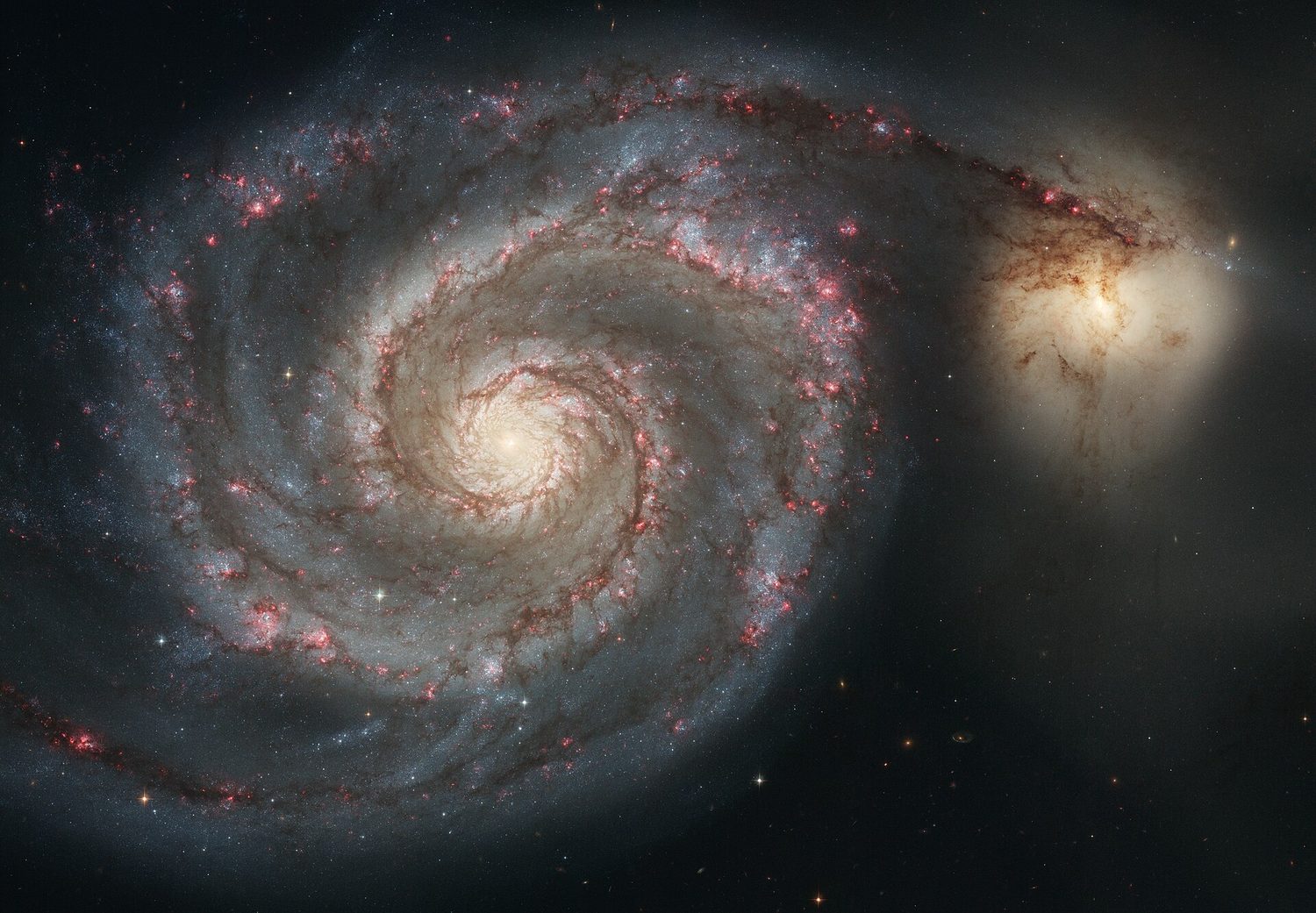
一个螺旋星系:由引力凝聚在一起的数十亿颗恒星
A galaxy is: · 一个星系是:
A galaxy is a huge collection of billions of stars bound by gravity. The Sun is one star in the Milky Way galaxy. · 一个星系是由引力束缚的数十亿颗恒星的一个巨大集合。太阳是银河系中的一颗恒星。
A light-year is a unit of: · 一光年是以下的一个单位:
A light-year is the distance light travels in one year — a measure of distance, not time. · 一光年是光在一年内传播的距离——一个距离的量度,不是时间。
Match each stage to what it is. · 把每个阶段与它是什么配对。
Each item links the term to its correct meaning. · 每一项把术语与它正确的含义联系。
The life cycle of a star
- A star forms from a nebula 星云 (a cloud of gas and dust).
- Gravity pulls it together and it heats up — a protostar 原恒星.
- It becomes a stable star when gravity's inward pull is balanced by the outward push from its very hot core.
- When the hydrogen fuel runs low, what happens next depends on the star's mass:
- a medium star → red giant 红巨星 → throws off a planetary nebula → leaves a white dwarf 白矮星;
- a massive star → red supergiant → explodes as a supernova 超新星 → leaves a neutron star 中子星 or a black hole 黑洞.
The life cycle of a star: all stars start the same way, but their mass determines how they end. Medium stars become white dwarfs; massive stars explode as supernovae and leave neutron stars or black holes.
Why does a supernova matter? A supernova explosion creates and scatters heavy elements (iron, gold, uranium) into space. Every atom of gold on Earth was forged inside a star that exploded billions of years ago.
A black hole is not a hole. It is an incredibly dense remnant where gravity is so strong that not even light can escape. It's a collapsed core, not an empty space.
一颗恒星的生命周期
- 一颗恒星从一个星云(nebula,一团气体和尘埃云)形成。
- 引力把它拉到一起,它升温——一颗原恒星(protostar)。
- 当引力的向内拉力被它非常热的核心的向外推力平衡时,它成为一颗稳定的恒星。
- 当氢燃料变低时,接下来发生什么取决于恒星的质量:
- 一颗中等恒星 → 红巨星 → 抛出一个行星状星云 → 留下一颗白矮星;
- 一颗大质量恒星 → 红超巨星 → 作为一颗超新星爆炸 → 留下一颗中子星或一个黑洞。

一颗恒星的生命周期:所有恒星以同样的方式开始,但它们的质量决定它们如何结束。中等恒星变成白矮星;大质量恒星作为超新星爆炸并留下中子星或黑洞。
为什么一颗超新星重要? 一次超新星爆炸创造并把重元素(铁、金、铀)散布到空间中。地球上每一个金原子都是在数十亿年前爆炸的一颗恒星内部锻造的。
一个黑洞不是一个洞。 它是一个极其致密的残骸,那里引力如此强以致连光都不能逃逸。它是一个坍缩的核心,不是一个空旷空间。
Put the life stages of a Sun-like star in order. · 把一颗类太阳恒星的生命阶段按顺序排列。
A star forms from a nebula → protostar → stable star → (fuel runs low) red giant → white dwarf. · 一颗恒星从一个星云形成 → 原恒星 → 稳定恒星 →(燃料变低)红巨星 → 白矮星。
In a stable star, the inward pull of gravity is balanced by: · 在一颗稳定的恒星中,引力的向内拉力被以下平衡:
The hot core pushes outward, balancing gravity's inward pull, so the star stays a stable size. · 热核心向外推,平衡引力的向内拉力,所以恒星保持一个稳定的大小。
A much heavier star ends its life as a supernova, leaving behind: · 一颗重得多的恒星作为一颗超新星结束它的一生,留下:
A massive star becomes a red supergiant, explodes as a supernova, and leaves a neutron star or a black hole. · 一颗大质量恒星变成一颗红超巨星,作为一颗超新星爆炸,并留下一颗中子星或一个黑洞。
You've got it
- the Sun is a medium star (H + He), powered by fusion of hydrogen into helium
- a galaxy = billions of stars held by gravity; we are in the Milky Way
- distances in light-years ($\approx 9.5 \times 10^{15}\ \text{m}$); billions of galaxies make the Universe
- life cycle: nebula → protostar → stable star → (red giant → white dwarf) or (supergiant → supernova → neutron star/black hole)
你掌握了
- 太阳是一颗中等恒星(H + He),由氢聚变成氦提供动力
- 一个星系 = 由引力凝聚的数十亿颗恒星;我们在银河系中
- 距离以光年($\approx 9.5 \times 10^{15}\ \text{m}$);数十亿星系构成宇宙
- 生命周期:星云 → 原恒星 → 稳定恒星 →(红巨星 → 白矮星)或(超巨星 → 超新星 → 中子星/黑洞)