Everything around you is made of atoms — yet an atom is almost entirely empty space. If the nucleus were the size of a marble, the whole atom would be the size…
1 Describe the structure of an atom in terms of a positively charged nucleus and negatively charged electrons in orbit around the nucleus
3 Describe how the scattering of alpha ($\alpha$) particles by a sheet of thin metal supports the nuclear model of the atom, by providing evidence for: (a) a very small nucleus surrounded by mostly empty space (b) a nucleus containing most of the mass of the atom (c) a nucleus that is positively charged
2 Know how atoms may form positive ions by losing electrons or form negative ions by gaining electrons
5.1.2 The nucleus
Core
Supplement
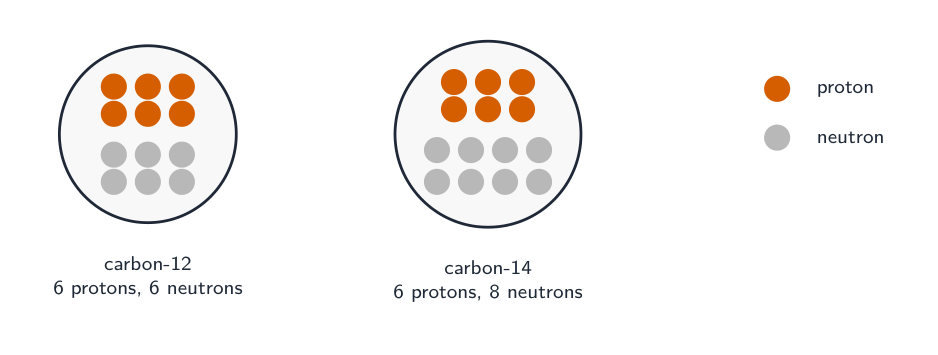
1 Describe the composition of the nucleus in terms of protons and neutrons
6 Describe the processes of nuclear fission and nuclear fusion as the splitting or joining of nuclei, to include the nuclide equation and qualitative description of mass and energy changes without values
2 State the relative charges of protons, neutrons and electrons as +1, 0 and –1 respectively
3 Define the terms proton number (atomic number) $Z$ and nucleon number (mass number) $A$ and be able to calculate the number of neutrons in a nucleus
7 Know the relationship between the proton number and the relative charge on a nucleus
8 Know the relationship between the nucleon number and the relative mass of a nucleus
4 Use the nuclide notation $^{A}_{Z}\text{X}$
5 Explain what is meant by an isotope and state that an element may have more than one isotope
2 Know the sources that make a significant contribution to background radiation including: (a) radon gas (in the air) (b) rocks and buildings (c) food and drink (d) cosmic rays
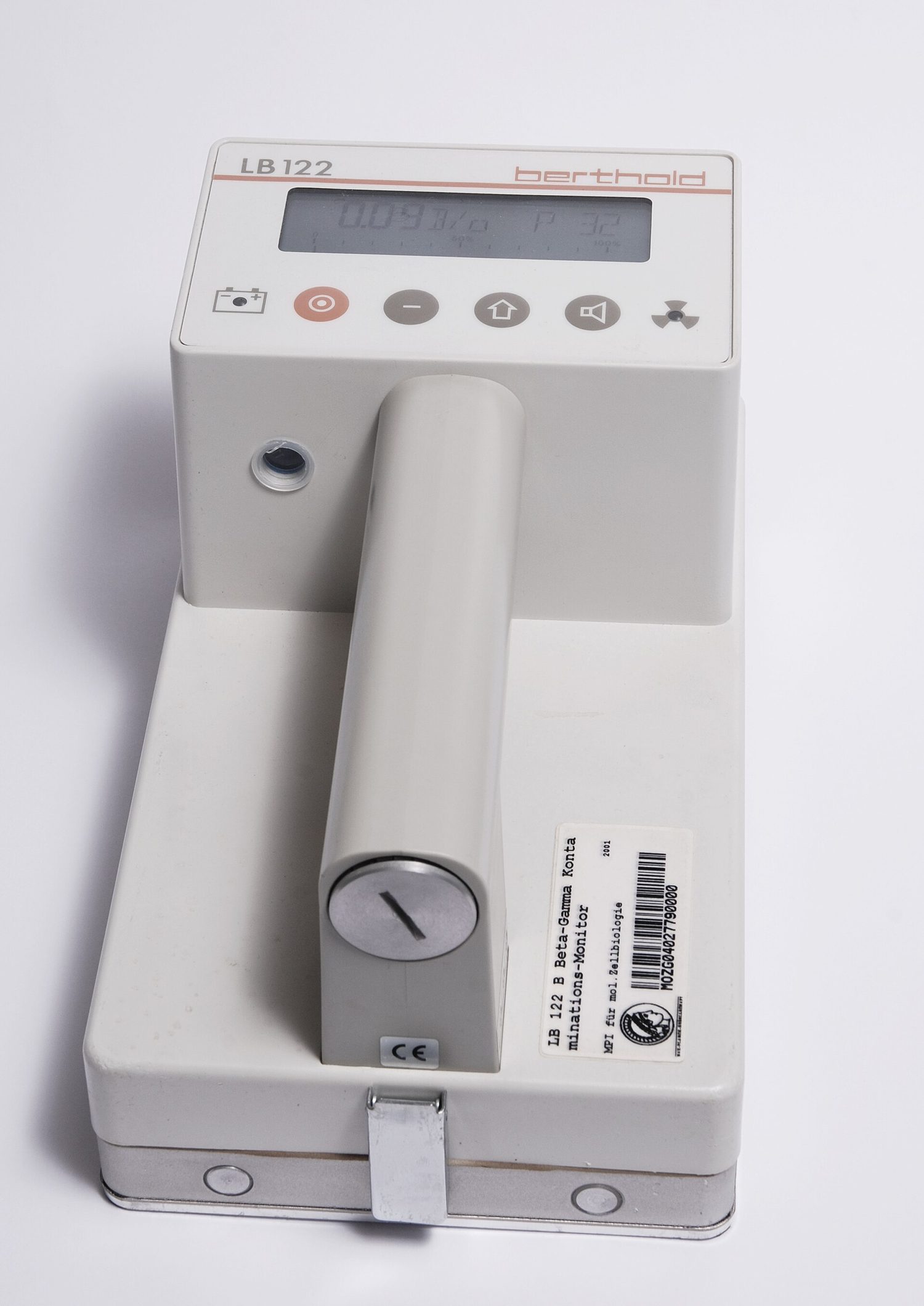
3 Know that ionising nuclear radiation can be measured using a detector connected to a counter
4 Use count rate measured in counts / s or counts / minute
5 Use measurements of background radiation to determine a corrected count rate
5.2.2 The three types of nuclear emission
Core
Supplement
1 Describe the emission of radiation from a nucleus as spontaneous and random in direction
2 Identify alpha ($\alpha$), beta ($\beta$) and gamma ($\gamma$) emissions from the nucleus by recalling: (a) their nature (b) their relative ionising effects (c) their relative penetrating abilities ($\beta^+$ are not included, $\beta$-particles will be taken to refer to $\beta^-$)
3 Describe the deflection of $\alpha$-particles, $\beta$-particles and $\gamma$-radiation in electric fields and magnetic fields
4 Explain their relative ionising effects with reference to: (a) kinetic energy (b) electric charge
5.2.3 Radioactive decay
Core
Supplement
1 Know that radioactive decay is a change in an unstable nucleus that can result in the emission of $\alpha$-particles or $\beta$-particles and/or $\gamma$-radiation and know that these changes are spontaneous and random
3 Know that isotopes of an element may be radioactive due to an excess of neutrons in the nucleus and/or the nucleus being too heavy
2 State that during $\alpha$-decay or $\beta$-decay, the nucleus changes to that of a different element
4 Describe the effect of $\alpha$-decay, $\beta$-decay and $\gamma$-emissions on the nucleus, including an increase in stability and a reduction in the number of excess neutrons; the following change in the nucleus occurs during $\beta$-emission neutron $\rightarrow$ proton + electron
5 Use decay equations, using nuclide notation, to show the emission of $\alpha$-particles, $\beta$-particles and $\gamma$-radiation
5.2.4 Half-life
Core
Supplement
1 Define the half-life of a particular isotope as the time taken for half the nuclei of that isotope in any sample to decay; recall and use this definition in simple calculations, which might involve information in tables or decay curves (calculations will not include background radiation)
2 Calculate half-life from data or decay curves from which background radiation has not been subtracted
3 Explain how the type of radiation emitted and the half-life of an isotope determine which isotope is used for applications including: (a) household fire (smoke) alarms (b) irradiating food to kill bacteria (c) sterilisation of equipment using gamma rays (d) measuring and controlling thicknesses of materials with the choice of radiations used linked to penetration and absorption (e) diagnosis and treatment of cancer using gamma rays
5.2.5 Safety precautions
Core
Supplement
1 State the effects of ionising nuclear radiations on living things, including cell death, mutations and cancer
2 Describe how radioactive materials are moved, used and stored in a safe way
3 Explain safety precautions for all ionising radiation in terms of reducing exposure time, increasing distance between source and living tissue and using shielding to absorb radiation
Each nucleus has a fixed chance of decaying, at random. Move time forward: about half the remaining nuclei decay every half-life — so the count halves, then halves again.