The nuclear atom · 核原子
| English | 中文 | Pinyin · 拼音 |
|---|---|---|
| nucleus/ˈnjuːklɪəs/ | 原子核 | yuán zǐ hé |
| nuclear model/ˈnjuːklɪə ˈmɒdl/ | 核模型 | hé mó xíng |
| neutral/ˈnjuːtrəl/ | 中性的 | zhōng xìng de |
| alpha particles/ˈælfə ˈpɑːtɪklz/ | α粒子 | α lì zi |
| gold foil/ɡəʊld fɔɪl/ | 金箔 | jīn bó |
| nucleons/ˈnjuːklɪənz/ | 核子 | hé zǐ |
| protons/ˈprəʊtɒnz/ | 质子 | zhì zi |
| neutrons/ˈnjuːtrɒnz/ | 中子 | zhōng zǐ |
| isotopes/ˈaɪsətəʊps/ | 同位素 | tóng wèi sù |
Mostly empty space
- If an atom were the size of a stadium, its nucleus 原子核 would be a pea in the centre.
- Almost all the atom is empty space — a surprising fact proved by a clever experiment.
- Let's build up the nuclear model 核模型 of the atom.
大部分是空旷空间
- 如果一个原子是一个体育场的大小,它的原子核(nucleus)会是中心的一颗豌豆。
- 几乎整个原子是空旷空间——一个由一个巧妙的实验证明的惊人事实。
- 让我们建立原子的核模型(nuclear model)。
The nuclear atom
- An atom has a tiny central nucleus (positive) with electrons (negative) moving around it.
- The whole atom is neutral 中性的 — equal positive and negative charge.
- Almost all the mass is in the nucleus, which is tiny compared with the atom.
- Lose electrons → a positive ion; gain electrons → a negative ion.
A nuclear power station; the large towers release waste heat as steam
核原子
- 一个原子有一个微小的中央原子核(正的),电子(负的)绕它运动。
- 整个原子是中性的——相等的正和负电荷。
- 几乎所有的质量在原子核中,它与原子相比是微小的。
- 失去电子 → 一个正离子;获得电子 → 一个负离子。

一个核电站;大塔作为蒸汽释放废热
Inside the atom · 原子内部
A tiny dense nucleus sits at the centre with electrons in shells around it — drag the proton number and watch the shells fill outward. · 一个微小致密的原子核位于中心,电子在它周围的壳层中——拖动质子数,看壳层从内向外填满。
Where is almost all of an atom's mass? · 一个原子几乎所有的质量在哪里?
Almost all the mass is concentrated in the tiny, dense nucleus; the rest of the atom is mostly empty space. · 几乎所有的质量集中在微小、致密的原子核中;原子的其余部分大部分是空旷空间。
An atom that loses an electron becomes a positive ion. · 一个失去一个电子的原子变成一个正离子。
Losing a negative electron leaves the atom with more positive charge — a positive ion. · 失去一个负电子使原子有更多的正电荷——一个正离子。
The alpha-scattering experiment
- Fast, positive alpha particles α粒子 were fired at very thin gold foil 金箔.
- Most went straight through → the atom is mostly empty space.
- A few were deflected → the nucleus is positive (it repels the alpha particles).
- A very few bounced back → the nucleus is tiny, dense and heavy.
α 散射实验
- 快速的、正的α 粒子(alpha particles)被射向非常薄的金箔(gold foil)。
- 大多数直接穿过 → 原子大部分是空旷空间。
- 少数被偏转 → 原子核是正的(它排斥 α 粒子)。
- 极少数弹回 → 原子核是微小、致密且重的。

In the alpha-scattering experiment, most alpha particles passed straight through the foil. This shows that: · 在 α 散射实验中,大多数 α 粒子直接穿过箔。这显示:
If most pass straight through, there must be very little in the way — the atom is mostly empty space. · 如果大多数直接穿过,路上必定很少有东西——原子大部分是空旷空间。
Inside the nucleus
- The nucleus is made of nucleons 核子: protons 质子 (charge $+1$) and neutrons 中子 (charge $0$).
- Proton number $Z$ = number of protons; nucleon number $A$ = protons + neutrons.
- So the number of neutrons is $A - Z$.
- We write a nucleus as $^{A}_{Z}\text{X}$ — for example $^{14}_{\ 6}\text{C}$ has $6$ protons and $14 - 6 = 8$ neutrons.
The nuclear model of the atom
原子核内部
- 原子核由核子(nucleons)构成:质子(protons,电荷 $+1$)和中子(neutrons,电荷 $0$)。
- 质子数(proton number)$Z$ = 质子数;核子数(nucleon number)$A$ = 质子 + 中子。
- 所以中子的数量是 $A - Z$。
- 我们把一个原子核写成 $^{A}_{Z}\text{X}$——例如 $^{14}_{\ 6}\text{C}$ 有 $6$ 个质子和 $14 - 6 = 8$ 个中子。

原子的核模型
The proton number (Z) of a nucleus is: · 一个原子核的质子数(Z)是:
Z is the proton number (atomic number). The nucleon number A is protons + neutrons. · Z 是质子数(原子序数)。核子数 A 是质子 + 中子。
How many neutrons are in a nucleus of $^{14}_{\ 6}\text{C}$? · $^{14}_{\ 6}\text{C}$ 的一个原子核中有多少个中子?
Neutrons $= A - Z = 14 - 6 = 8$. · 中子 $= A - Z = 14 - 6 = 8$。
Isotopes 同位素
- Isotopes are atoms of the same element (same $Z$) with different numbers of neutrons (different $A$).
- They behave the same in chemistry but differently in the nucleus.
- Example: $^{12}_{\ 6}\text{C}$ and $^{14}_{\ 6}\text{C}$ are both carbon.
Isotopes have the same number of protons but different numbers of neutrons — the same element with a different mass
同位素
- 同位素(isotopes)是同一元素(相同 $Z$)的原子,带不同数量的中子(不同 $A$)。
- 它们在化学中表现相同,但在原子核中不同。
- 例子:$^{12}_{\ 6}\text{C}$ 和 $^{14}_{\ 6}\text{C}$ 都是碳。
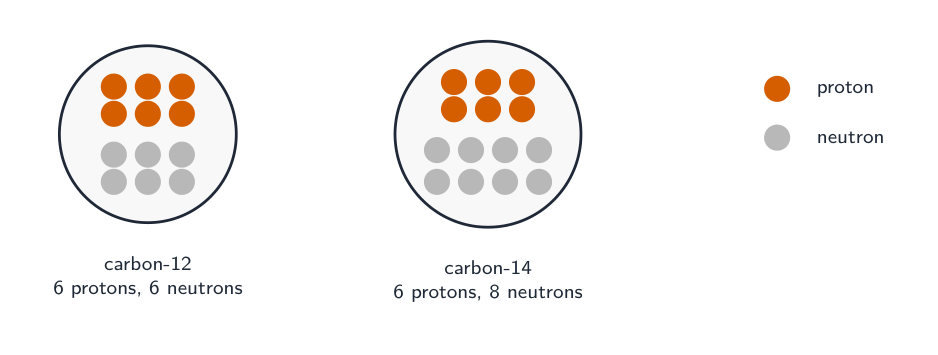
同位素有相同数量的质子但不同数量的中子——同一元素,不同质量
Isotopes of an element have: · 一个元素的同位素有:
Isotopes share the proton number Z (same element) but have different nucleon numbers A (different neutron counts). · 同位素共享质子数 Z(同一元素)但有不同的核子数 A(不同的中子数)。
You've got it
- atom = tiny positive nucleus + electrons; mostly empty space; almost all mass in the nucleus
- alpha-scattering: most pass through (empty), a few deflect (positive nucleus), a very few bounce back (small + dense)
- $Z$ = protons, $A$ = protons + neutrons, neutrons $= A - Z$; notation $^{A}_{Z}\text{X}$
- isotopes: same $Z$, different $A$
你掌握了
- 原子 = 微小的正原子核 + 电子;大部分是空旷空间;几乎所有质量在原子核中
- α 散射:大多数穿过(空的),少数偏转(正原子核),极少数弹回(小 + 致密)
- $Z$ = 质子,$A$ = 质子 + 中子,中子 $= A - Z$;符号 $^{A}_{Z}\text{X}$
- 同位素:相同 $Z$,不同 $A$