| English | 释义 | 拼音 |
|---|---|---|
| radioactivity/ˌreɪdɪəʊækˈtɪvɪti/ | 放射性 | fàng shè xìng |
| radioactive decay/ˌreɪdɪəʊˈæktɪv dɪˈkeɪ/ | 放射性衰变 | fàng shè xìng shuāi biàn |
| spontaneous/spɒnˈteɪnɪəs/ | 自发 | zì fā |
| background radiation/ˈbækɡraʊnd ˌreɪdɪˈeɪʃn/ | 背景辐射 | bèi jǐng fú shè |
| radon/ˈreɪdɒn/ | 氡 | dōng |
| cosmic rays/ˈkɒzmɪk reɪz/ | 宇宙射线 | yǔ zhòu shè xiàn |
| count rate/kaʊnt reɪt/ | 计数率 | jì shù lǜ |
| alpha/ˈælfə/ | α粒子 | α lì zi |
| ionising/ˈaɪənaɪzɪŋ/ | 电离 | diàn lí |
| beta/ˈbiːtə/ | β粒子 | β lì zi |
| gamma/ˈɡæmə/ | γ射线 | γ shè xiàn |
Unstable nuclei
- Some nuclei are unstable — sooner or later they break down and shoot out radiation.
- A Geiger counter clicks as it detects each burst.
- This is radioactivity 放射性, and it comes in three types.
Radioactive decay 放射性衰变
- An unstable nucleus breaks down and gives out radiation — radioactive decay.
- A nucleus may be unstable because it has too many neutrons or is too heavy.
- Decay is spontaneous 自发 (you cannot speed it up or slow it down) and random (you cannot say which nucleus is next, or exactly when).
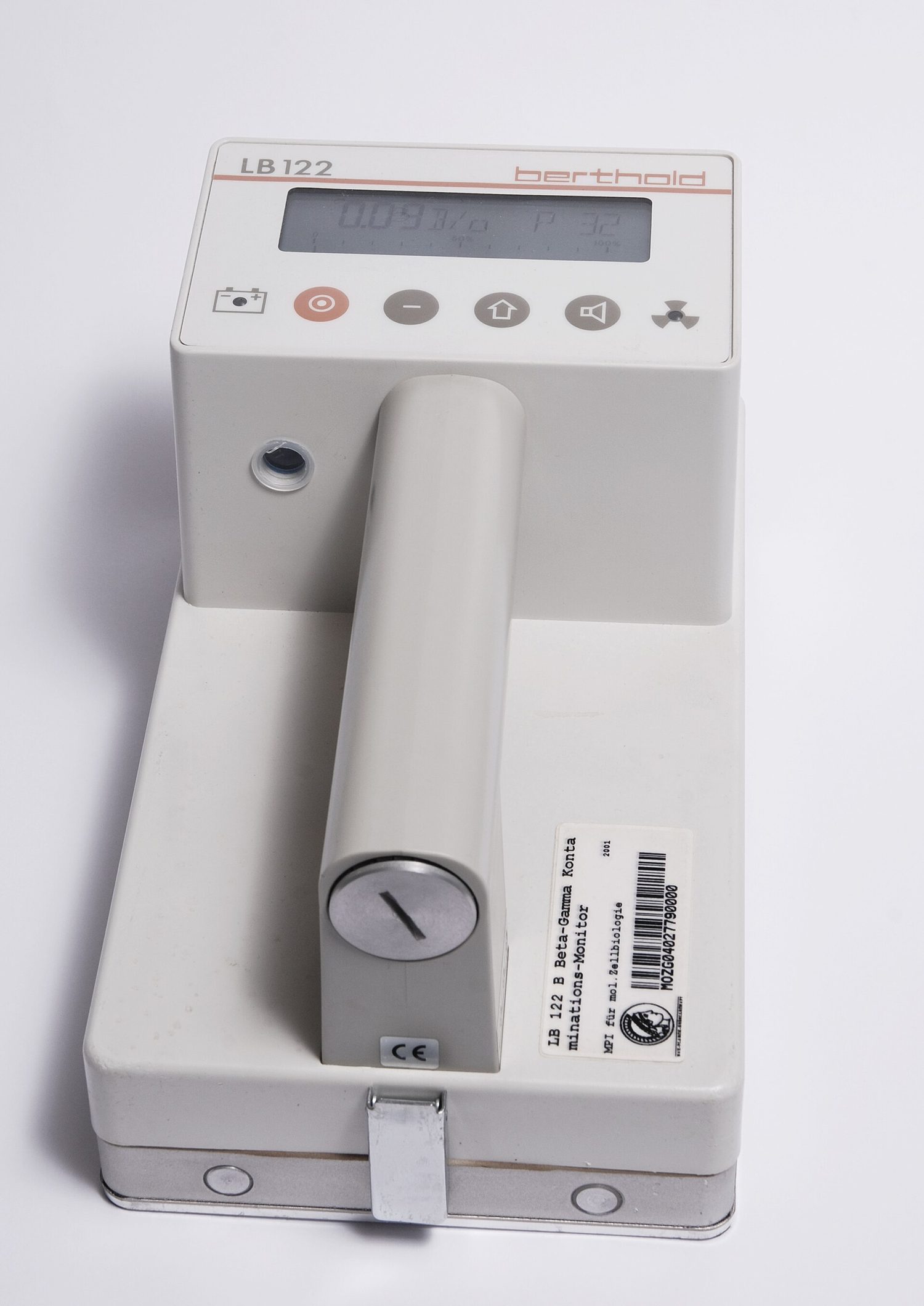
A Geiger counter detects and counts radiation
放射性衰变
N = N₀·bᵗ
The number of unstable nuclei 衰变 exponentially.
Radioactive decay is spontaneous and random. This means:
难度 1/5 · 今日首次完成可获 100 金币及少量额外奖励
Spontaneous = not triggered and not controllable; random = you cannot say which nucleus decays next or exactly when.
Background radiation 背景辐射 and measuring
- Some radiation is around us all the time — background radiation.
- Main sources: radon 氡 gas (usually the biggest), rocks and buildings, food and drink, cosmic rays 宇宙射线 from space.
- A detector and counter give the count rate 计数率 (counts per second or minute).
- To find a source's true rate, subtract the background:
A source reads $250$ counts/min. The background is $30$ counts/min. What is the corrected count rate, in counts/min?
难度 2/5 · 今日首次完成可获 140 金币及少量额外奖励
Corrected = measured − background = $250 - 30 = 220$ counts/min.
The three types of radiation
- Alpha α粒子 (α) — a helium nucleus (charge $+2$): most ionising 电离, least penetrating — stopped by paper.
- Beta β粒子 (β) — a fast electron (charge $-1$): medium — stopped by a few mm of aluminium.
- Gamma γ射线 (γ) — a high-energy EM wave (no charge): least ionising, most penetrating — only reduced by thick lead.
- Why alpha ionises most: it has the largest charge (+2) and a lot of kinetic energy, and it moves slowly, so it pulls electrons off almost every atom near its path. It uses up its energy in a few centimetres of air, which is why it penetrates least. Gamma has no charge, so it rarely ionises and travels furthest.
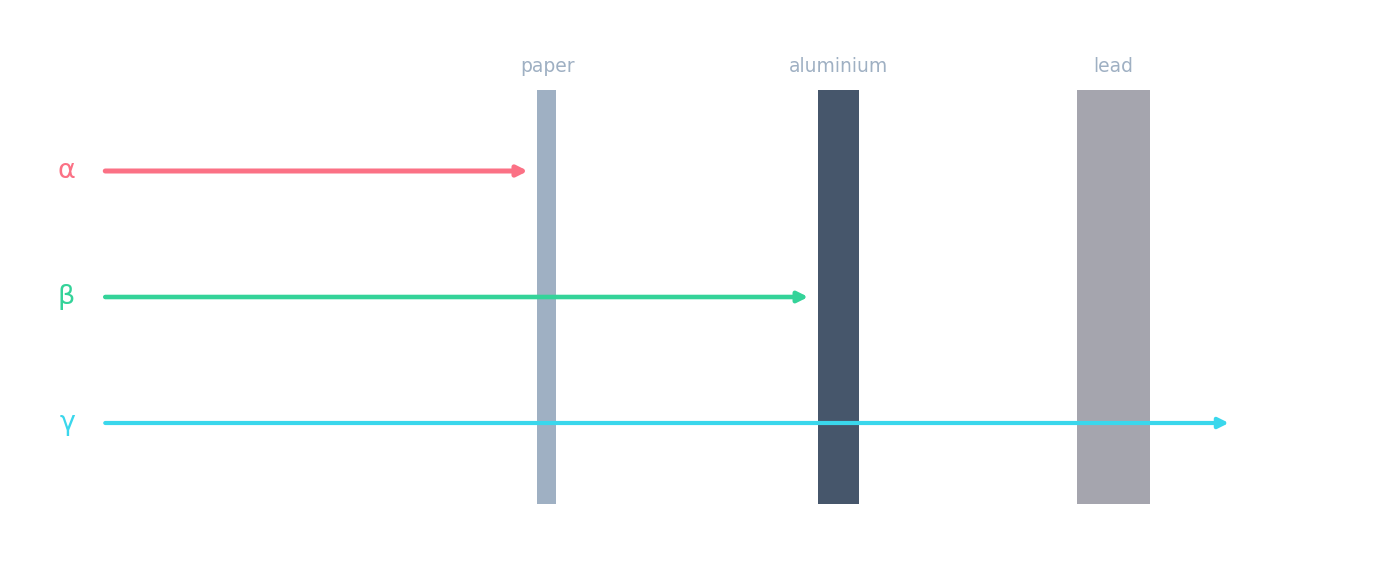
Match each radiation to what stops it.
难度 2/5 · 今日首次完成可获 140 金币及少量额外奖励
Alpha is least penetrating (paper), beta is medium (aluminium), gamma is most penetrating (thick lead only reduces it).
Which radiation is the most ionising but the least penetrating?
难度 1/5 · 今日首次完成可获 100 金币及少量额外奖励
Alpha is the most ionising (big +2 charge, slow and heavy) but is easily absorbed — the least penetrating.
Why is alpha radiation the most ionising?
难度 1/5 · 今日首次完成可获 100 金币及少量额外奖励
Ionising depends on charge and kinetic energy. Alpha (+2) interacts with nearly every atom near its path, so it loses its energy quickly and penetrates least.
Deflection and decay equations
- Because α and β are charged, electric and magnetic fields deflect them in opposite directions. β bends more because it is much lighter. γ has no charge and goes straight through.
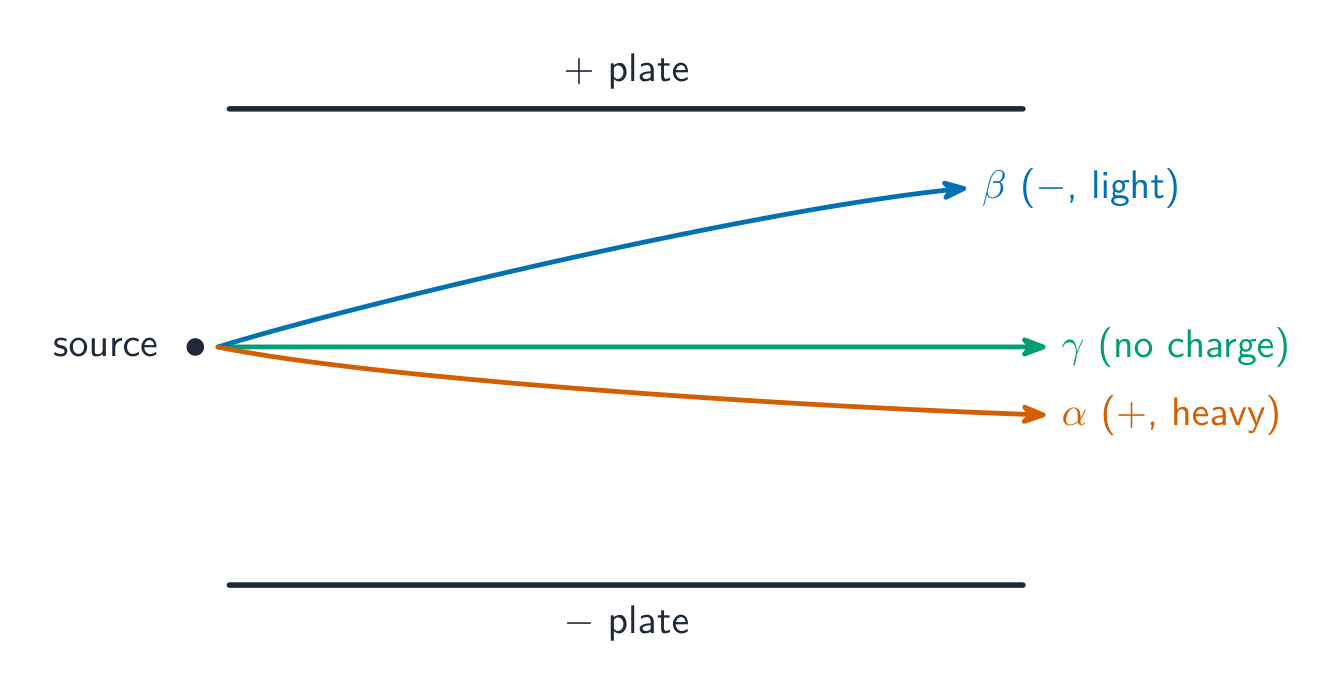
- In a magnetic field the paths curve too, α and β in opposite directions (use Fleming's left-hand rule, remembering that β moves like a negative current).
- In α or β decay the nucleus becomes a different element and gets more stable; β decay reduces the number of excess neutrons.
- Alpha decay: lose 2 protons + 2 neutrons, so $A$ falls by 4 and $Z$ by 2.
- Beta decay: a neutron becomes a proton + the emitted electron, so $A$ stays the same and $Z$ rises by 1, e.g. $^{24}_{11}\text{Na} \rightarrow {}^{24}_{12}\text{Mg} + {}^{\ \ 0}_{-1}\beta$.
- Gamma: only energy leaves, so $A$ and $Z$ are unchanged.
Exam question. Uranium-238 ($^{238}_{\ 92}\text{U}$) decays by alpha emission to thorium (Th). Write the decay equation. [2]
- The alpha particle is $^{4}_{2}\text{He}$ (or $^{4}_{2}\alpha$). Top: 238 − 4 = 234. Bottom: 92 − 2 = 90.
- $^{238}_{\ 92}\text{U} \rightarrow {}^{234}_{\ 90}\text{Th} + {}^{4}_{2}\text{He}$
- Mark-scheme reasoning: one mark for the correct alpha symbol, one for 234 and 90. Check that both rows balance: 238 = 234 + 4 and 92 = 90 + 2.
When a nucleus emits an alpha particle, the nucleon number A and proton number Z change by:
难度 1/5 · 今日首次完成可获 100 金币及少量额外奖励
An alpha particle is 2 protons + 2 neutrons, so A drops by 4 and Z drops by 2.
Gamma radiation is deflected by a magnetic field.
难度 1/5 · 今日首次完成可获 100 金币及少量额外奖励
Gamma rays have no charge, so they are not deflected. Only the charged alpha and beta particles bend in fields.
Polonium-210 (proton number 84) decays by alpha emission to lead. What is the nucleon number of the lead nucleus?
难度 2/5 · 今日首次完成可获 140 金币及少量额外奖励
Alpha emission removes 4 nucleons: 210 − 4 = 206. The proton number falls by 2, to 82 (lead).
Carbon-14 (proton number 6) decays by beta emission. What is the proton number of the new nucleus?
难度 2/5 · 今日首次完成可获 140 金币及少量额外奖励
In beta decay a neutron becomes a proton, so Z rises by 1: 6 + 1 = 7 (nitrogen-14). A stays 14.
Worked examples
1. A detector reads $340$ counts/min near a source; background is $20$ counts/min. Corrected count rate $= 340 - 20 = 320$ counts/min.
2. Paper barely changes the count; $3\ \text{mm}$ of aluminium brings it down to background. The source gives beta: not alpha (paper would stop it), not gamma (aluminium would not stop it).
Subtract the background first. It is there even with no source, so leaving it in makes every source look stronger.
You've got it
- decay is spontaneous and random; corrected rate = measured − background
- α (He nucleus, +2): most ionising, stopped by paper
- β (electron, −1): medium, stopped by aluminium; γ (EM wave): most penetrating, lead
- α decay: $A{-}4$, $Z{-}2$ · β decay: $A$ same, $Z{+}1$ · γ: no change; only α and β are deflected
Write from the data: find the corrected rate
- A detector reads 180 counts per minute. The background is 20 counts per minute.
- Find the corrected rate. Say what stops alpha radiation.
A source reads 180 counts per minute and the background is 20 counts per minute. What is the corrected rate, and what stops alpha radiation?
180 minus 20 is 160. The background is not part of the source's own rate.
What is the corrected count rate?
难度 1/5 · 今日首次完成可获 100 金币及少量额外奖励
180 minus 20 is 160 counts per minute.