| Core | Supplement |
|---|---|
| 1 Know that waves transfer energy without transferring matter | |
| 2 Describe what is meant by wave motion as illustrated by vibrations in ropes and springs, and by experiments using water waves | |
| 3 Describe the features of a wave in terms of wavefront, wavelength, frequency, crest (peak), trough, amplitude and wave speed | |
| 4 Recall and use the equation for wave speed $v = f \lambda$ | |
| 5 Know that for a transverse wave, the direction of vibration is at right angles to the direction of propagation and understand that electromagnetic radiation, water waves and seismic S-waves (secondary) can be modelled as transverse | |
| 6 Know that for a longitudinal wave, the direction of vibration is parallel to the direction of propagation and understand that sound waves and seismic P-waves (primary) can be modelled as longitudinal | |
| 7 Describe how waves can undergo: (a) reflection at a plane surface (b) refraction due to a change of speed (c) diffraction through a narrow gap | 9 Describe how wavelength and gap size affects diffraction through a gap |
| 8 Describe the use of a ripple tank to show: (a) reflection at a plane surface (b) refraction due to a change in speed caused by a change in depth (c) diffraction due to a gap (d) diffraction due to an edge | 10 Describe how wavelength affects diffraction at an edge |
波
IGCSE 物理 · 第 3 主题
 17:11
17:11
Waves
Drop a stone in a pond, and rings spread outward. But watch a leaf floating on the surface — it only bobs up and down; it does not travel with the ripples.…
英文讲解 · 内嵌中英文字幕
3.1
波的一般性质

大纲
来源:剑桥国际大纲
一个波(wave)把能量(energy)从一处带到另一处而不携带物质。例如,一个水波使一个漂浮的软木塞上下浮动,但软木塞不随波行进。你可以通过上下摇一根绳子的一端在绳子上做出一个波,或通过前后推一根长弹簧的一端在弹簧上做出一个波。在一个波纹水槽(ripple tank,一个浅的水盘,上方有一盏灯)中,你可以在下方的屏幕上观察水波。
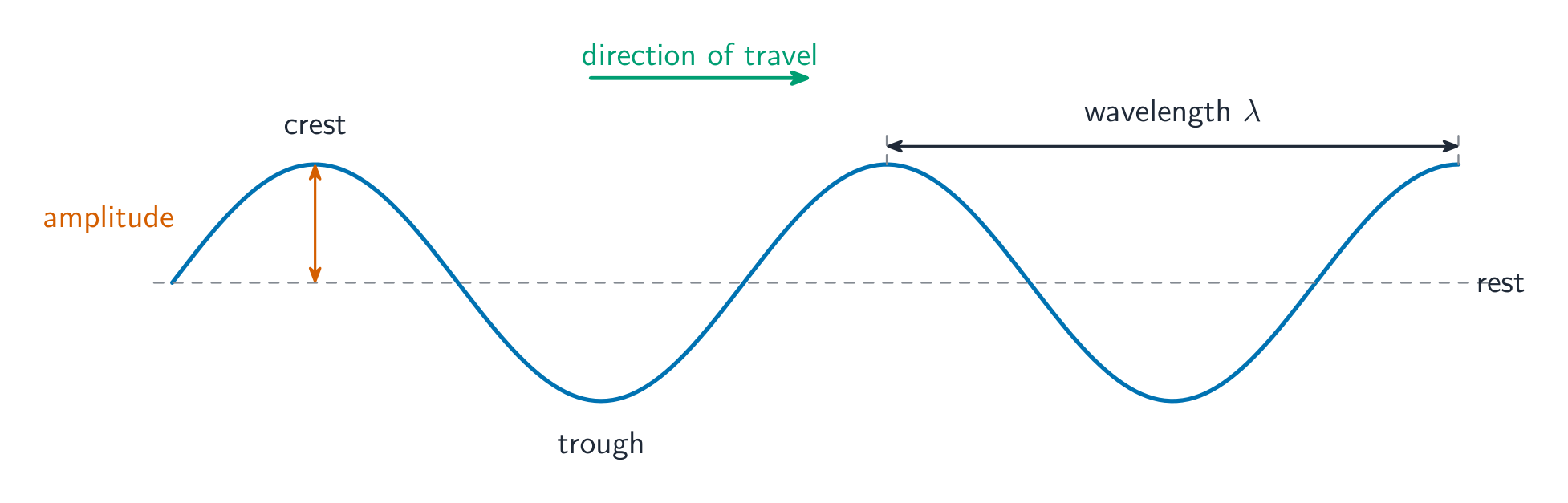
Describing a wave
- 波前(wavefront):连接一个波上一起运动的点的一条线(例如,一个涟漪的顶部)
- 波长(wavelength,$\lambda$):两个相邻波前之间的距离(一个完整的波)
- 频率(frequency,$f$):每秒通过一个点的波的数目,以赫兹(Hz)测量
- 波峰(crest,也叫 peak,顶)和波谷(trough,底)
- 振幅(amplitude):一个点从它静止位置移动的最大距离
- 波速(wave speed,$v$):一个波前行进得多快
这些由波动方程联系:
$$v = f\lambda$$
例题。 一个声波以 $340\ \text{m/s}$ 行进,有 $170\ \text{Hz}$ 的频率。求它的波长。
重排 $v = f\lambda$ 给出 $\lambda = \dfrac{v}{f}$:
$$\lambda = \frac{340}{170} = 2.0\ \text{m}$$
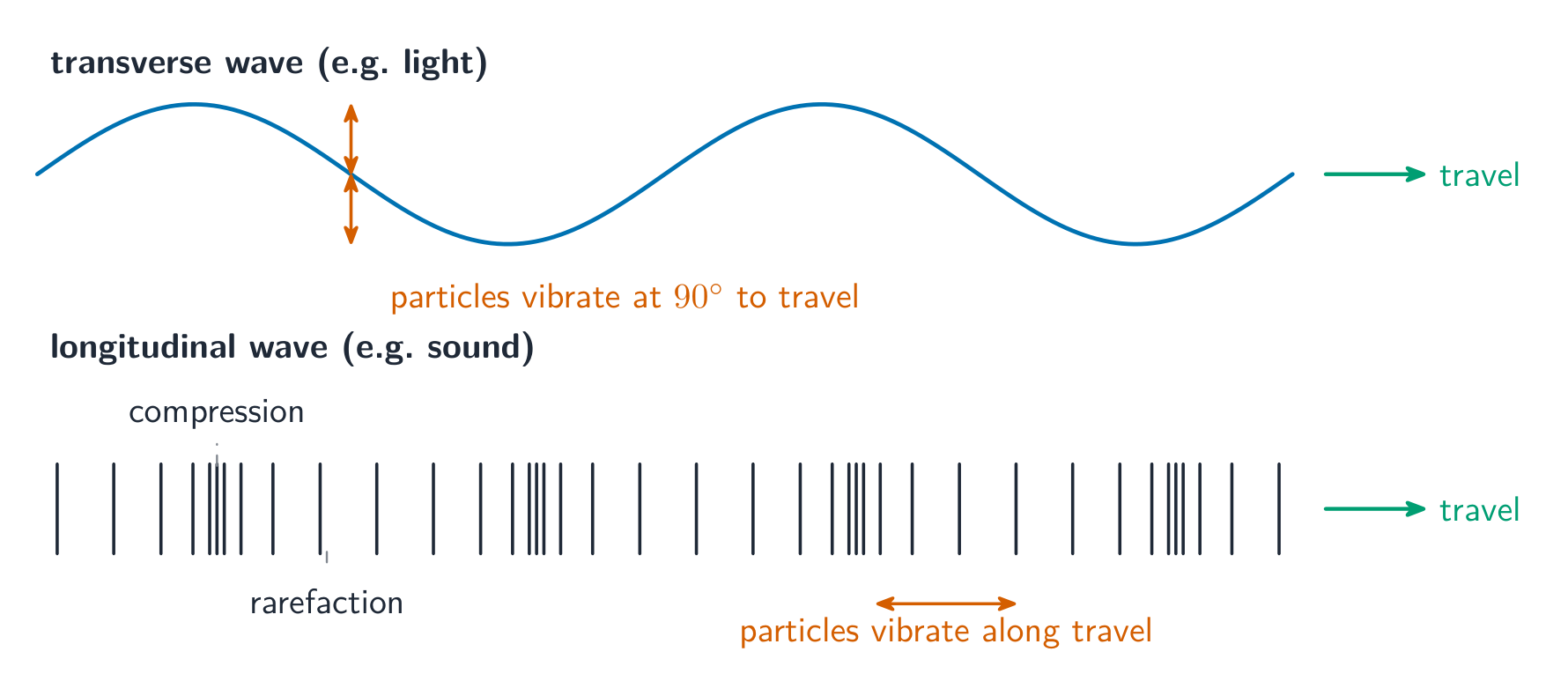
Two types of wave
- 在一个横波(transverse wave)中,粒子在与波行进(它的传播(propagation))成直角(90°)的方向振动。光、水波和地震 S 波(地震中横向的晃动)是横波。
- 在一个纵波(longitudinal wave)中,粒子沿波行进的同一个方向振动。声音和地震 P 波是纵波。
Wave behaviour
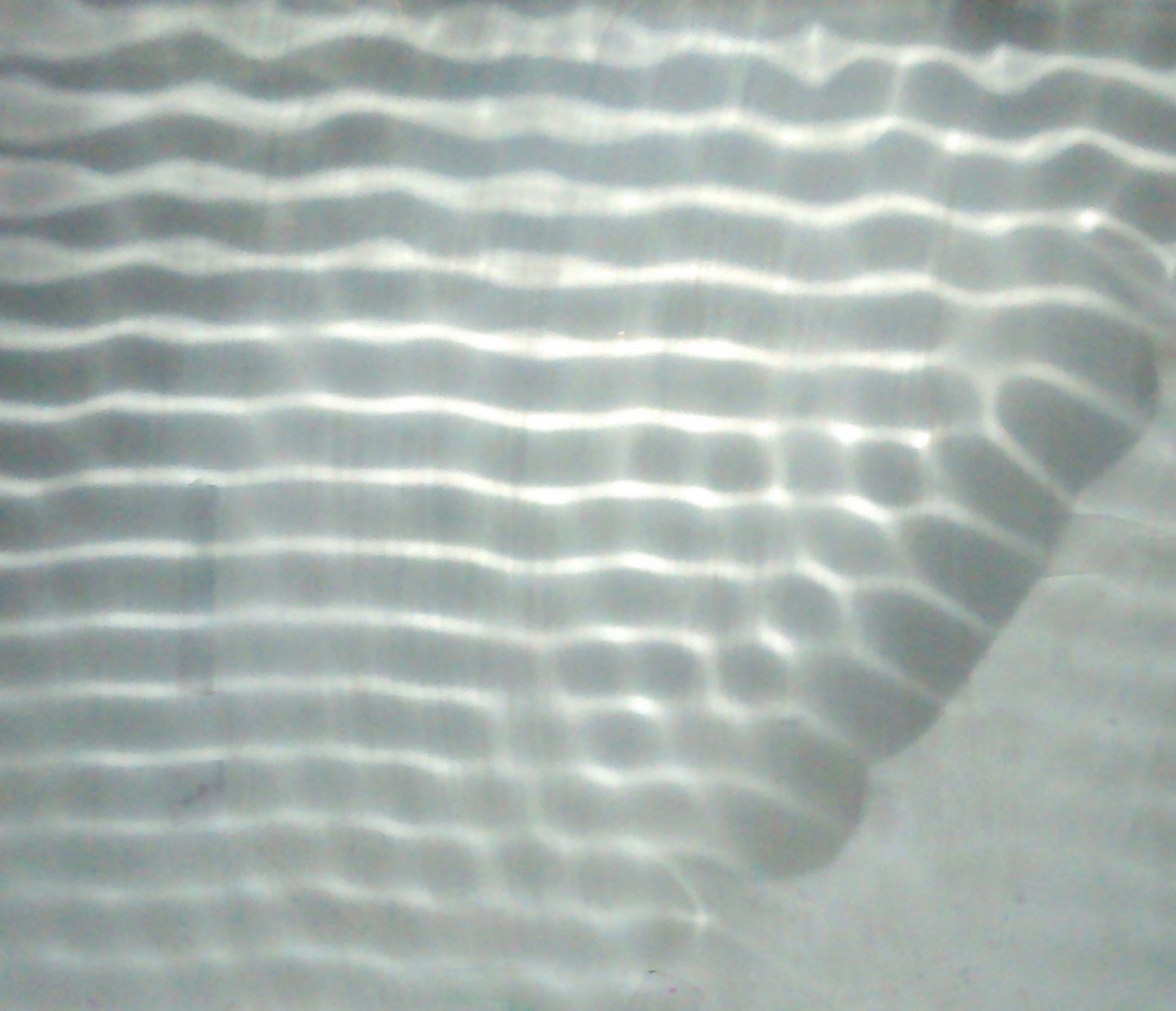
所有的波都能显示三种行为,你可以在一个波纹水槽(ripple tank)中看到:
- 反射(reflection):波从一个表面弹回。
- 折射(refraction):波在进入一个不同的材料或深度时改变速率(而且通常方向)。
- 衍射(diffraction):波在通过一个间隙或绕一个边缘之后铺开。当间隙约与波长同样大小时铺开最大。

探索
Properties of waves
y = a sin(bx + c)
A wave: a is amplitude, b sets the wavelength.
探索
Transverse & longitudinal waves
Flip between a transverse wave (particles bob up and down, like water and light) and a longitudinal one (particles slide back and forth, bunching into compressions, like sound). The wave moves; the particles stay put.
探索
Two waves overlapping
Change the second wave. Where waves meet they add — sometimes reinforcing, sometimes cancelling.
词汇表
训练
| 英文 | 中文 | 拼音 |
|---|---|---|
| wave/weɪv/ | 波 | bō |
| energy/ˈenədʒi/ | 能量 | néng liàng |
| ripple tank/ˈrɪpl tæŋk/ | 波纹水槽 | bō wén shuǐ cáo |
| wavefront/ˈweɪvfrʌnt/ | 波前 | bō qián |
| wavelength/ˈweɪvleŋθ/ | 波长 | bō cháng |
| frequency/ˈfriːkwənsi/ | 频率 | pín lǜ |
| crest/krest/ | 波峰 | bō fēng |
| peak/piːk/ | 峰 | fēng |
| trough/trɒf/ | 波谷 | bō gǔ |
| amplitude/ˈæmplɪtjuːd/ | 振幅 | zhèn fú |
| wave speed/weɪv spiːd/ | 波速 | bō sù |
| transverse wave/trænsˈvɜːs weɪv/ | 横波 | héng bō |
| propagation/ˌprɒpəˈɡeɪʃn/ | 传播 | chuán bō |
| longitudinal wave/ˌlɒŋɡɪˈtjuːdɪnl weɪv/ | 纵波 | zòng bō |
| diffraction/dɪˈfrækʃn/ | 衍射 | yǎn shè |
| light/laɪt/ | 光 | guāng |
3.2
光
大纲
3.2.1 Reflection of light
| Core | Supplement |
|---|---|
| 1 Define and use the terms normal, angle of incidence and angle of reflection | |
| 2 Describe the formation of an optical image by a plane mirror and give its characteristics, i.e. same size, same distance from mirror, virtual | |
| 3 State that for reflection, the angle of incidence is equal to the angle of reflection; recall and use this relationship | 4 Use simple constructions, measurements and calculations for reflection by plane mirrors |
3.2.2 Refraction of light
| Core | Supplement |
|---|---|
| 1 Define and use the terms normal, angle of incidence and angle of refraction | |
| 2 Describe an experiment to show refraction of light by transparent blocks of different shapes | 6 Define refractive index, $n$, as the ratio of the speeds of a wave in two different regions |
| 3 Describe the passage of light through a transparent material (limited to the boundaries between two mediums only) | 7 Recall and use the equation $$n = \frac{\sin i}{\sin r}$$ |
| 4 State the meaning of critical angle | 8 Recall and use the equation $$n = \frac{1}{\sin c}$$ |
| 5 Describe internal reflection and total internal reflection using both experimental and everyday examples | 9 Describe the use of optical fibres, particularly in telecommunications |
3.2.3 Thin lenses
| Core | Supplement |
|---|---|
| 1 Describe the action of thin converging and thin diverging lenses on a parallel beam of light | |
| 2 Define and use the terms focal length, principal axis and principal focus (focal point) | |
| 3 Draw and use ray diagrams for the formation of a real image by a converging lens | 6 Draw and use ray diagrams for the formation of a virtual image by a converging lens |
| 4 Describe the characteristics of an image using the terms enlarged/same size/diminished, upright/inverted and real/virtual | 7 Describe the use of a single lens as a magnifying glass |
| 5 Know that a virtual image is formed when diverging rays are extrapolated backwards and does not form a visible projection on a screen | |
| 8 Describe the use of converging and diverging lenses to correct long-sightedness and short-sightedness |
3.2.4 Dispersion of light
| Core | Supplement |
|---|---|
| 1 Describe the dispersion of light as illustrated by the refraction of white light by a glass prism | |
| 2 Know the traditional seven colours of the visible spectrum in order of frequency and in order of wavelength | 3 Recall that visible light of a single frequency is described as monochromatic |
来源:剑桥国际大纲
Reflection
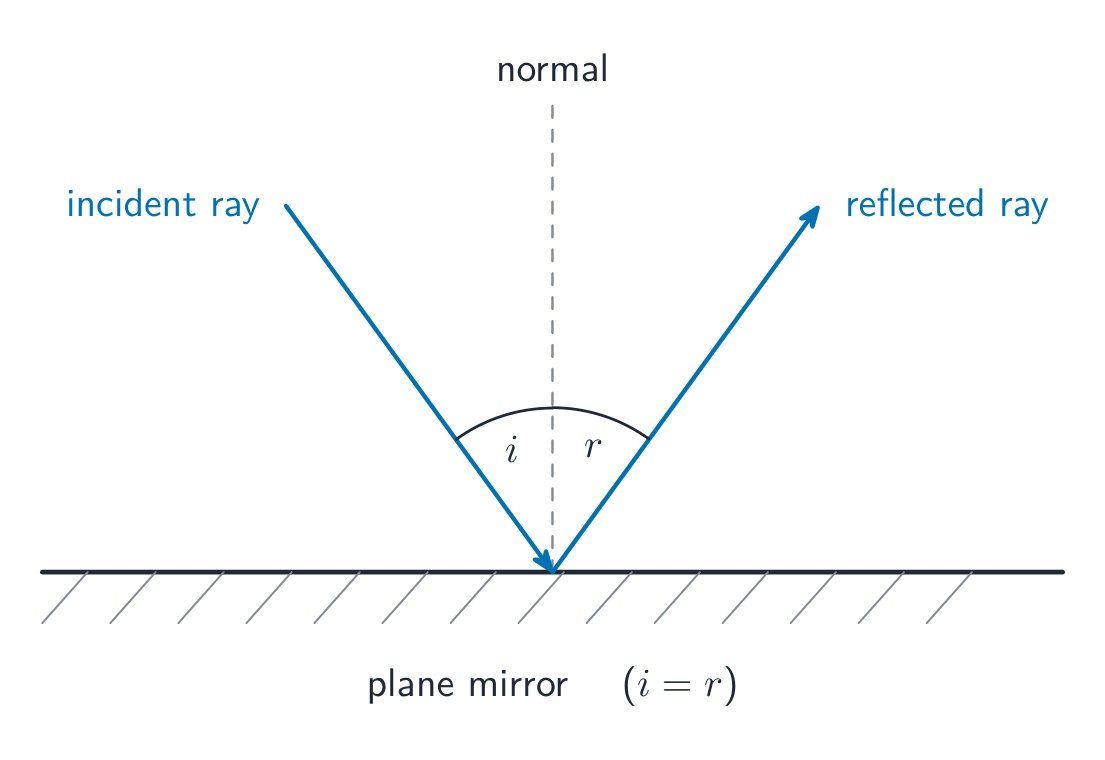
当光撞击一面镜子时,它反射。我们从法线(normal,一条与表面成 90° 的线)测量角。
反射定律:入射角(angle of incidence)等于反射角(angle of reflection)。
一面平面镜(plane mirror)构成一个像,它与物体同样大小、在镜子后面同样的距离,而且是虚的(它不能在一个屏幕上被接住)。
Refraction
当光从一个材料进入另一个时,它改变速率并弯曲。第二个材料中的角是折射角(angle of refraction)。
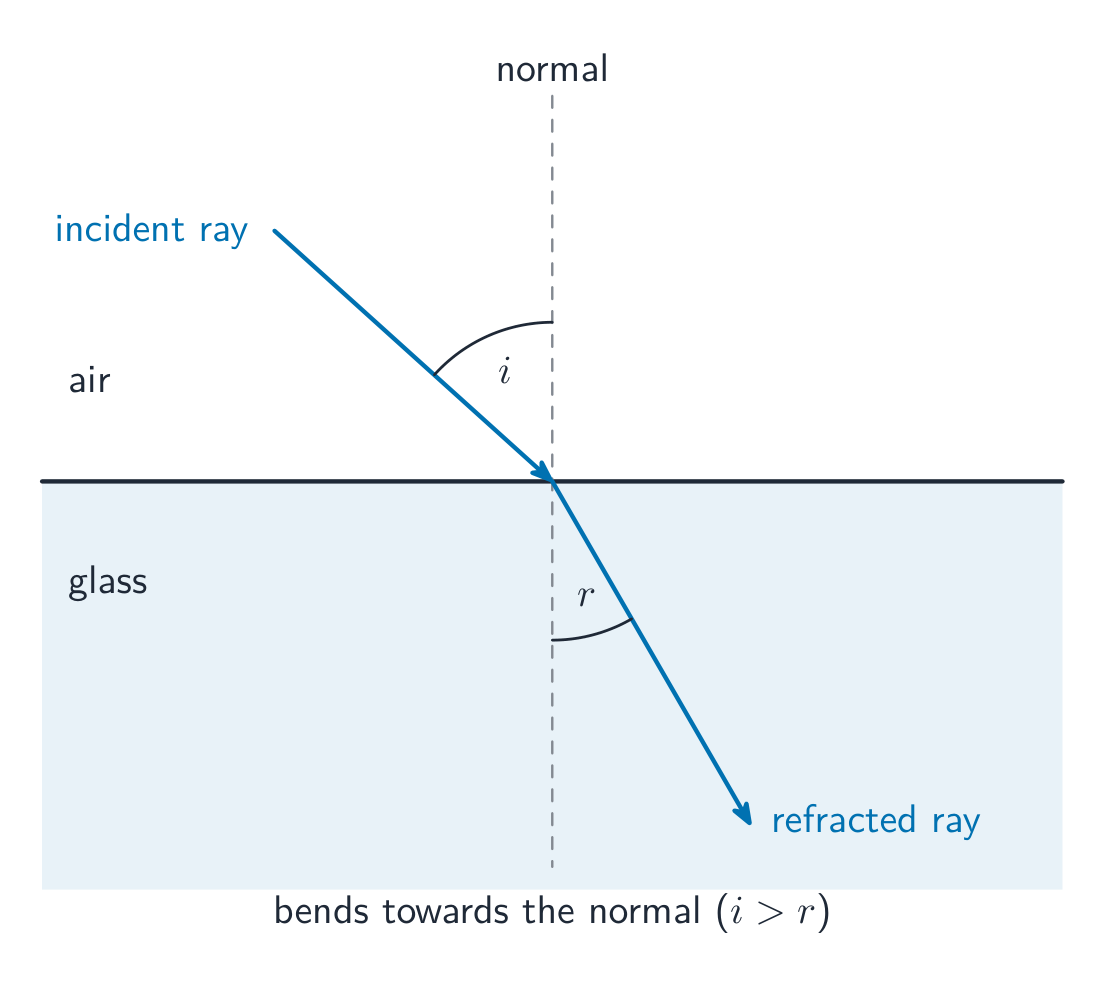
看见折射。 从一个光线盒(ray box)射一条窄的光线,进入一个立在纸上的矩形玻璃块。标记进去的光线和出来的光线,拿走玻璃块,把标记连起来画出玻璃里的光线。在光线进入处画法线,并用量角器测量入射角和折射角。用一个半圆形玻璃块或一个棱镜重复:光线在进入玻璃时总是朝法线弯曲,在离开时远离法线。
折射率(refractive index)$n$ 比较光在两个材料中的速率:
$$n = \frac{\sin i}{\sin r}$$
例题。 一条光线从空气进入玻璃。入射角是 60° 而折射角是 35°。求玻璃的折射率。(取 $\sin i = 0.87$ 和 $\sin r = 0.57$。)
$$n = \frac{\sin i}{\sin r} = \frac{0.87}{0.57} = 1.5$$
当光试图离开玻璃或水而角太大时,它不能出去,而是完全反射。这是全反射(total internal reflection)。它在内部的角比临界角(critical angle)$c$ 大时发生:
$$n = \frac{1}{\sin c}$$

这个效果被用于光纤(optical fibres),为电话和互联网携带光信号的细玻璃丝。

Lenses
一个凸透镜(converging lens,中间胖)把平行光线向内弯到一个叫焦点(principal focus)的点。主光轴(principal axis)是通过透镜中心并与它成直角的直线;焦点位于这条轴上。从透镜中心到焦点的距离是焦距(focal length)。一个凹透镜(diverging lens,中间薄)把平行光线铺开,好像它们来自入射一侧的一个焦点。
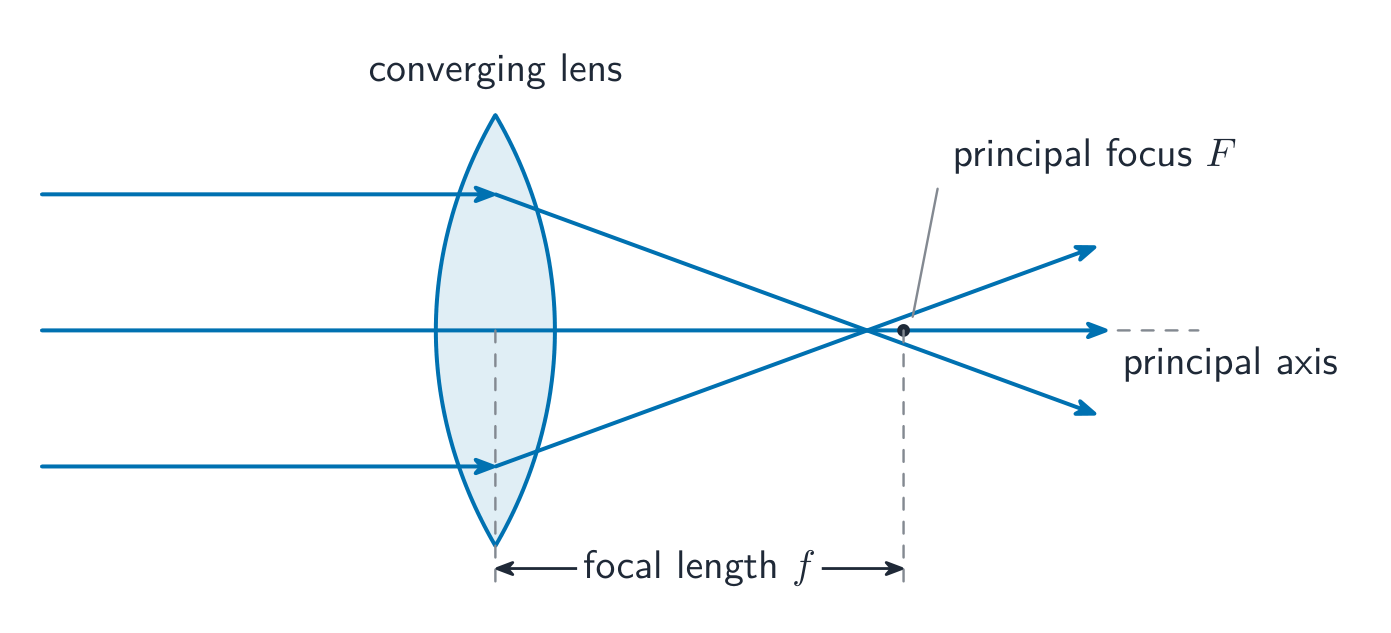
一个凸透镜能构成一个实像(real image,光线真的相遇;能在一个屏幕上显示)或,当物体非常近时,一个虚像(virtual image,光线只是似乎来自它)。在眼睛附近使用,一个凸透镜是一个放大镜(magnifying glass)。
用三对词描述一个像:放大的(enlarged)或缩小的(diminished)(或同样大小)、正立(upright)或倒立(inverted,上下颠倒),以及实的或虚的。一个远在焦点之外的物体给出一个缩小的、倒立的实像(如在一台相机中)。一个在焦点和透镜之间的物体给出一个放大的、正立的虚像(一个放大镜)。
矫正视力。 一个近视(short-sightedness)的人看近处清楚但远处模糊:眼睛把光聚焦在视网膜(retina,眼睛的后部)前面。眼前的一个凹透镜先把光线铺开,这样它们聚焦在视网膜上。一个远视(long-sightedness)的人看远处清楚但近处模糊:眼睛把光聚焦在视网膜后面。一个凸透镜在光线进入眼睛前先把它们稍微会聚。
Dispersion
一个玻璃棱镜(prism)把白光分裂成光谱(spectrum)的颜色。这个分裂叫色散(dispersion)。

颜色的顺序是红、橙、黄、绿、蓝、靛、紫。红光有最长的波长和最低的频率;紫是相反的。单一频率(一种纯颜色)的光是单色(monochromatic)的。

探索
Bend a light ray
Shine light into water, glass or diamond and change the angle. The ray slows and bends toward the normal — the denser the material (higher n), the more it bends. That bending is why a straw looks broken in a glass, and why diamonds sparkle.
探索
Image formation by a converging lens
Trace the three special rays from the object — where they meet is the image. Move the object closer than the focal point to flip it into a magnifying glass.
词汇表
训练
| 英文 | 中文 | 拼音 |
|---|---|---|
| reflection/rɪˈflekʃn/ | 反射 | fǎn shè |
| refraction/rɪˈfrækʃn/ | 折射 | zhé shè |
| normal/ˈnɔːml/ | 法线 | fǎ xiàn |
| angle of incidence/ˈæŋɡl ɒv ˈɪnsɪdəns/ | 入射角 | rù shè jiǎo |
| angle of reflection/ˈæŋɡl ɒv rɪˈflekʃn/ | 反射角 | fǎn shè jiǎo |
| plane mirror/pleɪn ˈmɪrə/ | 平面镜 | píng miàn jìng |
| angle of refraction/ˈæŋɡl ɒv rɪˈfrækʃn/ | 折射角 | zhé shè jiǎo |
| ray box/reɪ bɒks/ | 光线盒 | guāng xiàn hé |
| refractive index/rɪˈfræktɪv ˈɪndeks/ | 折射率 | zhé shè lǜ |
| total internal reflection/ˈtəʊtl ɪnˈtɜːnl rɪˈflekʃn/ | 全反射 | quán fǎn shè |
| critical angle/ˈkrɪtɪkl ˈæŋɡl/ | 临界角 | lín jiè jiǎo |
| optical fibre/ˈɒptɪkl ˈfaɪbə/ | 光纤 | guāng xiān |
| converging lens/kənˈvɜːdʒɪŋ lenz/ | 凸透镜 | tū tòu jìng |
| principal focus/ˈprɪnsɪpl ˈfəʊkəs/ | 焦点 | jiāo diǎn |
| principal axis/ˈprɪnsɪpl ˈæksɪs/ | 主光轴 | zhǔ guāng zhóu |
| focal length/ˈfəʊkl leŋθ/ | 焦距 | jiāo jù |
| diverging lens/daɪˈvɜːdʒɪŋ lenz/ | 凹透镜 | āo tòu jìng |
| real image/rɪəl ˈɪmɪdʒ/ | 实像 | shí xiàng |
| virtual image/ˈvɜːtʃuːəl ˈɪmɪdʒ/ | 虚像 | xū xiàng |
| magnifying glass/ˈmæɡnɪfaɪɪŋ ɡlæs/ | 放大镜 | fàng dà jìng |
| enlarged/enˈlɑːdʒd/ | 放大的 | fàng dà de |
| diminished/dɪˈmɪnɪʃt/ | 缩小的 | suō xiǎo de |
| upright/ˈʌpraɪt/ | 正立 | zhèng lì |
| inverted/ɪnˈvɜːtɪd/ | 倒立 | dào lì |
| short-sightedness/ʃɔːt ˈsaɪtɪdnəs/ | 近视 | jìn shì |
| retina/ˈretɪnə/ | 视网膜 | shì wǎng mó |
| long-sightedness/lɒŋ ˈsaɪtɪdnəs/ | 远视 | yuǎn shì |
| prism/ˈprɪzəm/ | 棱镜 | léng jìng |
| spectrum/ˈspektrəm/ | 光谱 | guāng pǔ |
| dispersion/dɪˈspɜːʃn/ | 色散 | sè sàn |
| monochromatic/ˌmɒnəʊkrəʊˈmætɪk/ | 单色 | dān sè |
3.3
电磁波谱
大纲
| Core | Supplement |
|---|---|
| 1 Know the main regions of the electromagnetic spectrum in order of frequency and in order of wavelength | |
| 2 Know that all electromagnetic waves travel at the same high speed in a vacuum | 6 Know that the speed of electromagnetic waves in a vacuum is $3.0 \times 10^8\text{ m/s}$ and is approximately the same in air |
| 3 Describe typical uses of the different regions of the electromagnetic spectrum including: (a) radio waves; radio and television transmissions, astronomy, radio frequency identification (RFID) (b) microwaves; satellite television, mobile phones (cell phones), microwave ovens (c) infrared; electric grills, short range communications such as remote controllers for televisions, intruder alarms, thermal imaging, optical fibres (d) visible light; vision, photography, illumination (e) ultraviolet; security marking, detecting fake bank notes, sterilising water (f) X-rays; medical scanning, security scanners (g) gamma rays; sterilising food and medical equipment, detection of cancer and its treatment | |
| 4 Describe the harmful effects on people of excessive exposure to electromagnetic radiation, including: (a) microwaves; internal heating of body cells (b) infrared; skin burns (c) ultraviolet; damage to surface cells and eyes, leading to skin cancer and eye conditions (d) X-rays and gamma rays; mutation or damage to cells in the body | |
| 5 Know that communication with artificial satellites is mainly by microwaves: (a) some satellite phones use low orbit artificial satellites (b) some satellite phones and direct broadcast satellite television use geostationary satellites | 7 Know that many important systems of communications rely on electromagnetic radiation including: (a) mobile phones (cell phones) and wireless internet use microwaves because microwaves can penetrate some walls and only require a short aerial for transmission and reception (b) Bluetooth uses radio waves because radio waves pass through walls but the signal is weakened on doing so (c) optical fibres (visible light or infrared) are used for cable television and high-speed broadband because glass is transparent to visible light and some infrared; visible light and short wavelength infrared can carry high rates of data |
| 8 Know the difference between a digital and analogue signal | |
| 9 Know that a sound can be transmitted as a digital or analogue signal | |
| 10 Explain the benefits of digital signalling including increased rate of transmission of data and increased range due to accurate signal regeneration |
来源:剑桥国际大纲
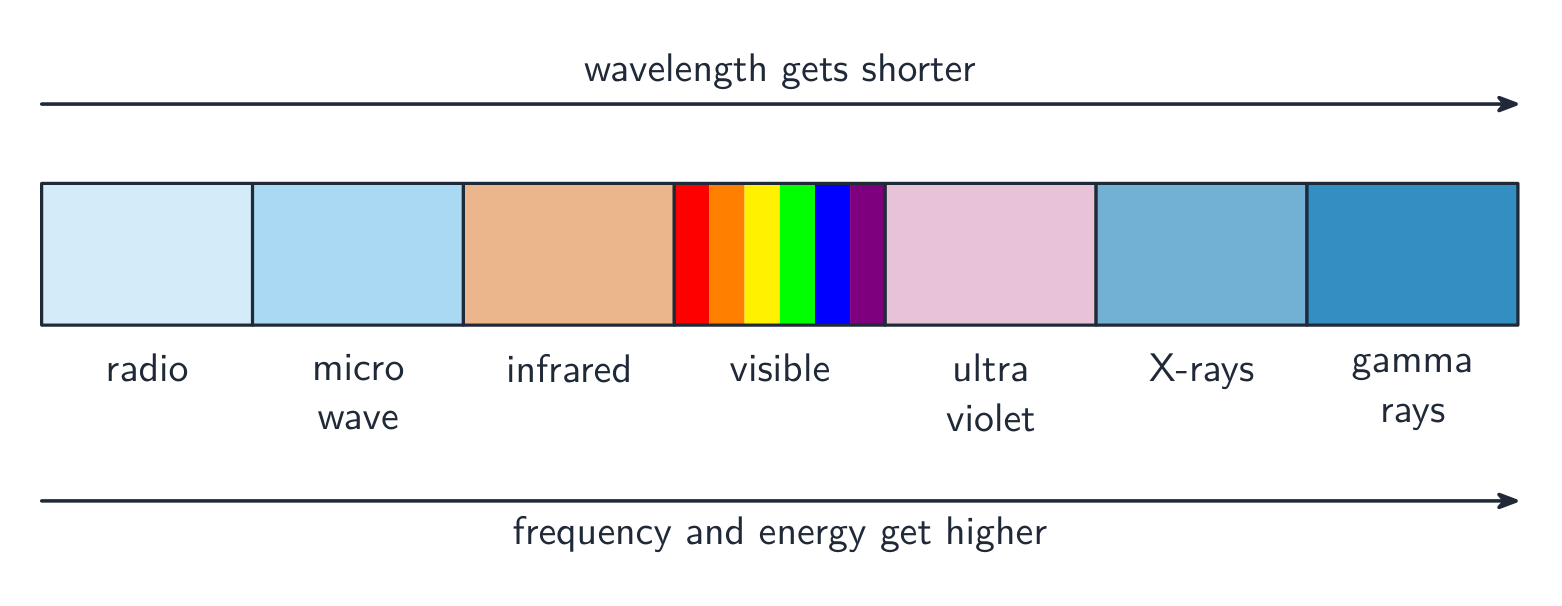
电磁波谱(electromagnetic spectrum)是一族波,它们在真空(vacuum)中都以同样的高速行进,$3.0 \times 10^8\ \text{m/s}$。按从最长波长(最低频率)到最短的顺序:
| 区域 | 一个典型的用途 | 太多的危险 |
|---|---|---|
| 无线电波(radio waves) | 无线电和电视信号、天文学、RFID 标签 | — |
| 微波(microwaves) | 手机、卫星电视、烹饪 | 身体细胞的加热 |
| 红外线(infrared) | 遥控器、热成像、烤架、光纤 | 皮肤烧伤 |
| 可见光 | 看见、摄影 | — |
| 紫外线(ultraviolet) | 净化水、检查钞票 | 皮肤癌、眼睛损伤 |
| X射线(X-rays) | 医疗和安全扫描 | 对细胞的损伤 |
| 伽马射线(gamma rays) | 消毒设备、治疗癌症 | 细胞的突变 |
随着你从无线电波到伽马射线,频率上升、波长下降,而能量(和危险)上升。电磁波在空气中的速率与在真空中几乎相同。
卫星。 与人造卫星(artificial satellites)的通信主要用微波,因为微波能穿过大气。一些卫星电话用低轨道(low orbit)上靠近地球的卫星。其他卫星电话,以及直播卫星电视,用地球静止轨道(geostationary orbit)上的卫星,它们停留在地球上同一点的上方。
数字信号与模拟信号
无线电波和微波把信息作为信号来携带,而一个信号要么是模拟(analogue)的,要么是数字(digital)的。一个模拟信号是连续变化的,可以取任何值;一个数字信号是只有两个值(开或关,1 或 0)的流。声音可以作为任一种信号发送:一个麦克风给出一个模拟信号,它可以被变成一个数字信号。
现代通信偏好数字信号,原因有两个,考试会问到:
- 更高的数据传输速率;
- 更大的范围:一个微弱的数字信号能被精确地再生回干净的
1/0,因为只需要分辨两个电平,所以沿途拾取的噪声被去除。一个模拟信号无法这样被清理,所以它的噪声会累积。
探索
Slide across the spectrum
Radio waves, visible light and gamma rays are all the same wave — only the wavelength changes, and with it the frequency, photon energy and everyday use.
词汇表
训练
| 英文 | 中文 | 拼音 |
|---|---|---|
| electromagnetic spectrum/ɪˌlektrəʊməɡˈnetɪk ˈspektrəm/ | 电磁波谱 | diàn cí bō pǔ |
| vacuum/ˈvækjuːm/ | 真空 | zhēn kōng |
| radio waves/ˈreɪdɪəʊ weɪvz/ | 无线电波 | wú xiàn diàn bō |
| microwave/ˈmaɪkrəʊweɪv/ | 微波 | wēi bō |
| infrared/ˌɪnfrəˈred/ | 红外线 | hóng wài xiàn |
| ultraviolet/ˌʊltrəˈvaɪəlɪt/ | 紫外线 | zǐ wài xiàn |
| X-rays/eks reɪz/ | X射线 | X shè xiàn |
| gamma rays/ˈɡæmə reɪz/ | 伽马射线 | gā mǎ shè xiàn |
| artificial satellites/ˌɑːtɪˈfɪʃl ˈsætəlaɪts/ | 人造卫星 | rén zào wèi xīng |
| low orbit/ləʊ ˈɔːbɪt/ | 低轨道 | dī guǐ dào |
| geostationary orbit/ˌdʒiːəʊˈsteɪʃənəri ˈɔːbɪt/ | 地球静止轨道 | dì qiú jìng zhǐ guǐ dào |
| analogue/ˈænəlɒɡ/ | 模拟 | mó nǐ |
| digital/ˈdɪdʒɪtl/ | 数字 | shù zì |
3.4
声

大纲
| Core | Supplement |
|---|---|
| 1 Describe the production of sound by vibrating sources | |
| 2 Describe the longitudinal nature of sound waves | 10 Describe compression and rarefaction |
| 3 State the approximate range of frequencies audible to humans as 20Hz to 20000Hz | |
| 4 Know that a medium is needed to transmit sound waves | |
| 5 Know that the speed of sound in air is approximately 330–350m/s | 11 Know that, in general, sound travels faster in solids than in liquids and faster in liquids than in gases |
| 6 Describe a method involving a measurement of distance and time for determining the speed of sound in air | |
| 7 Describe how changes in amplitude and frequency affect the loudness and pitch of sound waves | |
| 8 Describe an echo as the reflection of sound waves | |
| 9 Define ultrasound as sound with a frequency higher than 20kHz | 12 Describe the uses of ultrasound in non-destructive testing of materials, medical scanning of soft tissue and sonar including calculation of depth or distance from time and wave speed |
来源:剑桥国际大纲
声音(sound)由一个振动的物体制造。它是一个纵波:空气被挤进一个压缩(compression,粒子靠近)并被拉进一个稀疏(rarefaction,粒子相隔远)。
- 声音需要一个介质(medium,一个材料)来穿过,所以它不能穿过一个真空。
- 人类能听到约从 $20\ \text{Hz}$ 到 $20\,000\ \text{Hz}$ 的频率。
- 声音行进比光慢得多(空气中约 $340\ \text{m/s}$),而且在液体和固体中比在气体中更快。
- 一个更大的振幅使声音更响(更大的响度(loudness));一个更高的频率使音调(pitch)更高。所以海豚快速的咔嗒声是高音调的,而一记重的鼓击(大振动)是响的。
一个反射的声音是一个回声(echo)。
测量声速。 两个学生站在一个已知的距离之外,例如用卷尺或测距轮量出的 500 m。一个把两块木块撞在一起。另一个在看见木块相撞时启动秒表,在听到撞击声时停止它。光几乎立刻到达,所以测得的时间就是声音花的时间,而速率 = 距离 ÷ 时间。重复并取平均以减小反应时间误差。回声法只需要一个人:在离一堵大墙已知距离处拍手,并给反射的声音计时,记住声音来回走了两趟。
例题。 一个学生站在离一堵大墙 85 m 处并拍手一次。回声 0.50 s 后返回。求声速。
声音行进到墙并返回,一个距离 $2 \times 85 = 170\ \text{m}$,在 $0.50\ \text{s}$ 中:
$$v = \frac{s}{t} = \frac{170}{0.50} = 340\ \text{m/s}$$
超声波(ultrasound)是高于 $20\,000\ \text{Hz}$ 的声音——太高,人类听不到。它的用途依赖反射:声呐测量水深、医学扫描成像一个胎儿或软组织,而无损检测在不切开的情况下找出金属内部的裂缝。像回声一样,一个超声波脉冲来回行进,所以把总距离减半才到物体。
例题。 一个声呐脉冲在发出 $0.10\ \text{s}$ 后从海床返回;声音在水中以 $1500\ \text{m/s}$ 行进。脉冲来回行进 $s = v\times t = 1500\times0.10 = 150\ \text{m}$,所以海深 $150/2 = 75\ \text{m}$。
探索
Sound
y = a sin(bt + c)
Louder = bigger amplitude; higher pitch = higher frequency.
词汇表
训练
| 英文 | 中文 | 拼音 |
|---|---|---|
| sound/saʊnd/ | 声音 | shēng yīn |
| compression/kəmˈpreʃn/ | 压缩 | yā suō |
| rarefaction/ˌreərɪˈfækʃn/ | 稀疏 | xī shū |
| medium/ˈmiːdɪəm/ | 介质 | jiè zhì |
| loudness/ˈlaʊdnəs/ | 响度 | xiǎng dù |
| pitch/pɪtʃ/ | 音调 | yīn diào |
| echo/ˈekəʊ/ | 回声 | huí shēng |
| Ultrasound/ˌʊltrəˈsaʊnd/ | 超声波 | chāo shēng bō |
3.4
考试技巧
- 学习 $v = f\lambda$ 并准备好重排它。从法线(与表面成 90° 的线)测量所有的入射、反射和折射角,绝不从表面本身。
- 横波横过行进方向振动(光、水);纵波沿它振动(声音)。声音需要一个介质,所以它不能越过一个真空;光能。
- 全反射只在光从一个较密的材料行进到一个不那么密的材料且内部的角比临界角大时发生。
- 按顺序知道电磁波谱——无线电、微波、红外线、可见、紫外线、X射线、伽马。都在真空中以同样的速率行进;频率和能量从无线电到伽马上升。
- 进入一个较密的材料(空气 → 玻璃)光减速并朝法线弯曲;离开它(玻璃 → 空气)光加速并远离弯曲。
本主题的互动课程
逐步学习,并即时检测练习。