Sound · 声
| English | 中文 | Pinyin · 拼音 |
|---|---|---|
| longitudinal/ˌlɒŋɡɪˈtjuːdɪnl/ | 纵波 | zòng bō |
| compressions/kəmˈpreʃnz/ | 压缩 | yā suō |
| rarefactions/ˌreərɪˈfækʃnz/ | 稀疏 | xī shū |
| vacuum/ˈvækjuːm/ | 真空 | zhēn kōng |
| echo/ˈekəʊ/ | 回声 | huí shēng |
Good vibrations
- Every sound starts with something vibrating — a guitar string, a drum skin, your vocal cords.
- In space films, explosions are silent for a real reason: sound needs a material to travel through.
- Let's see how sound moves.
好的振动
- 每个声音都从某物振动开始——一根吉他弦、一个鼓面、你的声带。
- 在太空电影中,爆炸是无声的,有一个真实的原因:声需要一种材料来传播。
- 让我们看看声如何移动。
Sound is a longitudinal 纵波 wave
- A vibrating object pushes the air into compressions 压缩 (particles squeezed together) and rarefactions 稀疏 (particles spread apart).
- This makes sound a longitudinal wave — the air vibrates along the direction of travel.
- Because it needs particles, sound cannot travel through a vacuum 真空 (empty space).
Sound as a longitudinal wave: particles vibrate back and forth, creating regions of high density (compressions) and low density (rarefactions).
Worked example. A ship sends a sonar pulse to the seabed $150\ \text{m}$ below. Sound speed in water $= 1500\ \text{m/s}$. The sound travels down and back ($300\ \text{m}$ total), so time $= \dfrac{300}{1500} = 0.2\ \text{s}$.
Sound is NOT like light. Light can travel through empty space (a vacuum); sound cannot. In space films, explosions are silent for a real physics reason — there are no particles to carry the vibration.
声是一个纵波
- 一个振动的物体把空气推成压缩(compressions,粒子挤在一起)和稀疏(rarefactions,粒子分开)。
- 这使声成为一个纵波(longitudinal wave)——空气沿前进方向振动。
- 因为它需要粒子,声不能穿过真空(空旷空间)。
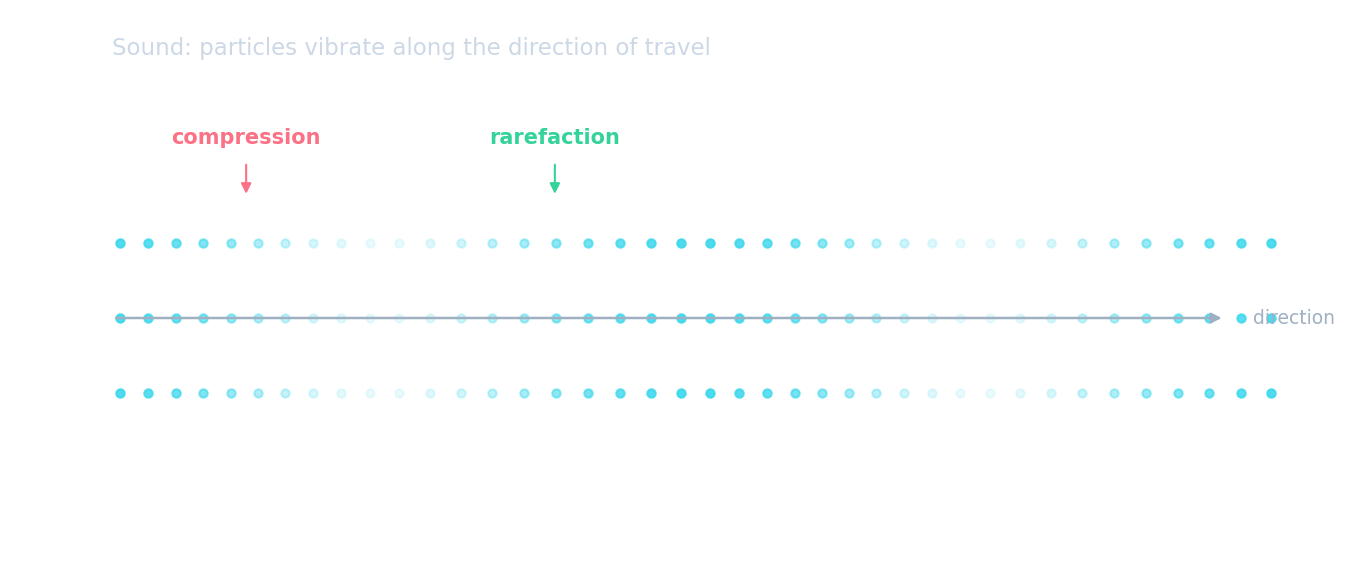
声作为一个纵波:粒子来回振动,产生高密度(压缩)和低密度(稀疏)的区域。
例题。 一艘船向下方 $150\ \text{m}$ 的海床发送一个声呐脉冲。水中声速 $= 1500\ \text{m/s}$。声向下传播并返回(总共 $300\ \text{m}$),所以时间 $= \dfrac{300}{1500} = 0.2\ \text{s}$。
声不像光。 光能穿过空旷空间(真空);声不能。在太空电影中,爆炸是无声的,有一个真实的物理原因——没有粒子来携带振动。
Sound · 声
y = a sin(bt + c)
Louder = bigger amplitude · 振幅; higher pitch = higher frequency · 频率. · 更响 = 更大的振幅;更高的音高 = 更高的频率。
Sound travels as a series of: · 声以一系列以下传播:
A vibrating source squeezes and stretches the air into compressions and rarefactions — a longitudinal wave. · 一个振动的源把空气挤压和拉伸成压缩和稀疏——一个纵波。
Sound can travel through a vacuum (empty space). · 声能穿过真空(空旷空间)。
Sound needs particles to pass the vibration along, so it cannot travel through a vacuum. · 声需要粒子来传递振动,所以它不能穿过真空。
Speed and hearing range
- Humans can hear from about $20\ \text{Hz}$ to $20\,000\ \text{Hz}$.
- Sound travels at about $340\ \text{m/s}$ in air — far slower than light.
- It travels faster in liquids and solids than in gases, because their particles are closer together.
The parts of a wave: wavelength, amplitude, crest and trough
速度与听觉范围
- 人类能从大约 $20\ \text{Hz}$ 听到 $20\,000\ \text{Hz}$。
- 声在空气中以大约 $340\ \text{m/s}$ 传播——比光慢得多。
- 它在液体和固体中比在气体中传播得更快,因为它们的粒子靠得更近。
The approximate range of human hearing is: · 人类听觉的大致范围是:
Most people hear from about 20 Hz (very low) up to about 20 000 Hz (very high). · 大多数人从大约 20 Hz(非常低)听到大约 20 000 Hz(非常高)。
Sound travels fastest through: · 声穿过以下传播最快:
The closer the particles, the faster the vibration is passed on — so sound is fastest in solids, slowest in gases. · 粒子越靠近,振动传递得越快——所以声在固体中最快,在气体中最慢。
Echoes 回声
- A reflected sound is an echo.
- You can measure the speed of sound by timing an echo over a known distance.
- The sound travels to the wall and back, so it covers twice the distance.
回声
- 一个反射的声是一个回声(echo)。
- 你能通过在一个已知距离上给一个回声计时来测量声速。
- 声传播到墙并返回,所以它走过两倍的距离。
A boy shouts at a cliff $660\ \text{m}$ away and hears the echo $4.0\ \text{s}$ later. What is the speed of sound, in m/s? · 一个男孩对 $660\ \text{m}$ 远的一座悬崖喊叫,$4.0\ \text{s}$ 后听到回声。声速是多少,以 m/s 计?
The sound travels there and back: $2 \times 660 = 1320\ \text{m}$ in · 入 $4.0\ \text{s}$, so $v = \dfrac{1320}{4.0} = 330\ \text{m/s}$. · 声传播到那里并返回:$4.0\ \text{s}$ 内 $2 \times 660 = 1320\ \text{m}$,所以 $v = \dfrac{1320}{4.0} = 330\ \text{m/s}$。
You've got it
- sound is made by vibrations and is a longitudinal wave (compressions + rarefactions)
- it needs a medium — no sound in a vacuum
- human hearing: about $20\ \text{Hz}$ to $20\,000\ \text{Hz}$; speed ≈ $340\ \text{m/s}$ in air
- an echo is reflected sound — remember it travels there and back
你掌握了
- 声由振动产生,是一个纵波(压缩 + 稀疏)
- 它需要一种介质——真空中没有声
- 人类听觉:大约 $20\ \text{Hz}$ 到 $20\,000\ \text{Hz}$;在空气中速度 ≈ $340\ \text{m/s}$
- 一个回声是反射的声——记住它传播到那里并返回