| English | 释义 | 拼音 |
|---|---|---|
| dispersion/dɪˈspɜːʃn/ | 色散 | sè sàn |
| converging lens/kənˈvɜːdʒɪŋ lenz/ | 凸透镜 | tū tòu jìng |
| principal focus/ˈprɪnsɪpl ˈfəʊkəs/ | 焦点 | jiāo diǎn |
| diverging lens/daɪˈvɜːdʒɪŋ lenz/ | 凹透镜 | āo tòu jìng |
| principal axis/ˈprɪnsɪpl ˈæksɪs/ | 主光轴 | zhǔ guāng zhóu |
| focal length/ˈfəʊkl leŋθ/ | 焦距 | jiāo jù |
| real image/rɪəl ˈɪmɪdʒ/ | 实像 | shí xiàng |
| virtual image/ˈvɜːtʃuːəl ˈɪmɪdʒ/ | 虚像 | xū xiàng |
| short sight | 近视 | jìn shì |
| long sight | 远视 | yuǎn shì |
| spectrum/ˈspektrəm/ | 光谱 | guāng pǔ |
| monochromatic/ˌmɒnəʊkrəʊˈmætɪk/ | 单色 | dān sè |
Focusing and splitting light
- A magnifying glass makes tiny print big, glasses make a blurred world sharp, and a prism turns white light into a rainbow.
- All three use refraction: light bending as it passes into and out of glass. This lesson covers lenses and dispersion 色散.
Converging and diverging lenses
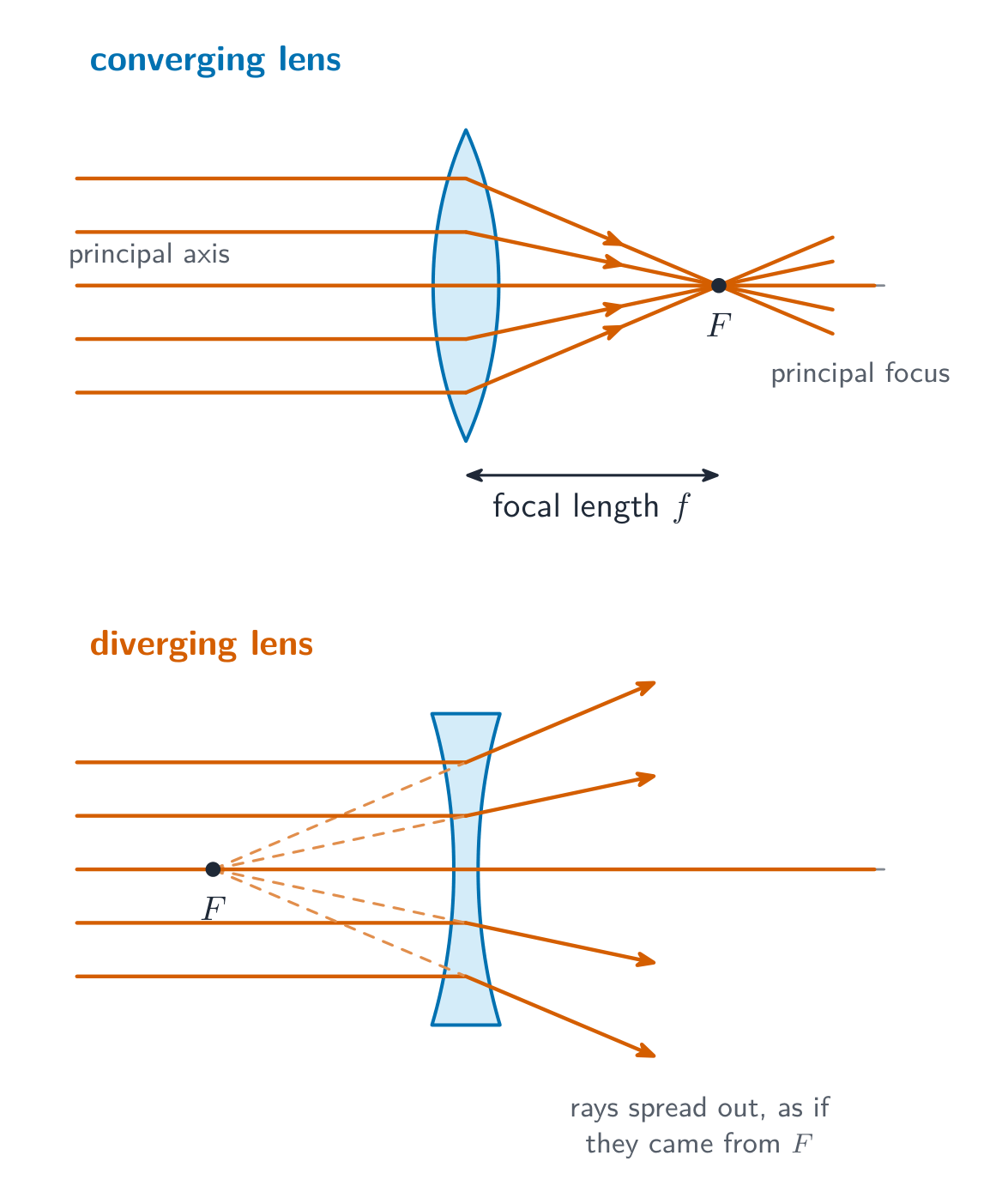
- A converging lens 凸透镜 is thicker in the middle. It bends a parallel beam inwards so the rays meet at the principal focus 焦点 $F$.
- A diverging lens 凹透镜 is thinner in the middle. It spreads a parallel beam out, so the rays seem to come from a principal focus in front of the lens.
| Term | Meaning |
|---|---|
| principal axis 主光轴 | the line through the centre of the lens, at right angles to it |
| principal focus (focal point) | the point where rays parallel to the axis meet (or seem to come from) |
| focal length 焦距 $f$ | the distance from the centre of the lens to the principal focus |
A converging lens makes parallel rays of light:
难度 1/5 · 今日首次完成可获 100 金币及少量额外奖励
A converging (convex) lens bends parallel rays inward so they meet at the principal focus.
The distance from the lens to its principal focus is called the ____ length.
难度 1/5 · 今日首次完成可获 100 金币及少量额外奖励
The focal length is the distance from the centre of the lens to the principal focus.
Drawing a ray diagram
- Draw the object as an arrow standing on the principal axis. From its top, draw two of these rays:
- a ray parallel to the axis bends and passes through $F$ on the far side;
- a ray through the centre of the lens goes straight on;
- a ray through $F$ on the near side comes out parallel to the axis.
- Where the rays cross is the top of the image. Describe it with three words: real or virtual, upright or inverted, enlarged, same size or diminished.
| Object position | Image | Used in |
|---|---|---|
| far away, beyond $2F$ | real, inverted, diminished | camera, the eye |
| between $F$ and $2F$ | real, inverted, enlarged | projector |
| closer than $F$ | virtual, upright, enlarged | magnifying glass |
Image formation by a converging lens
Trace the three special rays from the object — where they meet is the image. Move the object closer than the focal point to flip it into a magnifying glass.
A ray from the top of an object passes through the principal focus F before it reaches a converging lens. After the lens it:
难度 1/5 · 今日首次完成可获 100 金币及少量额外奖励
This is the third construction ray: through F on the way in, parallel to the axis on the way out. It is the parallel ray run backwards.
A projector makes a large picture on a screen. Where is the slide (the object)?
难度 1/5 · 今日首次完成可获 100 金币及少量额外奖励
The picture must be real (on a screen) and enlarged, so the object sits between F and 2F. The image is inverted, so slides go in upside down.
Worked examples on a grid
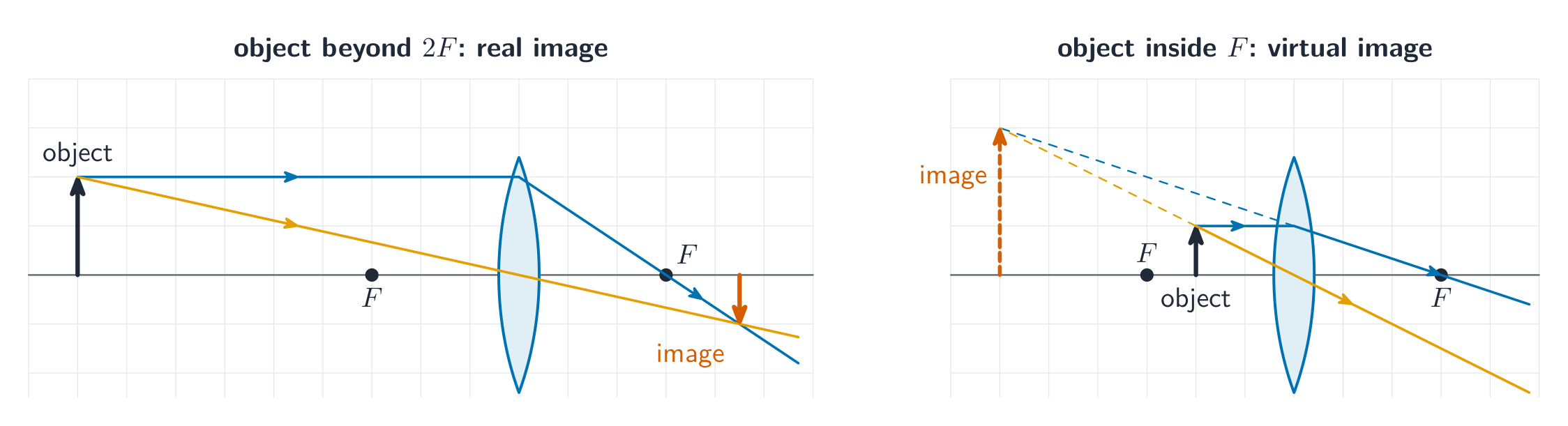
1. Real image. Lens $f$ = 3.0 cm; object 2.0 cm tall, 9.0 cm from the lens (left diagram).
- The parallel ray goes through $F$; the centre ray goes straight. They cross 4.5 cm behind the lens, 1.0 cm below the axis.
- Image: real, inverted, diminished (1.0 cm tall).
2. Virtual image. Same lens; object 1.0 cm tall, 2.0 cm from the lens (right diagram).
- After the lens the two rays spread apart and never meet. Trace them backwards (dashed): they meet 6.0 cm in front of the lens.
- Image: virtual, upright, enlarged (3.0 cm tall). This is a magnifying glass.
Exam marks for ray diagrams: use a ruler, put arrows on the rays, and draw at least two correct rays from the same point on the object. Dashed lines are only for rays traced back to a virtual image.
An object is 20 cm from a converging lens of focal length 5 cm. Describe the image.
难度 1/5 · 今日首次完成可获 100 金币及少量额外奖励
2F is 10 cm from the lens, so 20 cm is beyond 2F. The rays cross between F and 2F on the far side: a real, inverted, diminished image, as in a camera.
Virtual images and the magnifying glass
- A real image 实像 forms where rays really meet. You can catch it on a screen, as in a camera or a projector.
- A virtual image 虚像 forms where rays only seem to come from, when diverging rays are traced backwards. It cannot be shown on a screen: you see it only by looking through the lens.
- Magnifying glass: hold a converging lens so the object is closer than $F$. You see a virtual, upright, enlarged image on the same side as the object.
Used close to the eye as a magnifying glass, a converging lens makes a:
难度 1/5 · 今日首次完成可获 100 金币及少量额外奖励
With the object very close, the lens forms an enlarged, upright virtual image — a magnifying glass.
A virtual image can be shown on a screen placed where the image is.
难度 1/5 · 今日首次完成可获 100 金币及少量额外奖励
No light actually reaches the place where a virtual image seems to be. The rays only appear to come from there when traced back, so a screen shows nothing.
Correcting short and long sight
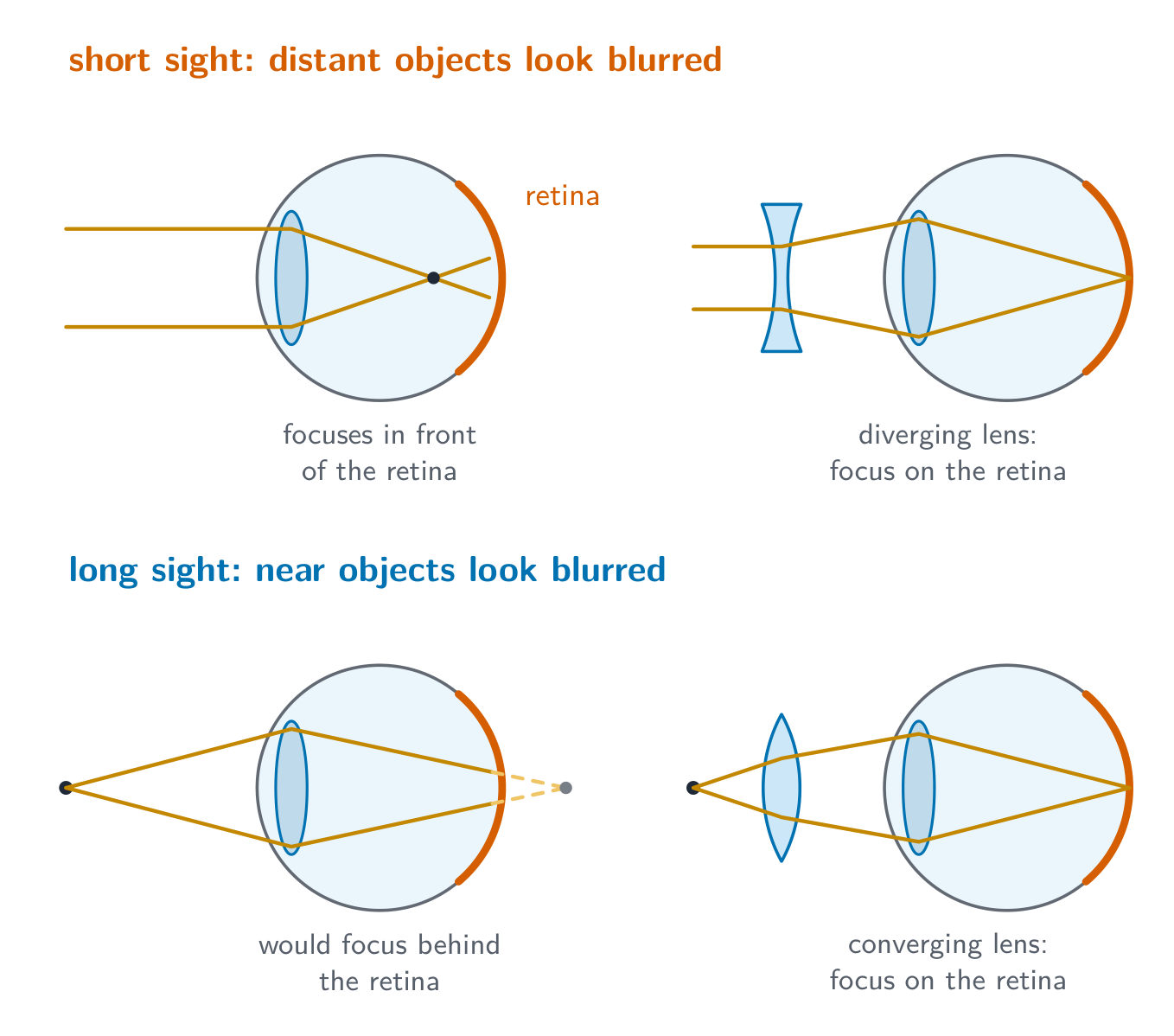
- Short sight 近视: distant objects are blurred. The eye focuses their light in front of the retina. A diverging lens spreads the rays a little first, so they focus on the retina.
- Long sight 远视: near objects are blurred. The eye would focus their light behind the retina. A converging lens bends the rays inwards first, so they focus on the retina.
A student cannot see the board clearly but can read a book. Which lens corrects this, and why?
难度 1/5 · 今日首次完成可获 100 金币及少量额外奖励
Distant things blurred means short sight. The eye bends light too much, so it focuses in front of the retina. A diverging lens spreads the rays first, so they focus on the retina.
In long sight, light from a near object would focus:
难度 1/5 · 今日首次完成可获 100 金币及少量额外奖励
The eye does not bend the light enough, so the focus would be behind the retina. A converging lens adds extra bending, bringing the focus forward onto the retina.
Dispersion
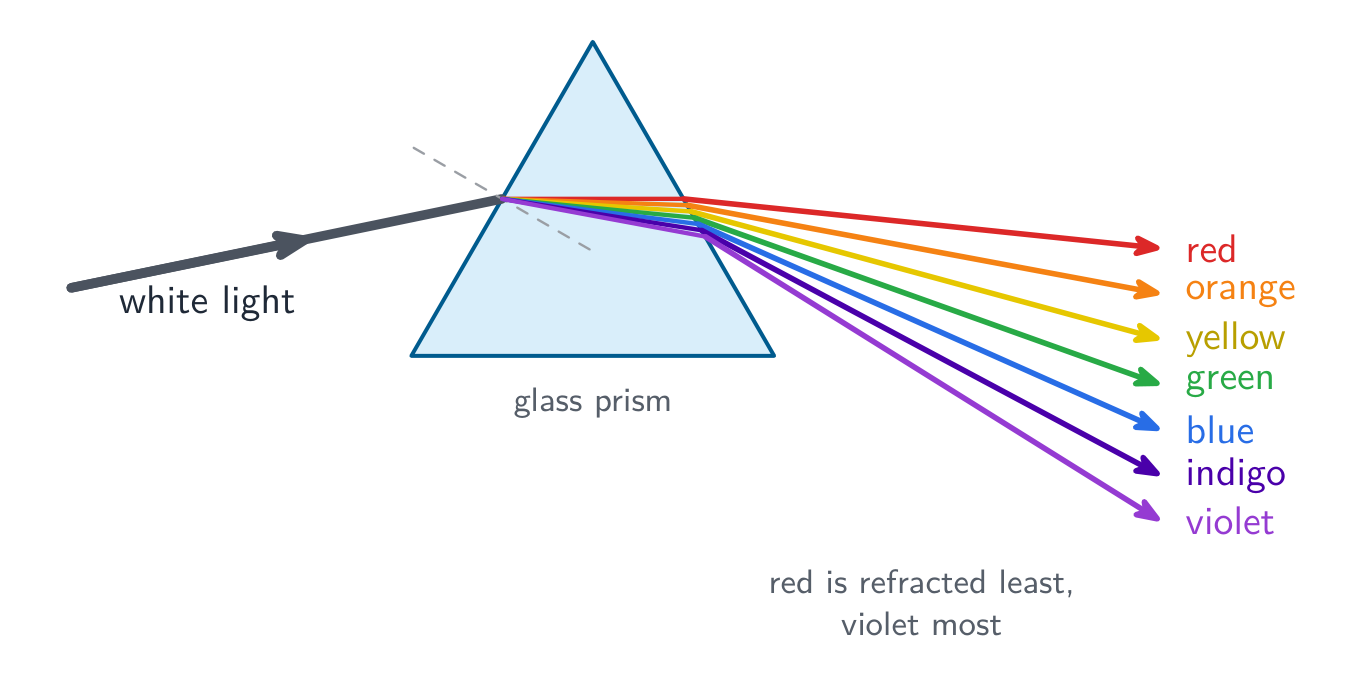
- A glass prism splits white light into a band of colours, the spectrum 光谱. This splitting is dispersion. It happens because each colour is refracted by a different amount: red least, violet most.
- The seven colours, in order of increasing frequency (and decreasing wavelength): red, orange, yellow, green, blue, indigo, violet.
- Light of a single frequency (one colour) is monochromatic 单色, for example the light from a laser.
Put these spectrum colours in order of wavelength, longest first.
难度 3/5 · 今日首次完成可获 200 金币及少量额外奖励
Red has the longest wavelength and violet the shortest, so: red, yellow, green, blue, violet.
Which colour of visible light has the longest wavelength?
难度 1/5 · 今日首次完成可获 100 金币及少量额外奖励
Red light has the longest wavelength and lowest frequency; violet has the shortest wavelength and highest frequency.
Which colour of visible light has the highest frequency and is refracted most by a prism?
难度 1/5 · 今日首次完成可获 100 金币及少量额外奖励
Violet has the highest frequency and shortest wavelength, and a prism bends it the most. Red is the opposite.
What does monochromatic light mean?
难度 1/5 · 今日首次完成可获 100 金币及少量额外奖励
Monochromatic means one colour, that is, one frequency. A prism cannot split it further. White light is a mixture of many frequencies.
You've got it
- converging lens: parallel rays meet at the principal focus; diverging lens: they spread out as if from $F$; focal length = lens to $F$
- ray diagram: parallel → through F, centre → straight, through F → parallel
- describe the image: real/virtual, upright/inverted, enlarged/same size/diminished
- virtual image: rays traced back; no image on a screen; a magnifying glass needs the object closer than $F$
- short sight → diverging lens; long sight → converging lens
- dispersion: red is refracted least, violet most; red has the longest wavelength and lowest frequency
A converging lens has focal length 15 cm. Where is the image of a very distant object, and what kind of image does an object 8 cm from the lens give? Explain how you know.
Parallel rays meet at F by definition. Inside F the lens cannot bring the rays together, so the image is virtual.
A converging lens has focal length 15 cm. Where is the image of a very distant object?
难度 1/5 · 今日首次完成可获 100 金币及少量额外奖励
Parallel rays from a distant object meet at the principal focus, 15 cm from the lens.