The electromagnetic spectrum · 电磁波谱
| English | 中文 | Pinyin · 拼音 |
|---|---|---|
| electromagnetic spectrum/ɪˌlektrəʊməɡˈnetɪk ˈspektrəm/ | 电磁波谱 | diàn cí bō pǔ |
| radio waves/ˈreɪdɪəʊ weɪvz/ | 无线电波 | wú xiàn diàn bō |
| microwaves/ˈmaɪkrəʊweɪvz/ | 微波 | wēi bō |
| infrared/ˌɪnfrəˈred/ | 红外线 | hóng wài xiàn |
| ultraviolet/ˌʊltrəˈvaɪəlɪt/ | 紫外线 | zǐ wài xiàn |
| X-rays/eks reɪz/ | X射线 | X shè xiàn |
| gamma rays/ˈɡæmə reɪz/ | 伽马射线 | gā mǎ shè xiàn |
One family of waves
- Radio, the warmth of a heater, the light you see, the X-ray at a hospital — all the same kind of wave.
- Together they make the electromagnetic spectrum 电磁波谱.
- They all travel at the same high speed in a vacuum: $3.0 \times 10^8\ \text{m/s}$.
一个波的家族
- 无线电、一个加热器的温暖、你看到的光、一家医院的 X 射线——全是同一种波。
- 它们一起组成电磁波谱(electromagnetic spectrum)。
- 它们在真空中都以同样的高速传播:$3.0 \times 10^8\ \text{m/s}$。
The order of the spectrum
- From longest wavelength to shortest: radio waves 无线电波, microwaves 微波, infrared 红外线, visible light, ultraviolet 紫外线, X-rays X射线, gamma rays 伽马射线.
- As you go that way: the wavelength falls, the frequency rises, and the energy rises.
- Visible light is just a thin slice in the middle.
The electromagnetic spectrum
波谱的顺序
- 从最长波长到最短:无线电波、微波、红外、可见光、紫外、X 射线、伽马射线。
- 当你那样走时:波长下降、频率上升,且能量上升。
- 可见光只是中间一个薄薄的切片。
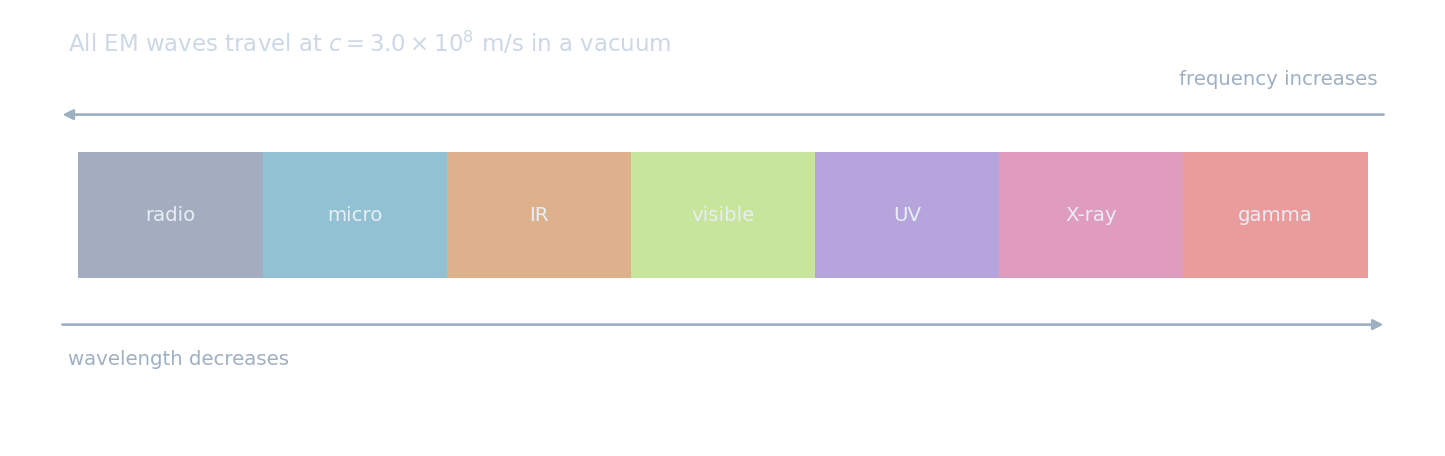
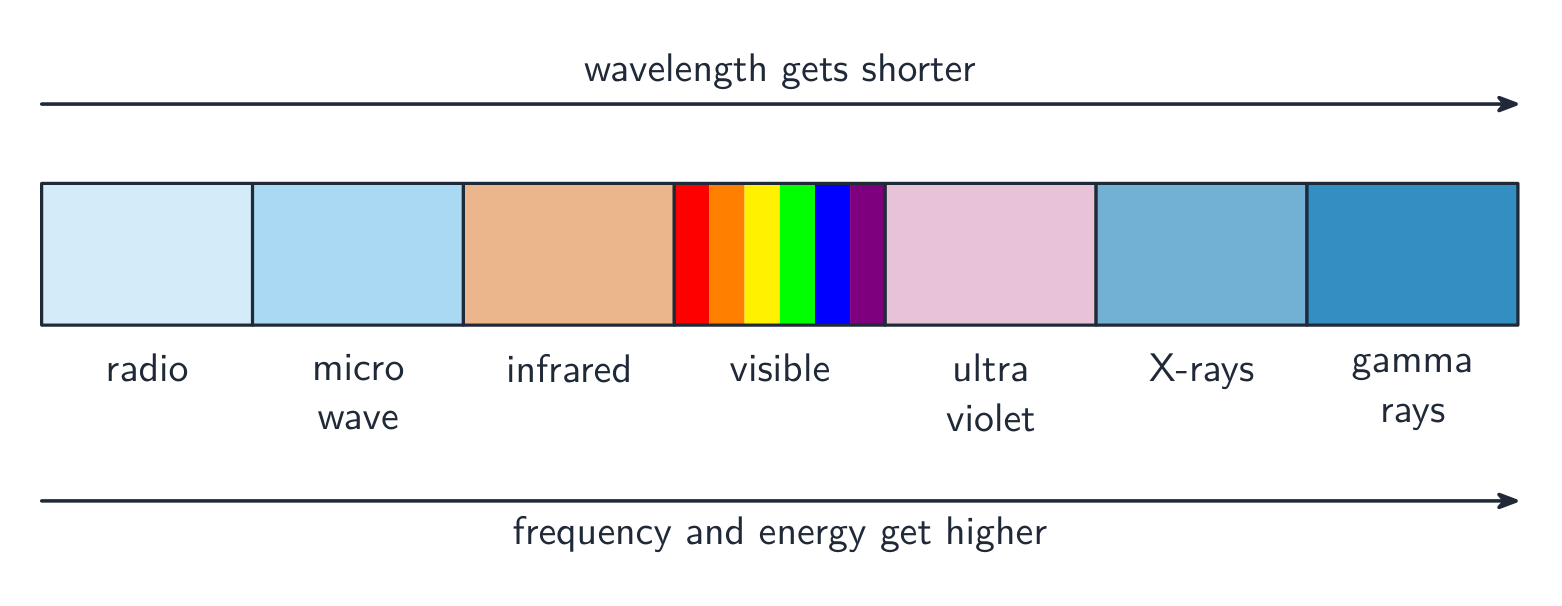
电磁波谱
Slide across the spectrum · 滑过电磁波谱
Radio waves, visible light and gamma rays are all the same wave — only the wavelength changes, and with it the frequency, photon energy and everyday use. · 无线电波、可见光和伽马射线都是同一种波——只是波长改变,频率、光子能量和日常用途也随之改变。
In a vacuum, how do the speeds of radio waves, light and gamma rays compare? · 在真空中,无线电波、光和伽马射线的速度如何比较?
All electromagnetic waves travel at the same speed in a vacuum, $3.0 \times 10^8\ \text{m/s}$. · 所有电磁波在真空中以相同的速度传播,$3.0 \times 10^8\ \text{m/s}$。
Put these EM waves in order of wavelength, longest first. · 把这些电磁波按波长,最长在先排序。
Radio waves have the longest wavelength and gamma rays the shortest: radio, microwave, infrared, visible, UV, X-ray, gamma. · 无线电波有最长的波长而伽马射线最短:无线电、微波、红外、可见、紫外、X 射线、伽马。
Going from radio waves toward gamma rays, the frequency: · 从无线电波朝向伽马射线,频率:
As wavelength falls (radio → gamma), the frequency and the energy both rise. · 随着波长下降(无线电 → 伽马),频率和能量都上升。
What each one is used for
- Radio waves — radio and TV broadcasts.
- Microwaves — mobile phones, satellite TV, cooking.
- Infrared — remote controls, thermal imaging, grills.
- Visible light — seeing and photography.
- Ultraviolet — sterilising water, checking banknotes.
- X-rays — medical and security scans.
- Gamma rays — sterilising equipment, treating cancer.
A glass prism splits white light into the colours of the spectrum
每一个用于什么
- 无线电波——无线电和电视广播。
- 微波——手机、卫星电视、烹饪。
- 红外——遥控器、热成像、烤架。
- 可见光——看和摄影。
- 紫外——给水消毒、检查纸币。
- X 射线——医疗和安检扫描。
- 伽马射线——给设备消毒、治疗癌症。

一个玻璃棱镜把白光分裂成光谱的颜色
Match each wave to a common use. · 把每种波与一个常见用途配对。
Microwaves carry phone signals, infrared works remote controls, and X-rays image bones. · 微波携带电话信号,红外操作遥控器,而 X 射线给骨骼成像。
The dangers
- The shorter, higher-energy waves are the dangerous ones.
- Microwaves — heat the water in body cells.
- Infrared — skin burns.
- Ultraviolet — skin cancer and eye damage.
- X-rays and gamma rays — damage cells and cause mutations.
危险
- 更短的、更高能量的波是危险的那些。
- 微波——加热身体细胞中的水。
- 红外——皮肤灼伤。
- 紫外——皮肤癌和眼睛损伤。
- X 射线和伽马射线——损伤细胞并造成突变。
Too much of which wave causes sunburn and skin cancer? · 太多哪种波造成晒伤和皮肤癌?
Ultraviolet has enough energy to damage skin cells, causing sunburn and skin cancer. · 紫外有足够的能量损伤皮肤细胞,造成晒伤和皮肤癌。
You've got it
- all EM waves travel at $3.0 \times 10^8\ \text{m/s}$ in a vacuum
- order (long → short wavelength): radio · micro · infrared · visible · UV · X-ray · gamma
- going that way: frequency and energy rise, wavelength falls
- higher energy → more dangerous (UV cancer, X/gamma cell damage)
你掌握了
- 所有电磁波在真空中以 $3.0 \times 10^8\ \text{m/s}$ 传播
- 顺序(长 → 短波长):无线电 · 微波 · 红外 · 可见 · 紫外 · X 射线 · 伽马
- 那样走时:频率和能量上升,波长下降
- 更高能量 → 更危险(紫外癌症,X/伽马细胞损伤)