Reflection and refraction · 反射与折射
| English | 中文 | Pinyin · 拼音 |
|---|---|---|
| normal/ˈnɔːml/ | 法线 | fǎ xiàn |
| angle of incidence/ˈæŋɡl ɒv ˈɪnsɪdəns/ | 入射角 | rù shè jiǎo |
| angle of reflection/ˈæŋɡl ɒv rɪˈflekʃn/ | 反射角 | fǎn shè jiǎo |
| virtual/ˈvɜːtʃuːəl/ | 虚的 | xū de |
| refractive index/rɪˈfræktɪv ˈɪndeks/ | 折射率 | zhé shè lǜ |
| total internal reflection/ˈtəʊtl ɪnˈtɜːnl rɪˈflekʃn/ | 全反射 | quán fǎn shè |
| critical angle/ˈkrɪtɪkl ˈæŋɡl/ | 临界角 | lín jiè jiǎo |
| optical fibres/ˈɒptɪkl ˈfaɪbəz/ | 光纤 | guāng xiān |
Bouncing and bending light
- A mirror bounces light back; a straw in a glass of water looks bent.
- These are reflection and refraction — the two basic things light does at a surface.
- We measure all angles from the normal 法线: a line at $90°$ to the surface.
弹回和弯曲光
- 一面镜子把光弹回;一杯水中的吸管看起来弯曲。
- 这些是反射(reflection)和折射(refraction)——光在一个表面做的两件基本事。
- 我们从法线(normal)测量所有角:一条与表面成 $90°$ 的线。
Reflection
- The law of reflection: the angle of incidence 入射角 equals the angle of reflection 反射角 (both from the normal).
- A plane mirror makes an image that is: the same size, the same distance behind the mirror, and virtual 虚的 (it cannot be caught on a screen).
The law of reflection
反射
- 反射定律(law of reflection):入射角(angle of incidence)等于反射角(angle of reflection)(都从法线)。
- 一面平面镜(plane mirror)产生一个像,它是:相同的大小、镜子后相同的距离,且是虚的(virtual,它不能被一个屏幕捕捉)。

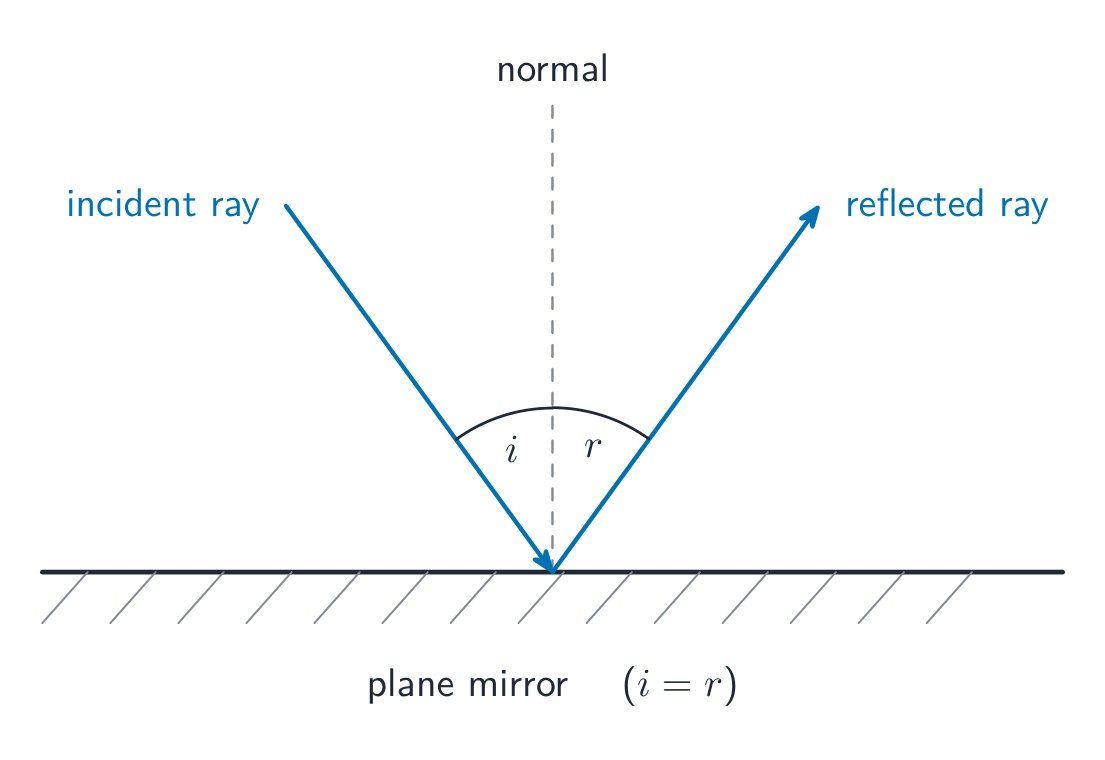
反射定律
Bend a light ray · 弯曲一条光线
Shine light into water, glass or diamond and change the angle. The ray slows and bends toward the normal — the denser the material (higher n), the more it bends. That bending is why a straw looks broken in a glass, and why diamonds sparkle. · 把光照进水、玻璃或钻石并改变角度。光线减速并朝向法线弯曲——材料越密集(n 越高),它弯曲得越多。那个弯曲就是为什么一根吸管在一个玻璃杯中看起来断了,以及为什么钻石闪闪发光。
A ray hits a plane mirror at $30°$ to the normal. At what angle to the normal does it reflect? · 一条光线以与法线 $30°$ 击中一面平面镜。它以与法线什么角反射?
The law of reflection: the angle of reflection equals the angle of incidence, both measured from the normal. · 反射定律:反射角等于入射角,都从法线测量。
An image in a plane mirror is: · 一面平面镜中的一个像是:
A plane mirror gives a virtual image, the same size, the same distance behind the mirror — it cannot be caught on a screen. · 一面平面镜给出一个虚像、相同大小、镜子后相同距离——它不能被一个屏幕捕捉。
Refraction
- When light passes into a new material it changes speed and bends.
- Going from air into glass, it slows down and bends toward the normal (so $i > r$).
- The refractive index 折射率 compares the bending:
折射
- 当光进入一种新材料时它改变速度并弯曲。
- 从空气进入玻璃,它减速并朝向法线弯曲(所以 $i > r$)。
- 折射率(refractive index)比较弯曲:

A ray of light passes from air into glass. It: · 一条光线从空气进入玻璃。它:
Light travels slower in glass, so going air → glass it bends toward the normal ($i > r$). · 光在玻璃中传播更慢,所以从空气 → 玻璃它朝向法线弯曲($i > r$)。
For light entering glass, $\sin i = 0.80$ and $\sin r = 0.50$. What is the refractive index? · 对进入玻璃的光,$\sin i = 0.80$ 且 $\sin r = 0.50$。折射率是多少?
$n = \dfrac{\sin i}{\sin r} = \dfrac{0.80}{0.50} = 1.6$. · $n = \dfrac{\sin i}{\sin r} = \dfrac{0.80}{0.50} = 1.6$。
Total internal reflection 全反射
- Light leaving glass bends away from the normal. Past a certain angle — the critical angle 临界角 $c$ — it cannot get out at all and reflects completely.
- This is total internal reflection, and it happens when the angle inside is bigger than $c$:
- It keeps light bouncing along optical fibres 光纤, the thin glass threads that carry internet and phone signals.
Total internal reflection keeps light bouncing along each optical fibre until it shines out at the tip
全内反射
- 离开玻璃的光远离法线弯曲。超过某个角——临界角(critical angle)$c$——它完全无法出来并完全反射。
- 这是全内反射(total internal reflection),它发生在内部角大于 $c$ 时:
- 它让光沿光纤(optical fibres,携带互联网和电话信号的细玻璃丝)弹跳。


全内反射让光沿每根光纤弹跳,直到它从尖端射出
Total internal reflection happens when light inside glass hits the surface at an angle that is: · 当玻璃内的光以一个以下的角击中表面时,全内反射发生:
Above the critical angle the light cannot escape and is reflected completely back inside. · 超过临界角光不能逃逸并完全反射回内部。
Optical fibres use total internal reflection to carry light signals. · 光纤用全内反射来携带光信号。
Light bounces along the fibre by total internal reflection, carrying internet and phone signals over long distances. · 光通过全内反射沿光纤弹跳,在长距离上携带互联网和电话信号。
You've got it
- measure angles from the normal; reflection: angle i = angle r
- a plane mirror image is virtual, same size, same distance behind
- refraction: into glass → slows, bends toward the normal; $n = \dfrac{\sin i}{\sin r}$
- past the critical angle, light is totally internally reflected (optical fibres)
你掌握了
- 从法线测量角;反射:角 i = 角 r
- 一个平面镜像是虚的、相同大小、后面相同距离
- 折射:进入玻璃 → 减速,朝向法线弯曲;$n = \dfrac{\sin i}{\sin r}$
- 超过临界角,光被全内反射(光纤)