| English | 释义 | 拼音 |
|---|---|---|
| wave/weɪv/ | 波 | bō |
| wavelength/ˈweɪvleŋθ/ | 波长 | bō cháng |
| amplitude/ˈæmplɪtjuːd/ | 振幅 | zhèn fú |
| frequency/ˈfriːkwənsi/ | 频率 | pín lǜ |
| wave speed/weɪv spiːd/ | 波速 | bō sù |
| transverse/trænsˈvɜːs/ | 横波 | héng bō |
| longitudinal/ˌlɒŋɡɪˈtjuːdɪnl/ | 纵波 | zòng bō |
| reflection/rɪˈflekʃn/ | 反射 | fǎn shè |
| refraction/rɪˈfrækʃn/ | 折射 | zhé shè |
| diffraction/dɪˈfrækʃn/ | 衍射 | yǎn shè |
Energy on the move
- Drop a stone in a pond: ripples spread out, but a floating cork just bobs up and down — it does not travel along.
- A wave 波 carries energy from place to place without carrying matter.
- All waves — water, light, sound — share the same set of ideas.
一个波把物质随它从一处带到另一处。
难度 1/5 · 今日首次完成可获 100 金币及少量额外奖励
一个波携带能量,不是物质。一个漂浮的软木塞上下浮动但不随波前进。
Describing a wave
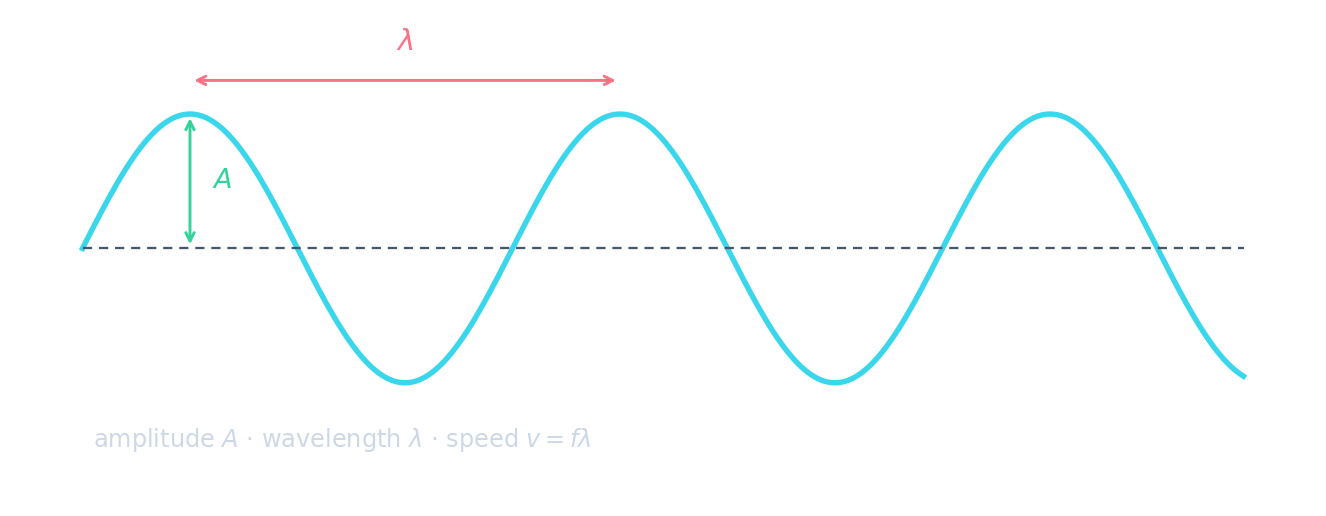
- wavelength 波长 ($\lambda$): the distance for one full wave (e.g. crest to crest).
- amplitude 振幅: the largest distance a point moves from its rest position.
- frequency 频率 ($f$): the number of waves passing a point each second, in hertz (Hz).
- wave speed 波速 ($v$): how fast a wavefront travels. These link by the wave equation:
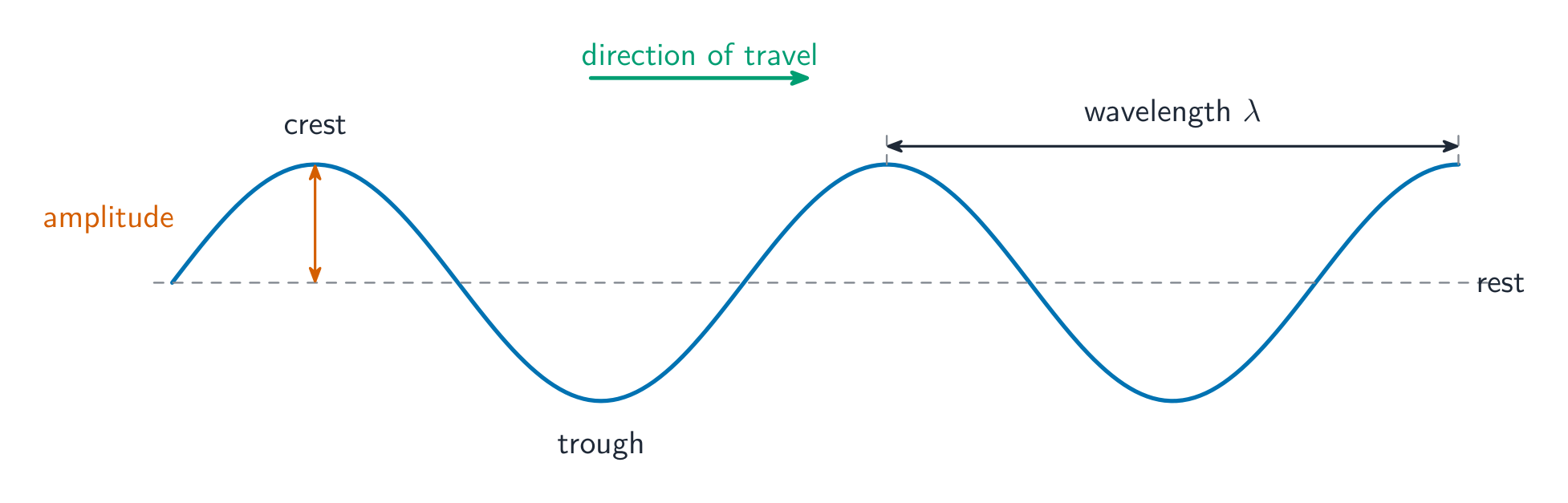
The parts of a transverse 横波 wave
波的性质
y = a sin(bx + c)
一个波:a 是振幅,b 设定波长。
横波与纵波
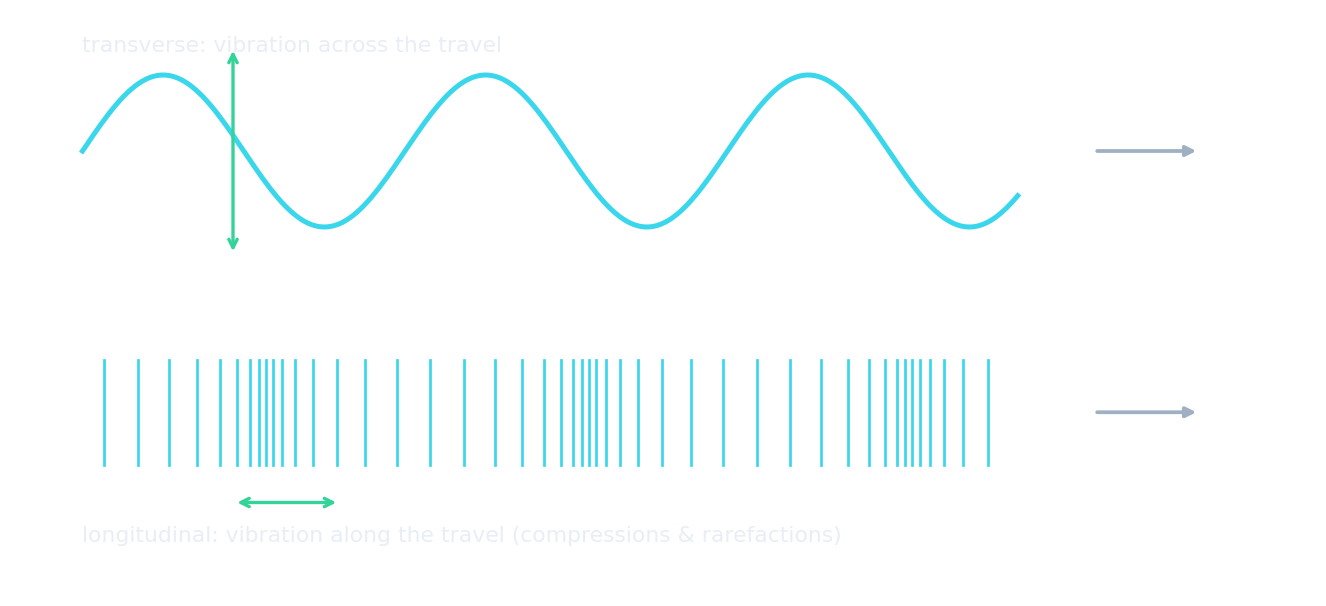
在一个横波(粒子上下浮动,像水和光)和一个纵波(粒子来回滑动,聚集成压缩,像声)之间切换。波移动;粒子留在原处。
一个波有频率 $5.0\ \text{Hz}$ 和波长 $2.0\ \text{m}$。它的速度是多少,以 m/s 计?
难度 2/5 · 今日首次完成可获 140 金币及少量额外奖励
$v = f\lambda = 5.0 \times 2.0 = 10\ \text{m/s}$.
一个声波以 $330\ \text{m/s}$ 传播,频率 $110\ \text{Hz}$。它的波长是多少,以 m 计?
难度 2/5 · 今日首次完成可获 140 金币及少量额外奖励
重排 $v = f\lambda$:$\lambda = \dfrac{v}{f} = \dfrac{330}{110} = 3.0\ \text{m}$。
一个波的振幅是:
难度 1/5 · 今日首次完成可获 100 金币及少量额外奖励
振幅是从静止的最大位移。波峰到波峰的距离是波长。
Two types of wave
- Transverse — the particles vibrate at right angles ($90°$) to the wave's travel. Light and water waves are transverse.
- Longitudinal 纵波 — the particles vibrate along the travel direction, making compressions and rarefactions. Sound is longitudinal.
声是哪种类型的波?
难度 1/5 · 今日首次完成可获 100 金币及少量额外奖励
在声中,粒子沿前进方向振动,产生压缩和稀疏——一个纵波。
How waves behave
- All waves can do three things (easy to see in a ripple tank):
- Reflection 反射 — the wave bounces off a surface.
- Refraction 折射 — the wave changes speed (and usually direction) entering a new material or depth.
- Diffraction 衍射 — the wave spreads out through a gap or around an edge; spreading is greatest when the gap ≈ the wavelength.
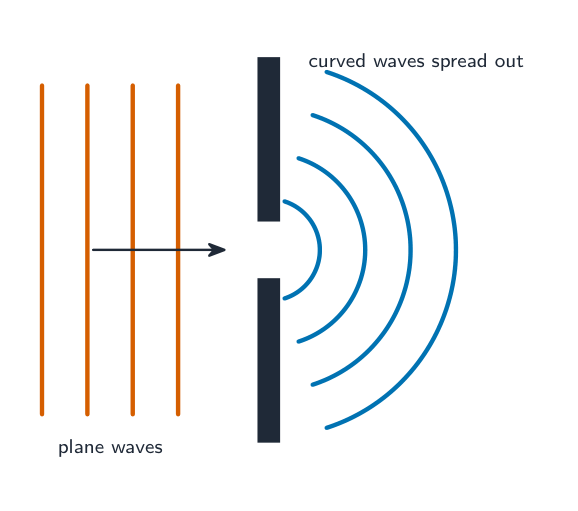
Plane waves passing through a narrow gap spread out into curved waves — diffraction is strongest when the gap is about one wavelength wide
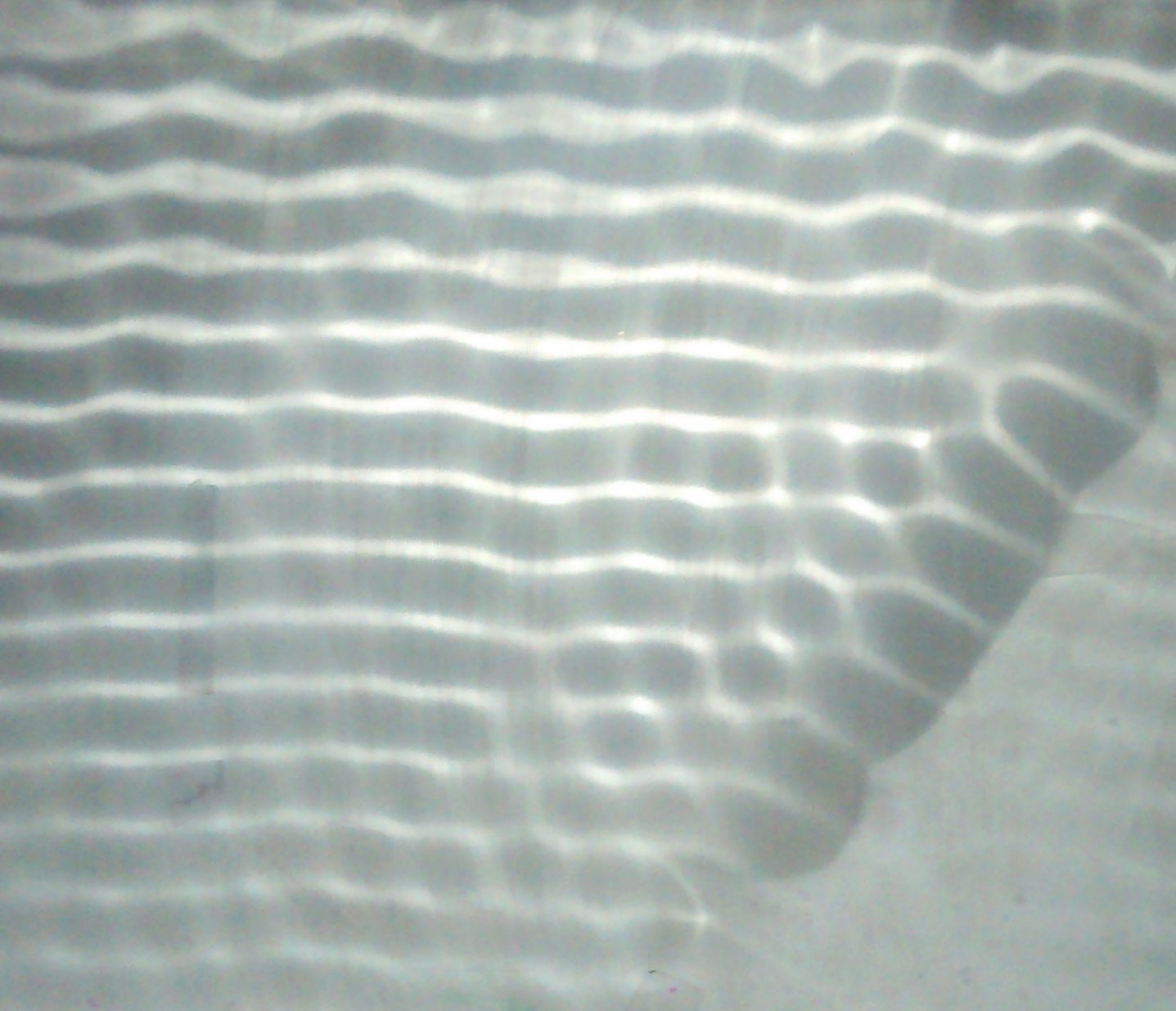
Two dippers in a ripple tank make overlapping circular water waves
一个波穿过一个窄缝隙后扩散。这是:
难度 1/5 · 今日首次完成可获 100 金币及少量额外奖励
穿过一个缝隙或绕过一个边缘扩散是衍射——当缝隙约一个波长宽时最大。
Worked examples
1. Water waves have frequency $50\ \text{Hz}$ and wavelength $0.40\ \text{m}$. $v = f\lambda = 50 \times 0.40 = 20\ \text{m/s}$.
2. A radio station broadcasts at $100\ \text{MHz}$. Radio waves travel at $3.0 \times 10^8\ \text{m/s}$, so $\lambda = \dfrac{v}{f} = \dfrac{3.0 \times 10^8}{1.0 \times 10^8} = 3.0\ \text{m}$.
Change kHz and MHz to Hz first. $100\ \text{MHz} = 1.0 \times 10^8\ \text{Hz}$. The frequency is set by the source, so when a wave enters a new material only its speed and wavelength change.
一列波的频率为9赫兹,波长为0.60米。它的波速是多少?这列波是否携带物质移动?
9乘以0.60等于5.4。频率乘以波长即为波速。
波速是多少?
难度 1/5 · 今日首次完成可获 100 金币及少量额外奖励
9乘以0.60等于5.4米每秒。其他选项——10米每秒(课程示例中5.0赫兹和2.0米对应的计算结果);3.0米(对应以330米每秒的速度、频率为110赫兹时的波长)。
You've got it
- a wave carries energy, not matter
- wave equation: $v = f\lambda$ (speed = frequency × wavelength)
- transverse (vibrate across travel) vs longitudinal (vibrate along travel; sound)
- waves can reflect, refract and diffract
Write from the data: find the wave speed
- A wave has frequency 9 Hz and wavelength 0.60 m.
- Find the speed. The wave carries energy, not the material.