| English | 释义 | 拼音 |
|---|---|---|
| Solar System/ˈsəʊlə ˈsɪstəm/ | 太阳系 | tài yáng xì |
| planets/ˈplænɪts/ | 行星 | xíng xīng |
| asteroids/ˈæstərɔɪdz/ | 小行星 | xiǎo xíng xīng |
| comets/ˈkɒmɪts/ | 彗星 | huì xīng |
| rocky/ˈrɒki/ | 岩石 | yán shí |
| gas giants/ɡæs ˈdʒaɪənts/ | 气态巨行星 | qì tài jù xíng xīng |
| satellites/ˈsætəlaɪts/ | 卫星 | wèi xīng |
| ellipses/ɪˈlɪpsɪz/ | 椭圆 | tuǒ yuán |
| accretion/əˈkreʃn/ | 吸积 | xī jī |
The Sun's family
- At the centre of the Solar System 太阳系 is one star — the Sun.
- Around it move eight planets 行星, plus moons, asteroids 小行星 and comets 彗星.
- Gravity holds the whole family together.
The eight planets
- In order from the Sun: Mercury, Venus, Earth, Mars, Jupiter, Saturn, Uranus, Neptune.
- The four inner planets are small and rocky 岩石.
- The four outer planets are large and gaseous (no solid surface).
- Jupiter and Saturn are gas giants 气态巨行星; Uranus and Neptune are ice giants.
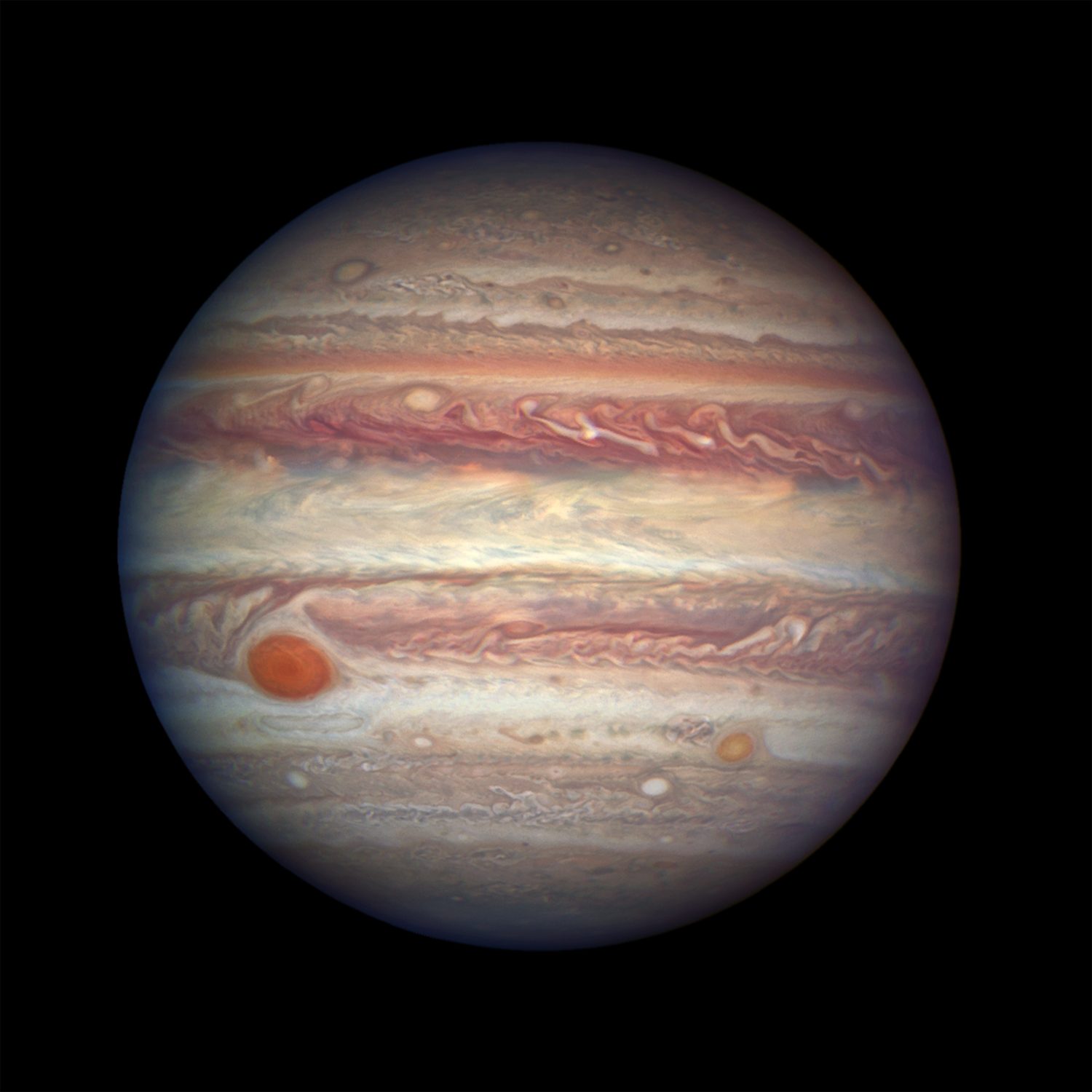
Jupiter, the largest planet, with its swirling bands of gas
观看行星赛跑
行星离太阳越近,绕行越快——水星 88 天,木星 12 年——因为太阳的引力在近处更强。
把这些行星按顺序排列,最靠近太阳的在先。
难度 3/5 · 今日首次完成可获 200 金币及少量额外奖励
从太阳起:水星、金星、地球、火星、木星、土星、天王星、海王星——所以这些中,水星、地球、木星、海王星。
内行星和外行星有何不同?
难度 1/5 · 今日首次完成可获 100 金币及少量额外奖励
四颗内行星小且岩石;四颗外行星大且气态(气态巨行星和冰巨行星)。
Other objects
- Dwarf planets (like Pluto) and asteroids — most asteroids lie in a belt between Mars and Jupiter.
- Moons (natural satellites 卫星) that orbit the planets.
- Comets — small icy bodies on very stretched orbits.
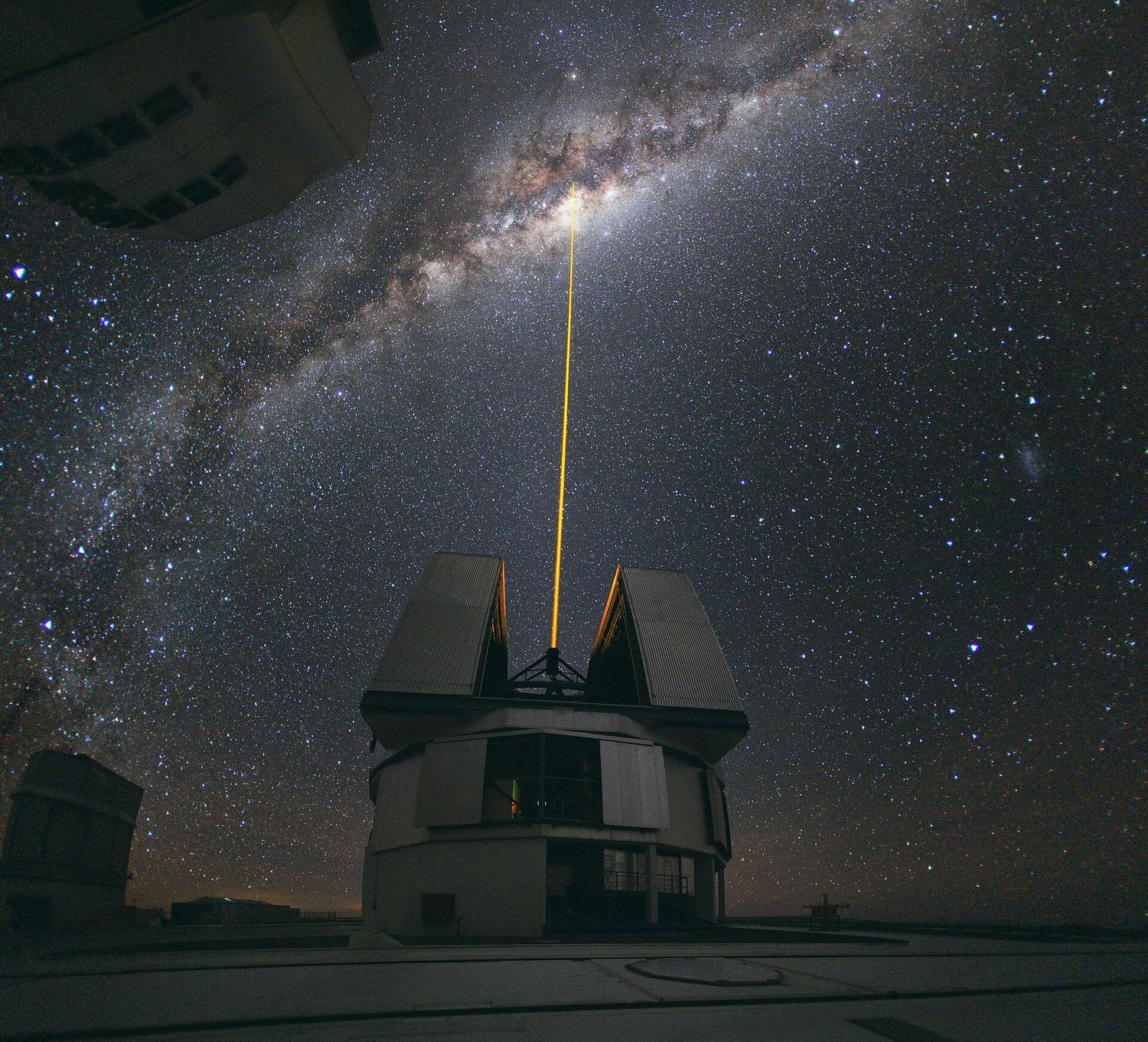
A giant telescope fires a laser to study the night sky
Orbits and gravity
- The Sun's gravity reaches out and keeps the planets in orbit; it is weaker further out, so outer planets orbit more slowly.
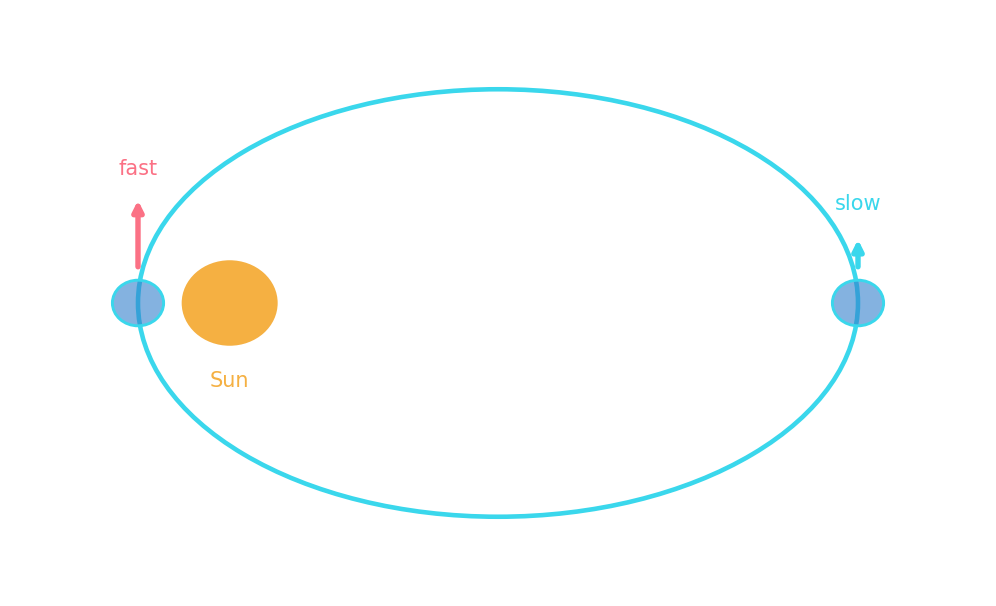
- Most orbits are ellipses 椭圆 (stretched circles), with the Sun at one focus (not the centre).
- A planet moves faster when closer to the Sun: as its gravitational PE falls, its kinetic energy rises (energy is conserved).
什么保持行星在它们绕太阳的轨道中?
难度 1/5 · 今日首次完成可获 100 金币及少量额外奖励
太阳持有太阳系大部分的质量,而它的引力把行星拉入轨道。
一颗在椭圆轨道上的行星在它以下时移动最快:
难度 1/5 · 今日首次完成可获 100 金币及少量额外奖励
当行星靠近时,它的引力势能下降而它的动能上升(能量守恒),所以它加速。
Light travel time and how it formed
- Space is huge, so we use light travel time: $\text{time} = \dfrac{\text{distance}}{\text{speed}}$, with light at $3.0 \times 10^8\ \text{m/s}$.
- Sunlight takes about 8 minutes to reach Earth.
- The Solar System formed by accretion 吸积: gravity pulled a spinning cloud of gas and dust into a disc; most fell to the centre to form the Sun, and the planets grew from the rest.
- Near the hot young Sun only rock and metal stayed solid → rocky inner planets; far out, gases collected too → giant outer planets.
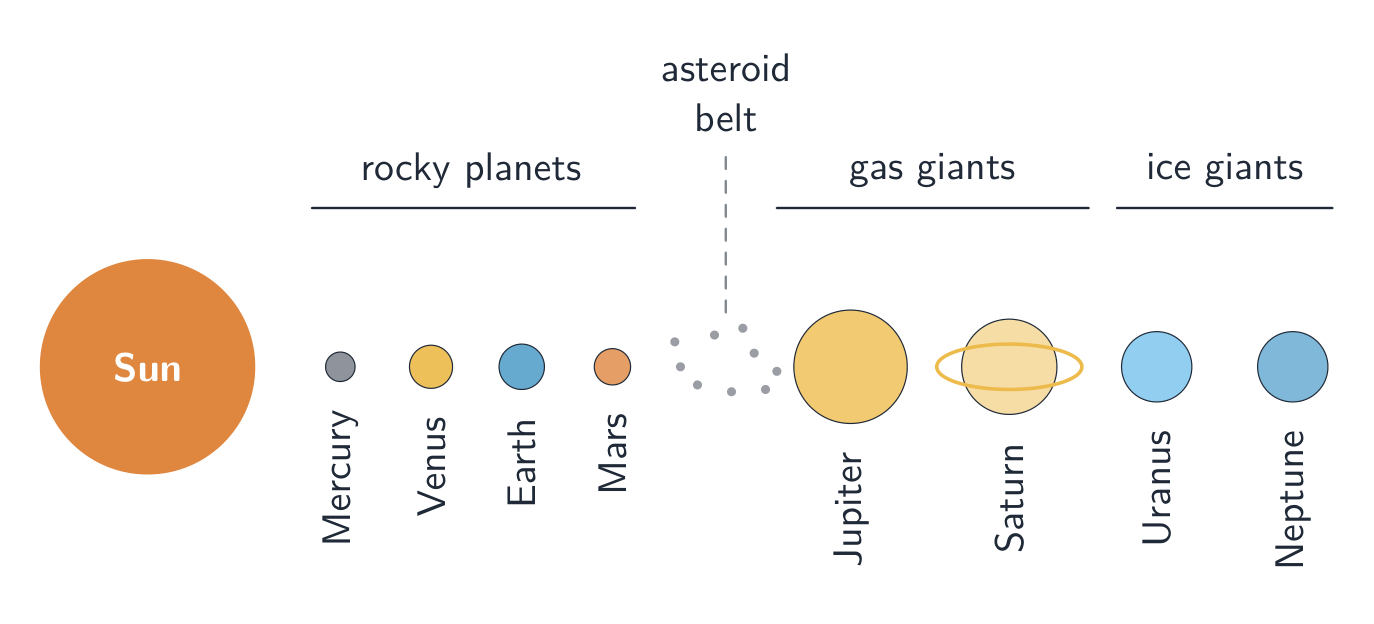
The Solar System
太阳约 $1.5 \times 10^{11}\ \text{m}$ 远。它的光花多长时间到达地球,以秒计?(光速 $3.0 \times 10^8\ \text{m/s}$)
难度 2/5 · 今日首次完成可获 140 金币及少量额外奖励
$\text{time} = \dfrac{d}{v} = \dfrac{1.5 \times 10^{11}}{3.0 \times 10^8} = 500\ \text{s}$(约 8 分钟)。
为什么内行星是岩石的?
难度 1/5 · 今日首次完成可获 100 金币及少量额外奖励
靠近炎热的太阳,气体不能凝结——只有岩石和金属保持固体,所以内行星是岩石的。
Worked examples
1. Jupiter is about $7.8 \times 10^{11}\ \text{m}$ from the Sun. Light takes $\dfrac{7.8 \times 10^{11}}{3.0 \times 10^8} = 2600\ \text{s}$, about $43$ minutes, to reach it.
2. Planet data show that planets further from the Sun have longer orbital periods and lower orbital speeds: the Sun's gravitational pull on them is weaker, and their orbits are longer.
Distances go from the centre. An orbit radius is measured from the centre of the Sun (or planet), not from its surface.
You've got it
- eight planets: four rocky inner, four gaseous outer (gas giants + ice giants)
- the Sun's gravity holds the planets; outer ones orbit slower
- orbits are ellipses with the Sun at a focus; planets move faster when closer
- light from the Sun takes ~8 min; the system formed by accretion of gas and dust
Write from the data: find the light-travel time
- A planet is 7.5 times 10 to the 11 metres from Earth. Light travels at 3.0 times 10 to the 8 metres per second.
- Find the travel time. The Sun's gravity holds the orbit.
一颗行星距离地球 7.5 乘以 10 的 11 次方米。在光速为 3.0 乘以 10 的 8 次方米每秒的情况下,其光线到达地球需要多长时间?是什么使行星保持在轨道上运行?
7.5 乘以 10 的 11 次方除以 3.0 乘以 10 的 8 次方等于 2500 秒。
光线需要多长时间?
难度 1/5 · 今日首次完成可获 100 金币及少量额外奖励
距离除以 3.0 乘以 10 的 8 次方等于 2500 秒。其他选项 — 500 秒(太阳位于 1.5 乘以 10 的 11 次方米处时的课程示例结果);2500 秒(因为外行星比内行星运行得更快)。