| English | 释义 | 拼音 |
|---|---|---|
| components/kəmˈpəʊnənts/ | 元件 | yuán jiàn |
| series/ˈsɪəriːz/ | 串联 | chuàn lián |
| parallel/ˈpærəlel/ | 并联 | bìng lián |
| potential divider/pəˈtenʃl dɪˈvaɪdə/ | 分压器 | fēn yā qì |
| fuse/fjuːz/ | 保险丝 | bǎo xiǎn sī |
| thermistor/ˈθɜːmɪstə/ | 热敏电阻 | rè mǐn diàn zǔ |
| LDR/ˌel diː ˈɑː/ | 光敏电阻 | guāng mǐn diàn zǔ |
Building circuits
- Real gadgets are circuits built from a handful of components 元件, wired in two basic ways.
- Get the rules for series 串联 and parallel 并联 and you can predict any simple circuit.
- We finish with a clever trick: the potential divider 分压器.
Components to know
- cell / battery — drives the current; a switch breaks or completes the circuit.
- resistor (fixed) and variable resistor (to control the current).
- fuse 保险丝 — melts if the current is too big; diode / LED — current one way only (an LED also lights).
- thermistor 热敏电阻 — resistance falls as it gets hotter; LDR 光敏电阻 — resistance falls as light gets brighter.
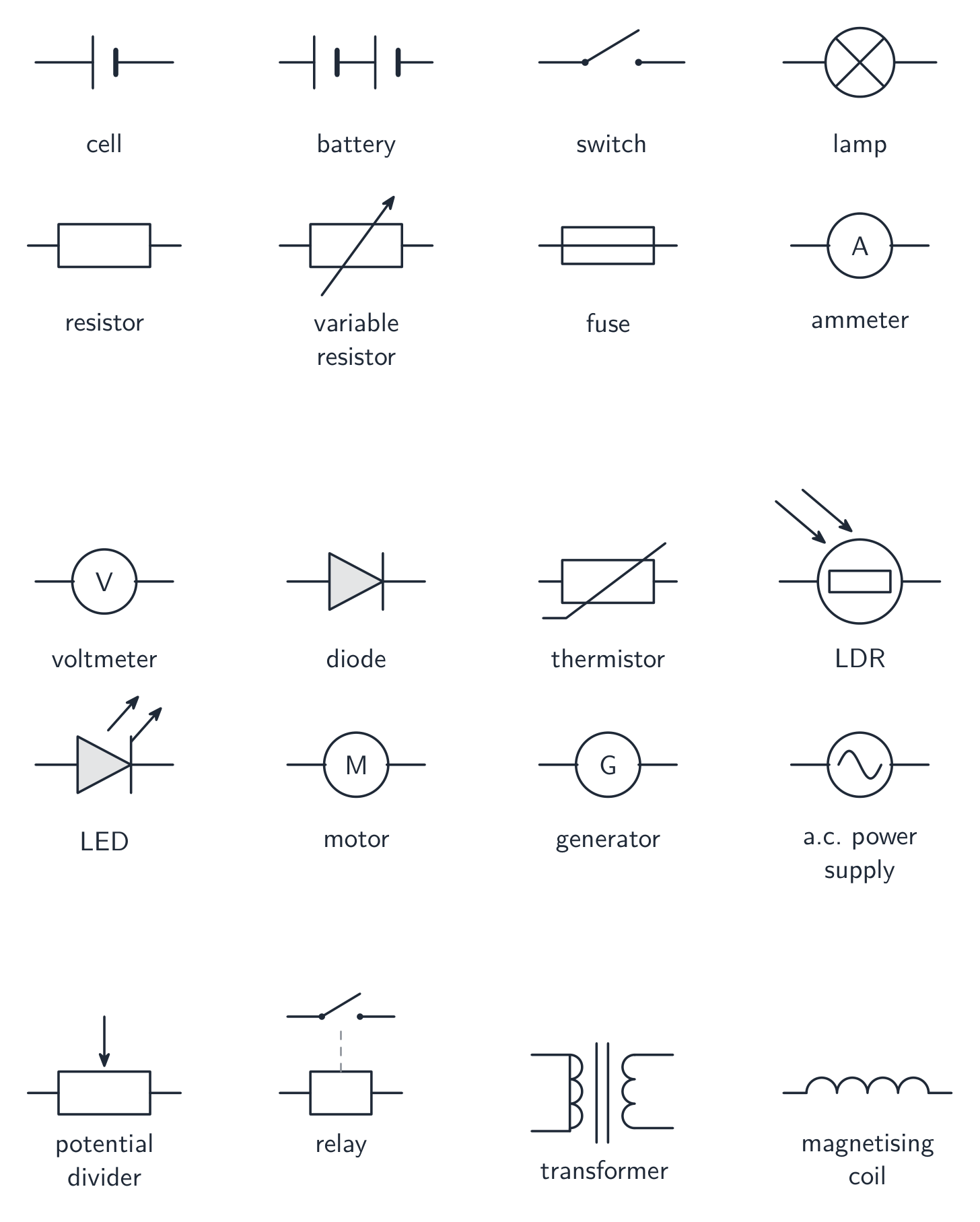
Standard circuit symbols
用欧姆定律建立电流
调高电压,电子加速,灯泡发光更亮;加电阻,电流下降。I = V/R,亮度 = 功率。
一个热敏电阻的电阻随它变热会怎样?
难度 1/5 · 今日首次完成可获 100 金币及少量额外奖励
一个热敏电阻的电阻随温度上升而下降——在温度感应电路中有用。
把每个电路规则与它适用之处配对。
难度 2/5 · 今日首次完成可获 140 金币及少量额外奖励
每一项把术语链接到它正确的含义。
Series circuits
- The parts form one single loop.
- The current is the same at every point.
- The supply p.d. is shared between the components.
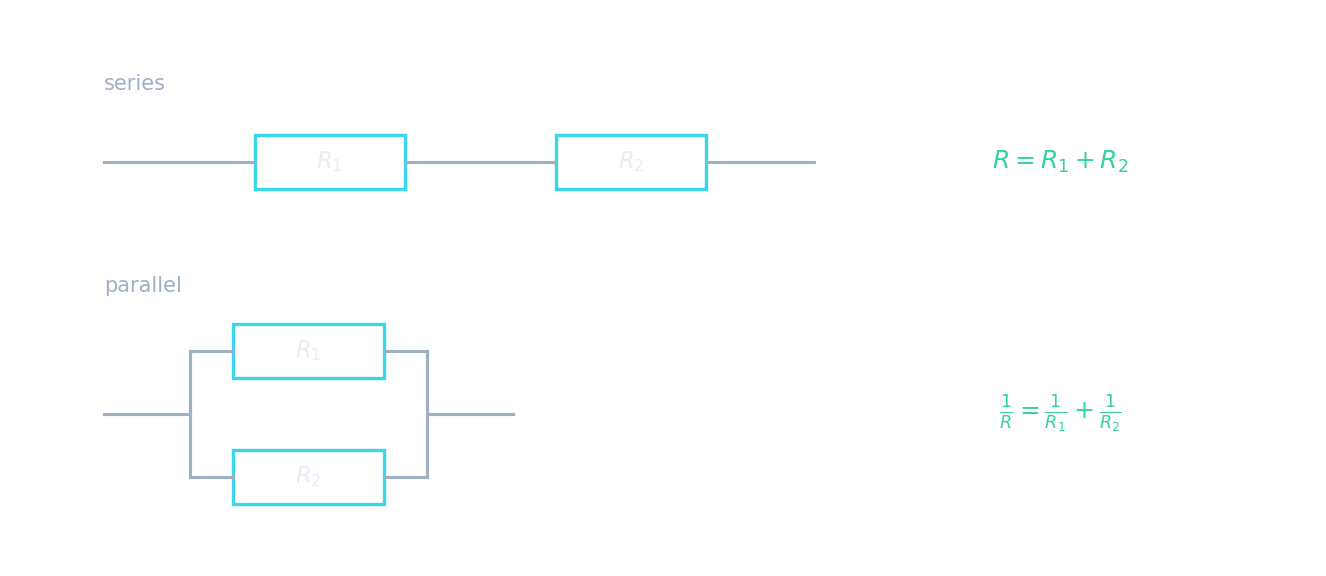
- Resistors in series add up: $R_{\text{total}} = R_1 + R_2 + \dots$
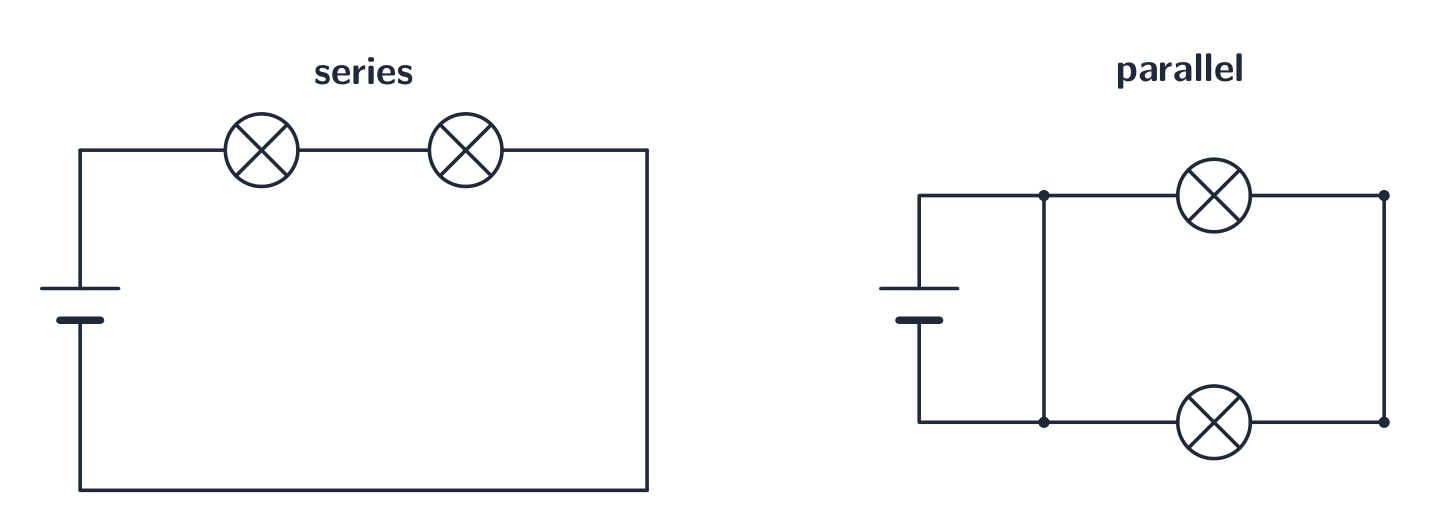
Series and parallel circuits
一个 $3.0\ \Omega$ 和一个 $5.0\ \Omega$ 的电阻器被串联连接。总电阻是多少,以 Ω 计?
难度 2/5 · 今日首次完成可获 140 金币及少量额外奖励
串联时,电阻相加:$R = 3.0 + 5.0 = 8.0\ \Omega$。
在一个串联电路中,电流是:
难度 1/5 · 今日首次完成可获 100 金币及少量额外奖励
只有一条路径,所以相同的电流流过一个串联电路中的每个元件。
Parallel circuits
- The parts are on separate branches.
- Each branch gets the full supply p.d.; the current splits between branches.
- The total resistance is less than the smallest single resistor: $\dfrac{1}{R_{\text{total}}} = \dfrac{1}{R_1} + \dfrac{1}{R_2}$
- Home lamps are wired in parallel — each gets full voltage, and one failing leaves the others on.
一个 $6.0\ \Omega$ 和一个 $3.0\ \Omega$ 的电阻器被并联连接。总电阻是多少,以 Ω 计?
难度 2/5 · 今日首次完成可获 140 金币及少量额外奖励
$\dfrac{1}{R} = \dfrac{1}{6.0} + \dfrac{1}{3.0} = \dfrac{1}{6} + \dfrac{2}{6} = \dfrac{3}{6}$,所以 $R = 2.0\ \Omega$——小于最小的电阻器。
为什么一个房子里的灯被并联接线?
难度 1/5 · 今日首次完成可获 100 金币及少量额外奖励
并联时每盏灯得到完整的供电 p.d.,而一个分支中的断开不会停止其他的。
Potential dividers
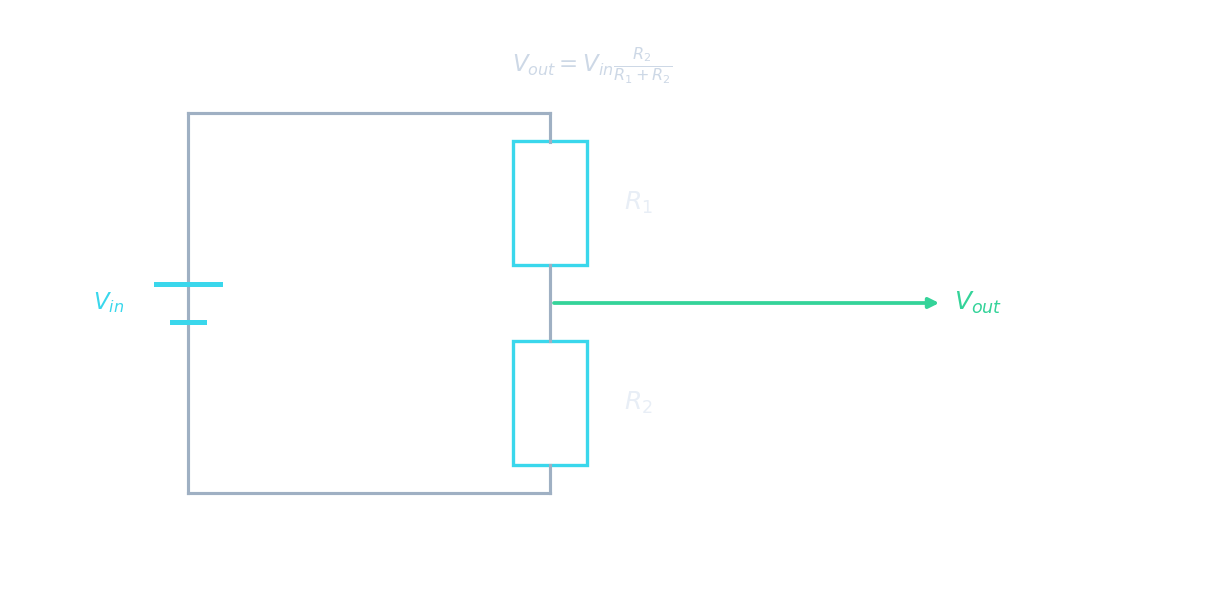
- Two resistors in series share the supply voltage — a potential divider.
- The bigger resistor takes the bigger share of the voltage:
- Use a thermistor or LDR as one resistor and the output voltage changes with temperature or light — perfect for switching a heater or lamp on automatically.
两个相等的电阻器跨过一个 $12\ \text{V}$ 供电串联。跨过它们之一的 p.d. 是多少,以 V 计?
难度 2/5 · 今日首次完成可获 140 金币及少量额外奖励
相等的电阻器平等地分享电压:每个得到 $\dfrac{12}{2} = 6\ \text{V}$。
Worked examples
1. A $4.0\ \Omega$ and a $6.0\ \Omega$ resistor are in series with a $12\ \text{V}$ battery. $R_{\text{total}} = 10\ \Omega$, so $I = \dfrac{V}{R} = \dfrac{12}{10} = 1.2\ \text{A}$.
2. The same current flows through both, so they share the voltage in the ratio of their resistances: $1.2 \times 4.0 = 4.8\ \text{V}$ and $1.2 \times 6.0 = 7.2\ \text{V}$, which add up to $12\ \text{V}$.
Parallel resistors do not add. A $6\ \Omega$ and a $3\ \Omega$ resistor in parallel have a combined resistance of $2\ \Omega$, less than either one. The current is the same at every point in a series circuit; it is not used up.
求一个6欧姆电阻和一个12欧姆电阻串联及并联的总阻值。若两个相等的电阻串联接在18伏电源上,其中一个两端的电势差是多少?
串联电阻相加。并联公式为乘积除以和,即72除以18,结果为4欧姆。
串联总阻值是多少?
难度 1/5 · 今日首次完成可获 100 金币及少量额外奖励
6加12等于18欧姆,而并联组合为4欧姆。
You've got it
- series: one loop, same current everywhere, p.d. shared, $R_{\text{total}} = R_1 + R_2$
- parallel: branches, each gets full p.d., current splits, $\dfrac{1}{R_{\text{total}}} = \dfrac{1}{R_1} + \dfrac{1}{R_2}$
- thermistor: R falls when hot · LDR: R falls in bright light
- potential divider: two series resistors share the voltage by their ratio
Write from the data given
- One resistor is 6 ohms and the other is 12 ohms.
- Find the series total and the parallel total. Two equal resistors share 18 V.