| English | 释义 | 拼音 |
|---|---|---|
| fuse/fjuːz/ | 保险丝 | bǎo xiǎn sī |
| live/laɪv/ | 火线 | huǒ xiàn |
| neutral/ˈnjuːtrəl/ | 零线 | líng xiàn |
| earth/ɜːθ/ | 地线 | dì xiàn |
| trip switch/trɪp swɪtʃ/ | 跳闸开关 | tiào zhá kāi guān |
| double insulation/ˈdʌbl ˌɪnsjuːˈleɪʃn/ | 双重绝缘 | shuāng chóng jué yuán |
市电能很危险
- 市电供应运行我们的家——但错误地使用它能给一个电击或引起一场火灾。
- 几个简单的安全特征让它处于控制之下。
- 让我们认识危险、三根线和保险丝。
Electrical safety route
Follow fault current and see how safety devices protect people.
冒险
- 损坏的绝缘——裸露的导线能给一个电击或引起一场火灾。
- 过热的电缆——太多电流使一根电缆变热。
- 潮湿的条件——水让电流通入一个人。
- 过载——一个插座里太多电器抽取太多电流。
Select 所有 of these that are electrical hazards.
难度 2/5 · 今日首次完成可获 140 金币及少量额外奖励
Bare wires, overloading and damp all raise the risk of shock or fire. Switching a lamp off is normal, safe use.
火线、零线和地线
- 一根市电电缆有三根线:
- 火线(live)携带高电压;
- 零线(neutral)在约零电压完成电路;
- 地线(earth)是一根连接到地面的安全线。
- 开关和保险丝在火线中,所以关掉就把电器从高电压切断。
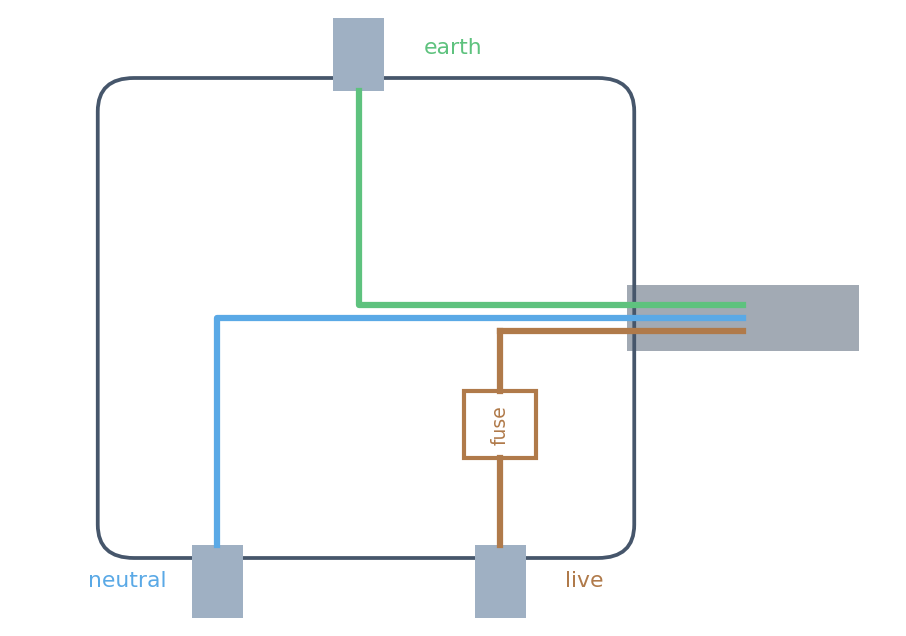
Which wire carries the high voltage?
难度 1/5 · 今日首次完成可获 100 金币及少量额外奖励
The live wire carries the high voltage; the neutral is near 0 V and the earth is a safety wire.
In which wire should the switch and fuse be fitted?
难度 1/5 · 今日首次完成可获 100 金币及少量额外奖励
Putting the switch and fuse in the live wire means that, when off, the appliance is cut off from the high voltage and is safe.
保险丝、跳闸开关和接地
- 一个保险丝是一根细线,如果电流变得太大就熔断,在电缆过热之前断开电路。
- 选择略高于正常工作电流的保险丝额定值(例如,对于正常工作电流约 $10\ \text{A}$ 的用电器,选用 $13\ \text{A}$ 的保险丝)。
- 一个跳闸开关(断路器)做同样的工作但更快且能被重置。
- 一个金属外壳通过接地(一个故障把一个大电流送到地并烧断保险丝)或通过双重绝缘(一个永不能带电的塑料外壳)而变得安全。
What does a fuse do?
难度 1/5 · 今日首次完成可获 100 金币及少量额外奖励
A fuse is a thin wire that melts if the current is too large, breaking the circuit before the cable can overheat.
An appliance normally draws about $10\ \text{A}$. Which fuse should it use?
难度 1/5 · 今日首次完成可获 100 金币及少量额外奖励
Choose a rating just above the normal working current. A 3 A or 5 A fuse would blow during normal use; 13 A is the right choice.
A double-insulated appliance with a plastic case needs an earth wire.
难度 1/5 · 今日首次完成可获 100 金币及少量额外奖励
A plastic case can never become live, so a double-insulated appliance needs no earth wire (its fuse still protects the cable).
例题
1。 保险丝有$3\ \text{A}$、$5\ \text{A}$和$13\ \text{A}$规格。一个$2300\ \text{W}$的电水壶接在$230\ \text{V}$电压下:$I = \dfrac{P}{V} = \dfrac{2300}{230} = 10\ \text{A}$,因此应选用$13\ \text{A}$。一个$60\ \text{W}$的灯泡:$I = 0.26\ \text{A}$,因此应选用$3\ \text{A}$。
2。 火线接触到接地的金属外壳。大电流经地线流过,保险丝熔断,从而切断外壳与火线的连接。
保险丝和开关必须接在火线上。 若接在中性线上,断开后电器仍与高压电源相连。
你掌握了
- 危险:损坏的绝缘、过热的电缆、潮湿、过载
- 三根线:火线(高电压)、零线(≈0 V)、地线(安全)
- 开关和保险丝在火线中
- 一个保险丝在电流太大时熔断;额定值刚好高于正常电流;双重绝缘不需要地线
由正常工作电流为8安培的电路写出
- 该设备正常工作时电流为8安培。
- 说明为何3安培的保险丝不适用,并指出保险丝和开关应安装的位置。
An appliance normally draws 8 A. Why is a 3 A fuse unsuitable, and in which wire do the fuse and the switch go?
The normal current is 8 amperes. A fuse smaller than that cannot carry normal operation.
Which fuse statement fits this 8 A appliance?
难度 1/5 · 今日首次完成可获 100 金币及少量额外奖励
The fuse must survive 8 amperes and still open on a fault, and it is placed in the live wire.