| English | 释义 | 拼音 |
|---|---|---|
| resistance/rɪˈzɪstəns/ | 电阻 | diàn zǔ |
| ohms/əʊmz/ | 欧姆 | ōu mǔ |
| filament lamp/ˈfɪləmənt læmp/ | 灯丝灯泡 | dēng sī dēng pào |
| diode/ˈdaɪəʊd/ | 二极管 | èr jí guǎn |
| fixed resistor/fɪkst rɪˈzɪstə/ | 定值电阻 | dìng zhí diàn zǔ |
| kilowatt-hour/ˈkɪləwɒt ˈaʊə/ | 千瓦时 | qiān wǎ shí |
Slowing the flow
- Push current through a thin wire and it gets hot; through a thick one, less so.
- Resistance 电阻 measures how hard it is for current to flow.
- It controls the current, heats your toaster, and sets your electricity bill.
Resistance
- Resistance $R$ is measured in ohms 欧姆 ($\Omega$). A bigger resistance gives a smaller current:
- To measure it: an ammeter in series reads $I$, a voltmeter across the component reads $V$, then divide.
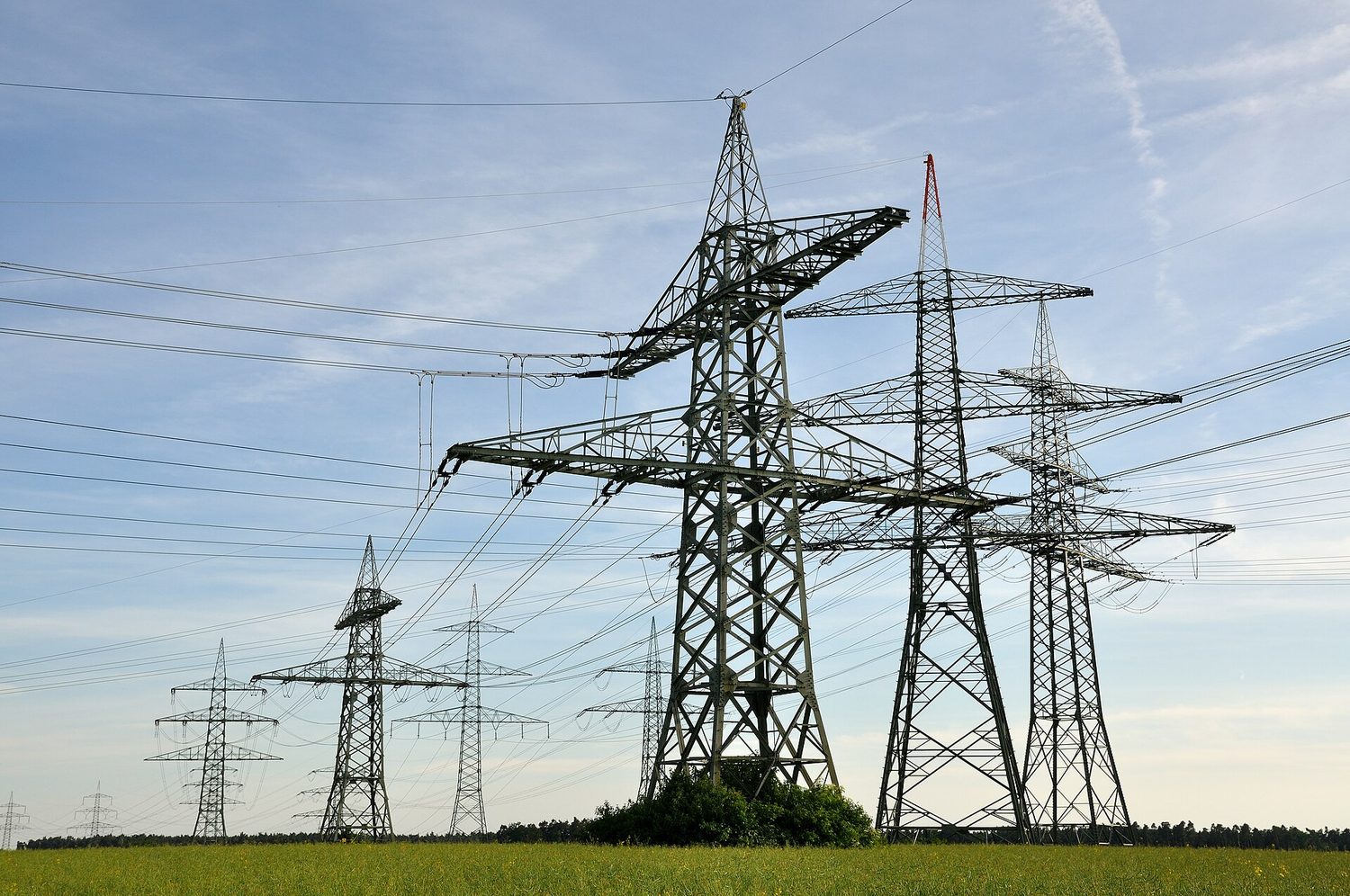
A pylon carries the cables that bring electricity at very high voltage
电阻
V = R·I
欧姆定律:电压与电流 成正比——斜率是电阻 R。
一个元件跨过它有 $12\ \text{V}$ 且通过它有 $3.0\ \text{A}$ 的电流。它的电阻是多少,以 Ω 计?
难度 2/5 · 今日首次完成可获 140 金币及少量额外奖励
$R = \dfrac{V}{I} = \dfrac{12}{3.0} = 4.0\ \Omega$.
What changes a wire's resistance
- A longer wire has more resistance — resistance is proportional to length ($R \propto l$).
- A thicker wire has less resistance — resistance is inversely proportional to the cross-sectional area ($R \propto \tfrac{1}{A}$).
- So doubling the length doubles $R$; doubling the area halves it.
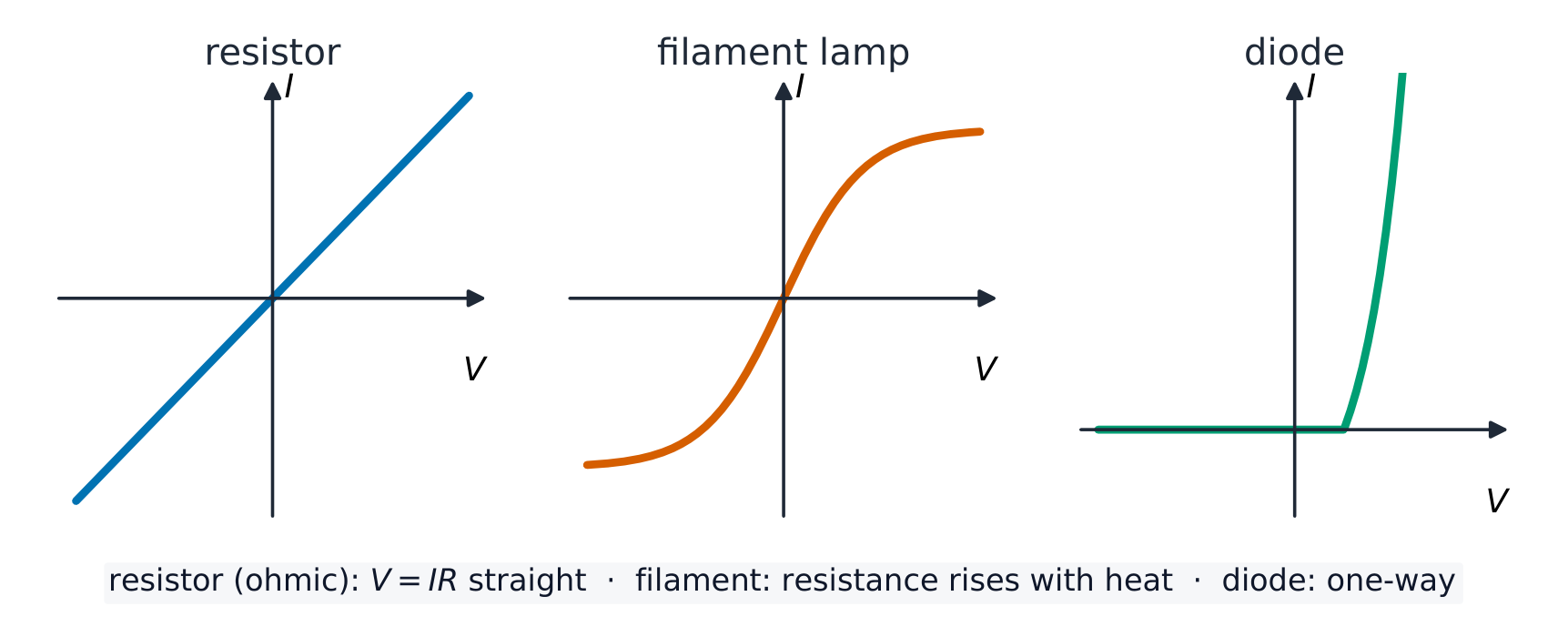
I-V graphs for a resistor, a filament lamp 灯丝灯泡 and a diode 二极管
I-V特性曲线
电阻给出直线;灯丝灯泡和二极管则不然。选一个元件,从曲线上读出 I 和 R。
一根导线被做成两倍长(相同厚度)。它的电阻:
难度 1/5 · 今日首次完成可获 100 金币及少量额外奖励
电阻与长度成正比,所以长度加倍使电阻加倍。
把每个电学关系与它的公式配对。
难度 2/5 · 今日首次完成可获 140 金币及少量额外奖励
每一项把术语链接到它正确的含义。
Current–voltage graphs
- A fixed resistor 定值电阻: a straight line through the origin — resistance is constant, so $I \propto V$.
- A filament lamp: an S-shape that gets flatter — the wire heats up, so its resistance rises.
- A diode: current one way only — very high resistance the "wrong" way.
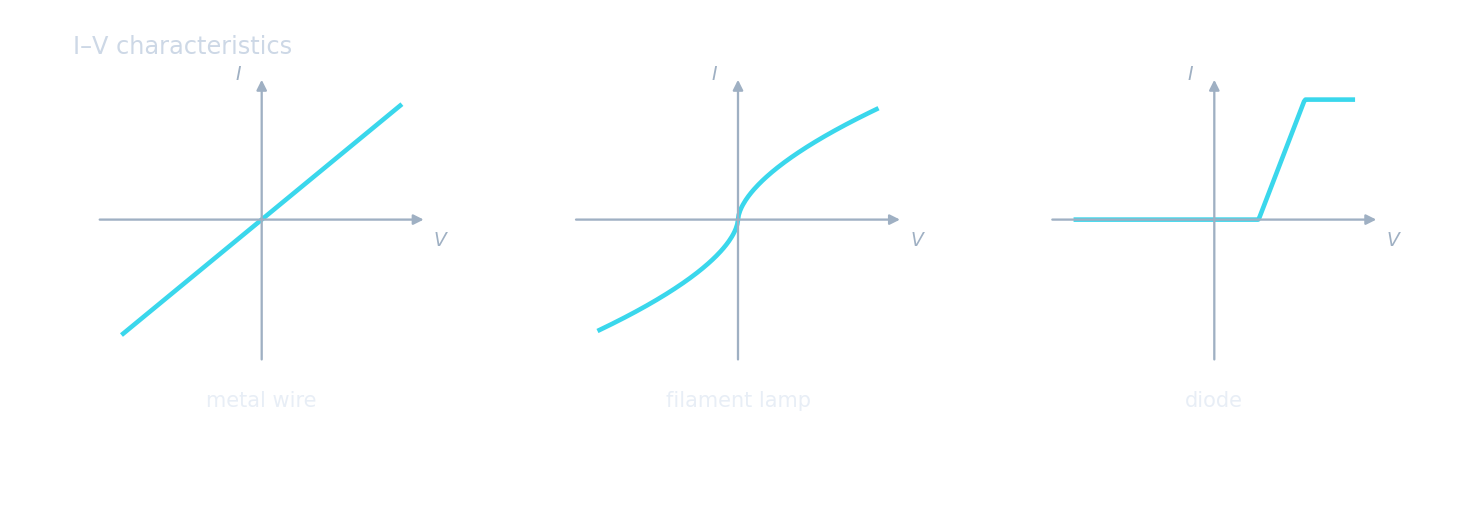
一个固定电阻器(在恒定温度下)的 I–V 图是:
难度 1/5 · 今日首次完成可获 100 金币及少量额外奖励
一个固定电阻器有恒定的电阻,所以 $I \propto V$——一条穿过原点的直线。
Electrical power and energy
- Power is the energy transferred each second, in watts (W):
- The energy transferred in a time $t$, in joules (J), is:
一个设备在 $12\ \text{V}$ 运行并抽取 $2.0\ \text{A}$。它的功率是多少,以 W 计?
难度 2/5 · 今日首次完成可获 140 金币及少量额外奖励
$P = IV = 2.0 \times 12 = 24\ \text{W}$.
The kilowatt-hour 千瓦时
- Electricity bills use a bigger unit, the kilowatt-hour (kWh): the energy a $1\ \text{kW}$ appliance uses in $1$ hour.
- Example: a $2\ \text{kW}$ heater for $3$ hours uses $6\ \text{kWh}$.
一个 $2.0\ \text{kW}$ 的加热器开 $3.0$ 小时。它使用多少能量,以 kWh 计?
难度 2/5 · 今日首次完成可获 140 金币及少量额外奖励
能量 = 功率 × 时间 = $2.0 \times 3.0 = 6.0\ \text{kWh}$。
如果一 kWh 花 $20$ 分,$6.0\ \text{kWh}$ 花多少,以分计?
难度 2/5 · 今日首次完成可获 140 金币及少量额外奖励
成本 = 能量 × 价格 = $6.0 \times 20 = 120$ 分。
Worked examples
1. A kettle on a $230\ \text{V}$ supply draws $9.0\ \text{A}$. $P = IV = 9.0 \times 230 = 2070\ \text{W} \approx 2.1\ \text{kW}$, and its resistance is $R = \dfrac{V}{I} = \dfrac{230}{9.0} = 26\ \Omega$.
2. A $2.0\ \text{kW}$ heater runs for $15$ minutes, which is $0.25\ \text{h}$. Energy $= 2.0 \times 0.25 = 0.50\ \text{kWh}$; at ¥0.60 per kWh the cost is $0.50 \times 0.60 =$ ¥0.30.
Use kilowatts and hours for kWh. $1500\ \text{W}$ for $30$ minutes is $1.5\ \text{kW} \times 0.5\ \text{h} = 0.75\ \text{kWh}$. Using watts and seconds gives joules, not kWh.
某元件两端电压为18V,通过的电流为2.0A。其电阻和功率分别是多少?一个1.5kW的加热器在2.0小时内消耗多少千瓦时?
18除以2等于9欧姆。电流乘以电压等于36瓦特。1.5千瓦乘以2.0小时等于3.0千瓦时。
电阻是多少?
难度 1/5 · 今日首次完成可获 100 金币及少量额外奖励
18除以2.0等于9欧姆。
You've got it
- $R = \dfrac{V}{I}$ (ohms); longer wire → more $R$, thicker wire → less $R$
- I–V graphs: resistor = straight line; lamp = S-curve (heats up); diode = one way
- power $P = IV$ (watts); energy $E = IVt$ (joules)
- kWh = power (kW) × time (h); cost = kWh × price
Write from the data: find the resistance
- A component has 18 V across it and a current of 2.0 A.
- Find the resistance and the power. A 1.5 kW heater runs for 2.0 hours.