English
This handout covers Topic 5, Mensuration (measuring length, area and volume). The Core and Extended content here is almost the same. In the exam, some formulas are given in the List of formulas, but you should still learn them all.
IGCSE 数学 · 知识点 5
 7:47
测量学
吉萨大金字塔已屹立四千五百年。里面有多少石头?大约二百五十万立方米——而且一个……
英语旁白 · 英中内嵌字幕
This handout covers Topic 5, Mensuration (measuring length, area and volume). The Core and Extended content here is almost the same. In the exam, some formulas are given in the List of formulas, but you should still learn them all.

| 学科内容 | 注释与示例 |
|---|---|
| 在实际情境中使用公制质量、长度、面积、体积和容量单位,并将数量换算为较大或较小的单位。 | 单位包括:• mm, cm, m, km • $\text{mm}^2$, $\text{cm}^2$, $\text{m}^2$, $\text{km}^2$ • $\text{mm}^3$, $\text{cm}^3$, $\text{m}^3$ • ml, l • g, kg。单位之间的换算包括:• 不同面积单位之间,例如 $\text{cm}^2 \leftrightarrow \text{m}^2$ • 体积与容量单位之间,例如 $\text{m}^3 \leftrightarrow \text{litres}$。 |
| 教学内容 | 注释和示例 |
|---|---|
| 在实际情境中使用质量、长度、面积、体积和容量的公制单位,并将数量转换为较大或较小的单位。 | 单位包括:• mm, cm, m, km • $\text{mm}^2$, $\text{cm}^2$, $\text{m}^2$, $\text{km}^2$ • $\text{mm}^3$, $\text{cm}^3$, $\text{m}^3$ • ml, l • g, kg。单位之间的转换包括:• 不同面积单位之间,例如 $\text{cm}^2 \leftrightarrow \text{m}^2$ • 体积和容量单位之间,例如 $\text{m}^3 \leftrightarrow \text{litres}$。 |
来源:Cambridge International 教学大纲
We use metric 公制 units for mass 质量 (g, kg), length 长度 (mm, cm, m, km), area 面积, volume 体积 and capacity 容量 (ml, litres — the space inside a container).
To change units, be careful with squares and cubes:
Worked example. Convert $3\text{ m}^{2}$ to $\text{cm}^{2}$.
Worked example: volume to capacity. A fish tank is $1.2\text{ m}$ long, $50\text{ cm}$ wide and $40\text{ cm}$ high. How many litres of water does it hold when full?
Change everything to centimetres first: $1.2\text{ m} = 120\text{ cm}$.
Common mistakes. Dividing by $100$ to change $\text{cm}^{2}$ to $\text{m}^{2}$ (it is $10\,000$), and multiplying lengths in different units, such as metres times centimetres.
选择与测量尺度相匹配的单位。
| English | 中文 | 拼音 |
|---|---|---|
| metric/ˈmetrɪk/ | 公制 | gōng zhì |
| mass/mæs/ | 质量 | zhì liàng |
| length/leŋθ/ | 长度 | cháng dù |
| area/ˈeərɪə/ | 面积 | miàn jī |
| volume/ˈvɒljuːm/ | 体积 | tǐ jī |
| capacity/kəˈpæsɪti/ | 容量 | róng liàng |

| 学科内容 | 注释与示例 |
|---|---|
| 进行涉及矩形、三角形、平行四边形和梯形周长及面积的计算。 | 除三角形面积外,未给出公式。 |
| 学科内容 | 注释与示例 |
|---|---|
| 进行涉及矩形、三角形、平行四边形和梯形周长及面积的计算。 | 除三角形面积外,不给出公式。 |
来源:Cambridge International 教学大纲
The perimeter 周长 is the distance all the way round a shape. The area is the amount of flat space inside it. Here $b$ is the base 底 and $h$ is the perpendicular height 高.
| Shape | Area |
|---|---|
| rectangle 矩形 | $\text{length} \times \text{width}$ |
| triangle 三角形 | $\tfrac{1}{2} \times b \times h$ |
| parallelogram 平行四边形 | $b \times h$ |
| trapezium 梯形 | $\tfrac{1}{2}(a + b)h$, where $a$ and $b$ are the two parallel sides |
Worked example. A trapezium has parallel sides $6\text{ cm}$ and $10\text{ cm}$, and height $4\text{ cm}$. Find its area.
面积 = 边长^2
改变边长并观察面积为何呈二次增长。
| English | 中文 | 拼音 |
|---|---|---|
| perimeter/pəˈrɪmɪtə/ | 周长 | zhōu cháng |
| base/beɪs/ | 底 | dǐ |
| height/haɪt/ | 高 | gāo |
| rectangle/ˈrektæŋɡl/ | 矩形 | jǔ xíng |
| triangle/ˈtraɪæŋɡl/ | 三角形 | sān jiǎo xíng |
| parallelogram/ˌpærəˈleləɡræm/ | 平行四边形 | píng xíng sì biān xíng |
| trapezium/trəˈpiːzɪəm/ | 梯形 | tī xíng |

| 学科内容 | 注释与示例 |
|---|---|
| 1 进行涉及圆的周长和面积的计算。 | 答案可能要求以 $\pi$ 的形式表示。 |
| 2 进行涉及弧长和扇形面积的计算,将其作为圆的周长和面积的分数部分,其中扇形的圆心角是 $360^\circ$ 的因数。 | 公式在公式列表中给出。 |
| 学科内容 | 注释与示例 |
|---|---|
| 1 进行涉及圆的周长和面积的计算。 | 答案可能要求用含 $\pi$ 的形式表示。公式见《公式表》。 |
| 2 进行涉及弧长和扇形面积的分数计算,这些分数分别对应于圆的周长和面积的一部分。 | 包括劣扇形和优扇形。 |
来源:Cambridge International 教学大纲
For a circle 圆 with radius 半径 $r$ (and diameter 直径 $d = 2r$):
The circumference 圆周 is the distance round the circle.
Worked example. A circle has radius $7\text{ cm}$. Find its circumference and area (leave $\pi$ in the answer).
Worked example: circle and square. A circle has radius $7\text{ cm}$. A square has the same perimeter as the circle's circumference. Find the side $x$ of the square in terms of $\pi$.
Common mistake. Using the diameter in $\pi r^{2}$. If the question gives the diameter, halve it first.
| English | 中文 | 拼音 |
|---|---|---|
| circle/ˈsɜːkl/ | 圆 | yuán |
| radius/ˈreɪdɪəs/ | 半径 | bàn jìng |
| diameter/daɪˈæmɪtə/ | 直径 | zhí jìng |
| circumference/sɜːˈkʌmfrəns/ | 圆周 | yuán zhōu |

| 学科内容 | 注释与示例 |
|---|---|
| 1 进行涉及圆的周长和面积的计算。 | 答案可能要求以 $\pi$ 的形式表示。 |
| 2 进行涉及弧长和扇形面积的计算,将其作为圆的周长和面积的分数部分,其中扇形的圆心角是 $360^\circ$ 的因数。 | 公式在公式列表中给出。 |
| 学科内容 | 注释与示例 |
|---|---|
| 1 进行涉及圆的周长和面积的计算。 | 答案可能要求用含 $\pi$ 的形式表示。公式见《公式表》。 |
| 2 进行涉及弧长和扇形面积的分数计算,这些分数分别对应于圆的周长和面积的一部分。 | 包括劣扇形和优扇形。 |
来源:Cambridge International 教学大纲
An arc 弧 is part of the circumference. A sector 扇形 is a "pizza slice" between two radii. If the sector angle is $\theta$, the arc and sector are that fraction $\dfrac{\theta}{360}$ of the whole circle:
A small slice is a minor sector 小扇形; the large rest is a major sector 大扇形.
Worked example. Find the arc length 弧长 and area of a sector with angle $90^{\circ}$ and radius $8\text{ cm}$.
The fraction is $\dfrac{90}{360} = \dfrac{1}{4}$, so
Worked example: perimeter of a major sector (Extended). A sector of angle $126^{\circ}$ is cut from a circle of radius $7.5\text{ cm}$. Find the perimeter of the major sector that is left.
The major sector has angle $360^{\circ} - 126^{\circ} = 234^{\circ}$.
The perimeter is the arc plus the two radii: $30.63 + 7.5 + 7.5 = 45.6\text{ cm}$ (3 s.f.).
Worked example: find the angle (Extended). A sector of radius $6\text{ cm}$ has arc length $11\text{ cm}$. Find the sector angle.
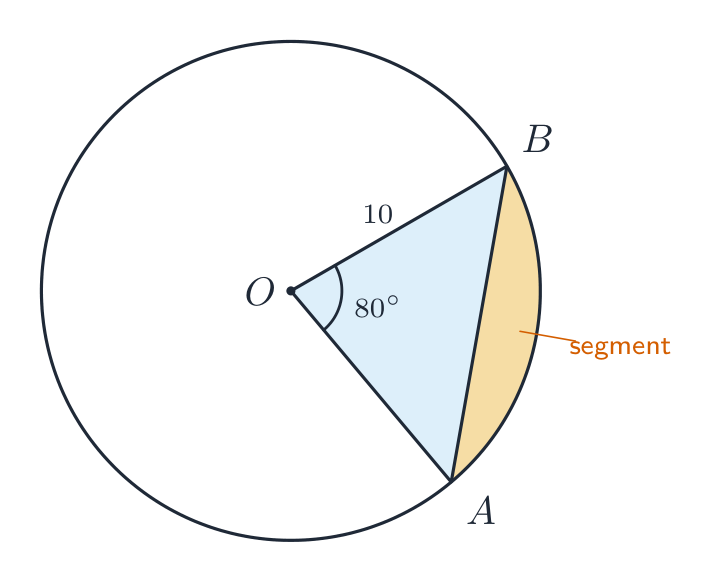
A segment 弓形 is the part of a circle between a chord and the arc. Its area is the sector area take away the triangle, and the triangle uses $\tfrac{1}{2}ab\sin C$ from Topic 6.
Worked example: area of a segment (Extended). Find the area of the minor segment cut off by a chord $AB$ when the radius is $10\text{ cm}$ and angle $AOB = 80^{\circ}$.
Common mistakes. Giving only the arc as the perimeter of a sector (add the two radii), and using the minor angle when the question asks about the major sector.
s = rθ · A = ½r²θ
更大的角或半径意味着更长的弧和更大的扇形面积。
改变角度和半径,读取弧长和扇形面积——即整个圆的一部分。
| English | 中文 | 拼音 |
|---|---|---|
| arc/ɑːk/ | 弧 | hú |
| sector/ˈsektə/ | 扇形 | shàn xíng |
| minor sector/ˈmaɪnə ˈsektə/ | 小扇形 | xiǎo shàn xíng |
| major sector/ˈmeɪdʒə ˈsektə/ | 大扇形 | dà shàn xíng |
| arc length/ɑːk leŋθ/ | 弧长 | hú cháng |
| segment/ˈseɡmənt/ | 弓形 | gōng xíng |

| 学科内容 | 备注与示例 |
|---|---|
| 进行涉及以下几何体表面积和体积的计算并解决相关问题: • 长方体 • 棱柱 • 圆柱 • 球体 • 棱锥 • 圆锥。 |
答案可能要求保留 $\pi$。以下公式将在公式列表中给出: • 圆柱的侧面积 • 圆锥的侧面积 • 球体的表面积 • 棱柱的体积 • 棱锥的体积 • 圆柱的体积 • 圆锥的体积 • 球体的体积。“棱柱”一词指具有均匀横截面的任何立体图形,例如圆柱扇形。 |
| 学科内容 | 注释与示例 |
|---|---|
| 进行涉及以下几何体表面积和体积的计算并解决相关问题:• 长方体 • 棱柱 • 圆柱 • 球体 • 棱锥 • 圆锥。 | 答案可能要求用含 $\pi$ 的式子表示。下列公式在《公式表》中给出:• 圆柱侧面积 • 圆锥侧面积 • 球体表面积 • 棱柱体积 • 棱锥体积 • 圆柱体积 • 圆锥体积 • 球体体积。术语“棱柱”指任何具有均匀横截面的立体图形,例如圆柱扇形。 |
来源:Cambridge International 教学大纲
The surface area 表面积 is the total area of all the outside faces. The volume is the space inside. For these solids ($r$ = radius, $h$ = height):
| Solid | Volume | Surface area |
|---|---|---|
| cuboid 长方体 | $\text{length} \times \text{width} \times \text{height}$ | add the six faces |
| prism 棱柱 | (cross-section 横截面 area) $\times$ length | — |
| cylinder 圆柱 | $\pi r^{2} h$ | $2\pi r h$ (curved surface area 侧面积) $+\, 2\pi r^{2}$ |
| pyramid 棱锥 | $\tfrac{1}{3} \times \text{base area} \times h$ | — |
| cone 圆锥 | $\tfrac{1}{3}\pi r^{2} h$ | $\pi r l$ (curved) $+\, \pi r^{2}$, where $l$ is the slant height 斜高 |
| sphere 球 | $\tfrac{4}{3}\pi r^{3}$ | $4\pi r^{2}$ |

Worked example. A cylinder has radius $5\text{ cm}$ and height $10\text{ cm}$. Find its volume and total surface area (in terms of $\pi$).
Worked example: a cone. A solid cone has base radius $5\text{ cm}$ and perpendicular height $12\text{ cm}$. Find its volume and its total surface area in terms of $\pi$.
The curved surface needs the slant height $l$, which is the hypotenuse of a right-angled triangle with sides $r$ and $h$:
Worked example: working backwards. A cylinder has volume $500\text{ cm}^{3}$ and height $8\text{ cm}$. Find its radius.
Worked example: melting and recasting. A metal sphere of radius $6\text{ cm}$ is melted and made into a cylinder of radius $4\text{ cm}$. Find the height of the cylinder.
The volume stays the same:
Common mistakes. Using the perpendicular height $h$ in $\pi r l$ (the curved surface needs the slant height $l$), and giving only the curved surface when the question asks for the total surface area of a solid.
表面积随尺度^2增长
改变长度比例并观察体积比表面积增长更快。
| English | 中文 | 拼音 |
|---|---|---|
| surface area/ˈsɜːfɪs ˈeərɪə/ | 表面积 | biǎo miàn jī |
| cuboid/ˈkjuːbɔɪd/ | 长方体 | cháng fāng tǐ |
| prism/ˈprɪzəm/ | 棱柱 | léng zhù |
| cross-section/krɒs ˈsekʃn/ | 横截面 | héng jié miàn |
| cylinder/ˈsɪlɪndə/ | 圆柱 | yuán zhù |
| curved surface area/kɜːvd ˈsɜːfɪs ˈeərɪə/ | 侧面积 | cè miàn jī |
| pyramid/ˈpɪrəmɪd/ | 棱锥 | léng zhuī |
| cone/kəʊn/ | 圆锥 | yuán zhuī |
| slant height/slænt haɪt/ | 斜高 | xié gāo |
| sphere/sfɪə/ | 球 | qiú |

| 学科内容 | 注释与示例 |
|---|---|
| 1 进行计算并解决涉及以下对象周长和面积的问题: • 复合图形 • 图形的部分。 | 答案可能要求用 $\pi$ 表示。 |
| 2 进行计算并解决涉及以下对象表面积和体积的问题: • 复合立体图形 • 立体图形的部分。 | 例如,求半球体的体积。 |
| 学科内容 | 注释与示例 |
|---|---|
| 1 进行涉及以下对象周长和面积的计算并解决相关问题: • 组合图形 • 图形的部分。 | 答案可能要求用含 $\pi$ 的形式表示。 |
| 2 进行涉及以下对象表面积和体积的计算并解决相关问题: • 组合立体图形 • 立体图形的部分。 | 例如:求圆台的表面积和体积。 |
来源:Cambridge International 教学大纲
A compound shape 组合图形 is made by joining or cutting simple shapes. Split it into parts you know, then add or subtract.
For "parts" of a circle or solid, take the right fraction. For example, a hemisphere 半球 (half a sphere) has volume
A frustum 平截头体 is a cone or pyramid with its top cut off parallel to the base; find its volume by subtracting the small top cone from the whole cone.
Worked example. Find the area of a shape made of a rectangle $8\text{ cm} \times 5\text{ cm}$ with a semicircle of diameter $5\text{ cm}$ on one end.

The semicircle has radius $2.5\text{ cm}$:
Worked example: volume of a frustum (Extended). A cone has base radius $6\text{ cm}$ and height $16\text{ cm}$. The top $8\text{ cm}$ is cut off, leaving a frustum. Find the volume of the frustum.
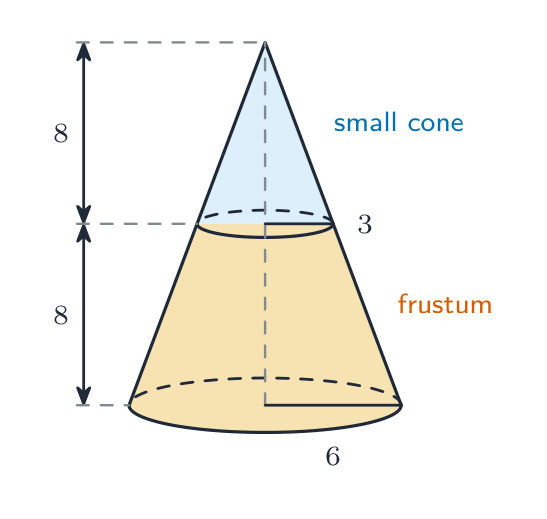
The small cone is half the height of the whole cone, so its radius is half too: $3\text{ cm}$.
Worked example: rate of flow (Extended). Water flows through a pipe with radius $1.5\text{ cm}$ at $20\text{ cm}$ per second into an empty cylindrical tank with radius $40\text{ cm}$. How long does it take for the water to be $30\text{ cm}$ deep?
Each second, a cylinder of water $20\text{ cm}$ long leaves the pipe:
The water needed is $\pi \times 40^{2} \times 30 = 48\,000\pi\text{ cm}^{3}$, so the time is
Worked example: a stone in a tank. A stone is put into a tank $40\text{ cm}$ long and $25\text{ cm}$ wide, and the water rises by $0.6\text{ cm}$. The stone's density is $2.5\text{ g/cm}^{3}$. Find its mass.
The stone's volume is the volume of water it pushes up: $40 \times 25 \times 0.6 = 600\text{ cm}^{3}$. Then mass $= \text{density} \times \text{volume} = 2.5 \times 600 = 1500\text{ g}$.
Common mistakes. Adding the volumes of the two cones of a frustum instead of subtracting, and mixing the units of a rate (cm per second) with a time given in minutes.
将组合图形分解为简单部分,然后重新组合。
| English | 中文 | 拼音 |
|---|---|---|
| compound shape/ˈkɒmpaʊnd ʃeɪp/ | 组合图形 | zǔ hé tú xíng |
| hemisphere/ˈhemɪsfɪə/ | 半球 | bàn qiú |
| frustum/ˈfrʌstəm/ | 平截头体 | píng jié tóu tǐ |
逐步完成,配合即时检查练习。
正在加载学科…